


Bidriware - The Handicraft Tradition of Karnataka
Explore Bidriware, the handicraft tradition of Karnataka, and learn about its origins, techniques, cultural significance, and artistic heritage.
Introduction
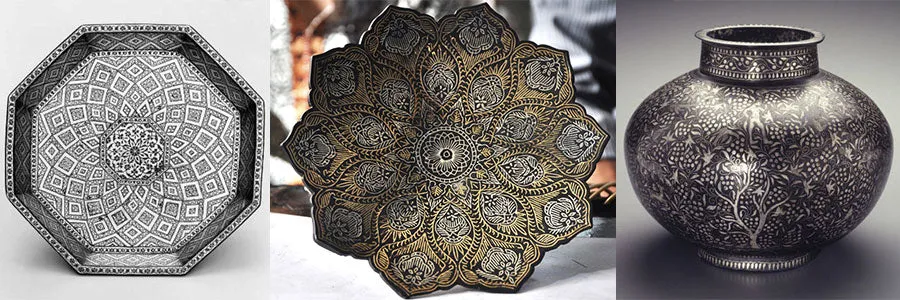
Bidriware is a form of metal handicraft originating from Bidar in the Hyderabad-Karnataka region, characterised by the inlay of silver or gold onto a zinc-copper alloy base that is subsequently oxidised to a matte black finish. The contrast between the dark metallic body and the bright inlaid decoration is the defining visual feature of Bidriware. The craft has been documented as a product of Bidar district and holds a Geographical Indication (GI) tag registered with the Government of India.
Etymology The name Bidriware derives directly from Bidar, the city in present-day Karnataka where the craft originated and has been practiced for several centuries. The word 'ware' denotes the category of manufactured metalwork goods. In Persian and Urdu usage, the craft is sometimes referenced as 'bidri' without a suffix.
Origin The craft is documented as having originated in the city of Bidar during the period of the Bahmani Sultanate in the 14th century CE. Academic sources and the referenced paper by Akshantala, Uppal, and Mokanaasri (2023), published in ShodhKosh: Journal of Visual and Performing Arts, trace the earliest documented origins to the Bahmani Sultans' court. The roots of the metalwork technique are attributed to influences from Persia and Iraq, which were transmitted through trade and political connections. One account suggests the craft reached Bidar via Ajmer, connected to the movement of Sufi communities. The Bahmani capital at Bidar was a meeting point of Turkish, Persian, Arabic, and Deccan artistic traditions, which are all reflected in the motif vocabulary of Bidriware.
Location Bidar, in the northern part of Karnataka, is the primary centre of Bidriware production. Historically, secondary centres also existed in Murshidabad (West Bengal), Lucknow (Uttar Pradesh), and Purnia (Bihar), but Bidar has remained the dominant and most historically continuous production site. The soil of Bidar Fort carries unique mineral properties that produce the characteristic black oxidised finish, making it geographically tied to the region.
Community Bidriware is produced by artisan communities in Bidar who have maintained the craft across generations within family lineages. The craft involves specialised skills transmitted from master craftsmen to apprentices, often within the same family. Shah Rasheed Ahmed Quadri, recipient of the Padma Shri award, represents an example of a multi-generational practitioner who also mentored twenty artisans under government-sponsored programmes. The craftsmen belong to communities historically associated with metalwork in the Deccan region.
Relevance Bidriware holds GI status under the Geographical Indications of Goods (Registration and Protection) Act, 1999, with recognition for its unique origin and technique. The craft has received national and state-level recognition, including awards to individual artisans such as the State Award (1984), National Award (1988), and Karnataka Rajyotsava Award (1996). Institutions including the National Institute of Design and the National Institute of Fashion Technology have documented and promoted Bidriware in contemporary design contexts. UNESCO has also recognised the craft in the domain of intangible cultural heritage.
History
Background Bidriware developed under the patronage of the Bahmani Sultans at Bidar in the 14th century. The craft flourished during this period as Bidar was an active centre for artisans drawn from across the Deccan. Following the Bahmani period, the craft continued under the Barid Shahi Sultanate, which succeeded the Bahmanis at Bidar. Royalty and nobility of various courts, including Mughal emperors, Rajput rulers, Bengal Nawabs, and Vijayanagara Sultans, are documented to have valued Bidriware. The study by Pandey (2016), published in International Journal of Research, confirms the craft's movement from its Persian and Iraqi roots to the Deccan, including transit through Ajmer.
After the decline of the Deccan Sultanates, Bidriware continued as a craft industry in Bidar but faced periods of reduced patronage. The Government of India's Development Commissioner (Handicrafts) has implemented support programmes including the Integrated Design and Technical Development Project in Bidri Craft at Bidar. The Karnataka government awarded the craft its GI tag in 2006.
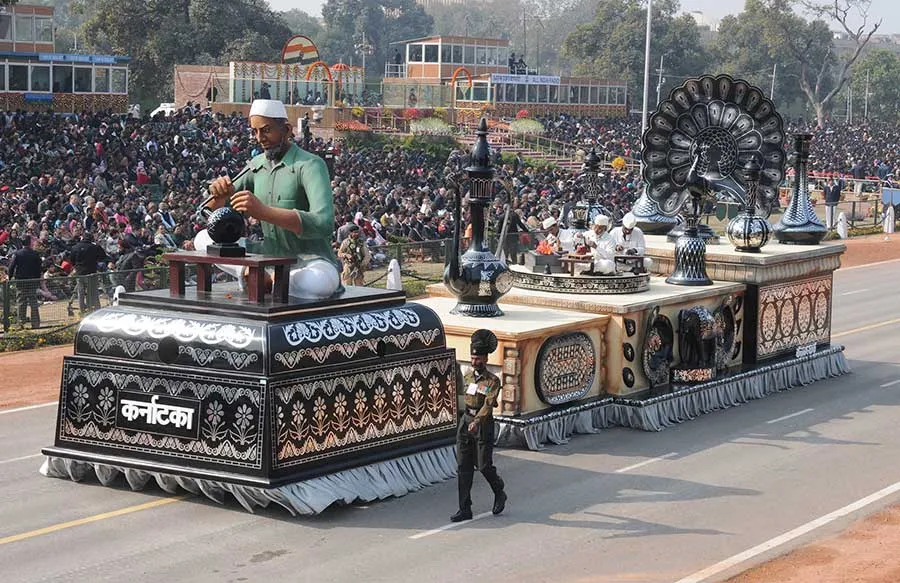
Culture and Societies Bidriware has been embedded in the material culture of the Deccan for several centuries. It has served as a luxury craft associated with royal gifts, ceremonial objects, and household prestige items. The craft has been historically patronised by Muslim, Hindu, and Sikh courts alike, reflecting its cross-cultural appeal. In contemporary contexts, it continues to feature in festivals and ceremonial exchanges. Organisations such as Sahayog, an NGO based in Bidar, work to promote artisans and provide training in marketing and business skills.
Religious Significance Bidriware does not carry a formal or documented religious association. Its motif vocabulary draws from Persian, Arabic, and Turkish decorative traditions, including Quranic calligraphy in some examples, and from local Deccan motifs including the lotus. However, the craft itself is not tied to a specific religious practice or ritual function. It has been produced for secular decorative and utilitarian purposes across religious communities.
Understanding the Art
Style Bidriware is distinguished by its matte black metallic base contrasted with bright silver or occasionally gold inlaid designs. The black finish results from oxidation using a mixture of soil from Bidar Fort and ammonium chloride (sal ammoniac). The overall aesthetic combines Perso-Arabic geometric patterning with floral motifs drawn from Mughal decorative traditions, and locally developed designs inspired by Deccan architecture.
Central Motifs and Their Significance The primary motif categories in Bidriware are floral patterns (including the Persian rose and stylised blooms), geometric forms, scrolling vines and tendrils, Quranic calligraphy in some traditional examples, and regional motifs including the lotus and swastika. The Persian rose is among the most recognised motifs and reflects the historical connections between Bidar and Persian cultural exchange. Geometric patterns draw from Islamic decorative traditions of tile and architectural ornamentation. Animal figures appear in some examples but are less dominant than floral and geometric forms.
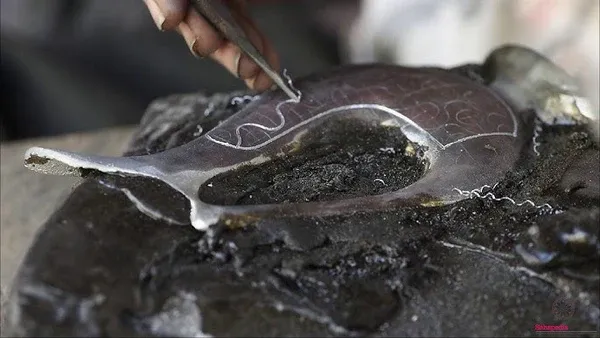
Process The production of Bidriware follows an eight-stage process as documented in academic literature. The stages are: (1) designing the object and its decorative scheme; (2) moulding the zinc-copper alloy (typically a ratio approximating 16 parts zinc to 1 part copper) into the required form using clay moulds; (3) smoothening the cast object with files and sandpaper; (4) engraving the design onto the polished surface using fine chisels; (5) inlaying pure silver wire, strips, or sheets into the engraved grooves by careful hammering; (6) oxidising the entire surface using a paste of Bidar Fort soil and ammonium chloride applied after heating, which blackens only the alloy and not the inlaid silver; (7) buffing the surface to remove excess oxidation and reveal the inlay; (8) final finishing and quality inspection.
Four distinct inlay techniques are documented: teh nashin (flush inlay where silver is set within deeply engraved surfaces), aftabi or mehatabi (silver applied over a blackened background with the pattern preserved in the positive), tarkashi (wire inlay where grooves are cut and silver wire is shaped to fit exactly), and zar buland or zar nashin (relief inlay where silver stands above the surface using a lead base).
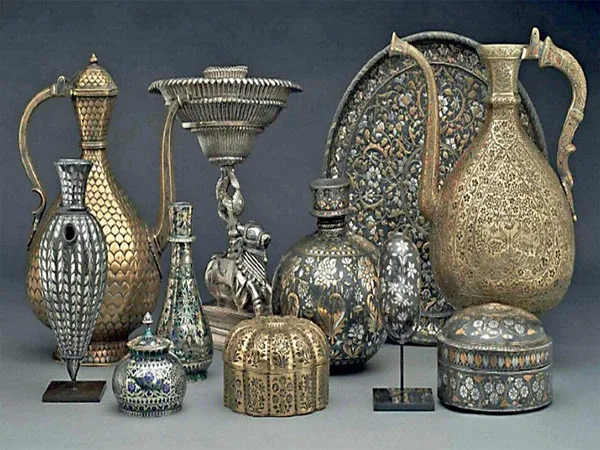
Mediums Used The primary medium is a zinc-copper alloy, with zinc constituting the major component. The alloy is cast using clay moulds. Inlay materials are pure silver, and in some historical examples, gold or brass. The oxidising agent is a specific soil obtained from the Bidar Fort area combined with ammonium chloride. Polishing is done using fine abrasives. The unique oxidising properties of the Bidar Fort soil are documented as essential to the characteristic black finish; soil from other sources does not produce the same result.
New Outlook
Contemporary artisans have adapted Bidriware to new product forms including USB drive covers, office stationery, lampshades, wall tiles, candle stands, and jewellery. The National Institute of Design and National Institute of Fashion Technology have incorporated Bidriware motifs into contemporary fashion and textile design. International exhibitions and online commerce have expanded the market beyond domestic buyers. Challenges include rising silver prices, the availability of authentic Bidar Fort soil, market penetration by imitation products, and insufficient skilled artisan recruitment. Government training programmes and NGO support remain active in addressing some of these concerns.
Learn Bidriware


Bibliography
Sources
Akshantala, Amiksha, et al. “Bidri Crafts and Its Enduring Impact on Indian Culture.” ShodhKosh: Journal of Visual and Performing Arts, vol. 4, no. 2, 2023.
La Niece, S., and G. Martin. “The Technical Examination of Bidri Ware.” Studies in Conservation, vol. 32, no. 3, 1987.
Markel, Stephen. “Bidri Ware: Lyric Patterns.” Golconda and Hyderabad, edited by S. Safrani, Marg Publications, 1992.
Pandey, A. “Bidri Ware: A Unique Metal Craft of India.” International Journal of Research: Granthaalayah, vol. 4, no. 3, 2016.
Stronge, Susan. Bidri Ware: Inlaid Metalwork from India. Victoria and Albert Museum, 1985.
Image Sources
“Bidri Work.” Housenama, 25 Jan. 2016, housenama.com/blogs/handmade-in-india/bidri-work. Accessed on April 30, 2026.
“The Bidri Art.” Bidri.in, 15 Jan. 2025, www.bidri.in/blogs/information/the-bidri-art. Accessed on April 30, 2026.