

Bharatanatyam - The Classical Dance Form of Tamil Nadu
Explore Bharatnatyam dance, the performance tradition of India, and learn about its origins, techniques, cultural significance, and artistic heritage.
Introduction
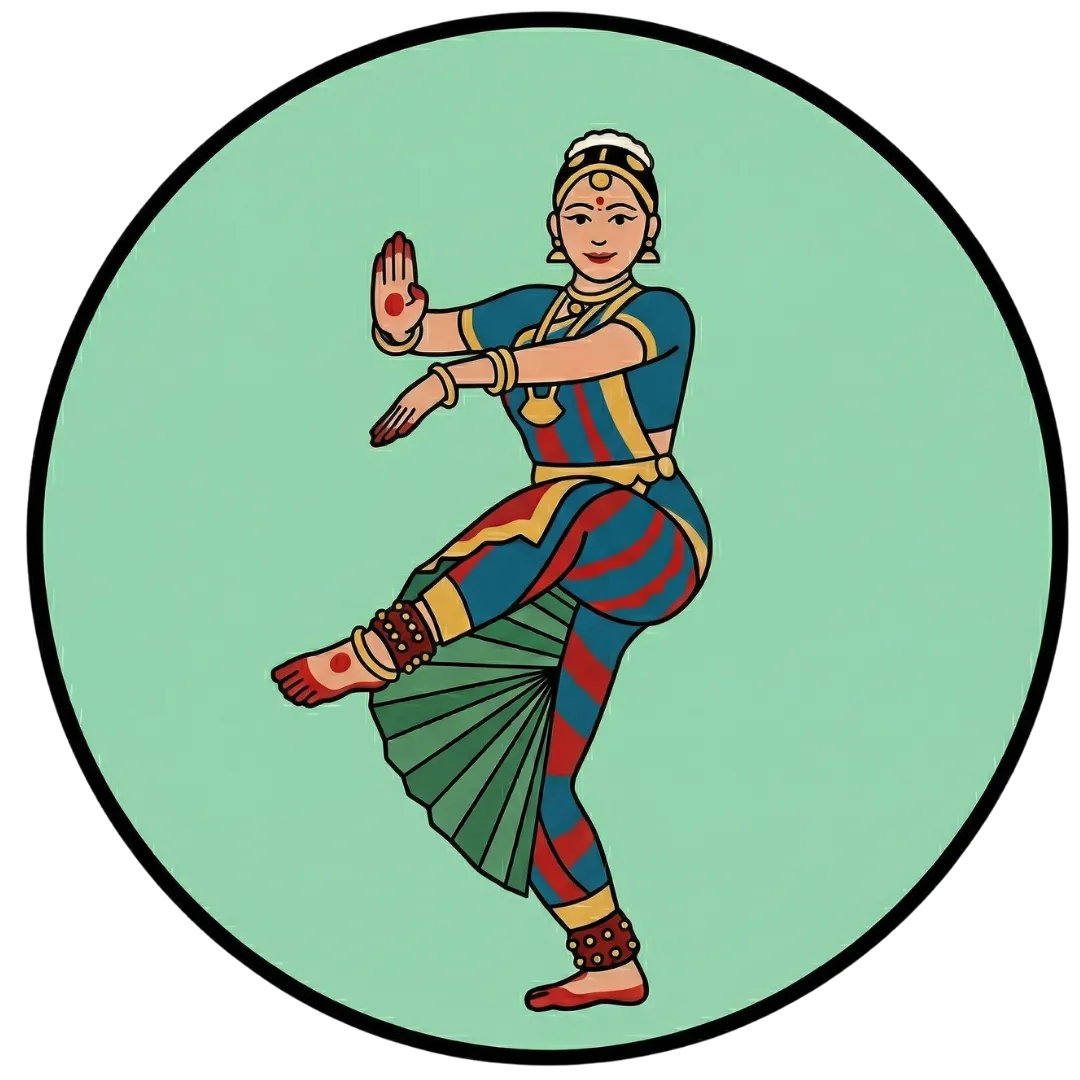
Bharatanatyam is one of the oldest surviving classical dance forms of India, originating in the Hindu temples of Tamil Nadu. It is a solo performance art that integrates nritta (pure rhythmic dance), nritya (expressive dance combining rhythm and meaning), and natya (dramatic storytelling), drawing its theoretical foundations from the ancient Sanskrit treatise Natya Shastra attributed to Bharata Muni. The dance was formally recognised by the Sangeet Natak Akademi as one of the principal classical dance forms of India. Today it is performed across the country and internationally by both male and female dancers, and is taught at major institutions including Kalakshetra Foundation in Chennai, which was declared an institution of national importance by the Indian Parliament in 1993.
Etymology The term Bharatanatyam is composed of three Sanskrit syllables: Bha from Bhava (emotion), Ra from Raga (melody), and Ta from Tala (rhythm), combined with Natyam, the Sanskrit and Tamil word for dance or dramatic art. This compound Etymology reflects the three inseparable elements of the dance form. An alternative Etymology derives the name from Bharata Muni, the author of the Natya Shastra, with natyam meaning the dramatic art described in that text. In 1932, at the Madras Music Academy, E. Krishna Iyer and Rukmini Devi Arundale proposed adopting the name Bharatanatyam as a replacement for the older term Sadir or Sadiraattam (also written Sadhir Koothu), a choice made in part to lend the form scholarly and cultural respect.
Origin The origins of Bharatanatyam are linked to the Devadasi system, in which women were dedicated to temple service and performed ritual dances as offerings to the deity. The Natyashastra mentions a regional style called Odra-Magadhi alongside what is identified as the Dakshinatya (southern) tradition, suggesting early classical antecedents. Inscriptions at the Brihadeeswarar Temple at Thanjavur built by Raja Raja Chola in the 10th century record 108 dance poses drawn from the Natyashastra carved on its walls, providing architectural evidence of an established performance tradition. Scholar Davesh Soneji has argued that courtesan dancing as a formal institution in South India emerged in the late 16th to 17th century during the Nayaka period of Tamil Nadu, while James Lochtefeld notes that classical dance remained exclusive to Hindu temples through the 19th century. The name Bharatanatyam in its current form was formally adopted at the Madras Music Academy in 1932.
Location Bharatanatyam is historically concentrated in the temple towns of Tamil Nadu, particularly Thanjavur, Chidambaram, and Madurai, where temple institutions provided patronage and training. The Thanjavur tradition, associated with the Tanjore Quartet of the 19th century (Chinnaiah, Ponniah, Sivanandam, and Vadivelu), systematised the margam or recital format. Today the dance is practised and taught across India, with significant institutional presence in Chennai through Kalakshetra Foundation and numerous academies in Mumbai, Delhi, Bengaluru, and internationally in North America, Europe, and Southeast Asia.
Community Bharatanatyam was historically transmitted within the Isai Vellalar community, a hereditary caste of devadasis and their male counterparts called nattuvanars (conductors who kept the rhythmic syllables and supervised training). The anti-nautch movement of the late 19th and early 20th centuries, alongside colonial-era legislative bans, including the Madras Devadasi Act of 1947, effectively ended the devadasi system of temple service. The 20th-century revival opened training to upper-class and middle-class women from diverse backgrounds. Key figures in this transition include Balasaraswati, considered one of the last great devadasi-lineage performers, and Rukmini Devi Arundale, who came from a Brahmin background and established Kalakshetra. Today the practitioner community spans multiple castes, regions, and nationalities.
Relevance Bharatanatyam occupies a central position in Indian classical arts as the most widely taught and performed of all classical dance forms. Its systematic margam structure, the codified vocabulary of hastas (hand gestures) documented in texts like Abhinaya Darpana and Natyashastra, and its integration with Carnatic classical music make it both a technically demanding and academically studied performance art. It is taught at university level across India, and degree programmes covering theory and practice are offered at institutions including Banaras Hindu University, Delhi University, and Rabindra Bharati University.
History
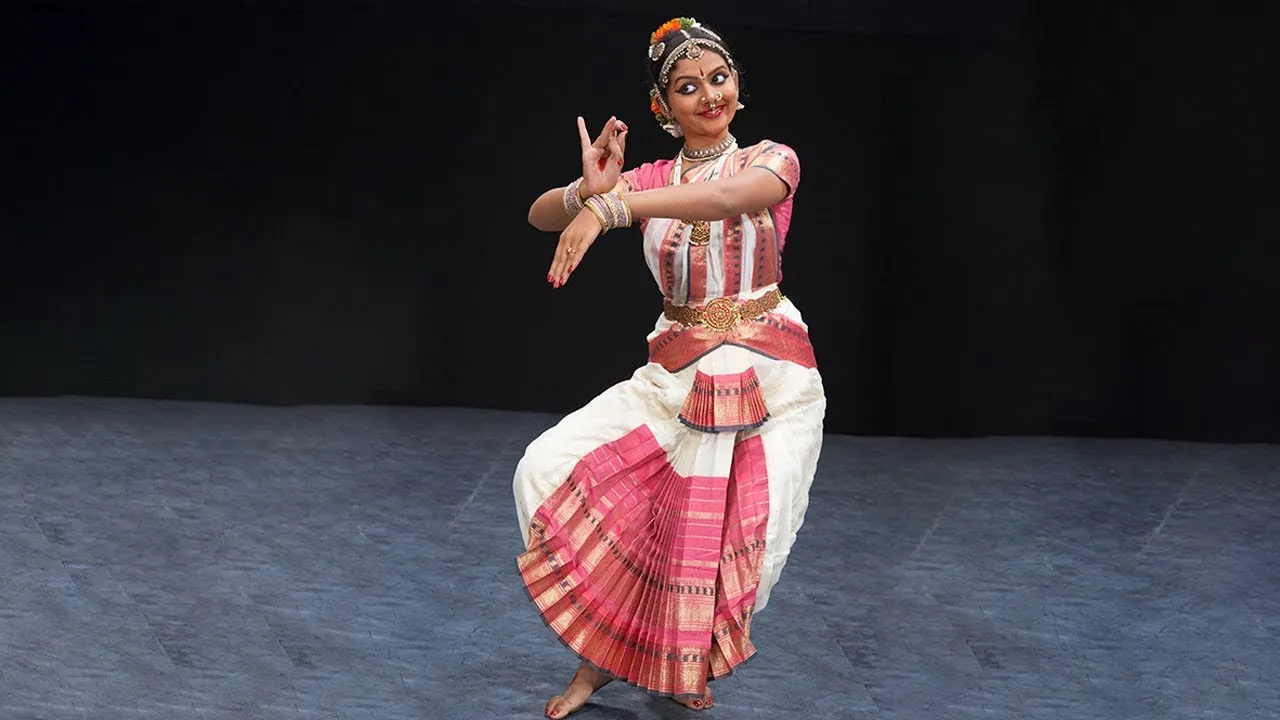
Background The earliest textual foundation for Bharatanatyam is the Natya Shastra, dated between 200 BCE and 200 CE in most scholarly estimates, though Richmond et al. place the Natasutras around 600 BCE. A later Tamil text, Kootha Nool derived from the Tholkappiyam (approximately 250 BCE), also addresses dance forms. Sculptures of dance poses are found at archaeological sites across Tamil Nadu, including the 108 karanas (movement units) inscribed at the Brihadeeswarar Temple at Thanjavur and the Nataraja temple at Chidambaram, both predating the colonial period by centuries.
The Tanjore Quartet formalised the present margam sequence during the 19th century under the patronage of the Thanjavur court. This sequence begins with Alarippu (an invocatory piece), progresses through Jatiswaram (pure rhythmic dance), Shabdam (narrative with words), Varnam (the central and most complex composition combining rhythm and expression), Padams (devotional-lyrical pieces), and concludes with Tillana (a fast rhythmic finale). The Quartet composed many pieces in this format that remain part of the standard repertoire.
The 1910 Madras Presidency ban on temple dancing under British colonial rule effectively ended institutional temple performance. Recovery began in the 1930s, when E. Krishna Iyer, a lawyer and activist, campaigned for the dance's dignity and revival, and Rukmini Devi Arundale established Kalakshetra in 1936. Her first public performance in 1935 at the Theosophical Society in Adyar marked a critical moment in presenting the dance to a metropolitan audience outside the temple context.
Culture and Societies The Tanjore Quartet's systematisation drew on the combined traditions of Carnatic music, temple sculpture, and pre-existing devadasi performance vocabulary. The institutional revival of the 1930s and 1940s introduced changes to costume and presentation: Rukmini Devi Arundale introduced silk sarees with temple jewellery inspired by sculpture, and modified the abhinaya (expressive) component to emphasise devotional (bhakti) rather than erotic (shringara) sentiment. These modifications have been the subject of academic debate, with scholars including Anne-Marie Gaston and Avanthi Meduri examining how the revival transformed both the aesthetic and social dimensions of the dance.
Post-independence India saw Bharatanatyam positioned as a symbol of Indian cultural heritage, supported by Sangeet Natak Akademi recognition and inclusion in state and national curricula. Major practitioners of the 20th century include Balasaraswati, Yamini Krishnamurti, and Padma Subrahmanyam, each of whom contributed distinct interpretive and choreographic approaches. Padma Subrahmanyam's research-based reconstruction of the 108 karanas described in the Natyashastra has been particularly significant for scholarship.
Religious Significance Bharatanatyam originated as a form of worship performed within temple precincts by devadasis ritually married to the deity. The dance was understood as a form of service (naivedya) to the divine, and the repertoire was drawn from devotional poetry dedicated to deities of Vaishnavism, Shaivism, and Shaktism. The Padams in the repertoire are frequently addressed to Krishna, Murugan, and other regional deities, using the nayika-nayaka (heroine-hero) poetic idiom in which the devotee expresses longing for the divine. The connection between Bharatanatyam and temple worship has been disrupted by the anti-nautch legislation, but the devotional content of the repertoire continues to be maintained in most traditional and institutional teaching.
Understanding the Art
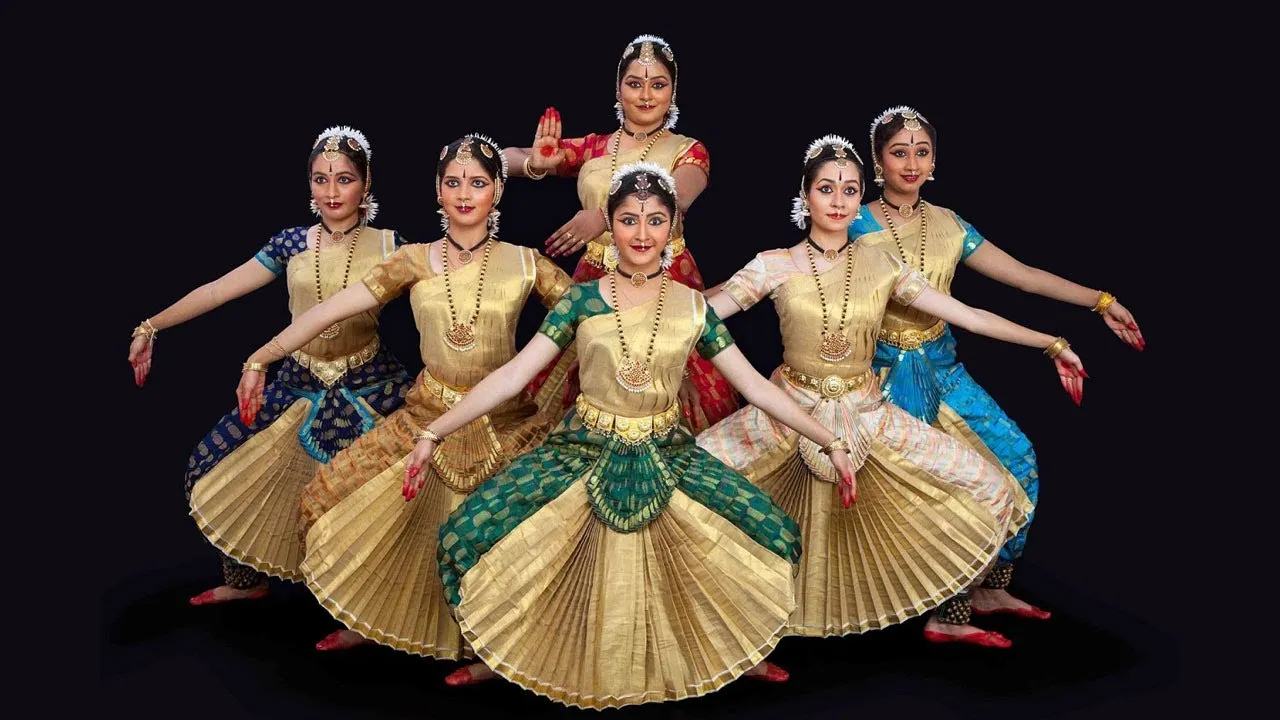
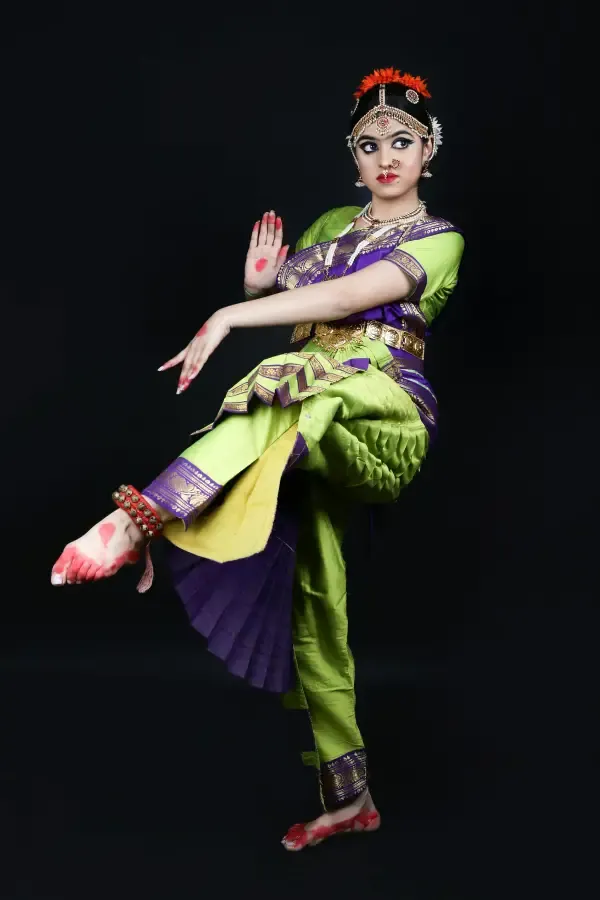
Style Bharatanatyam is characterised by its geometric and angular aesthetic, distinct from the circular and fluid qualities of north Indian classical forms. The fundamental stance is the aramandi (half-sitting position, also called ardhamandali), in which the knees are bent outward and the feet are turned out at approximately 45 degrees. From this base, the dancer executes complex footwork patterns (nattadavu, tattadavu, etc.) in precise synchrony with the rhythmic syllables called sollukattu or jatis, as kept by the nattuvanar or conductor. The Pandanallur, Vazhuvur, Kalakshetra, and Thanjavur styles represent the principal stylistic lineages, each with distinct emphases in footwork, abhinaya, and repertoire.
Nritta sequences demonstrate technical mastery through pure rhythmic movement without narrative content, while nritya pieces integrate facial expression (mukhabhinaya) and hand gestures (hastas) to convey the meaning of lyrical texts. The abhinaya component draws on a standardised vocabulary of 28 single-hand gestures (asamyukta hastas) and 24 combined gestures (samyukta hastas) documented in the Abhinaya Darpana attributed to Nandikesvara.
Central Motifs and Their Significance The core devotional repertoire centres on the mythology of Vaishnavism, Shaivism, and Shaktism, particularly the Bhagavata Purana narratives of Krishna, the Shaiva mythology of Nataraja, and the goddess traditions of Tamil Nadu. The Gitagovinda of 12th-century poet Jayadeva is among the most frequently set texts in abhinaya. Pieces set to compositions by the Thanjavur Quartet and by Muthuswami Dikshitar, Syama Sastri, and Tyagaraja (the Carnatic Trinity) form a substantial part of the repertoire. The Navarasa (nine emotions: shringara, hasya, karuna, raudra, vira, bhayanaka, bibhatsa, adbhuta, and shanta) are expressed through precise facial and bodily techniques taught in a systematic progression.
Process Training traditionally followed the guru-shishya (teacher-disciple) system, in which a student trained privately under a single guru over many years. Today the principal institution for formal training is Kalakshetra Foundation, which offers a four-year diploma programme. University-based programmes at institutions including the Tamil Nadu Music and Fine Arts University and Rabindra Bharati University offer BA and MA degrees in Bharatanatyam. A student's first formal public performance is called the Arangetram, which marks completion of foundational training. The margam sequence is performed in its entirety at the Arangetram.
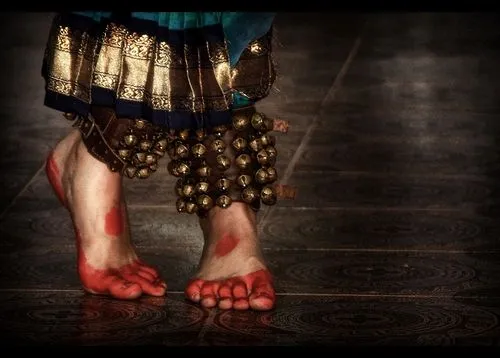
Mediums Used Bharatanatyam is performed to Carnatic classical music, which includes compositions by the Carnatic Trinity and the Tanjore Quartet. The accompanying ensemble typically includes a vocalist, a mridangam player (primary percussion), a nattuvangam player (who performs the rhythmic syllables on cymbals), a violin or veena player, and a tambura or sruti box player for the drone. The traditional costume is a stitched silk saree (typically in Kanchipuram silk) worn in a distinctive style that fans out behind the dancer, temple jewellery inspired by bronze sculpture, and stage makeup that emphasises the eyes to facilitate visibility of facial expression. The feet and fingers are traditionally coloured with alta (a red dye).
New Outlook
Contemporary Bharatanatyam practice includes both traditional margam performances and choreographic works exploring non-mythological, social, and contemporary themes. Choreographers including Leela Samson, V. P. Dhananjayan, and C. V. Chandrasekhar have expanded the thematic range of the form while maintaining technical fidelity to classical technique. Male practitioners, historically limited in number due to the dance's association with devadasi tradition, have become more common, with prominent artists including Alarmel Valli and Priyadarsini Govind working within traditional frameworks alongside those pursuing experimental approaches. Debates around caste, appropriation, and the historical displacement of devadasi practitioners continue to be addressed by scholars such as Srinivasan, Soneji, and Banerji.
Learn Bharatnatyam
Bibliography
Sources
Bharata Muni. Natyashastra. Estimated compilation between 200 BCE and 200 CE.
Gaston, Anne-Marie. Bharata Natyam: From Temple to Theatre. Manohar Publishers, 1996.
Kothari, Sunil, editor. Bharata Natyam: Indian Classical Dance Art. Marg Publications, 1979.
Meduri, Avanthi, editor. Rukmini Devi Arundale (1904–1986): A Visionary Architect of Indian Culture and the Performing Arts. Motilal Banarsidass, 2005.
Samson, Leela. Rhythm in Joy: Classical Dance Traditions of India. Lustre Press, 1987.
Soneji, Davesh. Unfinished Gestures: Devadasis, Memory, and Modernity in South India. University of Chicago Press, 2012.
Vatsyayan, Kapila. Indian Classical Dance. Ministry of Information and Broadcasting, Government of India, 1974.
Image Sources
Bookosmia. “Bharatanatyam: Fighting against the Odds.” Bookosmia, https://bookosmia.com/bharatanatyam-fighting-against-the-odds-blog/. Accessed on May 19, 2026.
Mandala Arts and Culture. “History of Bharatanatyam.” Mandala Arts and Culture, https://www.mandalaarts.org/blogs/history-of-bharatanatyam/. Accessed on May 19, 2026.
Meera Muraly Blog. “Discovered My Passion through Indian Classical Dance – Bharatanatyam.” Meera Muraly, 9 Sept. 2017, https://meeramuraly.wordpress.com/2017/09/09/discovered-my-passion-through-indian-classical-dance-bharatanatyam/. Accessed on May 19, 2026.