


Bastar Iron Craft - The Handicraft Tradition of Chhattisgarh
Explore Bastar Iron Craft, the handicraft tradition of Chhatisgarh, and learn about its origins, techniques, cultural significance, and artistic heritage.
Introduction
Bastar iron craft, also known by its local designation lohshilp or as wrought iron craft of Bastar, is a traditional metal craft practiced by ironsmith communities of the Bastar district in the state of Chhattisgarh, India. The craft involves shaping recycled scrap iron through repeated hammering while hot, without any casting or moulding, to produce both functional objects and sculptural forms that encompass ritual lamps, deity figurines, human figures, animal representations, masks, domestic implements, and ornamental items. It is registered at item 82 as "Bastar Iron Craft" under the GI Act 1999 of the Government of India, with registration confirmed by the Controller General of Patents Designs and Trademarks, conferring Geographical Indication status in 2008.
Etymology: The designation lohshilp is derived from two Hindi or Sanskrit-rooted words: loha, meaning iron, and shilp, meaning craft or art. The compound term is thus a direct description of the craft's material and nature, and it appears in government documentation from the D'Source (IIT Bombay) resource on wrought iron craft of Bastar, in Swadesi.org institutional documentation, and in general use among practitioners and institutional bodies in Chhattisgarh. The alternative designation "wrought iron craft of Bastar" appears in the official GI registration and in Incredible India government portal documentation. The word lohar, designating the ironsmith practitioner communities, derives from the same root loha, and refers across northern and central Indian contexts to blacksmith communities engaged in metal working.
Origin: The origin of Bastar iron craft cannot be assigned a precise founding date on the basis of currently available documented evidence. The D'Source (IIT Bombay) documentation by Palash Vaswani identifies it as one of the oldest craft forms of the Bastar region, originating from within the ironsmith communities who served the tribal population's needs for agricultural tools, forest-cutting implements, arrowheads, and hunting knives. The transition from purely functional production to artistic and ritual ironwork is documented as having followed from the communities' growing experimentation with material and technique over time. The Magik India documentation notes that the tribes of Bastar were among the first in India to work metal, and that the tools originally made for farming purposes were later adapted and evolved into an art form still practiced today. No founding artisan or datable founding event is identified in available documentation. The craft's GI registration places it within the institutional framework of protection from 2008 onward.
Location: Bastar iron craft is geographically concentrated in the Bastar district of Chhattisgarh, a state in central India. The D'Source documentation and the Incredible India portal consistently identify the three main production centres as Kondagaon, Umargaon, and Gunagaon.
The D'Source People documentation identifies Kedaichepda village, approximately 20 kilometres from Kondagaon, as one active production community, with eight families numbering approximately one hundred people dedicated to wrought iron craft at the time of documentation. Kondagaon in particular is described in multiple sources as famous for its ironsmith community. The broader Bastar region, as documented by the Magik India source, is characterised by approximately 70 percent tribal population, dense forests, and significant mineral resources including iron ore deposits, which have historically provided the material context for the craft's development. Chhattisgarh was carved out of Madhya Pradesh on 1 November 2000, and prior to that date the Bastar district fell administratively within Madhya Pradesh.
Community: The ironsmith communities practicing Bastar iron craft are documented under two interrelated community designations. The Asia InCH Encyclopedia of Intangible Cultural Heritage identifies the metal smiths as lohars belonging to named clans including Sodi, Netam, Poyam, Arkam, Marai, Nevra, Halami, Baghel, and Mandavi. The D'Source documentation identifies the primary community as the Gond and Maria tribal ironsmith specialists, noting that particularly Gond and Maria communities specialised in extracting iron from iron ore and formed ironsmith sub-communities within the broader tribal group. The research paper published on Academia.edu and the IJRASET journal documentation identify two practicing tribal groups in Chhattisgarh more broadly: the Lohar tribe, known particularly for its lamps and decorative carvings, and the Agriya tribe, both of which produce utensils and agricultural implements. The GiTagged documentation records the practitioner Tiju Ram Vishwakarma as belonging to the Gond community and as a resident of Kedaichepda village near Kondagaon, who learned the craft from his father and gained subsequent professional exposure through work with a designer in Mumbai.
The term Gond is documented in multiple sources as derived from the Telugu word Kond, meaning a mountain, historically associated with communities that settled in forested highland areas after the decline of their dynasties. The skill of Bastar iron craft is transmitted within families across generations, from father and mother to children, as stated in both the Wikipedia entry on Bastar iron craft and the D'Source documentation.
Relevance: Bastar iron craft holds formal legal protection through its GI registration (GI Number 68, registered 2008 under GI Act 1999) by the Government of India. The Incredible India government portal and the DC (Handicrafts) Ministry of Textiles documentation classify the craft as a significant tribal handicraft tradition of Chhattisgarh. The Gaatha craft documentation notes that the craft contributes to economic activity in the Bastar region, with tourist demand for wrought iron artworks forming a component of the local economy.
Multiple government promotional mechanisms are active: the Chhattisgarh government's emporium Shabri is documented by the eSamskriti documentation as selling products made by local craftsmen, and state and national craft fairs provide market access for practitioners. The ResearchGate academic paper on Bastar handicrafts identifies the craft's potential in both domestic and international markets, noting that pieces including wall hangings and office accessories have attracted buyers outside India, while also identifying challenges including limited market access and low wages for artisans.
History
Background: The foundational history of Bastar iron craft is rooted in the iron-rich ecology of the Bastar region. The D'Source (IIT Bombay) documentation, which provides the most detailed available historical narrative compiled from field documentation by Palash Vaswani at IDC IIT Bombay, states that Gond and Maria communities specialised in extracting iron from local iron ore deposits, forming ironsmith communities within the tribe. These communities initially served the functional needs of the broader tribal population: agricultural tools, forest-cutting implements, arrowheads, and hunting knives. Their skill evolved through experimentation with material and technique.
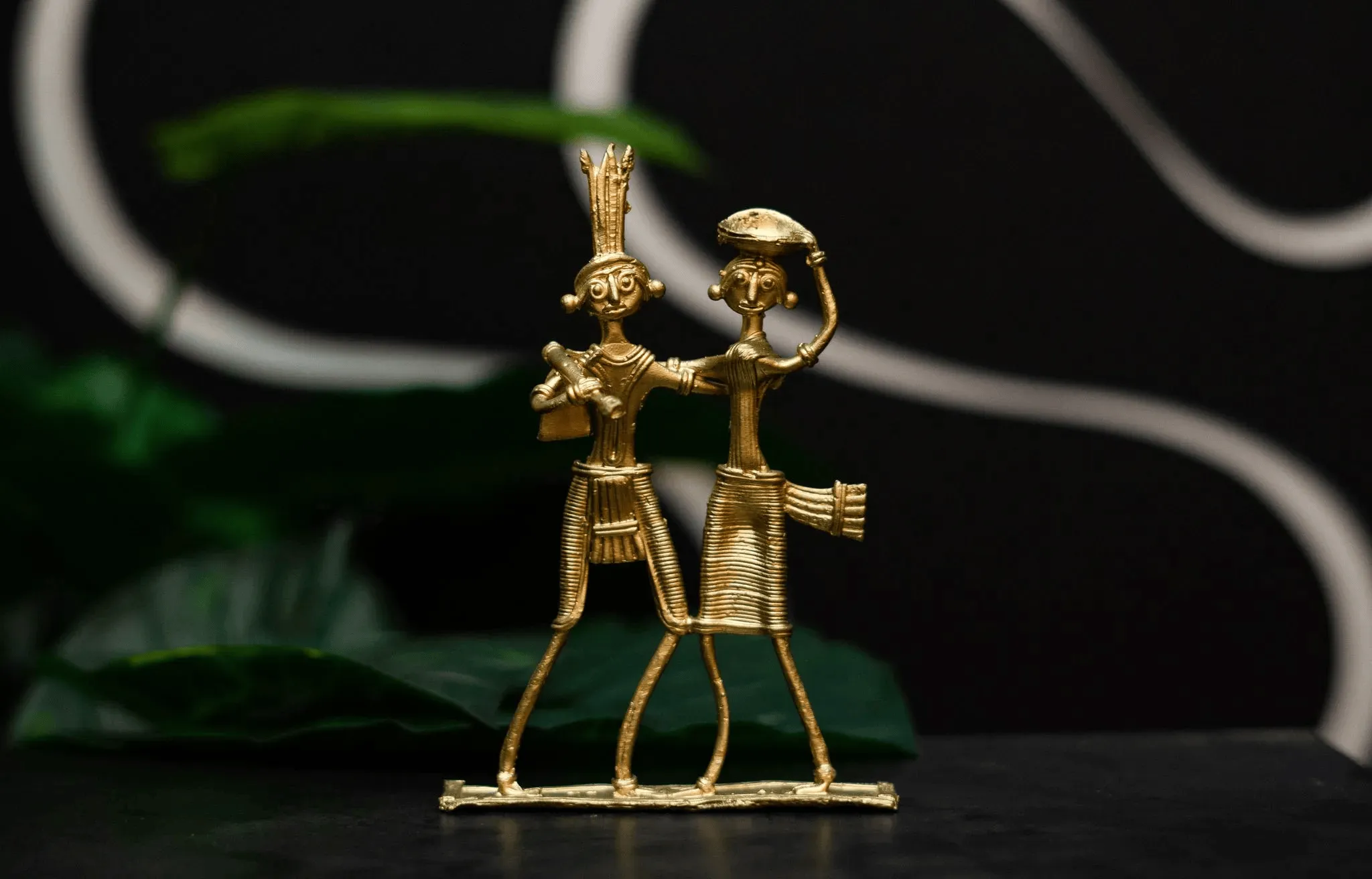
The next documented phase is the transition to religious and ritual metalwork. The D'Source documentation states that the Gond tribe's worship of Budha Dev, a deity associated with the sacred saja tree (Terminalia tomentosa, also known as Indian laurel), created a symbolic context for the transfer of religious meaning to iron. As the ironsmith communities recognised the strength of iron, they incorporated it as a parallel symbol of divine power, constructing cemented platforms under saja trees and placing iron tridents, spears, and chains as religious symbols. This documented shift from functional tool-making to ritual object production is the point at which Bastar iron craft acquired its dual character as both a domestic and ceremonial tradition. Ironsmiths then began making figurines of Budha Dev riding a horse and producing decorated wrought iron lamps, marking the emergence of the craft's figurative tradition. The Bastar Folk Art documentation by Postel and Cooper (1999) situates the craft within the broader material and religious culture of the Maria and Muria Gonds, including the Nagvanshi dynasty's establishment of temples in Bastar from the tenth century onward, which forms part of the regional cultural context.
Culture and Societies: Bastar iron craft is embedded in the material and social life of the Gond, Maria, and Muria tribal communities of Bastar. The Asia InCH Encyclopedia documents the craft's intimate connection to these communities through the production of lamps specifically designated for use by the Marias and Murias, and through the masks produced for Maria dances, which are an important ceremonial and social performance tradition. The IJRASET academic paper on Bastar tribal art in interior design identifies the craft as part of a wider complex of tribal artisanship in Chhattisgarh, including Dhokra metal work, bamboo craft, terracotta, tribal painting, bell metal craft, and wooden craft, all of which together constitute the material culture heritage of the Bastar tribal communities.
The Bastar Dussehra festival, a seventy-five day event documented by the eSamskriti source, is the most prominent regional celebration, gathering all major tribes of Bastar and celebrating the goddess Devi Mavli and the deity Danteswari. The festival forms part of the cultural landscape within which iron craft objects circulate as ritual and ceremonial items. The Kondagaon area, as the main centre of wrought iron production, has historically functioned as a gathering and trade point for craftsmen and their work. The D'Source field documentation records that ironsmiths who gained opportunity to travel with their craft were exposed to new contexts and forms, which fed back into experimentation and the expansion of the craft's formal vocabulary.
Religious Significance: Bastar iron craft has substantial and well-documented religious significance within the belief systems of the Gond and related tribal communities. The D'Source documentation by Palash Vaswani describes the process by which the Gond tribe's worship of Budha Dev, originally centred on the saja tree as the deity's sacred residence, expanded to incorporate iron as an equally powerful symbol of divine strength. Cemented platforms were constructed beneath saja trees and iron tridents, spears, and chains were installed as religious symbols at these shrines. This is the earliest documented context in which iron objects served a religious function within the Bastar ironsmith tradition.
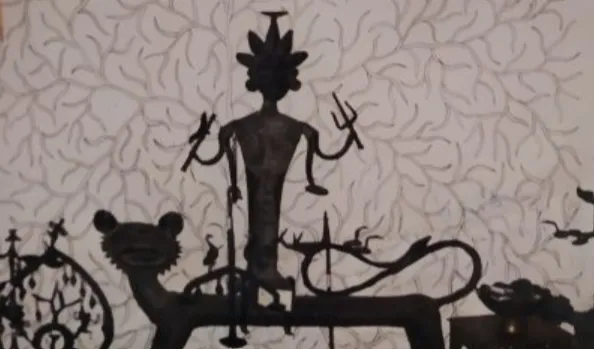
The ironsmiths subsequently extended this religious practice to figurative production: figurines of Budha Dev mounted on a horse became a canonical form, as documented uniformly in the D'Source, Incredible India, Culture and Heritage India, and GiTagged sources. The Asia InCH Encyclopedia documents the production of a full range of ritual lamps in multiple named forms, including dhiman, gud, laman, supali, khut, gadli, and viman diyas, all of which serve ritual lighting functions in domestic and community religious contexts. These lamps are decorated with animal motifs, with the peacock being among the documented motifs in the Postel and Cooper academic study. The masks made for Maria dances, documented in the Asia InCH Encyclopedia, function within a performance and ritual tradition specific to the Maria community. The sankaal (chain) and badgi (staff) are also listed among ritual objects made by Bastar lohars.
Understanding the Art
Style: The visual and formal character of Bastar iron craft is defined by the nature of the wrought iron process itself: objects are built through hammering and do not use casting or moulding, giving finished pieces a direct, unsmoothed quality in which the marks of the working process remain present in the surface of the metal. The Incredible India portal describes the aesthetic as possessing appeal despite its simplistic form, a formulation echoed in the D'Source introduction. Objects are produced in both solid and hollow forms, as documented by the Incredible India portal. The dark, raw appearance of the metal is a characteristic feature, and both solid and open-work structures are employed, particularly in the construction of lamp forms (deepak) assembled from multiple shallow diya bowls mounted on vertical and horizontal rods with diamond-shaped leaf structures. The Raodev Horse, specifically identified by the Incredible India portal as the most well-known signature craft from the region, is built with only two legs, a stylistic convention that distinguishes it from naturalistic representation and reflects the formal language of the tradition.
Central Motifs and Their Significance: Motifs in Bastar iron craft are drawn from the religious iconography of the Gond and related tribal communities, from the natural environment of the Bastar forest region, and from ceremonial and everyday life. The following motifs are documented across institutional and government sources.
Budha Dev mounted on a horse is the central religious figurine of the tradition, produced since the period when ironsmiths first began making ritual objects. The horse is the vehicle of the deity and is consistently depicted in iron. The peacock appears as a motif on lamp forms and as a standalone object, documented in both the Postel and Cooper academic study and the Incredible India portal, and carries associations of auspiciousness in the region's visual culture. Birds and animals more broadly are documented across all sources as a primary category of Bastar iron craft production, depicted in various postures and sizes as the D'Source documentation notes. Diamond-shaped leaf structures, which are used as space-filling elements in lamp constructions, are a characteristic formal element specific to this craft tradition. Human figures with marked facial expression are documented in the Asia InCH Encyclopedia as a category of wrought iron production. Masks made for Maria dance performances represent a specialised ritual object category. Farming implements and carpentry tools produced by the lohar communities for practical use within the tribal community represent the functional end of the craft's production range. The Lohar tribe's lamps (deepak) are identified in the IJRASET academic source as the most characteristic and celebrated product category, with jhaari and laman diya named as typifying objects in the ResearchGate Bastar handicrafts paper.
Process: The process of Bastar iron craft is fully documented in the D'Source field resource, the Incredible India government portal, the Memeraki institutional documentation, and the Culture and Heritage India source. The process involves no casting or moulding at any stage. The following steps are uniformly documented across sources.
The raw material is scrap iron sourced from households and markets, as documented by the Incredible India, GiTagged, and Memeraki sources. The GiTagged documentation identifies the raw materials as recycled iron scrap, charcoal, and red soil, with charcoal used as furnace fuel and red soil serving as an auxiliary material in the process. The Asia InCH Encyclopedia states that the lohars source iron from the market, reflecting the contemporary practice in which locally extracted ore has been replaced by commercially available scrap.
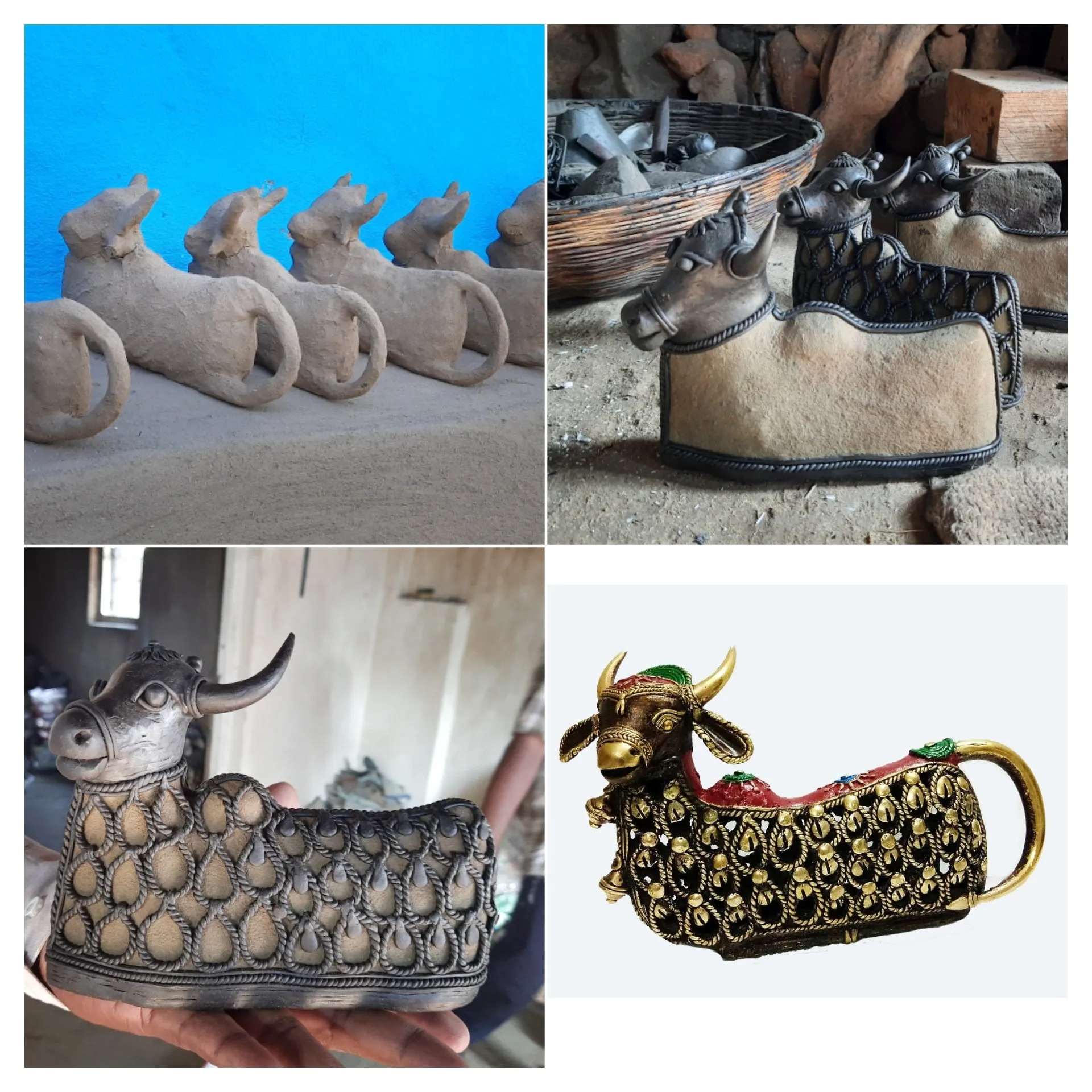
The scrap iron is heated in the dhunka sar or dhukna sar (furnace), the primary thermal tool of the craft. The Asia InCH Encyclopedia documents the full suite of tools used: muthi (light hammer), multha (heavy hammer), suma (piercing tool), sandesi (tongs), chimta (large forceps), and chheni (chisel). These tools are themselves made by the lohars, as documented in the Asia InCH Encyclopedia. Once the iron is sufficiently heated, it is beaten repeatedly with the hammers to achieve the desired thickness and shape. The Incredible India portal states that carefully pounding the hot iron gives it the desired form. Superfluous material is then removed by cutting. Additional detail is added through filing and chiselling. Objects are produced in both solid and hollow forms.
The finishing process is unique to Bastar iron craft and is consistently documented across the GiTagged and Incredible India sources: vegetable oil is applied to the completed iron object to prevent rust before the final finishing step. A varnish coat is then applied to bring out the shine. This vegetable oil application before finishing is identified by the GiTagged source as a distinctive feature of the craft.
Mediums Used: The primary material of Bastar iron craft is wrought iron in the form of recycled scrap sourced from households and markets. The GiTagged documentation specifies the three raw materials as recycled iron scrap, charcoal, and red soil. Charcoal functions as the fuel for the dhunka sar furnace. Vegetable oil is applied in the finishing stage to prevent rust, as documented by the Incredible India, GiTagged, and Memeraki sources. Varnish is applied as the final surface treatment. All tools used in production, including the hammers, tongs, forceps, piercing tool, and chisel, are themselves made by the lohar artisans from iron, as documented by the Asia InCH Encyclopedia.
New Outlook
Bastar iron craft faces documented sustainability pressures. The ResearchGate academic paper on Bastar handicrafts identifies the principal barriers as limited market access, low wages for artisans, and dependence on government-organised craft fairs and exhibitions as the primary sales mechanism. The Academia.edu paper on tribal crafts market in Bastar identifies the craft as having international market potential but recommends government support for digital marketing and trade fair participation to expand commercial reach.
The GI registration of 2008 (GI Number 68) provides legal protection against imitation and secures the craft's geographic identity, as documented by the Wikipedia entry and multiple institutional sources. The Chhattisgarh government's emporium Shabri sells products made by local craftsmen, and national craft fairs provide supplementary market access.
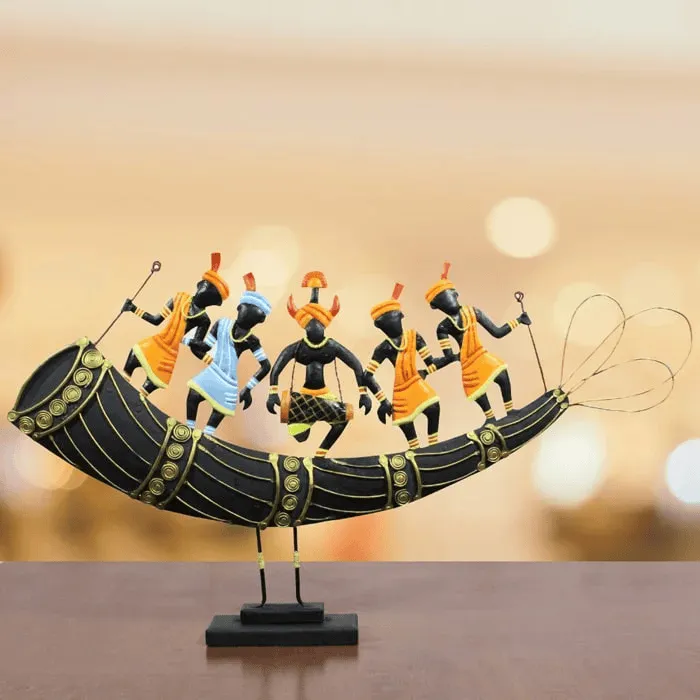
The D'Source field documentation on practitioner Tiju Ram Vishwakarma of Kedaichepda village illustrates one trajectory of contemporary adaptation: Vishwakarma's exposure to design contexts in Mumbai through collaboration with a professional designer expanded both his formal repertoire and his understanding of urban market requirements. This resulted in experimentation with new forms and sizes. The ResearchGate and Academia.edu sources both note that artisans have expanded the range of objects produced beyond traditional ritual and functional items to include masks, hangers, innovative lamp forms, wall hangings, showpieces, pen holders, and paper weights designed for contemporary domestic and office contexts.
The Asia InCH Encyclopedia classifies the craft in the category of Endangered or Rare, noting the vulnerability of the tradition. The Bastar craft documentation on eSamskriti records that a number of NGOs and the state government are working to keep the craft tradition alive, with consumer support through purchase identified as a key mechanism for sustaining artisan livelihoods.
Learn Bastar Iron Craft
Bibliography
Text Sources
Chattopadhyay, Kamladevi. The Glory of Indian Handicrafts. Asia Book Corp of America, 1985.
Jain, Jyotindra, editor. Other Masters: Five Contemporary Folk and Tribal Artists of India. The Crafts Museum and Handlooms Export Corporation of India, 1998.
Postel, Michel, and Zarine Cooper. Bastar Folk Art: Shrines, Figurines and Memorials. Project for Indian Cultural Studies, 1999.
Vaishna, Harihar. Bastar Ki Adivasi Evam Lok Hasthshilp Parampara. Radha Krishna Prakashan, vol. 1, 2011.
Internet Sources (for Images)
“Art and Crafts from Bastar.” The Lost Lander, 12 Mar. 2021, https://thelostlander.com/2021/03/12/art-and-crafts-from-bastar/. Accessed on April 22, 2026.
“Bastar Iron Craft.” Curriculture, https://curriculture.in/blogs-bastar-iron-craft/. Accessed on April 22, 2026.
“Blog.” Bastar Craft, https://bastarcraft.com/blog/. Accessed on April 22, 2026.
“Iron Craft of Chhattisgarh.” Asia InCH, https://asiainch.org/craft/iron-craft-of-chattisgarh/. Accessed on April 22, 2026.
“Wrought Iron Craft of Bastar, Chhattisgarh, India.” Zurich University of the Arts, https://blog.zhdk.ch/idss/files/2013/07/Wrought-Iron-Craft-of-BAstar-Chhattisgarh-India.pdf. Accessed on April 22, 2026.