


Bamboo Craft - The Handicraft Tradition of Assam
Explore Bamboo Craft of Assam, the handicraft tradition of Andhra Pradesh, and learn about its origins, techniques, cultural significance, and artistic heritage.
Introduction
Bamboo craft of Assam refers to the broad tradition of fabricating functional, structural, and decorative objects from bamboo through manual techniques including splitting, weaving, coiling, and carving, practiced across communities in the Brahmaputra valley, the Barak valley, and the hill districts of Assam. The tradition encompasses a wide range of products from utilitarian household items and fishing implements to ceremonially used objects, the most distinctive of which is the japi, a wide-brimmed sun-shade woven from bamboo strips and dried palm leaves. Bamboo craft of Assam is practiced as a primarily household industry with no exclusive occupational community, making it one of the most democratically distributed crafts in northeastern India.
Etymology: The term "bamboo craft" does not carry a single Assamese-language name as a unified category. Different products within the tradition carry their own locally specific designations. The Japi derives its name from the Assamese word for this form of sun-shade. Chalani denotes the sieve, kula the winnowing fan, dukula a large basket, khoralu a smaller basket, doon and dhol the measuring baskets, and jakoi, khaloi, juluki, and pollo various forms of fishing implements. Sitalpati, the term for the cool mat woven from Murta cane, is a compound of the Assamese words sital (cool) and pati (mat). Each product name is specific to its form and function within the broader material culture of Assam.
Origin: No definitive documentary record establishes the precise antiquity of bamboo craft in Assam. The Assam government's official portal on the craft states explicitly that no definite records are available to fix the antiquity, history, or origin of this craft, but that it can be assumed the craft has been practiced since the earliest periods of settled civilization in the region. The earliest datable textual reference that can be connected to the tradition appears in the Harshacharita, the seventh-century biographical text on the emperor Harsha composed by the poet Banabhatta. This text records that Bhaskara Varman, the king of Kamarupa in the early seventh century CE, sent to Harsha "baskets of variously coloured reeds," "thick bamboo tubes," and "various birds in bamboo cages," indicating that bamboo objects had reached a sophisticated level of production in Assam by this period. The Indira Gandhi National Centre for the Arts (IGNCA) documentation on bamboo and cane culture of Assam draws on this same textual evidence. The Assam Commissionerate of Industries and Commerce further notes an inscription prior to the twelfth century CE referencing a bamboo sun-shade sent by Bhaskarvarman to Harshavardhana. The tradition of the Japi is specifically connected to the period of the Chinese traveler Hiuen Tsang, who is documented as having visited Assam and having been received with decorated Japis.
Location:Bamboo craft is practiced throughout Assam, covering both the Brahmaputra valley and the Barak valley, as well as the hill districts. The IGNCA and the Assam State Portal identify concentrations of specific product types in particular districts. Japi production is concentrated in Nalbari, Kamrup, Nagaon (at villages including Kandali, Uriagaon, Jagi, and Kathiatoli), Darrang, Sibsagar, and Lakhimpur districts, with Nalbari and neighbouring villages including Kamarkuchi and Mughkuchi noted as the primary centres for the production of Fulam Japi (the decorated bamboo sun-shade). The village of Japisagia in Sonitpur district is also documented as a Japi-producing centre. Bamboo mat production on a commercial scale is particularly concentrated in Nagaon, Darrang, Cachar, and Karimganj districts. In Karimganj, thousands of artisans are documented as engaged in mat production, with local product names including dhara, jharia, and darma. The Sitalpati mat is most concentrated in Cachar, Karimganj, and Goalpara districts. Karbi-Anglong district is associated with distinctive basket-making traditions of the Karbi community.
The IGNCA notes that Assam possesses the most concentrated bamboo forests in all of India, with 51 documented species of bamboo growing across the state. The key bamboo-bearing areas documented for the handicraft include Cachar, Karbi-Anglong, North Cachar Hills, Nagaon, and Lakhimpur districts.
Community: The IGNCA documentation states explicitly that no particular caste or community in the Assam valley is exclusively connected with the bamboo craft tradition. The craft is described as carried on generally by all sections of the population, particularly by peasants irrespective of caste, community, or creed. This cross-community character distinguishes Assam's bamboo craft from traditions in which production is restricted to hereditary occupational castes.
Among specific ethnic communities, several documented sub-traditions exist. The Bodo community has a distinct basket-making technique involving the use of a mould to shape the neck and mouth of their baskets. The Sonowal Kacharis produce a documented range of bamboo products including pasi, kharahi, duli, dala, salani, kula, and fishing, weaving, and agricultural tools. The Karbi community of Karbi-Anglong district has a particularly well-documented bamboo craft tradition, studied in anthropological detail. Academic research published in the Journal of Archaeology, Tourism and Anthropology (University of Kelaniya, 2020) documents that Karbi bamboo craft knowledge is transmitted through direct community learning and encompasses eight bamboo species across five categories of use: agriculture and horticulture, fishery, house construction, weaving, and general household purposes. The principal species documented in Karbi craft use include Dendrocalamus sericus, Dendrocalamus longifimbriatus, Dendrocalamus giganteus, Bambusa tulda, Bambusa nana, Bambusa kingiana, Bambusa nutans, and Melocanna bambusoides.
The men of the household are documented as the primary weavers of bamboo baskets across most Assamese communities, while women participate in weaving activities such as mat-making (particularly in sitalpati production, where men prepare the cane slips and women do the weaving).
Relevance: Bamboo craft of Assam is documented as the most universally practiced craft in the state. The Assam government portal describes it as a product of which "its products have wide range of uses and as such are commonly found in every household." The IGNCA states that despite Assam having exceptional bamboo resources, the craft does not figure prominently in the national handicraft market and Assam's share in the export trade is negligible, a documented disparity between production scale and market presence. The craft provides subsidiary seasonal employment to cultivators during agricultural off-seasons and, increasingly, full-time commercial employment to skilled artisans producing decorative baskets, furniture, and mats for urban and export markets.
Government policy bodies supporting the craft include the Cane and Bamboo Technology Centre (CBTC) in Guwahati, operating as a technical support body under the National Bamboo Mission of the Ministry of Agriculture. A Bamboo Park at Chayagaon has been documented as under construction at a cost of Rs. 62.28 crore for integrated bamboo-based industry infrastructure. The National Mission on Bamboo Applications (NMBA) has additionally identified bamboo planting as an anti-erosion tool for Majuli Island. The Assam State Rural Livelihoods Mission (ASRLM) promotes bamboo craft production through its ASOMI programme for Self-Help Group women.
History
Background: The formal historical documentation of bamboo craft in Assam begins with the Harshacharita's record of bamboo products sent by Kamarupa's king Bhaskara Varman to Harsha in the early seventh century CE. The Harshacharita's author Banabhatta describes decorated and coloured baskets of reeds, thick bamboo tubes, and bird cages among the diplomatic gifts, evidence that bamboo craft had reached a sophisticated level of production in the Kamarupa kingdom. Ptolemy's geographical writings, as referenced in Dr. P.C. Choudhury's History of Civilization of the People of Assam, state that canes were grown and used as bridges in the region identified as Assam, providing an additional ancient external reference. References to decorated sitalpati mats used by people of wealth appear in early literature connected with the same period.
Following the establishment of Ahom rule in Assam after the thirteenth century, the craft gained further institutional support. Historical documentation records that Ahom kings patronized distinct professional artisan classes, including weavers, smiths, and craftsmen working in wood, ivory, and metal. The Ahom king Pratap Singha, in the early seventeenth century, brought artisans from Cooch Bihar specifically to introduce new techniques and designs to local artisans, indicating a documented policy of craft development through external expertise. The Assam Commissionerate of Industries and Commerce records that the khel system under the Ahom polity organized artisans by specific professions, connecting craft production to the administrative structure of the state.
The Satra institution, the network of Vaishnavite monasteries established following the reformist movement of the fifteenth-century saint Srimanta Sankardev, played a documented role in the development of bamboo craft during the medieval period. Bamboo and cane work within Satras is documented as having reached a high order of craftsmanship. The IOSR journal publication on the history of bamboo crafts notes that training in cane and bamboo work was provided by the Satras. The Auniati Satra is specifically documented as preserving a bichani (fan) of exceptional quality made from cane. Bamboo was also used within the Satra context for the production of masks used in the Bhaona dramatic performances introduced by Sankardev, which also required bamboo alongside clay, pith, metal, and wood.
Culture and Societies: Bamboo and its craft products are documented as integral to the domestic, agricultural, ceremonial, and social life of Assamese communities across the plains and hills. The craft primarily functions as a household industry in which every rural family is documented as possessing the basic tools, the dao and knife, and capable of producing standard items for domestic use. More complex and decorative production is associated with specialized artisans.
The Karbi community represents a well-documented case of bamboo's central role in a community's material culture. Academic research documents the Karbi practice of planting four bamboo plants in response to cutting one, reflecting a documented conservation ethic embedded in craft practice. The same research documents that bamboo is integral to Karbi life across food, medicine, shelter, household items, and ceremonially used objects. Among the Karbi, bamboo craft knowledge is identified as community-specific and transmitted through direct learning from older to younger members, primarily within male domains of craft production.
Religious Significance: Bamboo is used in specific objects that carry ceremonial and ritual functions within Assamese religious life. The japi, the traditional bamboo sun-shade, is documented as a ceremonial object in addition to its utilitarian function. Visitors to Assam have historically been welcomed with decorated japis, establishing it as a symbol of hospitality within Assamese cultural convention. Bamboo is documented as one of the materials used in the construction of masks for Sattria Bhaona performances, which are themselves Vaishnavite religious theatre traditions within the Satra institutional context.
Among the Karbi community, bamboo carries a documented spiritual significance. Research published through the academic community identifies bamboo as considered sacred within Karbi culture, reflected in community sayings and ritual practice, with the community's relationship to bamboo expressed in the concept that members are born and die with bamboo (jintak) in hand. The specific craft objects produced for ritual use within the Karbi tradition include fishing implements and ceremonial containers.
Within the broader Vaishnavite Satra context, bamboo objects including the bichani at Auniati Satra are preserved as artefacts of spiritual and cultural significance. However, no formally instituted religious requirement mandating the use of Assamese bamboo craft objects in Hindu temple ritual contexts has been documented by institutional sources. The religious dimension of bamboo craft in Assam is primarily associative, embedded in community practice and Satra traditions, rather than doctrinal.
Understanding the Art
Style: Assam's bamboo craft tradition encompasses two broadly documented product categories: utilitarian items produced to a standard functional form for household and agricultural use, and decorative or finely crafted items incorporating patterned weaving, coloured motifs, and applied materials. The visual style of the two categories differs substantially. Utilitarian items such as the chalani (sieve), kula (winnowing fan), dukula (large basket), and fishing implements are characterised by open-weave or lattice structures designed for their function, with no decorative elaboration. The weaving follows documented structural conventions: criss-cross weaving for sieves with calibrated open spacing, coiled basketry for carrying baskets with diameters that expand progressively from base to mouth, and conical forms for carrying baskets.
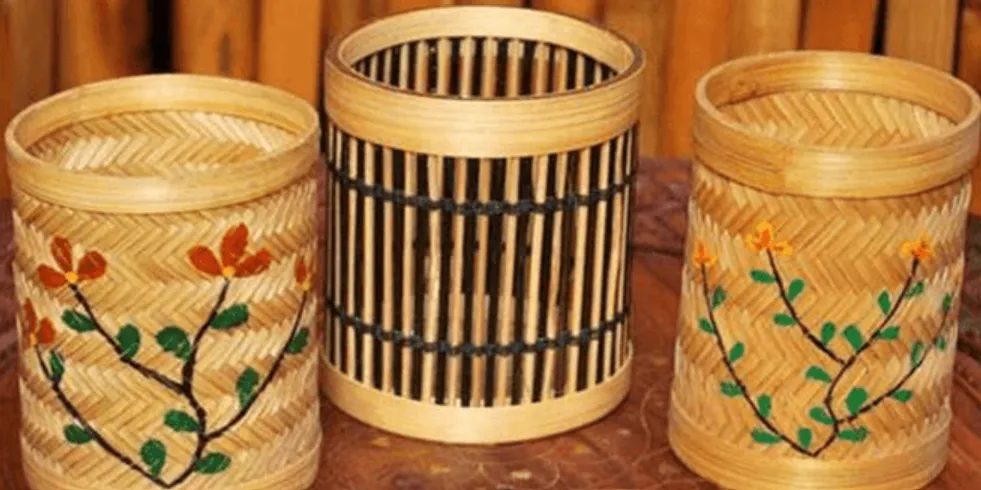
The most stylistically elaborated product is the fulam japi (decorated bamboo sun-shade), in which geometric and floral motifs in coloured wool, dyed yarn, and mica are applied over a base of split bamboo and dried tokow-pat palm leaves. The Nalbari district fulam japi is the most widely documented variant. Each district of Assam is noted in IGNCA documentation as having its own distinctive basket style and form, reflecting regional variation within the overall tradition.
Central Motifs and Their Significance: Decorative motifs in Assam's bamboo craft are most fully documented in the context of the fulam japi and bamboo umbrella handles. The fulam japi incorporates floral and geometric patterns applied in coloured wool, cotton, and dyed yarn, with mica used for surface reflection. Bamboo umbrella handles carry designs of leaves, creepers, plants, rings, and crosses, etched or carved onto the surface. The muli bamboo is specifically identified as the preferred species for these handles due to its surface properties. These decorative treatments are documented by both the IGNCA and the Asia InCH Encyclopedia of Intangible Cultural Heritage.
In basket weaving across different community traditions, the design varies by community and district. Bodo baskets have a documented distinctive form characterised by the use of a mould to shape the neck, producing a narrowed neck opening not common to plains-area basket production. The Assamese basket from Silchar has a documented square base with inward-capped corners that function as a support structure, designed for betel nut storage.
Process: The production of bamboo craft items involves several sequential stages documented across IGNCA and academic sources. The first stage is material selection and harvesting. The species used depends on the product to be made: Melocanna bambusoides (muli) for umbrella handles and fine splitting, Dendrocalamus species for heavier structural use, and Bambusa tulda for basketry among the Karbi. Selection criteria include age, moisture content, and condition of the culm. The documented conservation practice among the Karbi involves planting four bamboo plants for each plant harvested.
The second stage is splitting and preparation. The primary tool is the dao, a bill-hook that is the essential instrument in both plains and hill bamboo craft traditions. The dao is used to split the bamboo lengthwise into strips (slips) of varying width depending on the product. For fine items such as mats and screens, very thin slips are produced. For structural items, wider strips are used. A jak (a V-shaped wooden frame) is also documented as an essential tool in the splitting and sizing process. For cane-based products, the stems are additionally heated on a slow fire, typically using a kerosene lamp, to make them pliable for bending and shaping.
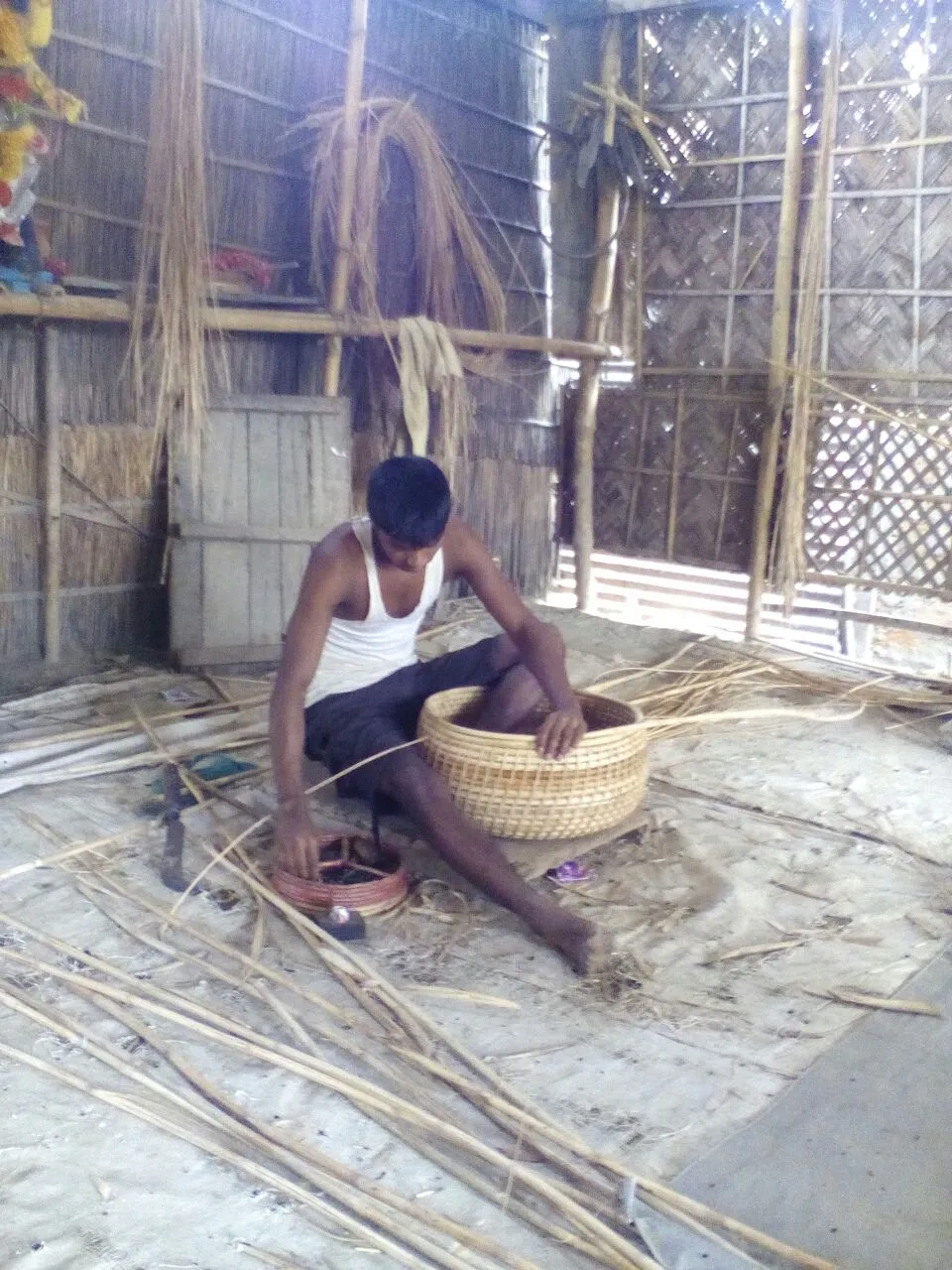
The third stage is weaving or construction. Two primary construction methods are documented: criss-cross weaving (used for sieves, mats, and flat items) and coiled basketry (used for carrying and storage baskets). In coiled basketry, the base is constructed by rolling cane or bamboo strip around a central hub, with additional strips stitched to the base spiral in a figure-eight stitch that passes above and below preceding coils, progressively increasing in diameter until the required height is reached. The Bodo community uses a mould of cone-shaped paper filled with sand to maintain the internal form of their baskets during the weaving of the neck and upper structure.
The fourth stage is finishing and surface treatment. For the fulam japi, finishing involves the application of coloured wool, mica, and dyed yarn over the woven bamboo and palm leaf base, followed by the application of varnishing materials. The IGNCA documents the following materials used for colouring and varnishing bamboo and cane products: bhatar phen (boiled rice juice), amrapata (Hibiscus Subdariffa extract), tamarind leaves, mezenta (a chemical dye), kalabati chach (lac resin), and methylated spirit. Ordinary japi production is documented as not requiring any special skill, while the decorated fulam japi requires both technical weaving skill and competence in applying the decorative materials.
Mediums Used; Bamboo is the primary material, with documented significant species including Melocanna bambusoides (muli), Teinostachyum dalloa (dalu), Dendrocalamus longispathus (khang), Oxytenanthera nigrociliata (kaligoda), and Dendrocalamus hamiltonii (pecha). Of these, muli and dalu are noted as having the greatest commercial importance, with muli used for umbrella handles and fine splitting, and dalu used for mat and basket production.
For the fulam japi, secondary materials include tokow-pat palm leaves (Corypha species), coloured wool, cotton, dyed yarn, and mica. Finishing and surface treatment materials include boiled rice juice (bhatar phen), Hibiscus Subdariffa extract, tamarind leaf extracts, lac resin, and synthetic dye stuffs. Tools consist of the dao (bill-hook) and knife as primary instruments, supplemented by the jak (V-shaped wooden frame) for splitting, and in furniture production by saws, hammers, pliers, and pincers. No mechanised equipment is documented in the production of hand-crafted bamboo items, a feature explicitly noted in both state government documentation and academic sources.
New Outlook
Assam's bamboo craft faces documented structural challenges arising from the replacement of bamboo products by lower-cost manufactured plastic alternatives in household and agricultural contexts. The decline of full-time indigenous artisans is documented in academic research, with the craft's base increasingly maintained by part-time cultivators and seasonal workers rather than dedicated craft specialists. The Karbi community's bamboo craft tradition is specifically identified in academic publications as on the verge of extinction due to the rise of inexpensive modern utensils and the misalignment between the time-intensive nature of craft production and contemporary consumer expectations.
At the policy level, the National Bamboo Mission and the Cane and Bamboo Technology Centre in Guwahati represent the primary institutional infrastructure supporting the modernisation and commercialisation of bamboo-based industries. The construction of a Bamboo Park at Chayagaon with integrated infrastructure for bamboo-based industries represents the most significant recent capital investment in the sector. The Assam State Rural Livelihoods Mission actively promotes bamboo craft production as a livelihood option for rural women through Self-Help Groups.
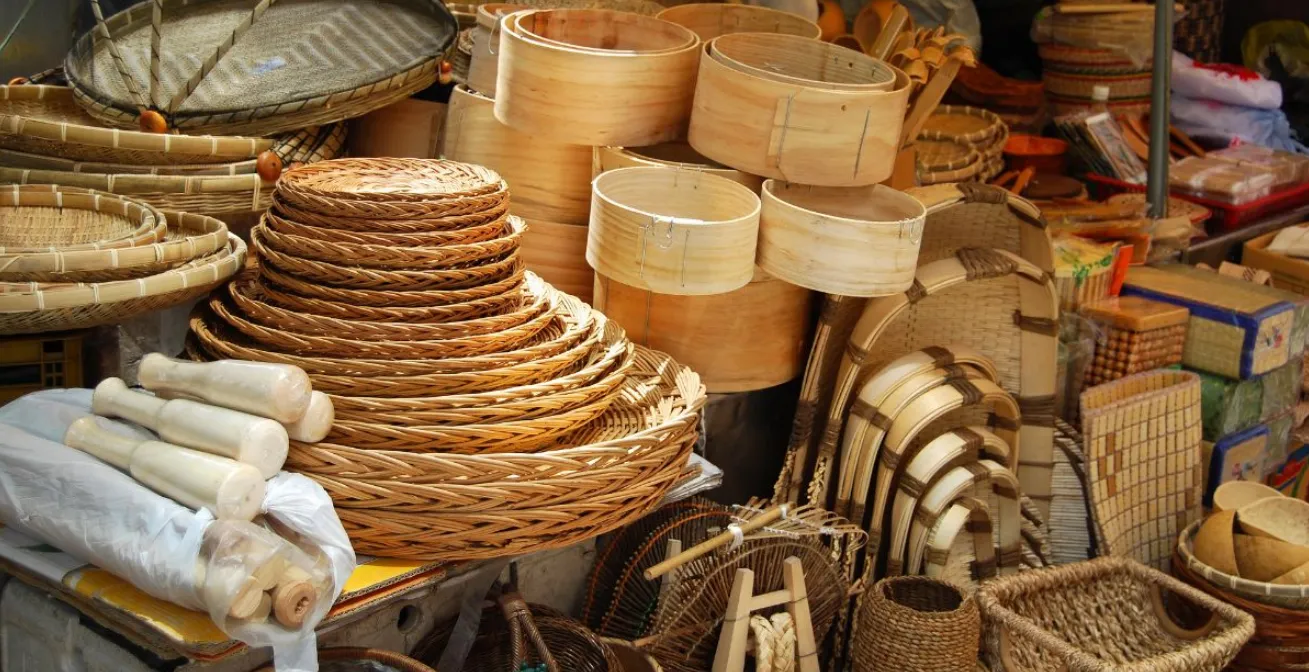
Documented adaptation strategies include the expansion of bamboo craft into new product categories for urban and export markets, including furniture, decorative items, lampshades, and commercial packaging. The japi, while no longer a functional agricultural implement in most contexts, has found documented viability as a decorative object, cultural artefact, and tourist souvenir. Academic research on youth involvement in Assam's bamboo craft tradition, documented in publications on balancing tradition and innovation in the craft heritage, identifies a youth-led adaptation approach combining traditional weaving techniques with contemporary design inputs as a partially documented preservation strategy.
Learn Bamboo Craft of Assam








Bibliography
Text Sources
Barbaruah, H. Ahomar Din. Publication Board of Assam, 1981.
Barpujari, H. K. Assam in the Days of the Company. 1963.
Choudhury, Pratap Chandra. The History of Civilisation of the People of Assam to the Twelfth Century A.D. Dept. of Historical and Antiquarian Studies in Assam, 1959.
Dutta, Payal. “Fostering Economic Development Through MSMEs: A Case Study of the Barpeta Cane and Bamboo Craft Cluster.” Indian Streams Research Journal, vol. 4, no. 5, 2014.
Khataniar, Rabinjyoti. “Cane and Bamboo Based Industrial Cluster in Assam: Profitability and Vulnerability.” IJHSSI, vol. 6, no. 11, 2017.
Phukan, J. N. The Economic History of Assam Under the Ahoms. PhD diss., Gauhati University, 1973.
Sarma, S. N. A Socio-Economic and Cultural History of Assam (1200–1800). Bina Library, 1989. Reprint 2001.
Internet Sources (for Images)*
“Assam Bamboo Industry: Cultural Significance and the Untapped Scope of Growth.” Diversity Assam, 21 Nov. 2025, https://diversityassam.com/blog/assam-bamboo-industry. Accessed on April 21, 2026.
“A Brief Look into Cane and Bamboo Craft of Assam.” Indian Institute of Crafts and Design (IICD), 25 Oct. 2019, https://www.iicd.ac.in/bamboo-craft-of-assam/. Accessed on April 21, 2026.
“Assam Cane and Bamboo.” Assam Cane Bamboo Blog, 2016, https://assamcanebamboo.blogspot.com/2016/. Accessed on April 21, 2026.
“Bamboo Handicrafts of Assam.” BoonToon, n.d., https://www.boontoon.com/blog/five-famous-handicrafts-of-assam/bamboo-handicrafts-of-assam-2/. Accessed on April 21, 2026.