

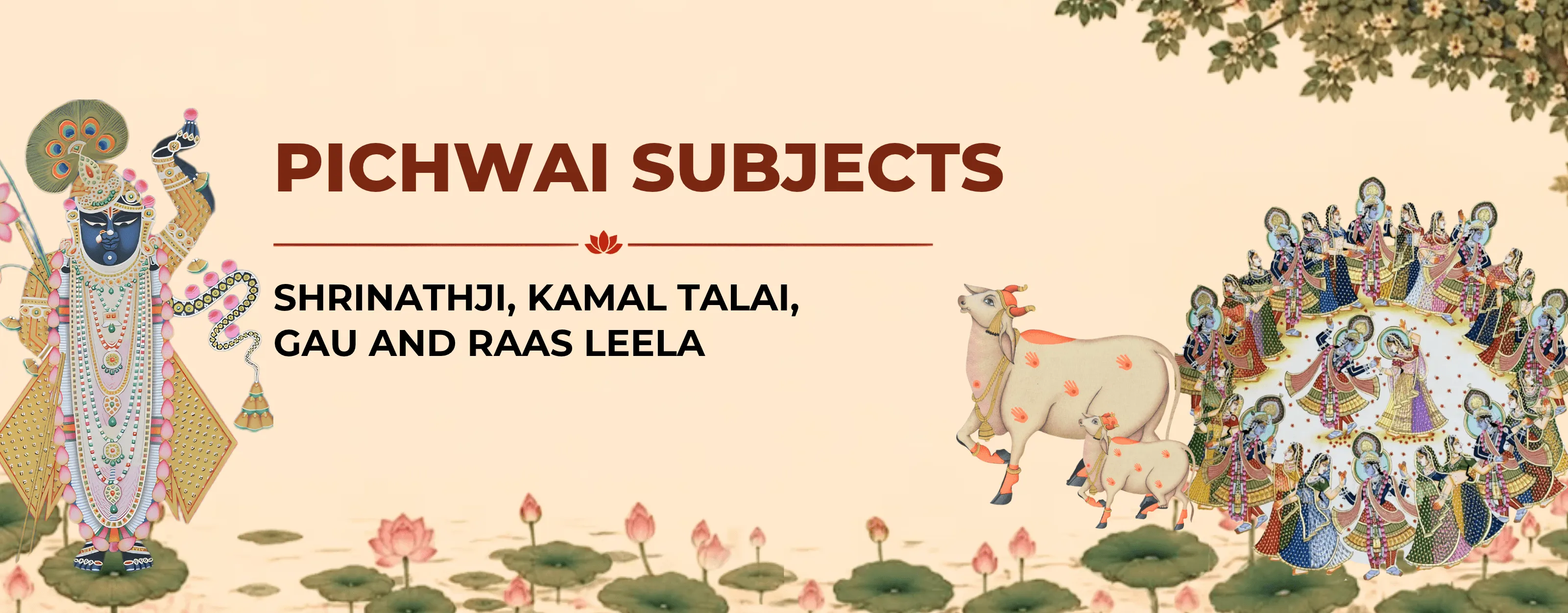

In the sanctum at Nathdwara, Shrinathji is never painted into his own pichwai. The temple cloth is cut where the deity stands. The painted parts show at the sides and above, and the living image fills the gap. Pichwai master Raja Ram Sharma explained this to Rooftop, and it changes how you read all four of the great Pichwai subjects: Shrinathji, Kamal Talai, Gau and Raas Leela.
This guide takes them in the order of the god's own time. Shrinathji is dressed in the morning. The cows go out to graze. The lotus pond belongs to the hot months. And on one autumn night, Krishna dances.
What a pichwai is for
The word joins pichh, behind, and wai, hanging. A pichwai is a painted cloth that hangs behind the image of Shrinathji, the child form of Krishna worshipped at Nathdwara, about 45 kilometres from Udaipur. The tradition belongs to Pushtimarg, the path of devotion set out by Shri Vallabhacharya. Painters work on hand-spun cotton that is starched and dried before the first line goes down.
Who paints them? Sharma gives a short answer. When Shrinathji came to Nathdwara, four families of Gaud chitrakars followed him in what he calls chitra seva, service through pictures. They began with wall paintings and moved to cloth. Two communities still do the work today, the Adi Gaud and the Jangid.
Sharma adds something the record usually misses. You cannot look at a pichwai and say it is a Jangid painting or an Adi Gaud painting. You can only tell one painter's hand from another's. What the world calls the Nathdwara style is the sum of all those hands.
Why Pichwai subjects follow a clock
Shrinathji is seen eight times a day. Each viewing is a darshan, and together they trace a child's day from waking to sleep. Sharma lists them in order: Mangala, Shringaar, Gwal, Rajbhog, Utthapan, Bhog, Sandhya Aarti and Shayan. The pichwai enters the ritual at Shringaar, the full morning adornment, when it is hung behind the deity.
On top of the daily clock sits a yearly one. Sharma told Rooftop that Shrinathji's shringar is fixed for all 365 days. The calendar sets the robe, the dupatta, the crown or turban, the garland, the lotus in the hand and even whether the feet are bare. Festivals and seasons bring their own backdrops. So a Pichwai subject is never only a picture. It is a time of day or a time of year.
| Subject | When it belongs | Look for | Ask the seller |
|---|---|---|---|
| Shrinathji | Every day, dressed for the date | Raised left hand, large eyes, the shringar of a named day | Which day or festival does this shringar show? |
| Gau | The Gwal darshan, when Krishna takes the herd out | Cows with calves, painted blankets, cow borders | Are the cows the subject or the border? |
| Kamal Talai | The summer months | Buds, half-open flowers and full blooms on one pond | Is the gold pressed varak or raised embose? |
| Raas Leela | Sharad Purnima, the first full moon of autumn | A ring of gopis with a Krishna beside each one | Is this sized for a temple or a home? |
Shrinathji: the subject with a fixed wardrobe
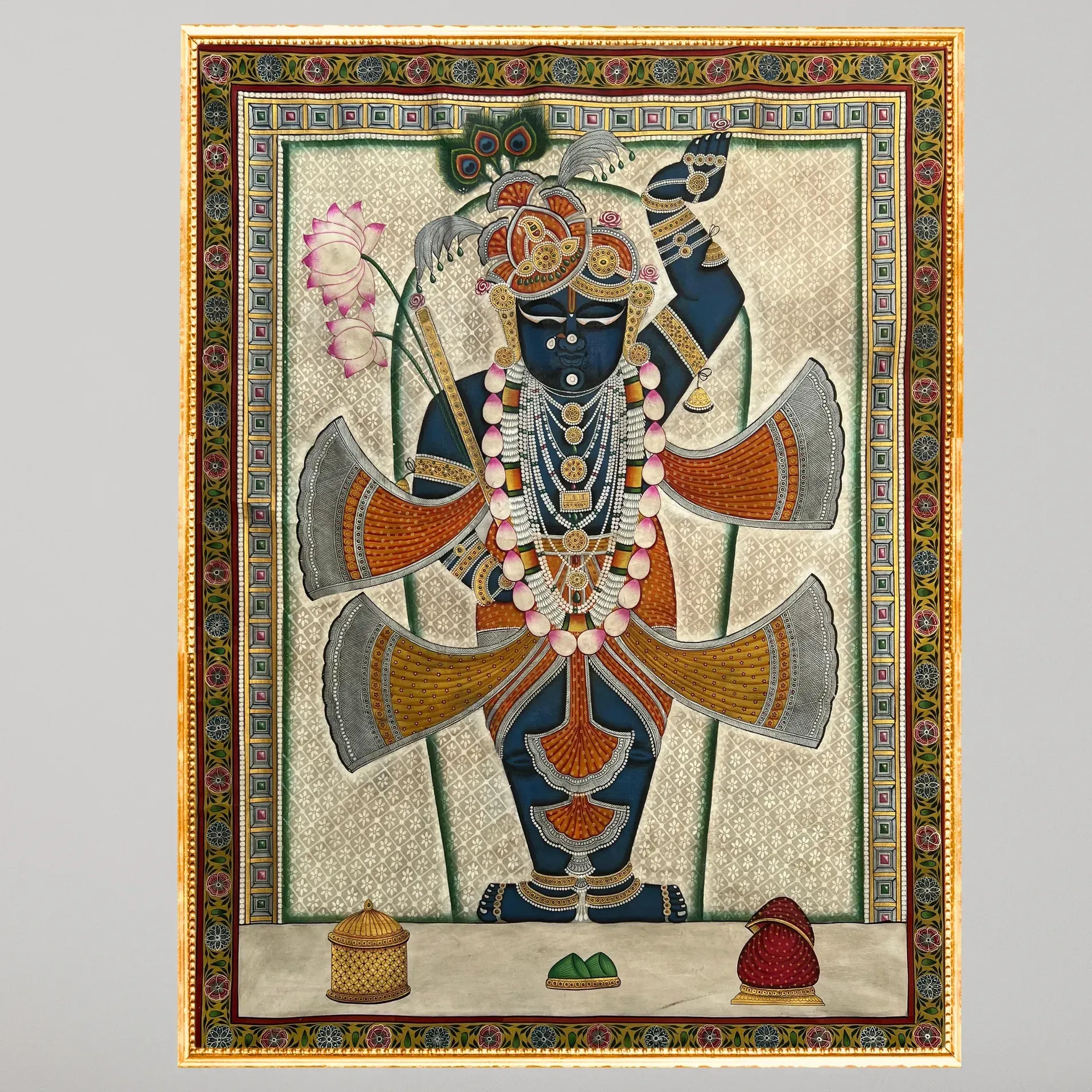
Mangla Darshan Rooftop
Shrinathji is the centre of the whole tradition. Rooftop's Pichwai Art Wiki describes him with large eyes, a big nose and a rounded belly. His left hand is raised, the gesture of the child who lifted Govardhan hill.
The hardest part of painting him is the date. Sharma says that a painter who does not know what the Lord wears on a given tithi goes to the temple, takes darshan and comes home to paint what he saw. Mistakes, in his words, come from painters who copy pictures of pictures.
Two details show how closely a painter follows the tradition.
The first is the eyes. Sharma says the aankh is always painted last. Opening the eyes is the pran pratishtha of the picture, the moment life enters it. The Phad master Prakash Joshi of Bhilwara described the same rule to Rooftop for his own scrolls. The two traditions sit about 200 kilometres apart and share one law of the brush.
The second is the feet. Older pichwais show Shrinathji's feet turned to the side. Newer ones show them facing you. Sharma's teachers gave him the reason. In early times the shringar covered the feet, so painters never saw them and drew them sideways. When the frontal darshan of the feet became possible, paintings changed to match. The image in the temple never changed. The darshan did. A painter who draws side-facing feet today is choosing an old mood. It is no longer a rule.
Then there is the cutout. In the temple, Sharma says, the pichwai stands behind the Lord. In homes, offices and galleries, it has to carry him. That is why every Shrinathji you can buy has him painted in. Both are honest objects, and only one is the temple object.
On Rooftop, Shrinathji 29 sets him among rows of cows, painted on cloth in mineral and fabric pigments, and is made to order. Mangla Darshan takes its name from the first viewing of the day, when the god has just woken in his lightest dress. 13 Darshan spreads his forms across a set of thirteen paintings.
Gau: the cowherd's darshan
The third darshan of the day is Gwal. Sharma describes it as Krishna the cowherd, gathering his herd to take them out to graze, the boy who loved the cattle. Cows are never far from Shrinathji. Rooftop's listing for Shrinathji 29 calls him Govardhan Nath, protector of the cattle and the pastoral world.
In a Gau pichwai, the cows can fill the whole picture. They stand in rows, often with calves at their feet, their backs covered in painted blankets. The Smithsonian's Pichwai Portals project notes that cows caring for their young echo the parental love Pushtimarg devotees feel for Krishna as a child god. That is the key to the subject. A cow pichwai is about tenderness.
Cows also run along the edges. Sharma lists the gai border among the standard pichwai borders, with the mor border of peacocks, a border of Krishna leela and the chaubis svarup, the 24 forms. Kamdhenu, the wish-granting cow of Hindu tradition, often takes the centre on her own.
Gau is the subject that settles most easily into a home without a shrine. It carries the devotion of the form without placing a deity on the living room wall, and for some buyers that matters.
Kamal Talai: the lotus pond
Kamal means lotus. Talai means pond. A Kamal Talai pichwai is a pond packed with lotus flowers and wide round leaves. Some show only the water and the flowers. Others place cows, birds or Shrinathji himself among them.
The lotus belongs to Shrinathji's dress as much as his scenery. Sharma names the lotus garland and the kamal in the hand among the items the calendar fixes for each day. A Rooftop guide to Pichwai motifs adds that Krishna carried a lotus in his right hand, wore garlands of them and had his bed covered in them.
Lotus pond pichwais are usually linked to the summer months. Good painters show the flowers at every stage, with buds, half-open flowers and full blooms on one surface, so the pond seems to grow while you look at it. Leaves overlap in layers of green, and fish or water birds sometimes move between them.
Kamal Talai is also where buyers most often meet raised gold, and here Sharma is precise. The old temple tradition knew only two gentle reliefs. Pearls were laid on in thick white so you could feel them, and gold varak was pressed over a base layer, so it sat just slightly raised. The heavy plaster relief with gold foil that sells widely today is called embose. It came, he says, from the Tanjore and Mysore styles, and it is new. He does not condemn it. It gives artists a living, and devotees love the shine. He only asks that buyers know which is which.
Raas Leela: the night dance
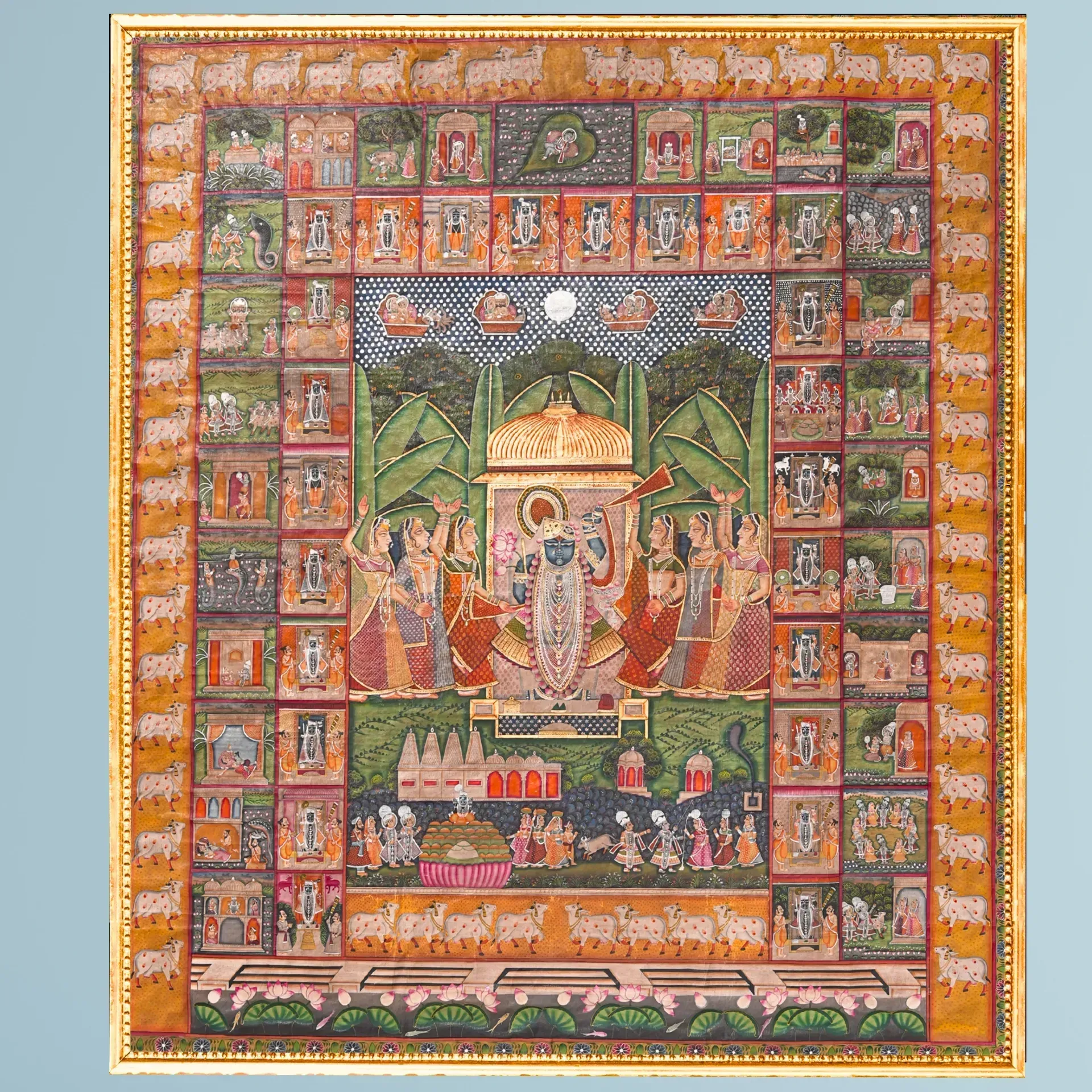
Krishna Raas Leela Rooftop
Raas Leela belongs to one night, Sharad Purnima, the first full moon of autumn. The Smithsonian's notes tell the story in a few lines. On that night in Braj, Krishna multiplied himself, one for each gopi, and joined them in a great circle dance. Pushtimarg marks the night as Maha Raas.
It is the hardest composition in the form. A painter has to set a ring of dancers, place a Krishna beside each gopi and keep the circle readable from across a room. The ground is often dark, so the figures and the moon carry the light. Rooftop's Janmashtami guide to Pichwai describes a pichwai called Sharad (Krishna Leela) that places Shrinathji at the centre of the Sharad Purnima celebration, with gopis and other deities arriving for darshan.
In a home, Raas Leela is the most social of the four subjects. It suits a dining room or any wall where people gather in the evening.
The yellow nobody saw being made
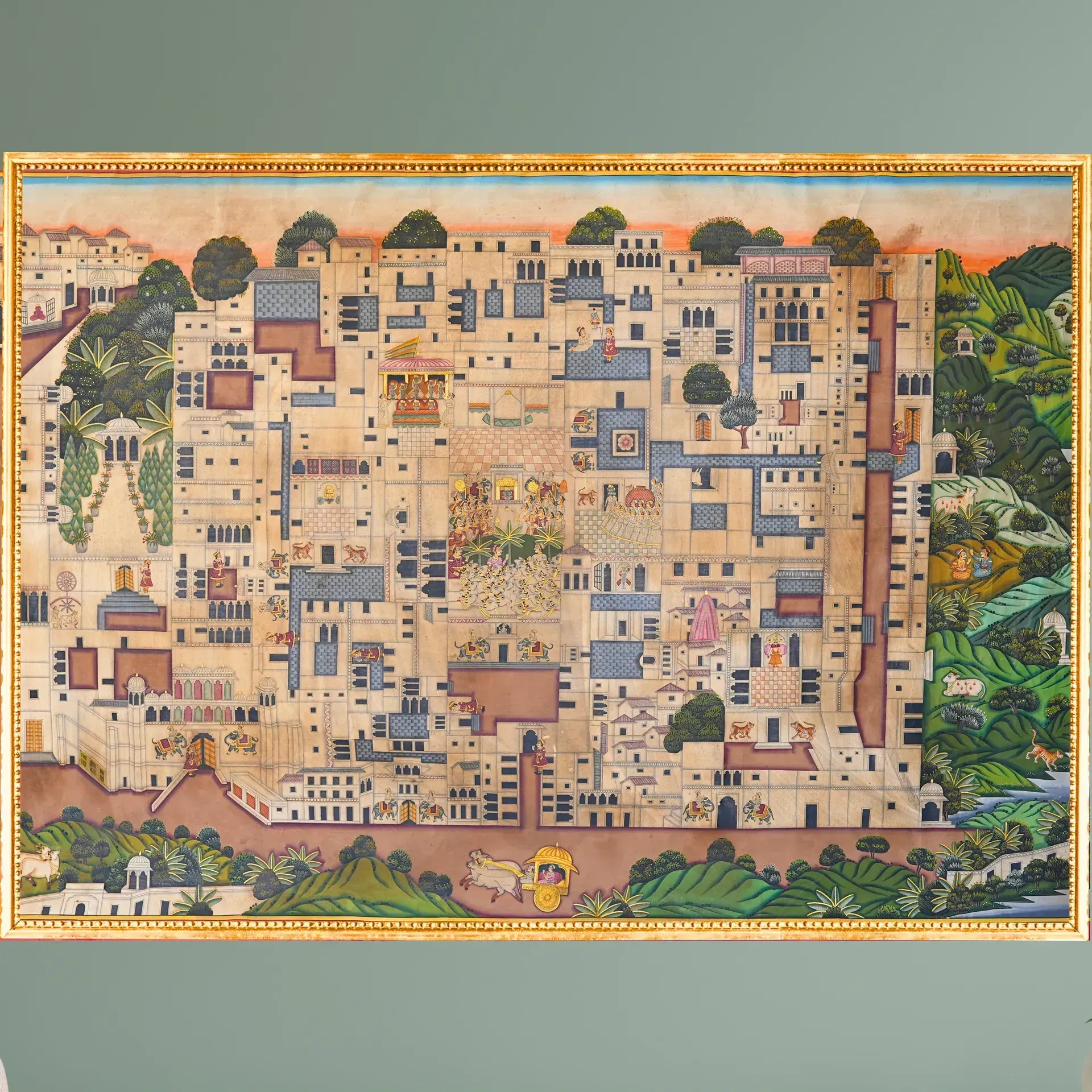
Yellow in Pichwai
Old pichwais glow with a yellow called gaugooli, known in the wider art world as Indian yellow. The story told everywhere is that it came from the urine of cows fed only mango leaves.
Sharma has painted for fifty years. He has never seen gaugooli made and never met anyone who saw it made. He accepts that paintings about a hundred years old used it. His conclusion is that another community made the pigment and supplied it to the painters, which is why the recipe vanished without a single painter able to save it. He rejects the mango leaf story outright, because no Sanatani, he says, would make a cow suffer.
Science supports the first half of his answer. In the Pichwai Portals project, the Indian yellow used on the leaves of one pichwai's trees glows bright under UV light. The pigment was real. Who made it is still an open question.
Borders: the frame inside the cloth
A pichwai hangs as cloth, with no rigid frame. Sharma says that is why painters made the border bright, so the edge would show clearly from a distance. Over time one border became two or three. Bigger festivals can carry grander borders, but borders are not fixed by season.
He has one rule. The more borders you add, the smaller the god becomes, so the border must frame him and never crowd him. When you compare two pichwais of the same subject, look at the borders first. They tell you how much room the painter left for the centre.
Bringing a pichwai home
Pichwai at Rooftop Suitable For Your Home
Decide first what you want, a temple-style backdrop or a painting that carries the god. Almost everything for sale is the second kind, and that is fine.
Then ask your questions. Which day or festival does the shringar show? Is the gold pressed varak or raised embose? Is the work painted on cloth, and with what pigments? Rooftop's listings state the surface and pigments for each work, and many Pichwai pieces are made to order, so a painter can take on the subject you want. Browse the Pichwai paintings on Rooftop by subject.
A cloth pichwai needs simple care. Hang it out of direct sun and away from damp walls. Do not fold it. To store it, roll it loosely around a tube with the painted side facing out and keep it somewhere dry. Dust it with a soft, dry cloth and never use water. A glazed frame, or a rod sewn along the top edge, keeps the cloth from sagging.
Learn Pichwai from the source
Sharma was born in Bijolia in Rajasthan's Bhilwara district and left home at thirteen to train under Tulsidas Chitrakar, head artist of the Shrinathji temple. The Pichwai art course by Raja Ram Sharma runs to ten hours across five chapters and 38 lessons, starting with the cows and the lotus and building up to the svarup itself. His full conversation with Rooftop, The Painter of God's Timetable, goes deeper into everything above, and the artist spotlight traces his training.
To practise at home, the Artventures of Pichwai books, created with Sharma, come in three levels: Elementary, Essentials and Expert, or as a set of three. For the closely related court style, Anandi Lal Sharma teaches the Nathdwara miniature course.
Before you buy a Shrinathji pichwai, ask the painter one thing: which day is he wearing? A painter trained inside the Nathdwara tradition can name the tithi. If yours can, you are holding a page from the god's own calendar.
