


Explore these 10 Pichwai paintings on Rooftop
Explore 10 original Pichwai paintings by Mukut Joshi on Rooftop, with the festival each one belongs to, sizes, prices and how to care for painted cloth at home.

Rooftop
Author
Sharad Purnima falls on 25 October this year. Annakut follows on the day after Diwali, and Gopashtami on the eighth day after it. In Nathdwara, a Pichwai is a painted cotton cloth hung behind the idol of Shrinathji, and each one is made for a particular season or festival of the Pushtimarg calendar. The name joins two Sanskrit words, pichh (at the back) and wai (hanging). The ten Pichwai paintings below are hand-painted originals listed on Rooftop, and three of them belong to the festivals above.
The list follows the temple's own clock. It starts with the first darshan of the day, moves through the festival year, and ends with paintings that hold many darshans on a single surface.
The painter behind all ten
All ten are by Mukut Joshi. He began painting young, under his elder brother and mentor Prakash Joshi, and his early training followed the family's traditional style. Prakash Joshi is a Phad painter from the Joshi family of Bhilwara and received the National Award in 2009. In 2014 Mukut committed himself fully to Pichwai. He paints on handwoven cotton with natural pigments and gold, and has run workshops at universities and museums. In March 2026 the brothers exhibited together at The Sacred Aesthetics at Bikaner House in New Delhi, with 15 Phad paintings by Prakash ji and 13 Pichwai paintings by Mukut ji. All thirteen of his works listed on Rooftop are on his artist page.
Ten Pichwai paintings, in the order the temple year runs
1. Mangla Darshan
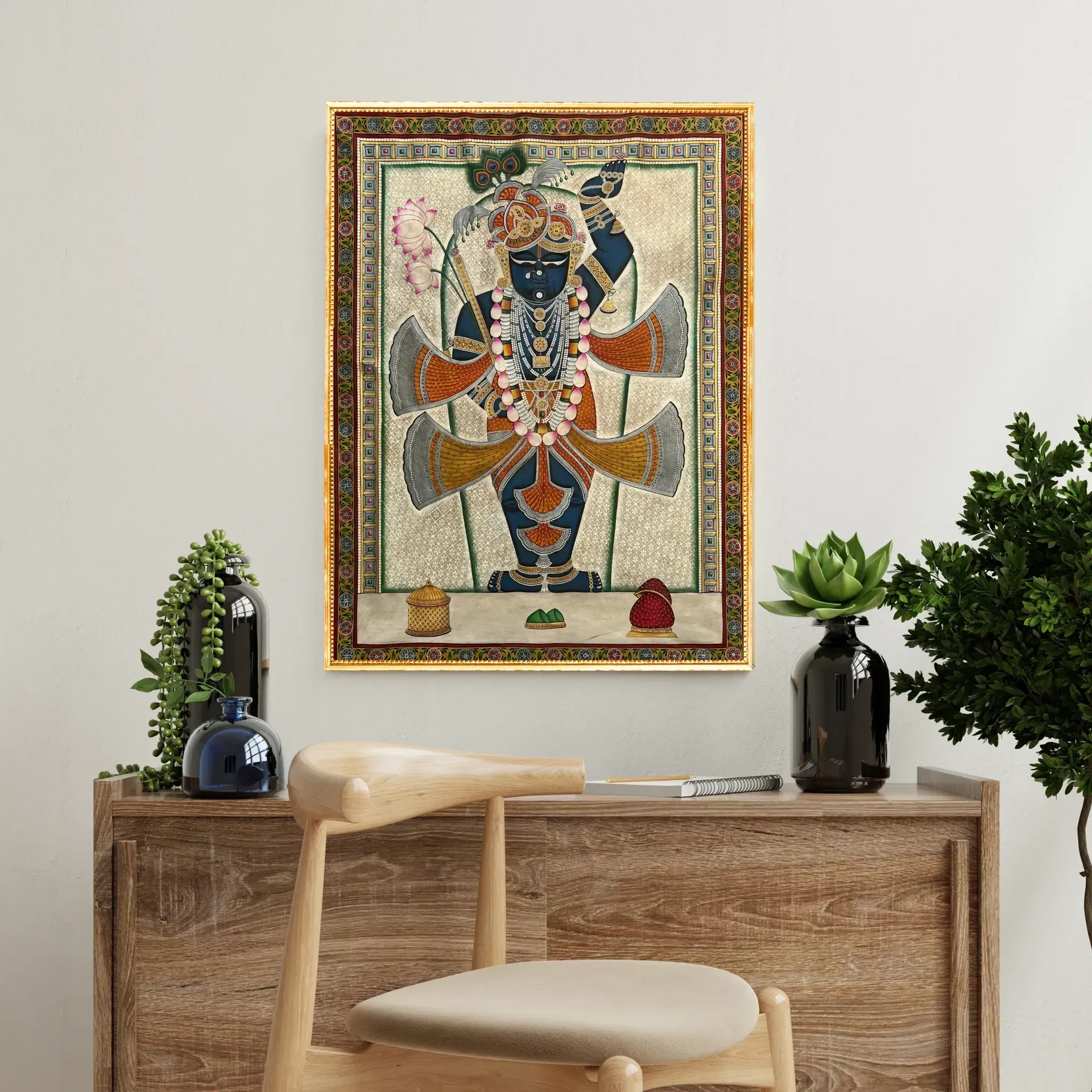
Mangla Darshan by Mukut Joshi, Shrinathji being woken for the first darshan of the day | ₹1,01,999 | Mukut Joshi
Mangla Darshan is the first of the eight daily darshans of Shrinathji and the first of the four held before noon. It marks the deity waking after his rest. This painting follows what comes next: the waking, the ritual bath (snaan), the shringar and the prayers. Mangla Darshan measures 48 × 36 inches and is painted in natural colours on cloth. It is also the lowest-priced work on this list, and for a home that has never had a Pichwai it makes sense to start where the temple day starts.
View Mangla Darshan on Rooftop
2. Tri Darshan
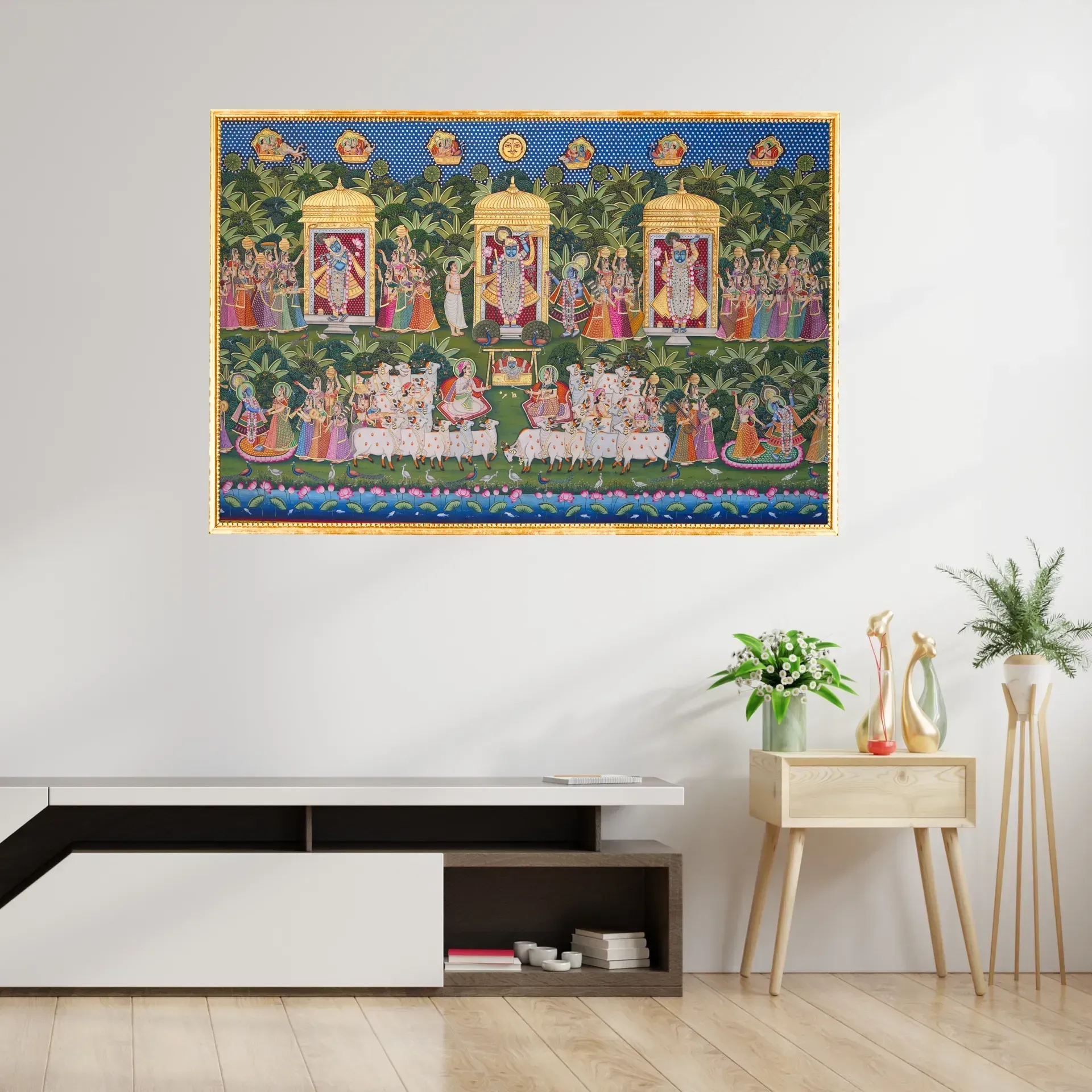
Tri Darshan by Mukut Joshi, gods and gopis above, Nand Baba and Yashoda rocking the infant Lalan below | ₹4,24,999 | Mukut Joshi
Tri Darshan puts three darshans on one cloth. In the upper register, gods arrive to watch and gopis bring fresh butter. Below them Nand Baba and Yashoda rock the infant Lalan in a swing, with cows on both sides. Shrinathji is the child form of Krishna, and the lower half shows vatsalya bhav, the love of a parent, set underneath the gods. Tri Darshan is 72 × 48 inches in natural colours and real gold leaf.
3. Hindola (Janmashtami)
Hindola (Janmashtami) by Mukut Joshi, the infant Krishna in a swing surrounded by gold toys | ₹2,54,999 | Mukut Joshi
Hindola means swing. In Hindola (Janmashtami), Nand Baba and Yashoda cradle Lalanji, the infant Krishna, in a swing for the festival of his birth, with gold toys around him. Shrinathji stands above the scene, since Shrinathji is himself a form of Krishna. The 24 darshans frame the composition. Hindola is 48 × 36 inches in natural colour and real gold leaf on cloth.
View Hindola (Janmashtami) on Rooftop
4. Daan Leela
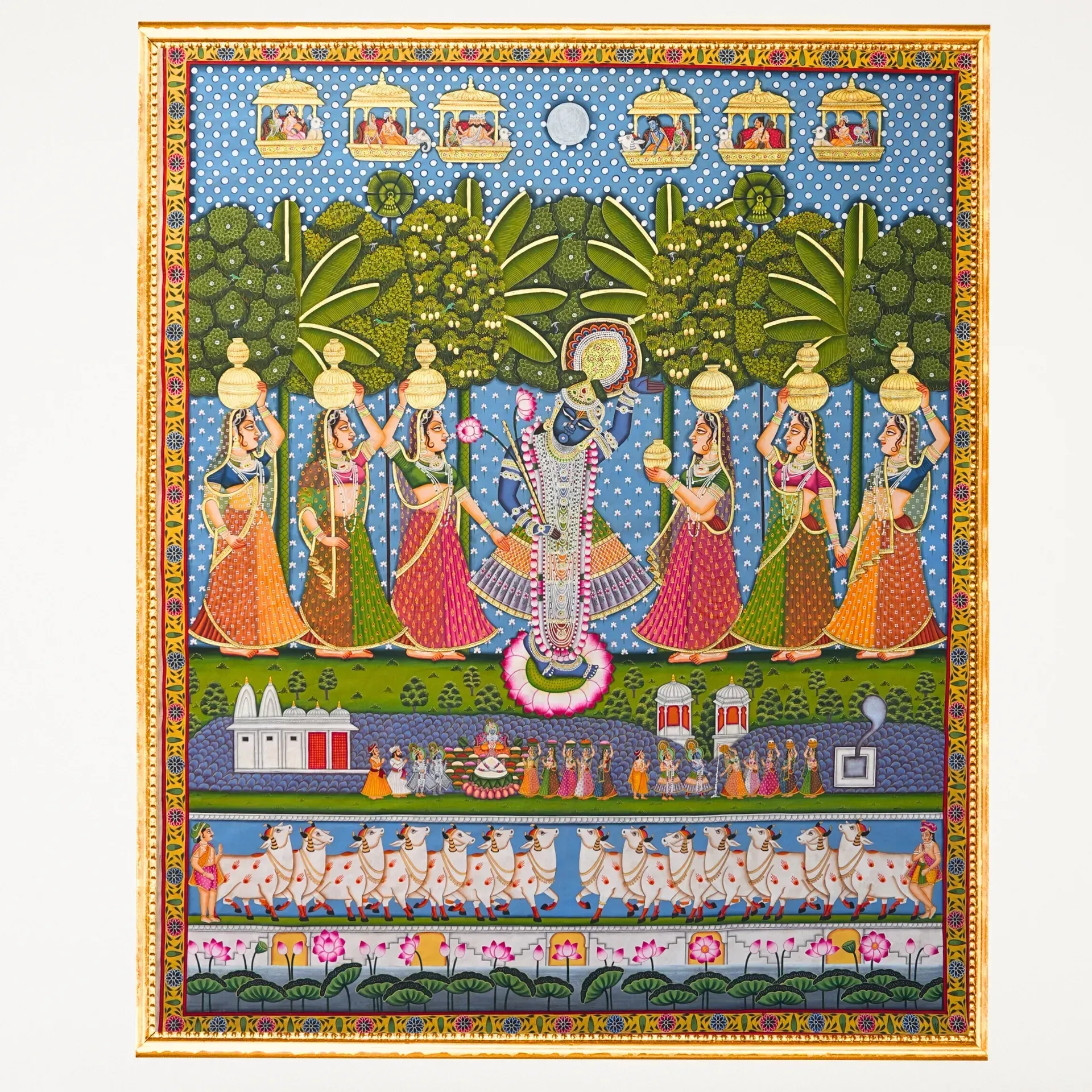
Daan Leela by Mukut Joshi, Krishna in the tribhanga pose with three gopis on each side carrying milk and butter | ₹3,39,999 | Mukut Joshi
Daan Leela is the episode in which Krishna demands a butter tax from the gopis. This Daan Leela shows him in the Bankey Bihari form, in the tribhanga pose with the neck, one leg and the knees bent. That bend, or bankey, gives the form its name. Three gopis stand on each side carrying butter, buttermilk, curd and milk. The painting is 58 × 48 inches, in natural colour and real gold leaf on cloth.
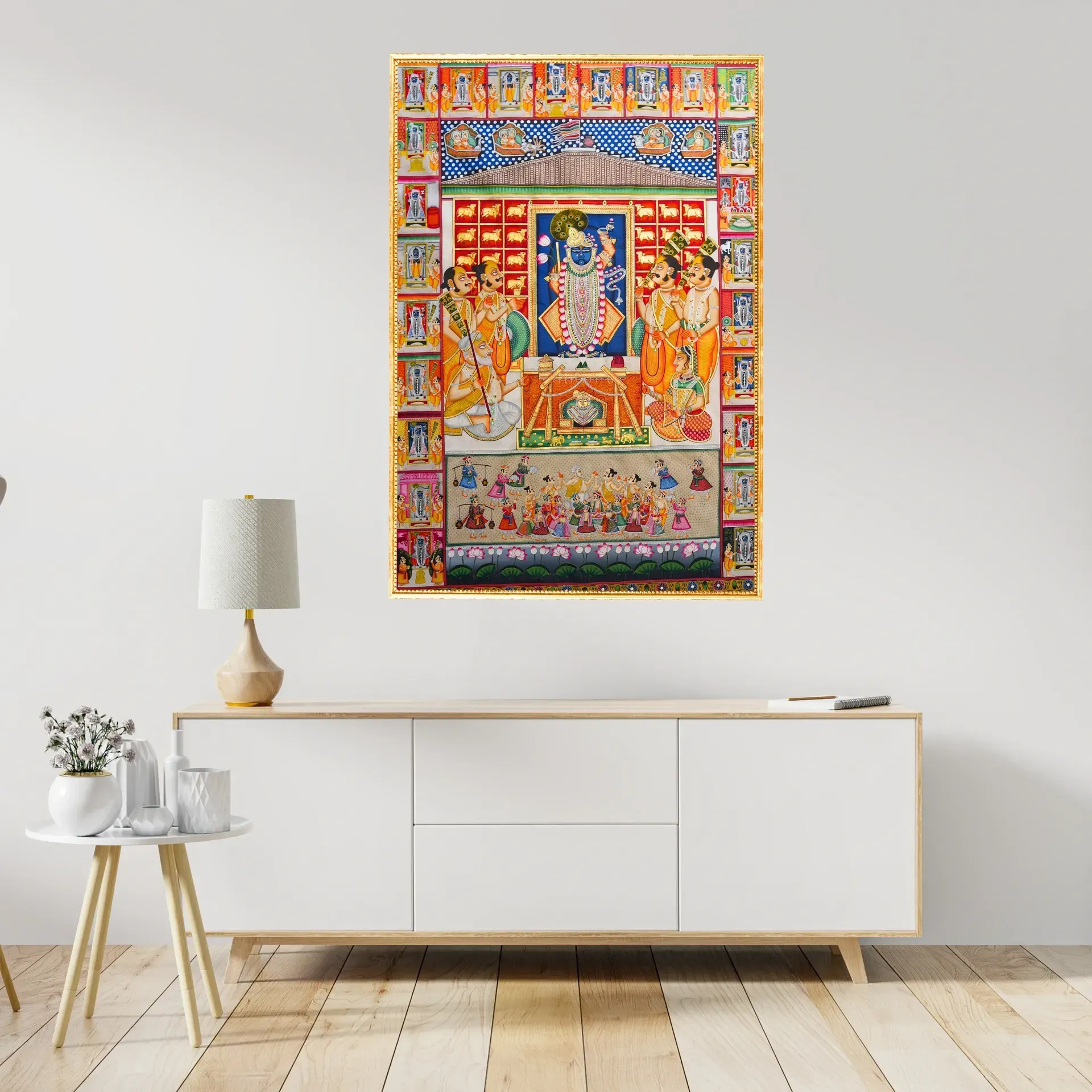
5. Sharad (Krishna Leela)
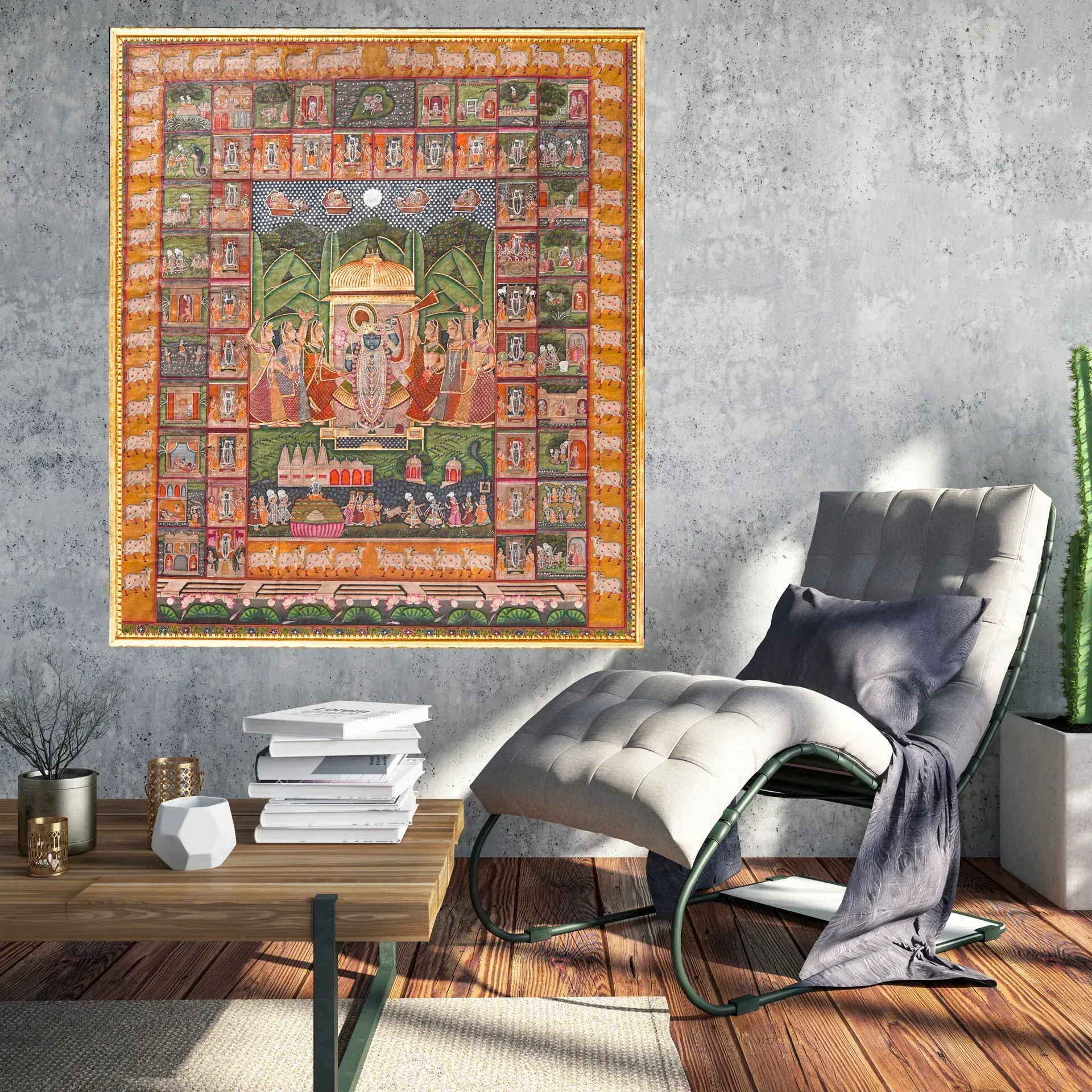
Sharad (Krishna Leela) by Mukut Joshi, Shrinathji in Sharad Purnima shringar framed by the 24 darshans and a yellow border of cows | ₹5,94,999 | Mukut Joshi
Sharad (Krishna Leela) is the largest painting here at 81 × 60 inches. The centre is Shrinathji in his Sharad Purnima shringar, with gopis on both sides and other deities arriving for the darshan. Below him are two smaller scenes of the Annakut and Daan Leelas. The 24 darshans frame all of that, and outside them run episodes of Krishna's life, his birth at one end and the slaying of Kansa at the other. Near the middle, look for Lalan lying on a peepal leaf. A yellow border of cows closes the cloth, for Shrinathji as Gopal, protector of cattle. It is painted in natural colour and real gold leaf.
View Sharad (Krishna Leela) on Rooftop
6. Annakoot
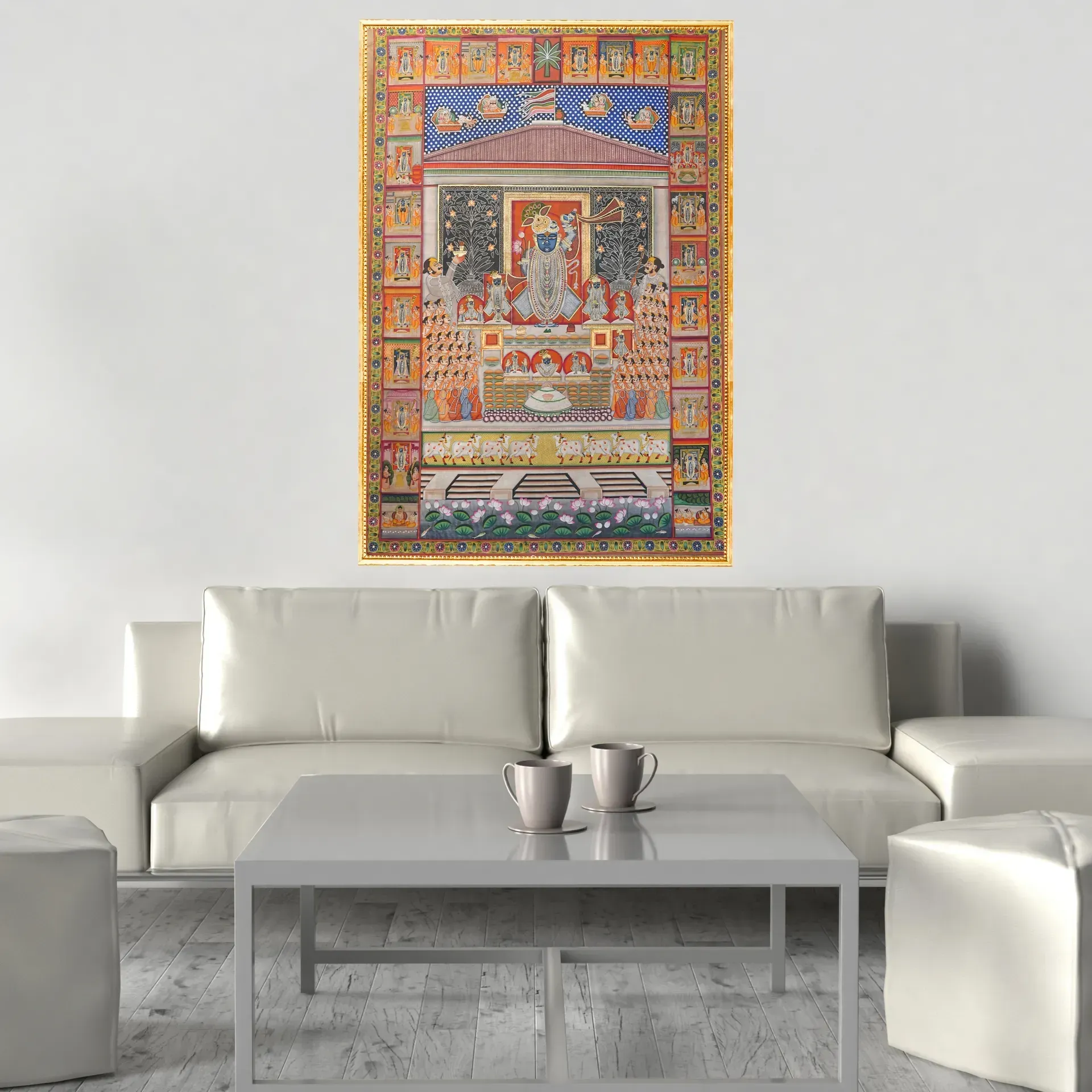
Annakoot by Mukut Joshi, the 56-dish offering before Shrinathji with the community gathering prasad | ₹4,24,999 | Mukut Joshi
Annakut is celebrated the day after Diwali, when chhappan bhog, 56 dishes, are offered to Shrinathji. This Annakoot shows the offering and also the loot, the custom in which the Bhil community and cowherds gather up the blessed prasad. The painting reads the loot as an echo of Krishna stealing butter as a child. Celestial beings watch from above and priests conduct the ritual below. Annakoot is 48 × 72 inches, in natural colour and real gold leaf on cloth.
##7. Gopashtami
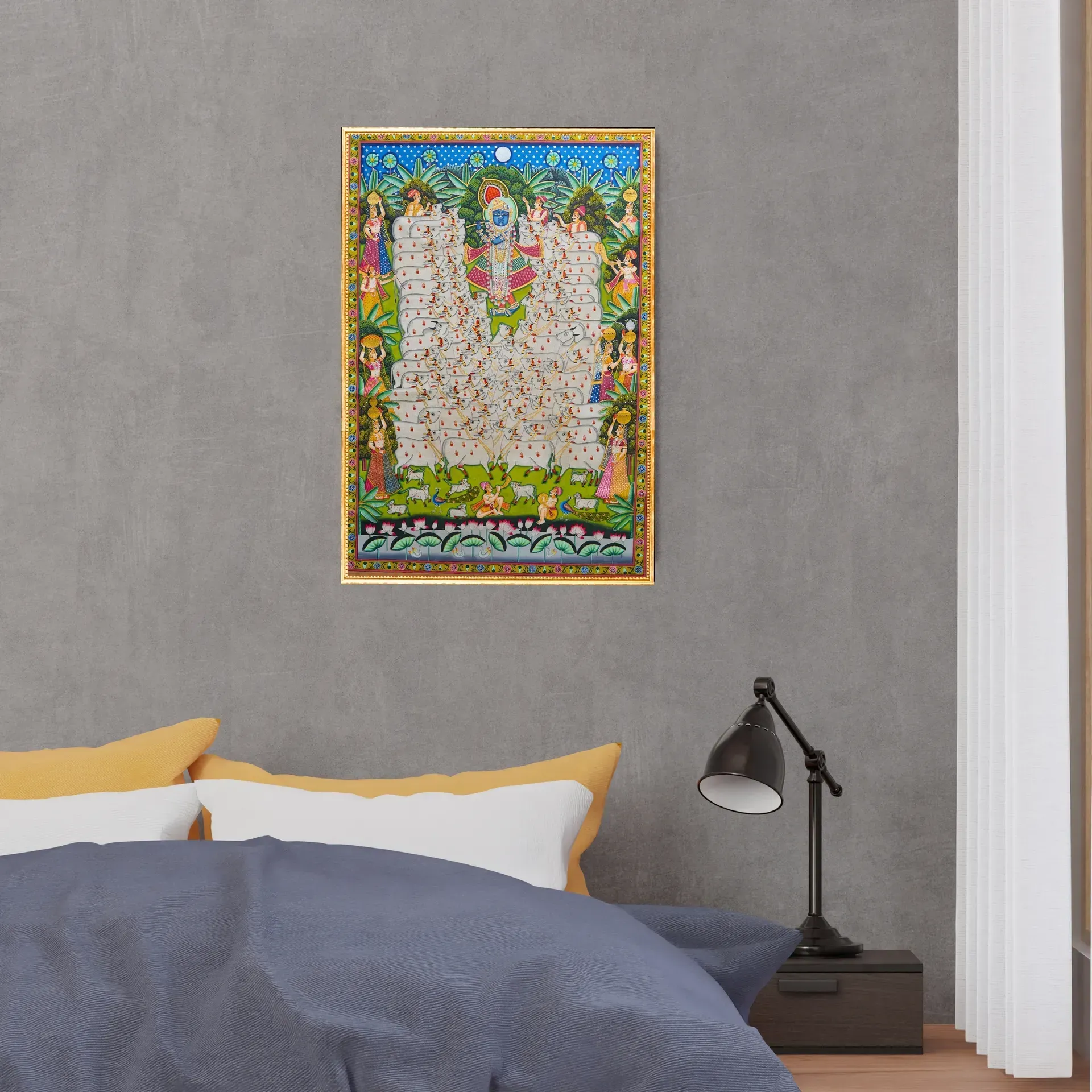
Gopashtami by Mukut Joshi, Shrinathji among cows, gwals and gopis | ₹1,35,999 | Mukut Joshi
Gopashtami falls on the eighth day after Diwali, in the bright fortnight of Kartik, and is set aside for decorating and worshipping cows. Gopashtami places Shrinathji among cows, gwals (cowherds) and gopis. The painting is 52 × 36 inches in natural colours on cloth. After Mangla Darshan, it is the lowest-priced cloth on this list.
8. Vanshavali
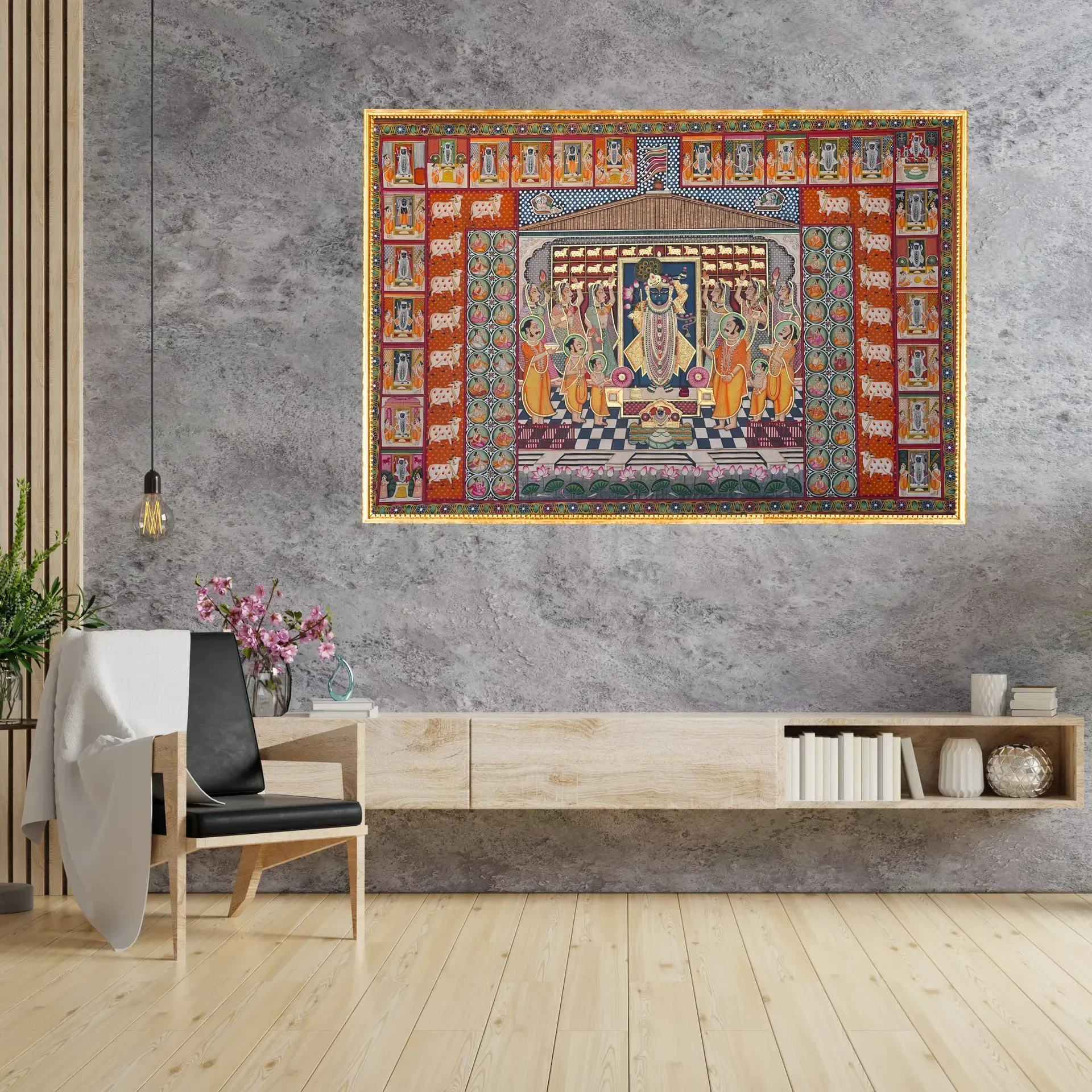
Vanshavali by Mukut Joshi, Shrinathji in Annakut shringar ringed by 24 forms and round portraits of Vallabhacharya's descendants | ₹4,24,999 | Mukut Joshi
Vanshavali means lineage. At the centre of Vanshavali, Shrinathji wears his Annakut shringar. Around him sit 24 smaller forms, two for each month, one for the Shukla Paksha and one for the Krishna Paksha. Cows flank the central figure, and round portraits fill the rest of the cloth. These are descendants of Vallabhacharya, the line of priests who have performed the temple's rituals across generations, so the painting is a calendar and a family tree at once. It measures 48 × 72 inches, in natural colours on cloth, and was painted in 2020.
9. Nathdwara Map
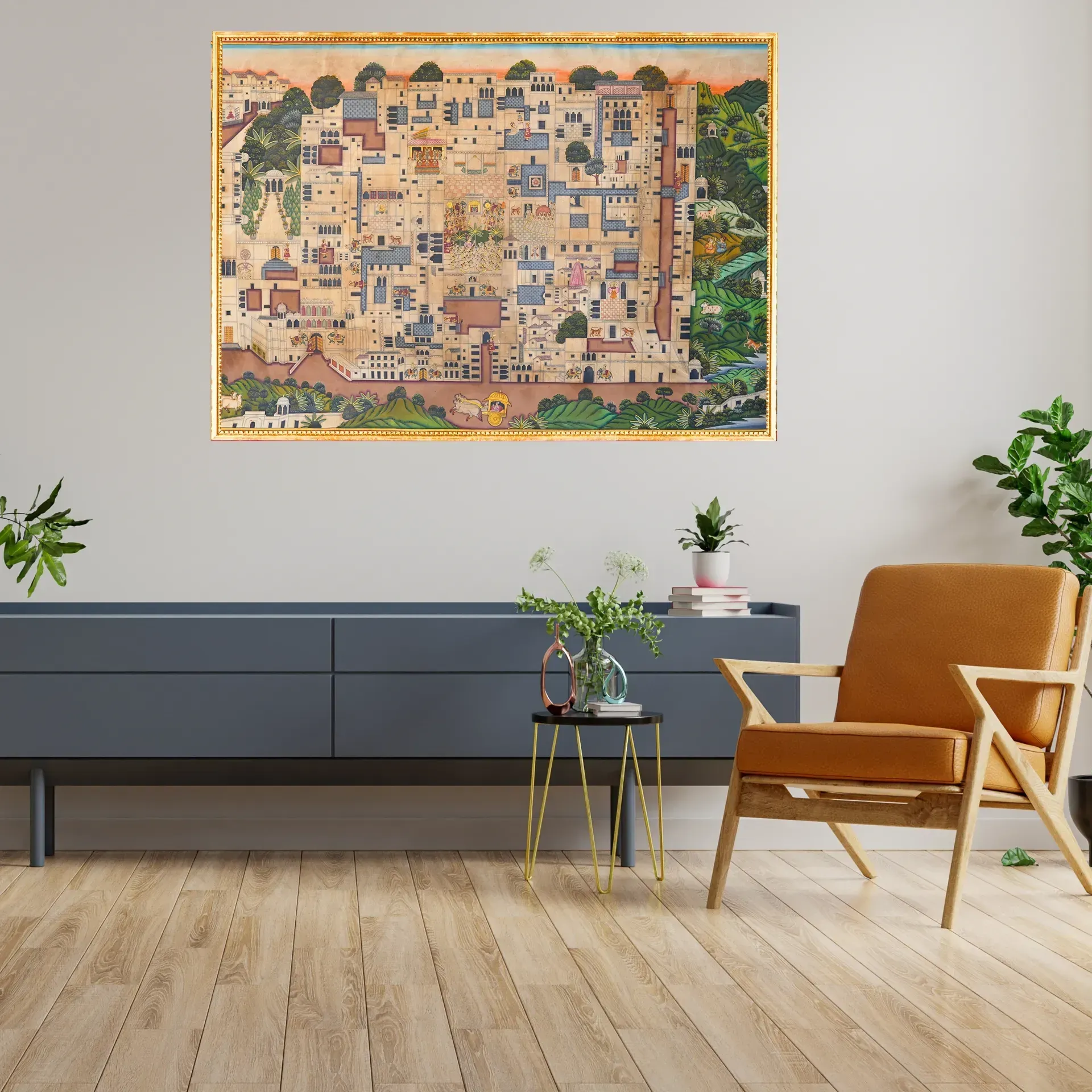
Nathdwara Map by Mukut Joshi, a painted plan of the Shrinathji temple complex and the town around it | ₹1,69,999 | Mukut Joshi
Nathdwara Map is a painted plan of the temple town. It marks the main Shrinathji temple, the Kamal Chowk (lotus courtyard), the temple of Lalanji, the points where pilgrims enter and the buildings around them. The layout leads the eye along the pilgrim's route through the complex. Nathdwara Map is 72 × 48 inches in natural colours on cloth.
10. 13 Darshan (Set of 13 paintings)
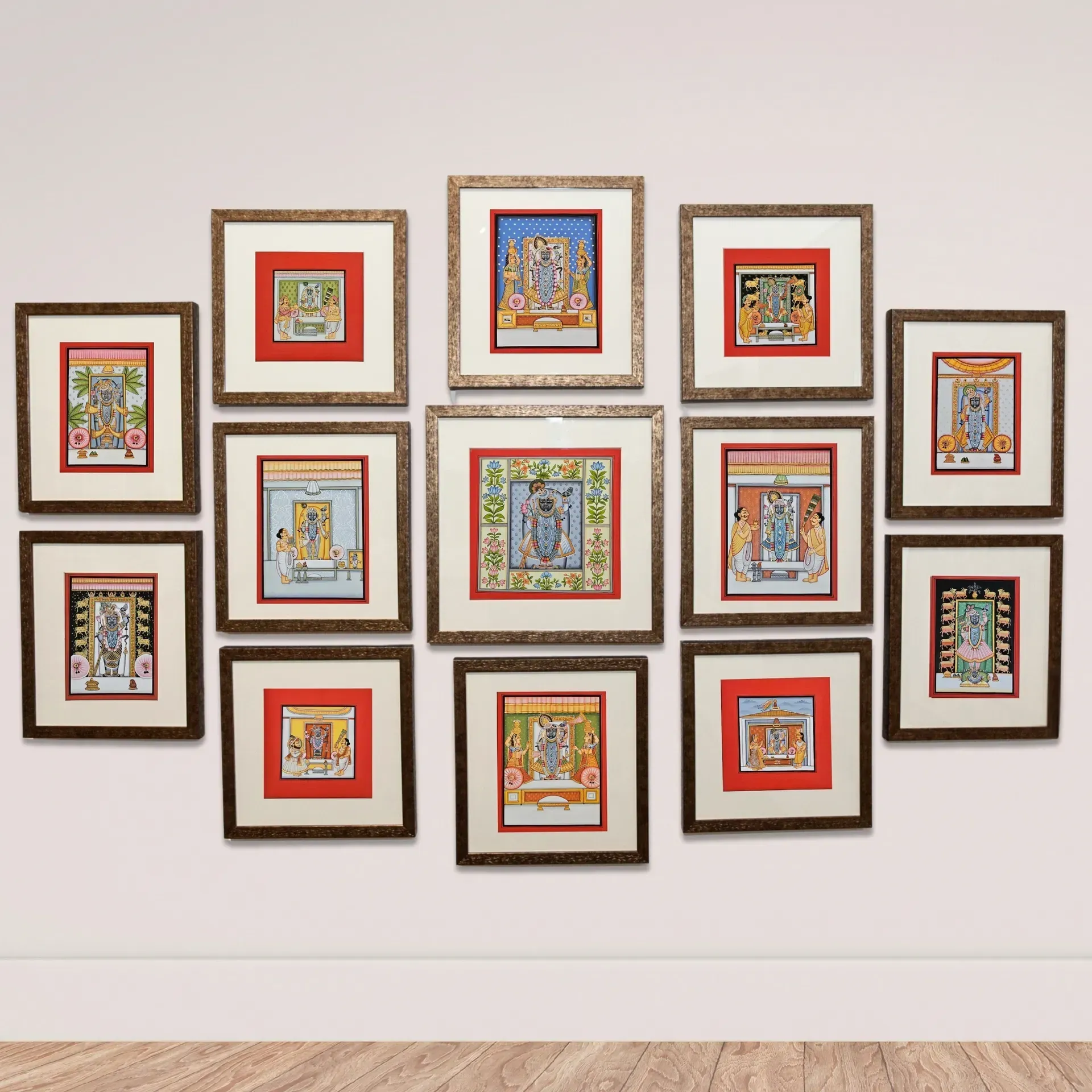
13 Darshan (Set of 13 paintings) by Mukut Joshi, twelve monthly shringars arranged around a central Sharad Purnima panel | ₹2,54,999 | Mukut Joshi
13 Darshan is the only set on this list and the only work on paper. Twelve paintings show Shrinathji in the shringar of each month, with festivals such as Annakut, Janmashtami, Radhashtami and Gopashtami among them, and the Sharad Purnima shringar sits at the centre. Sizes vary across the set, which was painted in natural colours in 2017. You can hang it as a grid, or show one sheet at a time and change it with the month, since in the temple each Pichwai belongs to a particular season or festival.
Each of the ten is sold by Rooftop Collections with a certificate of authenticity that records the artist, the origin and the medium. Orders cannot be cancelled once placed, and returns are accepted only if a painting arrives damaged. All ten ship unframed.
How to care for a Pichwai painting at home
A Pichwai is painted in natural colours on cotton that has been starched and dried, so the advice museums give for textiles applies. None of these paintings ships framed, which means the first decisions are yours.
Start with light. Winterthur Museum's conservators advise limiting a textile's exposure to light as much as possible, especially direct sun, so choose a wall the sun does not reach.
The Birmingham Museum of Art keeps its textiles at about 50 per cent relative humidity. That level is high enough to stop fibres drying out and low enough to prevent mould. Keep the painting out of damp rooms.
Never fold the cloth, because Winterthur notes that folded textiles can eventually break along the fold line. To store a Pichwai, roll it painted side out on a tube at least three inches across, with acid-free tissue or a pre-washed cotton sheet between the layers. That method follows guidance from BYU's conservators and the Birmingham Museum of Art. Keep the storage area clean too. Threads of Life lists moths, silverfish and cockroaches among the pests that damage stored textiles.
When you frame it, use a framer who works with archival materials and keeps adhesives off the cloth, as Winterthur recommends. 13 Darshan is on paper, so tell your framer that before they start.
Gold does not tarnish, so a dull gold area points to surface dirt. For a valuable or fragile piece, Threads of Life recommends asking a professional textile conservator.
If you would rather paint one
The Pichwai course taught by Raja Ram Sharma begins with preparing the cotton cloth and ends with painting Shrinathji's form in natural pigments. Or begin with Mangla Darshan, the first darshan of the temple day.