
The Sacred Aesthetics: Where Rajasthan's Living Art Traditions Come to Delhi
Discover The Sacred Aesthetics, showcasing Phad and Pichhwai art by master artists Prakash Joshi and Mukut Joshi at Bikaner House, New Delhi, March 20 to 23, 2026.

Rooftop
Author
Some forms of art transcend the mere act of beautifying a space. With every brushstroke, they tell stories of divinity, legend, and centuries of worship. Phad and Pichhwai painting traditions from the Indian desert state of Rajasthan do exactly that. In March this year, they will make a special journey from the remote, sandy deserts of Rajasthan to the culturally vibrant city of New Delhi.
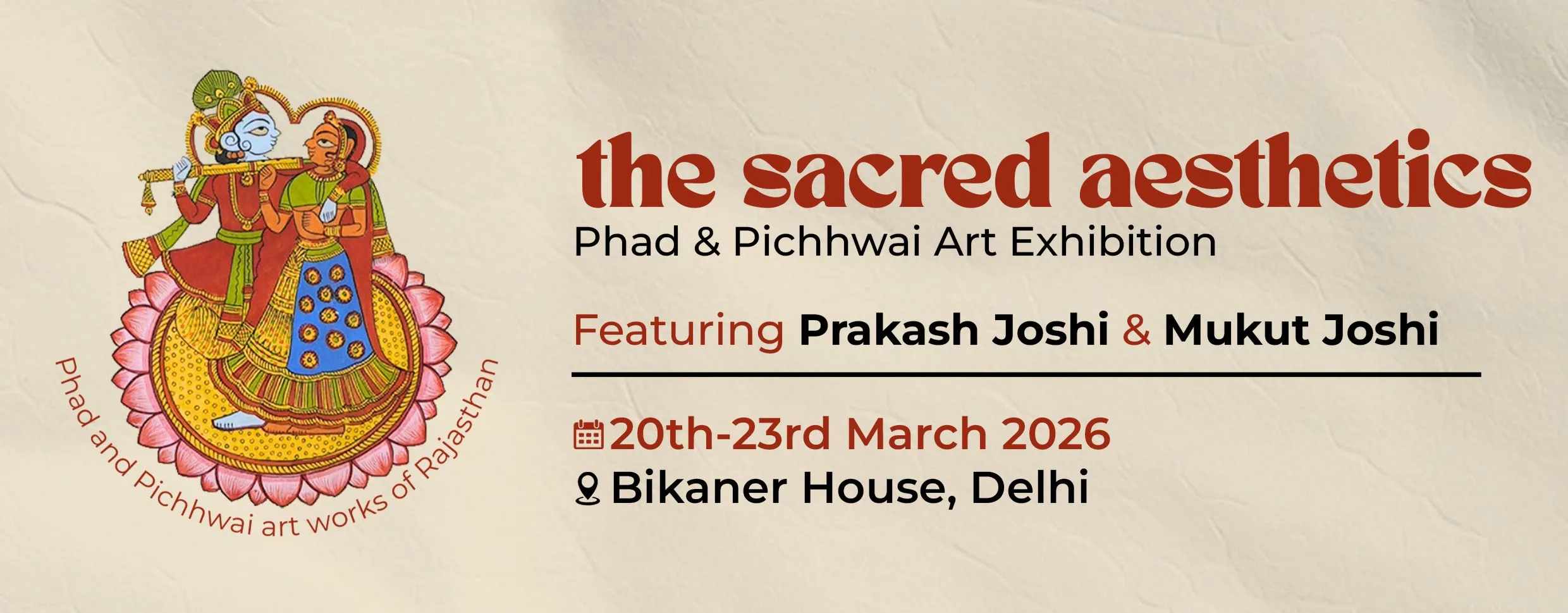
Rooftop, the world’s first creative multiverse, in association with Indiyart, will present The Sacred Aesthetics, an exhibition of Phad and Pichhwai paintings at Bikaner House, New Delhi, from March 20 to 23, 2026. The exhibition will showcase the award-winning Phad art of Prakash Joshi and the Pichhwai paintings of Mukut Joshi. Visitors will have a rare opportunity to witness two living artistic traditions presented together in a single exhibition.
What is Phad Painting? India’s Sacred Scroll Art Tradition
Phad (Pad) is a narrative scroll painting tradition that is more than 600 years old. It originated in the Bhilwara region of Rajasthan. These scroll paintings narrate the tales of Rajasthan’s folk deities, such as Pabuji and Devnarayan, as well as many other heroic legends.
Historically, these scrolls functioned as mobile temples. Bhopa priests, who were narrator-performers, carried the scrolls as they traveled from village to village. At night, they would unfurl the scrolls and narrate the stories through songs and devotional poetry, illuminated by a lamp. Phad was therefore not merely an art form but a powerful combination of oral storytelling, performance, and sacred imagery.
Key characteristics of Phad painting include:
- Bold, flat colours derived from natural and mineral pigments
- No use of perspective; figures are arranged hierarchically according to importance
- Complex narratives depicted through multiple scenes within a single composition
- Decorative borders filled with floral and architectural motifs
- Traditionally produced by the Joshi family of Bhilwara and passed down through generations
Prakash Joshi: A Master Keeper of the Phad Legacy
Shri Lal Joshi, a Padma Shri awardee, played a major role in bringing Phad art to global recognition. Today, artists such as Prakash Joshi continue that legacy with dedication and precision.
Each of Prakash Joshi’s works adheres to the classical structure of Phad painting. Through meticulous line work, carefully selected colours, and balanced compositions, he preserves the authenticity of this centuries-old tradition while keeping it relevant for contemporary audiences.
What is Pichhwai Painting? Devotional Art of the Divine Krishna
If Phad represents epic storytelling, Pichhwai embodies intimate devotion. Originating in Nathdwara, Rajasthan, the temple town dedicated to Shrinathji (a form of Lord Krishna), Pichhwai paintings were created as ritual backdrops behind the deity in temple sanctums. The word “Pichhwai” literally means “that which hangs behind.”
Pichhwai paintings are characterised by:
- Natural stone-based pigments and the use of real gold leaf in traditional works
- A contemplative quality, with art created as an act of devotion
- Large-scale compositions designed to adorn temple walls
- Rich jewel-toned palettes such as deep indigo, saffron, emerald, and gold
- Scenes depicting Krishna’s Ras Leela, seasonal celebrations, and Vaishnava festivals
Mukut Joshi: Devotion as Art, Art as Devotion
Mukut Joshi brings to the exhibition a body of Pichhwai work that is both spiritually resonant and visually captivating. Working in the classical Nathdwara style, his paintings celebrate Krishna-bhakti through intricate detail and luminous colour.
Each piece is created not merely as an artwork but as an offering. The scale, craftsmanship, and devotional intent behind these works invite viewers to pause, reflect, and experience the spiritual depth embedded in the tradition.
Exhibition Details: The Sacred Aesthetics at Bikaner House, Delhi
The Sacred Aesthetics goes beyond the format of a conventional gallery display. It offers visitors an immersive encounter with two sacred art traditions from Rajasthan, presented together under one roof.
- Dates: 20th to 23rd March 2026
- Venue: Bikaner House, Pandara Road, New Delhi
- Featuring: Phad art by Prakash Joshi | Pichhwai art by Mukut Joshi
- Presented by: Rooftop — the world’s first creative multiverse — in collaboration with Indiyart
- RSVP: +91-9819239871 | connect@rooftopapp.com
Bikaner House, the former royal residence of the Bikaner royal family, provides a fitting heritage setting for the exhibition, with deep architectural and cultural ties to Rajasthan.
Why You Should Experience This Exhibition
The Sacred Aesthetics stands out as an important cultural event at a time when global audiences are increasingly interested in authentic traditional art and heritage craft.
What makes this exhibition particularly significant is its focus on original works created by hereditary artists who continue centuries-old traditions.
- Authentic artistic lineage: The artworks are created by hereditary artists who continue their family traditions rather than mass-produced reproductions.
- Opportunity to collect original works: Phad and Pichhwai paintings are among the most respected and valuable forms of Indian traditional art.
- A rare Delhi showcase: Artists from Nathdwara and Bhilwara seldom bring large original works to the capital, making this exhibition a rare opportunity for collectors and art enthusiasts.
About Rooftop: The World’s First Creative Multiverse
Rooftop is the world’s first creative multiverse, a unique platform that merges online and offline spaces to connect audiences with living traditions of Indian folk, tribal, and contemporary art.
Through immersive art experiences, expert-led online workshops, and curated collections of original artworks, Rooftop enables learners, collectors, and art lovers to engage directly with master artists and their practices.
The Sacred Aesthetics reflects Rooftop’s commitment to presenting traditional art not as something confined to museum archives but as a living cultural experience shaped by practicing artists.
Plan Your Visit — RSVP Now
The Sacred Aesthetics runs for just four days. If you are in Delhi between March 20 and 23, 2026, this is one of the most significant art events of the season.
Bring your curiosity, bring someone who loves art, and experience the timeless beauty of Rajasthan’s sacred painting traditions.
📍 Bikaner House, New Delhi 📅 March 20 to 23, 2026 📞 +91-9819239871