

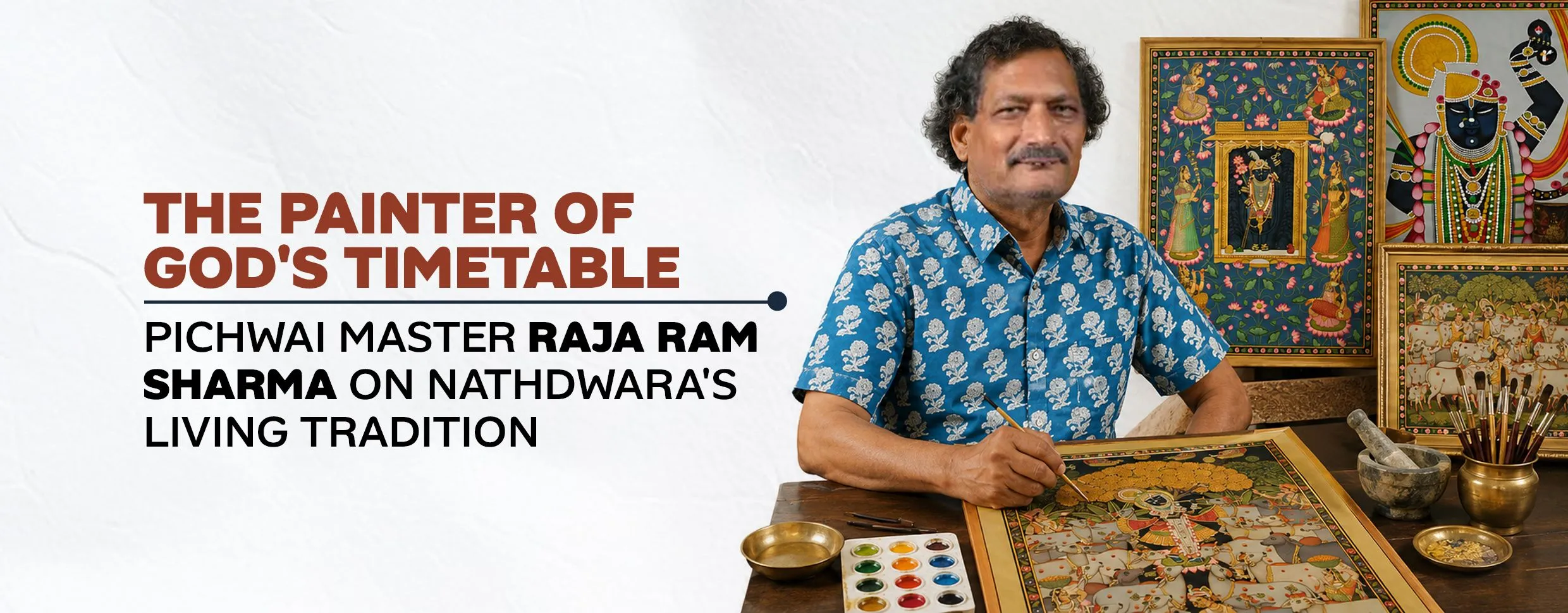
The Painter of God's Timetable: Pichwai Master Raja Ram Sharma on Nathdwara's Living Tradition
Pichwai master Raja Ram Sharma on the eight darshans, the 365-day shringar calendar, temple versus market pichwais, embossed gold and the Gaugooli pigment mystery.

Kartik Gaggar
Author
This piece is drawn from a series of recordings Pichwai master Raja Ram Sharma shared with Rooftop in Hindi, translated and lightly edited for clarity. He answers the questions the published record cannot, on the eight darshans as a painting problem, the fixed calendar of adornment, the cutout in the temple cloth, the new gold relief work, and the pigment legend he has spent fifty years failing to witness.
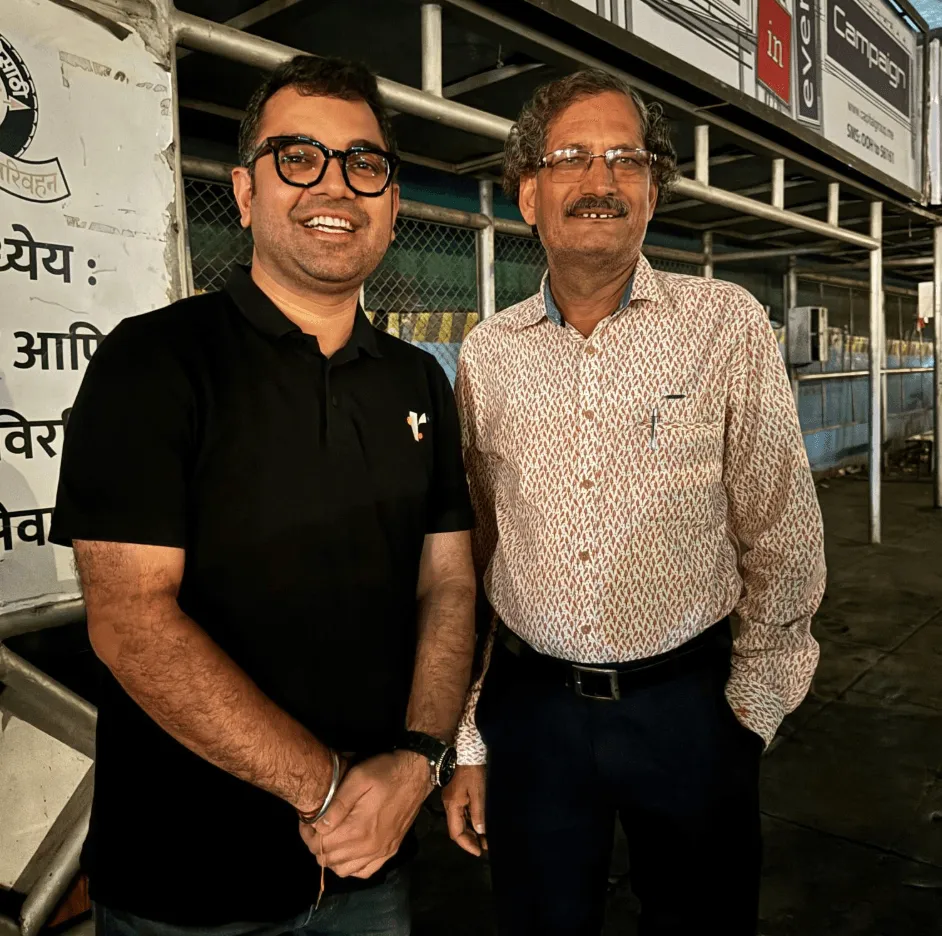
Rooftop's Founder Kartik Gaggar with Pichwai Artist Raja Ram Sharma
Most painters answer to a gallery, a market or their own restlessness. Raja Ram Sharma answers to a timetable, and the timetable belongs to a god. For fifty years he has painted Shrinathji, the child form of Krishna enshrined at Nathdwara, an image whose dress, garlands, crown and mood change with every one of the year's days and eight times within each day. To paint him correctly is not a matter of talent alone. It is a matter of knowing, on any given tithi, exactly what the Lord is wearing.
Sharma has earned the right to speak for this tradition the hard way. Born in Bijolia in Rajasthan's Bhilwara district, he left home at thirteen to train at Nathdwara under Tulsidas Chitrakar, the head artist of the Shrinathji temple itself, in the old guru-shishya way. The decades since have brought the All India Award of Traditional Art in 2010, a National Merit Certificate in 2016, exhibitions in New York, and places in the collections of the Boston Museum of Fine Arts, the Davis Museum at Wellesley College and the National Gallery of Victoria in Australia, a journey traced in Rooftop's spotlight on his life and work. His paintings still hang where his training began, in the temple at Nathdwara. What follows is his account of how that world actually works, from the inside.
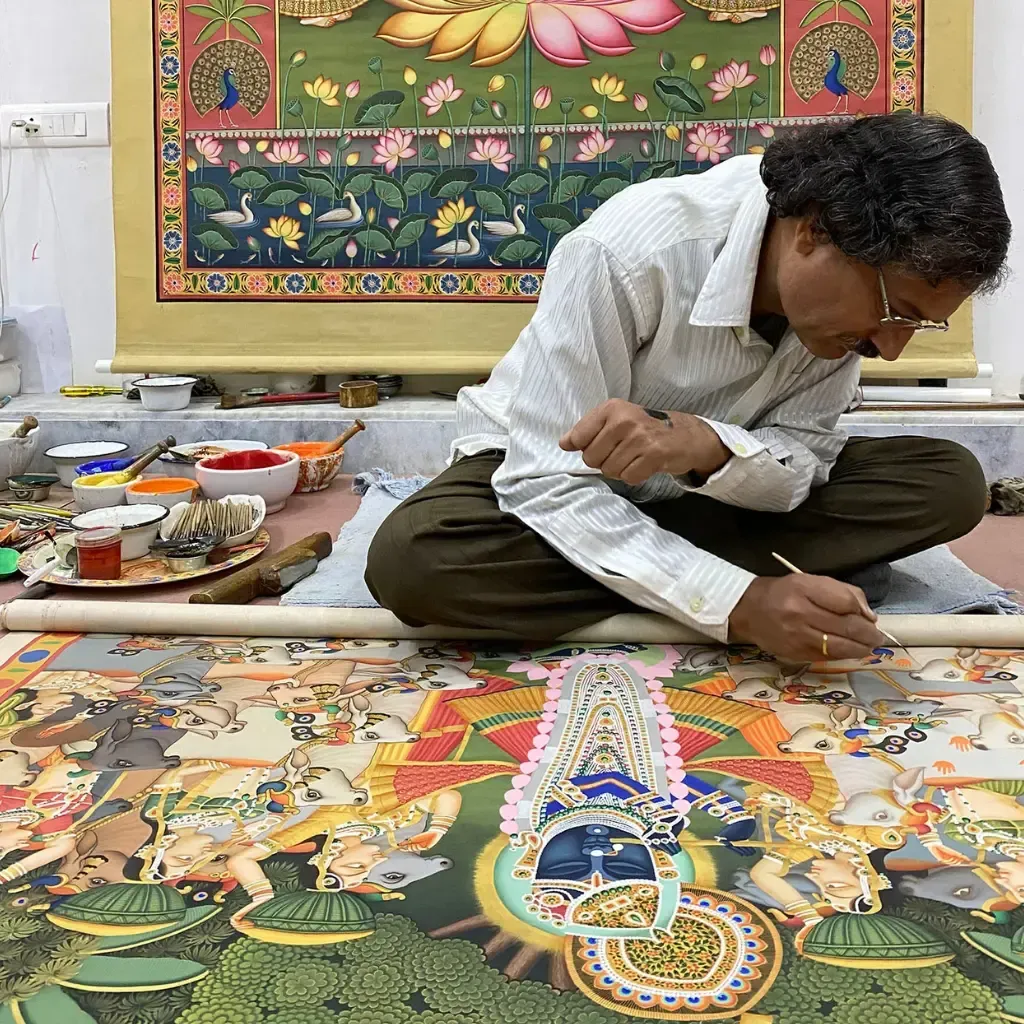
Raja Ram Sharma, who left home at thirteen to train under the head artist of the Shrinathji temple.
Four Families Who Followed a God
ROOFTOP: How did the painting tradition of Nathdwara actually begin, and what is the truth about the artist communities behind it?
RAJA RAM SHARMA: When Shrinathji came to Nathdwara, four families of Gaud chitrakars came along with him, in his chitra seva, his service through pictures. Because they were bound to Shrinathji, their arrival in Nathdwara followed his, and after some years the tradition of painting him took root. In the beginning they made bhitti chitra, wall paintings, and from the wall paintings they moved to the pichwai, showing their devotion through the chitra seva. Two communities remain joined to this work even today, the Adi Gaud and the Jangid.
ROOFTOP: Can a trained eye look at a pichwai today and say this is an Adi Gaud painting, this is a Jangid painting?
RAJA RAM SHARMA: No, and this is the point people miss. The old artists each developed their own shaili from their own practice and experience, and their families followed that personal style. As newer artists came up, each contributed something and made a style of their own. So today when we see a pichwai, we can estimate which artist made it, this one is his, that one is hers. But it cannot be said that this is a Jangid painting or an Adi Gaud painting. Broadly, everyone painted the pichwai, everyone tried to paint it well, and all of those personal styles together are what we today honour as the Nathdwara shaili.
That answer quietly settles a question the record has carried for decades. Scholars have long documented that Nathdwara's painters descend from distinct communities, and readers have assumed the communities must carry distinct styles. The master's verdict is that the signature in a pichwai belongs to the individual hand, never to the caste, and that the famous Nathdwara style is not one lineage's property but the merged inheritance of every hand that served the deity. Authorship in Nathdwara is personal. The tradition is collective.
God's Timetable: The Eight Darshans
ROOFTOP: Shrinathji is seen eight times a day, and pichwais serve those viewings. Where does the system of eight darshans come from?
RAJA RAM SHARMA: It comes from the seva paddhati that Shri Vallabhacharya Mahaprabhu ji set down, the method of devotional service in Pushtimarg. On that foundation the tradition of the eight darshans began, and to understand them you only need to understand the daily life of Krishna, his bal leela, his routine from waking to sleeping. The eight darshans follow his day.
He then walked the day itself, and it is worth setting down as he gave it, because each viewing is also a painting brief, a mood with its own dress, backdrop and weight.
- Mangala. The first darshan on waking, in the lightest attire, a simple dhoti, a kanthi at the neck, a nathni at the nose, barely adorned, the god as a child just risen.
- Shringaar. The full morning adornment, robes, garlands, ornaments, and behind the deity a pichwai is hung, the painted backdrop entering the ritual itself.
- Gwal. Krishna the cowherd, gathering his herd to take the cows to graze, the darshan of the boy who loved the cattle.
- Rajbhog. The great midday meal, taken in the company of his bal sakhas, his childhood friends, the richest viewing of the day.
- Utthapan. The waking from the afternoon rest, some hours after Rajbhog, the god rising as a child rises from a nap.
- Bhog. The afternoon offering that follows the waking.
- Sandhya Aarti. The evening prayer at dusk, when the heavy backdrop comes down and lighter adornment takes its place.
- Shayan. The final darshan before sleep, in soft, light clothing fit for rest, the day closed as gently as it opened.
Notice what this means for the art form. A pichwai is not generic decoration behind an idol. It is scenery for a specific hour of a specific divine day, and the painter who serves this system is less like a portraitist and more like the production designer of a play that has run, eight shows daily, for over three centuries.
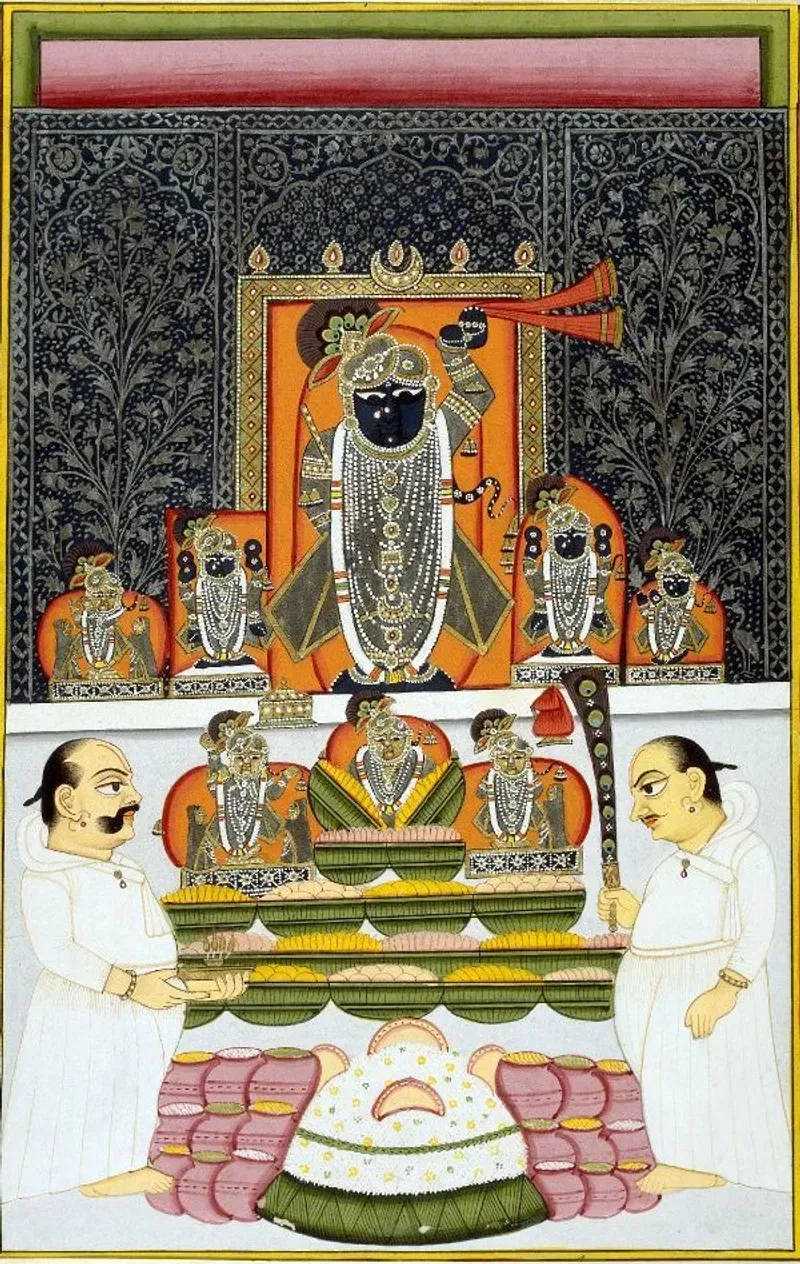
A Pichwai depicting Shrinathji in a darshan setting.
A Wardrobe Fixed for 365 Days
ROOFTOP: When an artist paints Shrinathji, what is the one thing they absolutely must know?
RAJA RAM SHARMA: That the shringar tradition of Shrinathji is fixed for all three hundred and sixty five days. The adornment is decided, day by day, tithi by tithi, festival by festival, and even today the darshan follows that calendar. Every artist who paints his svarup keeps this tradition in mind. If I am painting him for a particular day, then the dress of that day, the vaga, the dupatta, the mukut or the pagdi, the garland, whether a lotus mala or another, the kamal in the hand, the chhadi, even whether the feet are bare or in moje, all of it is fixed by the tithi and the utsav.
ROOFTOP: And if an artist does not know what a particular day requires?
RAJA RAM SHARMA: Then he goes to the temple that day, takes darshan, sees the shringar with his own eyes, and comes home and paints it. This is how it has always worked. The artist who understands the parampara, who is acquainted with it, who has taken darshan regularly, he cannot really make a mistake. The mistakes come from those who only copy pictures of pictures, or who paint from their own mind without the knowledge. One who paints from inside the tradition paints correctly, because the tradition itself is his reference.
365 fixed adornments, 8 darshans a day
Shrinathji's shringar is prescribed for every day of the year, and his form is viewed eight times daily under Vallabhacharya's seva paddhati. A Nathdwara painter does not invent what the deity wears. He knows it, or he walks to the temple and looks.
There is no equivalent to this anywhere else in Indian painting, a living iconographic calendar enforced not by an academy but by a functioning temple two streets from the artist's home. It also explains something collectors often sense without being able to name, which is why a true Nathdwara pichwai feels documentary rather than imagined. It is documentary. Somewhere behind every correct one stands a real morning, a real festival and a real darshan that the painter either remembered or went and took.
The Eyes Come Last
ROOFTOP: Is there an order to how the svarup is completed? What is the final act?
RAJA RAM SHARMA: The aankh is made last. The tradition of the eyes is that they come at the very end, and opening the eyes is the pran pratishtha of the picture, the establishing of life in it. Every artist keeps this in mind. Until the eyes are made, it is a painting being worked on. When the eyes open, Shrinathji is present in it. So the eye is the last thing the hand does.
Readers of this series will feel the echo. In our sitting with the Phad master Prakash Joshi of Bhilwara, he described the identical law in his own tradition, the pupil of the deity painted last, the moment after which the scroll may no longer be sat upon or placed carelessly, because it has become a temple. Two hereditary traditions, two hundred kilometres apart, one theology of the brush. In Rajasthan's sacred painting, sight is life, and the artist grants it last, like a signature that belongs to the god rather than the painter.
Why the Feet Turned to Face Us
ROOFTOP: In old pichwais, Shrinathji's feet are shown from the side. In newer work they face the viewer. What actually happened?
RAJA RAM SHARMA: What I have understood from my gurujan is this. In the old times, the charan darshan was not available. The Lord's feet were not seen, because of how the shringar covered them. So when the first pictures were made, the artists, not having the sight of the feet, painted them to the side, in the ras bhava. That is why it is held that the ancient charan were made in that manner. And there is no logic behind it of any change in Shrinathji's murti, none. The murti did not change. The darshan changed. As artists gradually began to receive the sanmukh darshan of the charan, the frontal view, the pictures began to be made that way, and today the feet are mostly painted facing forward.
ROOFTOP: So when an artist paints side-facing feet today, what is he doing?
RAJA RAM SHARMA: His logic is that the picture should look old, that it should carry the prachin bhava, the ancient feeling of Shrinathji's svarup. It is a choice of mood now, not a rule.
This is the kind of answer only a lineage can give. The published record frames the forward-facing feet as a stylistic import, possibly Western, and leaves it there. Sharma's teachers handed him something better, a history in which the painting simply tracked the darshan. The feet in the pictures turned to face us when the feet in the temple did. Iconography, in Nathdwara, is not designed. It is witnessed.
The Raised Gold Is New
ROOFTOP: Much of the pichwai sold today carries raised, embossed gold work. Is that part of the old tradition?
RAJA RAM SHARMA: The raised relief work is not an ancient tradition of Shrinathji's parampara. In the old tradition, the raised element was only this much, that the moti, the pearls, were laid on in thick white so that if you ran your hand over them you would feel them standing up, and the gold varak was pressed over a base layer, so it too sat very slightly raised. That was all. This heavily raised work that we see today on wooden murtis and on plain paper is a new tradition. It is called embose. In embose, plaster is built up thick, the design is shaped in it, and the gold varak is pressed over that, so it stands out. Understand it like Mysore chitrakala or Tanjore painting. Artists have taken that manner and used it, newly, in making Shrinathji's chhavi.
ROOFTOP: And how do you regard it?
RAJA RAM SHARMA: It is very much in fashion today. Many Vaishnav devotees love the raised Shrinathji, there is more shine and sparkle in it, and it attracts them greatly. Many artists are making it, and for the artists it has become new work, a new livelihood. But it does not come from the old temple parampara. One should simply know which is which.
Old tradition: flat brushwork, raised pearls, pressed gold. Embose: new
Traditional temple pichwai knew only two gentle reliefs, thick white pearl dots and gold varak over a base. The heavy plaster-and-foil embossing popular today is a recent adoption from the Tanjore and Mysore styles, beloved by the market, valuable to artists, and absent from the old parampara.
What is striking is the total absence of bitterness in his account. He does not denounce the embossed work, and he will not pretend it is ancient. It has given painters a living and devotees a joy, and it has a proper name and a proper genealogy, which he supplies. This is what custodianship sounds like when it is confident, an insistence not that the new be stopped, but that the ledger stay accurate.
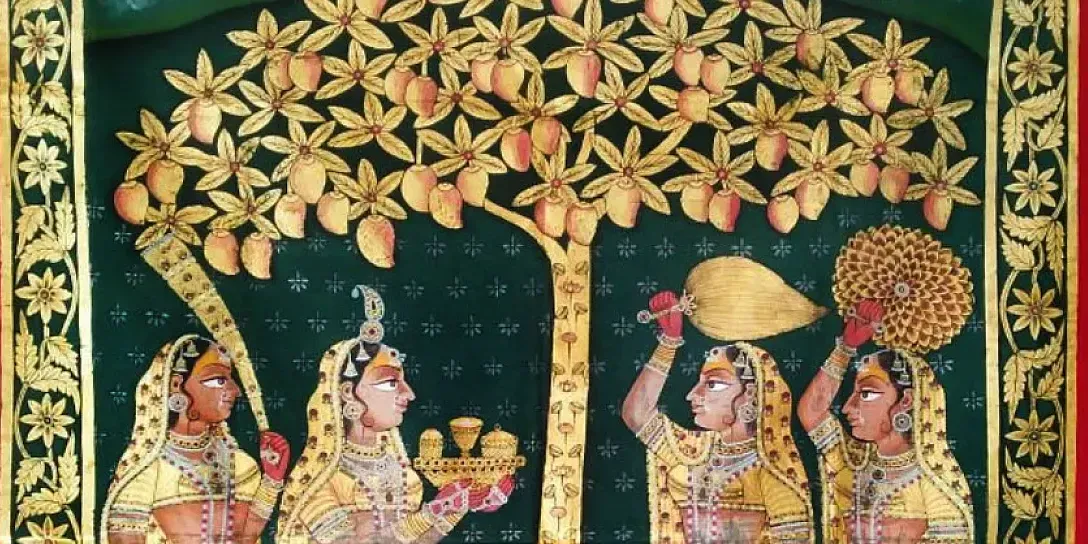
Gopis . Gold foil Work Source: Gaatha
Borders That Do a Frame's Job
ROOFTOP: Pichwai borders are elaborate in a way most Indian painting borders are not. What are they actually for?
RAJA RAM SHARMA: Think of how a pichwai hangs. It hangs as cloth, without a rigid frame. So the chitrakars thought about this, and the border was made bright, so bright that from a distance the final edge of the pichwai shows clearly. The border became the outer framing of the work, the frame built into the cloth itself. Then, slowly, artists took the border forward with their own ideas, and it spread into many borders, one border, two borders, three. Today when we make a pichwai, there is the border of the chaubis svarup, the twenty-four forms, there is the border of Krishna leela, there is the border of the gai, the cows, and the mor border of peacocks.
ROOFTOP: Do specific borders belong to specific festivals or seasons?
RAJA RAM SHARMA: It is not that they are fixed by season. But yes, when there is a very large utsav, a great festival or a great day, the artist brings that kind of border into the pichwai to give it grandeur for the occasion. And beyond that, one must be careful. The more borders you add, the smaller the inner svarup of the pichwai becomes, the subject shrinks. So it is judgement. The border must frame the god, not crowd him.
There, in four sentences, is the border grammar the internet does not have. The border began as engineering, a visual frame for a frameless object. It evolved into vocabulary, cows, peacocks, the twenty-four forms, the leelas. It flexes for festivals rather than seasons. And it is governed by one aesthetic law, that the frame serves the centre. Every ornate triple-bordered pichwai in every gallery is a negotiation with that law, whether its painter knows it or not.
The Cutout in the Cloth
ROOFTOP: What separates a pichwai made for the temple from one made for a home or a gallery?
RAJA RAM SHARMA: The temple pichwai has its fixed sizes, the sizes of the mandir, and it is made to hang there. And in the pichwai of Shrinathji's nij mandir, his own sanctum, the pichwai is painted leaving Shrinathji's place empty. The cloth is cut where Shrinathji stands, and the painted parts show at the sides and above. So when it is hung behind him, the deity and the pichwai merge into one, and the devotee receives the darshan of Shrinathji complete with his backdrop, as a single form. In the temple, Shrinathji himself is never painted into the pichwai. The svarup is the murti. The cloth serves it.
ROOFTOP: And in the market work?
RAJA RAM SHARMA: For the small temples, for people's homes, their drawing rooms, offices, the art galleries, there Shrinathji is painted fully within the pichwai, and the sizes vary with the space and the wish of the buyer. That is the difference one should keep in mind. In the mandir the pichwai stands behind the Lord. In the bazaar, the pichwai must carry him.
The cutout is the single most misunderstood fact about this art form, and he states it with total clarity. The original pichwai is, literally, incomplete by design, a painting with a god-shaped absence at its centre, finished only when hung behind the living svarup. Every complete Shrinathji you have seen painted into a pichwai is, by the temple's own definition, the market edition. Neither is false. But only one is the thing the word pichwai, that which hangs behind, was coined for.
This is exactly the level at which his teaching operates, and it is now available to anyone. The Pichwai art course taught by Raja Ram Sharma on Rooftop carries the tradition the way he received it under the guru-shishya parampara, from the foundational motifs, the cows and the lotus, to the discipline of the svarup itself, taught by the National Awardee whose work hangs in the Nathdwara temple.

The Pichwai art course by Raja Ram Sharma, the tradition taught by a temple-trained master. View on Rooftop
The Gaugooli Verdict
And then there is the pigment, the one every article repeats and no living painter seems to have seen. Gaugooli, the legendary luminous yellow of old Nathdwara, said in the retellings to have been made from the urine of cows fed only mango leaves, the pigment the wider art world knows as Indian Yellow. We asked the man with fifty years at the easel to settle it.
ROOFTOP: Gaugooli appears constantly in the lore of Nathdwara painting. Have you ever seen it made?
RAJA RAM SHARMA: I have been working for fifty years now, and I have never seen any artist making gaugooli, and I have never heard from anyone's own mouth that they saw it being made. Yet these stories we too have heard since childhood, and the artists of Nathdwara have all heard them. And it is true that in the old paintings, the ones about a hundred years old that we get to see, gaugooli was used. So the question stood before us also. If it was used so much, how did it vanish?
ROOFTOP: And what did your own search conclude?
RAJA RAM SHARMA: I made great effort to know this, and after much searching my conclusion is this. Just as the artist prepares his other colours in his own way from materials that reach him, this gaugooli too was made by some other community, some other people, and it reached the chitrakars, who used it in their own manner. That is why the stories are so widespread while the making was never witnessed. And as for the famous account, that the cow is fed only mango leaves, that she develops the yellowness and her urine turns yellow, and from that gauvmutra the colour is made, I say this. In Sanatan dharma, to make Gau Mata suffer, to torment her, no Sanatani would ever do it. So I do not accept that a colour was made in this way. Many people claim today that they have rediscovered gaugooli or invented it again. It is not possible in my view. If someone has knowledge beyond mine, I cannot speak to it. But for me, the tradition ends here.
Fifty years, zero witnesses
In half a century inside the Nathdwara tradition, Raja Ram Sharma has never seen gaugooli made nor met anyone who saw it made, even as century-old paintings visibly contain it. His conclusion: the pigment came to the painters from an outside supplier community, and the cruel mango-leaf production story fails the most basic test of a culture that worships the cow.
Understand what his answer does and does not claim. He does not deny the pigment existed. The old paintings prove it did, and pigment scientists studying pichwais have identified Indian Yellow in historical works. What he testifies to is the tradition's own relationship with it, that Nathdwara's painters were users of a supplied material, not its makers, which is precisely why the recipe could vanish without a single painter able to save it, and why every colourful production legend flourished unchecked. It is the most honest possible answer to a mystery, the answer of a man who searched, found the edge of his knowledge, and marked it plainly.
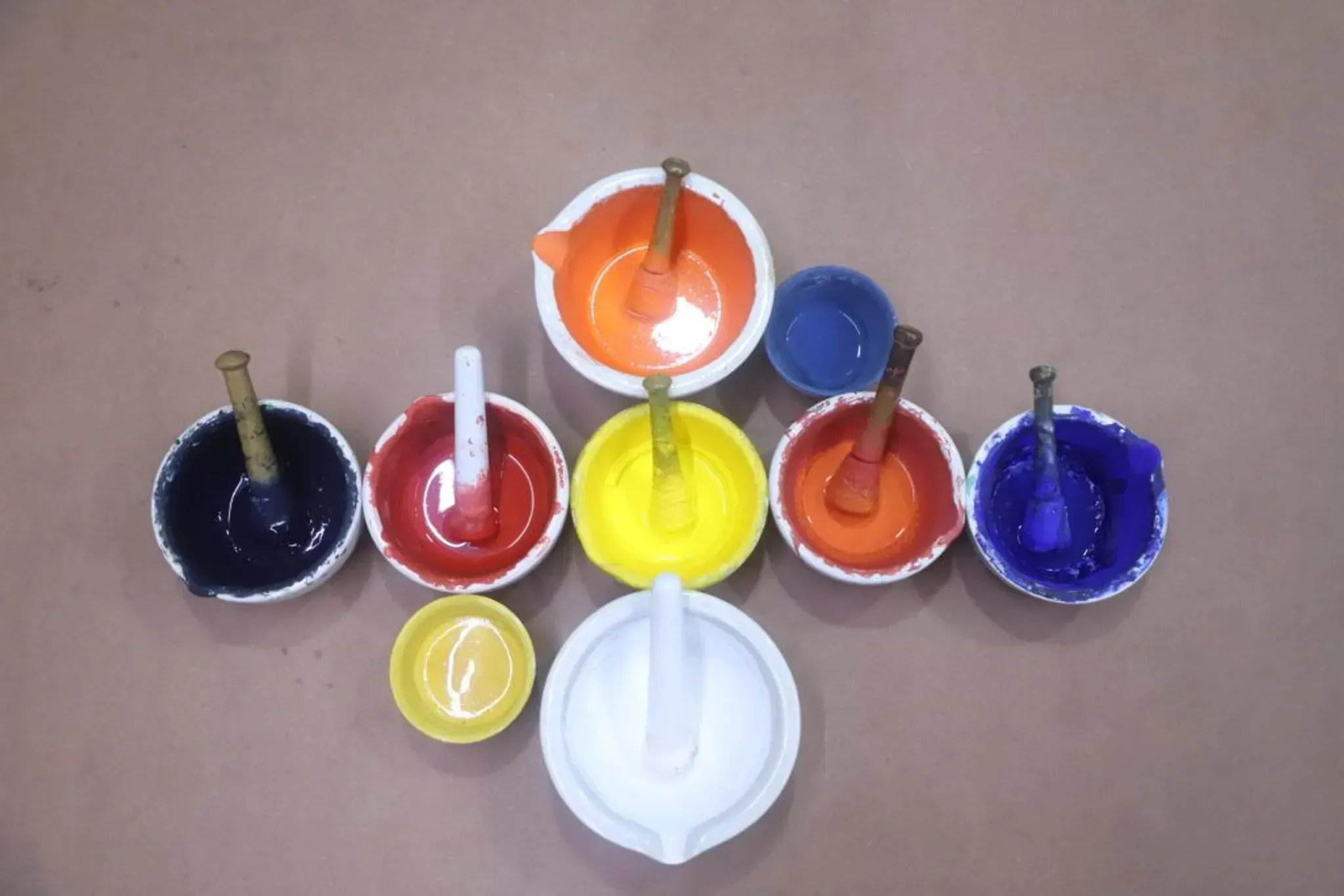
Mineral pigments and gold materials of the traditional Nathdwara palette
What Remains for a Second Sitting
Honesty requires saying what this conversation did not reach, because the questions are worth recording even unanswered. The precise latitude a master has inside the fixed svarup, the errors that instantly betray an unschooled hand. The compositional logic of the great Annakut pichwais, why the mountain of food, the massed cows and the Govardhan form sit exactly where they sit. The palette disciplines of the six ritus, season by season, as his gurus taught them. The full construction sequence of a workshop pichwai, who paints what, and what the master reserves for his own hand beyond the eyes. And the largest question of all, the one we will put to him at length, what his guru knew that he fears will leave with his generation. Those belong to a second sitting, and this series intends to have it.
The Tradition, Teachable
Across five sittings now, this series has heard the same quiet law from Mithila to Bhilwara to Bikaner to Nathdwara. The traditions survive exactly as far as they are transmitted, hand to hand, guru to shishya, and nowhere else. Raja Ram Sharma is the proof in both directions, the boy of thirteen who received the parampara from the temple's own head artist, and the master of seventy who now hands it onward to anyone willing to learn it properly. That handing-on has a shape you can hold. The Artventures of Pichwai book, created with Raja Ram Sharma, carries the tradition's dictionary onto your own table, the borders and motifs, the shringars and the sacred cows, the Nathdwara calendar and the figures of the Pushtimarg, with practice built in, so that the knowledge in this interview becomes something your hand learns rather than something your eye admired once.
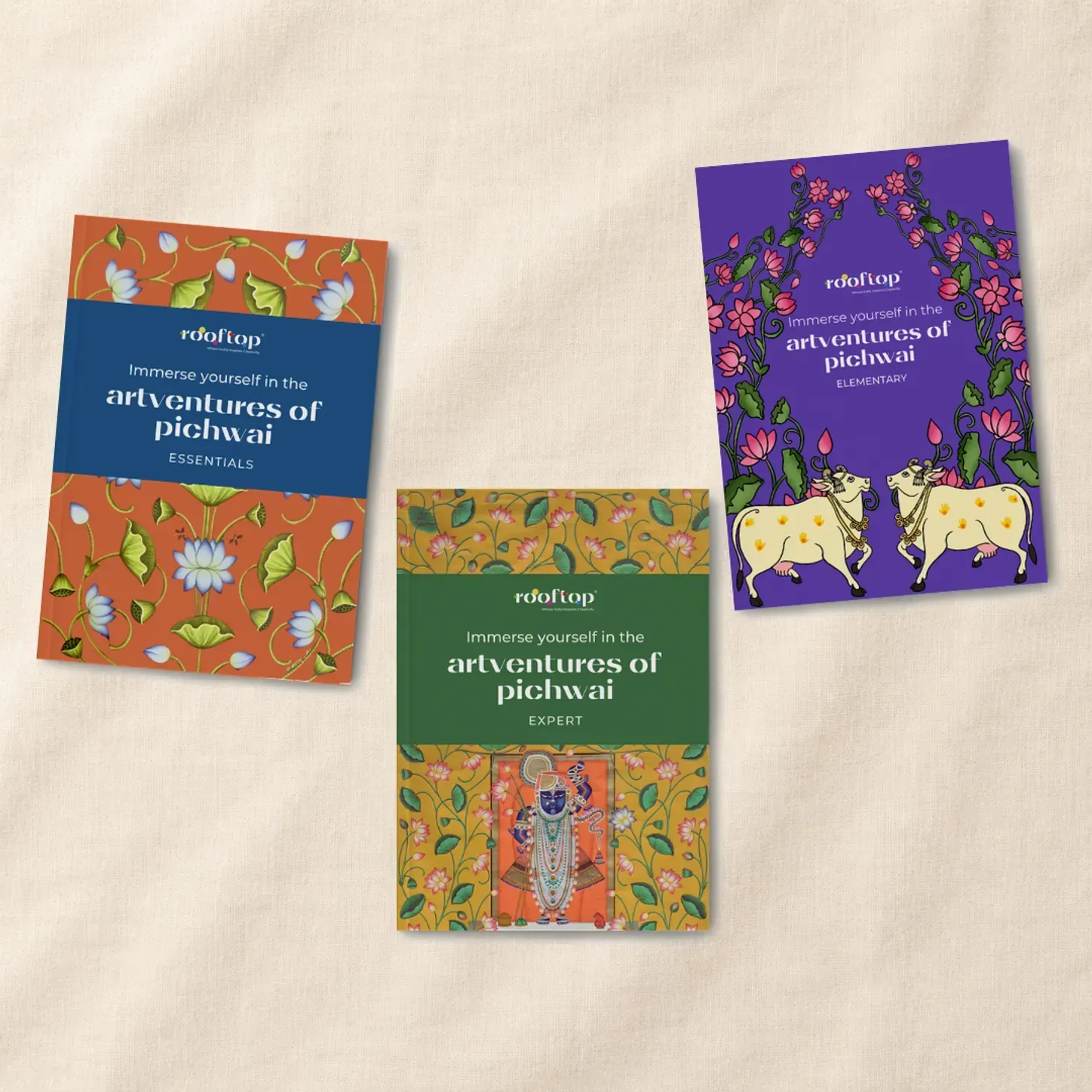
Artventures of Pichwai, created with Raja Ram Sharma, the tradition's patterns and calendar as a practice book. View on Rooftop
Somewhere in Nathdwara tomorrow morning, before most of India wakes, a curtain will open on a small dark god in a plain dhoti, and the day's first darshan will begin, exactly as the calendar prescribes, exactly as it has for three centuries. Somewhere nearby, a painter will note what the Lord is wearing. This is the only art form in the world with a living model who keeps a stricter schedule than his painters, and thanks to masters like this one, both halves of that appointment are still being kept.