
Meet J. Gurappa Chetty
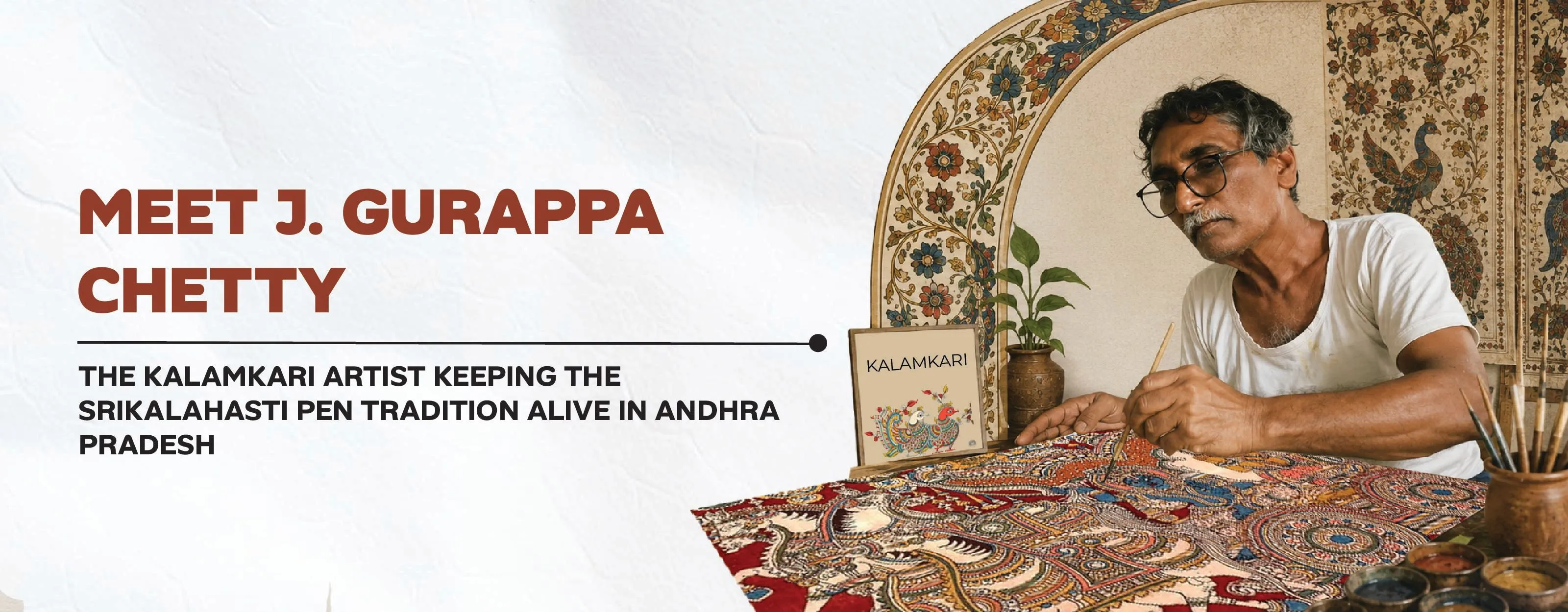
Meet J. Gurappa Chetty: The Kalamkari Artist Keeping the Srikalahasti Pen Tradition Alive in Andhra Pradesh
J. Gurappa Chetty spent his life preserving Srikalahasti Kalamkari, from learning the craft as a boy to teaching generations of artists and keeping its stories alive.

Kartik Gaggar
Author
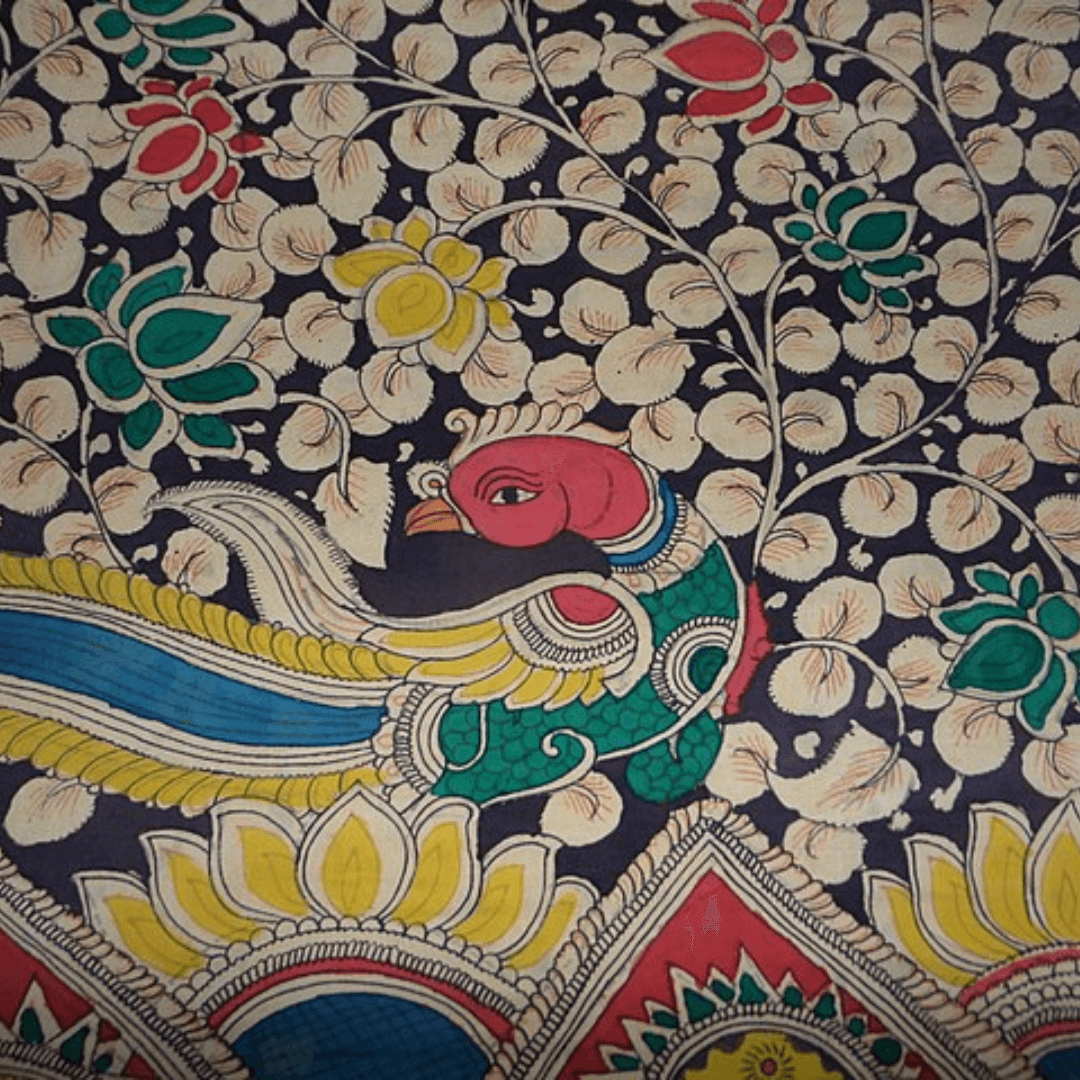
In Srikalahasti, the kalam is a deceptively simple tool. It is essentially a small bamboo pen, fitted with cotton so it can hold and release colour, yet in the hands of an experienced artist it can turn a length of cotton cloth into an entire world. Figures, expressions, architecture, trees and animals emerge one line at a time, often carrying a story that the viewer is expected to recognise. This was the world Jonnalagadda Gurappa Chetty spent his life preserving. Born in Srikalahasti in 1937, he learnt Kalamkari from his father, Lakshmaiah Chetty, beginning at the age of 13 and eventually became one of the most important practitioners of the freehand tradition.
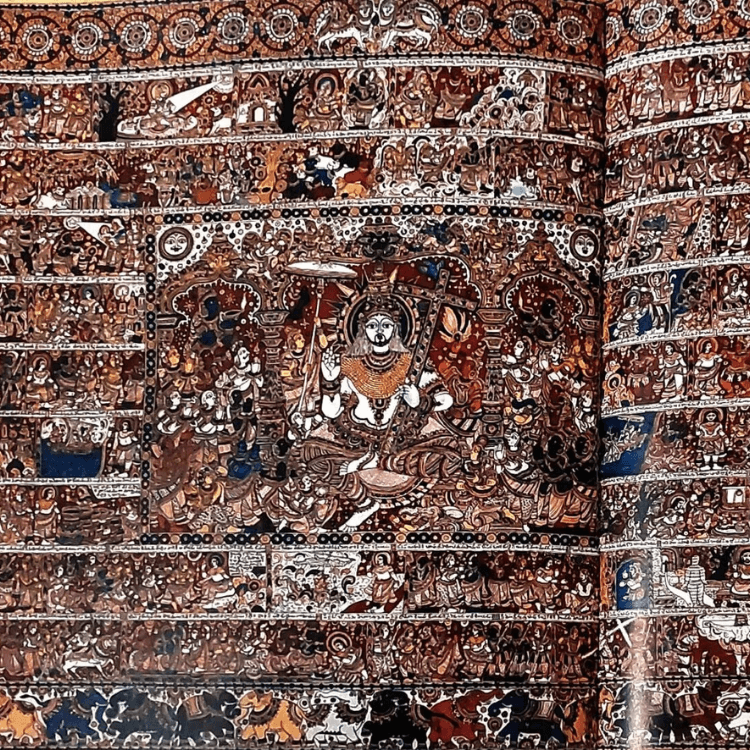
The setting matters because Srikalahasti Kalamkari was never simply about making attractive patterns on cloth. The tradition developed around narrative textiles used in temples and other sacred spaces, where large painted panels could depict episodes from the Ramayana, Mahabharata, Bhagavatam and other stories. Artists had to know what they were drawing because the figures and scenes followed established visual conventions. In Gurappa Chetty's work, that knowledge extended beyond Hindu epics too. He produced narrative Kalamkari depicting subjects including the New Testament and Buddha, showing how the form could accommodate new stories without losing its visual grammar.
He Learnt It From His Father
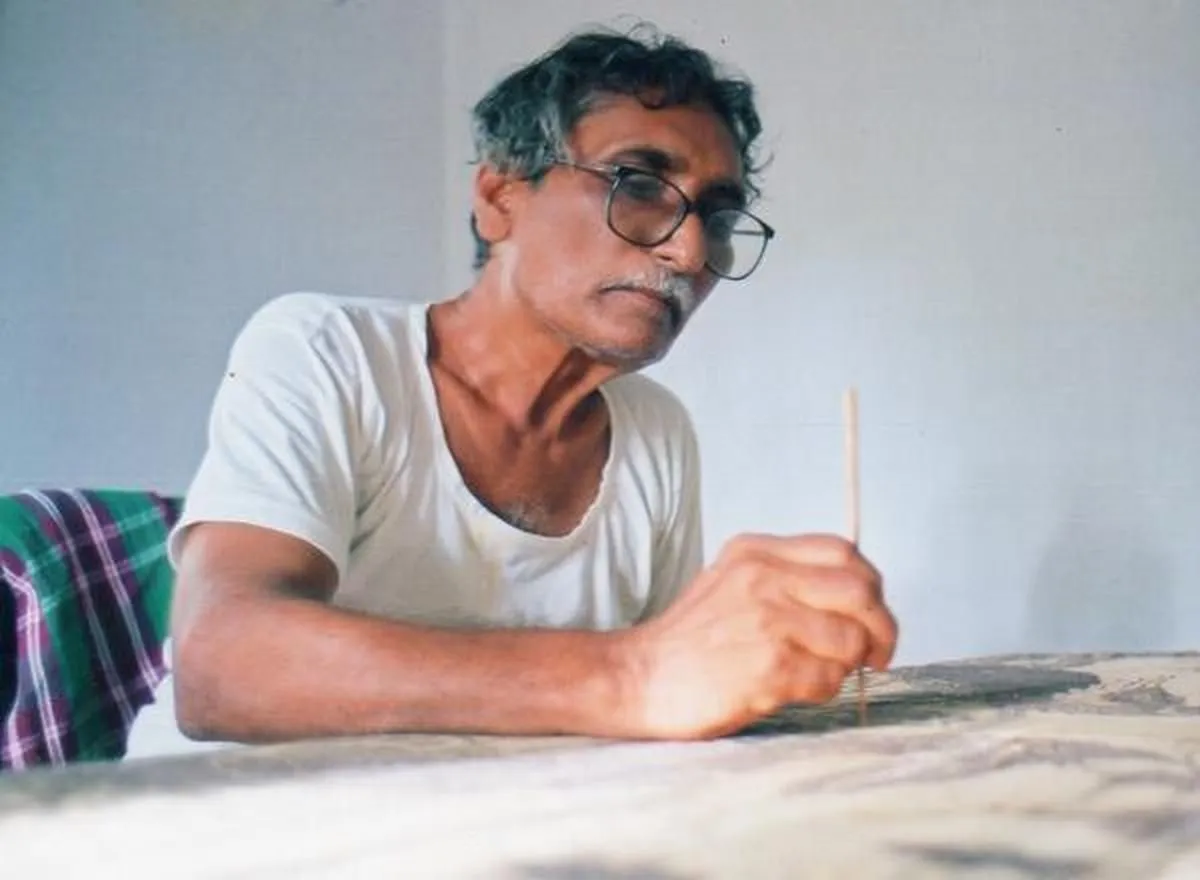
How Gurappa Chetty Carried a Legacy Credits - The Hindu
Chetty's training was long before the word "workshop" became associated with learning traditional Indian art. He learnt by working within his family and absorbing a process that had been passed down through generations. Later, however, his own experience as a teacher made him particularly interested in finding ways to explain that knowledge to people outside the family.
This became increasingly important as the government and craft organisations began creating formal training programmes to revive traditional arts. Chetty was among the early trainees of the All India Handicrafts Board's Kalamkari training system, even though he had already learnt the craft at home. He understood both sides of the process: the inherited knowledge of the workshop and the difficulty of explaining that knowledge to someone encountering it for the first time.
The distinction mattered because Srikalahasti Kalamkari is much harder to reduce to a few instructions than its finished pieces might suggest. Chetty described it as vrathapani, essentially the practice of writing or painting with a pen. Unlike the block-printed Kalamkari associated with Machilipatnam, the Srikalahasti artist draws directly onto the treated cloth. The figures, expressions and details have to be built by hand, following a visual vocabulary that Chetty knew intimately. Rama carries his bow, Krishna his flute, Ravana has ten heads and Hanuman carries his mace. Knowing how to draw those figures was only part of knowing what they meant.
That understanding remained central to Chetty's own work. He became known for large narrative pieces depicting episodes from the Puranas, Ramayana, Mahabharata and Bhagavatam, while also taking the tradition into less expected territory. His subjects included the Buddha, the New Testament, traditional Indian games and scenes of everyday life. His famous 20-metre Ramayana panel won the Presidential National Award for Craftsmanship in 1976.
He Refused to Treat It as a Quick Lesson
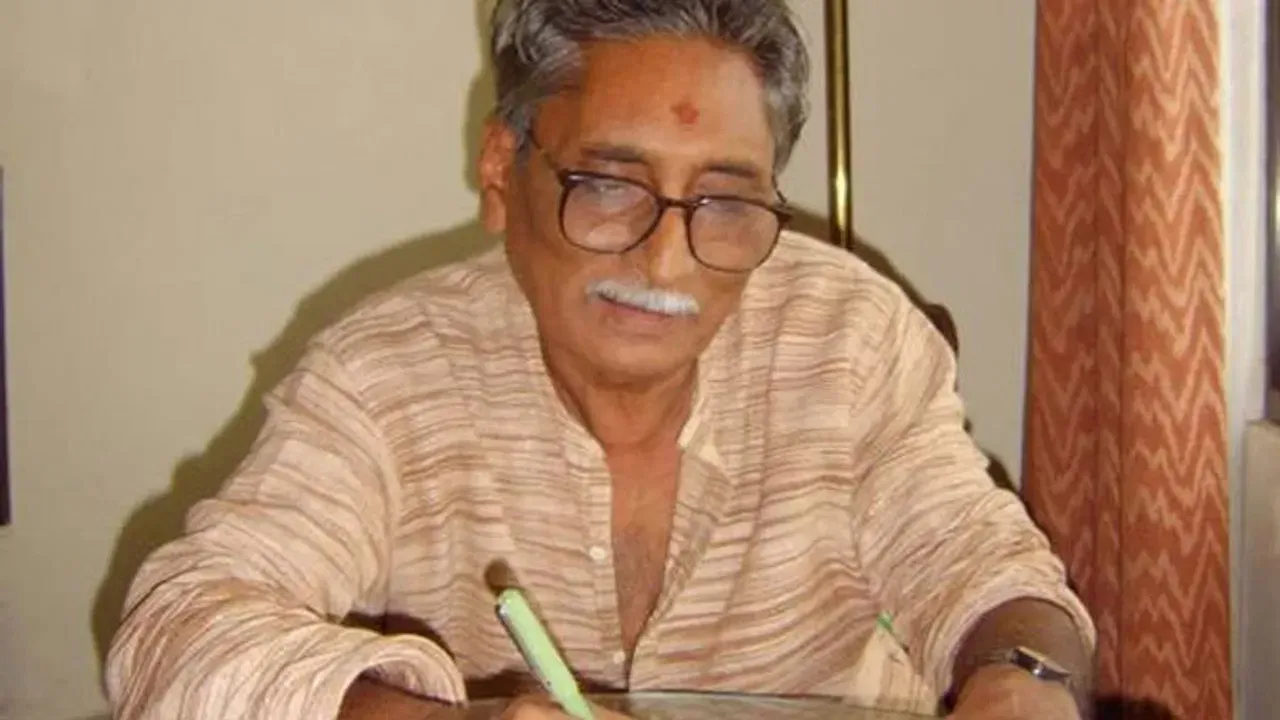
The Man who kept the Srikalahasti Pen Tradition Alive Credits - TV9 Telugu
Chetty's attitude towards teaching was unusually direct. He did not believe traditional craft could be understood through a few days of demonstration. When he travelled to Pune in 2011 to conduct a workshop, he openly complained that short workshops could never be enough to properly learn traditional arts. He explained that Kalamkari itself involved around 17 stages, from preparing the cloth to drawing, dyeing, washing and treating it repeatedly. Even a relatively small piece could take around 15 days.
That frustration was tied to a larger concern. Chetty had spent his life watching Kalamkari move between tradition, revival and the modern market, and he knew that recognition alone could not solve the problems faced by its practitioners. A hand-painted piece made through a long sequence of natural dyeing and washing could not easily compete on price or speed with commercially produced textiles. He was particularly critical of the gap between the money and attention given to celebrated artists and the craftsmen who depended on the work for their livelihoods.
Still, he was not pessimistic about the future. What mattered to him was getting more people to actually learn the craft. He conducted workshops across the country, including programmes for schools and colleges, and worked with organisations such as SPIC MACAY to introduce students to Kalamkari. He believed that bringing children into contact with the process could give the tradition a future that awards and exhibitions alone could not provide.
He Wanted Women to Learn It Too
One of Chetty's most significant contributions came through his efforts to teach women. After receiving the National Award in 1976, he became involved in a training programme where he agreed to train women specifically. He later explained that women could practise the craft from home and pass what they learnt on to other members of their families. For him, this was more than a question of increasing the number of people who could paint. It was another way of making sure the knowledge could move from one household to another.
His own family became part of that story. His wife, Girijamma, began as his student after their marriage, but Chetty later joked that she had become his guru. The relationship captures something important about the way he understood craft knowledge. It was not supposed to remain permanently fixed with one master. If someone learnt enough to surpass you in some part of the process, that was something to celebrate rather than resist.
His son Niranjan followed the same path. At one point, Niranjan had considered becoming a doctor, but a conversation about how few people were still practising Kalamkari persuaded him to reconsider. He eventually trained under his father and continued the family tradition, developing his own work and becoming a teacher and advocate for Srikalahasti Kalamkari himself.
Recognition Came, But So Did Responsibility
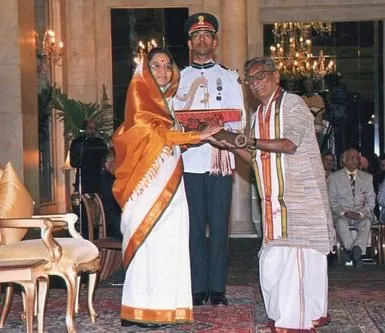
Long due recognition Gurappa Chetty
Upon reaching the later part of his career, Chetty had become difficult to separate from the revival of Srikalahasti Kalamkari. The National Award came in 1976, followed by the title of Shilpa Guru in 2002 and the Padma Shri in 2008. He also received honours including the Kamaladevi Vishwa Karigar Award and Tulsi Samman. His work travelled far beyond Srikalahasti, and he encountered examples of Kalamkari in museums and collections abroad, including the United Kingdom, Australia and Canada.
However, he never seemed particularly interested in treating those honours as the end of the story. His interviews repeatedly return to the same concern: who is going to learn the craft after him? He was willing to travel long distances for demonstrations and workshops, and he spoke about teaching with the same urgency with which he spoke about the difficulties facing traditional crafts. At one workshop, he even said he was willing to share his knowledge for free because passing it on mattered more than turning every encounter into a commercial opportunity.
That is perhaps the most revealing thing about Gurappa Chetty. He spent decades making Kalamkari, but his legacy was never confined to the pieces he painted. He wrote books about the craft, trained students, encouraged women to learn, worked with schools and institutions, and brought his knowledge to audiences far removed from Srikalahasti. He understood that a tradition survives through practice, but practice itself survives only when somebody is willing to teach it.
Chetty died in Srikalahasti in March 2021, but the family lineage continues through his son Niranjan and later generations of artists. His life therefore sits between two kinds of inheritance: the knowledge he received from his father and the knowledge he spent his own life making sure somebody else would receive from him.
For anyone encountering Srikalahasti Kalamkari today, that may be the most useful way to understand Gurappa Chetty. The long preparation of the cloth, the natural dyes, the freehand figures and the painstaking narrative panels are all important, but they were never isolated techniques in his mind. They belonged to a living body of knowledge. He learnt it because somebody before him had kept it alive, and he spent his career making sure the next person would have the chance to learn it too.