
Kalamkari (Machilipatnam) - The Painting Tradition of Andhra Pradesh
Discover the Kalamkari (Machilipatnam) style, a style of hand block-printed and resist-dyed textile art of Andhra Pradesh.
Introduction
Machilipatnam Kalamkari is a style of hand block-printed and resist-dyed textile art produced primarily in the town of Pedana, located approximately 13 kilometers from Machilipatnam in Krishna district, Andhra Pradesh. It is one of the two principal styles of Kalamkari produced in Andhra Pradesh, the other being the freehand pen-drawn Srikalahasti style. The Machilipatnam style is distinguished by its use of hand-carved wooden printing blocks applied to cotton fabric treated with natural mordants and dyes derived from plant and mineral sources.
The tradition has its documented origins in the patronage context of the Golconda Sultanate and Mughal administration during the 16th and 17th centuries, when Persian-influenced design motifs were incorporated into an existing tradition of mordant-resist textile printing on the Coromandel Coast. The name Kalamkari derives from the Persian and Urdu kalam (pen or brush) and kari (craft or work), reflecting the Persian cultural influence on the tradition during this period.
Etymology
The term Kalamkari is composed of two Persian-derived elements: kalam, meaning pen, brush, or calam (writing instrument), and kari, meaning craftsmanship or work. In Telugu, the tradition was historically referred to as vraata pani, meaning writing work, before the Persian-influenced designation became dominant under the Qutb Shahi rulers of Golconda (1518 to 1687). The name suggests that the tradition was initially associated with a pen-drawn process before the Machilipatnam style developed its characteristic block-printing technique. The Srikalahasti style retains the original pen-drawn process that the name literally describes.
Origin
The geographic region of Machilipatnam (formerly Masulipatnam, the principal port of the Golconda Sultanate) was a major center of textile trade on the Coromandel Coast from at least the 15th century. The port facilitated trade with the Malay Archipelago, the Persian Gulf, and, from the 16th century, with European trading companies. Portuguese, Dutch, and English traders were all active at Masulipatnam from the 16th century, and textile exports, including Kalamkari fabrics, constituted a significant component of this trade. The Dutch East India Company (VOC) maintained a factory at Masulipatnam from 1605, and English East India Company records document textile purchases at the port from the early 17th century.
The patronage of the Golconda Sultanate introduced Persian design vocabulary into the Machilipatnam textile tradition. Persian floral arabesques, the Tree of Life motif, and geometric patterning were integrated with existing regional design elements to produce the characteristic style associated with this tradition. The Karkhana system, under which textile production was organized in workshops under state or merchant supervision, was also introduced during this period.
Location
The center of production for Machilipatnam Kalamkari is Pedana, a weaving and printing town in Krishna district, Andhra Pradesh. Pedana was historically a subsidiary production center to the port city of Machilipatnam but has retained the craft tradition more actively than the city itself. The GI tag registered in 2008 is specifically designated for Machilipatnam (Pedana) Kalamkari, reflecting the geographic concentration of the tradition in Pedana.
Community
Machilipatnam Kalamkari is produced by artisan communities with hereditary specializations in the different stages of the production process. Block carvers, fabric preparers, printers, and dyers each represent distinct occupational specializations within the craft. The community is predominantly Hindu, and the craft is not restricted to a single caste or community identity. The karkhana (workshop) system, in which artisans work under a single supervisory structure, has been the organizational model for Machilipatnam Kalamkari production since the Golconda period.
Relevance
Machilipatnam Kalamkari is recognized by the Government of India through its GI tag registration, which provides intellectual property protection for the geographical designation. The craft is supported by state and central government handicrafts programs and has been promoted in domestic and international fashion markets. The All India Handicrafts Board, under the first chairpersonship of Kamaladevi Chattopadhyay, was instrumental in supporting the revival of Kalamkari traditions in the post-independence period. The design consultant Nelly Sethna is documented as having worked with Kalamkari weavers in the 1970s and 1980s to adapt designs for contemporary market contexts.
History
Background
The earliest phase of the Machilipatnam textile tradition predates the documented Kalamkari designation. The Coromandel Coast was a major textile-producing and exporting region throughout the medieval period, with documented trade connections to Southeast Asia through which Indian printed textiles influenced the textile traditions of Java, Bali, and other islands. The introduction of resist-printing techniques and mordant dyeing, the technical foundations of Kalamkari, is associated with this long trade history.
During the Golconda Sultanate period (1518 to 1687), the textile workshops of Masulipatnam received both state patronage and the design influence of Persian court aesthetics, producing the distinctive floral and geometric vocabulary associated with the Machilipatnam style. The Mughal period extended and reinforced this patronage structure. Following the decline of Golconda and the disruption of the old patronage networks, the tradition persisted through the merchant and trade demand of the Coromandel Coast, maintaining production through the period of European trading company dominance.
Culture and Societies
The Machilipatnam Kalamkari tradition was shaped by the commercial export economy of the Coromandel Coast. Unlike the Srikalahasti tradition, which was temple-centered and primarily served religious functions, the Machilipatnam tradition was oriented toward secular commercial production from an early period. The motifs and color combinations developed in the tradition reflect both the aesthetic preferences of local consumers and the preferences of export markets in Persia, Southeast Asia, and Europe. Dutch VOC records describe specific design preferences requested by Asian buyers, providing documentary evidence of the tradition's commercial adaptation.
Religious Significance
Machilipatnam Kalamkari does not have a documented primary religious function. Unlike the Srikalahasti style, which produces temple hangings and ritual textiles, the Machilipatnam style has historically produced secular textiles including garments, furnishing fabrics, and decorative cloths for domestic and commercial use. Some Machilipatnam productions include representations of deities and mythological narratives, but these are produced for decorative purposes rather than as temple offerings or ritual objects.
Understanding the Art
Style
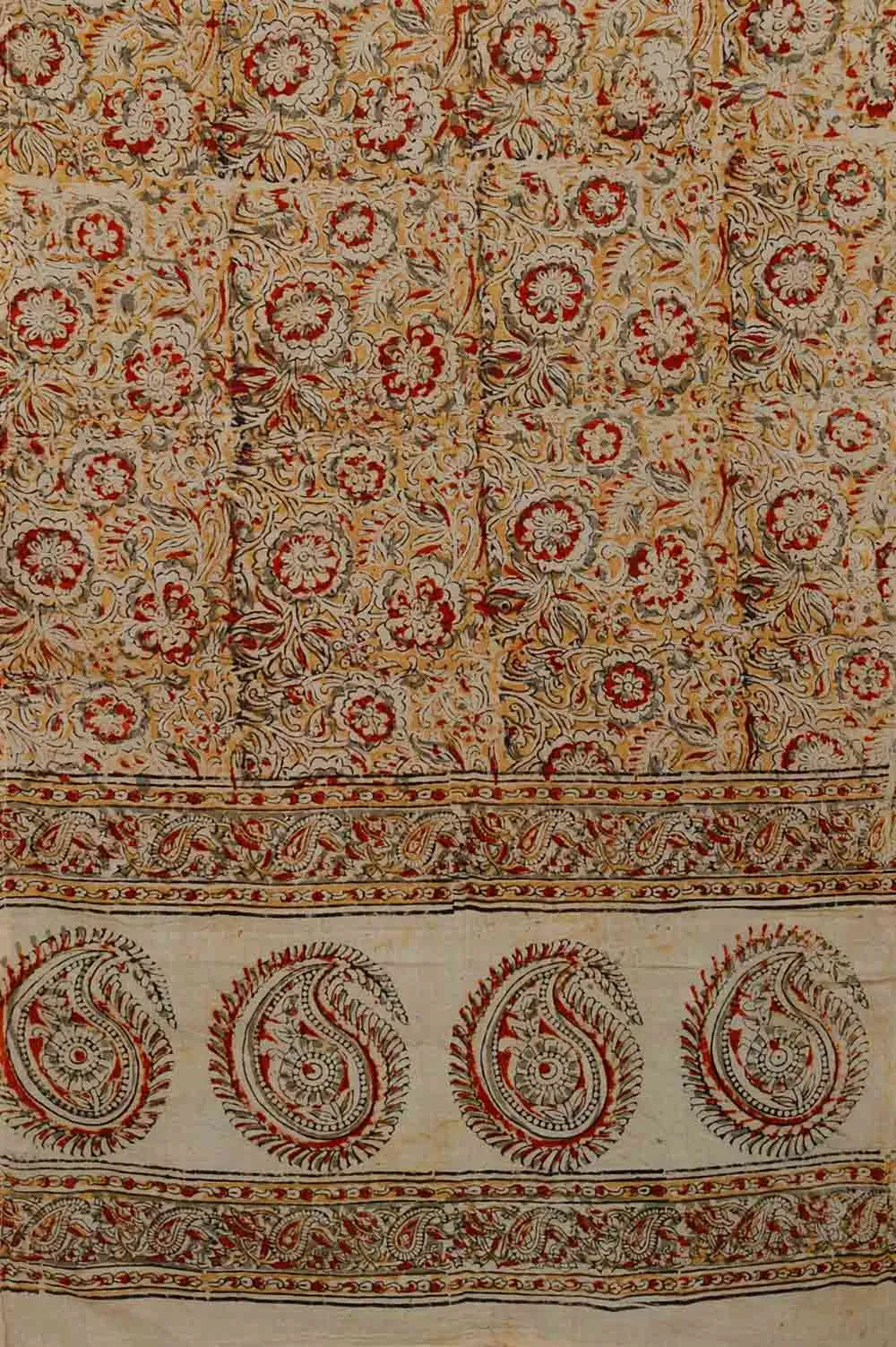
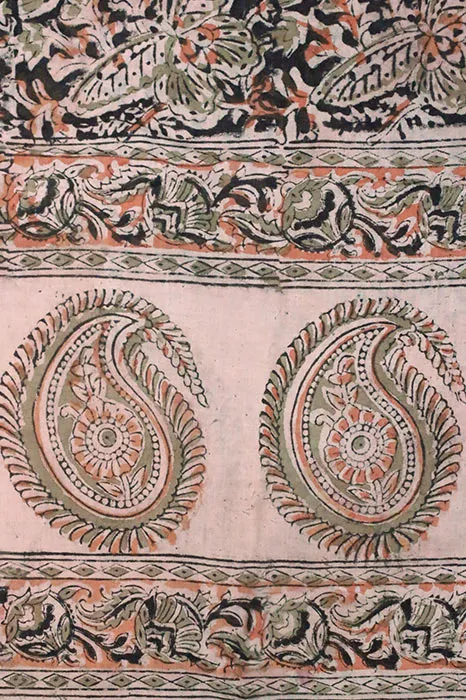
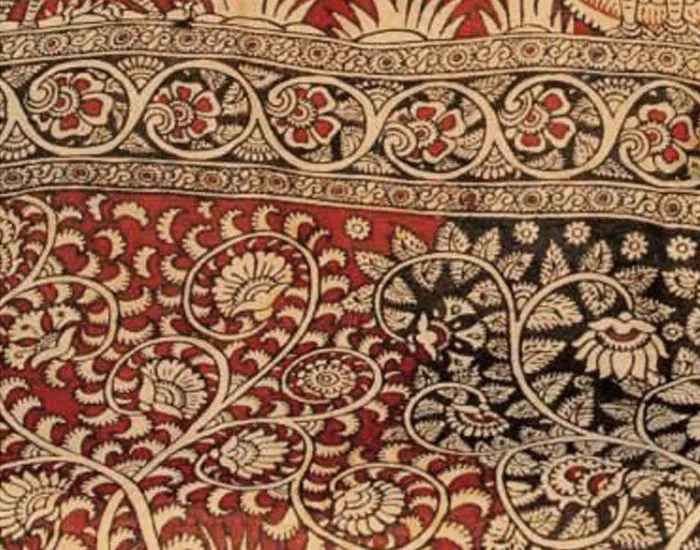
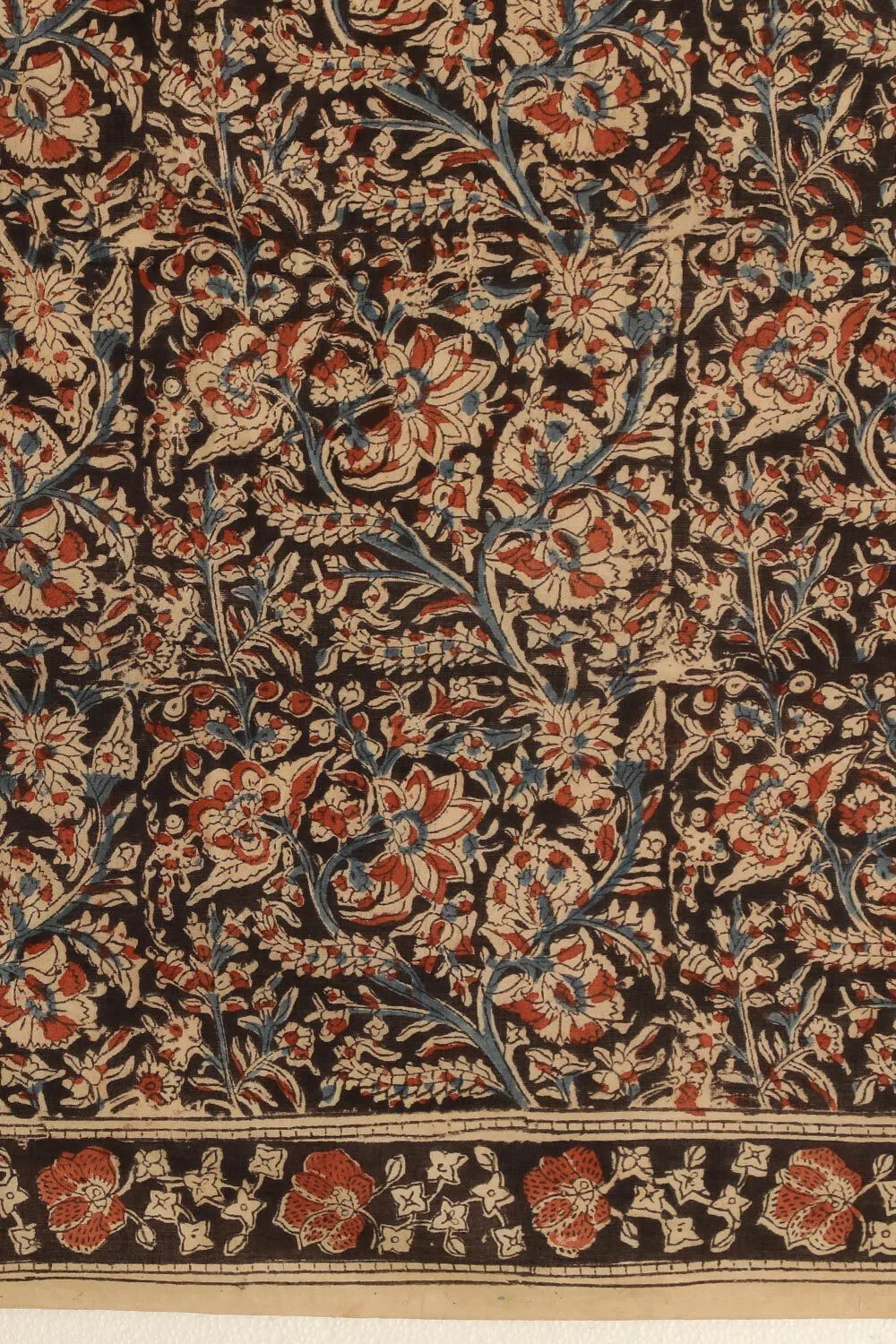
The Machilipatnam style is characterized by its use of hand-carved wooden blocks to apply mordant and dye to pre-treated fabric. The visual aesthetic is characterized by dense floral patterning, bilateral symmetry, and the integration of Persian-influenced arabesques with regional motifs. The color palette is determined by the natural dyes used in the process and is characterized by deep blues, blacks, reds, and warm ochre tones. The block-printed design typically covers the entire surface of the fabric, with borders and field patterns clearly differentiated.
Central Motifs and Their Significance
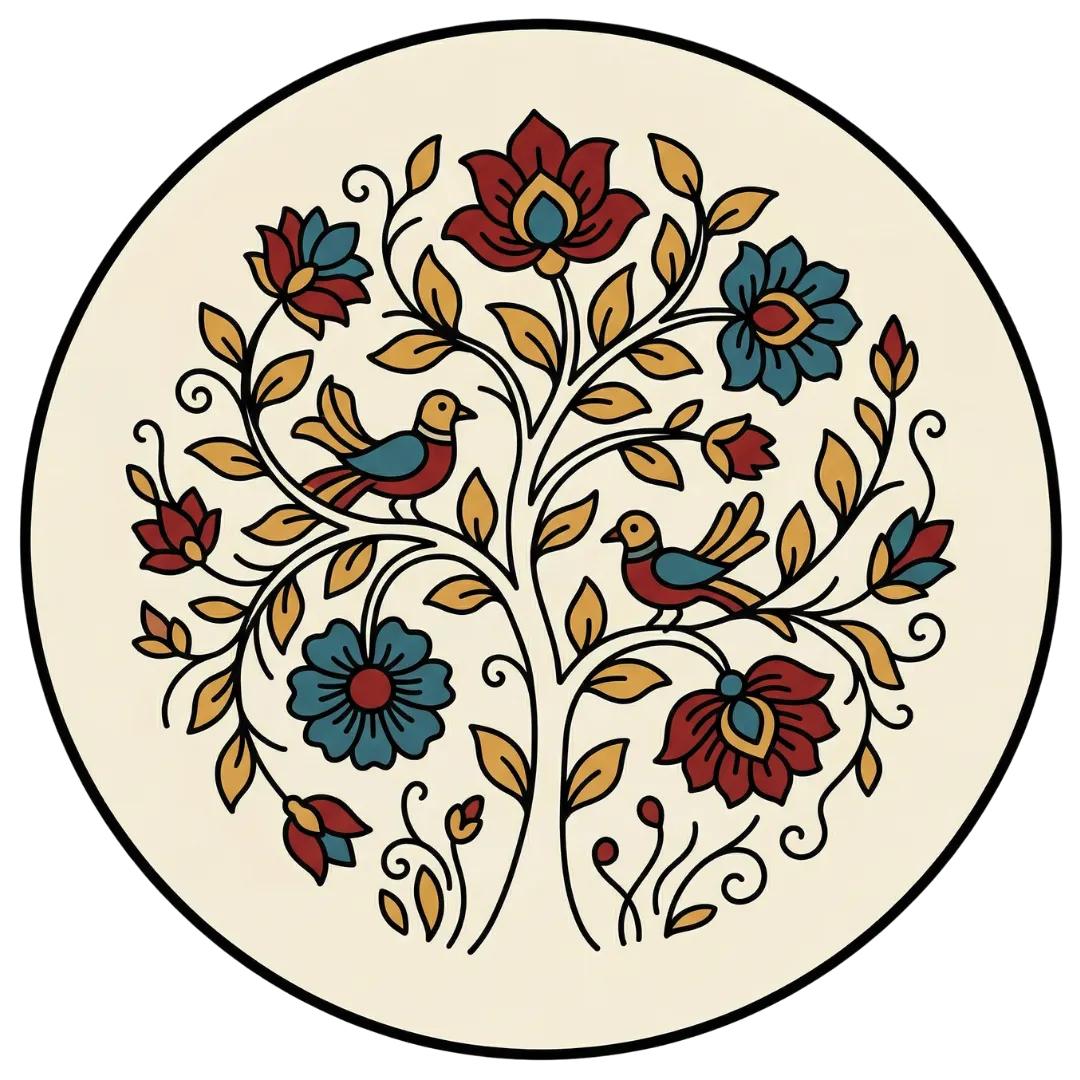
The principal motifs of Machilipatnam Kalamkari include the Tree of Life (a Persian-influenced motif representing cosmic order), floral arabesque scrollwork, parrots and peacocks, vines and leaves in spiraling arrangements, and geometric border patterns. In productions made for local Hindu consumers, deities, scenes from the Ramayana and Mahabharata, and divine figures may appear within the design structure. The Persian-influenced motifs that dominate the commercial tradition carry no specific religious significance; they are aesthetic conventions derived from the historical patronage context.
Process
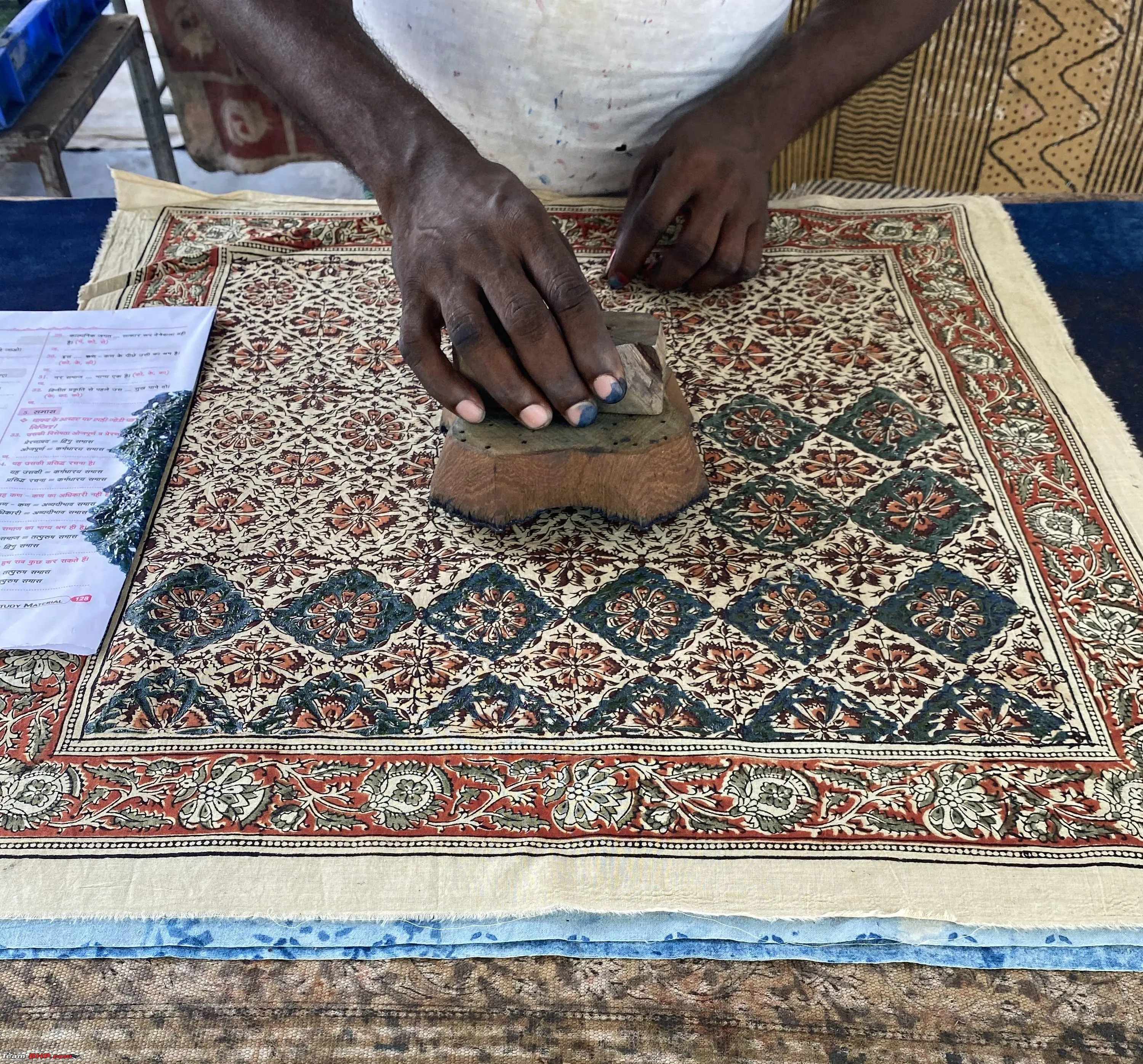
The production of Machilipatnam Kalamkari involves a multi-stage process using natural materials. The cotton fabric is washed to remove impurities and then treated with a mordant solution, typically using buffalo milk mixed with myrobalan fruit (Terminalia chebula) extract, which serves as a base mordant fixing subsequent dye applications. The fabric is then dried and the wooden blocks are applied in sequence, beginning with the outline blocks and proceeding through the fill and background blocks. Different blocks carry different mordant materials, which will attract different dye colors in the subsequent dyeing stages. The fabric is immersed in dye baths in sequence, with intermediate washing steps between dye applications. The finished cloth is washed in running water and dried in sunlight.
The wooden blocks used in this tradition are carved by specialist block-makers from teak or tamarind wood, with motifs carved in relief so that the dye-carrying surface projects from the block. A single textile may require multiple blocks for different elements of the design. The production of a complete set of blocks for a new design represents a significant investment of skill and time.
Mediums Used
The materials used in Machilipatnam Kalamkari are exclusively natural in the traditional process. The fabric is cotton, typically mill-woven and pre-washed. The dyes used include indigo (blue), iron rust prepared from iron filings in myrobalan solution (black), madder root (red), pomegranate peel combined with aluminum mordant (yellow), and combinations of these to produce secondary colors. Alum is used as the primary mordant.
New Outlook
Machilipatnam Kalamkari has successfully integrated into the contemporary fashion and home textile market, both in India and internationally. Designers from Indian fashion industry contexts have incorporated Kalamkari block printing into garment and home textile collections, and export-oriented production in Pedana supplies international buyers. The GI tag has provided some framework for quality identification, though enforcement of GI standards in the craft sector presents challenges. Government training programs and cooperative structures for artisans have been established in Pedana.
Learn Kalamkari (Machilipatnam style)
Bibliography
Sources
Barnes, Ruth. Indian Block-Printed Textiles in Egypt: The Newberry Collection in the Ashmolean Museum. Clarendon Press, 1997.
Crill, Rosemary. Indian Embroidery. Victoria and Albert Museum, 1999.
Krishna, Nanditha, and M. Amirthalingam. Sacred Plants of India. Penguin Books, 2014.
Lynton, Linda. The Sari: Styles, Patterns, History, Techniques. Thames and Hudson, 1995.
Image Sources
"Machilipatnam Kalamkari Stole." Gitagged, https://www.gitagged.com/product/kalamkari-machilipatnam-stole/?srsltid=AfmBOop9XKQCf9D9T0o3S3AbNlzwUD_33vc0eLfLk8rEErsFilw8FIb-. Accessed 10 July 2026.
"Machilipatnam Block Prints." IMP-ART, https://imp-art.org/articles/machilipatnam-block-prints/. Accessed 10 July 2026.
"Visit to Pedana – Home of Kalamkari." Team-BHP, https://www.team-bhp.com/forum/travelogues/235904-visit-pedana-home-kalamkari.html. Accessed 10 July 2026.
"Off White Pure Cotton Machilipatnam Kalamkari Saree." Taneira, https://www.taneira.com/product/off-white-pure-cotton-machilipatnam-kalamkari-saree-spg08b00481.html?srsltid=AfmBOoqgxNvPyN7rysyH5Tm3tJVKACDMnzYRA114EV285A83BNm7hxNI. Accessed 10 July 2026.
"Kalamkari Stoles." Gitagged, https://www.gitagged.com/product/kalamkari-stoles-2/?srsltid=AfmBOor4vKs-wDx96SIvnPHySqtMst1npNDns40A9w1H2I9-OuHLGthL. Accessed 10 July 2026.