
Kalamkari (Srikalahasti) - The Painting Tradition of Andhra Pradesh
Explore Kalamkari (Srikalahasti) style, a Srikalahasti temple-centered Hindu mythology and epic literature driven art form...
Introduction
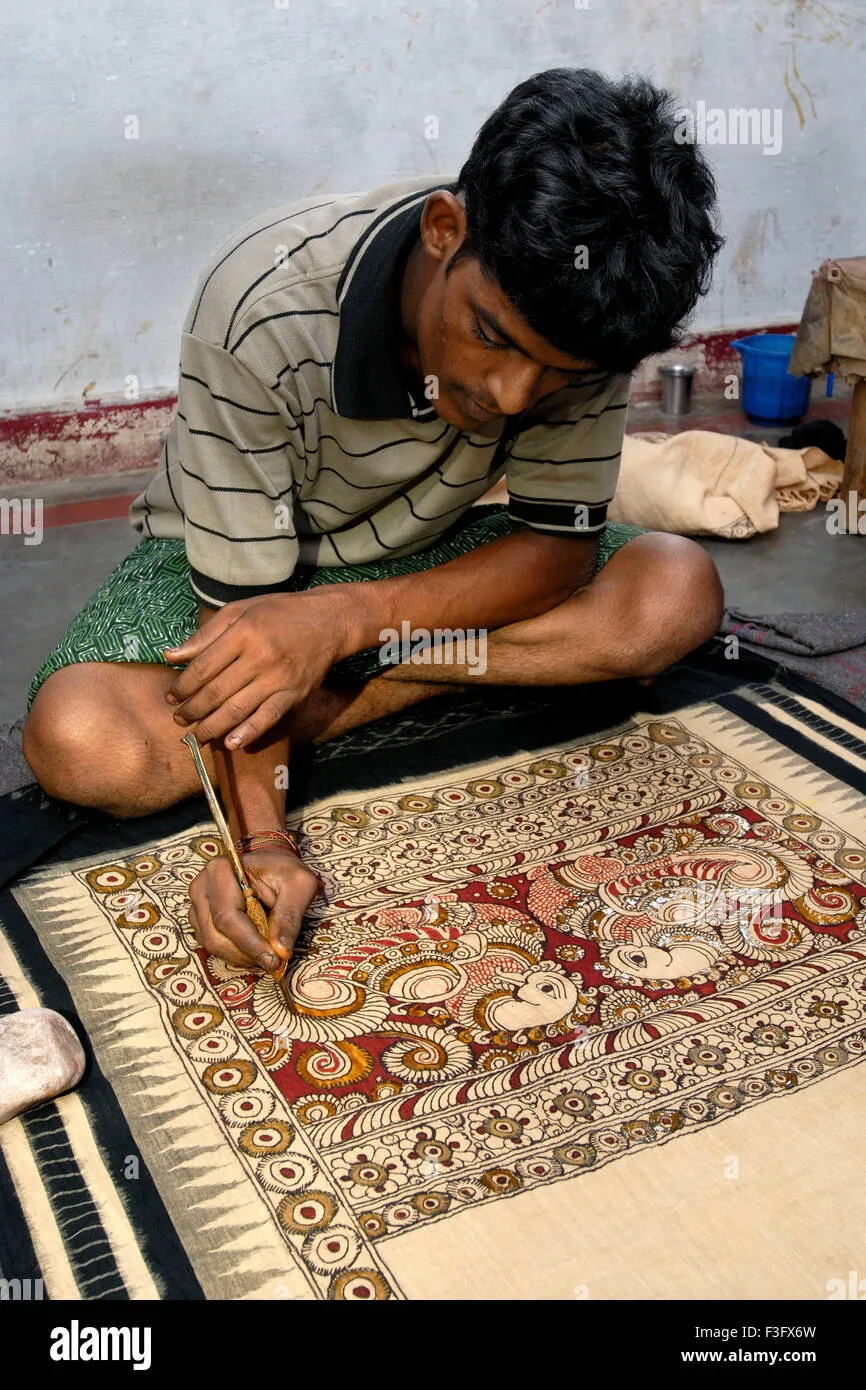
Srikalahasti Kalamkari is a style of hand-drawn and natural-dyed textile art produced in Srikalahasti, a town in Tirupati district, Andhra Pradesh, associated with the Srikalahasti Shiva temple. It is one of the two primary styles of Kalamkari in Andhra Pradesh, distinguished from the Machilipatnam block-printed style by its entirely freehand process using a bamboo or date palm pen (kalam) tipped with a cotton wool bundle. The tradition is temple-centered in its origin, having developed within the context of the Srikalahasti temple's ritual textile requirements, and its primary subject matter is drawn from Hindu mythology and epic literature.
The Srikalahasti style received a Geographical Indication registration in 2005, preceding that of the Machilipatnam style. The tradition is maintained by artisan families in Srikalahasti who have practiced the craft across generations, and their work has been collected by Indian and international museums including the Victoria and Albert Museum in London.
Etymology
The etymology of Kalamkari is shared with the Machilipatnam style: kalam (Persian and Urdu for pen or writing implement) and kari (Persian and Urdu for work or craft). In the Srikalahasti context, the name is particularly apt, as the tradition involves exclusively pen-drawn work without any block printing. The kalam used in the Srikalahasti tradition is a pointed bamboo or date palm stick with cotton fibers wrapped around one end to serve as a reservoir for the drawing medium.
Origin
The Srikalahasti Kalamkari tradition is associated with the temple of Srikalahasti, a significant Shaiva pilgrimage site dedicated to Kalahastiswara (Shiva) located on the banks of the Swarnamukhi River. The tradition developed as a temple art form, producing textiles for use as temple hangings, backdrop cloths for deity images, processional banners, and chariot decorations. The oldest surviving examples of Srikalahasti Kalamkari in institutional collections date to the 15th and 16th centuries, associated with the patronage period of the Vijayanagara Empire (1336 to 1646).
The Vijayanagara Empire was a significant patron of temple arts throughout the southern Deccan, and the temple complexes of Andhra Pradesh expanded and elaborated their ritual textile and visual arts programs during this period. The Srikalahasti temple, with its continuous pilgrimage activity and royal patronage, provided both the economic support and the iconographic programs that shaped the Srikalahasti Kalamkari tradition.
Location
Production is concentrated in Srikalahasti town and the surrounding artisan localities in Tirupati district, Andhra Pradesh. The Swarnamukhi River provides the water supply essential to the multi-stage washing process. Srikalahasti is located approximately 100 kilometers from the city of Tirupati, which is the site of the Tirumala Venkateswara temple, among the most visited pilgrimage sites in India, creating a regional pilgrimage economy that has historically provided a market for Kalamkari textiles.
Community
Srikalahasti Kalamkari is produced by artisan families who practice the craft hereditarily. The primary practitioner community includes both Hindu and Muslim families in the Srikalahasti area, though the iconographic content of the tradition is exclusively Hindu in the temple-service context. Specialist roles include the kalam practitioners (who do all drawing and painting), the dye preparers, and the fabric washers and processors. The tradition is not caste-exclusive, but the primary practitioner families have maintained the craft across generations as a hereditary occupation.
Relevance
Srikalahasti Kalamkari holds high cultural relevance as a temple art tradition with verified historical depth and as a significant example of freehand textile painting using natural dyes. The GI tag registered in 2005 was among the earlier craft GI registrations in India and has been used as a reference case in discussions of GI protection for traditional crafts. The tradition has been supported by government bodies including the All India Handicrafts Board and the Andhra Pradesh government's handicrafts programs. The production-cum-training centre established at Panagal by the Andhra Pradesh government has contributed to the training of new artisans.
History
Background
The earliest phase of Srikalahasti Kalamkari is insufficiently documented to construct a precise timeline. The tradition's oral history among practitioners traces the work to a founding period associated with the Vijayanagara Empire, and the temple context makes this plausible given the empire's documented support for temple arts. The Weavers' Service Centre at Srikalahasti, established in the mid-20th century, was instrumental in providing institutional support for the tradition after the decline of royal and aristocratic patronage.
Culture and Societies
The Srikalahasti Kalamkari tradition was shaped by the temple economy of the Srikalahasti complex and by the pilgrimage market associated with the Kalahastiswara temple and the broader Tirupati pilgrimage circuit. Artisans produced textiles specifically for temple ritual use, including the large backdrop hangings (pichavai) behind the deity image, and also for pilgrims seeking devotional souvenirs. The shift from temple-service production to a broader craft and souvenir economy occurred gradually from the late colonial period onward and accelerated in the post-independence era.
Religious Significance
Srikalahasti Kalamkari is a deeply religious tradition in its foundational context. The textiles produced are understood as offerings to the deity and as means of making the deity's narratives visually present for devotees. The iconographic programs of temple Kalamkari follow the visual conventions of Andhra temple art, with deities represented according to established iconographic standards. The use of sacred materials and the production process itself are traditionally embedded in ritual contexts, with practitioners observing specific purity rules during production of temple textiles.
Understanding the Art
Style
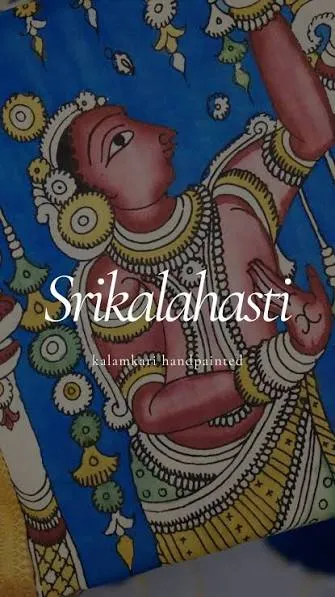
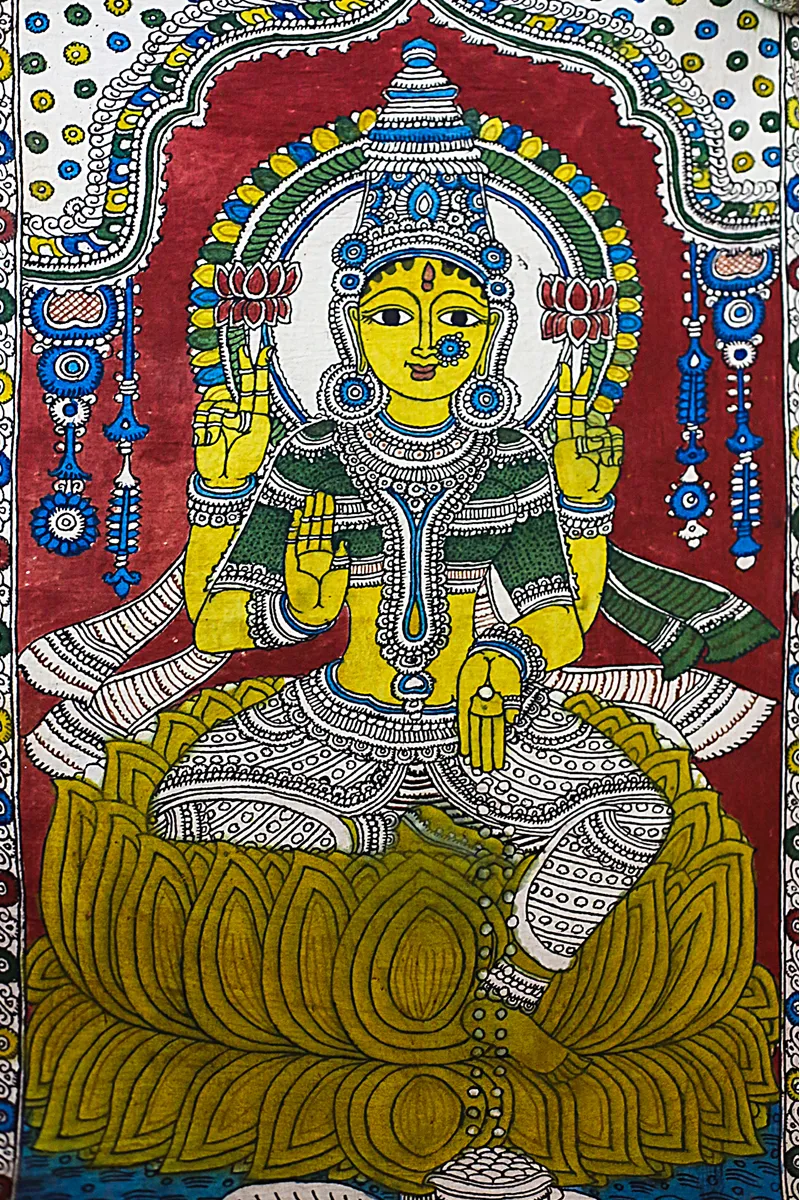
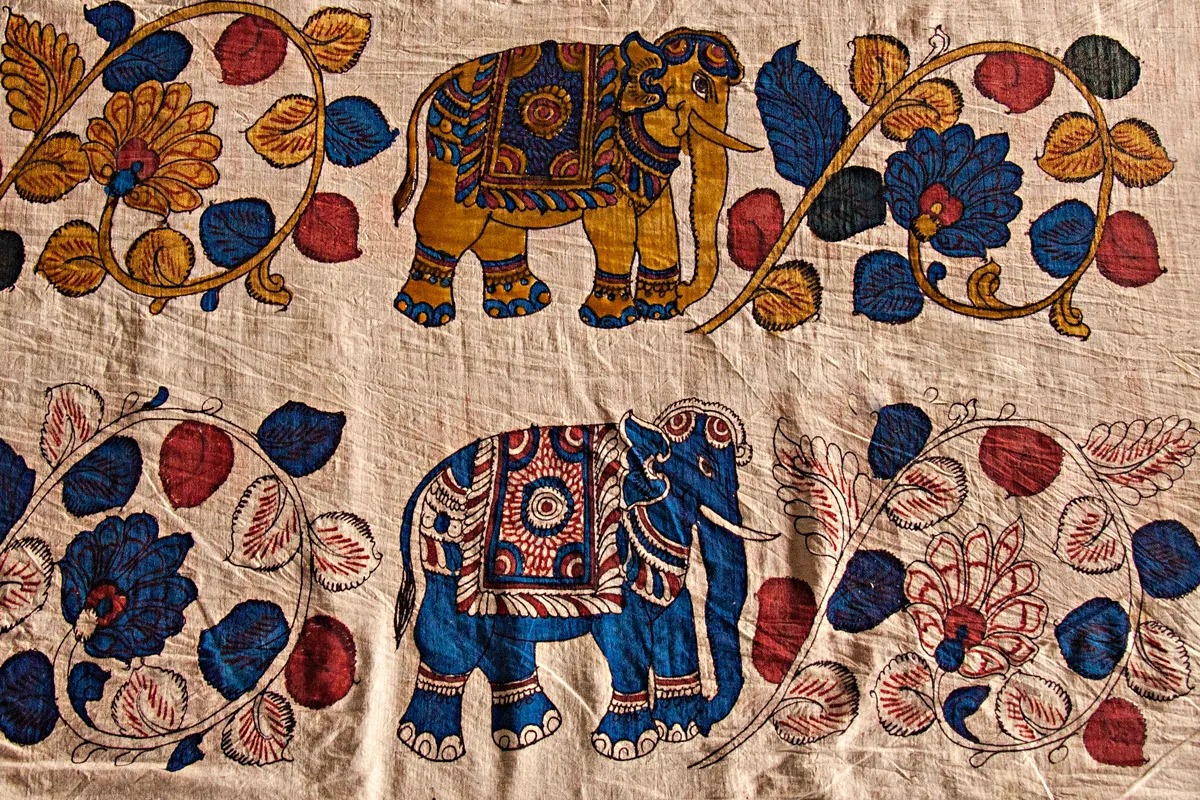
The Srikalahasti style is characterized by its fluid, spontaneous-looking line quality produced by the hand-drawn kalam, which contrasts with the regularized patterns produced by block printing. Individual compositions show considerable variation in line quality, composition, and detail, reflecting the hand of individual artisans. Large-format hangings that narrate epic stories in sequential panels are a characteristic product of the tradition. The visual register is closer to monumental narrative painting than to textile pattern design, and the Srikalahasti tradition is sometimes categorized as textile painting rather than textile printing.
Central Motifs and Their Significance
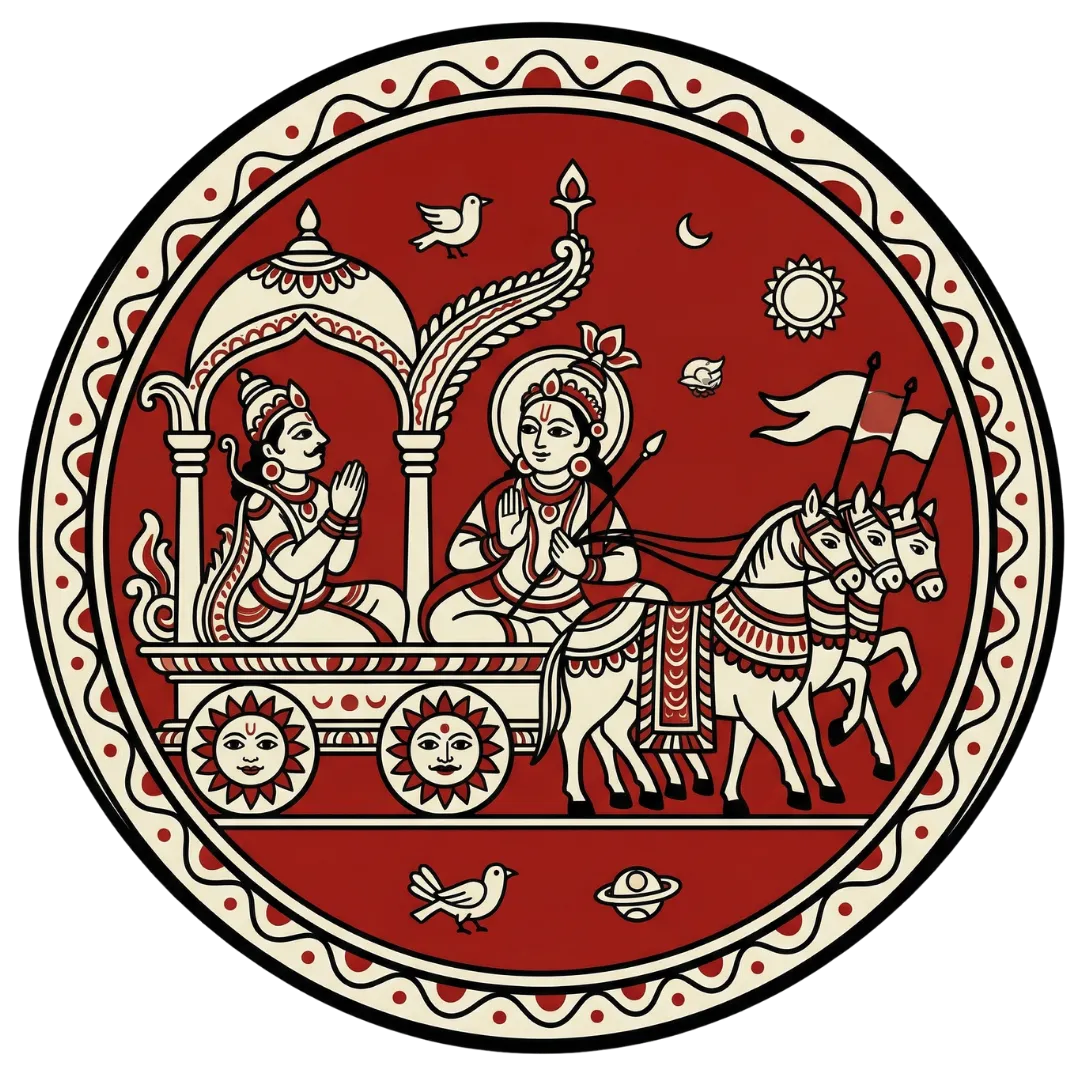
The primary motifs of Srikalahasti Kalamkari are drawn from Hindu iconography and narrative traditions. Episodes from the Ramayana and Mahabharata, the Puranas, and the specific mythological narratives associated with the Srikalahasti temple and its deity (Kalahastiswara) are the principal subject matter. Deity compositions following established iconographic conventions for Shiva, Vishnu, Brahma, Saraswati, Durga, Parvati, and the avatars of Vishnu are standard subjects. The conch, the wheel, the lotus, the trident, and other divine emblems function as identifying attributes within the iconographic system.
Process
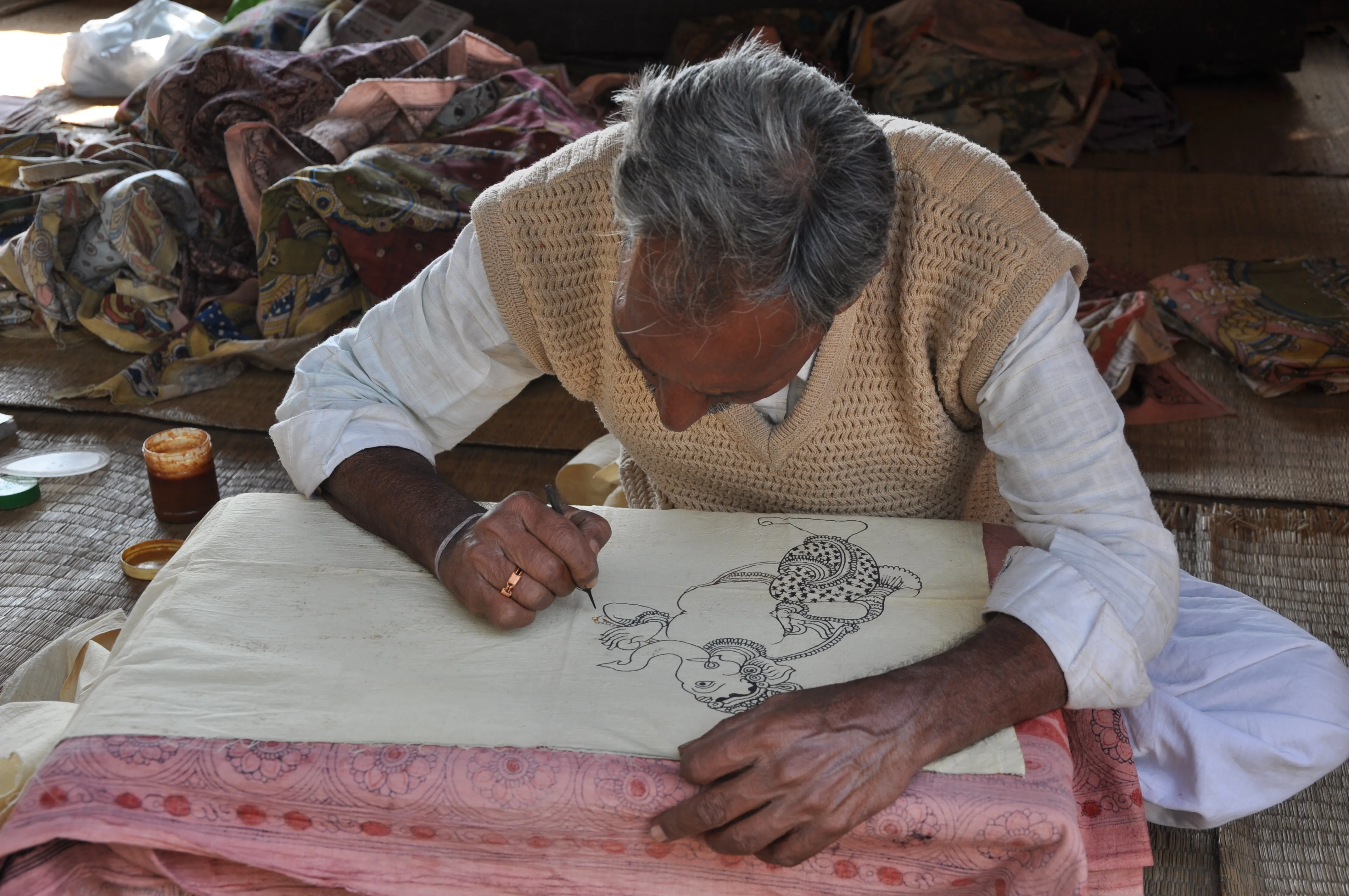
The 23-stage process of Srikalahasti Kalamkari is among the most technically complex natural-dye textile traditions in India. The fabric (cotton) is soaked overnight and then beaten to remove starch. It is treated with a mordant mixture of buffalo milk and myrobalan fruit dust and dried in the sun. An outline sketch is made with charcoal derived from tamarind twigs. The black outlines are drawn using kasimi, a liquid prepared from iron filings fermented in jaggery solution, applied with the bamboo kalam. The kasimi process produces the characteristic sharp black outlines of the tradition. Alum is then applied as a mordant to areas intended to receive red dye. The fabric is boiled in madder dye solution to develop the red and pink areas. Blue is applied using indigo in a cold fermentation vat. Yellow is obtained from pomegranate peel or myrobalan. The fabric is washed in the Swarnamukhi River after each dye stage.
Mediums Used
The materials used in Srikalahasti Kalamkari are: hand-spun or mill-woven cotton fabric; bamboo or date palm kalam with cotton tip; kasimi (iron-based black drawing medium prepared from iron filings, jaggery, and water); alum mordant; natural dyes including madder root (red), indigo (blue), pomegranate peel and myrobalan (yellow), and their combinations; and buffalo milk with myrobalan as fabric preparation medium.
New Outlook
Srikalahasti Kalamkari has maintained a connection to its temple-art origins while also adapting to contemporary markets in decorative arts, fashion, and home textiles. International interest in natural dye textiles has contributed to demand for the tradition in niche markets. Design collaborations between Kalamkari artisans and fashion designers have produced garment collections that have received exposure in national and international fashion events. The production-cum-training centre at Panagal and the Weavers' Service Centre at Srikalahasti continue to provide institutional infrastructure for the tradition.
Learn Kalamkari (Srikalahasti style)
Bibliography
Sources
Jayakar, Pupul. The Earthen Drum: An Introduction to the Ritual Arts of Rural India. National Museum, 1980.
Crill, Rosemary. Chintz: Indian Textiles for the West. Victoria and Albert Museum, 2008.
Krishna, Nanditha, and M. Amirthalingam. Sacred Plants of India. Penguin Books, 2014.
Lynton, Linda. The Sari: Styles, Patterns, History, Techniques. Thames and Hudson, 1995.
Image Sources
"Srikalahasti Collection." Indoartisans, https://indoartisans.com/collections/srikalahasti?srsltid=AfmBOopvLaNFkghynfFo7En6wS4rJ3zejM08xSKZr1Z3cyotm9zKljPV. Accessed 10 July 2026.
"Srikalahasti Kalamkari." Wikipedia, https://en.wikipedia.org/wiki/Srikalahasti_kalamkari. Accessed 10 July 2026.
"Kalamkari Work – Srikalahasti: Introduction." D'Source Digital Online Learning Environment for Design, https://www.dsource.in/resource/kalamkari-work-srikalahasti/introduction. Accessed 10 July 2026.
"Kalamkari Work – Srikalahasti: Introduction." D'Source Digital Online Learning Environment for Design, https://www.dsource.in/resource/kalamkari-work-srikalahasti/introduction. Accessed 10 July 2026.
"Srikalahasti Is Famous for Kalamkari, a Method of Painting Natural Dyes on Cloth." Alamy, https://www.alamy.com/stock-photo-srikalahasti-is-famous-for-kalamkari-a-method-of-painting-natural-88245665.html. Accessed 10 July 2026.