

Updated 14 November 2026
Search for a Madhubani painting online and the prices make no sense. One listing asks ₹500 for a 22 x 30 inch canvas. Another asks ₹20,000 for something that looks almost the same. A third, by a Padma Shri painter, does not even fit on the same chart.
The prices are not random. A Madhubani painting's price comes from a handful of things you can check: how big it is, what it is painted on, what colours were used, which style it follows and, more than anything, who painted it. This guide puts real listed prices side by side and explains what you are paying for at each level, so you can tell a fair price from a strange one.
| Madhubani painting | |
|---|---|
| Also called | Mithila painting |
| Home | Madhubani, Darbhanga and the wider Mithila region of Bihar |
| Legal protection | Registered with India's GI Registry as Madhubani Paintings, application 37 (IP India) |
| Styles | Bharni, Kachni, Tantrik, Godna, Kohbar |
| Surfaces | Mud walls and floors, now also handmade paper, cloth and canvas (Bihar Tourism) |
| Who it supports | About 20,000–25,000 artisan families in Madhubani district and other parts of Bihar (Bihar Tourism) |
Why Madhubani prices swing so much
A hand-painted Madhubani beside a mechanical copy · Image source: Rooftop
Madhubani is one of the most copied art forms in India. Its bold outlines, flat colour and repeated borders are easy to imitate and easy to print. So the same image can reach you as a printed poster, a fast hand-painted decor piece from a workshop far from Bihar, a careful sheet by a village painter, or a museum-grade work by a master. All four get called Madhubani.
The Government of Bihar describes the form as synonymous with the art and craft of the state, painted with fingers, twigs, brushes, nib-pens and matchsticks, using natural dyes and pigments (Bihar Tourism). Bihar Bhawan's note on the state's GI products dates the Geographical Indication for Madhubani Paintings to 2007 (Bihar Bhawan). A GI ties the name to the region. It does not stop a decor manufacturer in another city from selling something it calls Madhubani, which is why the cheapest end of the market looks the way it does.
Madhubani painting prices: what real listings ask
These are prices from live listings, picked to show each level of the market. Prices change, so treat them as markers, not quotes.
| What you are buying | Size and surface | Listed price | Where it was listed |
|---|---|---|---|
| Decor canvas from a non-Mithila manufacturer | 22 x 30 in, canvas | ₹500 a piece, before tax | IndiaMart, a Mumbai decor maker |
| Hand-painted sheet sold through the government portal | Paper, size not stated | ₹3,200 (₹3,500 before discount) | IndiaHandmade, Ministry of Textiles |
| Madhubani learning kit | 12.9 x 9.5 in kit | ₹5,399 | Rooftop Madhubani Art Kit |
| Large sheet in natural colours | 30 x 22 in, handmade khadi paper | ₹6,499, before tax | IndiaMart, a New Delhi seller |
| Hand-painted Madhubani saree from Bihar's livelihood mission | Cotton saree | ₹6,999 | BRLPS JEEViKA shop, Government of Bihar |
| Framed canvas at a furniture retailer | 39 x 29 in, framed canvas | ₹20,799 (listed MRP ₹51,998) | WoodenStreet |
| Work by a Padma Shri master | 30.9 x 24.5 in, acrylic on canvas | Top of Rooftop's Madhubani range | Life in the Fisherfolk Community by Dulari Devi |
Two of these rows deserve a closer look. The ₹500 canvas is listed as handmade, but it comes from a decor manufacturer in Mumbai, nowhere near Mithila. And the government's own IndiaHandmade portal, set up by the Ministry of Textiles to let artisans sell without middlemen, prices a hand-painted Madhubani sheet at a little over ₹3,000. That gap of six times between two hand-painted pieces is mostly the gap between a factory and a village painter's day.
On Rooftop's own Madhubani shelf the spread is just as wide. The cheapest listing costs about a twentieth of Dulari Devi's large canvas. Each Rooftop listing shows its current price on the page.
The five things that set the price
1. Size
Size is the first thing to check, and the most honest. 22 x 30 inches, a standard full sheet of handmade paper, turns up again and again across sellers. Smaller works are often a half or a quarter of that sheet. Larger canvases, long scrolls and multi-panel sets sit above it.
When you compare two prices, compare them at the same size. A ₹3,000 sheet and a ₹6,500 sheet are not far apart if the second one is twice the area.
2. Surface
Paper, cloth and canvas each cost different amounts and behave differently. Handmade paper, sometimes washed with cow dung, gives the soft, slightly uneven ground that Mithila painters grew up with. Canvas is sturdier and is what most decor retailers sell. A painted saree or dupatta adds the cost of the fabric and the risk of painting on something you cannot redo.
3. Colours
Natural colours take time. Painters grind and mix them from plants, flowers, soot and minerals, and they are slower to lay down evenly. Acrylics come from a tube. Neither is wrong, and many fine painters use acrylic today. But a listing that says natural colours and charges the same as an acrylic decor piece should make you ask questions.
4. Style
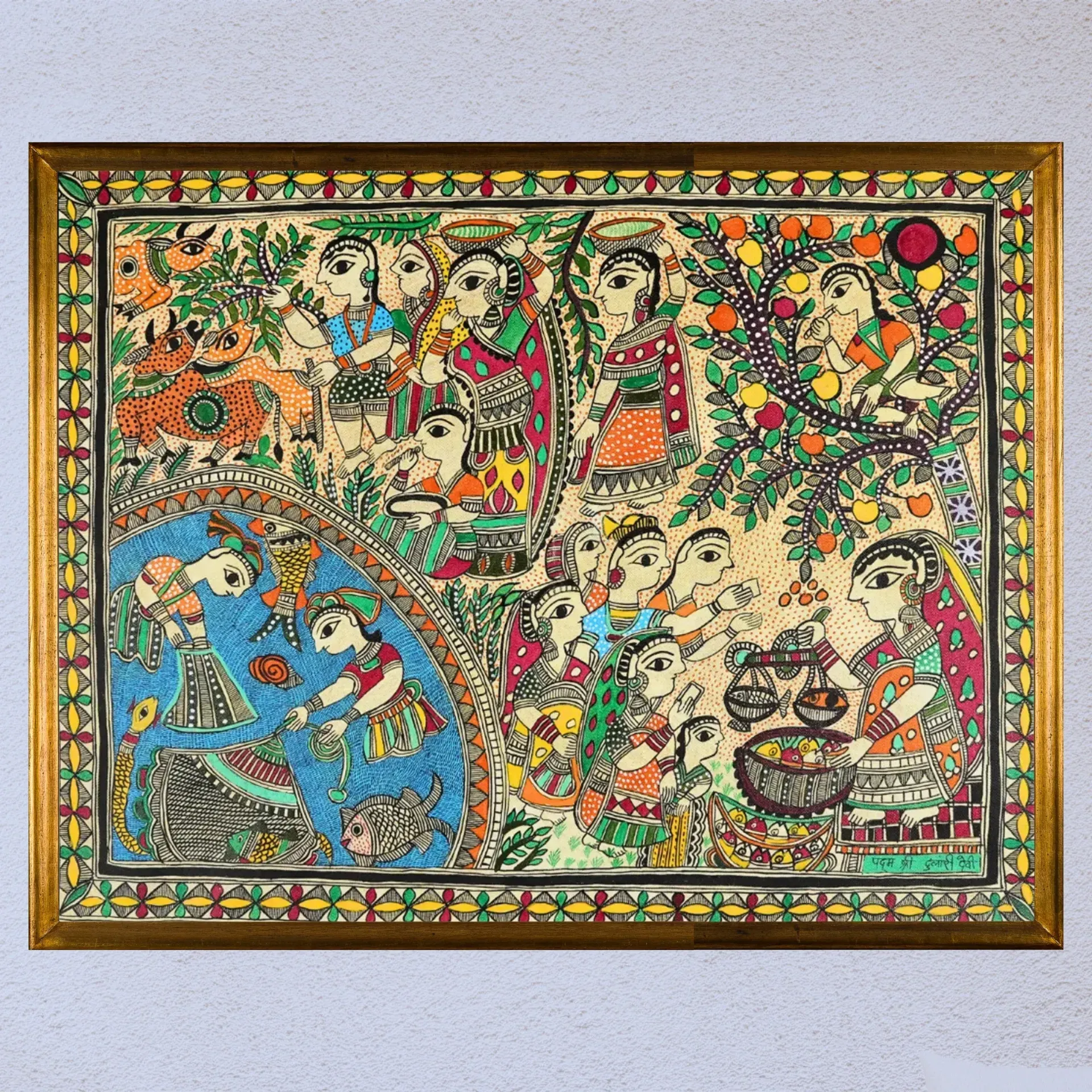
The Madhubani styles, from fine Kachni line to bold Bharni fills · Image source: Rooftop
The five styles take very different amounts of work. Kachni is built from fine lines and hatching, often in one or two colours, and a dense Kachni sheet can take far longer than a bold Bharni piece of the same size. Bharni fills shapes with solid colour inside strong outlines. Tantrik, Godna and Kohbar each carry their own symbols, and a full Kohbar, the marriage painting with its lotus, bamboo and fish, is one of the most complex compositions in the tradition.
A good example on Rooftop is the Godna painting by Ambika Devi, who learned Madhubani from her mother at twelve. Godna borrows the tattoo patterns of Mithila women, so the whole sheet is made of repeated fine marks.
5. The painter
This is the biggest single factor, and it is where most of the price difference at the top end comes from.
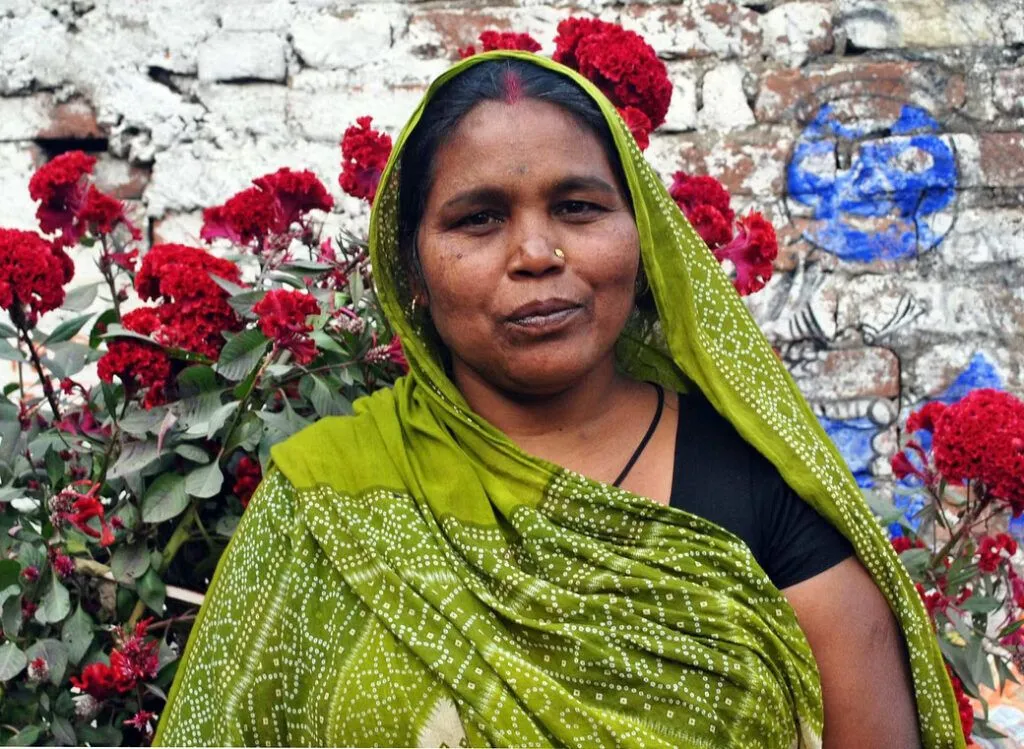
Padma Shri Dulari Devi · Image source: Rooftop
Dulari Devi comes from a fishing community in Ranti village and worked as a domestic helper in the home of the masters Mahasundari Devi and Karpoori Devi, where she learned to paint. She received the Bihar State Award in 2012 and the Padma Shri in 2021. Her painting Life in the Fisherfolk Community shows boats, nets and families on the river she knows, at 30.9 x 24.5 inches on canvas. A work like this is priced for the hand, the story and the record of the person who made it.
Madhubani price by artist seniority
The same size and surface can carry very different prices depending on who painted it. Here is how seniority usually shows up in a listing.
| Painter's standing | What you are paying for | What to check on the listing |
|---|---|---|
| Unnamed workshop or factory | Speed and quantity | Usually no artist name, no village, identical stock photos |
| Village painter, often a woman painting at home | Real hand-painting, regional style | A name and a village, some variation between pieces |
| Established painter with a body of work | Consistent quality, a recognisable hand | Several works by the same painter, exhibitions |
| State or National Award winner | Recognised mastery | The award and the year |
| Padma Shri artist | One of the form's leading names | The name on a government honours list, a long record |
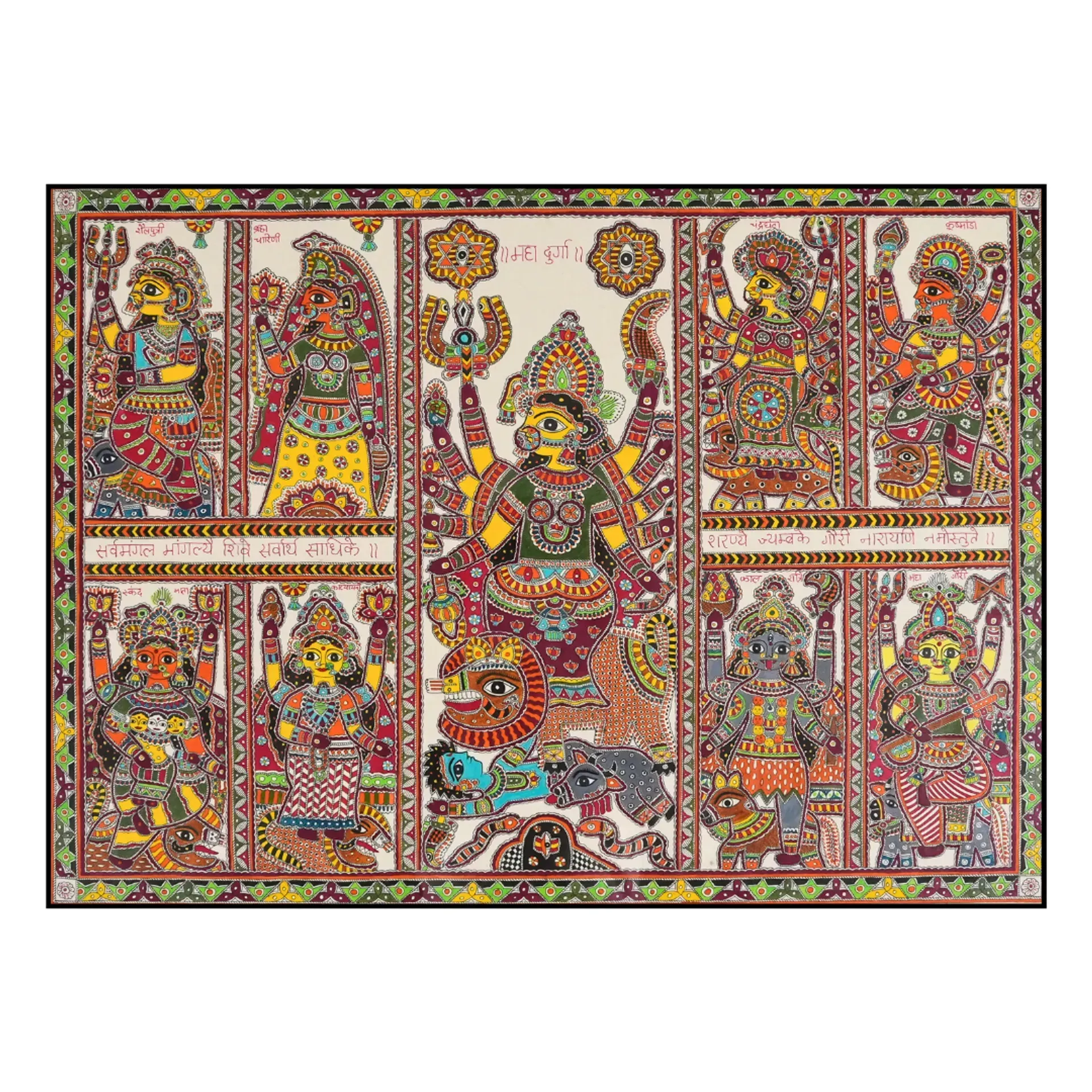
Rooftop's Madhubani painters sit across this range. Hema Devi's Navadurga shows the nine forms of Durga in the Bharni style using natural colours. The nine-painting Navadurga set and Doli-Kahaar, a wedding procession with the bride carried in a palanquin, show how subject and scale change the price within one tradition.
Is the price fair? Five quick checks
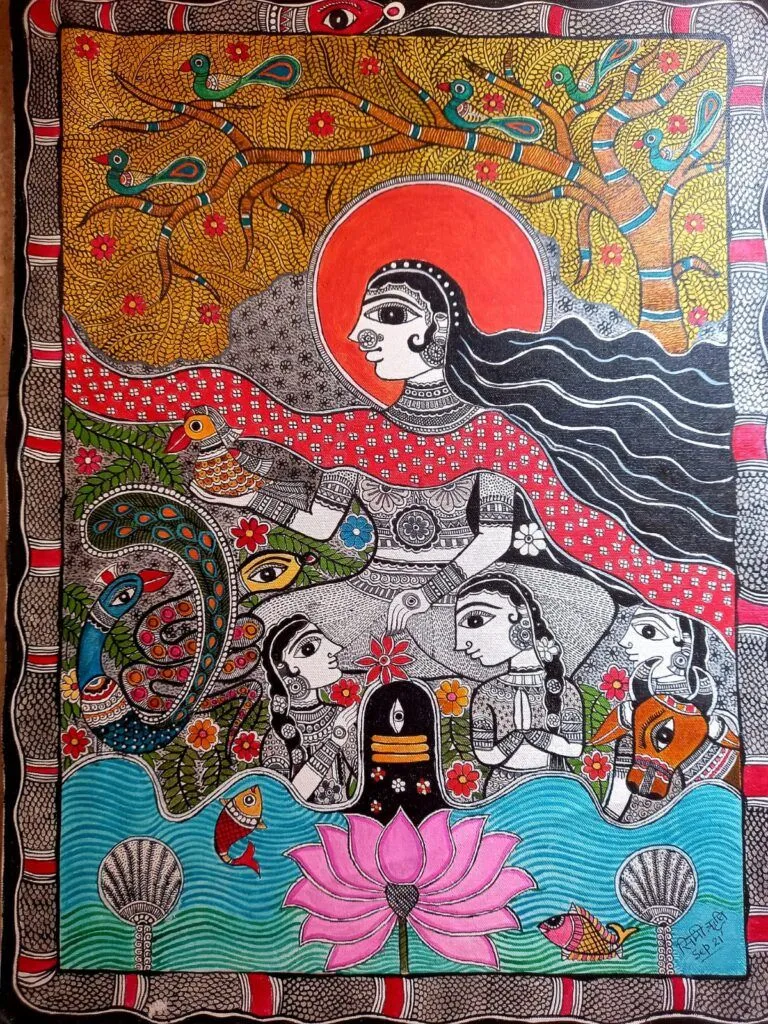
Signs of a handmade Madhubani painting · Image credit: International Indian Folk Art Gallery, via Rooftop
Before you pay, run through these.
- Does the listing name the painter and their village? A real Madhubani painter has both.
- Do the size and surface match the price band above? A large canvas for a few hundred rupees is almost certainly not what it claims.
- Is the line work uneven in the way a human hand is uneven? Perfectly identical borders suggest a print or a stencil.
- Does the seller say how the artist is paid? Rooftop artists earn a royalty on every sale.
- Is there a certificate of authenticity that names the artist?
Our guide on how to buy authentic Madhubani paintings goes deeper into spotting a handmade work, and the Madhubani Art Wiki explains the styles and their history.
What older Madhubani paintings show us about value
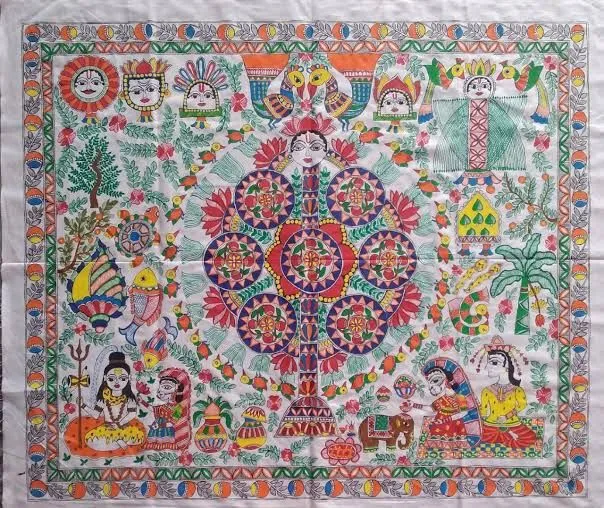
A Kohbar Ghar painting, made for the wedding room of a Mithila home · Image credit: International Indian Folk Art Gallery, via Rooftop
Madhubani began on the mud walls of Mithila homes, and the Kohbar painted for a wedding room is still one of its most complex compositions. Museums abroad began collecting Mithila paintings on paper in the 20th century, after the form moved off village walls. The Cleveland Museum of Art holds a group of them, small sheets in ink and colour, many showing women, gods and animals in the same bold outline painters use today. One of them, a large multi-armed figure, measures 36.5 x 28 cm, about 14 x 11 inches.
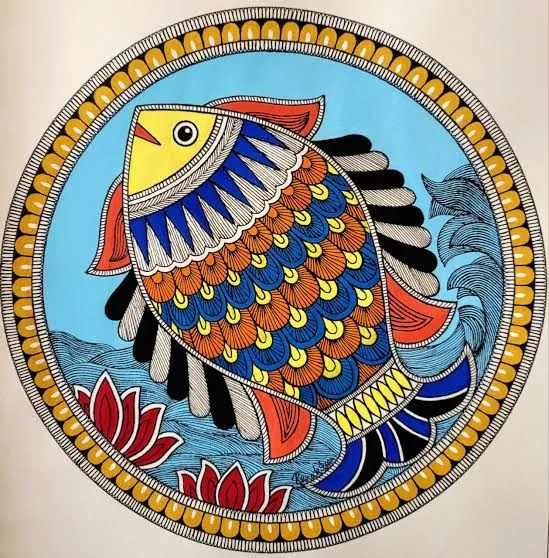
A Madhubani fish, the motif of fertility and plenty · Image credit: International Indian Folk Art Gallery, via Rooftop
Some of the most collected Madhubani work is small. Size sets a floor for the price, but the hand sets the ceiling.
Where your money goes
When you buy from a decor manufacturer, most of the price pays for the factory, the shop and the margin. When you buy from a village painter through a middleman, the painter's share can be small. The government's IndiaHandmade portal was set up precisely to cut out intermediaries, and JEEViKA, the Government of Bihar's rural livelihoods mission, sells hand-painted Madhubani sarees through its own shop.
On Rooftop, every Madhubani painting is hand-painted by a verified artist named on the listing, ships with a certificate of authenticity, and pays the artist a royalty on the sale.
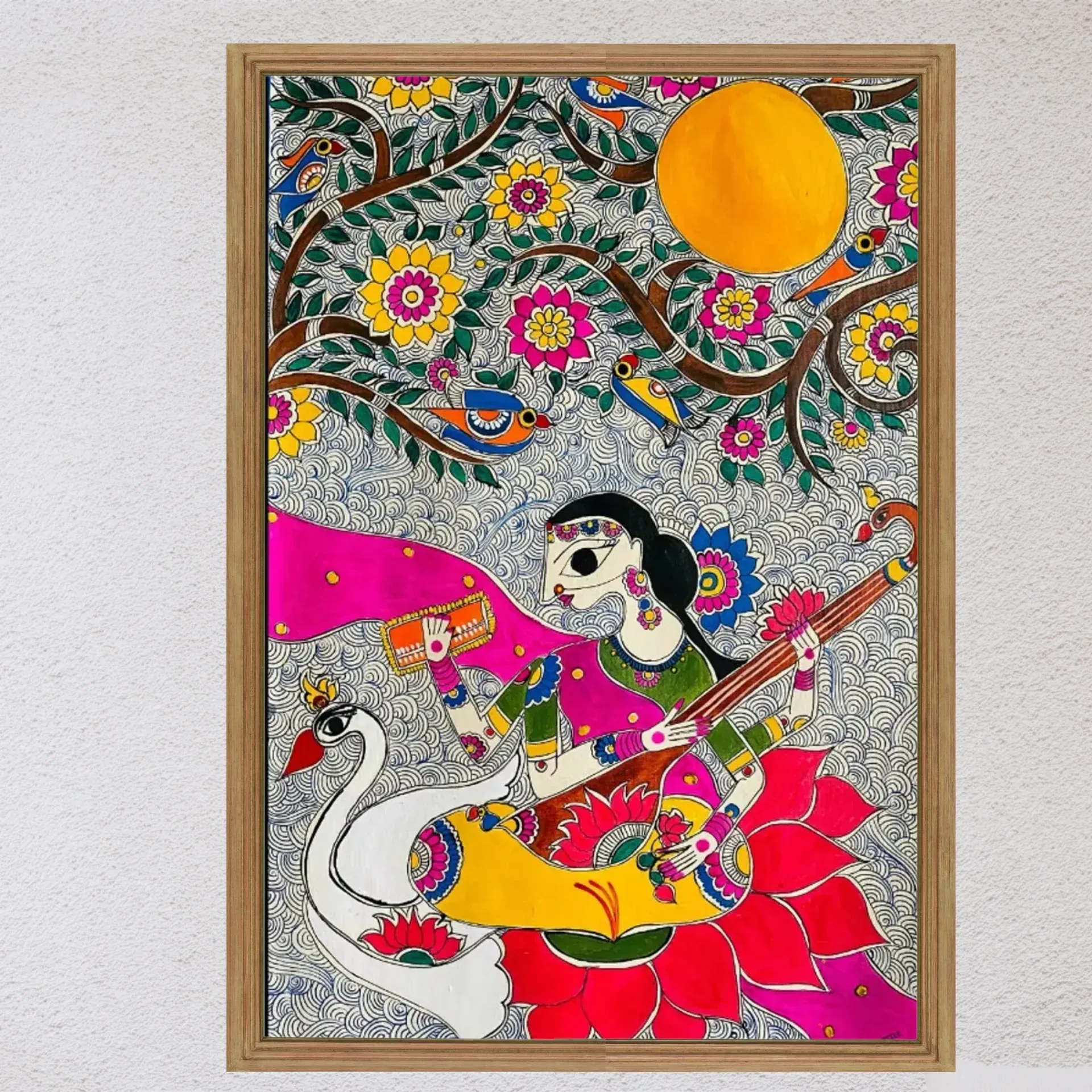
Madhubani Saraswati Painting, hand-painted Madhubani on Rooftop · Image source: Rooftop
Budget guide: what your money buys
Under ₹1,000, expect decor pieces, prints and fast workshop canvases. Some will be hand-painted, many will not come from Mithila, and very few will name a painter.
Around ₹3,000–7,000, you can buy a genuine hand-painted sheet from a Mithila painter, often on handmade paper, sometimes in natural colours. This is the best value band for a first original.
Above ₹10,000, you are paying for size, framing, a recognised painter, or all three. Check which one before you pay.
At the top, works by award-winning masters like Dulari Devi are priced as collector's pieces.
If you would rather make your own, the Madhubani course by Dulari Devi teaches the borders, Bharni and Kachni from the painter herself, and every Madhubani painting on Rooftop names its painter.
Frequently asked questions
What is the price of a Madhubani painting in India?
Listed prices run from about ₹500 for a mass-made decor canvas to ₹3,000–7,000 for a genuine hand-painted sheet from a Mithila painter, and around ₹20,000 for large framed canvases at decor retailers. Works by award-winning masters such as Padma Shri Dulari Devi cost more again.
Why are some Madhubani paintings so cheap?
Very cheap pieces are usually printed or painted quickly in a decor workshop, often outside Bihar. A real Madhubani painting takes a painter hours or days, and the price reflects that time.
Does natural colour make a Madhubani painting more expensive?
Usually yes. Natural colours take time to prepare and apply evenly, so a sheet in natural pigments often costs more than an acrylic piece of the same size.
Is Madhubani painting GI tagged?
Yes. Madhubani Paintings are registered with India's GI Registry under application 37, which links the name to the Mithila region of Bihar.
How do I know I am paying a fair price?
Check that the listing names the painter and their village, compare prices at the same size and surface, look for the unevenness of real hand-painting, and ask for a certificate of authenticity that names the artist.