
How to Buy Authentic Madhubani Paintings
How to Buy Authentic Madhubani Paintings: Why Most Online Listings Are Not What They Claim
Learn how to identify authentic Madhubani paintings, understand their traditional styles, spot handmade details, and make informed choices when buying Mithila art.

Rooftop
Author
Few traditional art forms are as widely celebrated, or as frequently reproduced, as Madhubani painting, also known as Mithila art. Originating in the Mithila region of Bihar and Nepal, the art form is known for its distinctive geometry, double outlines, intricate patterns, and vibrant themes. Its growing popularity, however, has also led to an increase in factory-made prints, screen-printed reproductions, and tourist-market copies being sold alongside handmade works.
For first-time buyers, telling a hand-painted Madhubani artwork from a mechanical reproduction can be difficult, especially when shopping online. Knowing what to look for in the artwork, materials, colours, and finer details can help buyers make more informed choices while supporting the artisans who continue to practise the tradition.
Why This Confusion Is Worse for Madhubani Than Other Art Forms
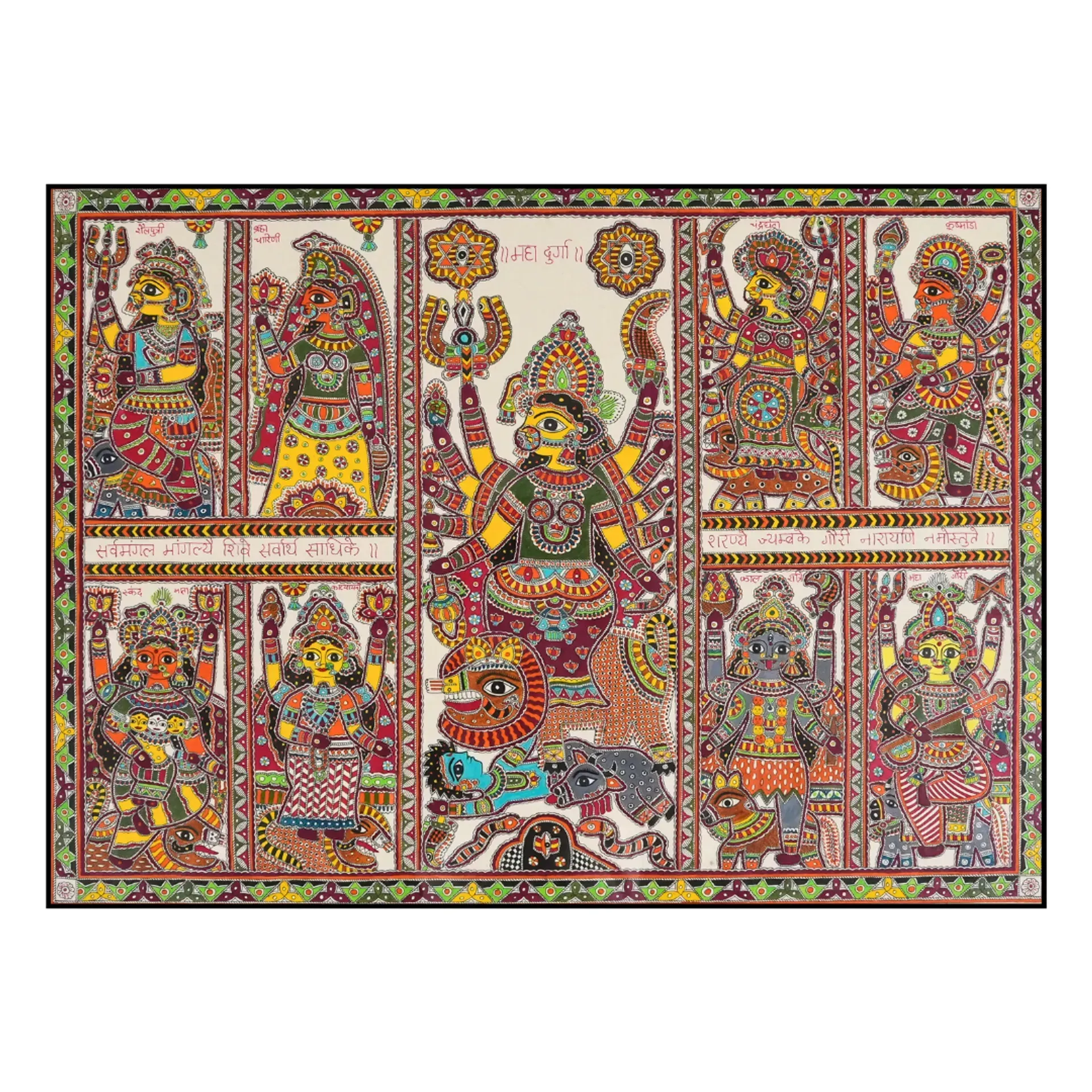
Real vs Mechanical Madhubani
Madhubani paintings can be difficult to authenticate because some of their most recognisable features are relatively easy to reproduce mechanically. Three factors make this especially important for buyers:
- Distinctive Lines and Flat Colours: Madhubani styles such as Kachni and Bharni rely heavily on defined outlines, patterned details, and areas of solid colour. These visual elements can be photographed, digitally traced, and reproduced on paper, canvas, fabric, or home décor with considerable consistency. A printed copy may therefore look convincing at first glance, even though it contains none of the hand-painted work of the original.
- The Distance Between Artisan and Buyer: Much of Madhubani painting continues to be practised in Bihar, including areas around Madhubani and Darbhanga. When an artwork reaches an online marketplace or a shop far from its place of production, buyers may have little information about who painted it, where it was made, or whether it was actually produced by hand. This makes clear artist information and provenance particularly useful when evaluating a purchase.
- The Price Difference Between Handmade and Printed Work: Producing a single hand-painted Madhubani artwork requires an artist's time and labour, while a digital reproduction can be printed repeatedly once the original image has been digitised. Both may be sold with similar-looking imagery, but they represent very different products. Understanding this distinction helps buyers assess whether the description, materials, pricing, and claims about the artist make sense together.
Five Markers of an Authentic Handmade Work
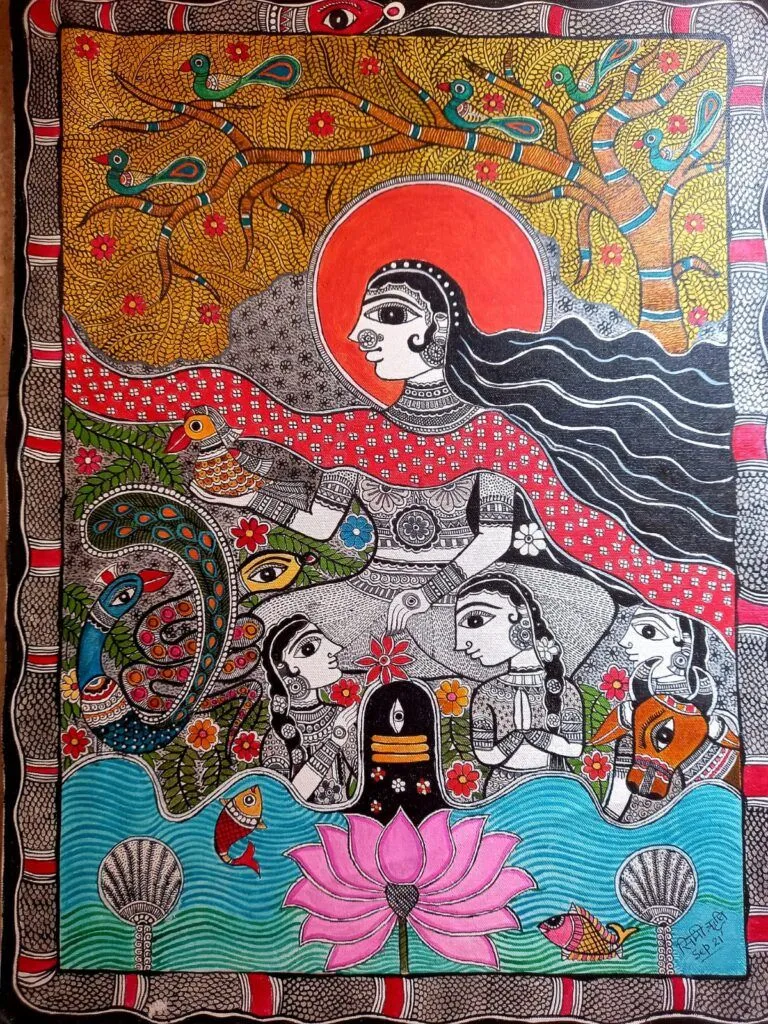
Handmade Madhubani Signs Credits - International Indian Folk Art Gallery
A Madhubani painting reveals something of the artist’s hand in the way its lines, colours, patterns, and surface come together. When buying a piece, look beyond the overall image and pay attention to the small details that are difficult to reproduce consistently by machine.
- Variation in the Lines: Traditional Madhubani paintings are drawn by hand, often using simple tools such as bamboo or reed pens and fine brushes. As the artist moves across the surface, the pressure and movement of the hand naturally change. Look for slight variations in line thickness, curves, and tapering rather than perfectly uniform outlines.
- The Way Colour Meets the Line: In a hand-painted work, colour is applied by the artist within carefully drawn forms. Small variations where the colour meets an outline, along with subtle differences in coverage, can reveal the process of painting by hand. These details may be especially noticeable when viewed closely.
- The Surface Beneath the Painting: The material itself can tell you something about the artwork. Madhubani paintings may be created on handmade paper, cloth, or other prepared surfaces, depending on the artist and style. Look closely at the paper or fabric for its natural texture, fibres, and variations rather than assuming that every authentic work must have the same type of ground.
- Hand-Drawn Motifs and Patterns: Borders, flowers, fish, birds, leaves, and other recurring Madhubani motifs are built through repetition, but hand-drawn repetition is rarely perfectly identical. Slight differences in spacing, shape, or angle can indicate that the elements were drawn individually rather than mechanically duplicated.
- The Overall Surface: Finally, look at the painting as a physical object. Handmade works can carry subtle variations in colour, texture, and application across the surface. A completely uniform finish, particularly when combined with identical repeated elements and a smooth printed appearance, may warrant a closer look at whether the piece is a reproduction.
The Styles and What They Tell You About Price
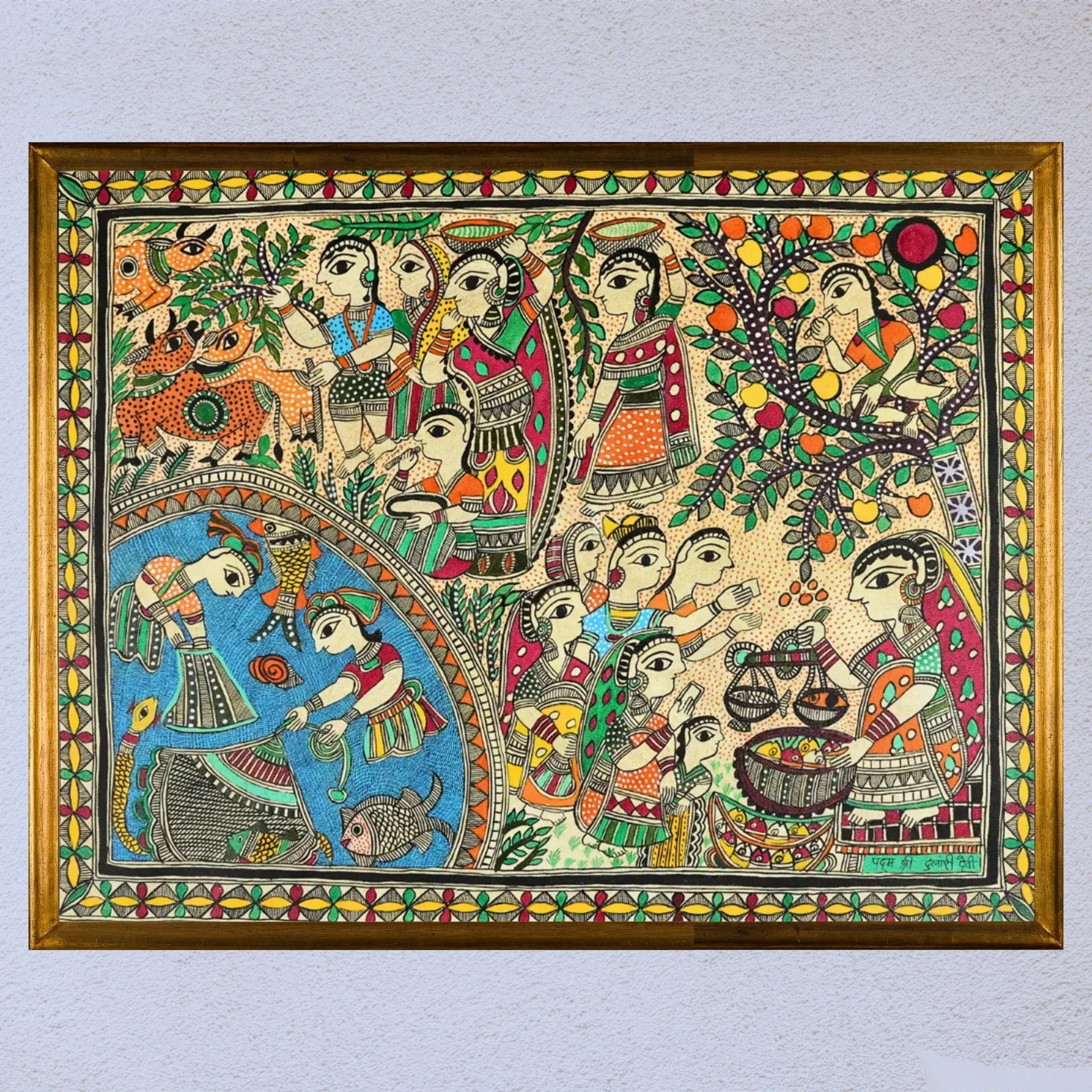
Different Style Madhubani Art
Madhubani painting encompasses several traditional styles, each distinguished by its approach to line, colour, subject matter, and pattern. Understanding these styles can help buyers appreciate what they are looking at and better understand how technique, time, and complexity can influence the value of a painting.
Kachni
Kachni is defined by delicate line work, often using monochrome or limited colours. Artists create shading, texture, and intricate patterns through fine hatching and cross-hatching rather than large areas of colour. The amount of detailed line work can make a Kachni painting particularly time-consuming to execute.
Bharni
Bharni is known for bold colour fills enclosed by strong outlines. Traditional Bharni paintings often feature religious and mythological subjects, including figures associated with Rama, Sita, Krishna, and Durga. Carefully filling these areas with colour gives the paintings their distinctive visual character.
Tantrik
Tantrik Madhubani focuses on sacred imagery, deities, yantras, and other forms of spiritual symbolism. Figures such as Kali and Surya appear in this style, alongside compositions based on established symbolic forms and geometric arrangements. Understanding these symbols adds another layer to appreciating a Tantrik painting.
Godna
Godna draws from the tattoo traditions of communities in the Mithila region. The style uses fine lines and repeated patterns to depict animals, plants, trees, circles, and other natural forms. Its visual language connects Madhubani painting with older traditions of body art and carries an important social and cultural history.
Kohbar
Kohbar is closely associated with marriage rituals and traditionally decorated the nuptial chamber. Its compositions feature auspicious symbols connected with fertility and prosperity, including the bamboo plant (bans), lotus, fish, turtles, sun, and moon. These elements come together in elaborate compositions with strong ceremonial significance.
Questions Every Buyer Should Ask
Looking closely at the painting is only part of the process. Before buying, it is worth asking the seller a few simple questions about the artist and how the work was made. A seller who works directly with artists should be able to answer these clearly.
- Who painted this artwork? Ask for the artist’s name and, where relevant, their village or district in the Mithila region. A specific artist story is far more useful than a broad description such as “Bihar folk art.”
- Was the entire painting made by hand? Find out whether the artwork was painted from start to finish by hand or whether a printed image was used as a base and then finished with hand-painted details.
- What materials did the artist use? Ask about the paper or fabric, colours, inks, and other materials used to create the piece. This can also help you understand how the artwork was made and cared for.
- Can you provide details about the artist and the artwork? If the seller provides a Certificate of Authenticity, check whether it includes useful information such as the artist’s name, title, dimensions, medium, and other identifying details.
- How do you work with the artist? A good seller should be able to explain where the artwork came from and how they source it. If they work directly with artists or artisan communities, ask how that relationship works and whether they can share information about the artist.
Choosing the Right Madhubani Painting
Once you know what to look for in a Madhubani painting, the next step is finding a seller who provides the same level of clarity about the artwork and the artist behind it. Details such as the artist’s name, location, style, materials, and provenance should be easy to find rather than something a buyer has to piece together.
This is also where platforms such as Rooftop can make the buying process easier. Its Madhubani collection features works sourced from artists in Bihar, with information about the artist and the style used in each piece. Purchases also come with artist documentation and a Certificate of Authenticity, giving buyers a clearer understanding of what they are collecting and who created it.
When buying traditional art, that transparency matters. It helps ensure that the value of a Madhubani painting is connected to the artist’s work, skill, and story rather than simply the image printed on the surface.