

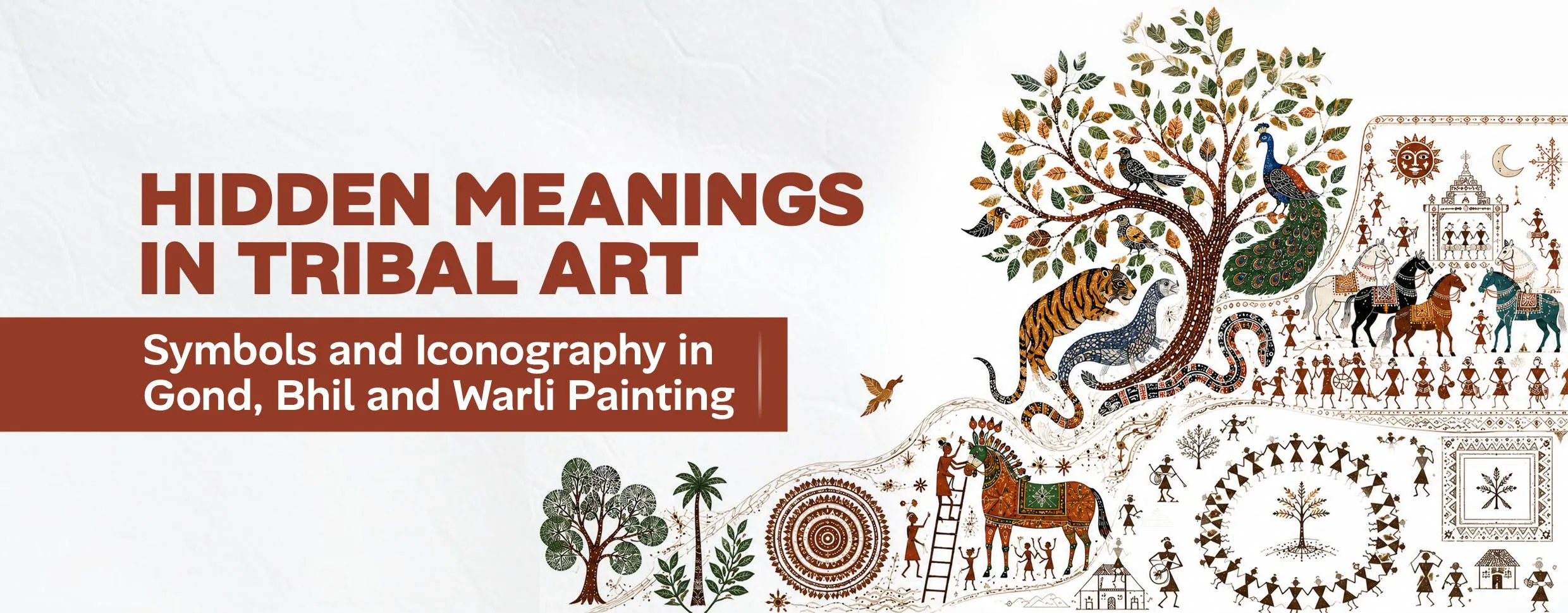
Hidden Meanings in Tribal Art: Symbols and Iconography in Gond, Bhil and Warli Painting
The symbols in Gond, Bhil, and Warli painting are not decorative. They are a complete visual language carrying cosmology, ritual, and community identity. A reader's guide to seeing tribal art as a text.

Rooftop
Author
There is a particular pleasure in standing before a Gond, Bhil, or Warli painting and letting the visual energy wash over you without trying to understand it. The rhythmic patterning of dots and lines, the dense composition of figures, the way every inch of the surface seems to hum with movement. You can admire any of these traditions for that experience alone, and many viewers do. What most do not realise is that they are standing in front of a complete symbolic system, not a decorative one. Every element carries specific meaning, and the meaning is layered, deliberate, and rooted in centuries of community knowledge.
Learning to read tribal painting changes the experience of looking at it entirely. The peacock is no longer just a beautiful bird. The tree is no longer just a tree. The triangle is not a geometric shape but a body, a mountain, or a sacred enclosure depending on how it sits within the composition. The dots are not decoration but ancestors. Once you know the grammar, you cannot unsee it. Each tradition has its own visual language and its own way of encoding the things that matter most to the community that made it.
Why Tribal Visual Languages Developed and What They Do
It helps to understand why these visual languages came into being. Many tribal communities in India did not historically have a written script. Knowledge, history, mythology, genealogy, ritual, and cosmology were transmitted through oral storytelling, song, and visual marking. A painting on the wall of a Gond home, a Pithora mural in a Bhil household, a Warli composition prepared for a wedding, all of these were doing work that elsewhere would have been performed by written texts. The visual language was the script. The symbols were the alphabet.
Rooftop’s long-form essay on shape language and storytelling in Indian tribal art makes this point well: tribal forms convey complex messages through simple, repeated geometric forms, and the ability to read them depends on understanding the system they belong to.
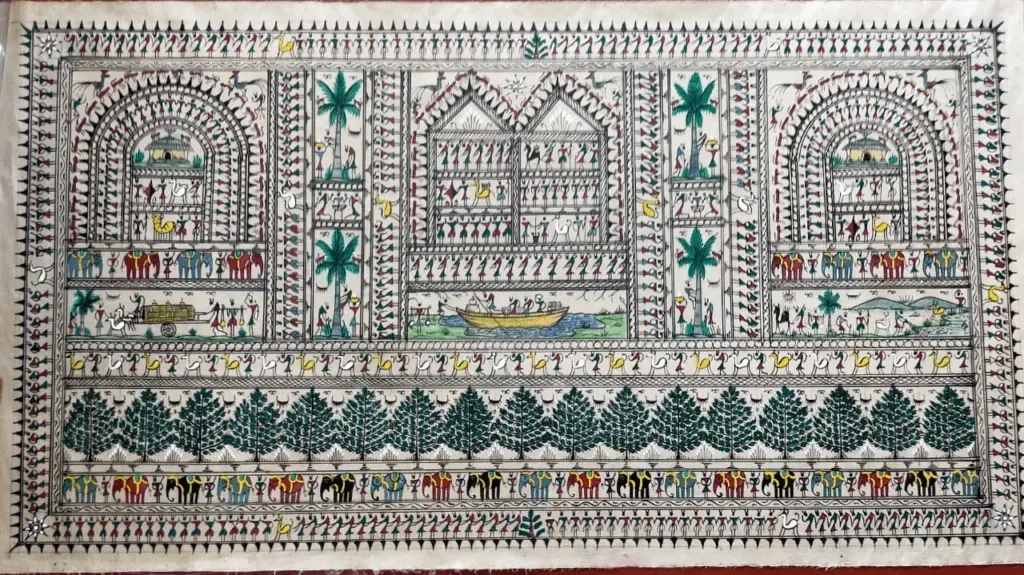
An intricate Saura painting (image source: indianfolkart.org)
Symbols in tribal painting do several things at once:
- Ritual protection: specific motifs were painted at doorways or walls to invite blessings or ward off harm.
- Fertility and abundance: imagery related to crops, livestock, marriage, and childbirth was used to invoke prosperity.
- Cosmological mapping: compositions arranged figures, deities, and natural elements in ways that placed the household inside a larger spiritual order.
- Community identity: symbols specific to a clan, region, or kin group functioned as markers of belonging and continuity.
Because these languages did this kind of work, they belonged to the community rather than to the individual artist. A symbol was not personal expression. It was shared knowledge, passed down through generations, authorised by the community that recognised it.
Reading Gond Art: Animals, Trees, and the Patterns Within
Gond visual language is built around the idea that depicting a thing well brings that thing’s spiritual presence into the home where the painting hangs. Every figure is therefore an invocation, not just a representation. The animals, trees, and figures that fill Gond compositions are not interchangeable. Each carries specific meaning.
The recurring sacred figures in Gond painting
- The tiger: a being of immense spiritual power, often Bagh Dev, the tiger god. A guardian, a respected force, never merely admired aesthetically.
- The peacock: associated with celebration, beauty, fertility, and the joy of being alive. Often signals abundance and good fortune.
- The serpent: frequently the Satbehni Saanp or seven-sister serpent. Carries protective and cosmic associations and signifies continuity.
- The fish: a symbol of fertility and water, often appearing near depictions of rivers and trees.
- The tree: particularly the sacred Saja, where Badadev, the supreme creator force, is invoked. The Mahua appears as a symbol of sustenance and feminine sacred energy.
The intricate dot and line patterning that fills the body of every figure in Gond painting is not decoration applied after the outline. It is the central symbolic act of the form. The pattern is what communicates that the figure is alive in the spiritual sense, that it carries soul rather than being mere shape. The denser the patterning, the more energy the artist is bringing into the image. A Gond painter does not draw a peacock and then decorate it. They draw a peacock by means of the pattern, because without the pattern the peacock would not be alive.
In Gond art, pattern is not surface. Pattern is what makes the figure real.
Reading Bhil Art: The Pithora Mural and Its Cast of Gods
Bhil visual language is dominated by the dot. The whole compositional surface is built from thousands of carefully placed coloured dots, each understood to represent an ancestor or a spirit. The act of placing each dot is itself an act of remembrance and devotion.
If you want a fuller picture of the cosmology behind the form, this Rooftop entry on Bhil tribal art sets out the community’s history, geographic spread across Madhya Pradesh, Gujarat, Maharashtra, and Rajasthan, and the religious framework in which the painting operates.
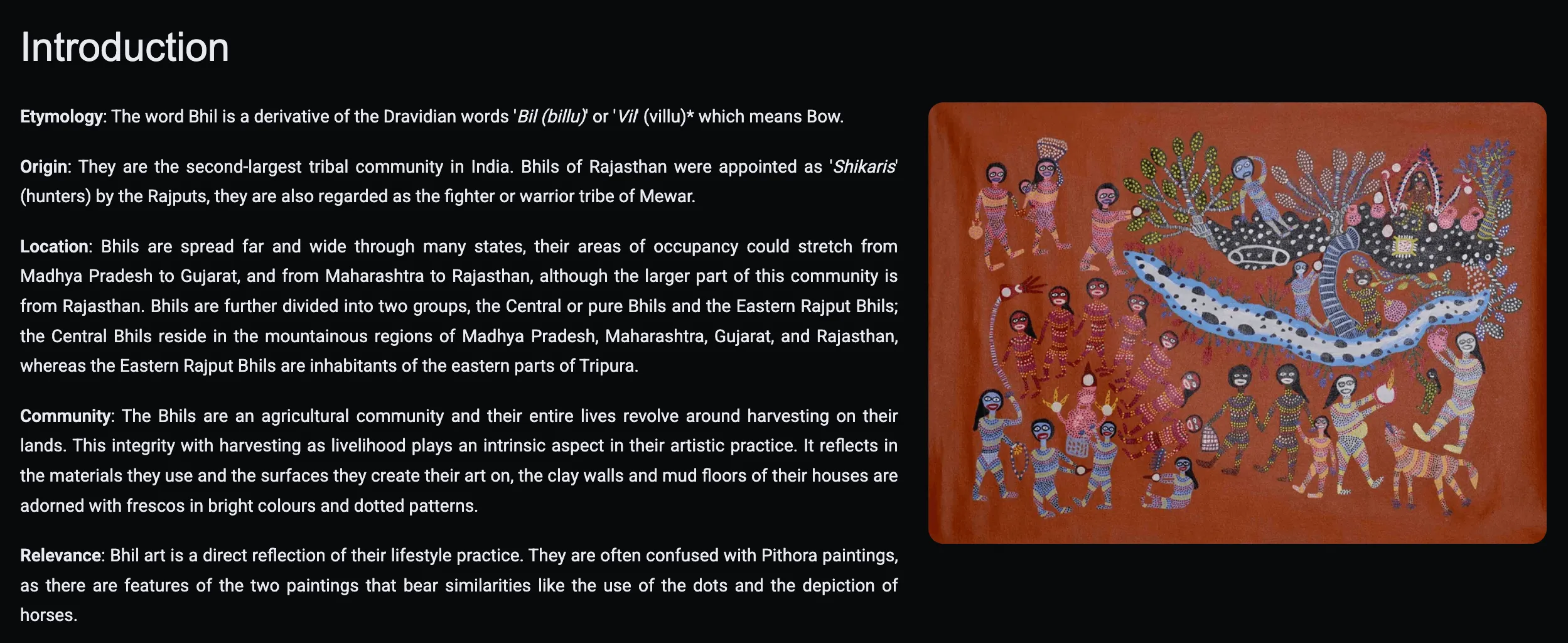
Within the Bhil tradition, the most symbolically charged form is the Pithora mural. A Pithora is commissioned to fulfil a vow made to the deity Pithora Baba, typically at moments of transition or crisis: a marriage, a recovery from illness, a successful harvest, the fulfilment of a long-held prayer. The painting is made on the inner wall of the home by a male priest-painter known as a Lakhara, who is the only person ritually authorised to execute it. The painting is not decorative. It is the offering itself.
The figures that populate a Pithora composition
- Horses in long processions, representing the deity’s vehicle and the journey of the soul.
- Pithora Baba and an entourage of associated deities arranged across a flat, vivid colour field.
- The sun and the moon, signalling cosmic time and the witnessing presence of the heavens over the household.
- Wedding processions, signifying the social bonds and continuities the painting is meant to honour.
- Animals, ancestors, and human figures distributed across the composition in ways that map the wider spiritual world of the community.
The overall arrangement is read by the Bhil community as a complete cosmological diagram. The household commissioning the painting is located inside this diagram, with their lives, their wishes, and their ancestors all visible within the same composition. Lado Bai, one of the most important contemporary Bhil artists, has described her early work as featuring the sun, moon, deer, Pithora Baba, snakes, and Mother Earth, painted with cow dung and coloured soil before the eventual move to canvas.
Reading Warli Art: The Circle, the Triangle, and the Dance
Warli visual language is the most minimal of the three traditions, and arguably the most demanding to read because so much meaning is carried by so few elements. The form, set out in the Rooftop entry on Warli art, builds its entire visual vocabulary from three basic shapes.
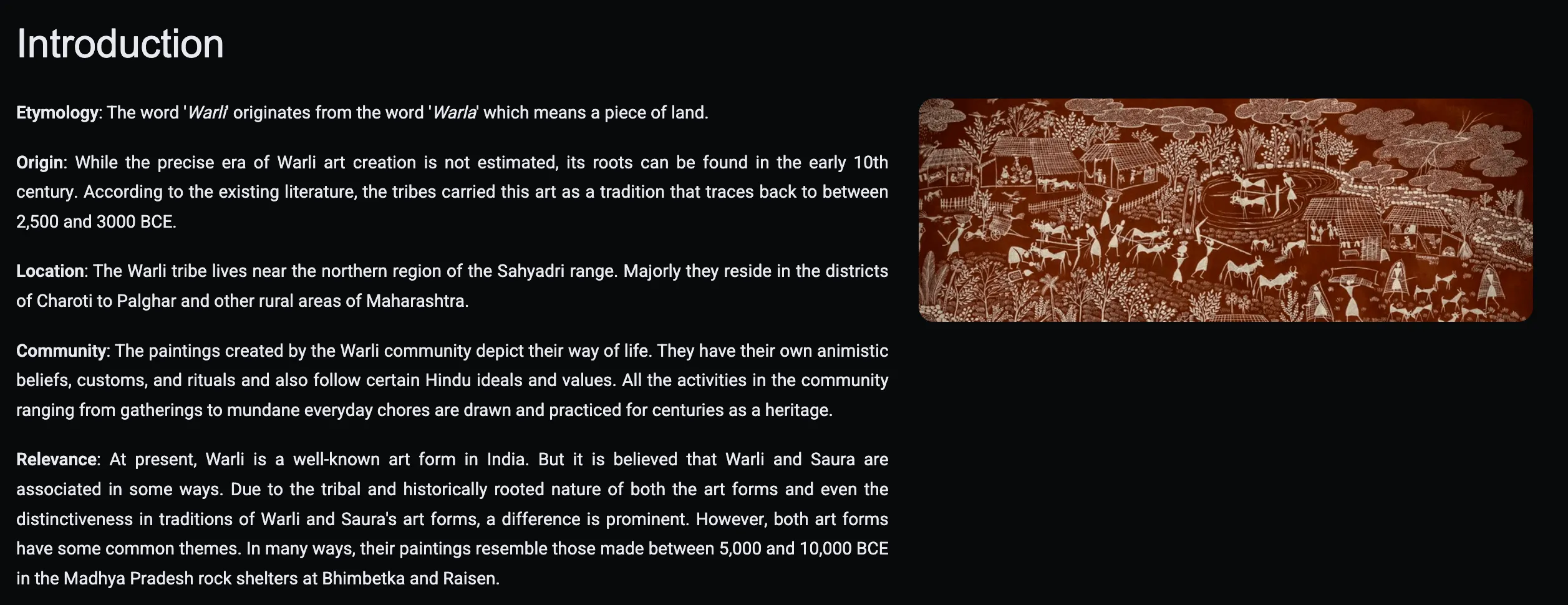
The geometry of meaning in Warli
- The circle: represents the sun and the moon, cyclical time, and continuity. When figures gather in concentric circles around a central player, as in the tarpa dance, the circle becomes a symbol of community and the cyclical flow of life.
- The triangle: represents both the human form, built from two triangles joined at their points, and the natural world, particularly mountains. The same shape carries two meanings depending on context.
- The square: represents an enclosure, a sacred space, or a threshold. Most importantly, it represents the chaukat at the centre of a ritual composition.
The chaukat is the most symbolically dense element in Warli painting. It is a sacred square placed at the centre of compositions made for major ritual occasions, particularly weddings. Inside the chaukat sits Palaghata, a mother goddess associated with marriage, fertility, and the continuity of the household. The chaukat functions as both a literal threshold within the visual composition and a spiritual one within the ritual. The painting is the door through which the marriage passes.
The tarpa dance, the recurring scene where men and women link hands and circle a tarpa player who plays a long trumpet-like instrument, carries its own layered meaning. It is a celebration of community. It is a reminder of the cyclical structure of time, since the dance has no beginning and no end. It is also a ritual marker, performed at harvest, weddings, and seasonal festivals. When you see the tarpa dance in a Warli painting, you are looking at a portrait of social continuity itself.
Where the Three Traditions Overlap and Where They Diverge
Once you start reading these languages, the overlaps and divergences become fascinating. All three traditions share core concerns. All three communities used painting to invoke fertility, protect the household, honour ancestors, and place the family inside a larger natural and spiritual order. All three understood the natural world as a living network of beings with whom humans existed in mutual relationship. All three treated painting as ritual practice rather than pure aesthetics.
The divergences are equally meaningful. Each visual language reflects the specific geography, pantheon, and social structure of the community that built it. Gond painting, rooted in the heavily forested belt of central India, fills its compositions with the dense ecology of the forest and assigns spiritual presence to its animals and trees. Bhil painting, drawing on an agricultural community spread across western and central India, organises its compositions around social ritual and ancestral remembrance, with the dot as the unit of devotion. Warli painting, made by an agrarian community of the Northern Sahyadri range, builds its language around the geometric clarity of communal life.
What this reveals is the genuine plurality of tribal visual culture in India. There is no single tribal aesthetic. There are dozens of distinct visual languages, each shaped by a different relationship with land, community, and the sacred. To treat them as interchangeable is to miss almost everything.
Symbols in the Contemporary Market and the Risk of Losing Their Meaning
The growing urban market for tribal art has created both opportunity and risk for the artists carrying these languages forward. The opportunity is obvious. Recognition, income, and international visibility for artists like Bhuri Bai, Lado Bai, Jangarh Singh Shyam, and Jivya Soma Mashe has fundamentally changed what is possible for tribal painters. The risk is more subtle, and it concerns precisely the symbolic grammar this article has been describing.
Tribal symbols are increasingly reproduced without context. A Warli triangle pattern appears on a fashion-house textile. A Gond peacock motif features on a furniture catalogue cover. A Bhil dot pattern is silkscreened onto packaging. None of these reproductions carry the meaning the original symbols held. Worse, none of them return value to the community whose visual knowledge they are borrowing. The triangle in the textile no longer marks a body or a mountain. The peacock on the catalogue no longer signals fertility or celebration. It is just a graphic.
Stripping symbols of meaning is not a neutral aesthetic choice. It is a form of cultural depletion that affects the communities whose knowledge these symbols carry.
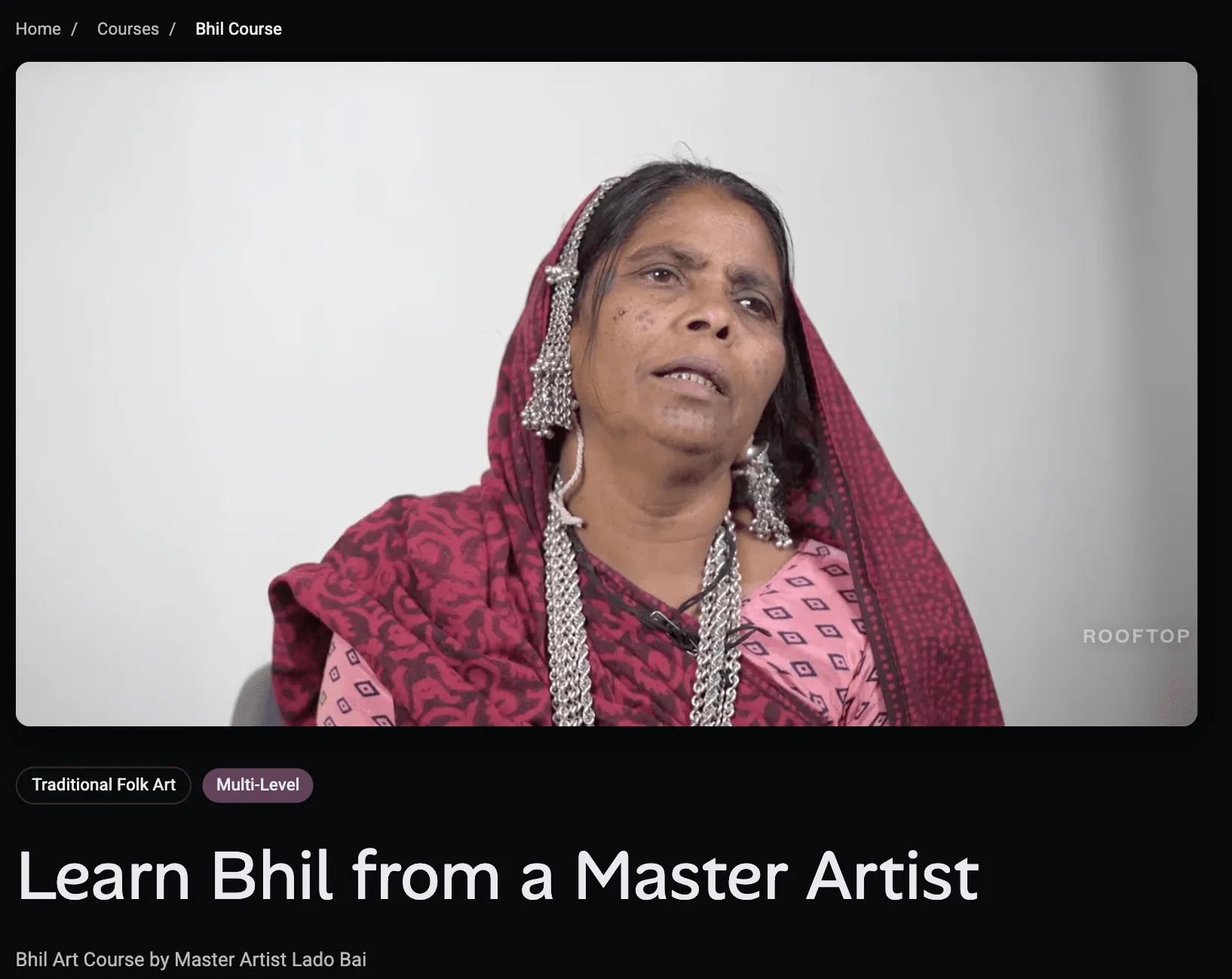
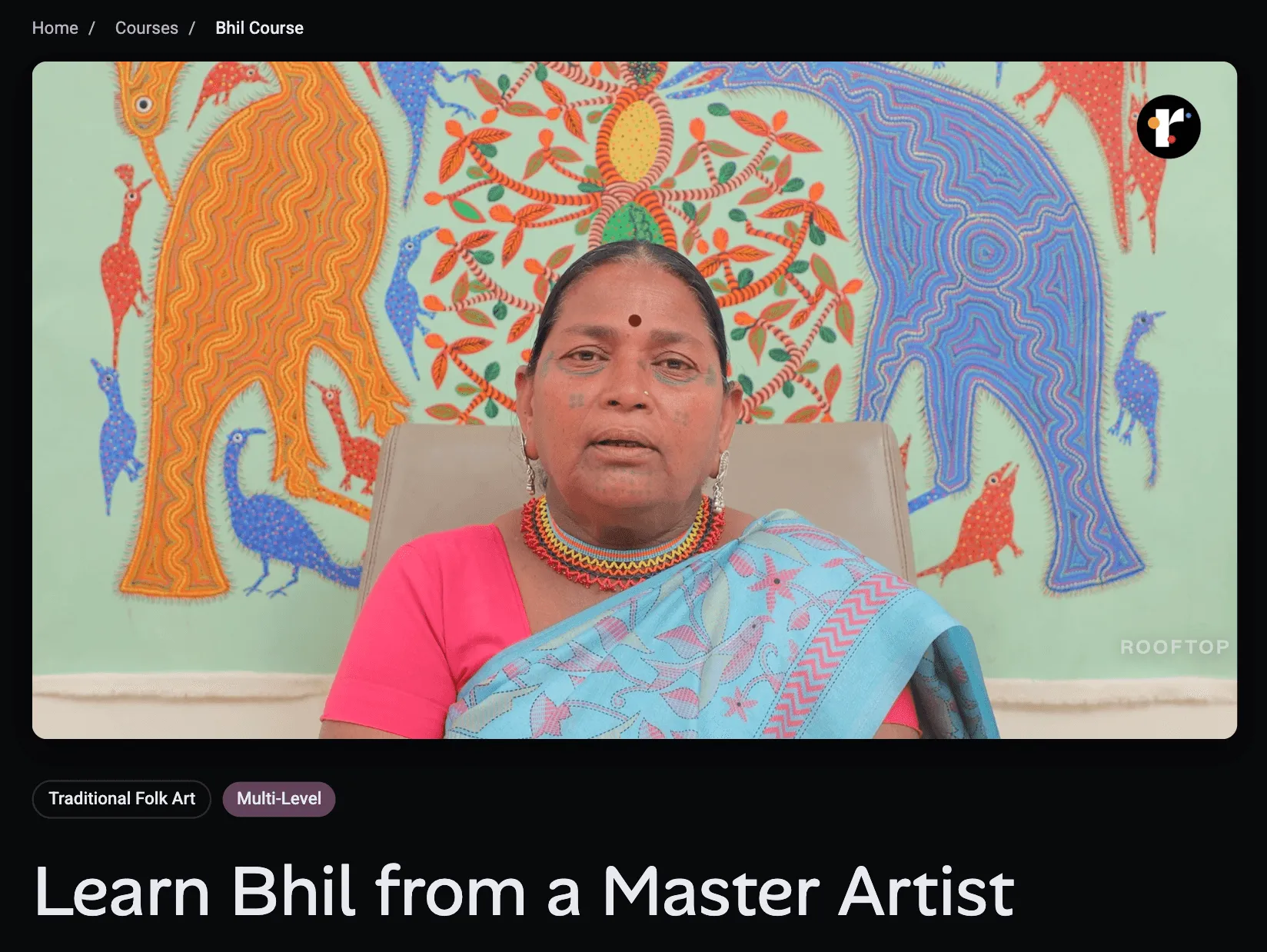
This is why training with practising masters matters. Rooftop’s online courses, including the Bhil painting course taught by Lado Bai and the Bhil course taught by Padma Shri Bhuri Bai, are built around the principle that learning these traditions means learning their meanings. Technique cannot be separated from symbolic grammar without losing the form.
For collectors, the equivalent principle is straightforward. Buy from artists who know what they are saying. Ask about the symbols in the painting before you buy it. A serious Gond, Bhil, or Warli artist will tell you what every element of a composition means, why it is placed where it is, and what it carries forward. That conversation is the difference between bringing home decoration and bringing home a text.
Every Painting Is a Text Waiting to Be Read
The next time you stand in front of a Gond painting, look at the patterning inside the animal before you look at the animal. Ask what the pattern is doing, why it is dense in some places and sparser in others, what it might be saying about presence and energy. The next time you see a Bhil painting, count the dots. Notice their colours. Read them as ancestors. The next time you see a Warli composition, find the chaukat. Trace the circles and triangles back to their meanings.
These traditions were never decorative. They were always texts. Rooftop’s paintings collection presents work by artists who know what their compositions mean and can tell you, and that conversation is where serious collecting actually begins.