
Manjusha Painting: Bihar's Ancient Serpent Art Tradition
Let's explore this tribal art form from Bihar.
Introduction and Origin
In the ancient city of Bhagalpur in Bihar, an extraordinary art form has been painted on boxes, pots, and scroll paper for more than a thousand years. Manjusha painting - named after the Sanskrit word manjusa, meaning box - is one of India's most distinctive examples of Indian folk art, tying everyday objects to mythology, ritual, and the stories of the snake deity Bishahari. Today, this deeply rooted tradition from Bihar is drawing new admirers and finding a place in art galleries, homes, and online classrooms across India.
What Is Manjusha Painting?
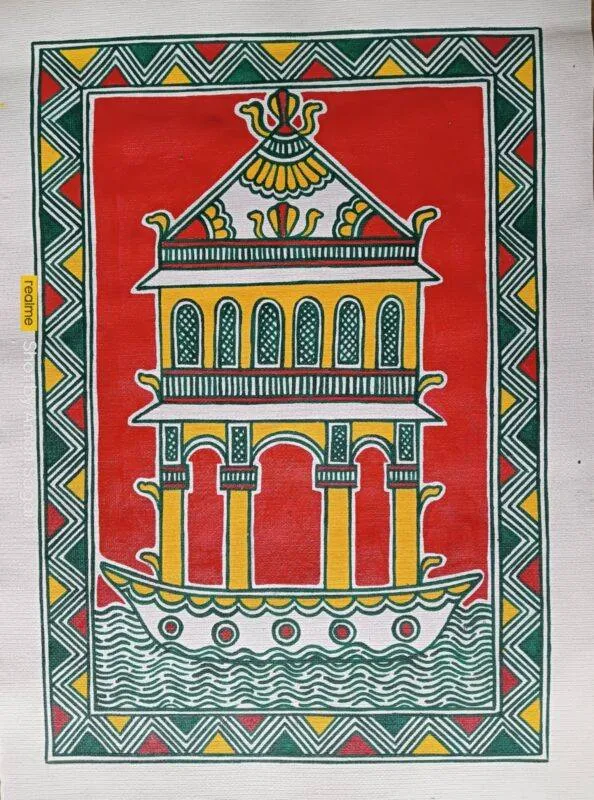
Manjusha painting is a scroll and box-based folk art from Bhagalpur, Bihar, that depicts the mythological story of Bihula-Bishahara - the legend of a devoted wife who saved her husband from a serpent deity's curse. The word manjusa literally means box in Sanskrit, and the art is painted on box structures made of bamboo and paper-mache called Manjusha boxes, as well as on scrolls, pots, and fabric. Practitioners traditionally came from two artisan communities: the Kumbhakar community, who made and decorated clay pots called Kalash, and the Malakar community, who constructed and adorned the Manjusha box structures. This Manjusha painting India tradition is visually identifiable by its use of only three colours - pink, green, and yellow - and its strict straight-line geometry, which gives figures a distinctive flat and angular appearance.
History and Origin
The origins of Manjusha painting lie in ancient Angapradesh, a region that today covers parts of Bihar, Jharkhand, and West Bengal, with Bhagalpur at its historical centre. Scholars place the art form as early as the 7th century, though it flourished most actively between 1931 and 1948. The art is believed to have grown organically from the geography of Bhagalpur - a region rich in reptiles, including rattlesnakes, which led the community to develop the Bishahari serpent deity worship as a way of making sense of and engaging with the natural world around them. The central myth, Bihula-Bishahari, also carries knowledge of Ayurvedic healing, with the story describing the immediate steps to take after a snakebite, including the use of local plants and herbs. Over time, both the Kumbhakar and Malakar artisan communities became the custodians of this tradition, and the art passed from generation to generation through active use in religious festivals and wedding rituals.
Key Features and Famous Artists
Key Features and Visual Style
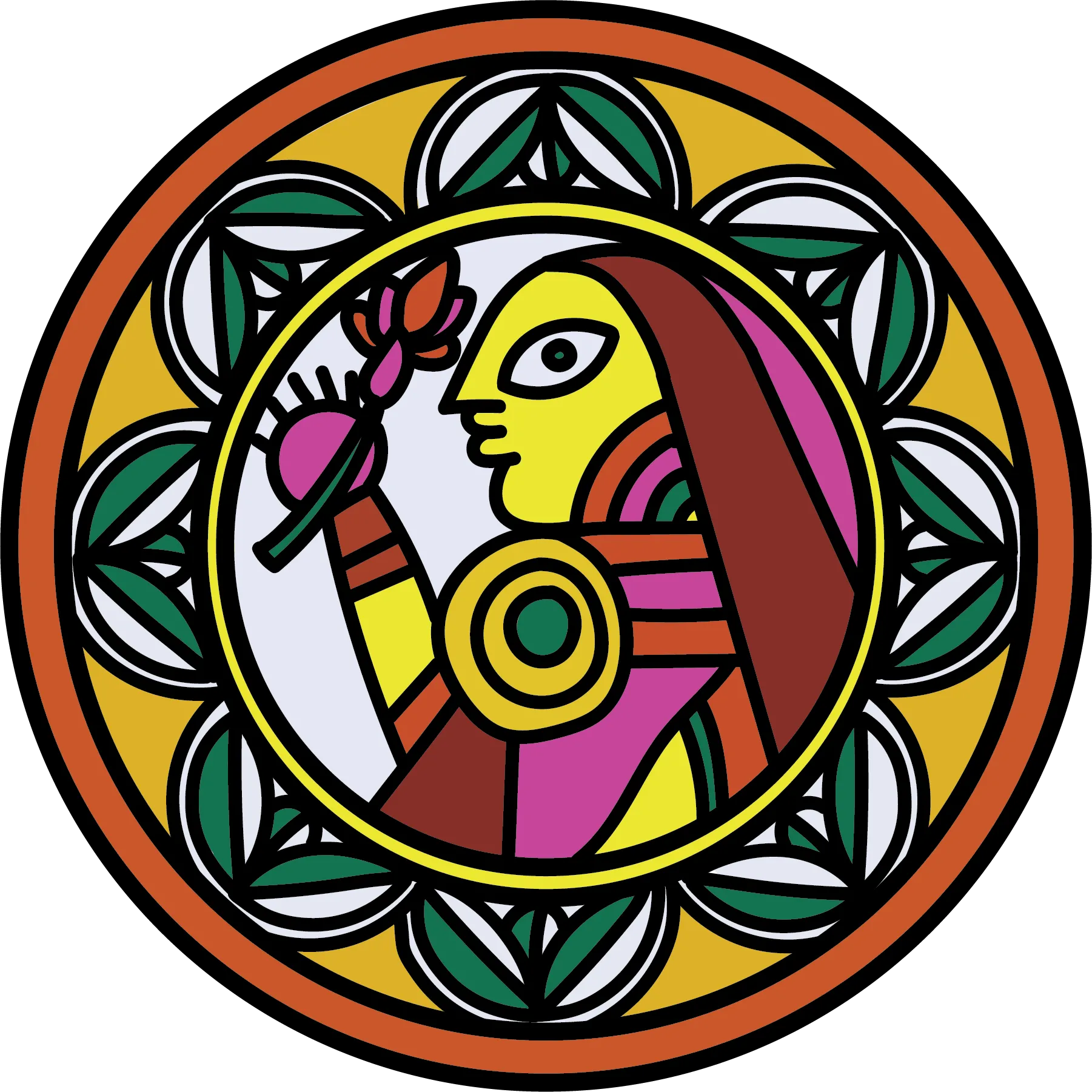
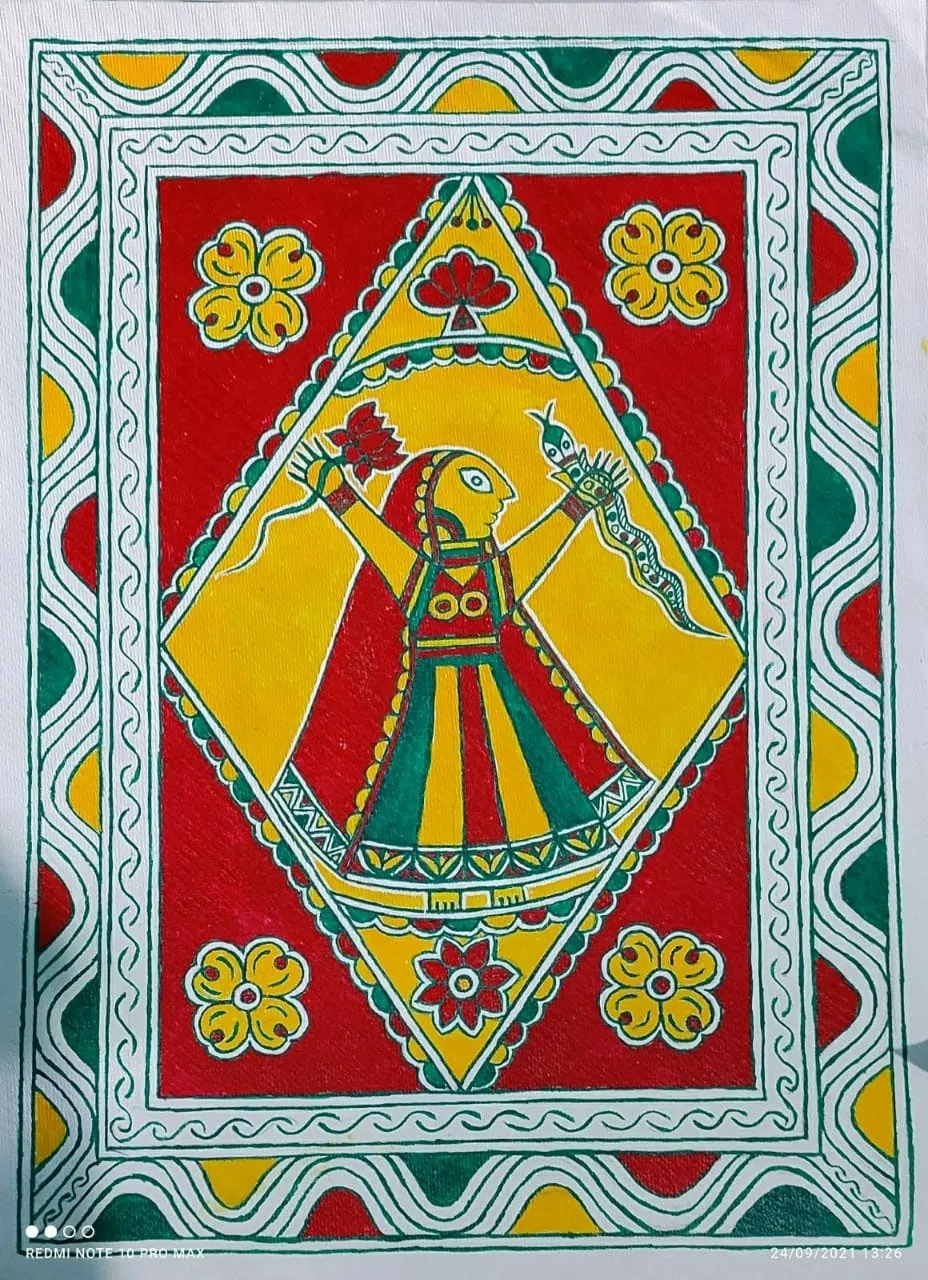
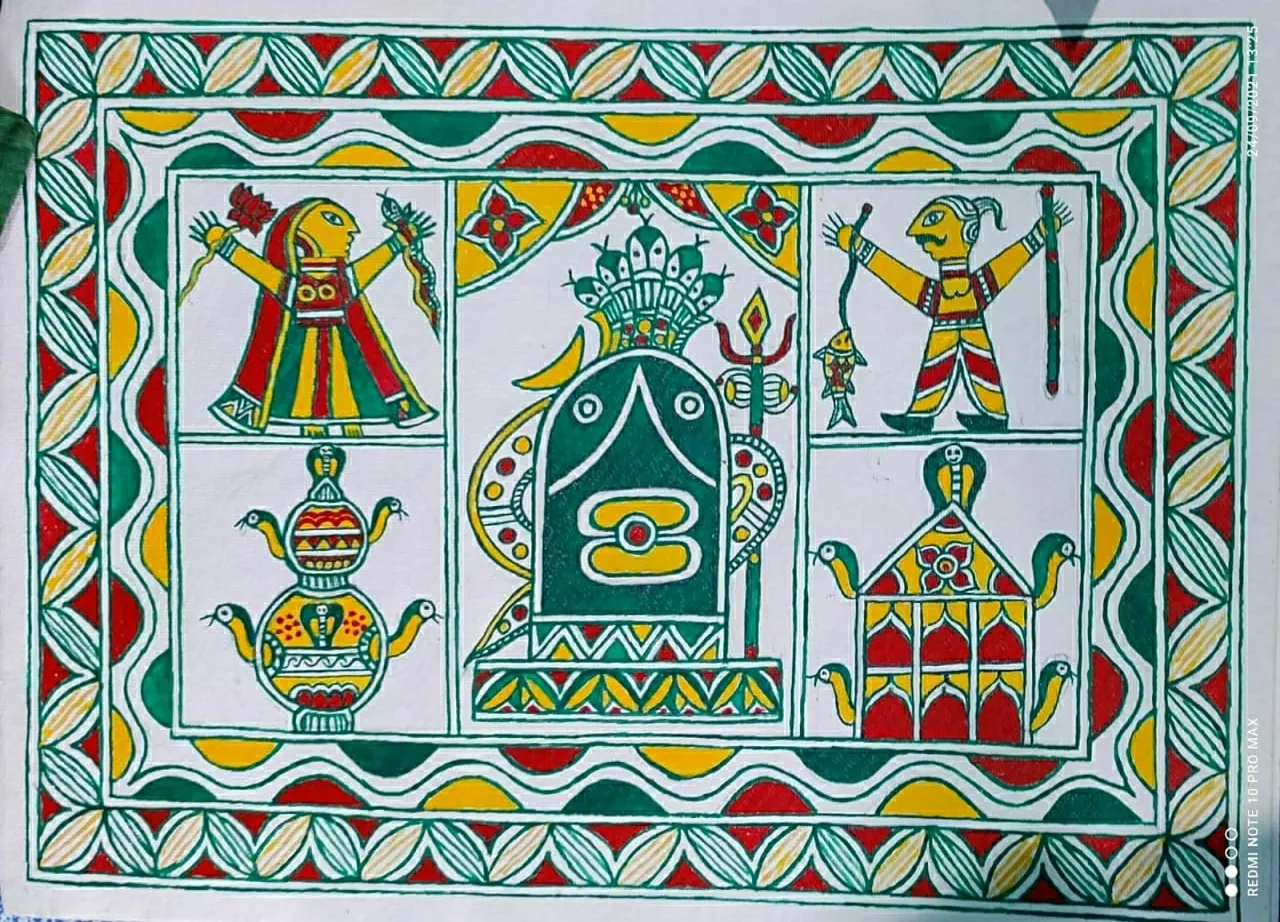
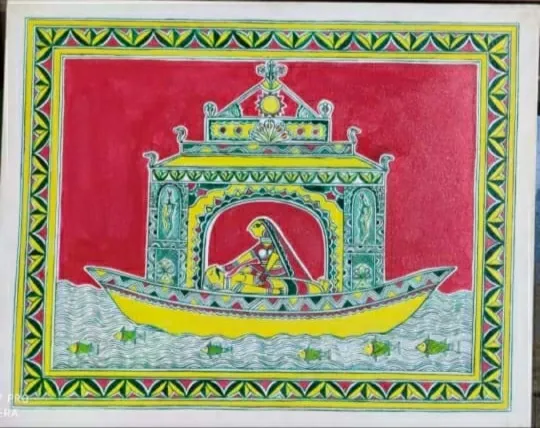
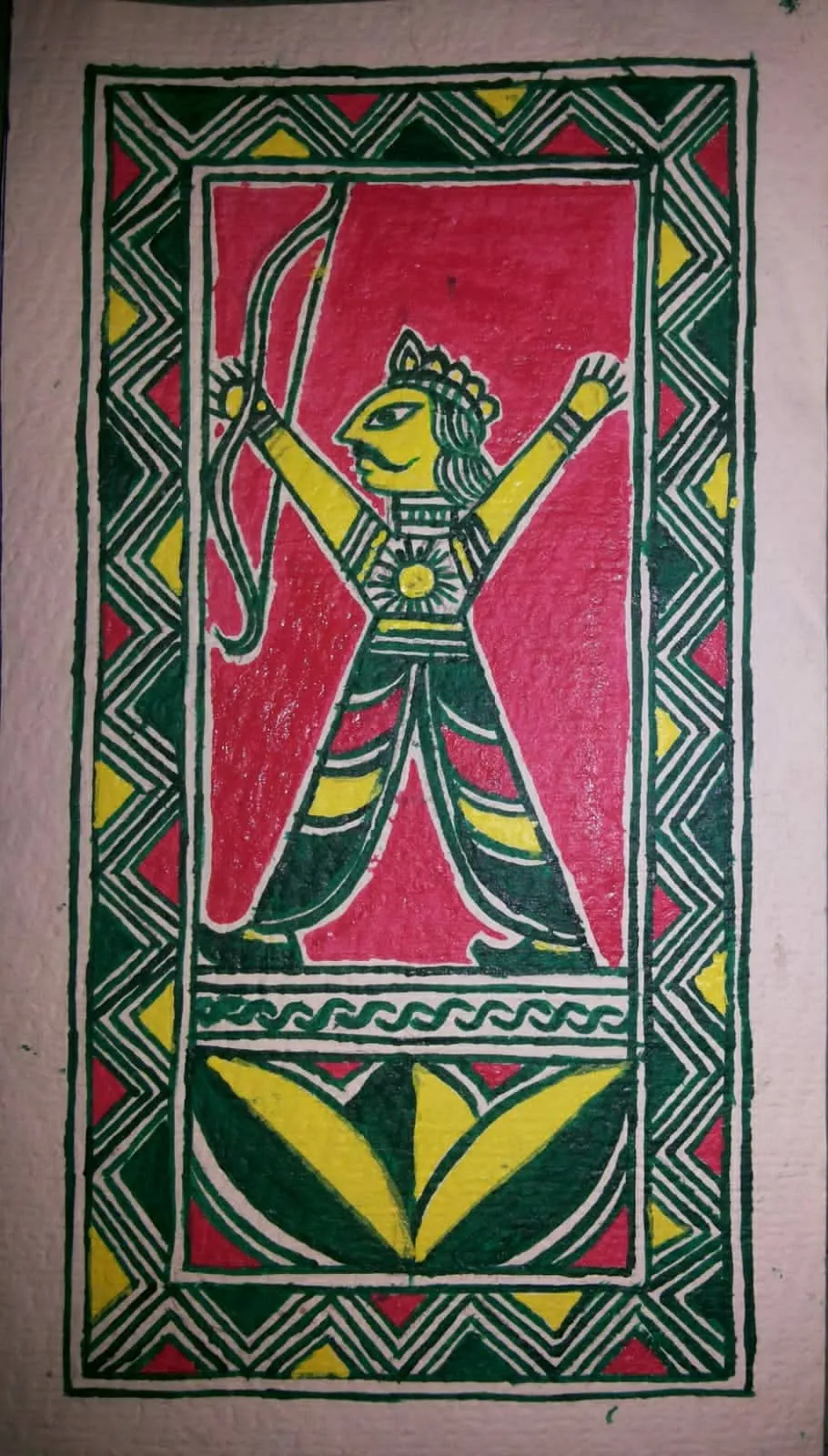
What makes Manjusha painting immediately recognisable is its use of bold outlines, flat figures, and a tightly controlled colour palette drawn originally from natural sources. The style follows strict straight-line geometry, meaning all figures - human, animal, and divine - appear angular and deliberately stiff rather than fluid or naturalistic. The borders of every Manjusha piece are filled with repeating patterns of leaves, triangles, and snakes, which are just as important as the central scene.
Colours are restricted to pink, green, and yellow in the traditional form; contemporary works also incorporate shades of red, orange, and fluorescent pink.
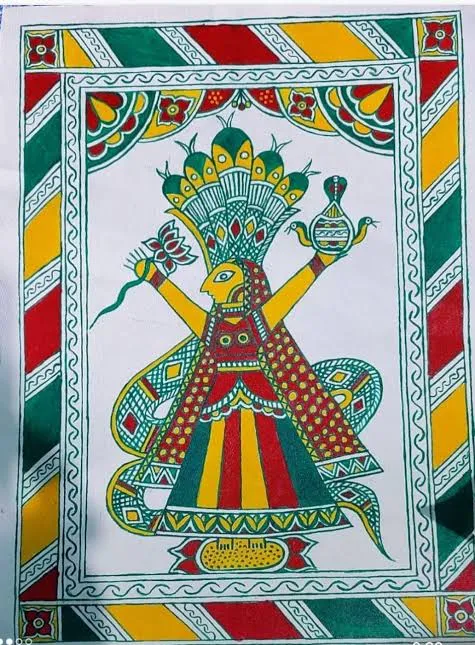
Central motifs include mythological characters such as Padmavati, Mynah Bisahari, Dhothila Bhavani, Maya Bisahari, Jaya Bisahari, Chando Saudagar, and the Kalash pot.
Borders filled with patterns of leaves, triangles, and snakes are a defining structural element - they frame every composition and carry their own symbolic significance.
Traditional surfaces include bamboo-and-paper-mache Manjusha boxes, Kalash clay pots, handmade paper, raw silk, paper tassel silk, cotton, and woollen fabric.
Original tools were bamboo pens or cloth-wrapped sticks; present-day artists use pencils, brushes, pen nibs, rulers, compasses, and geometric instruments for precision.
The painting process begins with sketching, followed by multiple stages of colour filling and detailed finishing before the work is considered complete.
Famous Artists of Manjusha Painting
Unlike some Indian folk traditions, Manjusha painting does not yet have a single nationally celebrated master artist, largely because for generations it was produced collectively by entire community families rather than named individuals. The Kumbhakar community of Bhagalpur has produced skilled practitioners who decorate Kalash pots used in the Bishari festival held on the 17th and 18th of August each year. Similarly, artisans from the Malakar community in Bhagalpur's Naughachhia and Shahkund blocks have kept the Manjusha box-making and painting tradition alive. The NGO Disha Gramin Vikas Manch and NABARD together trained more than two thousand rural women across all sixteen blocks of Bhagalpur through a dedicated Manjusha Art Development Programme, producing two hundred and fifty trained artisans who collectively formed the Manjusha Art Activity Based Group. Several of these artisans have gone on to exhibit their work at state and national craft fairs. Their efforts have helped shift Manjusha from a purely ritualistic object to a recognised art form practised by named, skilled individuals.
How to Learn Manjusha Painting
If you want to learn Manjusha painting, the most direct path is through a structured course taught by someone with roots in the Bihar folk tradition. Rooftop offers online courses in traditional Indian art taught by master artists from across India - including art forms with close kinship to Manjusha, such as Madhubani painting from the same Bihar region. These courses let you work through technique step by step, from sketching to colour, with guidance from artists who have grown up with these traditions.
Where to See and Buy Manjusha Painting
The best place to see Manjusha painting in its original context is during the Bishari festival in Bhagalpur, Bihar, held each year on the 17th and 18th of August. State-run craft fairs in Bihar, as well as national-level events like the Surajkund Crafts Mela, regularly feature Manjusha artisans. Museums such as the Patna Museum and the Bihar Museum in Patna hold collections of Bihar's folk and tribal arts. For those wanting to buy authentic pieces, Rooftop's art shop carries original works from verified Indian folk artists, and the Bhagalpur district's artisan cooperatives supported by NABARD also sell directly. When purchasing, look for work that includes the signature bordered scroll format and the restricted traditional colour palette, as these are marks of genuine Manjusha craft.
Learn Manjusha
Frequently Asked Questions
What is Manjusha painting and where does it come from?
Manjusha painting is a Bihar folk art that originated in ancient Angapradesh, now centred in Bhagalpur district. The name comes from manjusa, Sanskrit for box, because the art was traditionally painted on bamboo-and-paper-mache box structures used in religious rituals. It depicts stories from the Bihula-Bishahari mythology, which connects the art form to the serpent deity Bishahari. The tradition dates back to at least the 7th century.
Which community in Bihar practises Manjusha painting?
Historically, Manjusha painting was produced by only two artisan communities in Bhagalpur: the Kumbhakar community, who painted clay Kalash pots, and the Malakar community, who built and decorated the Manjusha box structures. Both communities used their craft during the annual Bishari festival and as part of wedding rituals. Today, community-based programmes run by NGOs and NABARD have extended the practice to thousands of rural women and artisans across all sixteen blocks of Bhagalpur district.
What colours and materials are used in Manjusha painting?
Traditional Manjusha painting uses only three colours: pink, green, and yellow, all originally derived from natural sources. Contemporary works have expanded this palette to include shades of red, orange, and fluorescent pink. The base materials include handmade paper, raw silk, paper tassel silk, cotton, and woollen fabric. The Manjusha box structures themselves are made from bamboo frames covered with paper-mache, and Kalash pots used in the tradition are made from clay.
What stories and motifs appear in Manjusha painting?
Every Manjusha painting draws from the Bihula-Bishahari mythology, which tells the story of Bihula saving her husband from the wrath of the serpent deity. The central characters depicted include Padmavati, Mynah Bisahari, Dhothila Bhavani, Maya/Manasa Bisahari, Jaya Bisahari, and the merchant Chando Saudagar. Snakes are a constant presence, along with plants significant to local Ayurvedic knowledge such as lotus, paddy, and belpatra - wood apple leaves. The borders of each piece are filled with repeating patterns of leaves, triangles, and snakes.
Can I learn Manjusha painting online in India?
Yes, it is possible to learn Manjusha painting and closely related Bihar folk art traditions through online platforms. Rooftop offers structured courses in traditional Indian art taught by practising master artists, including teachers from the Bihar and eastern Indian folk art traditions. These courses cover foundational techniques in Indian folk art that share visual and cultural ground with Manjusha, and are designed for complete beginners as well as those with some art background.
Manjusha painting carries within it the landscape, mythology, and community life of Bhagalpur in a way that few art forms do. From the decorated Kalash pots worshipped during the Bishari festival to the Manjusha boxes that tell Bihula's story across hand-painted panels, this Bihar folk art is one of India's most quietly remarkable traditions. Explore courses and original artworks on Rooftop and bring this ancient serpent art tradition into your home and practice.
Bibliography
Sources
- Sinha, Rajiva Kumar, and Om Prakash Pandey. Manjusha Art: Reflections in Folklore, Trade, and Regional History. Shivalik Prakashan, 2012.
Image Sources
Manjusha Devi #1 – Manjusha Painting (30 Inch × 22 Inch). International Indian Folk Art Gallery, https://indianfolkart.org/product/manjusha-devi-1-manjusha-painting-size-30-inch-x-22-inch/. Accessed 16 July 2026.
Manjusha Painting #2 (12" × 18"). International Indian Folk Art Gallery, https://indianfolkart.org/product/manjusha-painting-2-12-x-18/. Accessed 16 July 2026.
Manjusha Painting #3 (15" × 11"). International Indian Folk Art Gallery, https://indianfolkart.org/product/manjusha-painting-3-15-x-11/. Accessed 16 July 2026.
Manjusha Painting #4 (30" × 22"). International Indian Folk Art Gallery, https://indianfolkart.org/product/manjusha-painting-4-30-x-22/. Accessed 16 July 2026.
Manjusha Painting #9 (15" × 11"). International Indian Folk Art Gallery, https://indianfolkart.org/product/manjusha-painting-9-15-x-11/. Accessed 16 July 2026.
"The Best of Manjusha Painting: A Colossal Ancient Art." The World for You (WFY), https://thewfy.com/the-best-of-manjusha-painting-a-colossal-ancient-art/. Accessed 16 July 2026.