Your Cart

Your cart is empty

Indian Paintings Online: Shop Original Handmade Folk Art

Shop Indian paintings online at Rooftop. Authentic handmade folk art - Pichwai, Madhubani, Gond, Warli and more - created by India's master artists. Buy original Indian art.

Showing 361 – 384 of 1733

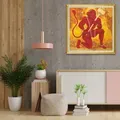
Hanuman Chalisa
CertifiedOnly 1 left

Folk Art

Hanuman Chalisa

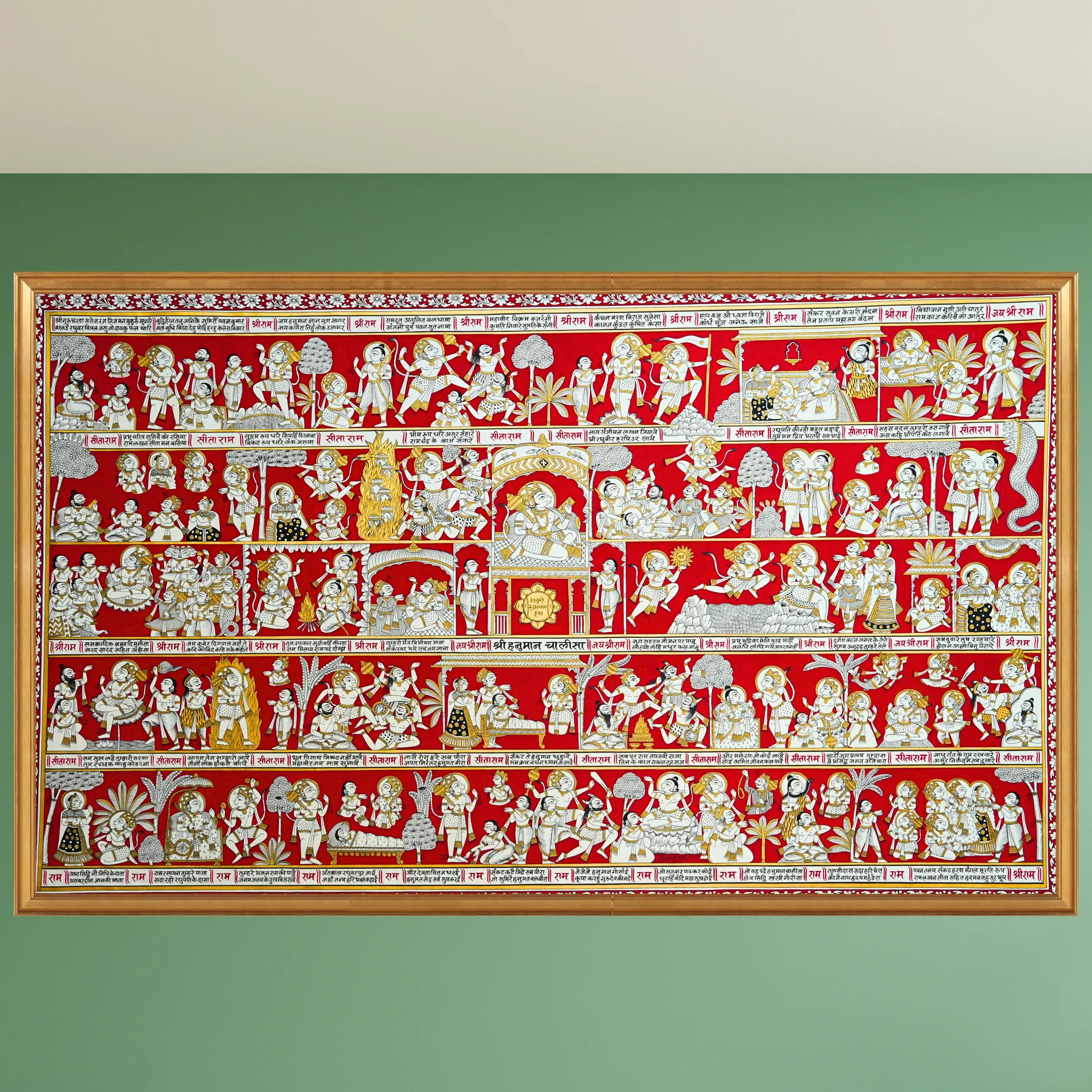
This artwork is dedicated to the Hanuman Chalisa, rendered in a striking red and gold color palette on a significant scale. The piece features the complete text of the prayer—including all three dohas and forty chaupais—meticulously written in Devanagari script. The painting is characterized by its detailed narrative scenes and powerful character expressions, carefully depicting Lord Hanuman's varying moods, from intense anger to gentle politeness. Every element, including atmospheric details like clouds, has been included to create a comprehensive and expressive visual representation of the sacred verses.

$ 3,849
Traditional pabuji ki phad 3
CertifiedOnly 1 left

Folk Art

Traditional pabuji ki phad 3

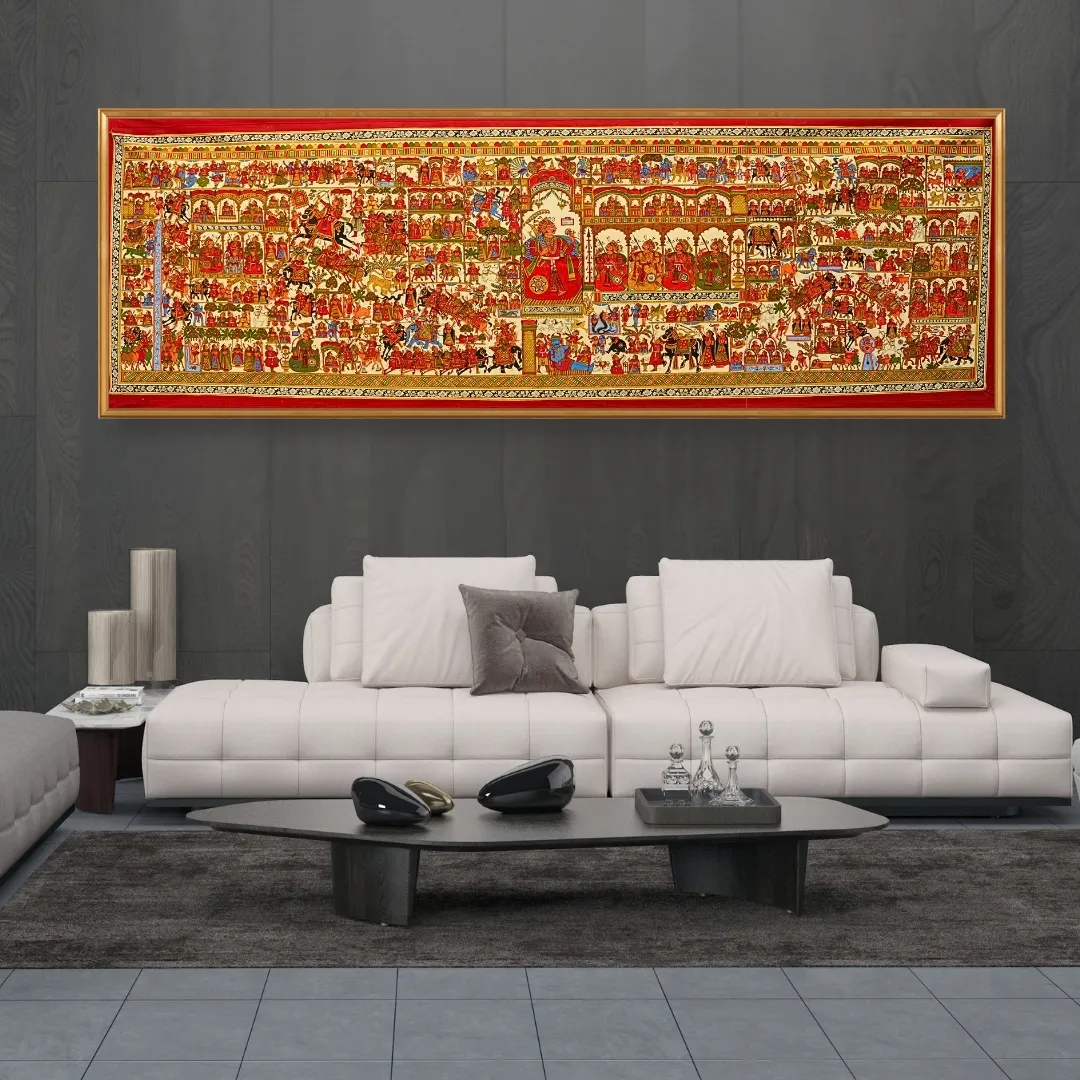
Created in 2004, this National Merit Award-winning Phad painting offers an expansive visual narrative of the life and legends of the folk deity Pabu ji Rathore. The composition meticulously follows the traditional storytelling structure used by Bhopa and Bhopi oral narrators, opening with auspicious invocations of Lord Ganesha, the Dashavatara, and other sacred scripts. The artwork captures the quest for his famous mare, Kesar Kalmi, and his subsequent meeting with the deity Goga ji. A central theme involves Pabu ji fulfilling a promise made at his niece Kelam's wedding to provide camels as a gift. Much like Lord Rama sent Hanuman to find Sita, Pabu ji dispatches his trusted aide, Harmal, to Lankeya (in modern-day Pakistan) to locate the animals. The painting illustrates the strategic mission to retrieve the camels, the romantic union with Princess Phulwanti in Soda, and the ultimate sacrifice where Pabu ji achieves martyrdom while defending a Charani woman’s cows.

$ 8,979
Traditional pabuji ki phad 2
CertifiedOnly 1 left

Folk Art

Traditional pabuji ki phad 2

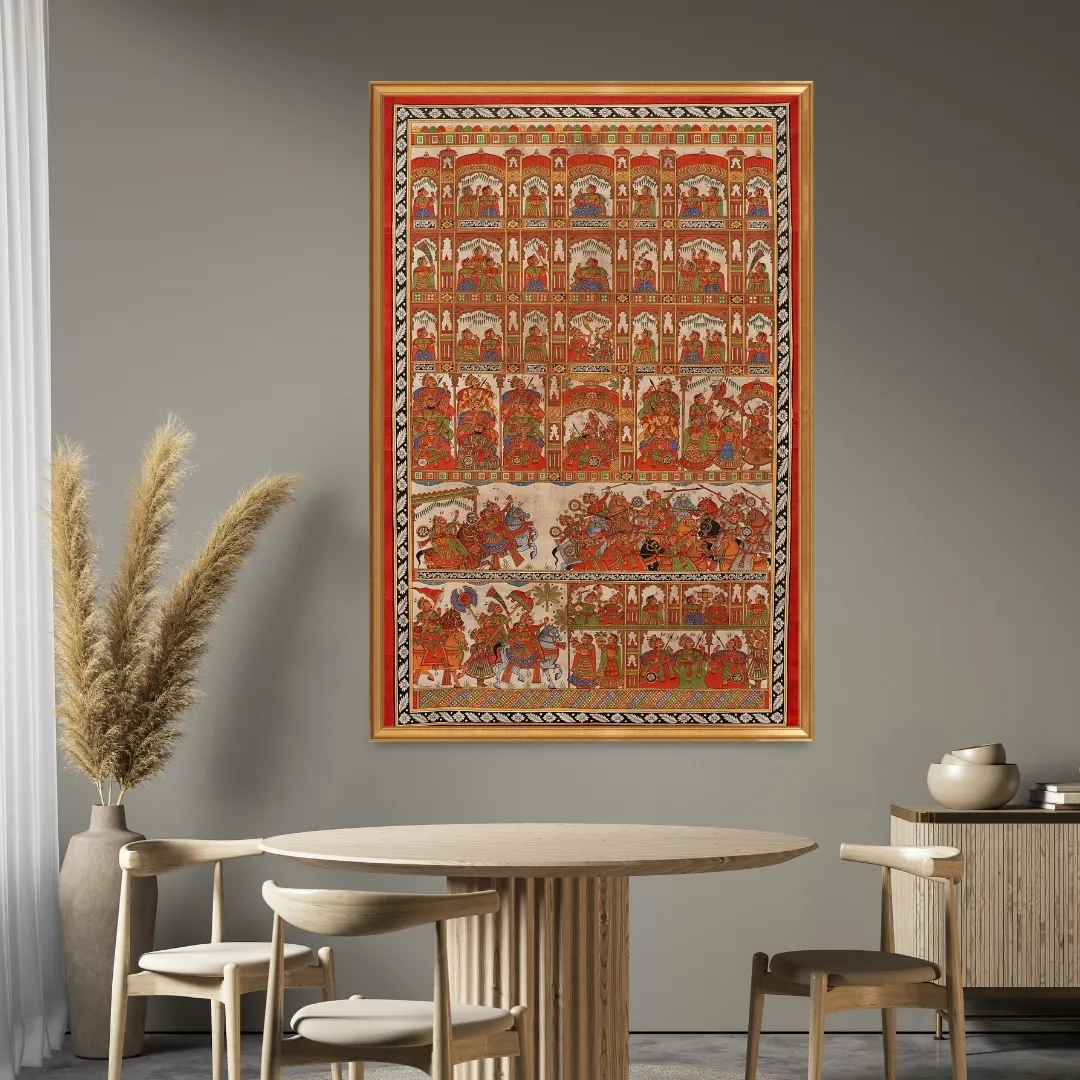
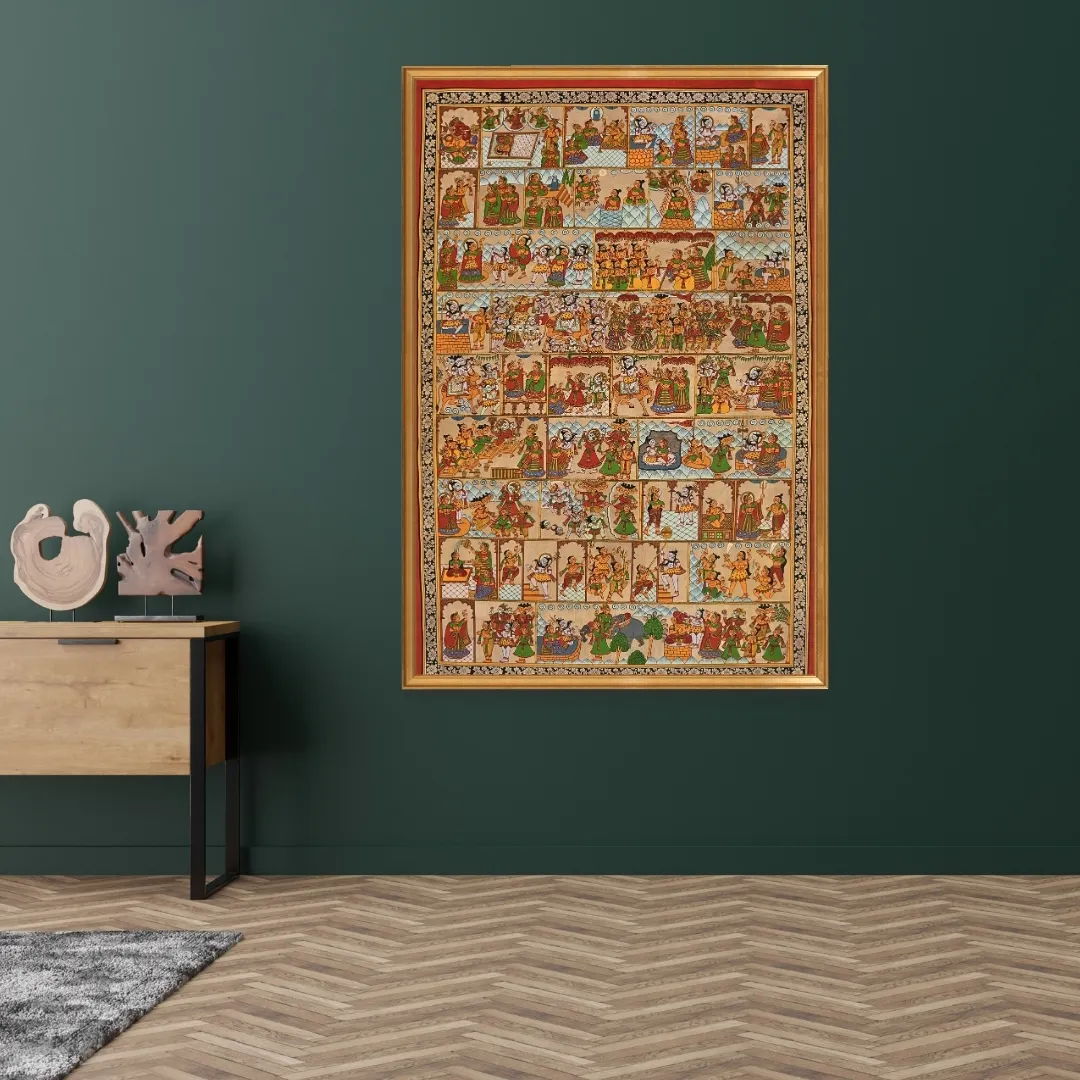
This artwork presents the traditional epic of Pabu ji Rathore in a distinctively antique-finished style. While Phad paintings are typically horizontal, the artist has adapted this extensive narrative into a vertical format, meticulously aged to appear over a century old despite being a contemporary creation. The composition begins with divine invocations of Ganesha, Saraswati, and the Dashavatara, followed by scenes depicting Pabu ji's birth and his regal court. The narrative detail is comprehensive, illustrating Pabu ji's wedding and his legendary conflict with Ravana of Lanka. A key sequence depicts the antagonist Khichi stealing camels, prompting Pabu ji to go to war to reclaim them. The visual story culminates in the fierce battle where Pabu ji achieves martyrdom (Veergati). Unlike the artist's other works that use a fresh color scheme, this piece is defined by its weathered, historic aesthetic.

$ 3,849
Traditional pabuji ki phad 1
CertifiedOnly 1 left

Folk Art

Traditional pabuji ki phad 1

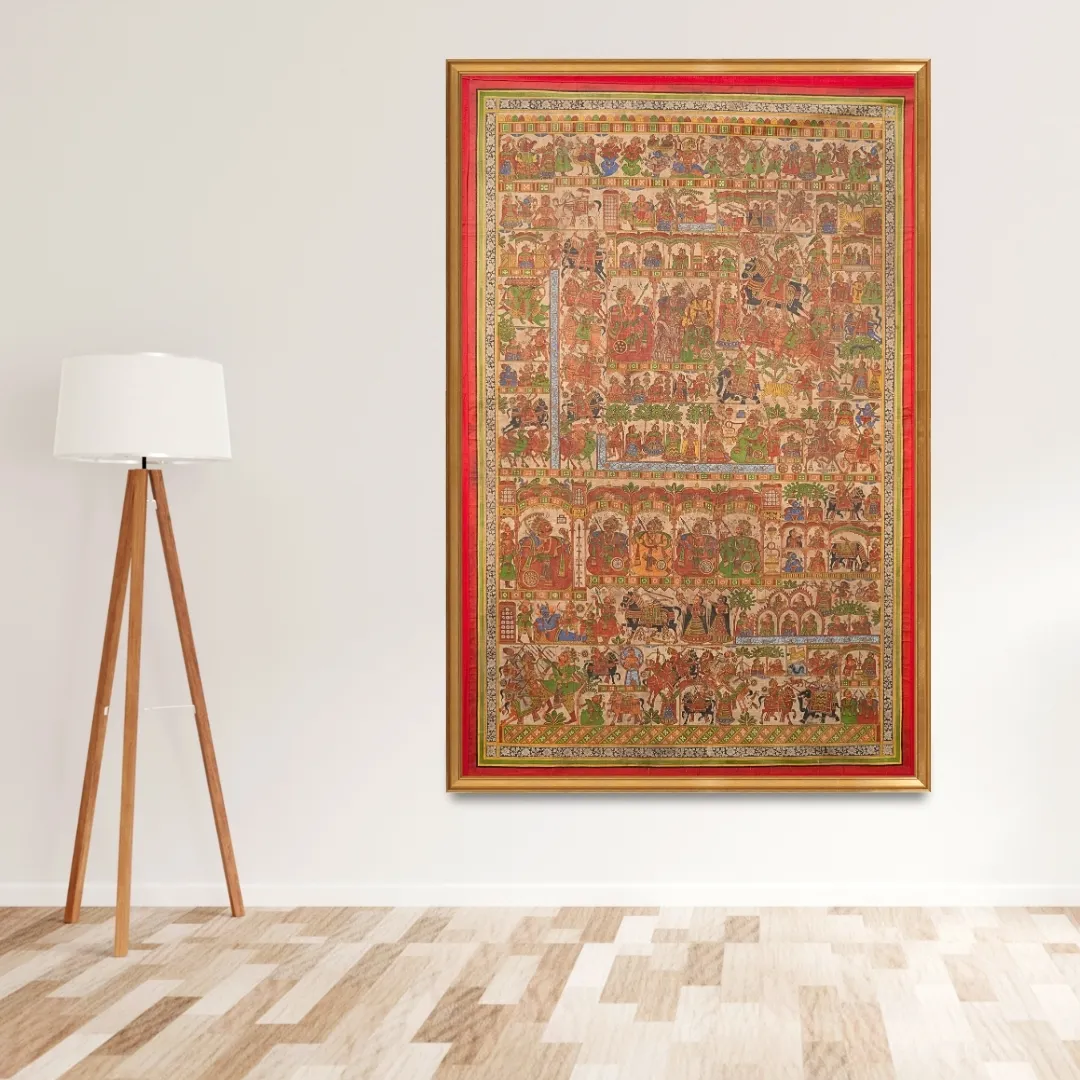
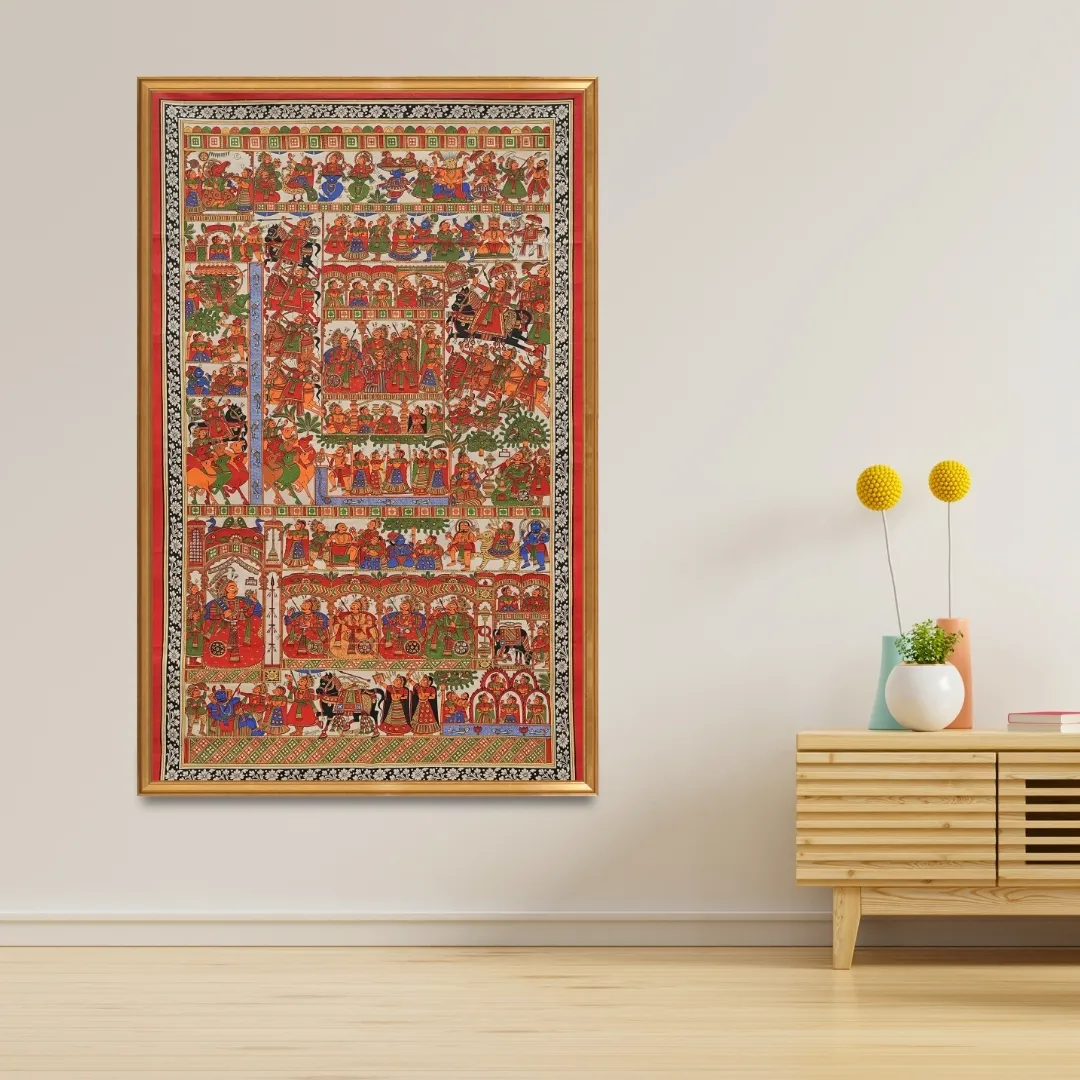
This traditional Phad painting is a vertically oriented composition that provides a condensed narrative of the folk deity Pabu ji Rathore. The artwork opens with auspicious figures of Lord Ganesha and Goddess Saraswati, followed by the ten incarnations (Dashavatara) of Vishnu. A central theme of the piece is Pabu ji’s heroic expedition across the Sindh to Lanka to retrieve camels, illustrated through dynamic battle scenes. The visual story continues with the depiction of Pabu ji Rathore’s wedding and a formal portrayal of his royal court. Strategically placed near the court scene is his famous mare, Kesar Kalmi, along with the two Charan women from whom he obtained her. The painting concludes with various vignettes showing Pabu ji's triumph over several demons, successfully summarizing his legendary life in a compact format.

$ 1,159
Prithviraj chauhan and Sanyogita
CertifiedOnly 1 left

Folk Art

Prithviraj chauhan and Sanyogita

This historical artwork portrays the legendary love story of Prithviraj Chauhan and Sanyogita amidst the dramatic setting of her Swayamvar. Despite King Jayachand's animosity toward Prithviraj, Sanyogita’s secret letter compels the Delhi king to attend the ceremony in disguise. The painting depicts the pivotal moment where Sanyogita garlands a statue of Prithviraj—placed mockingly as a gatekeeper—only for the king himself to emerge from behind it. The narrative concludes with their daring escape, a fierce battle between the armies of Kannauj and Delhi, and their triumphant union in Delhi.

$ 1,159
Krishna Leela
CertifiedOnly 1 left

Folk Art

Krishna Leela

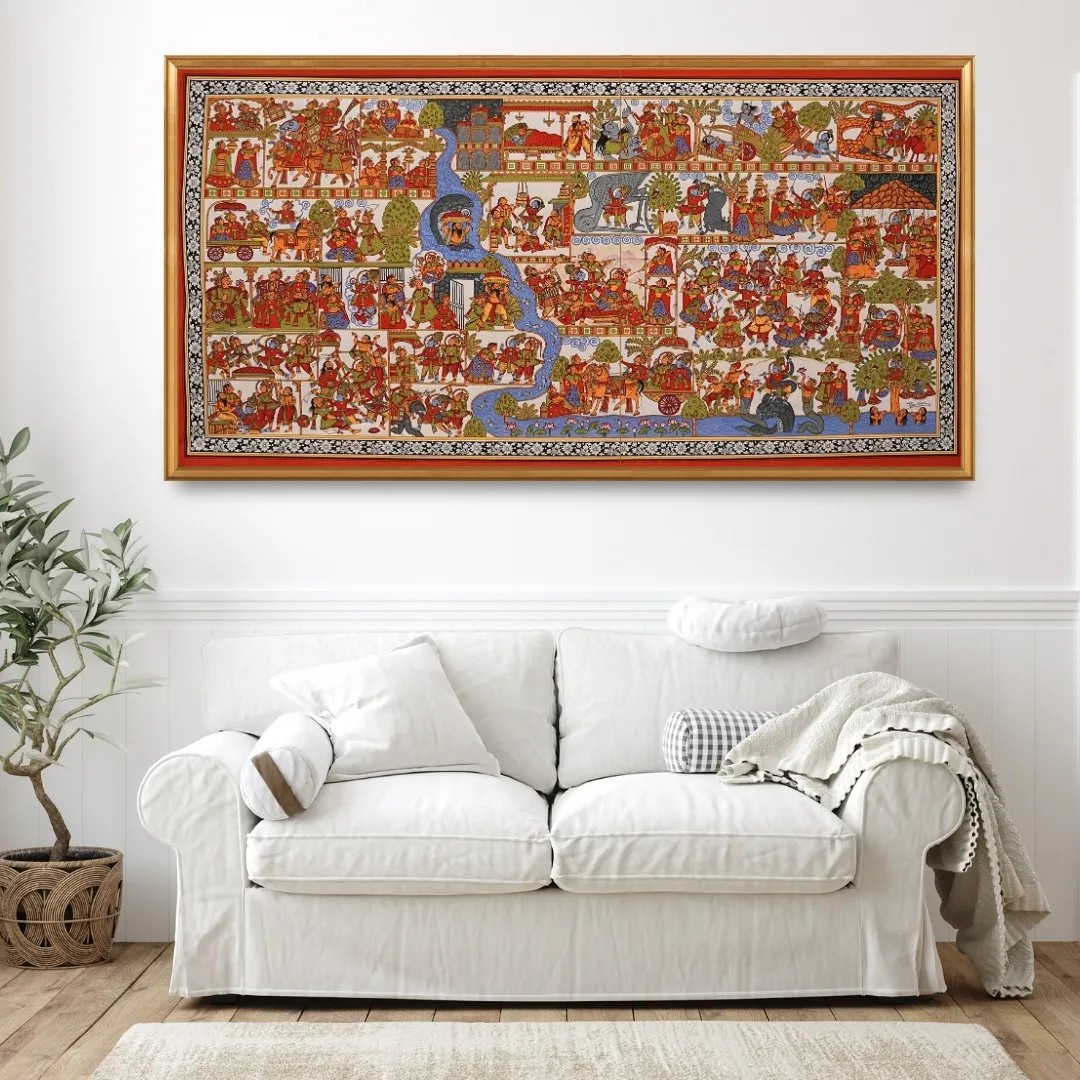
This painting illustrates the expansive Krishna Leela through a unique map-style composition centered on the Yamuna River, with Mathura situated to the right and Gokul, Barsana, and Vrindavan to the left. The narrative begins with the marriage of Devki and Vasudev, their subsequent imprisonment by Kansa, and the miraculous birth of Krishna, whom Vasudev carries across the river to safety. The artwork captures numerous legendary feats, including the slaying of demons like Putana and Bakasura, the lifting of Govardhan Hill, and the Raas Leela. The story reaches its climax as Krishna and Balaram return to Mathura to defeat a maddened elephant and ultimately slay King Kansa, successfully liberating their parents.

$ 3,849
Shiv puran
CertifiedOnly 1 left

Folk Art

Shiv puran

This artwork illustrates the Shiv Puran, focusing on Lord Shiva’s journey from his separation from Sati to his marriage with Parvati. It depicts Parvati’s birth, her intense penance to win Shiva, and the deities persuading Shiva to wed. The narrative includes the Saptarishis visiting King Himavan, the grand wedding procession, and Queen Maina’s welcome. It concludes with the birth of Ganesha, where Parvati creates him from clay, leading to Shiva’s intervention and Ganesha receiving an elephant’s head.

$ 1,409
Vinayak
CertifiedOnly 1 left

Folk Art

Vinayak

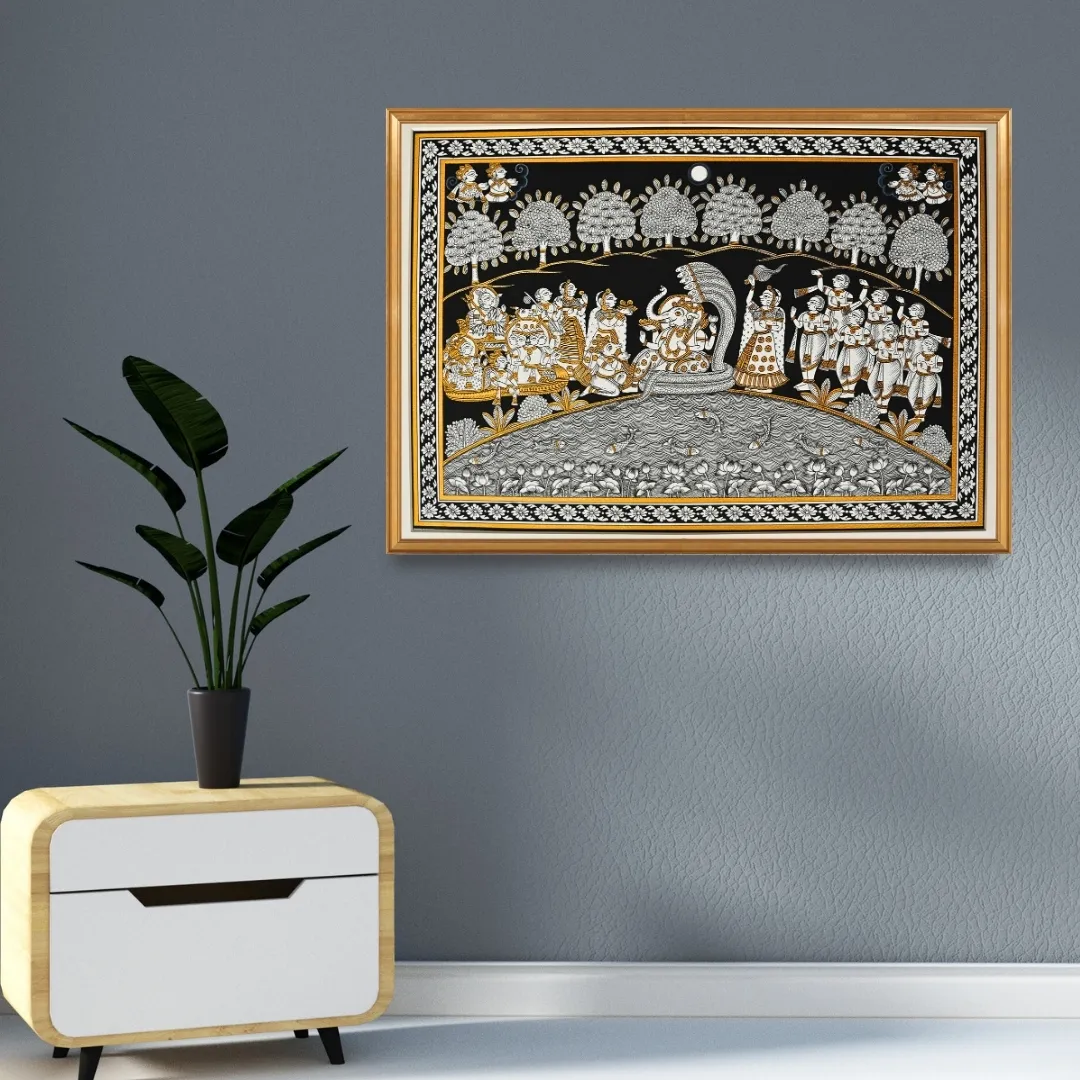
This artwork highlights Lord Ganesha as Vinayak, majestically seated atop the celestial serpent Sheshnag. He is flanked by Riddhi and Siddhi, who are shown performing ritual worship and waving ceremonial fans (Chauris). His vehicle, the Mooshak, is positioned in the foreground. Numerous deities, including Brahma, Vishnu, Shiva, Narad, and Lakshmi, descend from their respective realms to pay homage, while the Saptarishi stand reverently behind Ganesha, completing this grand divine assembly.

$ 519
Krishna raas leela
CertifiedOnly 1 left

Folk Art

Krishna raas leela

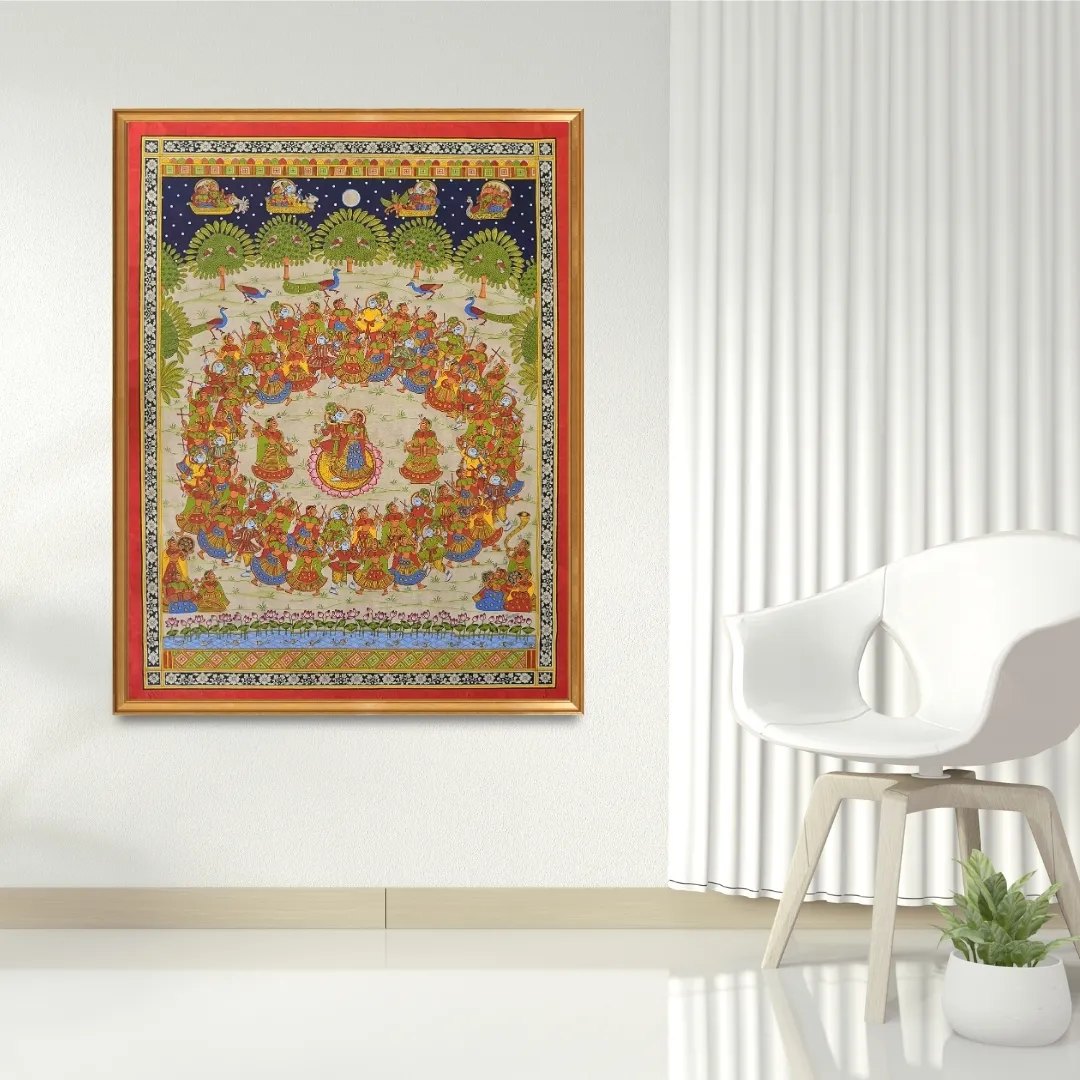
This vibrant artwork depicts the celestial Raas Leela of Lord Krishna during the auspicious night of Sharad Purnima. While traditionally rendered in Pichwai style, the artist has uniquely adapted this theme into the Phad tradition. Under a glowing full moon, divine observers including Brahma, Shiva, and Indra gather to witness the event. At the center, Krishna and Radha stand amidst blooming lotuses, surrounded by numerous Gopis, each dancing in rhythmic harmony with Krishna in this timeless spiritual celebration.

$ 2,049
Ganesha with Tanpura
Only 1 left

Contemporary Art

Ganesha with Tanpura

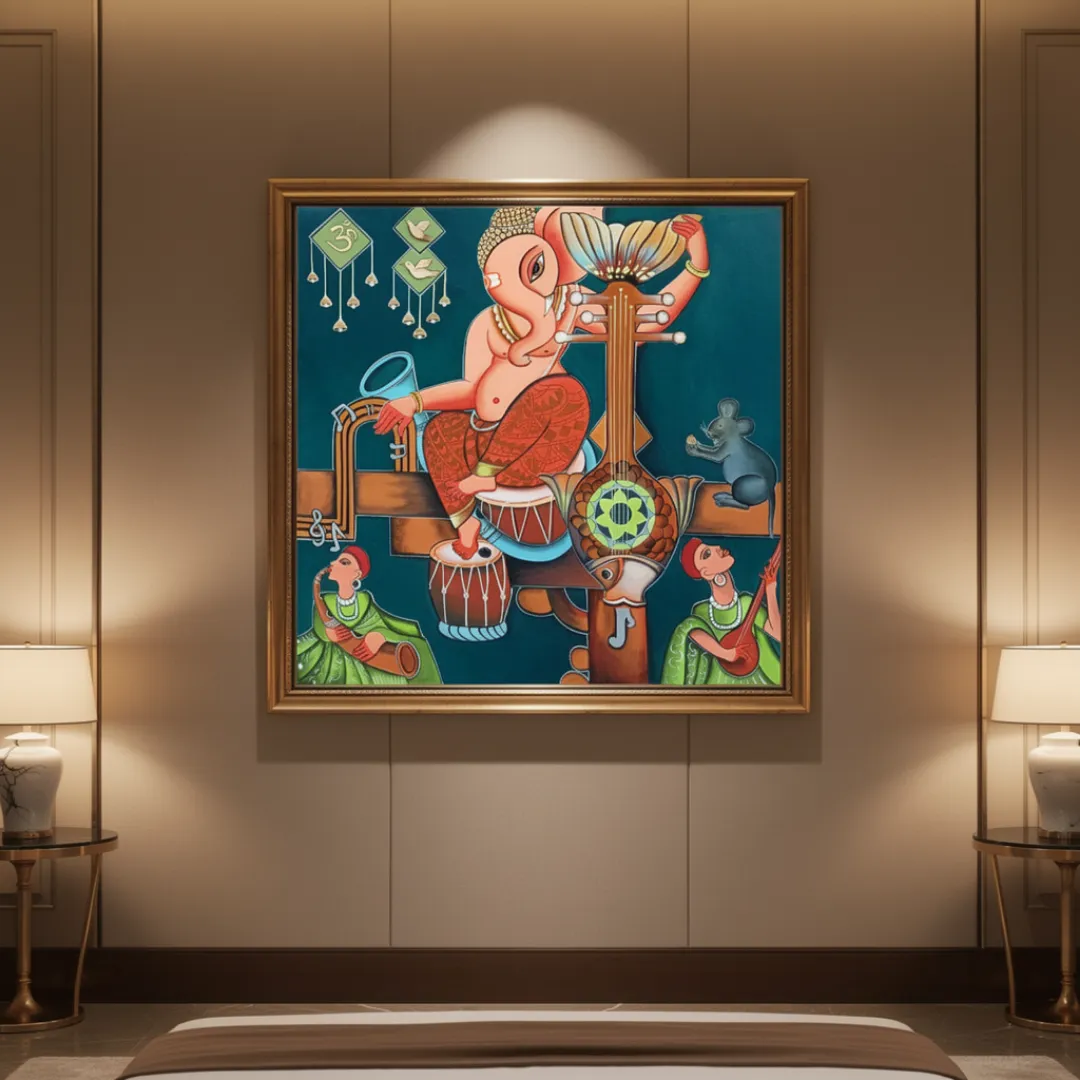
He does not merely play music; he becomes the music itself. Seated in calm concentration, Lord Ganesha holds the long neck of a tanpura, his form gently curved around the instrument as if sound and devotion are woven together. The fingers rest lightly upon the strings, suggesting a melody that flows not from effort but from inner stillness. His expression is serene, eyes soft and meditative, embodying the quiet joy of sacred rhythm. The composition unfolds like a musical raga. At the center, the vertical line of the tanpura rises through the painting, creating a powerful structural axis that holds the entire scene together. Around Ganesha, musicians appear immersed in their own instruments—tabla, flute, and string—each figure contributing to a harmonious orchestration of color and movement. A small mouse sits attentively nearby, a playful yet symbolic reminder of Ganesha’s traditional companion. Rich jewel tones dominate the palette: deep teal blues create a contemplative background while warm coral, red, and ochre tones illuminate the divine figure. Decorative patterns on garments and instruments add layers of rhythm and detail, echoing the visual language of Indian folk and contemporary figurative art traditions. The painting balances narrative and abstraction, devotion and celebration. Rather than depicting a mythological moment, the artwork captures a feeling—the universal language of music as meditation. It invites the viewer into a space where sound, color, and spirituality merge into a quiet yet vibrant harmony. **Why This Artwork Stands Out** * The central tanpura acts as a bold visual spine, structuring the composition and guiding the viewer’s eye through the musical narrative. * The presence of multiple musicians and instruments creates a dynamic sense of rhythm and celebration within the stillness of the scene. * Traditional iconography of Lord Ganesha is reinterpreted through contemporary color and stylized form. * The painting blends Indian folk aesthetics with modern figurative composition, making it both culturally rooted and visually fresh.

$ 769
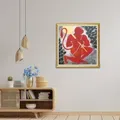
Painting: Vayuputra
CertifiedOnly 1 left

Sacred Indian Artworks: Gods & Goddesses

Painting: Vayuputra

Against a field of deep, luminous blue, a figure crouches in the compressed stillness of someone about to move. The body is rendered entirely in red, bold and unmodulated, the colour of devotion and sacred energy concentrated into a single form. In one hand, a flag curves upward into the wind. In the other, a string of rudraksha beads, the tears of Shiva, held with the ease of something worn close to the body for a very long time. The posture is not static. It carries the particular quality of a held breath, a moment of complete readiness in which power and composure exist in the same gesture. The flag is the painting's second subject. Unfurled and lifting, it is both emblem and invocation, a reminder that Vayuputra, son of the wind, is never entirely still. The blue ground gives the composition its air, its expanse, the sense of open sky surrounding a form that is equally at home in any element. Bharat Tripathi works in a contemporary idiom that distils devotional iconography into its essential emotional charge: no elaborate ornament, no narrative crowd, only the figure and what it carries. This painting belongs to his Anjaneya Series, work that was exhibited at Jehangir Art Gallery in Mumbai in September 2025, and which approaches the deity not through the conventions of religious art but through the directness of felt presence. Painted in acrylic on canvas, it offers Hanuman not as an object of worship but as a living embodiment of strength held in perfect, unhurried readiness. **Why This Artwork Stands Out** **** - The reduction of the figure to a single unbroken red silhouette against blue gives the composition an iconic clarity that is immediately recognisable and visually arresting at any scale. - The rudraksha beads introduce a devotional intimacy into an otherwise bold, almost graphic composition, anchoring the monumental in the personal. - The unfurled flag introduces movement into a crouching posture, creating a visual tension between stillness and force that is the painting's central emotional drama. - As part of the Anjaneya Series exhibited at Jehangir Art Gallery, this work carries exhibition provenance that places it within a serious and considered body of contemporary devotional art.

$ 3,999

Painting: Panchmukhi II
CertifiedOnly 1 left

Sacred Indian Artworks: Gods & Goddesses

Painting: Panchmukhi II

Five faces look outward in five directions, and the world is held between them. The Panchamukha form of Hanuman is among the most cosmologically complete images in the devotional tradition, each face presiding over a different direction, each a different aspect of divine power gathered into a single body. Bharat Tripathi renders this form not through the layered iconography of temple sculpture but through the compressed, direct language of contemporary painting, where the multiplicity of faces becomes a formal problem solved with compositional clarity rather than decorative accumulation. The result is a figure that is recognisably ancient in its subject and entirely present in its execution.The five heads are not arranged to overwhelm. They are held within the composition with the same quality of contained force that characterises all of Tripathi's figures in the Anjaneya Series: power that does not need to announce itself, presence that fills the frame without crowding it. The contemporary style invites the viewer to encounter a form they may already know through an unfamiliar visual register, stripped of the emblematic detail that can sometimes place devotional imagery at a distance and returned instead to its essential charge. This is Hanuman not as a sacred diagram but as a living presence, multiplied not to intimidate but to encompass. This work was exhibited as part of the Anjaneya Series at Jehangir Art Gallery in Mumbai in September 2025, a body of paintings that engages the devotional tradition with the full resources of contemporary figurative art. Painted in acrylic on canvas, it asks the viewer to look at something familiar and see it newly. **Why This Artwork Stands Out** **** - The five-headed form, traditionally rendered in sculptural or diagrammatic terms, is here translated into contemporary figurative painting, creating a visual encounter rather than an iconographic reference. - The compositional handling of five faces within a single painted field demonstrates a formal intelligence that makes the theological content and the artistic structure inseparable from one another. - The restraint of the contemporary style removes the distance that elaborate devotional iconography can create, making the figure's presence immediate and unmediated. - As part of the Anjaneya Series shown at Jehangir Art Gallery, this work belongs to a sustained and critically engaged body of paintings that repositions Hanuman within the vocabulary of modern Indian art.

$ 3,999

Painting: Sanjeevani
CertifiedOnly 1 left

Sacred Indian Artworks: Gods & Goddesses

Painting: Sanjeevani

He moves through the night sky with the momentum of something that cannot be stopped. The figure is airborne and entirely in motion, red body blazing against a deep teal sky, a yellow trail of energy streaming behind him like the wake of a comet. In one hand, a mountain. In the other, a mace. Below, the Himalayas rise in great dark forms, their peaks catching the cold light of a full moon that holds its position at the centre of the composition with the steadiness of something that has witnessed everything and remains unmoved. The clouds that gather around the flying figure are not obstacles but atmosphere, the painting's way of saying that this journey takes place at the border of the possible. The scene is one of the most charged moments in the Ramayana: Hanuman, unable to identify the Sanjeevani herb among the countless plants of Dronagiri, lifts the entire mountain and carries it through the sky to save the fallen Lakshman. Bharat Tripathi renders this act not as mythology held at a reverent distance but as something immediate and kinetic, a body in full flight, a decision made and acted upon without hesitation. The palette is bold and unambiguous: the red of the deity, the yellow of divine energy, the deep green and blue of mountain and sky, the white of the moon. No detail is decorative. Every colour is load-bearing. This work belongs to Tripathi's Anjaneya Series, exhibited at Jehangir Art Gallery in Mumbai in September 2025, a body of paintings that approaches Hanuman not through iconographic convention but through the directness of painted feeling. In acrylic on canvas, it captures a moment of devotion expressed entirely through action. **Why This Artwork Stands Out** **** - The central moon anchors a composition of tremendous movement, creating a still point around which everything else, figure, mountain, cloud, peak, organises itself with instinctive clarity. - The yellow energy trail behind the figure introduces a sense of speed and divine force that transforms a narrative moment into a visual experience of momentum. - The Himalayan ground below gives the aerial scene genuine spatial scale, making the flight feel both mythologically vast and compositionally grounded. - As part of the Anjaneya Series shown at Jehangir Art Gallery, this work carries exhibition provenance that situates it within a serious and sustained engagement with devotional subject matter in contemporary painting.

$ 3,999

Painting: Lanka Dahan
CertifiedOnly 1 left

Sacred Indian Artworks: Gods & Goddesses

Painting: Lanka Dahan

The city is burning and he stands above it, unhurried. The figure of Hanuman dominates the upper field of the composition, his form immense against a sky that has turned the same colour as the flames below. Red, orange and yellow move through the painting in great surging waves, the palette of fire and of the divine wrath that feeds it. Below, Lanka is consumed. The destruction is total and the destroyer is calm, a combination that is the painting's central and most unsettling truth: that this is not rage but justice, not chaos but the precise consequence of an act of violation against the sacred. Bharat Tripathi works in a figurative language that distils mythological episodes into their essential emotional charge. Lanka Dahan is one of the Ramayana's most theatrically charged moments, the moment when Hanuman, captured and sentenced to have his tail set alight, uses that very punishment to reduce an entire kingdom to ash. Tripathi does not illustrate the episode so much as embody its atmosphere, the overwhelming warmth of the palette creates a canvas that feels genuinely heated, as though the fire has not yet finished. The figure stands in it without being consumed by it, a detail the tradition has always understood as the deepest demonstration of Hanuman's invincibility. This work belongs to Tripathi's Anjaneya Series, exhibited at Jehangir Art Gallery in Mumbai in September 2025, a sustained body of contemporary paintings that approaches Hanuman not as religious subject matter but as living, felt presence. Painted in acrylic on canvas, it is a work that does not ask to be contemplated quietly. **Why This Artwork Stands Out** **** - The monumental scale of the figure against the burning city establishes a visual hierarchy that is both iconographically correct and compositionally powerful, making the deity's dominance felt rather than simply depicted. - The near-total immersion of the palette in warm reds, oranges and yellows makes the painting function as a chromatic experience of fire before it is read as a narrative one. - The calm of the figure within the destruction introduces the painting's deepest emotional register: power that does not require agitation, justice that does not require anger. - As part of the Anjaneya Series shown at Jehangir Art Gallery, this work carries exhibition provenance that places it within a considered and cohesive body of contemporary devotional painting.

$ 3,999
Painting: Kesari Nandan
CertifiedOnly 1 left

Sacred Indian Artworks: Gods & Goddesses

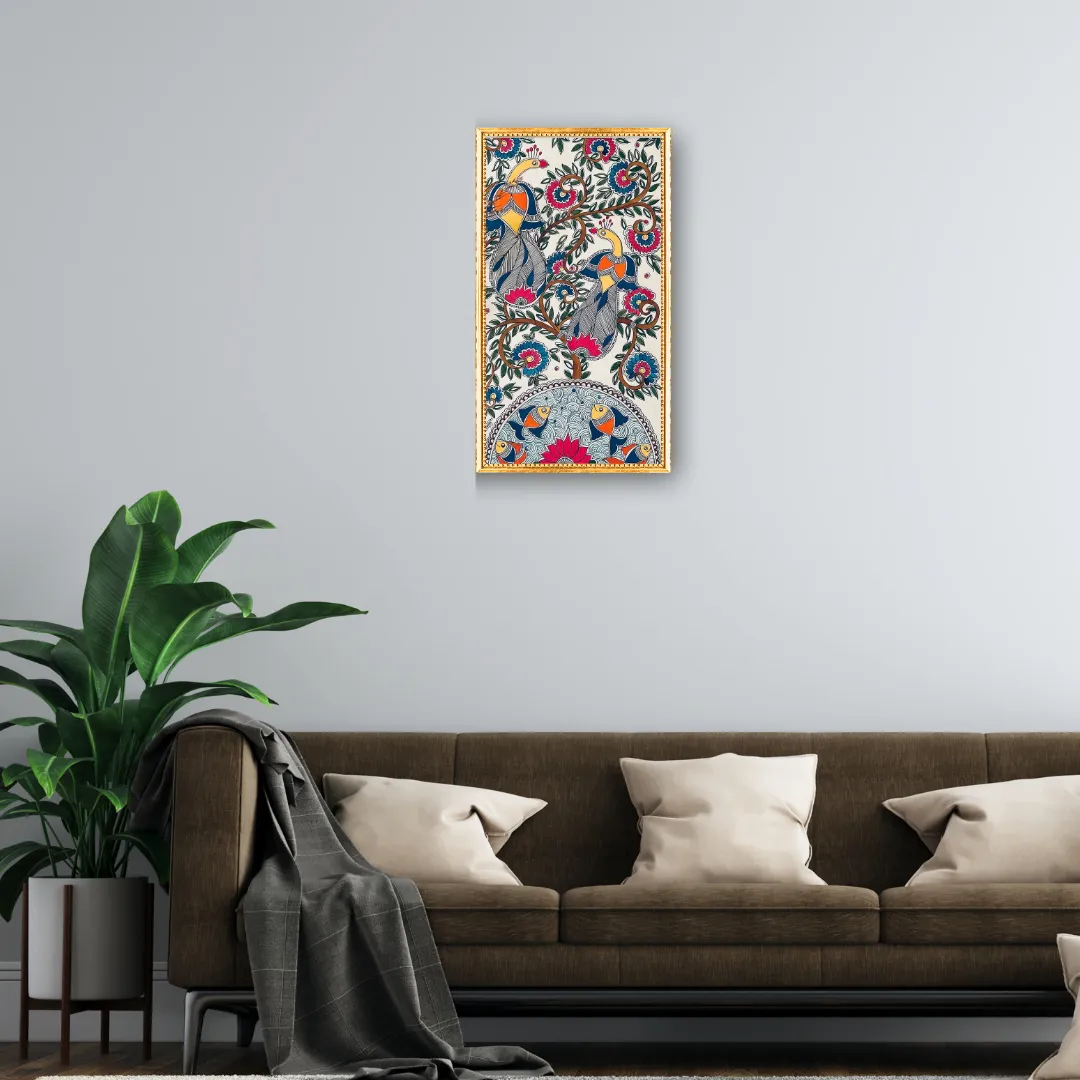
Painting: Kesari Nandan

He kneels, but there is nothing submissive in the posture. The body is coiled with a readiness that makes stillness feel temporary, the pause of someone who could rise in an instant and fill the entire sky. Vermilion red from crown to foot, the figure of Hanuman holds a golden mace with the ease of a being for whom strength is not effort but nature. The mace glows against the lighter blue of the setting, a single warm accent in a composition that otherwise moves between the cool and the sacred. On either side, dark green foliage presses in from the edges, dense and lush, framing the figure the way a forest frames a clearing, with the particular quality of something ancient holding space for something divine. The name Kesari Nandan, son of Kesari, grounds the deity in lineage and in the particular tenderness of the devoted child. Bharat Tripathi holds both registers at once: the muscular form and the kneeling posture, the golden weapon and the contained energy, the guardian and the devotee. Neither quality overwhelms the other. The foliage that flanks the figure is not merely decorative; it situates Hanuman in the natural world from which he is never entirely separate, the forest god as much as the divine warrior. This work belongs to Tripathi's Anjaneya Series, exhibited at Jehangir Art Gallery in Mumbai in September 2025, a sustained body of paintings that approaches Hanuman through the directness of contemporary figurative painting rather than the conventions of devotional imagery. Painted in acrylic on canvas, it is an image of power held quietly, which is the most demanding kind. **Why This Artwork Stands Out** - The kneeling posture introduces a devotional intimacy into an otherwise monumental figure, making the painting's emotional register simultaneously powerful and tender. - The dark green foliage flanking the vermilion form creates a chromatic contrast that gives the figure its visual weight and situates the deity within the natural world. - The golden mace, the sole warm accent against the blue ground, draws the eye with the precision of a detail that carries both iconographic and compositional significance. - As part of the Anjaneya Series shown at Jehangir Art Gallery, this work is part of a cohesive and critically engaged body of contemporary devotional painting.

$ 3,999
Painting: Bal Hanuman
CertifiedOnly 1 left

Sacred Indian Artworks: Gods & Goddesses

Painting: Bal Hanuman

He is airborne and entirely convinced. The child Hanuman streaks across a sky of blue and gold, his red body tilted forward with the absolute confidence of someone who has identified a target and has no reason to doubt he will reach it. The target is the sun. He has mistaken it for a ripe fruit, and the mistake is so pure, so free of hesitation, that it reads less as error and more as the first demonstration of a nature that will spend a lifetime reaching for what others consider unreachable. A yellow scarf streams behind him, catching the motion of flight and giving the composition its sense of speed, the line of colour that tells you the figure has just passed through this part of the sky and is already somewhere further ahead. The palette is warm and unambiguous: the red of the child's body, the yellow of the scarf and the sun-touched horizon, the blue of open sky. Bharat Tripathi renders the scene in the direct, energised language of contemporary figurative painting, where the mythological episode is stripped of ceremonial distance and returned to the quality it has always contained at its core: the irresistible momentum of a child utterly at home in his own extraordinary nature. There is joy in this painting, the specific joy of a being who does not yet know the word impossible. This work belongs to Tripathi's Anjaneya Series, exhibited at Jehangir Art Gallery in Mumbai in September 2025, a body of paintings that approaches Hanuman across all stages of his life and legend with the same quality of felt, immediate presence. Painted in acrylic on canvas, it is the youngest and perhaps the most luminous work in the series. **Why This Artwork Stands Out** - The airborne posture of the child figure captures the precise quality of innocent, unstoppable momentum that makes this episode among the most beloved in the Hanuman legend. - The flowing yellow scarf introduces a trail of movement that animates the composition and gives the sense of flight a visual velocity beyond what the figure alone could carry. - The warm red, yellow and blue palette achieves a celebratory brightness that sets this work apart from the more weighted devotional register of other paintings in the series. - As part of the Anjaneya Series shown at Jehangir Art Gallery, this painting completes the arc from the divine child to the cosmic warrior, giving the series its note of pure, unguarded beginning.

$ 3,999
Painting: Origin of Shiva
CertifiedOnly 1 left

Sacred Indian Artworks: Gods & Goddesses

Painting: Origin of Shiva

This an acrylic on canvas painting by artist Bharat Tripathi that is symbolic depiction of the origin of Shiva. In this powerful composition, the deity's ascetic and cosmic nature has been emphasized through his long matted hair and the golden trident, a symbol of divine authority and spiritual power against the background of intense flames. The scene created is one based on contemporary devotional aesthetic that blends traditional symbolism with modern compositional style. This painting is a part of the Shiva Series by the artist and was displayed in an exhibition titled "The Story of Shiva" held at the Coomaraswamy Hall, CSMVS Museum, Mumbai in December 2012.

$ 3,199
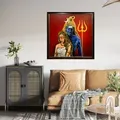
Painting: Shiva and Sati
CertifiedOnly 1 left

Sacred Indian Artworks: Gods & Goddesses

Painting: Shiva and Sati

This an acrylic on canvas painting by artist Bharat Tripathi that is a portrayal of Shiva together with Sati in a figurative style. In this aesthetic depiction, the divine couple of Shiva and Sati have been rendered in a contemporary style with strong symbolic elements. The red background intensifies the emotional and spiritual atmosphere. The picture creates a sense of divine companionship and spiritual balance. This painting is a part of the Shiva Series by the artist and was displayed in an exhibition titled "The Story of Shiva" held at the Coomaraswamy Hall, CSMVS Museum, Mumbai in December 2012.

$ 3,199
Painting: Kishkindha Kand - Bali Vadh
CertifiedOnly 1 left

Sacred Indian Artworks: Gods & Goddesses

Painting: Kishkindha Kand - Bali Vadh

This an acrylic on canvas painting by artist Bharat Tripathi that depicts the episode from the Ramayana where Lord Rama kills the ignoble monkey king Bali and reinstates his brother Sugriva on the throne of Kishkindha. In the foreground, one can see the two monkey brothers jostling in combat with the sihouette of Lord Rama in the background. This is an episode from the Kishkindha Kand or the fourth chapter of the Ramayana. This painting is a part of the Ramayana Series by the artist and was displayed in an exhibition at the Lalit Kala Akademi in New Delhi in November 2015.

$ 6,399
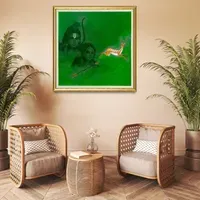
Painting: Aranya Kand - Marich
CertifiedOnly 1 left

Sacred Indian Artworks: Gods & Goddesses

Painting: Aranya Kand - Marich

This is an acrylic on canvas painting by artist Bharat Tripathi that depicts the episode from the Ramayana where Rama is led to chase Marich, a demon transformed into a golden deer at the behest of Sita. Set against the background of green signifying the forest, the holy couple look onward to the prancing deer with the arrow signifying the subsequent chase. This is an episode from the Aranya Kand or the third chapter of the Ramayana. This painting is a part of the Ramayana Series by the artist and was displayed in an exhibition at the Lalit Kala Akademi in New Delhi in November 2015.

$ 6,399
Painting: Aranya Kand - Jatayu
CertifiedOnly 1 left

Sacred Indian Artworks: Gods & Goddesses

Painting: Aranya Kand - Jatayu

This an acrylic on canvas painting by artist Bharat Tripathi that depicts the episode of the killing of Jatayu by Ravana. In this skillful rendering, one can see the contorted form of Jatayu in the foreground with the faint silhouette of Ravana in the background whose hand is raised to strike down Jatayu. This is an episode from the Aranya Kand or the third chapter of the Ramayana. This painting is a part of the Ramayana Series by the artist and was displayed in an exhibition at the Lalit Kala Akademi in New Delhi in November 2015.

$ 6,399
Painting: Lanka Kand - Ravan Vadh
CertifiedOnly 1 left

Sacred Indian Artworks: Gods & Goddesses

Painting: Lanka Kand - Ravan Vadh

This an acrylic on canvas painting by artist Bharat Tripathi that is a symbolic and figurative representation of the march of Lord Ram towards Lanka that led to the eventual death of Ravan. One can see the Ram Setu leading upto Lanka and Ravan with a depiction of the Shivling in the foreground that symbolises divine order and orchestration that finally leads to the triumph of good over evil. This is an episode from the Lanka Kand or the sixth chapter of the Ramayana. This painting is a part of the Ramayana Series by the artist and was displayed in an exhibition at the Lalit Kala Akademi in New Delhi in November 2015.

$ 6,399
Whispers of the Forest: Gond Bird Handpainted Wall Art
Only 1 left

Tribal Art

Whispers of the Forest: Gond Bird Handpainted Wall Art

A bird emerges from a field of intricate lines and rhythmic patterns, its form filled with the visual language of Gond art, where every surface becomes an opportunity for storytelling. In Whispers of the Forest: Gond Bird Handpainted, the creature is not presented simply as an animal but as a living presence within the forest. Its body is built from carefully repeated motifs—dots, curves, and flowing lines—that echo the natural rhythms of leaves, branches, and wind moving through the trees. The bird appears alert yet calm, as though listening to the quiet sounds of the forest that surrounds it. The composition reflects the traditional approach of Gond painting, where the figure becomes a canvas for pattern and movement. The bird’s body carries a dense network of decorative forms that suggest life and energy flowing through it. Rather than isolating the subject from its environment, the patterns connect the bird to the forest itself, turning the entire image into a celebration of nature. Colours move through the surface in harmonious layers, reinforcing the sense that the creature belongs to a vibrant ecological world. Handpainted with careful attention to detail, the artwork carries forward the visual heritage of Gond tribal art from central India. The painting transforms a simple bird into a symbolic messenger of the forest, where nature, rhythm, and storytelling merge into a single visual language. Whispers of the Forest: Gond Bird Handpainted invites the viewer to experience the quiet vitality of the natural world through a tradition that has long expressed the spiritual connection between humans, animals, and the land. **Why This Artwork Stands Out** - The artwork celebrates traditional Gond tribal art, known for its intricate patterns and nature-inspired storytelling. - - The bird’s body is filled with rhythmic motifs that create a sense of movement and life within the composition. - - Carefully layered colours and detailed linework highlight the craftsmanship of handpainted folk art. - - The painting reflects the deep connection between wildlife and the forest, a central theme within Gond artistic tradition.

$ 269
Mayura Madhubani Painting
Only 1 left

Religious Art

Mayura Madhubani Painting

A peacock unfolds across the surface of the composition, its form alive with intricate lines and vibrant colour. In Mayura Madhubani Painting, the bird becomes both subject and ornament, its feathers expanding outward in rhythmic patterns that echo the traditional visual language of Madhubani art. The body of the peacock is filled with delicate motifs—curves, dots, and repeating forms—each carefully arranged to create a sense of balance and movement. Rather than existing in isolation, the bird appears integrated within a decorative landscape where every element contributes to the overall harmony of the image. The composition reflects the characteristic structure of Madhubani painting, where space is rarely left empty. Floral forms, geometric patterns, and ornamental borders surround the central figure, creating a rich visual tapestry that celebrates abundance and life. The peacock itself carries symbolic meaning in Indian art, often associated with beauty, grace, and prosperity. Through layered colour and meticulous pattern work, the painting transforms the bird into a vibrant emblem of nature’s elegance. Handpainted using traditional Madhubani techniques, the artwork preserves the storytelling spirit of this folk art tradition from Bihar. The careful linework and saturated colours reveal the patience and skill required to build each detail by hand. Mayura Madhubani Painting becomes more than a depiction of a bird—it becomes a celebration of cultural heritage, where nature and ornament merge to form a living expression of Indian folk artistry. **Why This Artwork Stands Out** **** - The painting showcases the distinctive Madhubani folk art style, known for its intricate linework and decorative patterns. - - The peacock, or mayura, serves as a symbolic figure representing beauty, grace, and prosperity in Indian tradition. - - Dense ornamental motifs and vibrant colours create a visually rich composition that reflects the abundance of nature. - - The handpainted technique preserves the authenticity and craftsmanship of traditional folk art practices.

$ 139