

Mata ni Pachedi: The Sacred Textile Art of Gujarat's Vaghari Community
Mata ni Pachedi is not a decorative textile but a portable temple, made by and for the Vaghari community of Gujarat who were historically denied entry to brick-and-mortar shrines.

Rooftop
Author
Picture a small clearing on the outskirts of an Ahmedabad neighbourhood, late on a Navratri evening. A length of cotton cloth, perhaps eight feet long, is being raised on a wooden frame against a low wall. Painted on the cloth in deep alizarin red and iron-black is the goddess: many-armed, seated on her vahana, surrounded by attendants, musicians, devotees, animals, and smaller deities arranged in registers across the field. The cloth is unrolled, fixed in place, and within minutes a shrine that did not exist that morning has been brought into being. People begin to gather. The drummer starts. The goddess is now present, in the only place she was ever going to be present for this community: not a stone temple with priests at the door, but a cloth made by their own hands.
This is Mata ni Pachedi, the sacred textile painting tradition of Gujarat's Vaghari community. The name describes the function: pachedi, meaning that which is behind, and Mata, the goddess. The cloth is what stands behind the goddess. It is, in a more important sense, what allows the goddess to be present at all. For a community historically barred from mainstream Hindu temples by caste exclusion, Mata ni Pachedi is not a decorative textile that happens to carry religious imagery. It is a portable temple, and every cloth is the sanctum, the icon, and the sacred boundary of worship all at once.
The Vaghari Community and the Origin of a Sacred Textile
The Vaghari people, also known as Devipujak or worshippers of the goddess, are a community whose recorded history along the Sabarmati river in Gujarat stretches back several centuries. They were historically nomadic, later settling into agricultural work, and have been positioned at the margins of caste hierarchies in Gujarat for as long as documentary records exist. The position was not abstract. Vaghari Vaados, the settlements where Vaghari families lived, were typically located outside village boundaries. Entry to the brick-and-mortar temples of mainstream Hindu Gujarat was, for generations, prohibited.
Faced with this exclusion, the community made its own temples. The Mata ni Pachedi tradition emerged as a direct response to caste-based denial of access to sacred space, a portable shrine the Vaghari could carry, hang, and worship at without permission from any institution outside their own community. The making of the cloth, the hanging of it, and the worship in front of it together constituted the equivalent of building, consecrating, and praying inside a temple. Every Pachedi was a temple in cotton.
400+ years the conservatively documented age of the Mata ni Pachedi tradition, with community oral histories suggesting a continuous practice stretching back 700 to 1000 years along the Sabarmati river in Gujarat.
The community's account of its origin traces the present concentration of artists to a migration roughly three centuries ago, when their ancestors moved from the village of Ashoknagar in the Chunwar area of Saurashtra to Ahmedabad following severe floods. The Chitara families settled in what is now the Vasna neighbourhood of Ahmedabad, and the tradition has continued in that geographic concentration ever since. Only twelve households across Ahmedabad continue to make Mata ni Pachedi in its full ritual form, and almost all belong to the same extended Vaghari family network.
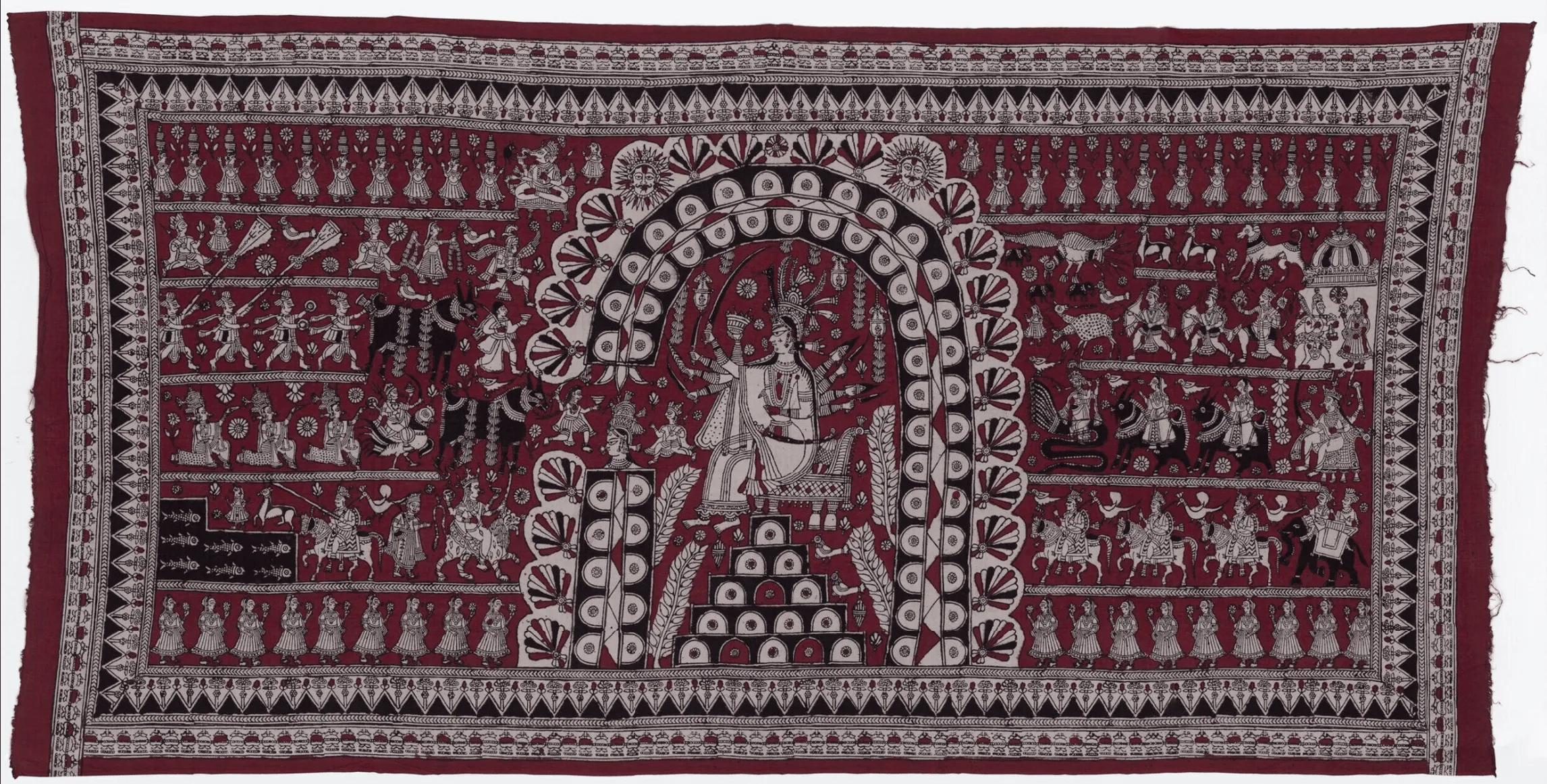
A printed cotton Mata ni Pachedi from 1967 showing the central goddess flanked by registers of attendants, musicians, and devotees. Held in the V&A's South Asia collection. Source: Victoria and Albert Museum, London
The Iconography of Mata ni Pachedi: The Goddess and Her World
The central image on a Mata ni Pachedi is always the goddess, and the specific form depends on who has commissioned the cloth. Each Vaghari subgroup has its own Kuldevi or clan goddess, and each cloth is made to honour the specific deity to whom the worshipper has made a vow. The visual conventions for identifying particular goddesses are stable and well established, transmitted within the Chitara families across generations.
The principal goddesses depicted
- Bahuchara Mata, associated with the Bahucharaji temple in Mehsana district and venerated as a protector of those who turn to her for grace. Often shown seated on a rooster, her traditional vahana.
- Vishat Mata, the twenty-armed warrior goddess from whom the Vaghari community claims direct ancestry through the legend of the drummer-man created from her sweat. The most distinctively Vaghari of the deities.
- Vahanvati Mata, also known as Sikotar Mata, depicted in a boat with outstretched sails and venerated by communities associated with the sea and with trade.
- Hadkai Mata, the goddess invoked against rabies, particularly important in rural Gujarat. Worshippers at her shrines historically gave up rice, sugar, and coconuts for one and a half months as part of their vows.
- Momai Mata, also known as Dashamaa, the protector of health, livestock, and harvest, particularly associated with the Kutch region.
- Khodiyar Mata and Meladi Mata, additional regional goddesses with their own iconographic conventions and associated communities.
Around the central goddess, the surrounding field is populated with a rich cast of supporting figures. Ganesha typically appears to the left or above, marking the auspicious beginning of the visual programme. Bhuvas, the Vaghari ritual specialists who serve as mediums for the goddess, are depicted with their characteristic peacock-feather whisks. Musicians, drummers, and singers, who in actual ritual would be physically present, perform for the goddess inside the cloth as their living counterparts perform for her outside it. Worshippers, panihari water-bearers, animals including horses and elephants, the sun and moon in the upper corners, and architectural elements suggesting the sacred enclosure of the shrine all find their place in the composition.
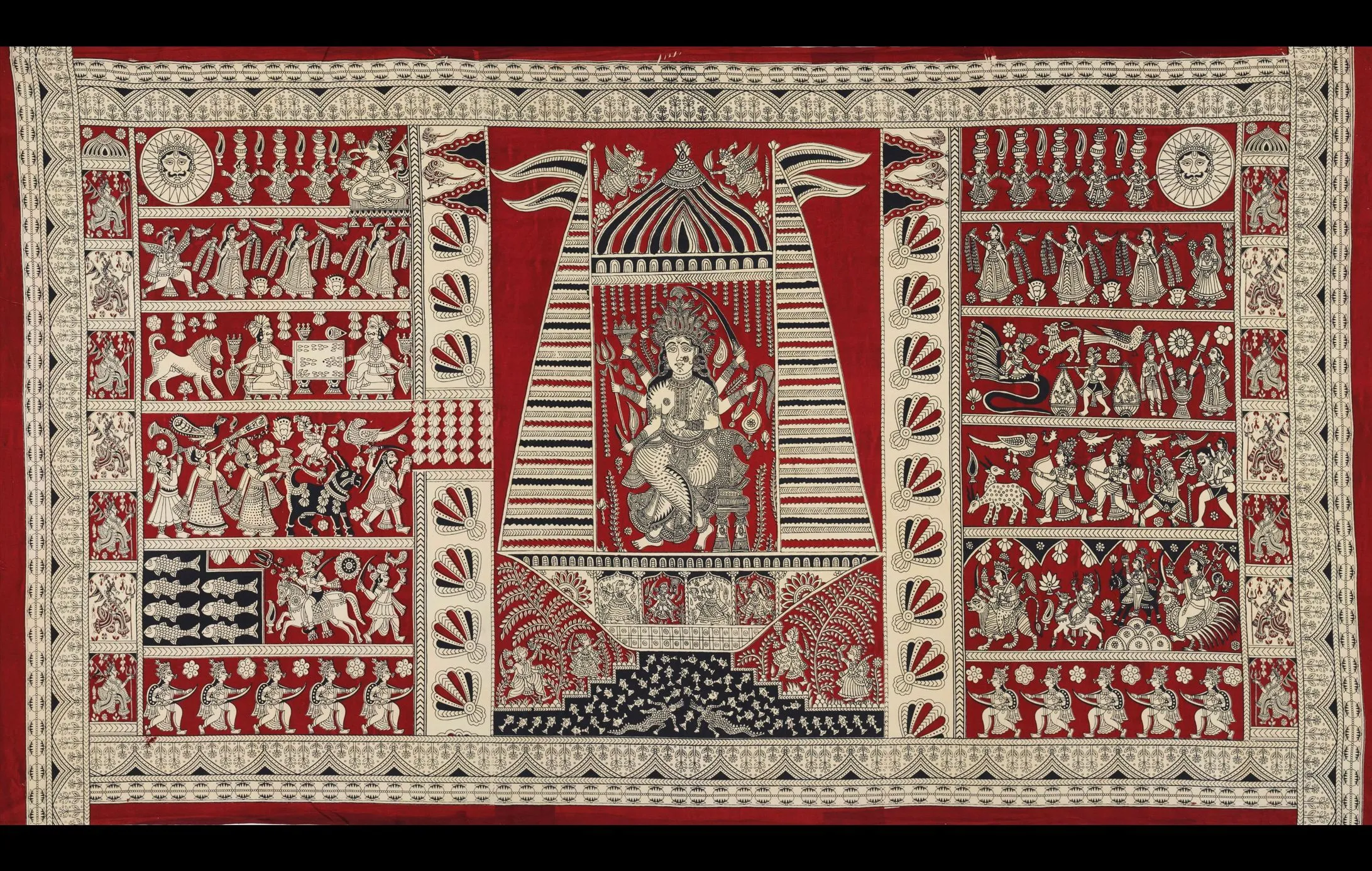
A Sanjay Chitara Mata ni Pachedi showing the six-armed Vahanvati Mata seated on a boat with sails extended, surrounded by worshippers, deities from the Hindu epics, and other supporting figures. Source: Sarmaya Arts Foundation
Every figure on a Mata ni Pachedi has a job. The cloth is not a stage. It is the entire ritual congregation, painted in place around the goddess at its centre.
The Visual Language: Layout, Motifs, and Sacred Geometry
The compositional logic of a Mata ni Pachedi is rigorous and consistent. The central deity occupies the sanctum, typically a rectangular zone at the visual core of the cloth, often framed by an architectural enclosure suggesting the inner sanctum of a temple. Around this central zone, the composition unfolds in registers, with bands of supporting figures arranged in horizontal rows the viewer reads as one would the surrounding precincts of a temple complex.
The motifs that fill these registers each carry specific meaning:
- Horses, associated with the vahanas of various deities and with the journey of the soul. A recurring auspicious motif in nearly every Pachedi.
- Elephants, vehicles of certain goddesses and symbols of strength and good fortune, often shown carrying small figures or arranged in processional rows.
- Fish, fertility symbols and references to water as a sacred element, frequently placed in the upper or lower registers as auspicious marks.
- Flowering trees, Tree of Life motifs that anchor goddesses like Jogni Mata and signal the abundance and protective grace the deity confers.
- Sun and moon, almost always placed in the two upper corners of the cloth, marking the cosmic frame within which the rest of the composition operates.
- Geometric border units, typically block-printed using carved wooden blocks sourced from Pethapur, where specialist block-makers have produced the wooden tools of the Chitara workshops for generations.
The border is not decorative. It functions as a sacred threshold, separating the divine space of the cloth from the everyday world outside it. When the cloth is hung at a shrine, the border marks the boundary across which the goddess becomes present. The interior is consecrated space. The exterior is the world the worshipper has temporarily left behind.
Materials, Natural Dyes, and the Making of the Cloth
The technical process of making a Mata ni Pachedi is precise, multi-stage, and shaped by the chemistry of natural dyes used by the Chitara families for generations. The cloth itself is unbleached cotton, soaked in water and then in a solution of myrobalan or harda, the dried fruit of Terminalia chebula, which acts as a mordant. The mordanted cloth is sun-dried and prepared for printing and painting.
The traditional palette of Mata ni Pachedi is built on three colours, which together carry the form's distinctive visual signature:
- Red is derived from alizarin, the principal pigment of the madder root, fixed onto the mordanted cotton in a controlled dyeing process. Red dominates the palette and is associated with the divine feminine, vitality, and ritual energy.
- Black is produced from a fermented iron-based solution, made by soaking rusted iron pieces in jaggery and water over several days. The chemistry binds the black to the mordant, producing the deep, durable outlines that define the figures.
- White is the colour of the base cotton itself, exposed through resist techniques and through the deliberate use of negative space around figures.
Modern contemporary work sometimes introduces ochre and indigo, but the classical Pachedi is built primarily on the red, black, and white triad. The outlines of the central deity and the principal supporting figures are drawn freehand using a kalam, a bamboo pen with a chipped tip, the technique that gives the form its other common name, the Kalamkari of Gujarat. Borders, repeating motifs, and stock figures are then block-printed using carved wooden blocks, combining the precision of hand-drawing for the central iconography with the consistency of block-printing for the framework around it.
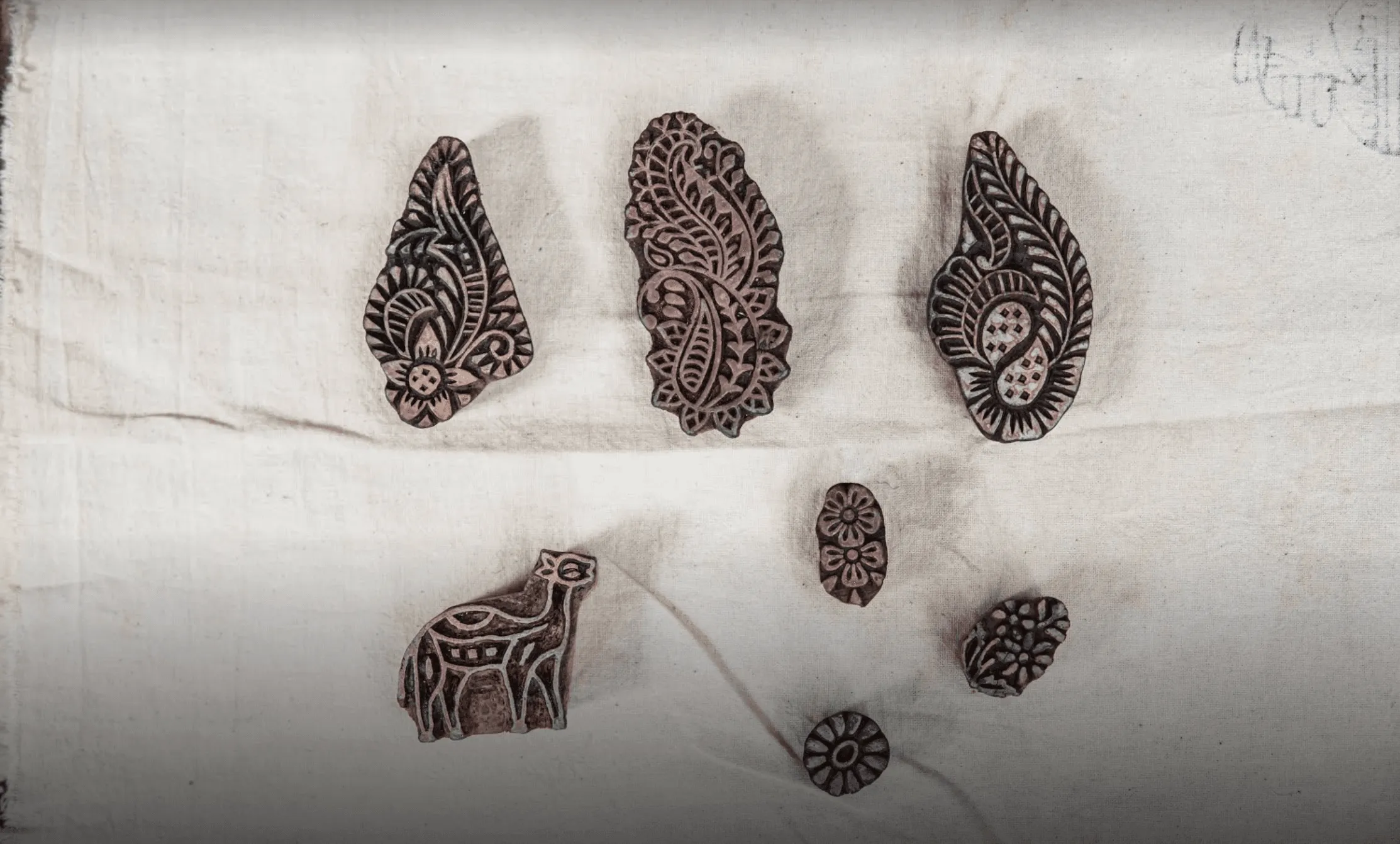
Samples of carved wooden blocks used for printing borders and repeating motifs on Mata ni Pachedi cloths, sourced from specialist block-makers in Pethapur, Gujarat. Source: Dastkari Haat Samiti / Google Arts & Culture
Once the printing and painting are complete, the cloth is washed in running water to fix the dyes and remove excess pigment. The full process for a major Pachedi can take several days to several weeks. Chandrakant Chitara, recipient of the Shilp Guru Award in 2019 and one of the senior figures of the Chitara family, along with his brothers Kiran, Vikram, and Vinod, has been instrumental in carrying both the technical and the iconographic depth of the tradition forward from their late father Bhulabhai Chunilala Chitara, who taught all four of them in the family workshop in Vasna.
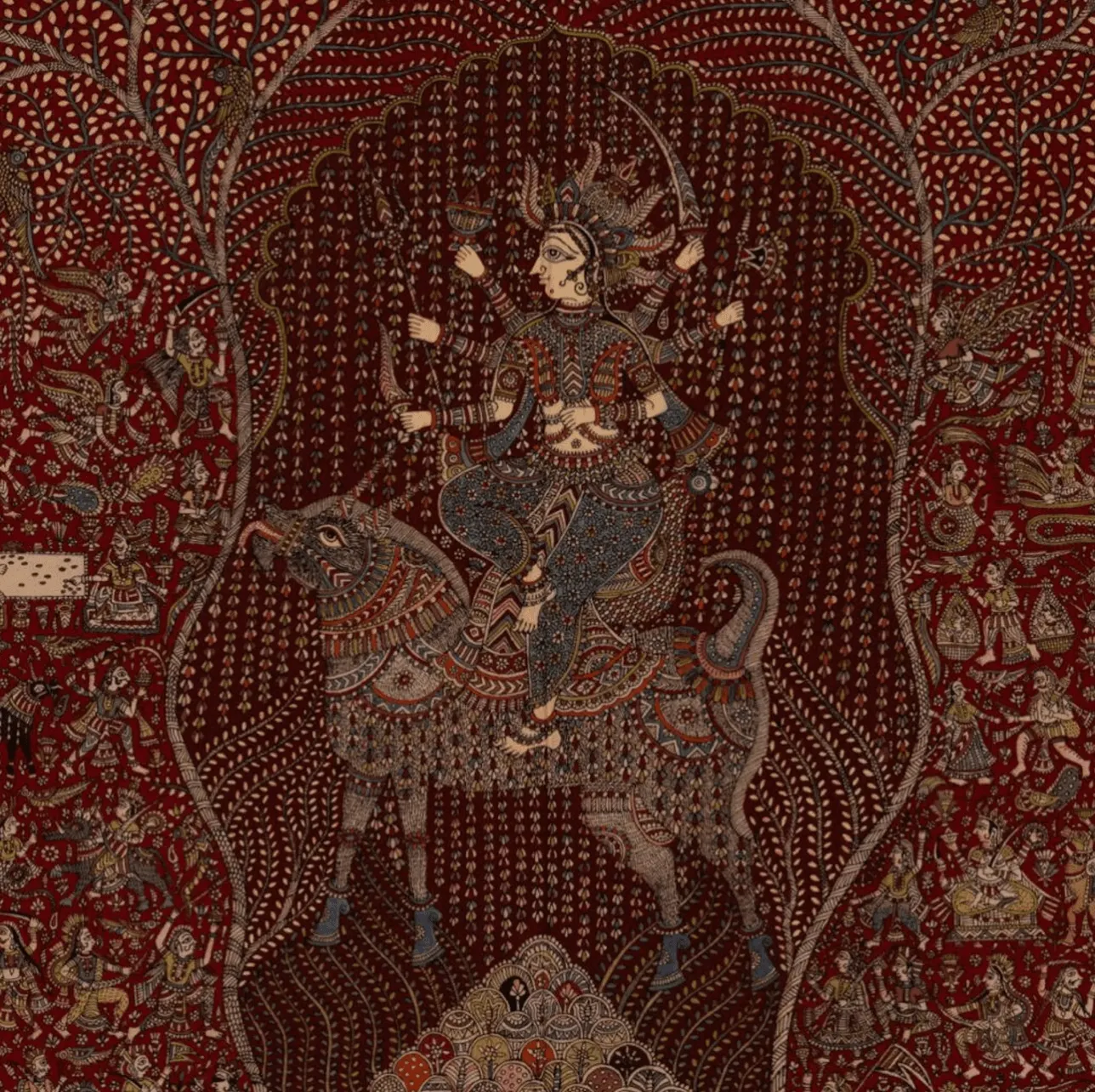
Image Source: Saint Louis Art Museum
The Ritual Life of the Cloth: How Mata ni Pachedi Is Used and When
Mata ni Pachedi is most commonly commissioned as a manat, a vow fulfilled to the goddess in return for a blessing received or a prayer answered. A devotee facing illness, a difficult childbirth, a court case, a marriage proposal, or any moment of crisis may make a promise to the goddess. If the prayer is answered, the devotee commissions a Pachedi to the relevant Mata as the offering. The cloth is the vow made material.
The Pachedis are raised and venerated at specific moments in the ritual calendar. The community traditionally uses them at four festivals: Magha in February, Chaitra in April, Arshad in July, and Ashvin in October, the last of which includes the Navratri celebrations when goddess worship reaches its annual peak. Each occasion brings the cloths out from family storage, sets them up at the shrine site, and reactivates the sacred function the Pachedi was made to perform.
64 Jogini forms the multiple manifestations of the goddess that the Mata ni Pachedi tradition celebrates and depicts across its full iconographic repertoire, reflecting a Tantric and shakti-centred theological framework distinct from mainstream Hindu temple worship.
After the ritual, the fate of the cloth varies. Some Pachedis are folded and kept as family heirlooms, preserved across generations as records of vows fulfilled. Others, particularly those used in major life-cycle rituals or those that have deteriorated with age, are ritually immersed in flowing water, returning the sacred cloth to the river system in which the Vaghari community has historically lived. The immersion is itself a final ritual gesture, acknowledging that the cloth has done its sacred work and can now be returned to the elemental world from which its materials came.
Mata ni Pachedi Today: Artists, Recognition, and the Challenge of Continuity
The contemporary practice of Mata ni Pachedi is concentrated almost entirely in Vasna, Ahmedabad, where the Chitara family workshops continue to function as both ateliers and family homes. The seven-generation lineage of the Chitara family has produced several artists of national standing, including Chandrakant Bhulabhai Chitara, who received the National Merit Award in 2000, the National Award in 2001, and the Shilp Guru Award in 2019, and Sanjay Manubhai Chitara, who received President Abdul Kalam's National Award in 2000 after beginning his apprenticeship to his father at the age of twelve.
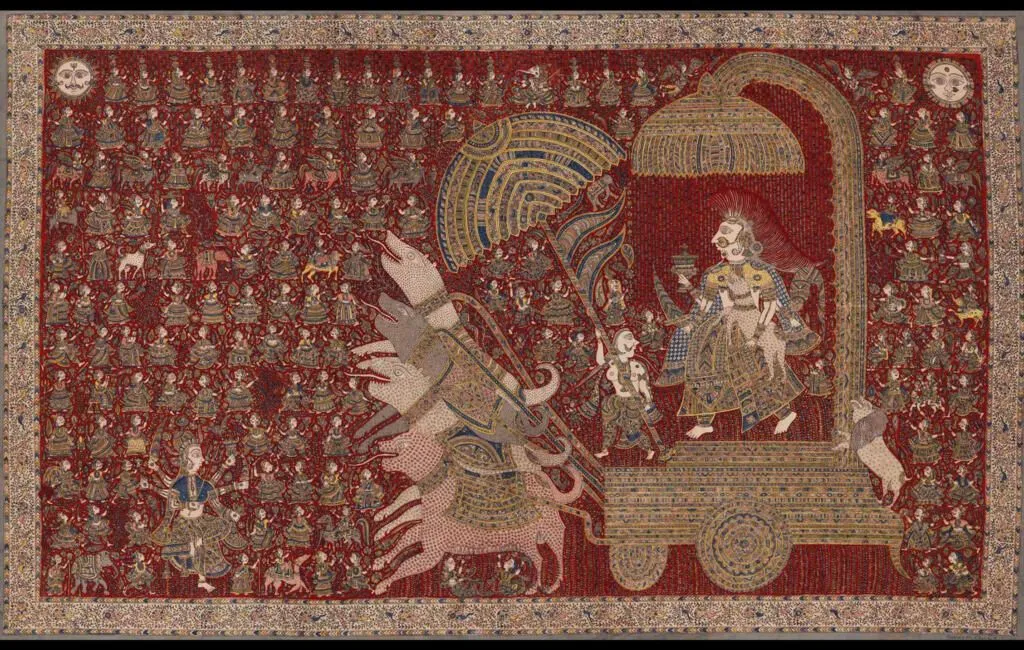
A Sanjay Chitara Pachedi to Hadkai Mata, the goddess invoked for protection against rabies, executed in the traditional red, black, and white palette using cotton and natural dyes. Source: Sarmaya Arts Foundation
In April 2023, Mata ni Pachedi received its Geographical Indication tag from the Government of India, formally recognising the form's origin in Gujarat and its distinct Vaghari and Chitara family lineage. The recognition has raised the visibility of the tradition, but the underlying economic pressures remain serious. With only twelve households continuing the practice and the older generation passing the work to children who must also contend with the realities of contemporary urban India, the question of continuity is real. The seven-hour online course taught by the Chitara brothers is one structured way the family has chosen to address this, opening up the iconographic and technical foundations of the tradition to learners who would otherwise have no path into it.

For learners who want to engage with [the tradition more independently, the Artventures of Mata ni Pachedi book, produced with the Chitara family](the Artventures of Mata ni Pachedi book, produced with the Chitara family) covers the mythological characters, human figures, flora, and fauna of the form with guided exercises and motif breakdowns. It functions as a serious introduction to a tradition that is otherwise transmitted almost exclusively within Chitara family workshops.
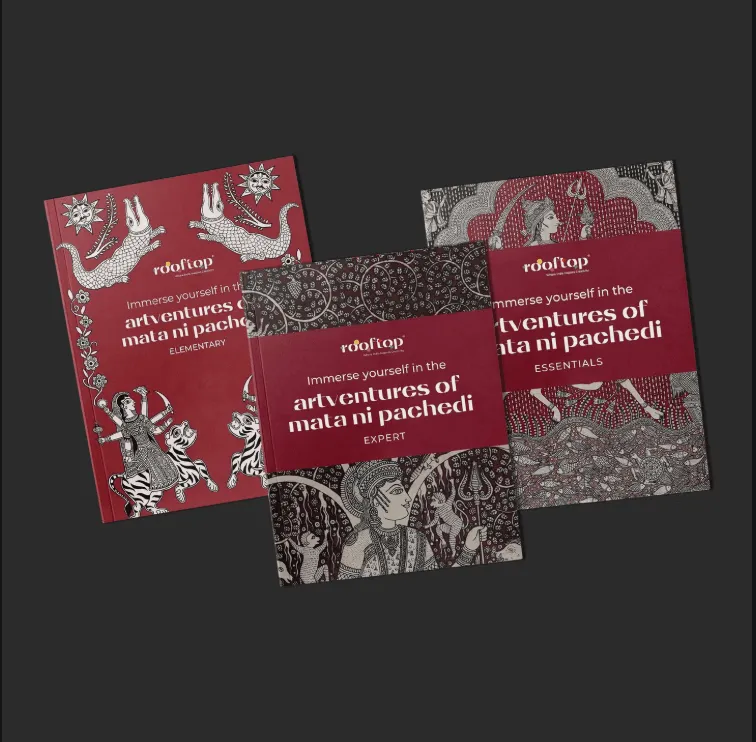
Artventures of Mata Ni Pachedi: A Devotional Journey Through Art (3 Set)
For collectors, authentic Mata ni Pachedi works by practising Chitara artists come with a particular kind of weight. Each one is a vow, an iconographic programme, and a piece of devotional practice all at once, made by a member of a community whose entire reason for inventing the form was the refusal of access to other forms of worship. To buy one is not to acquire a textile. It is to participate in keeping alive a tradition that has had to make itself, repeatedly, against the grain of the broader institutions around it.
The Cloth as Temple
Return for a moment to the Navratri evening. The Pachedi is hung. The drummer is playing. The bhuva is moving into trance. The goddess, painted in red and black on white cotton by Kiran Chitara or one of his brothers in a workshop in Vasna some weeks earlier, is present in this clearing as completely as she could be in any stone-built temple. The cloth is not symbolic. It is functional. It does what a temple does, because for the community gathered in front of it, a temple has never been available.
That is what every Mata ni Pachedi finally is. Not a piece of decorative textile art, not a folk craft, not a heritage object to be admired at distance, but the physical record of a community's centuries-long refusal to accept that its goddesses could be denied to it. The cloth is a temple. The temple is a vow. The vow is a continuity. And the continuity, against every odds the broader social world has placed in its way, is still being made today, by the same families, with the same kalam pens and the same natural dyes, in the same neighbourhood of Ahmedabad.