
Madhubani Painting For Begginers
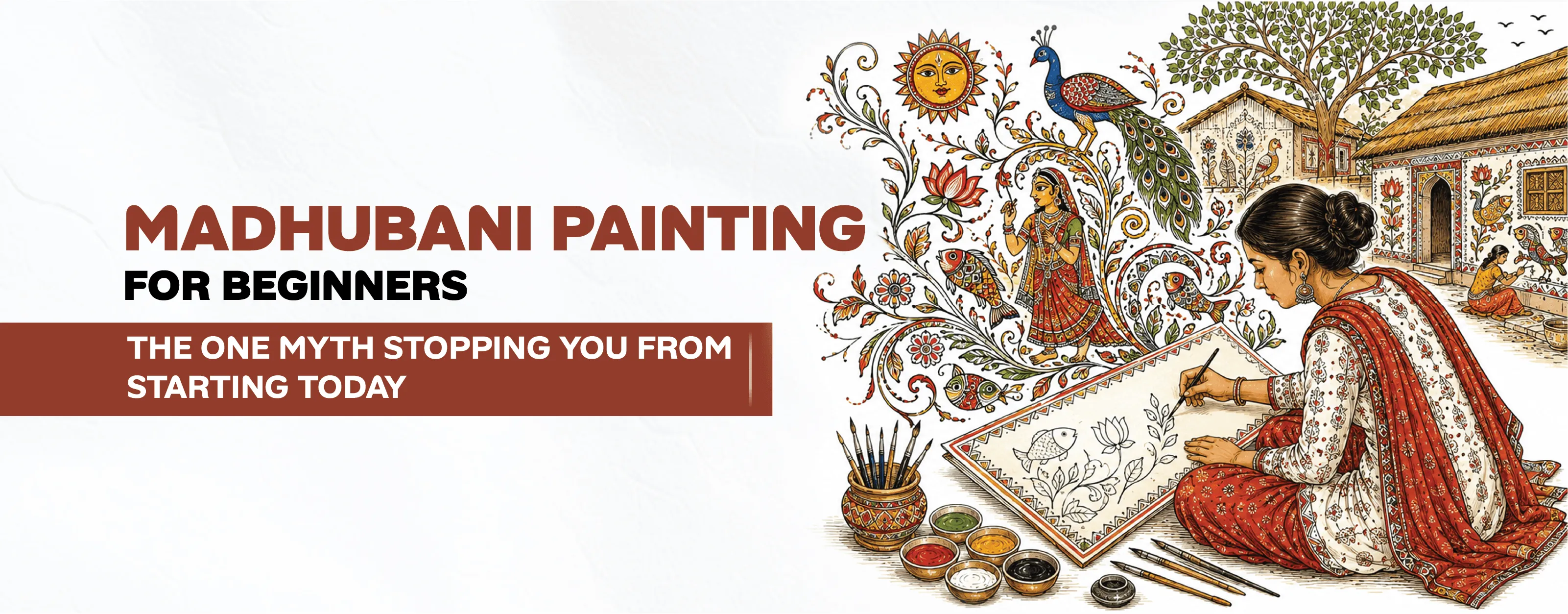
Madhubani Painting for Beginners: The One Myth Stopping You from Starting Today
Learn how to create Madhubani paintings as a beginner with simple motifs, traditional borders, and easy techniques. Explore the art form’s basics and discover guided learning experiences.

Rooftop
Author
When people first encounter a traditional Madhubani painting, the intricate patterns can be a little intimidating. The double outlines, closely packed details, and carefully repeated motifs are beautiful to look at, but they can also make the art form seem difficult to attempt. It is easy to admire a painting and think, I could never make something like that. I can barely draw a straight line.
This belief often keeps beginners from trying at all. Madhubani art may look complex, but you don't need years of formal training or an innate gift for drawing to get started. Rooted in the Mithila region of Bihar, this folk art developed through everyday practices, with women traditionally painting the walls of their homes with motifs drawn from nature, mythology, and daily life. Much of its visual language relies on patterns, lines, and shapes that can be learnt through practice.
The secret is to understand how Madhubani art is put together, one element at a time. Once you begin to recognise its recurring motifs and simple ways of filling space, the art form becomes far less intimidating. You don't have to master everything in one go. Start with a few basic patterns, let your hand find its rhythm, and build from there.
Why Madhubani Painting Is Easier to Learn Than It Looks
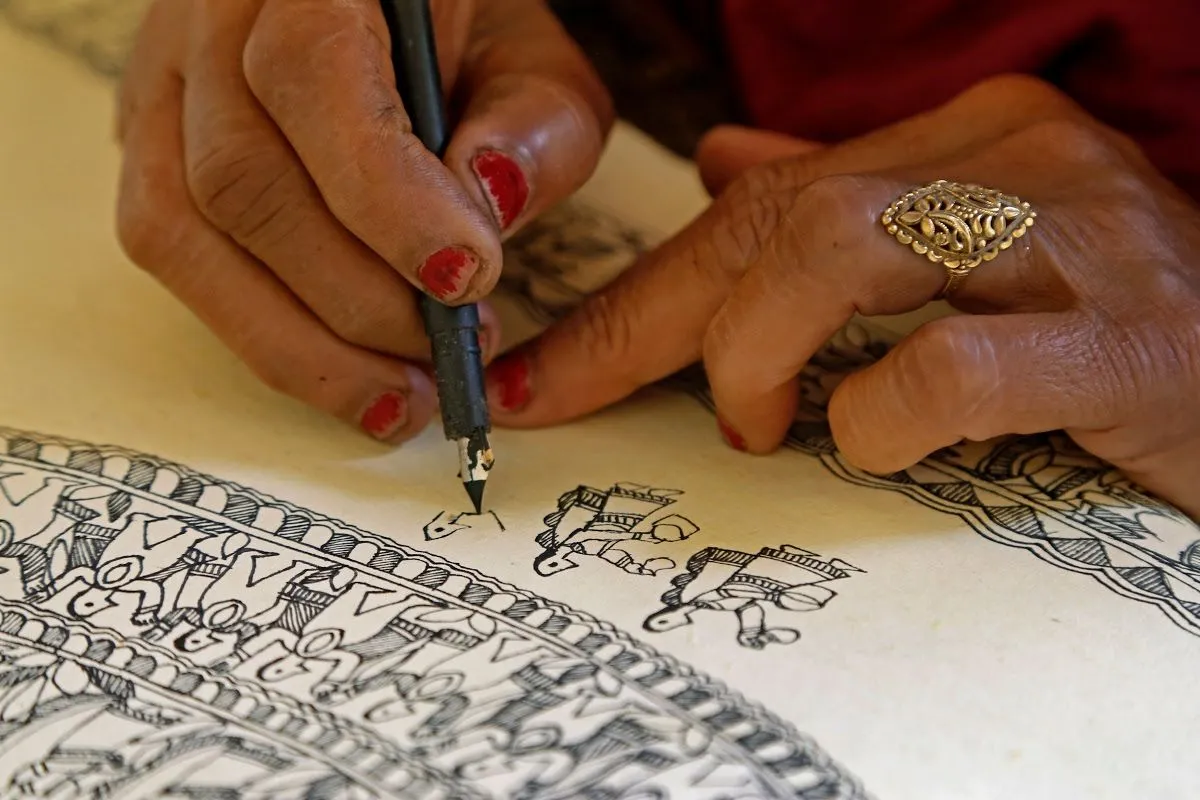
How to get started with a Madhubani Painting. Source - Google Arts & Culture
Madhubani painting may look intricate, but its beauty lies in a visual language that beginners can learn one element at a time. Unlike art forms that often rely on realistic perspective, shading, and three-dimensional depth, Madhubani uses bold outlines, repeated patterns, and flat colours to bring a composition to life. Once you understand how these elements work together, the art form becomes much less intimidating.
Here are a few things that make Madhubani approachable for beginners:
A Vocabulary of Familiar Motifs: Fish, lotuses, peacocks, trees, and geometric borders appear frequently in Madhubani paintings. Learning to draw these individual elements gives you a starting point for building your own compositions. With practice, you can combine them in different ways and develop designs of your own.
Flat Shapes Instead of Realistic Depth: Madhubani does not depend on vanishing points or the kind of perspective used to make objects look three-dimensional. Its compositions often arrange figures, plants, and other motifs across a flat surface. This allows you to focus on their shapes and placement without worrying about getting every angle or proportion exactly right.
Lines and Colours That Build the Picture: Two well-known Madhubani styles offer different ways to approach a painting. Kachni relies on fine lines and intricate patterns, while Bharni is known for filling shapes with colour. Both offer beginners a way to practise gradually, whether they enjoy the rhythm of repeated lines or the process of bringing a design to life with colour.
Patience Matters More Than Natural Talent: You do not need to have always been good at drawing to begin exploring Madhubani. Steady lines, repeated patterns, and careful colouring are skills that improve with practice. Starting with simpler motifs and gradually moving towards more detailed compositions makes the process easier without the pressure of getting everything right on the first attempt.
The important thing is to give yourself room to learn. Your first attempt does not have to resemble a finished traditional painting to be worthwhile. Start with a few shapes, experiment with patterns, and let your confidence grow with each one.
How to Start a Madhubani Painting Step by Step
Learning Madhubani painting becomes easier when you approach it in stages rather than trying to fill an entire sheet at once. In a structured workshop led by traditional Mithila artists, beginners can build their skills gradually, starting with simple motifs and moving towards a complete composition.
Start With a Single Motif: An empty sheet can feel intimidating, especially when you're looking at a large canvas. Begin instead with one simple motif, such as a fish (Matsya) or a lotus (Puren), on a smaller piece of practice paper. This gives you room to get comfortable with the shapes, outlines, and patterns before taking on a larger design.
Learn to Draw the Border (Hashiya): Madhubani paintings often feature distinctive borders that frame the central artwork. Practise drawing a double-line border around the edges of your paper before moving on to the main composition. This helps you understand how to use the available space and gives your painting a clear structure.
Break the Composition Into Sections: Even a detailed Madhubani painting can feel more manageable when you approach it in smaller parts. Try dividing your paper into quadrants or using concentric rings to plan where different motifs will go. This gives you a basic layout to work with and helps you arrange the elements without overcrowding the composition.
Bring the Elements Together: Once you're comfortable drawing individual motifs, creating borders, and planning your layout, begin combining these elements into a complete painting. You can start with a few familiar shapes and gradually introduce more details and patterns as your confidence grows. With practice, you'll find it easier to create a composition that feels balanced and distinctly your own.
The idea is to build one skill at a time. You don't have to create a detailed Madhubani painting on your first try. Learning to draw a motif, frame it with a border, and arrange it thoughtfully gives you a solid foundation to work from.
What Can You Create in Your First Three Madhubani Sessions?
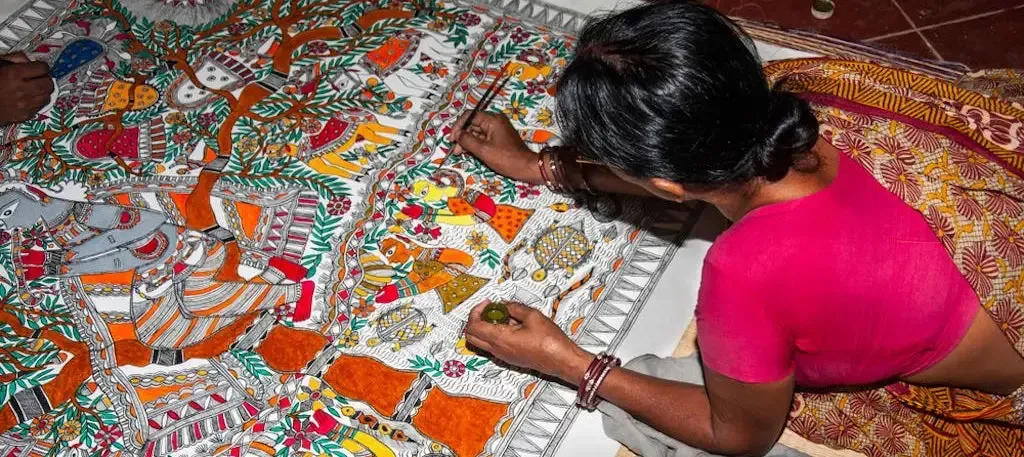
Learning in different sessions of a Madhubani Painting Workshop
Madhubani painting can become much more approachable once you begin practising its basic techniques. With a little guidance and regular practice, beginners can progress from drawing individual motifs to putting together a small, complete artwork in just a few sessions.
Session 1: Getting Comfortable With the Basics The first session focuses on overcoming hesitation and getting used to drawing with a steady hand. Beginners practise the double-outline technique and learn to draw simple motifs, such as fish and lotuses, on their own.
Session 2: Exploring Borders, Lines, and Colours Once the basic shapes feel familiar, the next step is to create a traditional repeating border (Hashiya). Beginners also practise fine-line patterns associated with Kachni and the solid colour fills characteristic of Bharni, gaining a feel for two important approaches to Madhubani painting.
Session 3: Creating a Complete Artwork By the third session, beginners can bring these skills together in a small original painting. A central motif, such as a peacock or a pair of fish, can be framed by a hand-drawn border and finished with carefully applied colours and balanced patterns.
Completing a painting that captures the distinctive character of Madhubani art can be deeply satisfying, especially for someone who began with little confidence in their drawing skills. What once seemed like an overwhelming task starts to make sense when broken down into manageable steps. Each new technique builds on the last, giving beginners the confidence to keep experimenting and develop their own approach.
Begin Your Madhubani Painting Practice
Learning Madhubani painting starts with a few simple lines, familiar motifs, and the patience to see them come together. You don't need to be an experienced artist to give it a try. With the right guidance, even a fish, a lotus, or a repeating border can become the starting point for something beautiful.
At Rooftop, you can explore traditional Indian art through learning experiences led by artists who have spent years practising and preserving these art forms. Learning directly from traditional artists offers a chance to understand the techniques, stories, and cultural context behind Madhubani painting, while developing the confidence to create your own artwork.
Whether you're picking up a pen for the first time or looking to explore a new art form, begin with the basics and let your skills grow with practice. Your first painting doesn't have to be perfect. It simply has to be a start.