

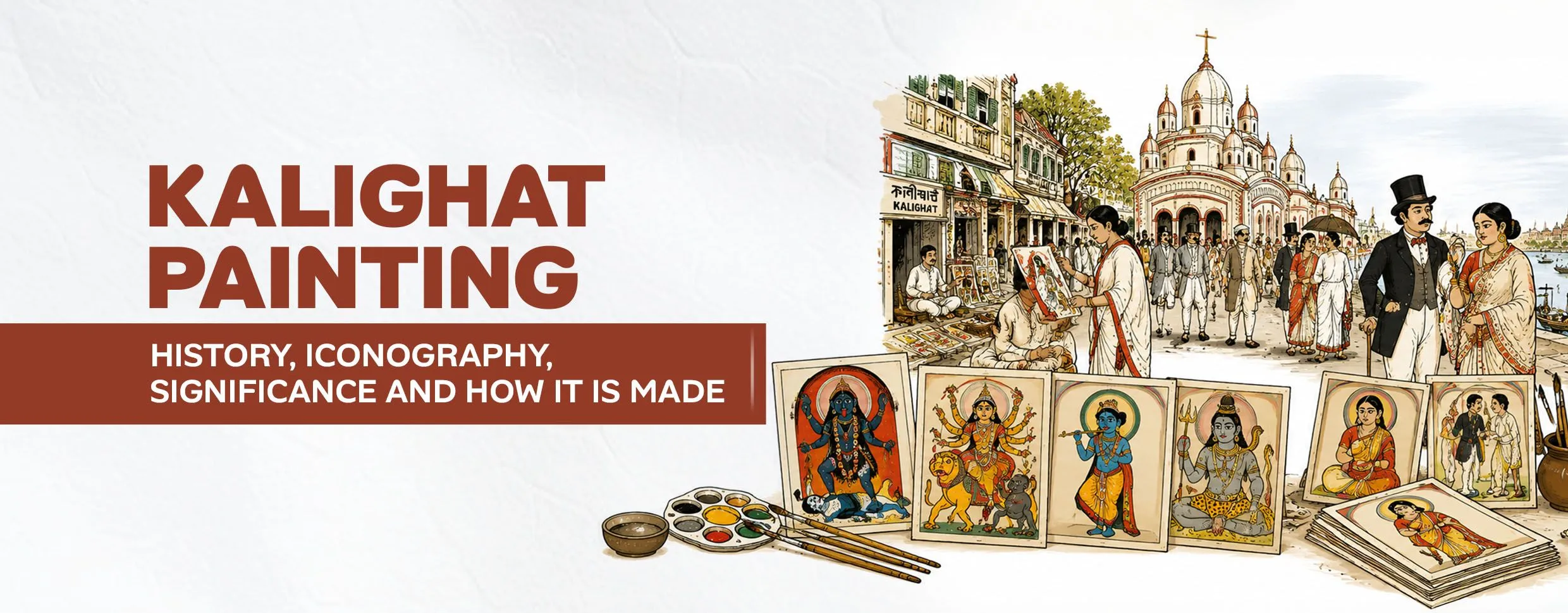
Kalighat Painting: History, Iconography, Significance and How It Is Made
Kalighat painting is one of the few Indian folk traditions shaped as much by urban satire as by devotion. A deep look at its history, iconography, materials, and the Patua artists in Naya village who continue to paint it today.

Rooftop
Author
Picture the lanes outside the Kalighat Kali temple in Kolkata in the middle of the nineteenth century. The temple is freshly built, the city is the second-largest in the British empire, and the foot traffic around the shrine is constant. Pilgrims arrive from across Bengal looking for a souvenir to carry home. Among the stalls selling sweets, brass lamps, and bangles, there are makeshift studios run by painters who have migrated from villages in rural Bengal. They work at speed, producing single-sheet paintings of Kali, Durga, and Krishna at prices most pilgrims can afford. None of them imagine, in those crowded lanes, that what they are making will one day be studied by curators in London, collected by Picasso, and acknowledged as a foundational moment in modern Indian art.
This is the origin story of Kalighat painting, a tradition shaped as much by urban commerce and social commentary as by devotion, and that dual identity, as sacred art on the one hand and sharp satire on the other, is precisely what makes it unlike any other folk painting tradition in India.
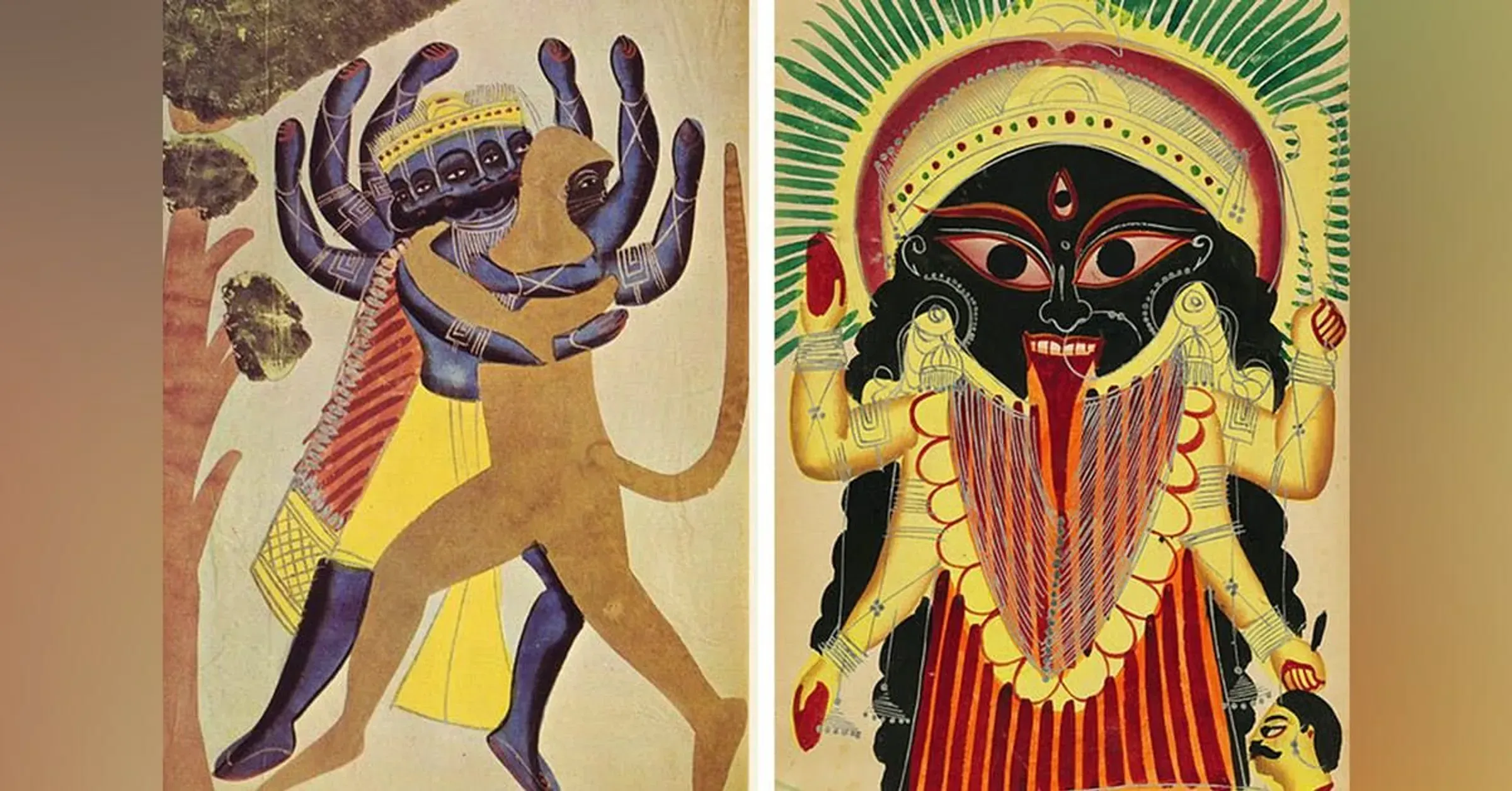
Image Source: LBB
The Patua scroll painters of rural Bengal had been a recognised artisan community for centuries. They travelled from village to village carrying long painted scrolls known as patachitras, unrolling them panel by panel as they sang stories of gods, kings, and local heroes. The income was modest, and the visual style suited a slow, narrative form of performance art.
This changed in the early nineteenth century. Kolkata had become the capital of British India and a thriving harbour city, and the Kalighat Kali temple, built in or around 1809 in its present form, was drawing growing numbers of pilgrims. Patua artists from villages across Bengal began migrating to the temple precincts, drawn by the prospect of a more reliable income than itinerant scroll narration could provide.
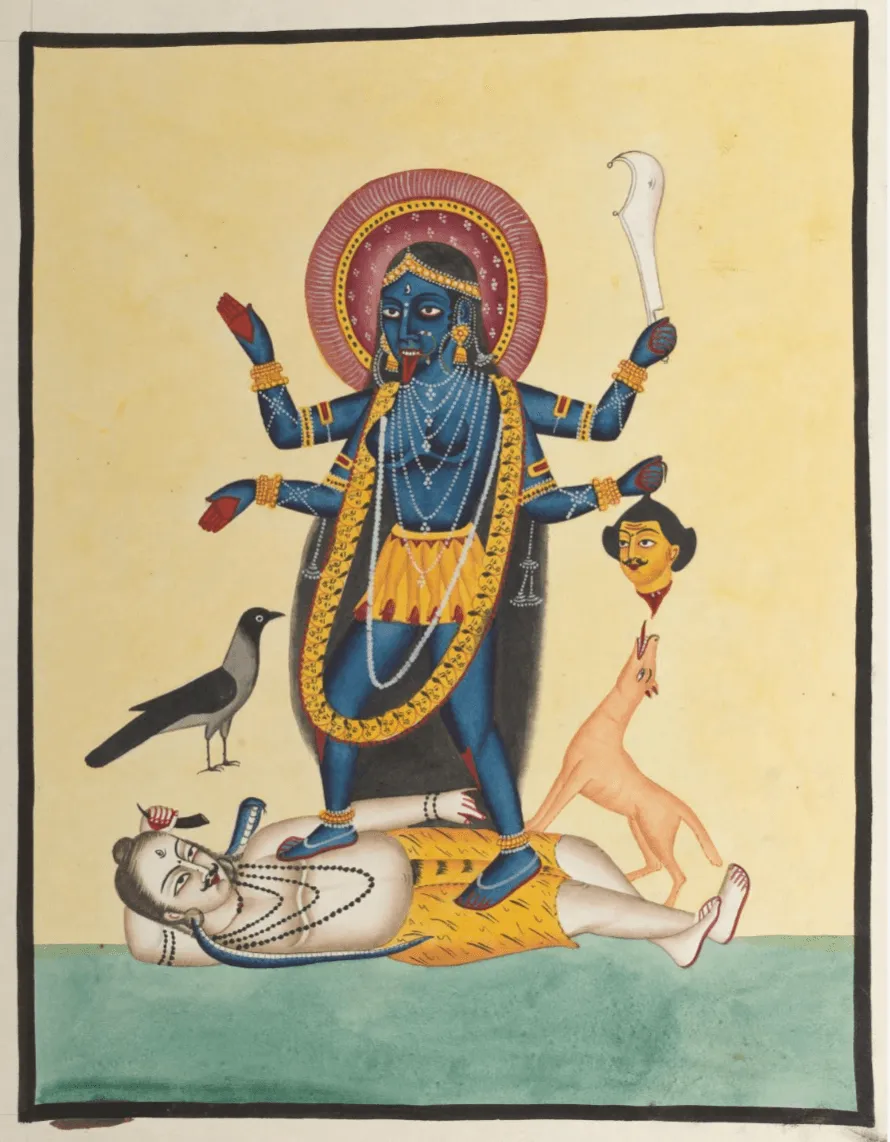
Goddess Kali, Kalighat painting, late 19th century, Calcutta. Source: Cleveland Museum of Art
The form they developed in Kolkata had little in common with the scroll painting they had inherited. Instead of long narrative cycles, they painted single iconic images. Instead of cloth and lengthy preparation, they used mill-made paper, sometimes still bearing watermarks of the British paper mills that supplied it. Instead of slow recitation, they painted at speed. The compositional logic of the form was rebuilt for urban commerce: cheap paper, fast production, immediate sale to a passing pilgrim audience.
**₹ a few annas ** the price at which a single Kalighat painting typically sold to pilgrims in the late nineteenth century, making it one of the most accessible forms of devotional art ever produced in India.
This commercial pressure is sometimes treated as if it diluted the form, but the opposite is closer to the truth. The economic constraints of the Kalighat market are what gave the painting its visual identity. The thick black outlines, the broad sweeping brushstrokes, the limited but vivid palette, the figure isolated against a near-empty background, all are responses to a demand for paintings produced quickly and sold cheaply without sacrificing devotional intensity.
The Iconography of the Divine: Gods and Goddesses in Kalighat Painting
The early decades of Kalighat painting were dominated by religious subjects. The community of artists, called Patuas after the patachitra they had once made, organised their workshops as family operations: one member ground pigments, another drew the outline, another filled in the colour, and the painting moved through the family until it was finished. The division of labour, combined with constant pilgrim demand for specific deities, produced a stable iconographic repertoire any working Patua could execute with confidence.
The principal deities of the Kalighat repertoire
- Kali, the goddess of the Kalighat temple itself, depicted with her dark body, her garland of severed heads, her protruding red tongue, and her four arms holding a sword, a severed head, a gesture of fearlessness, and a gesture of blessing.
- Durga, in her ten-armed warrior form, slaying the buffalo demon Mahishasura, often astride her lion in the midst of decisive action.
- Krishna, in romantic scenes with Radha, in episodes from his childhood, and in playful scenes that suited the bold, simplified figural style of the form.
- Shiva and Parvati, shown in domestic and mythological scenes including the dance of Shiva and the family group with Ganesha and Kartikeya.
- Hanuman, Ganesha, and Lakshmi, individually rendered in single-figure compositions that pilgrims took home as small devotional objects.
What is striking about the Kalighat treatment of these subjects is the reduction. A full mythological cycle that in classical miniature painting might have unfolded across many panels with elaborate backgrounds, courtiers, and architectural detail, is collapsed in Kalighat into a single iconic figure or a single dramatic moment. The viewer is given the essence of the scene with nothing extraneous around it. The painting reads instantly, which is precisely what a pilgrim needed it to do.
Kalighat reduced the entire visual machinery of Hindu mythology to its most concentrated devotional unit: a single figure, charged, isolated, and unmistakable.
The Satirical Tradition: Babus, Bibis, and Social Commentary
Within a few decades of its emergence as a devotional form, Kalighat painting developed a second, equally important strand: a tradition of secular and satirical painting that took as its subject the contradictions of nineteenth-century Bengali society. The newly wealthy Bengali babus who had grown rich through trade with the British, the courtesans known as bibis who lived at the social margins of this urban world, the false sadhus who exploited religious devotion, the relationships of power between men and women in the urban household, all became subjects for the same Patua brushes that painted Kali.
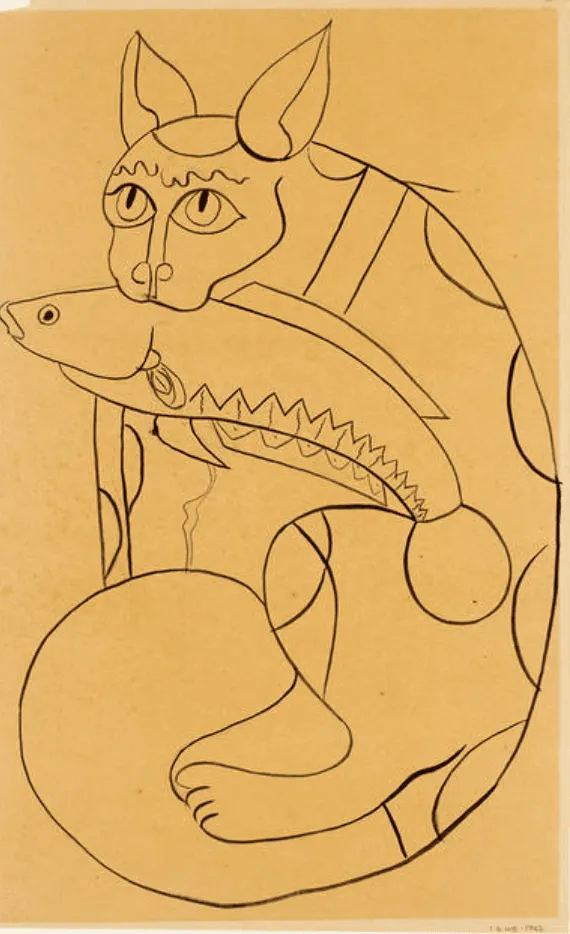
Cat with a Fish in its Mouth, a famous Kalighat satirical work commonly read as a comment on hypocrisy among self-styled holy men. Source: Victoria and Albert Museum, London
The satirical paintings followed the same visual conventions as the devotional ones. The same thick black outlines, the same flat colour washes, the same isolated figures against empty grounds. What changed was the subject. A wealthy babu seated on a Western-style chair, dressed in a hybrid of Bengali dhoti and English jacket, playing the sitar with affected concentration, was depicted with the same care a Patua would give to a portrait of Krishna. The juxtaposition was the joke.
The themes of the satirical tradition included the foppish babu corrupted by wealth and Western influence, the bibi as the object of his sexual interest, the elderly husband paired with a young wife in scenes of marital comedy, the cat with a fish in its mouth as a stock symbol of religious hypocrisy, and the Jackal Raja's court as a sustained allegory of corruption in colonial Calcutta. The Occidental school of Kalighat, as it is sometimes called in distinction from the Oriental devotional school, also took on patriotic subjects in the late nineteenth and early twentieth centuries, depicting freedom fighters including Tipu Sultan and Rani Lakshmibai.
Read as a body of work, the satirical Kalighat paintings constitute one of the earliest examples of urban popular art in India. They are not folk art in the sense of being village-rooted and timeless. They are popular art: mass-produced, commercially distributed, topical, aimed at an audience that wanted to laugh at itself. Almost a century before the political cartoon emerged in Indian newspapers, Kalighat painters were doing what political cartooning would later do, with brush and watercolour rather than pen and ink.
Materials, Brushwork, and the Making of a Kalighat Painting
The materials of Kalighat painting were modest by classical Indian standards, and that modesty was central to what made the form work. The ground was mill-made paper, often the same lined or watermarked stock used for ledgers and official documents. The pigments were originally natural and locally sourced: yellow from turmeric root, blue from the petals of the Aparajita flower, black from lamp soot collected by burning oil lamps under an inverted pot. Over the nineteenth century, commercial European pigments became available, and many later Kalighat works combine natural and commercial colours within a single painting.
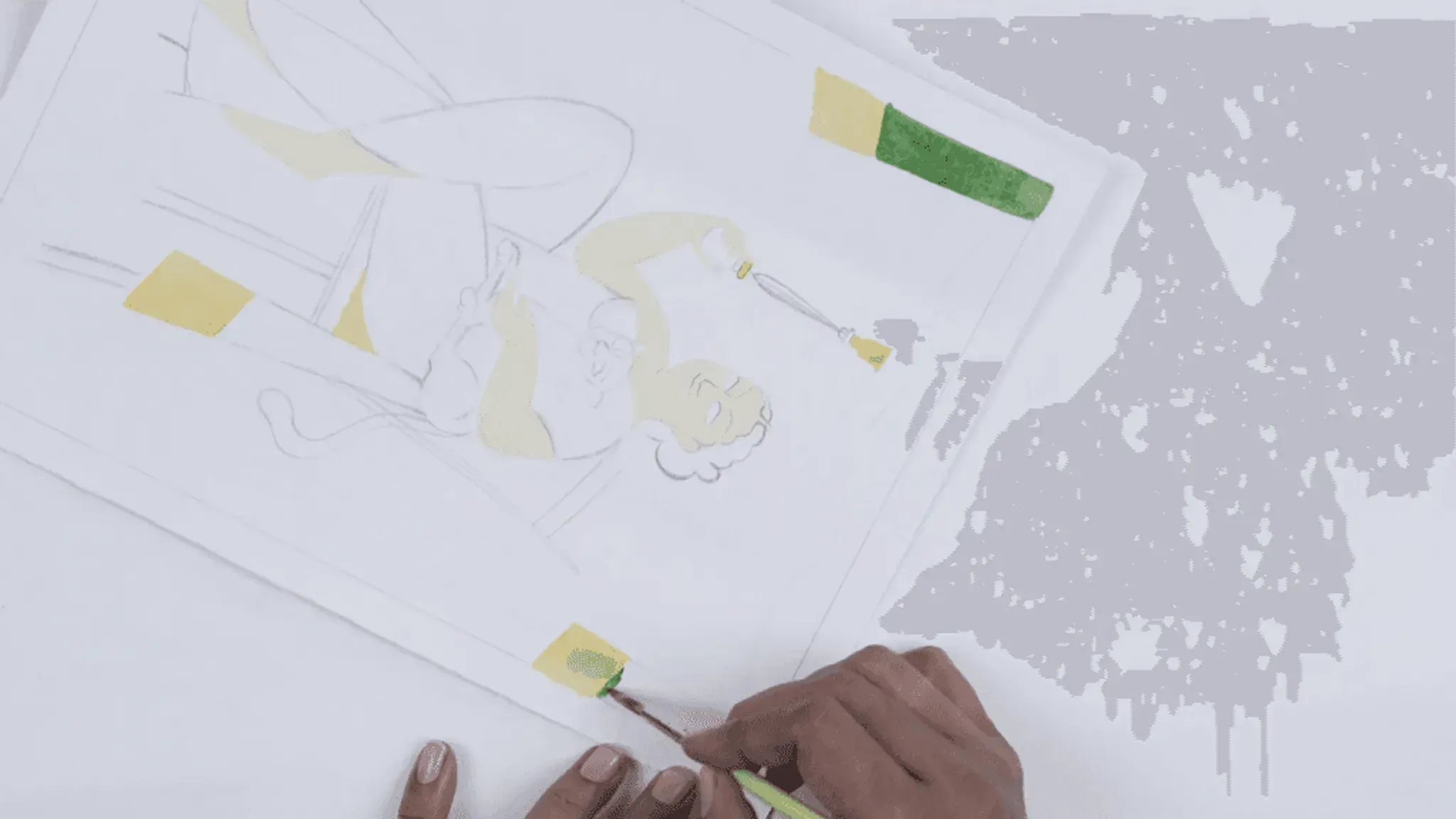
The technique was built for speed. A typical workshop had several painters working in parallel, each specialising in one stage. The senior artist drew the outline in confident black brushwork, defining the figure with a few decisive sweeping lines. The colour fields were filled in by other family members, with broad flat washes laid down in unmixed tones. Highlights, jewellery, and ornamental detail were added at the end. The whole painting could be completed in less than an hour by a skilled team.
Under 1 hour the time a skilled Patua workshop typically took to complete a single Kalighat painting, working in parallel with one family member drawing outlines, another filling colour, and another adding detail.
This speed is visible in the finished work, and it is part of what gives Kalighat its visual energy. The brushwork is loose, direct, unforgiving. There are no second chances on the page. The line that defines a shoulder, the arc of a hip, the curve of an eye, all are made in a single decisive stroke, and the confidence of that stroke is what carries the painting. Where classical Indian miniature traditions cultivated fine detail across days or weeks of careful work, Kalighat cultivated the opposite virtue: the bold, economical mark that captures everything essential and discards everything else.
The palette is equally economical. A typical Kalighat painting works with a handful of strong colours, often red, yellow, blue, green, white, and black, applied flat and unmodulated. The tonal range comes from the way these colours are juxtaposed rather than from any subtle gradation within them. A figure in deep blue against a white ground, with red accents on the lips and palms, is doing all the work the painting needs. The simplicity is the sophistication.
Why Kalighat Painting Matters Beyond Its Origins
By the early decades of the twentieth century, Kalighat painting had entered a long decline. Cheaper wood-block and machine-printed images, mass-produced in Calcutta and other centres, began to displace the hand-painted Kalighat works in the pilgrim market. The Patua workshops shrank. The original first-generation artists died without successors. By the 1930s, the form was widely understood to be over.
And yet, in the decades that followed, Kalighat painting became one of the most consequential references in modern Indian art. Abanindranath Tagore, the central figure of the Bengal School, studied Kalighat carefully and adopted aspects of its line and composition into the new pan-Asian style he was developing. Jamini Roy went further. After training in academic European painting at the Government School of Art in Calcutta, Roy turned away from realism in the 1920s and built his mature style directly on Kalighat foundations, simplifying his figures, flattening his colour fields, and adopting the same bold confident line. He received the Padma Bhushan in 1954 and is now recognised as one of the most important Indian modernists of the twentieth century.
Beyond India, the form found admirers in Paris. The historian and curator William Archer documented that artists including Pablo Picasso, Fernand Leger, and Henri Matisse acquired Kalighat paintings in the early twentieth century, drawn to the same qualities, the bold flat fields, the economical line, the iconic clarity, that would also drive European modernism in the same period. The V&A in London holds the world's largest collection of Kalighat paintings, with around 645 works acquired between 1879 and the 1930s.
645 works the size of the Victoria and Albert Museum's Kalighat collection in London, the largest in the world, acquired between 1879 and the 1930s primarily through the bequest of John Lockwood Kipling and other British collectors.
Other significant institutional holdings include the Victoria Memorial Hall in Kolkata, the Gurusaday Museum, the Ashutosh Museum at Calcutta University, the Cleveland Museum of Art, the Naprstek Museum in Prague, and the Queensland Art Gallery in Brisbane. The geographic spread gives a sense of how far Kalighat travelled from the lanes outside its temple, and how seriously it is treated as a foundational moment in Indian visual culture.
Kalighat Painting Today and the Artists Continuing the Tradition
Kalighat painting is not over. It survives today, although the centre of practice has moved. The Patua community most actively continuing the tradition is based in Naya village in West Midnapore district of West Bengal, where families of Chitrakar artists have built a sustained contemporary practice that retains the visual conventions of historical Kalighat while engaging with the present.
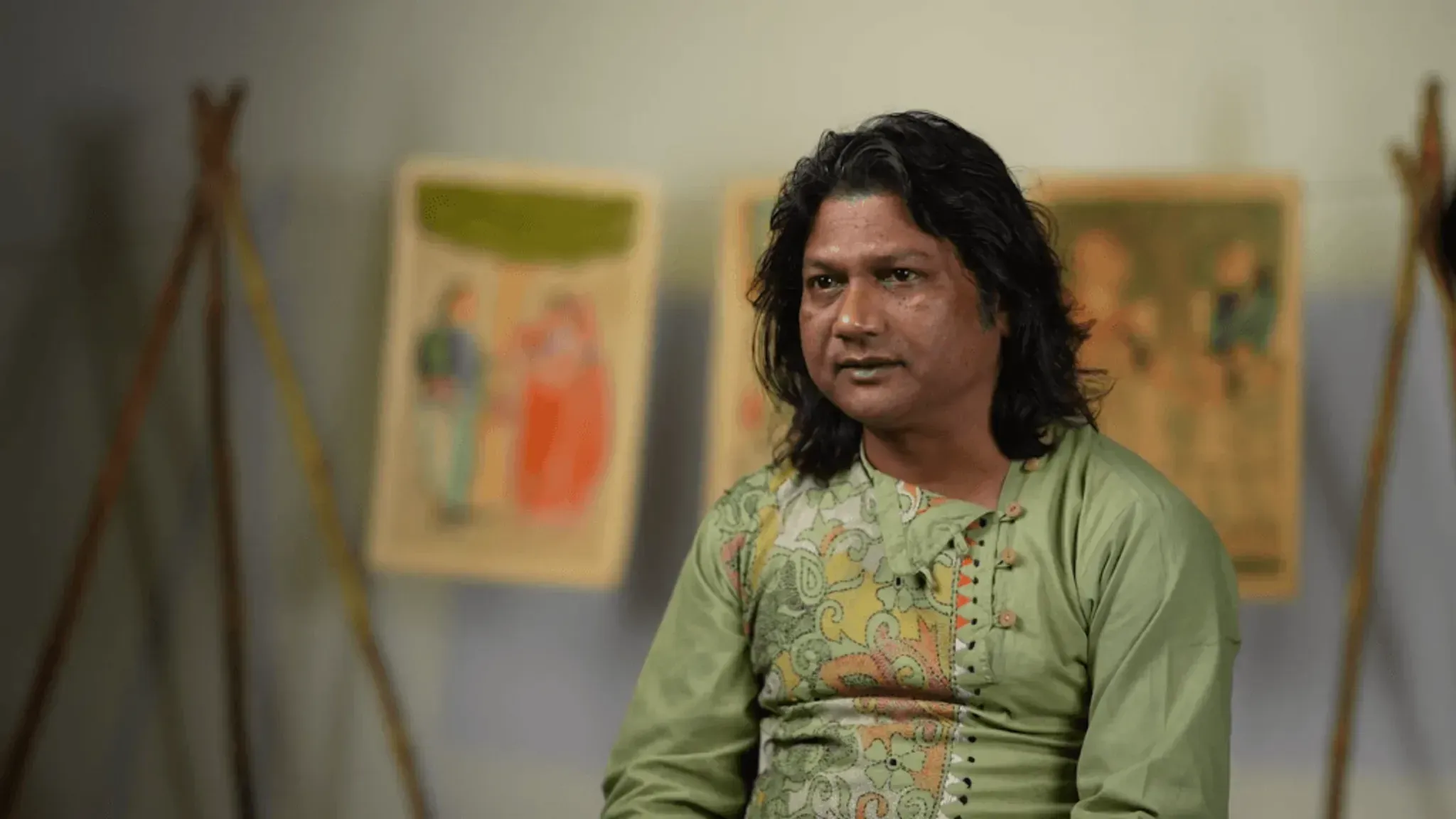
Contemporary Patua artist Anwar Chitrakar, National Award winner in 2006, painting in the Kalighat tradition. His work has been exhibited at the V&A in London and the Berlin Festival. Source: Rooftop Maestro Course feature
Anwar Chitrakar, born in Naya village in 1980 and recipient of the National Award in 2006, is one of the most prominent contemporary Kalighat artists. His work has been exhibited at the Victoria and Albert Museum, the Berlin Festival in 2012, the Namaste India Japan Festival, and the Mumbai International Airport. An online course taught by him on Rooftop walks students through the etymology, history, and motifs of the form, alongside the technique of painting subjects like zamindar ladies seated on chairs, a recurring figure that retains the satirical edge of the original tradition.
Kalam Patua, born into a Patua family in Murshidabad and working as a rural postmaster for much of his career, has become known for contemporary Kalighat work that retains the satirical impulse of the nineteenth-century form while turning it onto present-day subjects: dowry deaths, violence against women, the absurdities of bureaucracy. His paintings are held in international collections including the Queensland Art Gallery.
The continuity matters because the form was never simply about visual style. It was about a particular relationship between the artist and the urban world they painted from, combining devotional seriousness with sharp social observation. Original Kalighat paintings by contemporary Patua masters bring that relationship into homes that will never see the lanes outside the Kalighat temple, while preserving the visual language and worldview that made the form what it was.
More Than a Relic
It is tempting, with a tradition this thoroughly historicised, to read Kalighat painting backwards from the V&A collection, the Jamini Roy retrospectives, and the Picasso acquisitions, as if it were always already a modernist source rather than a living folk tradition. That reading misses what Kalighat actually was, and is.
It was, and is, a popular urban art made by working artists for a working audience, devotional and satirical at the same time, materially modest and visually uncompromising, fast in execution and exact in observation. The Patuas who set up their stalls outside the Kalighat temple in the 1830s would recognise the painters working today in Naya village, and the painters in Naya village are still doing what their predecessors did: looking at the world around them with both reverence and a critical eye, and putting what they see down on paper with the same confident black line.