

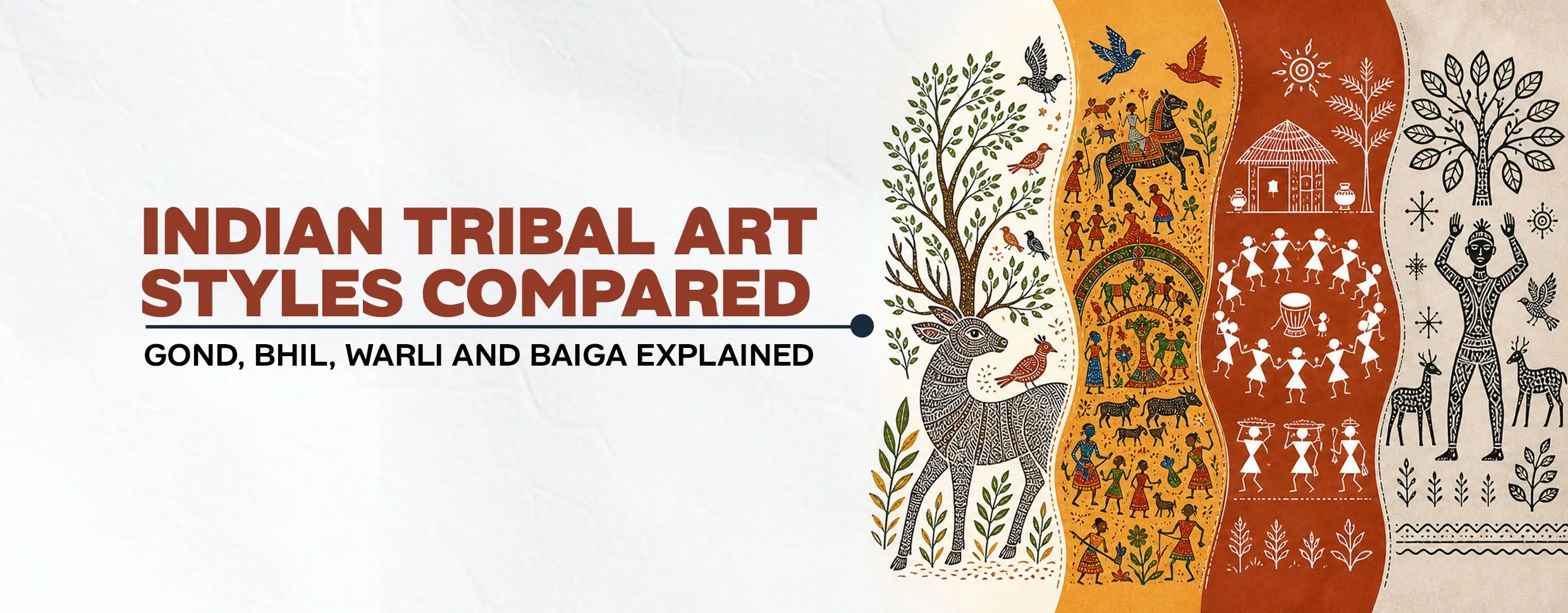
Indian Tribal Art Styles Compared: Gond, Bhil, Warli and Baiga Explained
Gond, Bhil, Warli, and Baiga are not interchangeable. Each is a distinct visual language with its own cosmology, materials, and way of seeing. A deep guide for buyers, collectors, and the simply curious.

Rooftop
Author
There is a habit of speech you encounter often when Indian tribal art comes up in conversation. Someone says they love tribal painting. Someone else says they have a beautiful piece on the wall. The conversation rarely gets more specific than that. The category absorbs everything: Gond, Bhil, Warli, Baiga, sometimes Saura and Pithora thrown in, all collapsed into a single broad label that does not actually describe any of them. It is the visual culture equivalent of saying you love European cuisine.
Looking closely at four of the most significant tribal art forms of India, Gond, Bhil, Warli, and Baiga, reveals four distinct visual languages, each shaped by a different cosmology, a different material environment, a different relationship between people and the world they inhabit. Each tradition has its own grammar of marks, its own pantheon of subjects, its own ritual occasions for being made.
Gond Art: A Universe of Interlocking Forms and Sacred Energy
Gond art comes from the Gond community, one of the largest tribal populations in India, with their primary base in Madhya Pradesh and significant presence across Chhattisgarh, Maharashtra, Andhra Pradesh, and Odisha. Gond visual culture sits inside a worldview where every meaningful element of the natural world carries soul and spiritual presence. Forests, rivers, animals, trees, even particular hills and stones are alive in a way that the Gond cosmological view recognises and Gond art makes visible. There is a long-standing belief among Gond artists that depicting a thing well brings good fortune to the home where the painting hangs. The act of painting is, in this sense, never purely aesthetic. It is participatory.
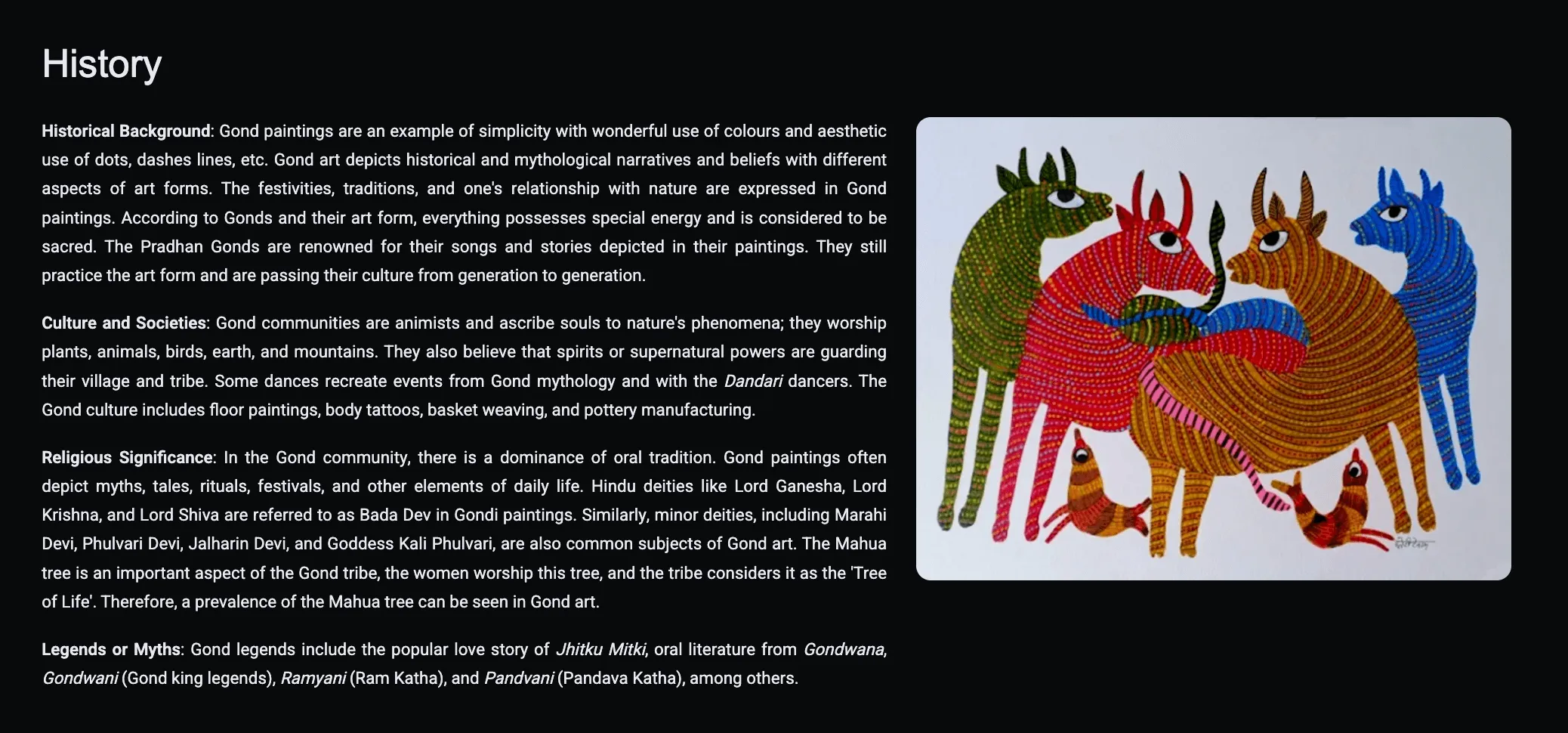
Visually, Gond paintings are immediately recognisable. The bodies of animals, trees, and figures are filled with intricate patterning made up of dots, fine repeating lines, fish-scale textures, and rhythmic geometric units. These are not decorative flourishes added at the end. They are how the artist communicates that the being depicted is alive, soul-bearing, and present. Pattern is presence in this tradition. The denser the patterning, the more energy the image carries.
The most familiar subjects in Gond art include the sacred Saja and Mahua trees, the tiger as a being of spiritual power, the peacock as a creature of celebration, the elephant, the deer, the cow, the serpent, and clan deities including Badadev, the supreme creator force in Gond religious life. The form moved decisively from village walls to paper and canvas through the work of Jangarh Singh Shyam in the 1980s, who was discovered at Bharat Bhavan in Bhopal. His descendants and students, including Venkat Raman Singh Shyam, Bhajju Shyam, and Durgabai Vyam, continue to develop the visual language. Read more about Gond art on the Rooftop Art Wiki.
Bhil Art: Pithora Ceremony, Dots of Colour, and a World Animated by Ritual
Bhil art comes from one of the largest indigenous communities in India, with significant populations across Madhya Pradesh, Gujarat, Maharashtra, and Rajasthan. Where Gond artists fill the bodies of figures with rhythmic patterning, Bhil artists work with dots. The whole composition of a Bhil painting is built from thousands of carefully placed coloured dots, each one understood to represent an ancestor, a spirit, a small offering of remembrance and prayer. For the Bhil community, painting itself is a form of devotion.
The most ceremonially important form within the Bhil tradition is Pithora painting. Pithora murals are commissioned at moments of transition or difficulty within a household: marriages, recoveries from illness, the fulfilment of vows. The painting is made on the inner wall of a home by a male priest-painter known as a Lakhara, and it functions as a ceremonial offering to Pithora Baba and a wider pantheon of Bhil deities. The composition arranges figures of horses, ancestors, deities, and humans across a flat field of vivid colour, functioning as a map of mythological and social relationships rather than a static image.
Beyond ritual murals, Bhil painting has developed an extraordinary contemporary practice through artists like Bhuri Bai and Lado Bai, both discovered at Bharat Bhavan by J. Swaminathan in the 1980s. Bhuri Bai was the first Bhil artist to paint on paper and canvas, and her decades of work earned her the Padma Shri in 2021. Lado Bai, her contemporary, has developed her own style within the tradition, particularly through dots arranged in zigzag and wave-like patterns that give her figures a sense of movement.
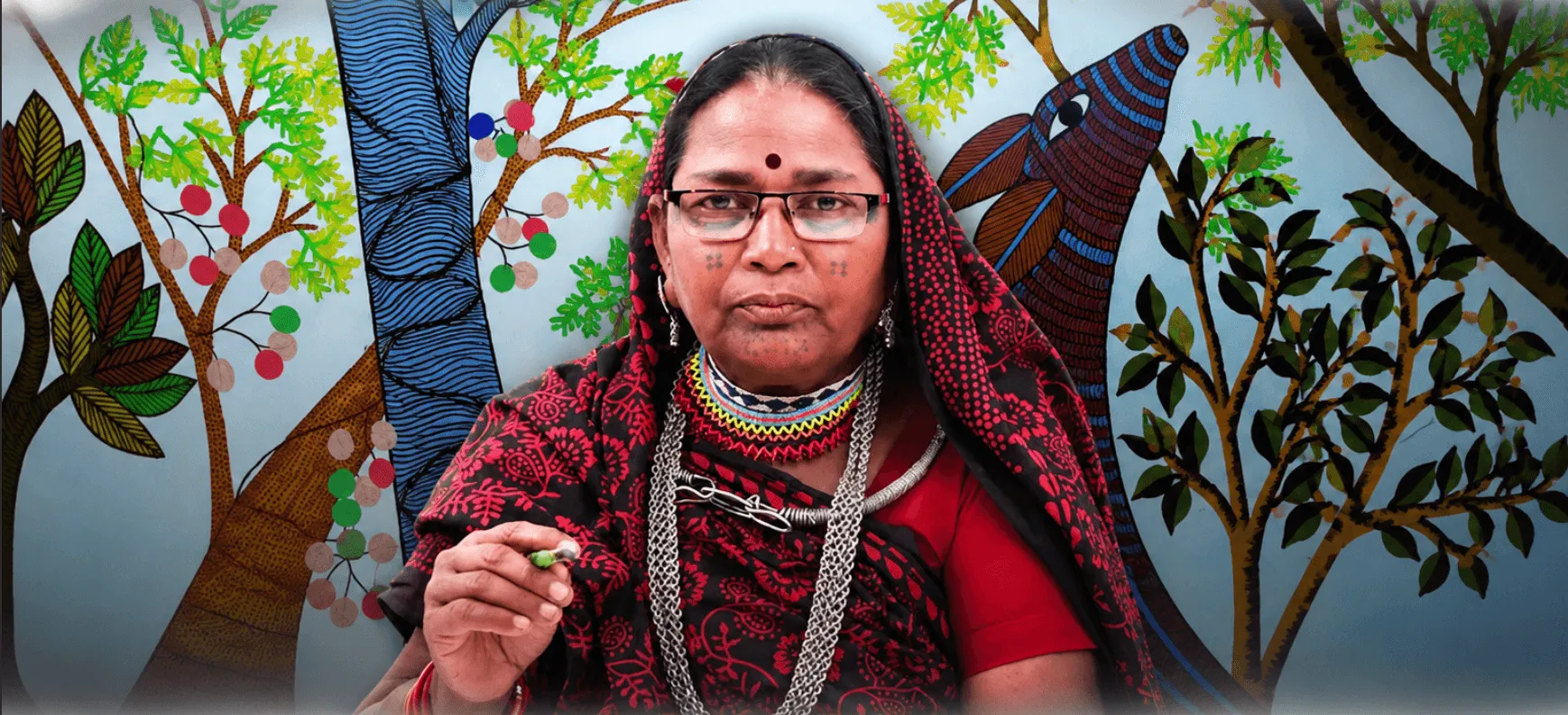
Bhuri Bai was the first Bhil artist to paint on paper and canvas
Explore the full Bhil painting collection on Rooftop to see how the dot has become one of the most expressive and disciplined units in all of Indian visual culture.
Warli Art: Geometry, Community, and the Rhythms of Everyday Life
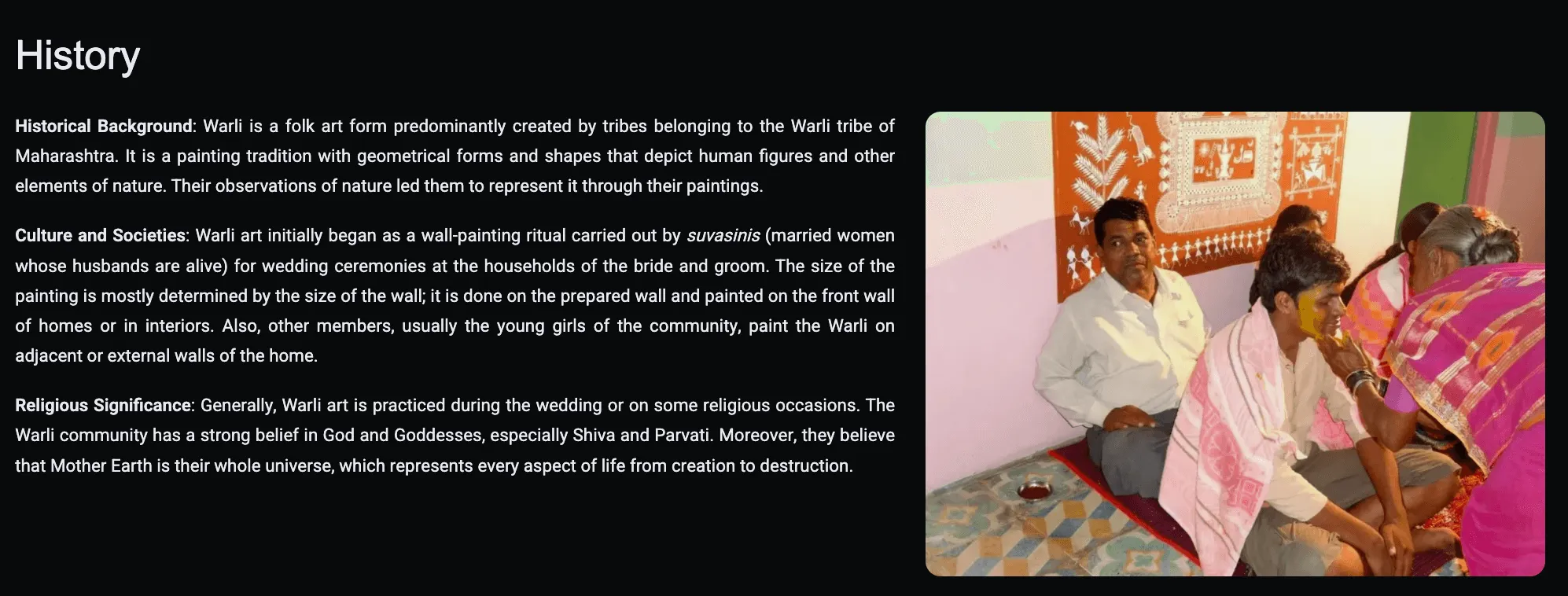
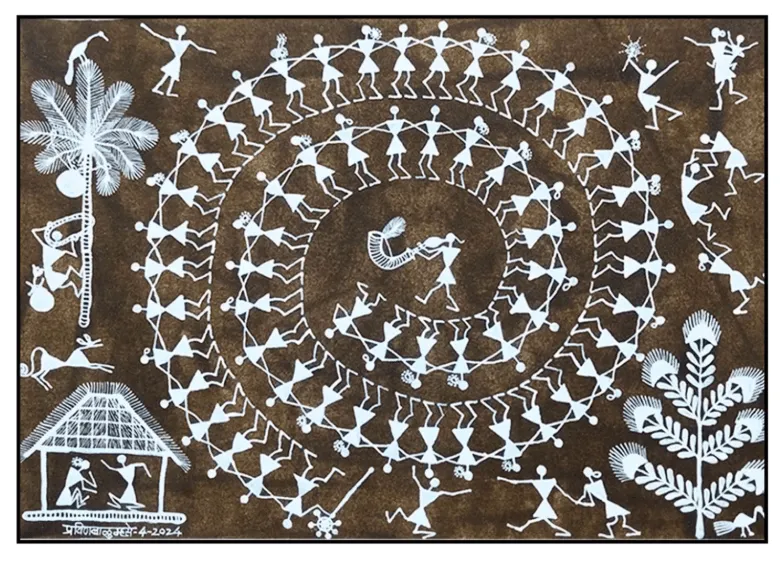
Warli art comes from the Warli tribe of Maharashtra, primarily concentrated in Palghar, Dahanu, Talasari, and Jawhar in the Northern Sahyadri range. The visual logic of Warli is the visual logic of geometry. Every figure is built from circles, triangles, and squares. A human body is two triangles joined at their points. A circle represents the sun or the moon. A square encloses sacred space. From this minimal vocabulary, Warli artists have built a tradition documented for at least a thousand years and believed by some scholars to carry continuities reaching back into the rock paintings of Bhimbetka.
The visual surface of Warli is also strikingly distinct. The motifs are painted in white pigment, traditionally made from rice paste mixed with water and gum, on a deep earthen-coloured background prepared with cow dung and geru. The white figures emerge from the dark base like marks scratched into ancestral memory.
The subjects of Warli painting are also distinct. Warli compositions tend to focus on collective human life rather than on deities or cosmological drama.
The tarpa dance, in which men and women link hands and circle a tarpa player who plays a long trumpet-like instrument, is one of the most iconic recurring scenes. Wedding ceremonies, harvest, hunting, fishing, farming, and village gatherings appear repeatedly. At the centre of many ritual Warli compositions sits the chaukat or chauk, a sacred square enclosing the goddess Palaghata, associated with marriage, fertility, and the continuity of the household.
Warli painting was traditionally made by suvasinis, married women whose husbands were alive, on the inner walls of homes during weddings and ritual occasions. The form moved onto paper and canvas in the 1970s through the work of Jivya Soma Mashe. Read the Warli Art Wiki on Rooftop for a fuller account of the form.
You can also see a striking contemporary Warli composition in the Rhythm of Tradition: Tarpa Dance painting.
Baiga Art: The Body as Canvas and the Forest as Sacred Map
Baiga art comes from the Baiga community, who live primarily in Madhya Pradesh, with smaller populations across Chhattisgarh, Uttar Pradesh, and Jharkhand. The primary surface of Baiga art for centuries was not the wall and not the canvas. It was the human body. Tattooing, known as godna, has been a foundational visual practice within Baiga culture, particularly for women, who carry elaborate dotted and lined patterns across their faces, necks, arms, and legs from early adolescence. The patterns are protective, devotional, and identifying all at once, placing a Baiga woman within a particular clan and accompanying her through life and into the afterlife.
This deep tradition of tattooing has shaped the visual vocabulary of Baiga painting in distinctive ways. Bold lines, flat unornamented forms, and direct symbolic depiction characterise the work. Where Gond paintings fill bodies with intricate patterning and Bhil paintings build figures from accumulated dots, Baiga painting tends towards a more emphatic, declarative visual logic. Patterning is present but used selectively rather than as the primary structural device.
The subjects of Baiga painting are organised around the forest, which the community considers sacred and which traditionally provided their entire economic and spiritual life. The Mahua, Sarai, Kullu, and Palash trees appear repeatedly. Animals associated with the forest, including the tiger as Bageswar the tiger god, deer, snakes, peacocks, and elephants, fill compositions. Ritual scenes featuring shamans, ceremonial dances, and offerings to ancestral spirits ground the work in the religious life of the community. The Dhignaa, a traditional rangoli pattern made on the floor during religious occasions, also enters Baiga painting as a recurring motif.
The transition of Baiga art onto paper and canvas is recent and ongoing, driven by mentorship from artists like Ashish Swami who has guided several Baiga women painters into the wider art world. Padma Shri Jodhaiya Bai Baiga, who began painting at the age of 69 and has since exhibited in Bhopal, Delhi, Milan, and Paris, is the most internationally recognised Baiga artist. Other contemporary practitioners include Roopa Bai, Ramrati Bai, and Sakun Bai. Read the Rooftop introduction to Baiga painting.
How Materials, Ritual Context, and Geography Shape Each Style
The visual differences between these four traditions are not surface accidents. They are direct expressions of the natural environments, ritual occasions, and material economies in which each form developed.
Gond paintings traditionally used pigments from the central Indian forest landscape: yellow from ramraj soil near the Narmada, black from charcoal, white from limestone, earthy red from geru, and light green from cow dung. Bhil paintings used soot, limestone, berries, and turmeric, applied over walls prepared with mittchitra. Warli paintings used a single white pigment of rice paste against a base of cow dung and geru. Baiga paintings used clay, rice paste, soil, plant extracts including turmeric and charcoal, and ink from the Kohla tree.
These material differences correspond to differences in ritual context. Gond painting was understood as energetic invocation. Bhil Pithora painting was a contractual offering to deities, made at moments of need. Warli painting was ceremonial preparation of sacred space, particularly for weddings. Baiga painting was part of a broader visual culture in which the body itself was the primary canvas. Geography mattered too. Gond and Baiga both come from the heavy forest belt of central India, where the visual emphasis on trees and forest creatures reflects daily proximity to those beings. Bhil communities drew on a different ecology with greater agricultural focus. Warli artists in coastal Maharashtra reflected the rhythms of communities living between forest and sea.
What These Four Traditions Share and Why the Distinctions Matter
There are real commonalities. All four traditions began as ritual rather than commercial practice. All four are rooted in oral tradition and storytelling, with the visual image functioning as a record of myth, song, and communal memory. All four were authored communally before they became individually authored, with the named artist emerging only as the work moved into urban and international markets in the second half of the twentieth century. All four understand the relationship between humans and the natural world as one of mutual presence rather than human dominance.
These shared foundations are worth recognising, but they are not the same thing as a shared style. The risk in the contemporary commercial market is that buyers, retailers, and decorators flatten the distinctions, treating Gond, Bhil, Warli, and Baiga as interchangeable inputs to a generic tribal aesthetic. This flattening hurts the artists, hurts the traditions, and produces worse work, because mass-produced reproductions trying to evoke a generalised tribal feel inevitably lose the specific visual logic that gives each form its power.
If you are buying tribal art, knowing which tradition you are looking at is the first step in collecting responsibly. A genuine Gond painting, a Pithora-influenced Bhil work, a Warli ritual composition, and a Baiga forest scene each carry visual signatures that can be identified by anyone who has spent time looking. Asking the seller which artist made the work, where they live, and what tradition they belong to separates honest collecting from the casual consumption of decorative imagery.
Look at Each Tradition on Its Own Terms
These four visual languages were built by different communities, in different forests, in conversation with different deities and ancestors. Treating them as one category does each of them an injustice. Treating them on their own terms opens up four distinct ways of seeing, and four distinct opportunities to bring genuine tribal art into a home in a way that respects the people who made it.
Explore original Gond, Bhil, Warli, and Baiga paintings from verified artists on Rooftop’s paintings collection. Each work is hand-painted, traceable to its artist, and supplied with the cultural context that makes it more than a decorative object.
If you are a tribal artist looking to share your work directly with collectors, you can register as a vendor on Rooftop’s provider page.