

A Tryst with an Artist : Bharat Tripathi
Discover Bharat Tripathi's journey from IRS officer and Harvard alumnus to celebrated contemporary artist, guided by legendary painter S. H. Raza.

Rooftop
Author
There are a few in the contemporary art scene who have pursued high-profile jobs and yet sustained their enduring passion for the arts alive. And Bharat Tripathi is one of them. Bharat is an officer of the 1988 batch of the Indian Revenue Service. He has also completed his double master's from Harvard University in International Taxation from Harvard Law School and Management. Along with this, he is also a prolific contemporary artist whose artistic journey and practice of the last twenty years has been one that is straight out of the books.
Innate Talent and Interest in Art
Bharat was a good student and was good at art when in school. He even won Camel’s All India Art Contest as a student. Keeping his talent in mind, his school, Bishop’s in Pune, also instituted a special prize in art just for him. His priority and focus were on getting a good education and a good job. He passed the Indian Revenue Service examinations in 1988. Mid-career, he got a scholarship and completed his double master's in International Taxation from Harvard Law School and Management from Harvard University, USA in 1990.
Always in Touch
Living in Mumbai, Bharat's love for the arts was manifested through the various art exhibitions that he frequented. This also gave him the opportunity to meet with artists. He also had the good fortune to meet M. F. Husain during one of his shows at Jehangir Art Gallery. His time at Harvard encouraged him to engage beyond just work. And then, he met the eminent artist S. H. Raza through a common friend. His meetings with Raza continued and during one such meeting, Bharat mentioned to Raza that he used to paint as a child. Raza told him to start painting again. Bharat was apprehensive. He had no formal training or education in fine art.
Even in school, the mediums he has worked with were different, crayons, watercolours and pastels. But Raza only encouraged him further. Raza said that an artist does not need training and to pick up a canvas and a brush and start painting. Raza further assured him that he would help with the technical training for Bharat.
After coming back from Harvard, Bharat’s horizons had broadened to engage in things which were beyond work. And with such encouragement from Raza at the right time, Bharat decided to seriously pursue art again. At a time when he held a high-profile and sensitive position in a government job, art functioned as a respite and a release for him.
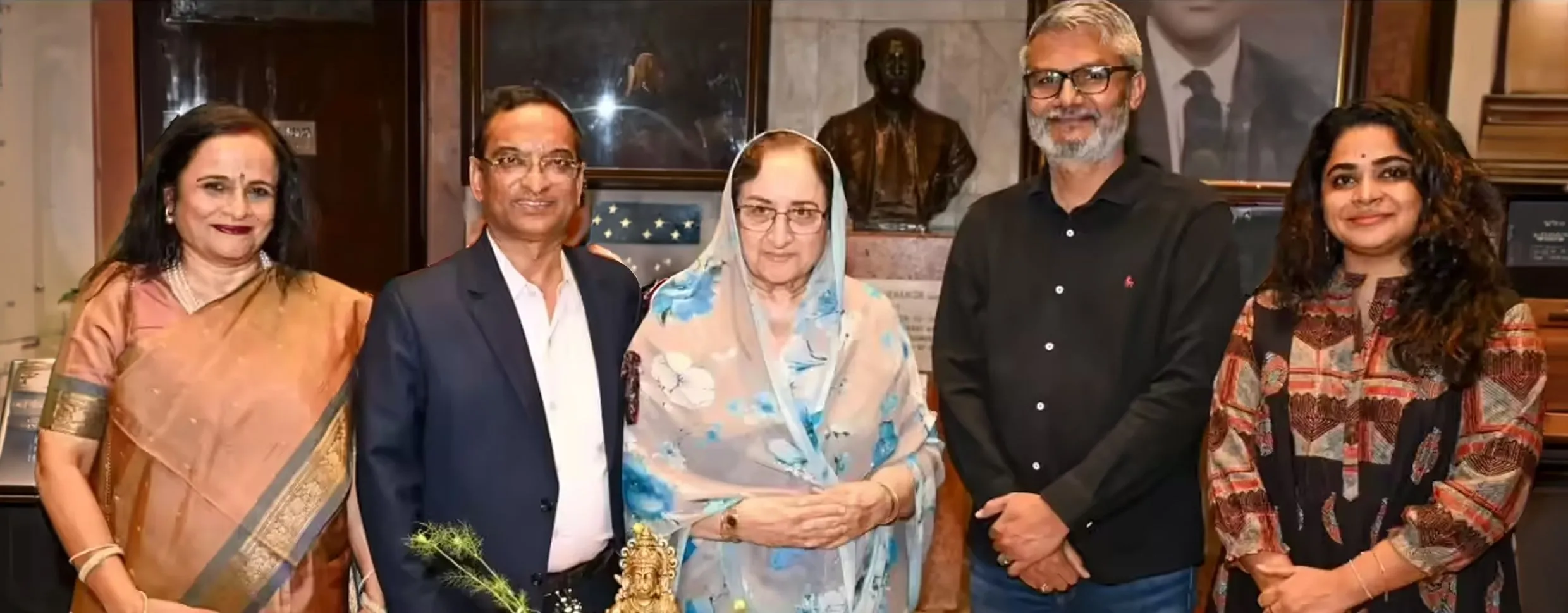
Artist Bharat Tripathi returns to the canvas after nine years with ‘Anjaneya’
The Becoming of an Artist
Bharat, dedicated to his art, undertook an initial training to understand mediums. He started with painting figurative works and some works in pastel. Yet, he still felt the need for professional training and took art classes from a Professor of the Sir J. J. School of Arts in Mumbai. These lessons were spread over a period of six months, where he was taught how to use acrylic, oil, watercolour and charcoal. And then, he could undertake painting independently on his own.
Bharat started painting a few works each year and would show these to Raza during their meeting for feedback. Raza, upon seeing these, told him that he had a sense of colour and thought process behind each work.
Then, finally, the conceptualisation of his first series of paintings, the Navdurga, drew upon him. In 2008, while reading the Durgasaptashati, which is a sacred Hindu text, he got the inspiration to convert nine shlokas or Sanskrit verses from the Durgasaptashati into paintings. Every day after his prayers, he used to take up a painting. Thus, he started one painting on each of the nine days of his reading of the Durgasaptashati text. He finished the nine works in exactly the next two months. To display these works, Bharat held his very first exhibition at the Hacienda Art Gallery in Mumbai in February 2009. Raza himself opened the show and held a press conference to launch Bharat, which gave him a platform that stands in good stead even today.
This show was such a great success that the gallery owner extended the show by a week. When Bharat decided to sell the paintings exhibited, all the paintings were sold out in a day. The success of his first exhibition inspired him to exhibit more. What followed were a series of successful exhibitions in succession namely ‘Ramayan’ held at Lalit Kalal Akademy in November 2015, ‘Tirthankars’ held at Jehangir Art Gallery in February 2014, ‘Dashavatar’ at Museum Art Gallery, Kala Ghoda, Mumbai in November 2011, ‘The Story of Shiva’ held at Coomaraswamy Hall, Prince of Wales Museum, Mumbai in December 2012, ‘The Tirthankars’ held in February 2014 at Jahangir Art Gallery, Mumbai, ‘Ramayan’ held at Lalit Kala Akademi in New Delhi and ‘Anjaneya’ held at Jehangir Art Gallery in Mumbai in 2025. His shows were well-received by the public at large.
Artistic Process, Evolving Style
The initial works of Bharat Tripathi were greatly inspired by Raza’s works and comprised of geometric forms. But with the conceptualisation of his ‘Navdurga’ series, he had created a unique artistic style which defined his own visual language. With this development, his compositions consisted of an amalgamation of pertinent elements, some of which were highlighted and some of which were subdued. Yet, each element was a point of discussion in itself, as the thought process behind each is in-depth and detailed.
The initial thought for a particular theme or topic comes in a spontaneous way. But once Bharat has identified a topic or a theme, he conducts extensive research on the same. He gleans information from all sources available at hand, whether they be online, through textual sources or through oral discussions. With his research complete, he would then conceptualise his thoughts, which would then be rendered onto the canvas. He chooses to keep the well-known elements as subdued and highlights a particular character or an episode through elements created from his own particular lens of understanding. Thus, through his works, he invariably seeks to bring a fresh perspective that enables the viewer to experience a known mythological topic in a new light.
For example, for the painting ‘Chhaya’ from his Navdurga series, a tiger was depicted in motion in a canvas that was half of which was painted black. This painting was much appreciated by Raza himself. Another notable work is titled Jatayu from the Ramayan series. The interplay of elements brings to life the episode of the Jatayu Vadh, with the contorted Jatayu at the fore, with only the slightest rendering of Ravan in the background, one hand raised to strike down the opponent. Displaying a high level of technical skill, this is reminiscent of the techniques of the celebrated Indian painter M. V. Dhurandhar.
When working on a series, Bharat works in a very focused and meticulous manner to take his conceptualisations to a logical end. Once he makes his conceptualisations concise, he embarks on creating initial sketches to compose and arrive at a colour scheme for the same. Since he manages his time with a full-time job at hand, he has to plan every aspect of the execution. He prepares the required materials in advance, and his artistic process in itself is very meticulous. He plans how many canvases will be required, what the colour scheme will be for each and how each element will be executed and reflected in the composition, everything being meticulously planned. What is to be done and how it is to be done is fixed. Then, with everything prepared and laid out, he works when time is available at hand. Two months before every show, he paints daily.
An Evolving Artistic Journey
Art, according to Bharat, is a continuously evolving process. The themes for his next four shows are already decided, which also centre around mythology. At the same time, he is also experimenting with creating abstracts. Along with this, he is thinking of creating a botanical series in watercolours where he wishes to create paintings of the variety of flowers he has collected during his travels. As of now, he is working on his next series on Krishna, a show eagerly awaited by his audience.