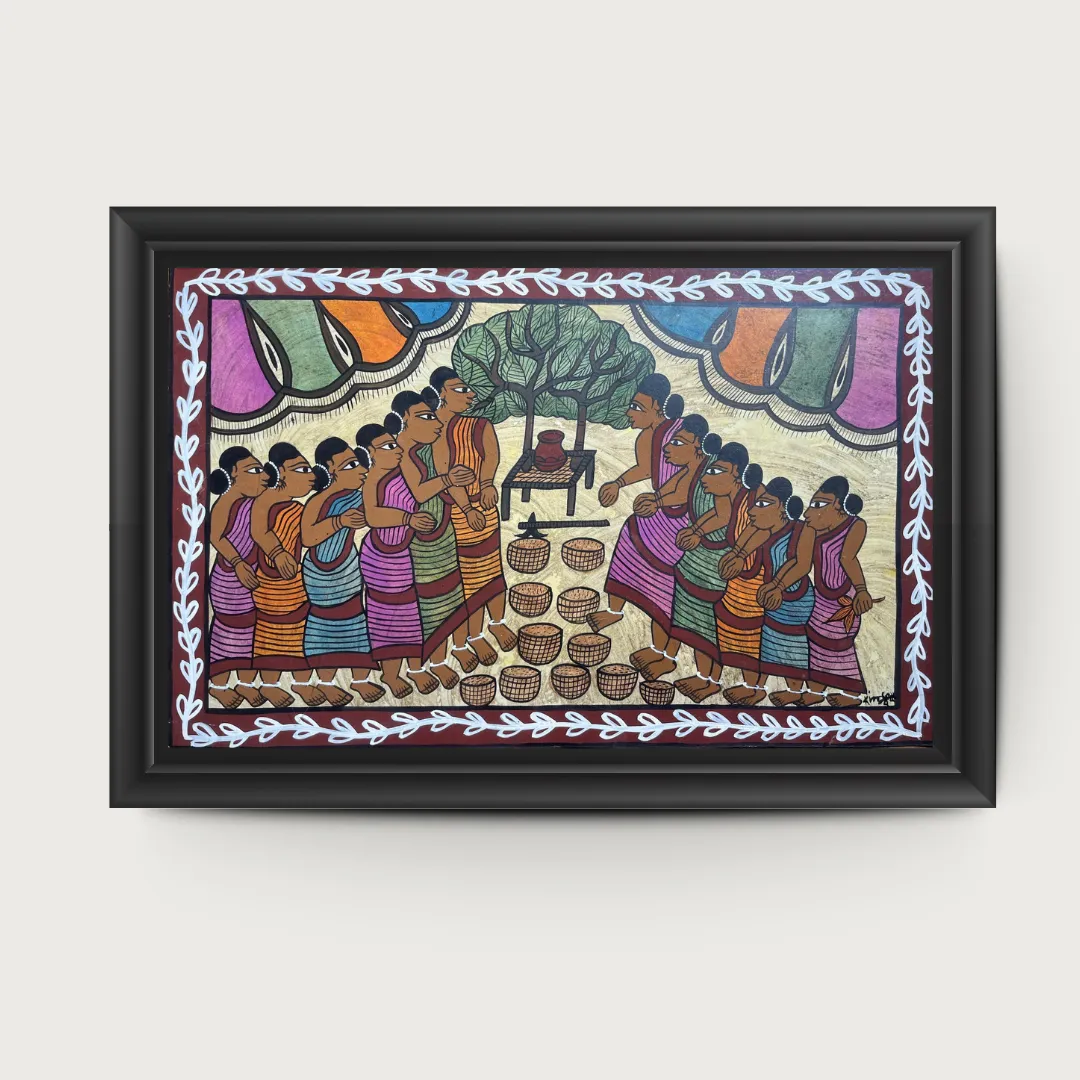
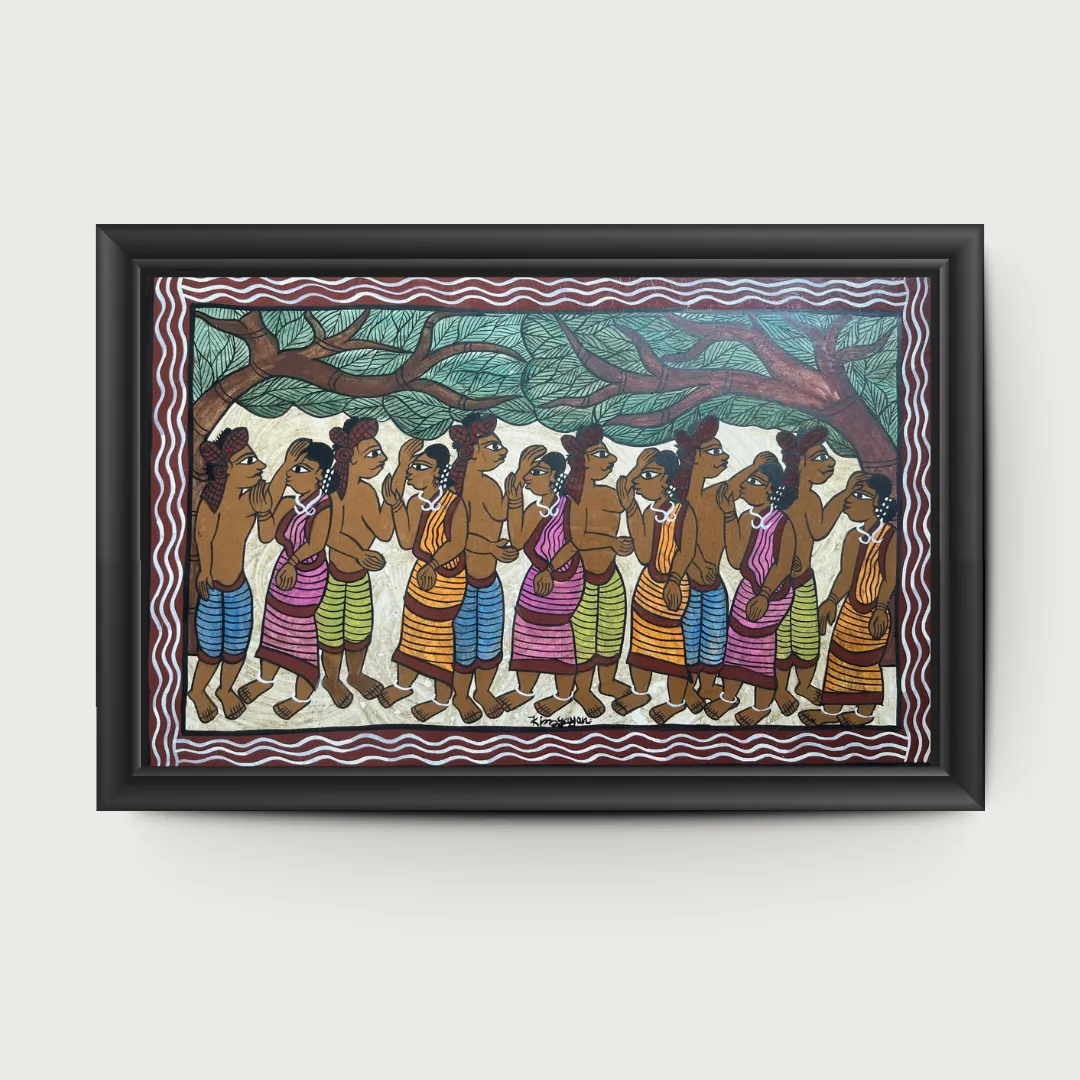
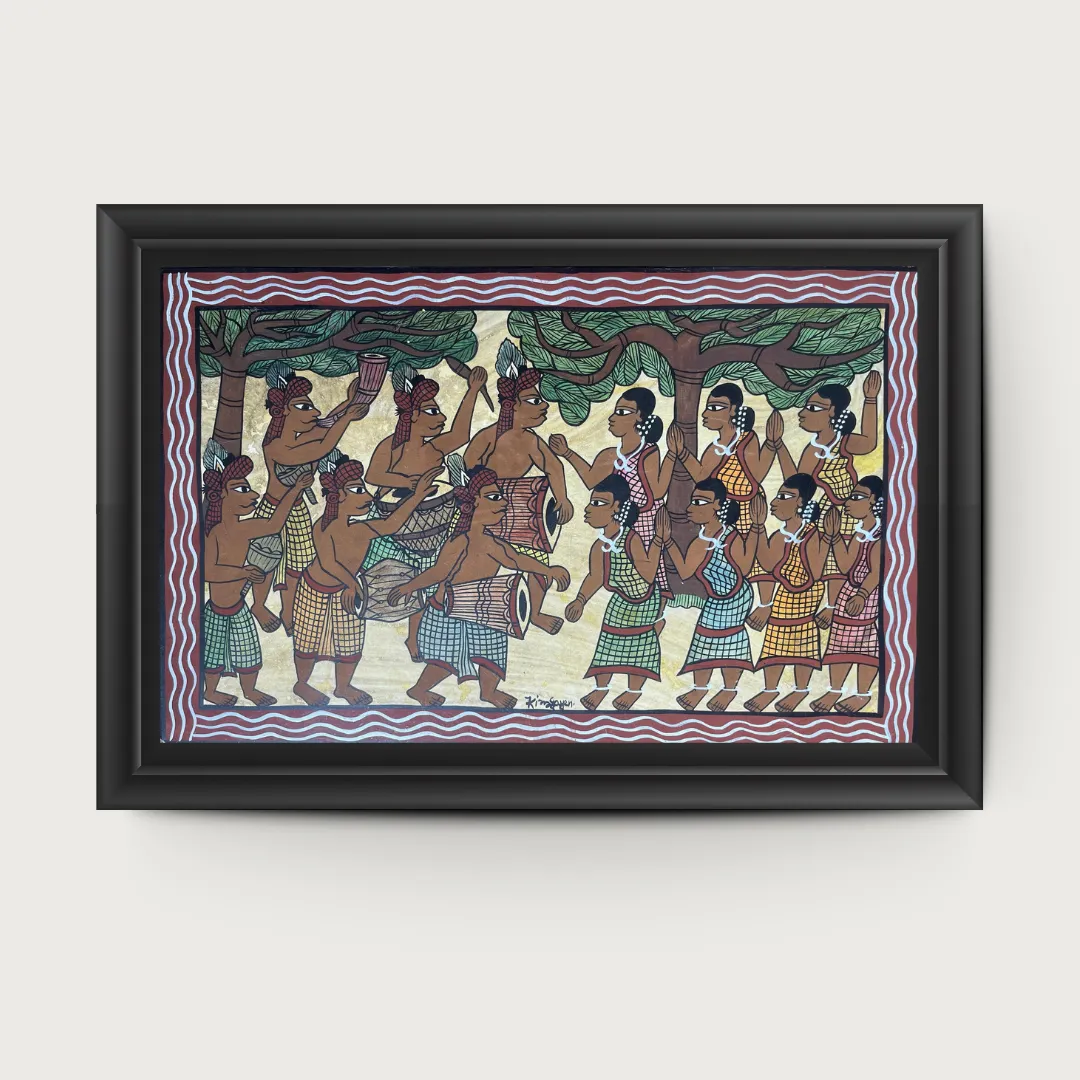
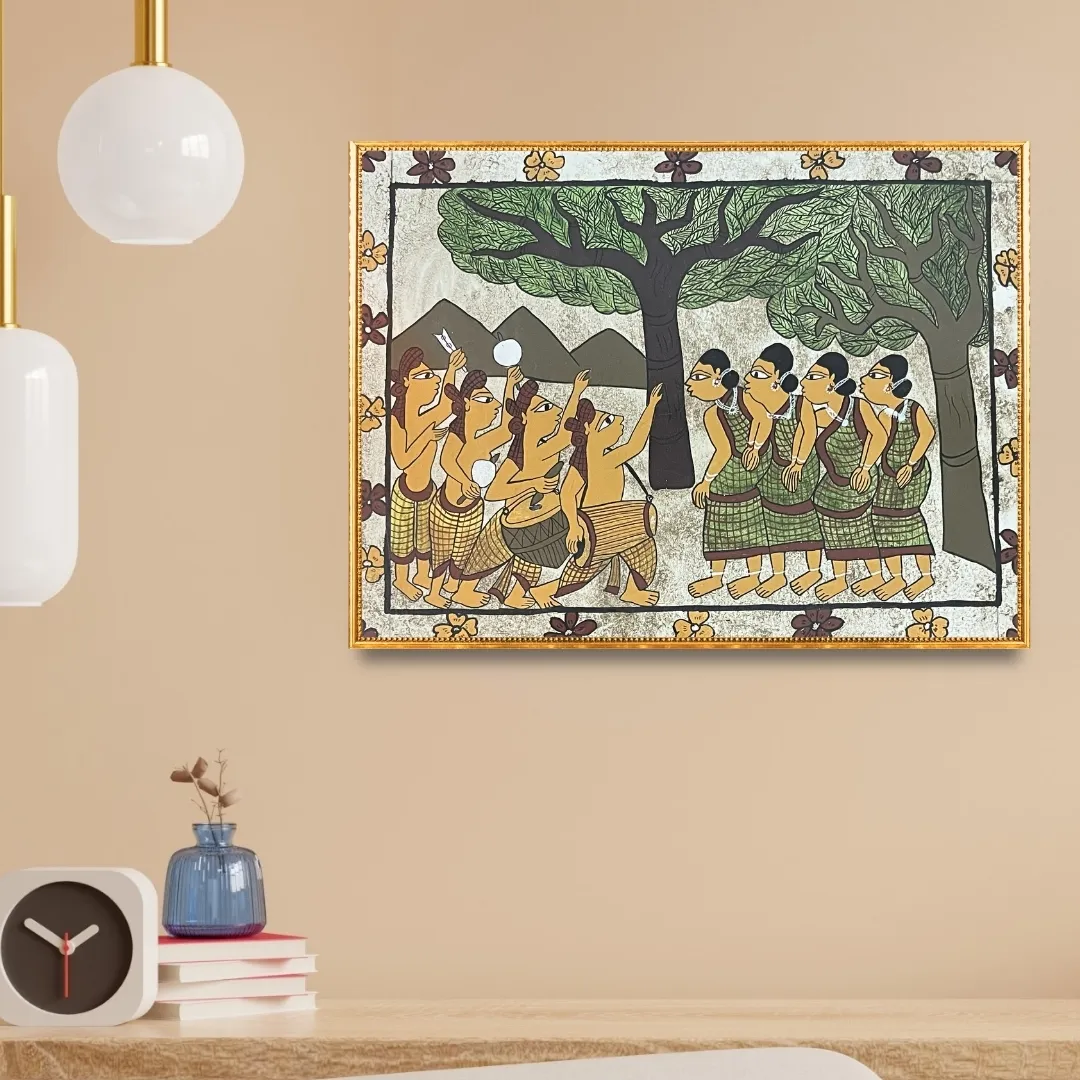
Lagre Courting Dance under the Canopy by Kishor Gayen
$ 319


Know about paitkar art.
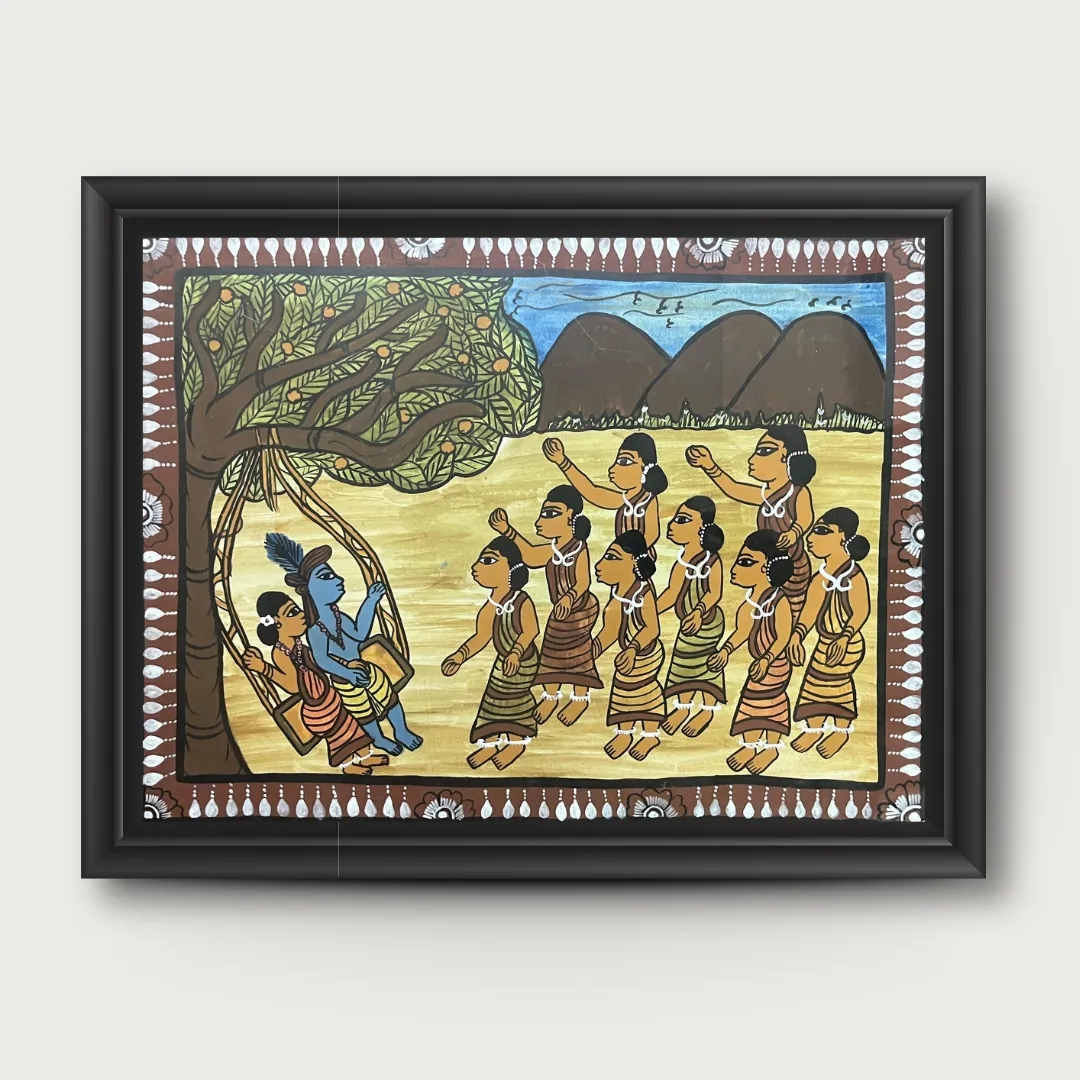
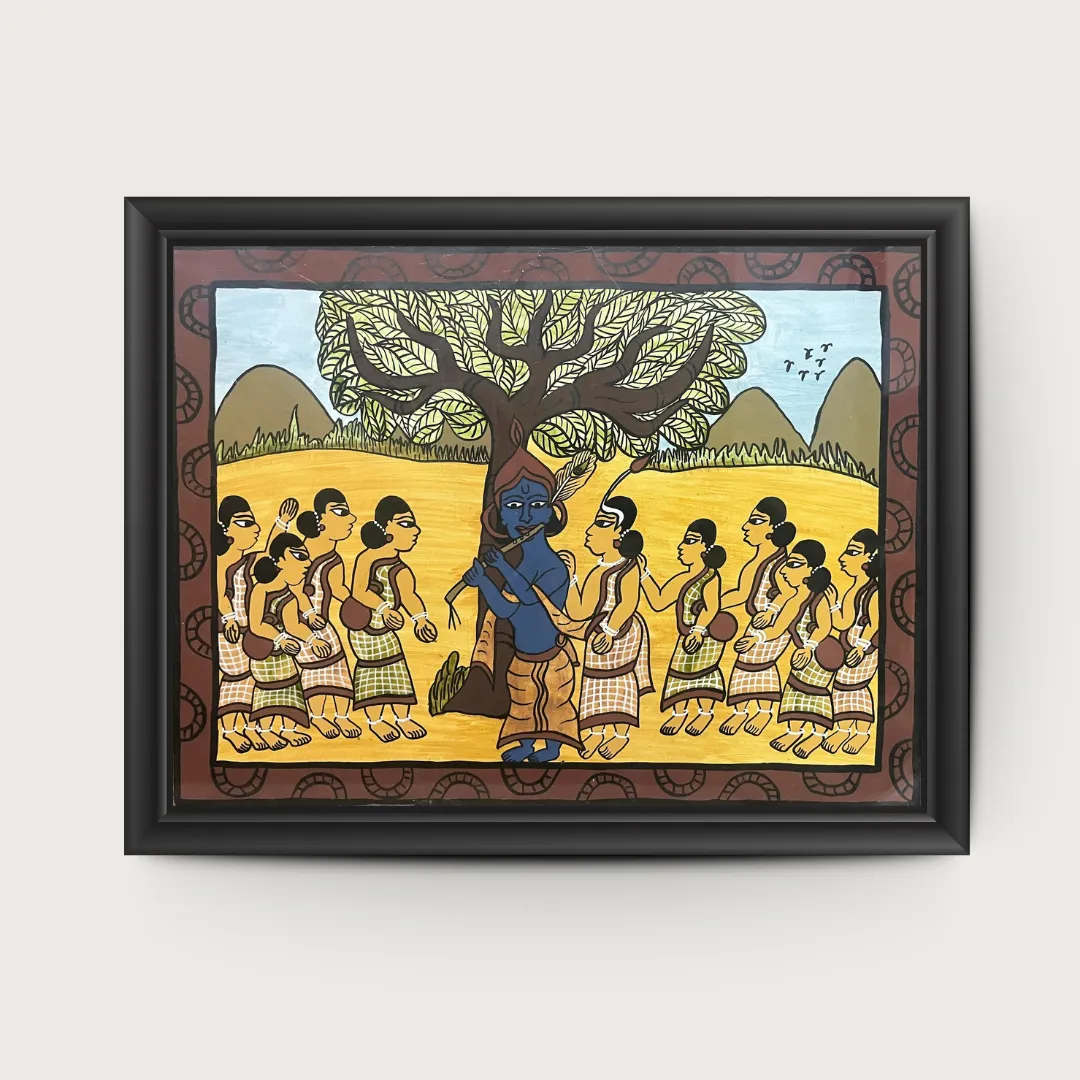
In the forests and hills of Jharkhand, a scroll-painting tradition called Paitkar painting has been kept alive for generations by a community of artists who paint not just for beauty, but for the soul. Originating from Amadubi village in eastern Jharkhand, these scroll paintings were once an essential part of funeral rites, believed to guide the spirit of the deceased toward the afterlife. Today, Paitkar painting stands as one of India's most layered and spiritually significant forms of Indian folk art, carrying within its thick black outlines the myths, rituals, and daily life of the Chitrakar community.
What Is Paitkar Painting?
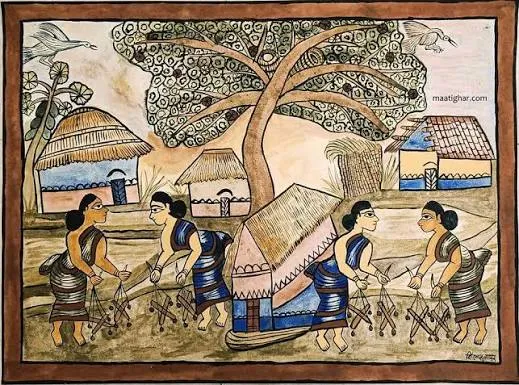
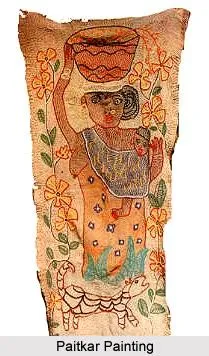
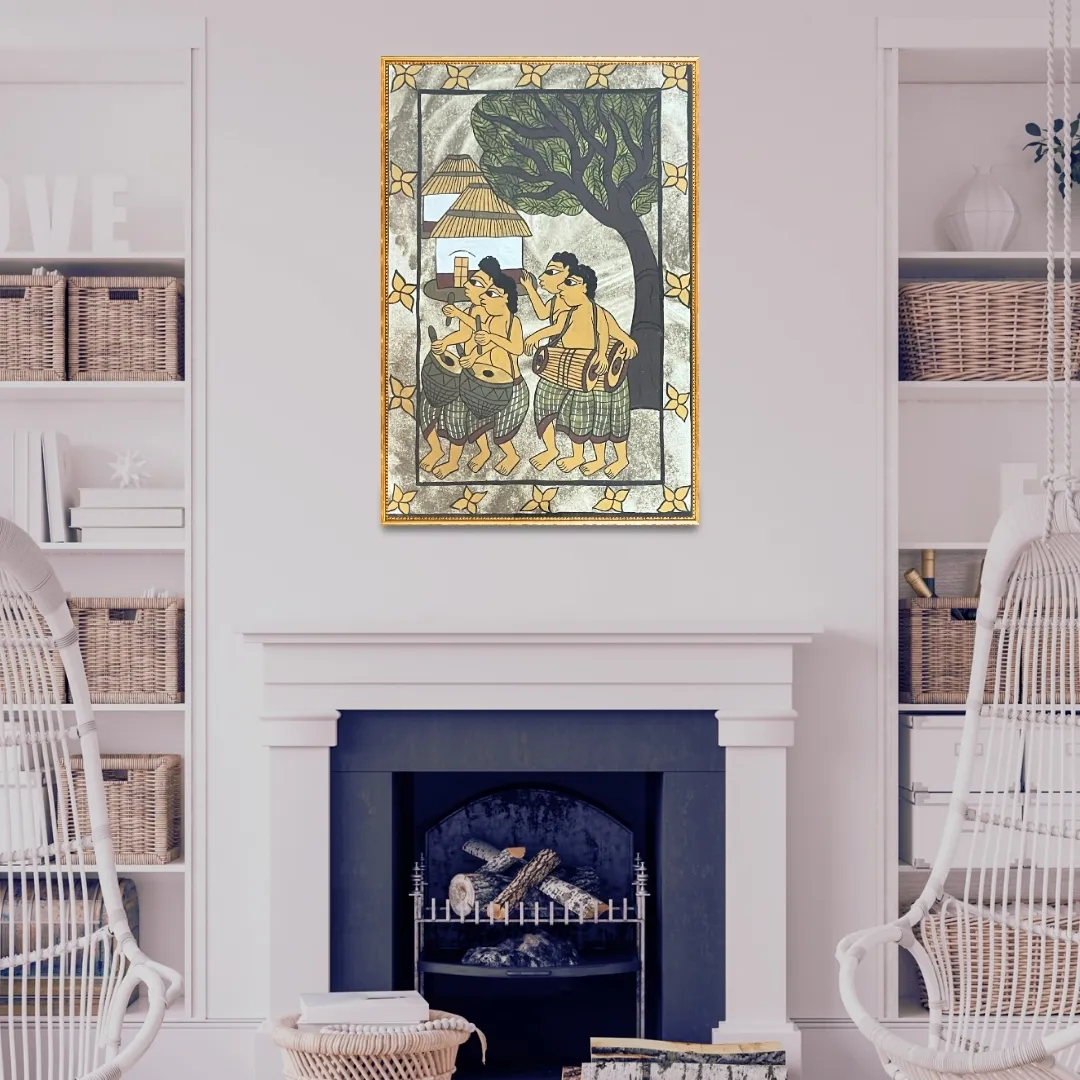
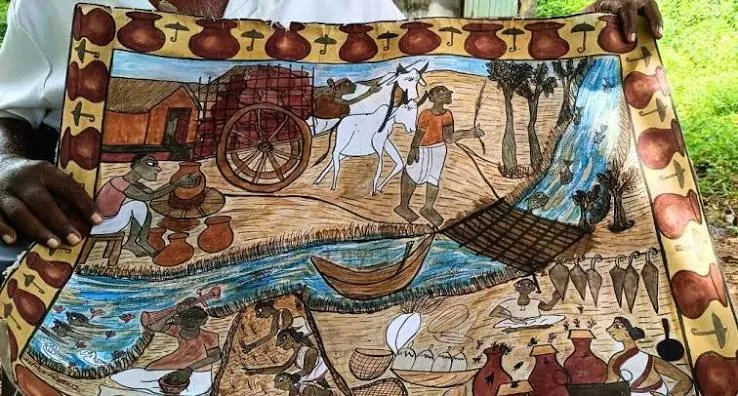
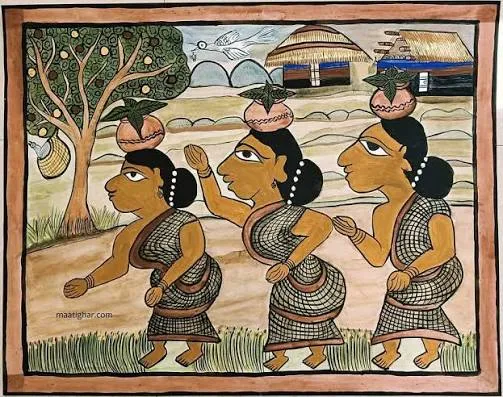
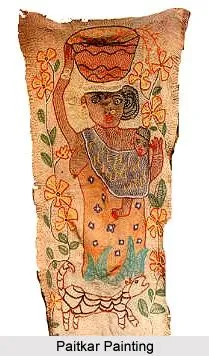
Paitkar painting is a traditional scroll-based art form practised exclusively in Amadubi village, located in the eastern part of Jharkhand. The name 'Paitkar' is considered a variant of the term Pata or Pata Chitra, referring to scroll paintings. These paintings are created by Bengali painters from the Chitrakar community, whose name literally translates to 'picture makers.' Paitkar paintings are vertical scrolls drawn with thick outlines, depicting human figures in profile or semi-profile with elongated eyes that reflect the classical Indian painting style. The works portray socio-religious customs, mythology, and scenes from everyday life. Traditionally, they served a ritual purpose at funerals, where Chitrakars would present the scroll depicting the journey of the departed soul, and the family of the deceased would pay the artist for performing this spiritual service.
History and Origin
The roots of Paitkar painting trace back to the cultural practices of West Bengal, and the art form can be understood as a subset of the broader Pata Chitra scroll-painting tradition. The art was once popular across Odisha, Bihar, and West Bengal, but over time it became concentrated in Amadubi village, which eventually came to be known as 'Paitkar village' after the art form itself. The tradition is transgenerational and has historically been passed down from father to son, making it one of the most guarded craft lineages in eastern India. The Chitrakar community that practises it does not limit itself to painting alone: they also create relief sculptures on bricks, weave on palm leaves, and craft objects from waste tin. The art form mirrors both Bengali and Jharkhandi folklife, and its survival is closely tied to the identity of the Amadubi community.
Key Features and Visual Style
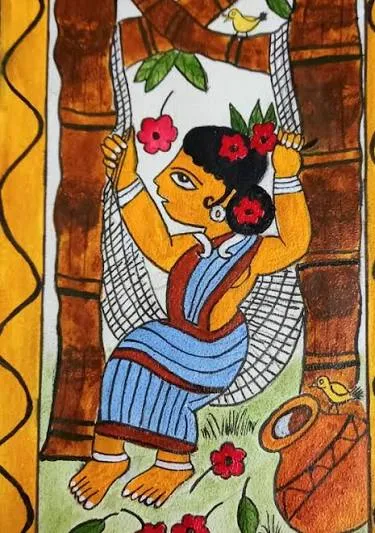
Paitkar paintings are immediately recognisable by their vertical scroll format and bold, flat visual style. Human figures dominate the composition, rendered in profile or semi-profile with elongated eyes inspired by classical Indian painting conventions. The paintings tell stories in sequential segments, stitched or sewn together, making each scroll a narrative artwork rather than a single image.
Colours are made entirely from natural sources: red from Red Hematite (Gerua Patthar), yellow from yellow ochre stone (Haldi Patthar) or turmeric, orange from the Palash flower, brown from brownstone, black from burnt rice, lamp soot, and kerosene lamp ash, blue from indigo, and green from broad bean leaves.
Pigments are mixed with fruit gum and neem resin to preserve them and help them adhere to the surface.
Paintings are made on paper or cloth (traditionally on stacked palm leaves), with artists preferring the rough side of paper for better pigment absorption.
Thick, bold borders are drawn between narrative panels, and outlines are finished in black paint to give the figures a clean, complete appearance.
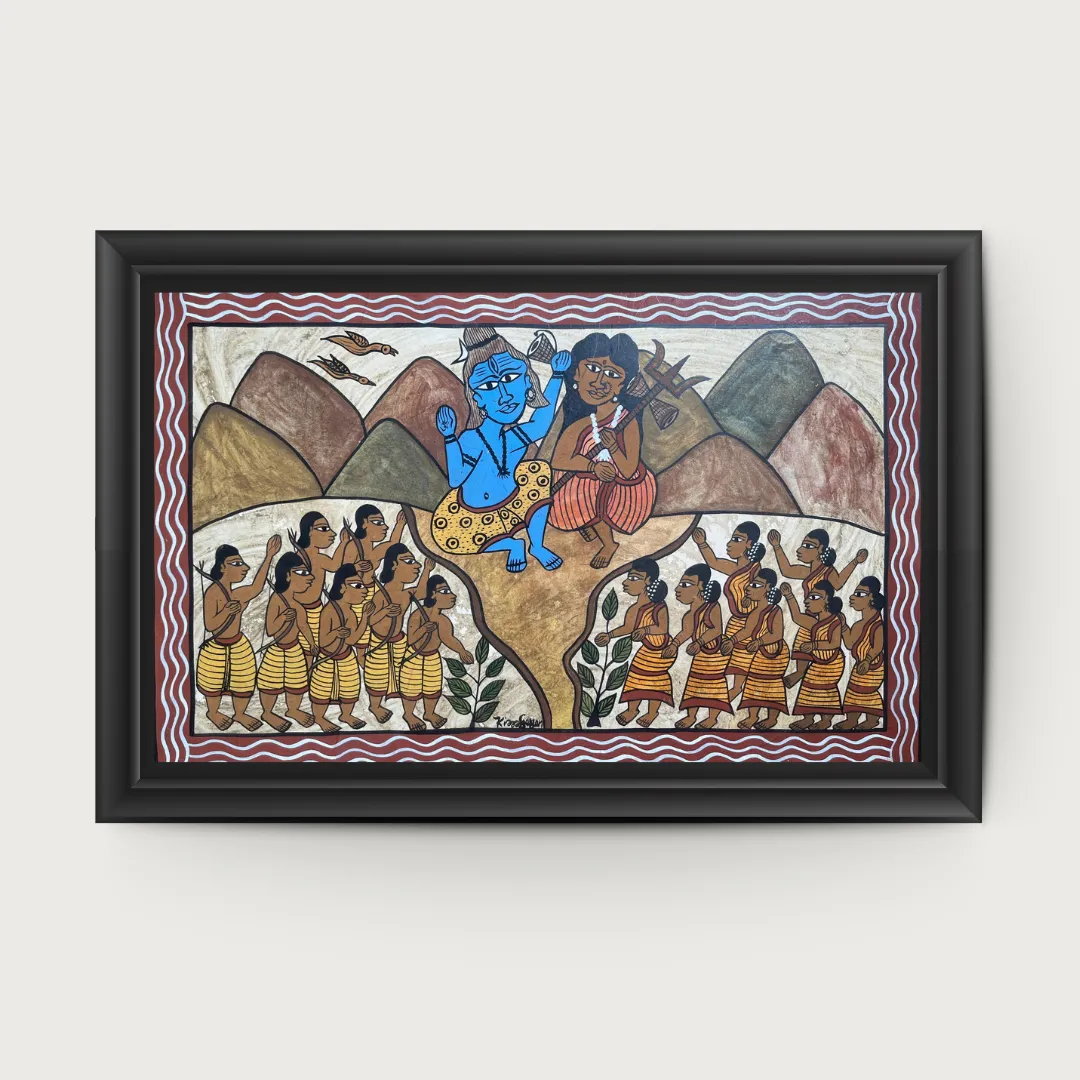
Motifs include scenes from the Hindu epics Ramayana and Mahabharata, the Manasa song (Manasa Pada), the Kali song (Kali Pada), and tribal religious rituals such as Karam Puja, Dansai, and Baha.
Key characters from the Ramayana depicted include Rama, Sita, and Mandudari, alongside tribal deities and figures from day-to-day village life.
Famous Artists of Paitkar Painting
The survival of Paitkar painting today is largely due to a small group of dedicated artists from Amadubi village who continue to practise, teach, and advocate for the tradition. These artists work with organisations such as Jharcraft and the Jharkhand Tourism Development Corporation (JTDC) to organise tours, exhibitions, and training programmes for younger generations.
Moni Chitrakar, based in Amadubi, Jharkhand, is one of the most recognised practitioners of Paitkar scroll painting, known for her detailed depictions of mythological narratives.
Vijay Chitrakar, also from Amadubi, has been instrumental in presenting Paitkar art at national exhibitions and working to introduce the tradition to new audiences.
Anil Chitrakar and Subhash Chitrakar, both from the Amadubi Chitrakar community, are known for preserving the classical scroll format while exploring themes from tribal festivals and everyday Jharkhandi life.
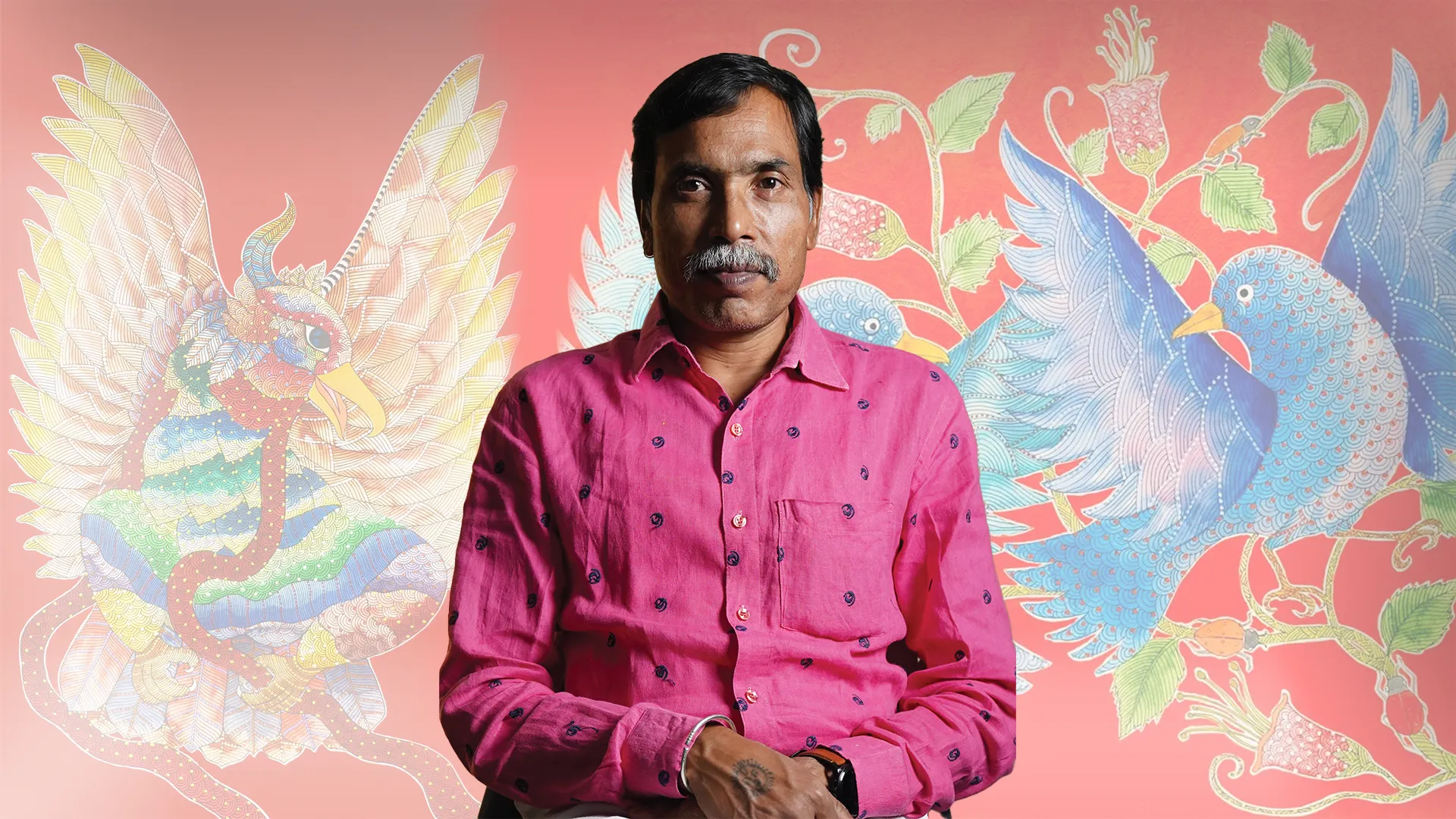
Ganesh Gayan and Kishor Gayan are among the younger-generation Paitkar artists who have taken on the dual role of practitioner and teacher, ensuring that this rare Jharkhand scroll art form is not lost.
If you want to learn Paitkar painting, Rooftop offers a hands-on Paitkar painting experience taught directly by artists from the Amadubi tradition. This is one of the few ways to engage with this rare art form outside of Jharkhand itself. Rooftop also features a wider range of Indian folk art courses taught by master artists, making it possible to learn authentic traditional techniques from the comfort of your home.
The best place to experience Paitkar painting in its living context is Amadubi village in Jharkhand's East Singhbhum district. The village has become a modest heritage destination, partly through the efforts of Jharcraft and the JTDC, which organise village tours and craft exhibitions. Paitkar works are also displayed at state crafts fairs and national tribal art exhibitions across India. For those looking to buy authentic Paitkar scrolls and products, Rooftop's shop carries original works from traditional artists. You can also explore the full range of traditional Indian art on the Rooftop Art Wiki.
What is Paitkar painting and where does it come from?
Paitkar painting is a traditional scroll-based folk art form from Jharkhand, practised exclusively in Amadubi village in the eastern part of the state. The name derives from the term Pata or Pata Chitra, referring to scroll paintings. It was traditionally created by the Chitrakar community to perform at funeral rituals, where the scroll depicting the journey of the deceased soul was presented to the grieving family as a spiritual service.
Which community in Jharkhand practises Paitkar painting?
Paitkar paintings are made by the Chitrakar community, Bengali painters whose name translates to 'picture makers.' This community has practised the art for generations in Amadubi village, with the tradition passed down from father to son. The Chitrakars are not only painters but also create relief sculptures on bricks, weave patterns on palm leaves, and craft decorative items from waste tin .
What materials and colours are used in Paitkar painting?
Paitkar artists use natural pigments prepared from leaves, stones, and soil. Red comes from Red Hematite (Gerua Patthar), yellow from yellow ochre stone or turmeric, orange from the Palash flower, black from burnt rice and lamp soot, blue from indigo, and green from broad bean leaves. Pigments are mixed with fruit gum and neem resin to help them bind and last. The paintings are made on paper or cloth, with artists preferring the rough side of paper for better adhesion.
What themes and stories do Paitkar paintings depict?
Paitkar paintings depict a wide range of themes including scenes from the Hindu epics Ramayana and Mahabharata, the Manasa Pada (Manasa song), and the Kali Pada (Kali song). They also portray tribal religious rituals such as Karam Puja, Dansai, and Baha. Key characters from the Ramayana depicted include Rama, Sita, and Mandudari. The paintings reflect both the Hindu mythological universe and the tribal social life of Jharkhand.
Who are some notable Paitkar artists from Jharkhand?
Notable Paitkar artists include Moni Chitrakar, Vijay Chitrakar, Anil Chitrakar, and Subhash Chitrakar, all from the Amadubi Chitrakar community in Jharkhand. Ganesh Gayan and Kishor Gayan are among the younger artists actively preserving and teaching the tradition. Many of these artists work with organisations like Jharcraft and the Jharkhand Tourism Development Corporation (JTDC) to promote the art form through exhibitions and village tours.
Can I learn Paitkar painting online or through an experience?
Rooftop offers a guided Paitkar painting experience led by artists from the Amadubi tradition, making it one of the most accessible ways to engage with this rare Jharkhand scroll art outside the village itself. Rooftop's platform connects learners with traditional Indian artists across many folk art forms, offering hands-on experiences and structured courses for all skill levels.
Paitkar painting is one of India's most spiritually rooted folk traditions, carrying centuries of Jharkhandi culture within its scrolls. Supporting and engaging with this art means helping a living community keep their identity and craft alive. Explore Paitkar painting on Rooftop and take your first step into one of eastern India's most remarkable folk art traditions.
Sources
Image Sources
"Paitkar Painting of Jharkhand." Asia InCH, https://asiainch.org/craft/paitkar-painting-of-jharkhand/. Accessed 21 July 2026.
"Paitkar Paintings: The Scroll Paintings of the East." The Heritage Observer, 23 Mar. 2015, https://theheritageobserver.wordpress.com/2015/03/23/paitkar-paintings-the-scroll-paintings-of-the-east/. Accessed 21 July 2026.
"Paitkar Paintings: Fading in Jharkhand." Village Square, https://villagesquare.in/paitkar-paintings-fading-in-jharkhand/. Accessed 21 July 2026.
"Paitkar Paintings of Jharkhand." Maati Ghar, https://www.maatighar.com/paitkar-paintings-of-jharkhand. Accessed 21 July 2026.