
Your Cart

Your cart is empty

Indian tribal art paintings: Authentic Handmade Indian Art

Buy Indian tribal art paintings on Rooftop. Authentic handmade Indian art created by master folk artists. Shop original Indian tribal art online.

Showing 385 – 408 of 646

All Products
Paintings
Indigenous Art
Tribal Art 648
Untitled XII
Certified

Tribal Art

Untitled XII

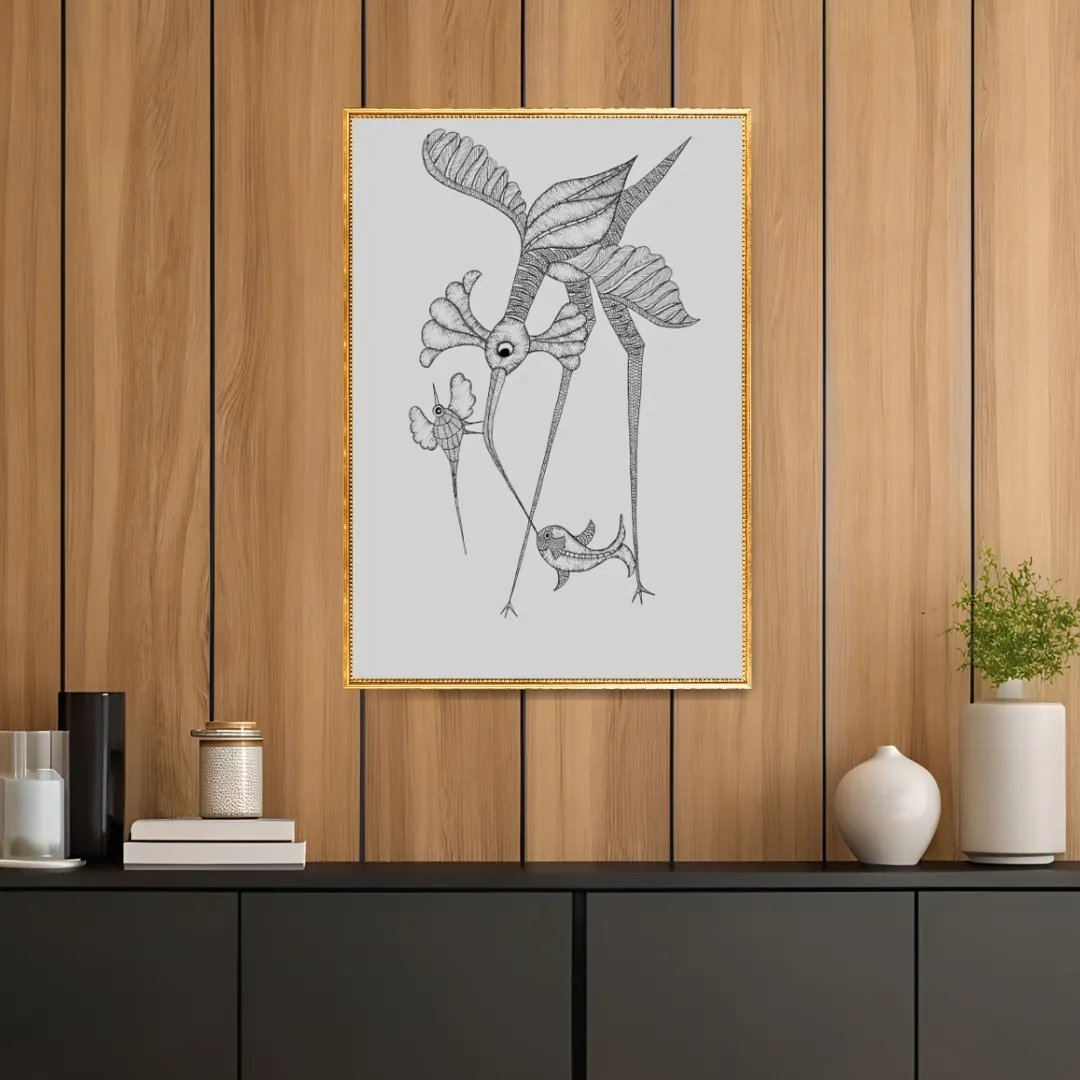
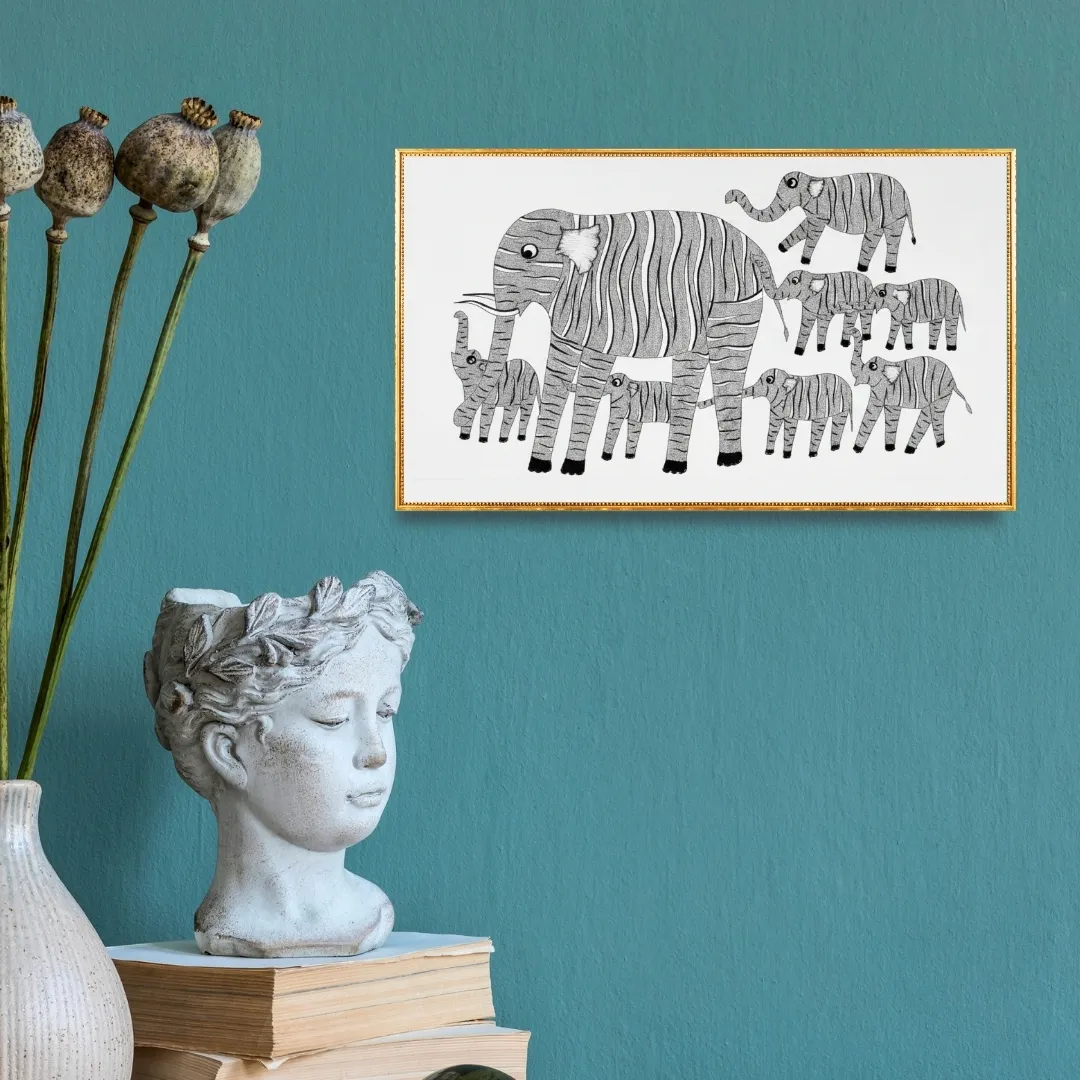
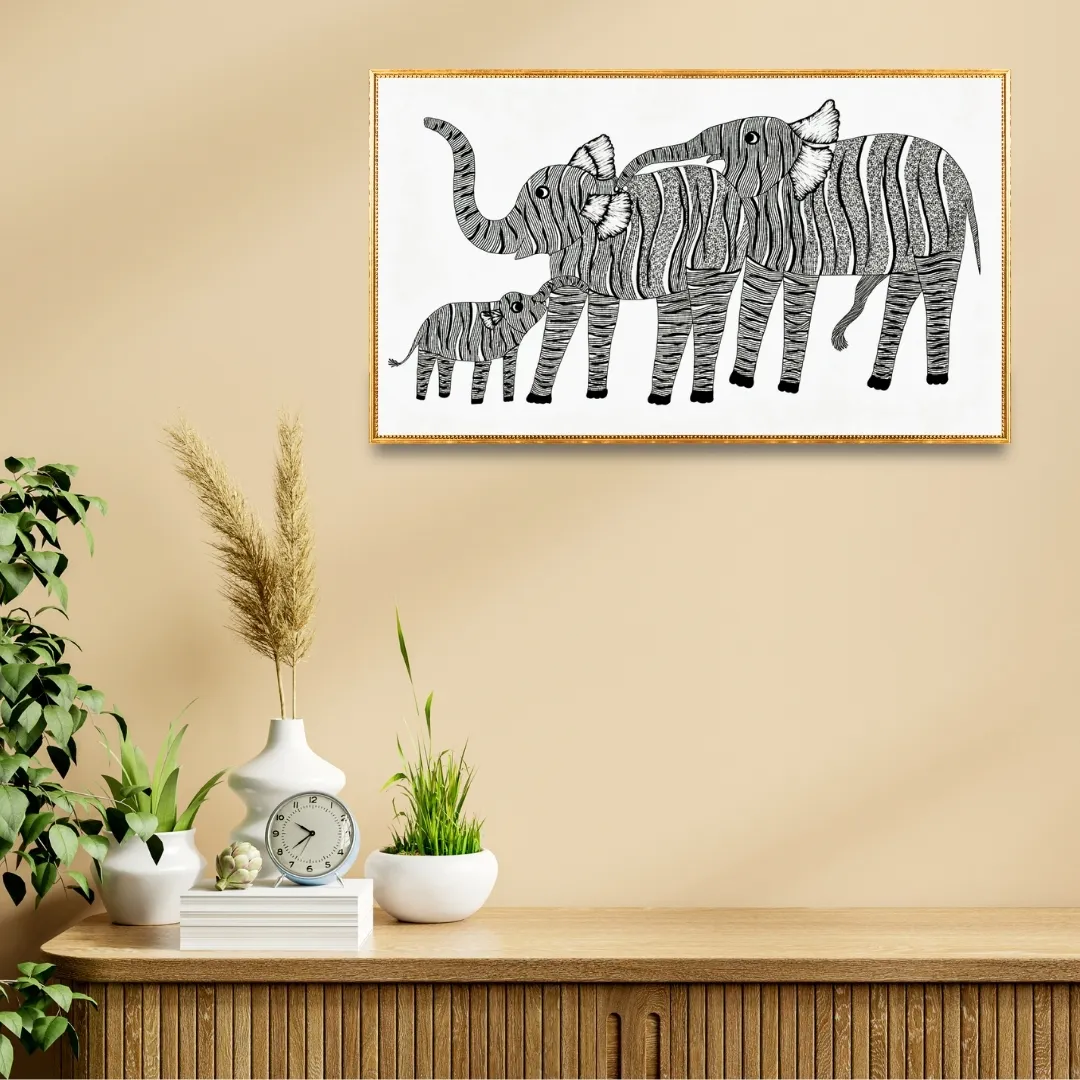
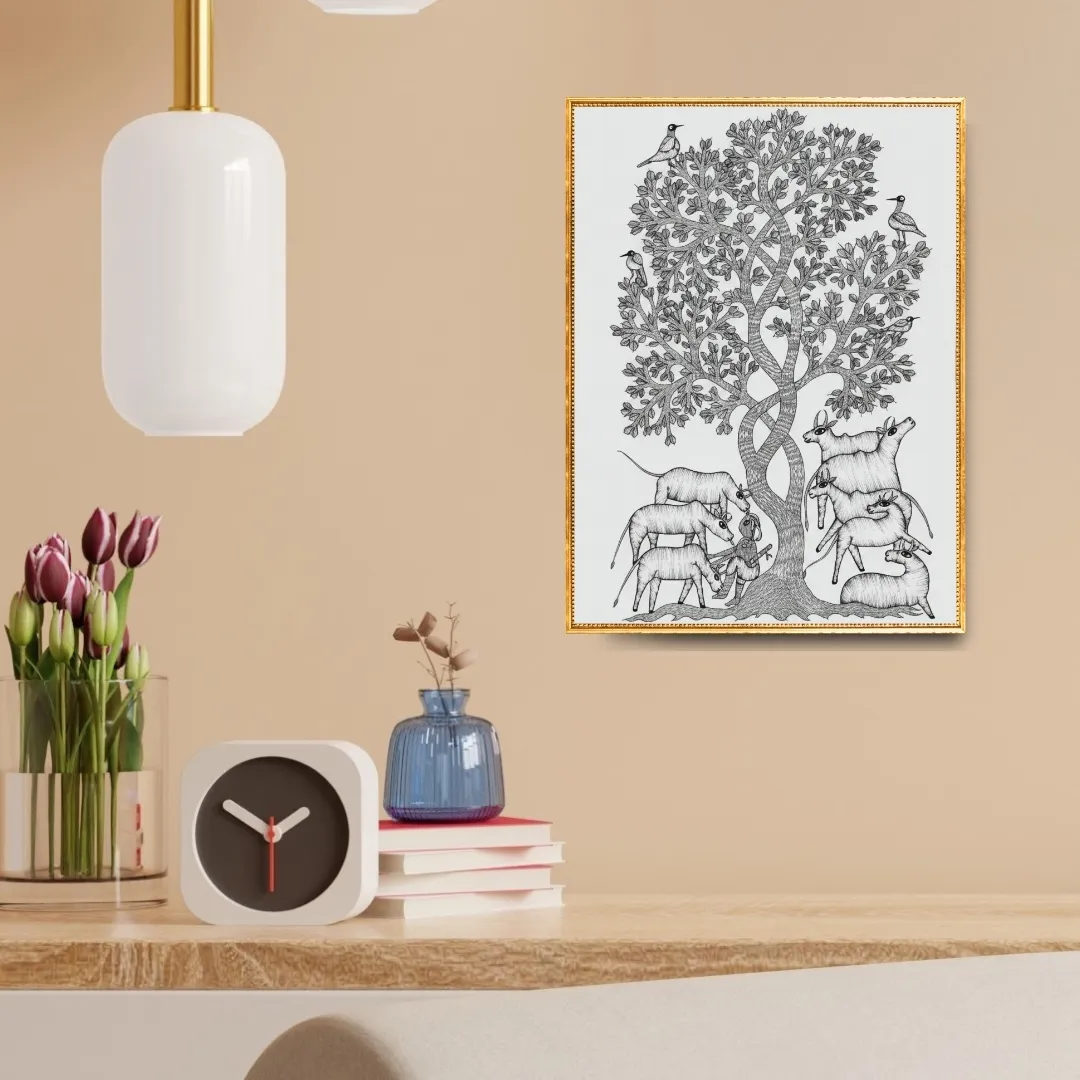
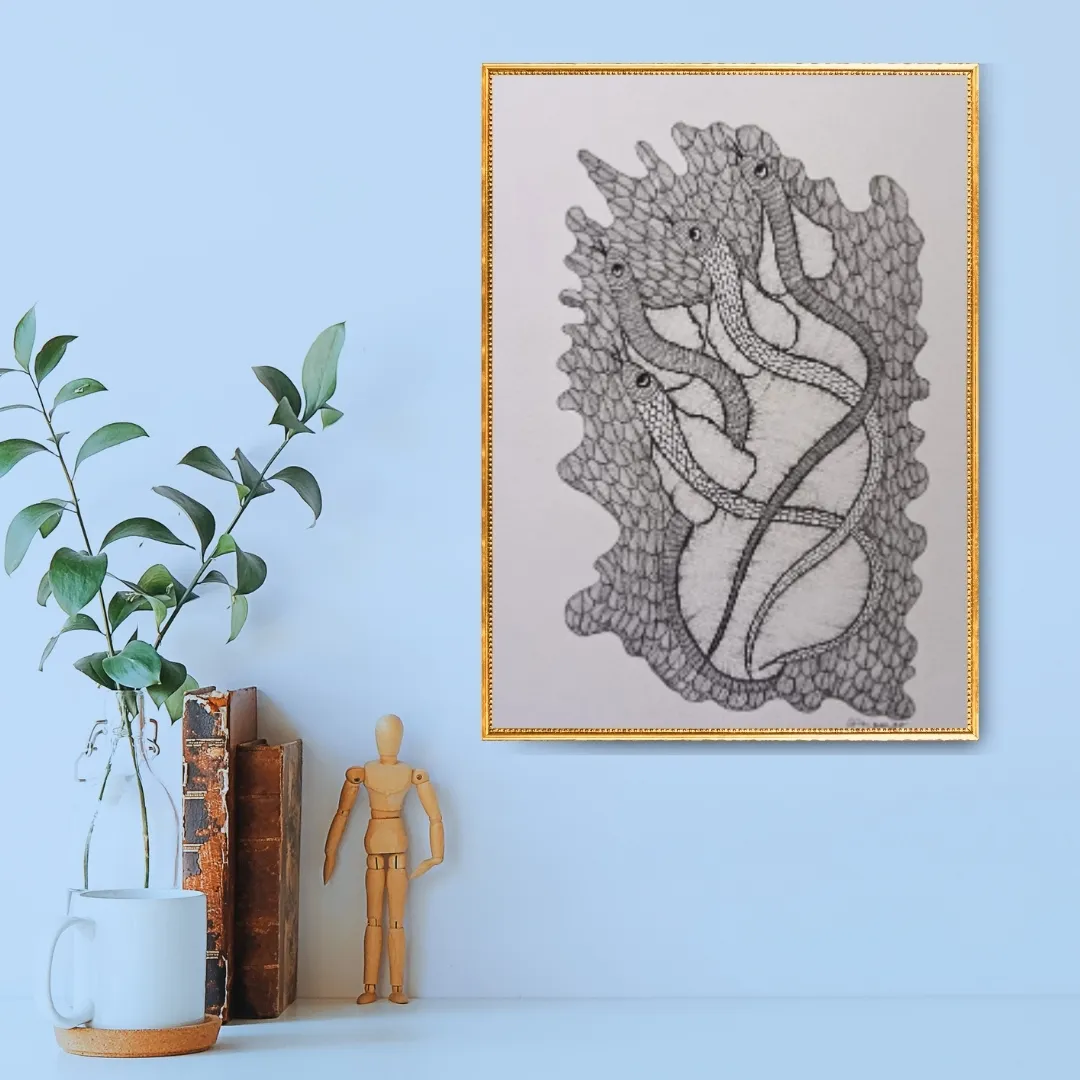
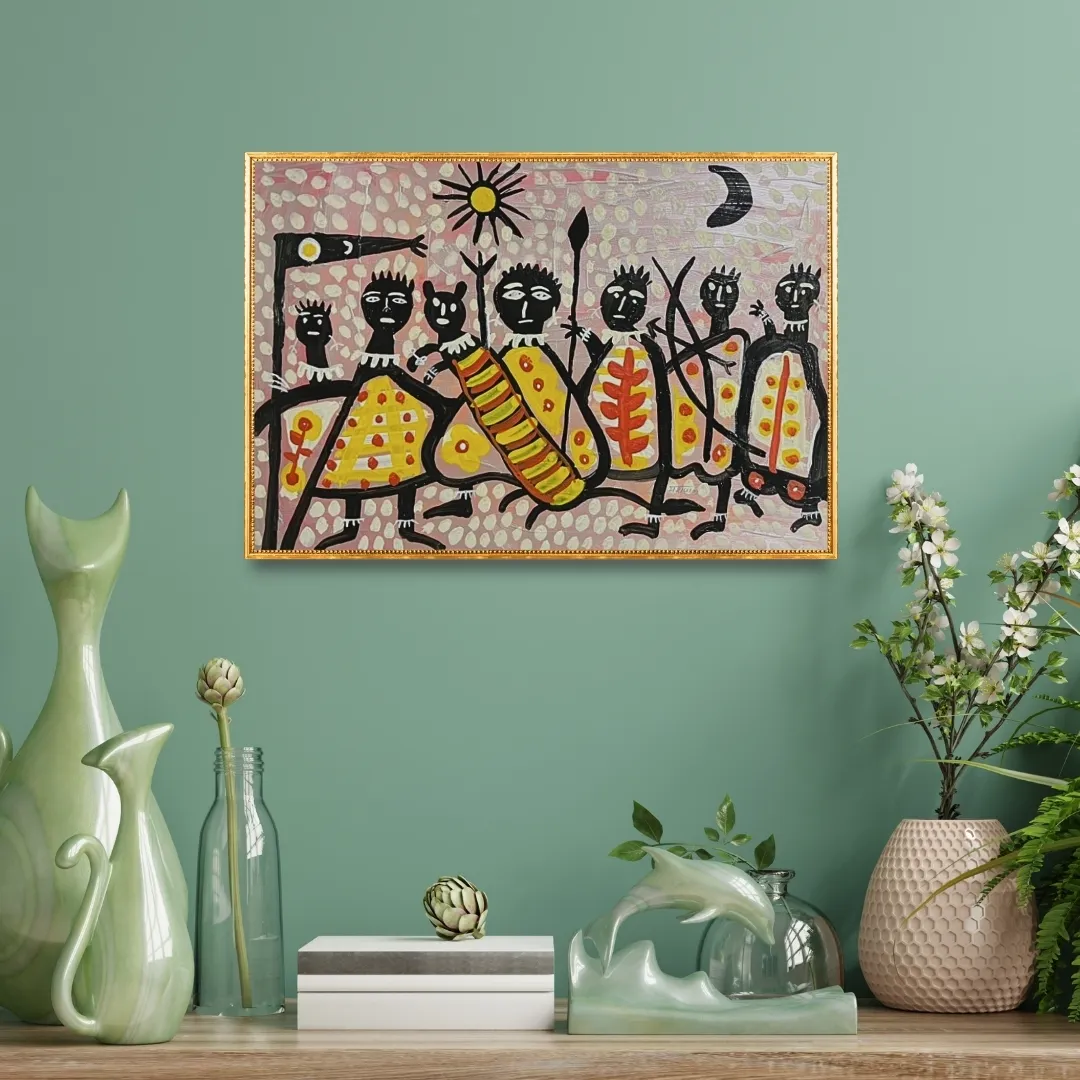
The composition unfolds as a carefully balanced field of interlocking forms, each shape defined by confident contour and filled with intricate, rhythmic patterning. Figures and motifs—whether human, animal or vegetal—are rendered with stylised clarity, their interiors animated by repeated marks that create density without heaviness. The eye moves steadily across the surface, guided by repetition and variation rather than narrative sequence. Colour is applied in flat, assertive planes that heighten the decorative force of the image while maintaining structural control. Pattern does not overwhelm form; instead, it reinforces it, giving each body a contained energy that feels deliberate and composed. Open areas of ground create breathing space between concentrated passages of detail, ensuring that the overall composition retains cohesion and visual clarity. Working within a living tribal art tradition, Yashpal Baranda translates inherited visual language into a contemporary framework defined by balance and precision. In acrylic on canvas or paper, he builds each image through disciplined repetition, allowing structure, colour and ornament to function as one unified system. Untitled XII stands as a testament to this synthesis—an artwork where pattern becomes architecture and surface becomes rhythm.
$ 149
Untitled XVIII
Certified

Tribal Art

Untitled XVIII

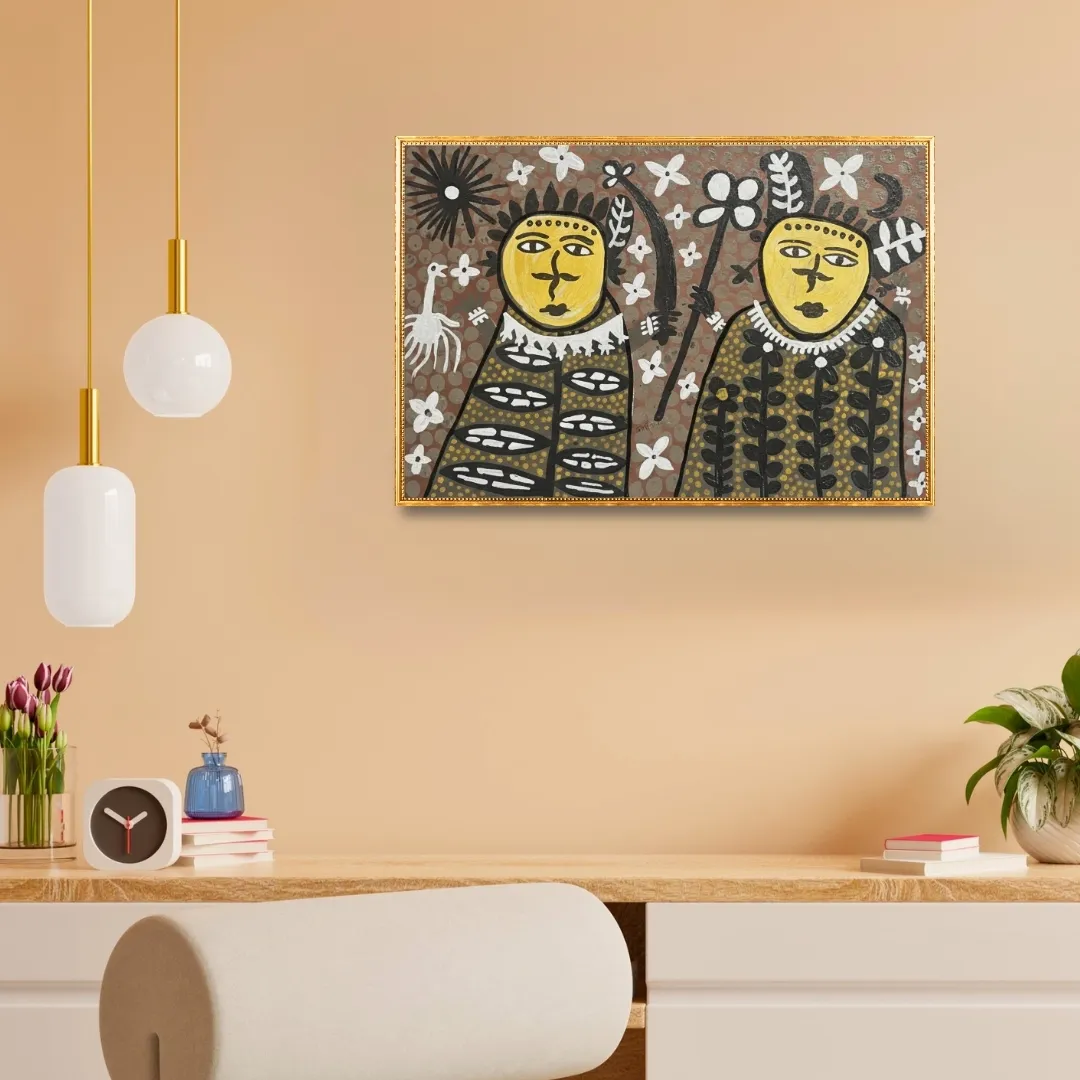
A network of forms spreads across the surface in deliberate balance, each figure articulated through intricate internal patterning that gives the composition its steady pulse. Curving outlines contain dense fields of repeated marks—dots, stripes, cross-hatching or scale-like motifs—that transform bodies into textured terrains. No single element claims dominance; instead, the image unfolds as a unified field where repetition becomes rhythm and structure emerges from ornament. Colour is applied with confidence and clarity, flat yet luminous, allowing the patterned interiors to carry the visual weight. The absence of conventional depth keeps the viewer close to the surface, attentive to the dialogue between filled form and open ground. Negative space is neither empty nor incidental; it functions as a pause between passages of intensity, sharpening the impact of each meticulously rendered shape. Working within a living tribal visual tradition, Yashpal Baranda builds each composition through disciplined repetition and compositional restraint. In acrylic on canvas or paper, he balances inherited pattern vocabulary with contemporary clarity, ensuring that every mark contributes to the integrity of the whole. Untitled XVIII becomes a study in equilibrium—an image where colour, repetition and form converge into a quietly sustained visual harmony.

$ 149
Untitled XXIII
Certified

Tribal Art

Untitled XXIII

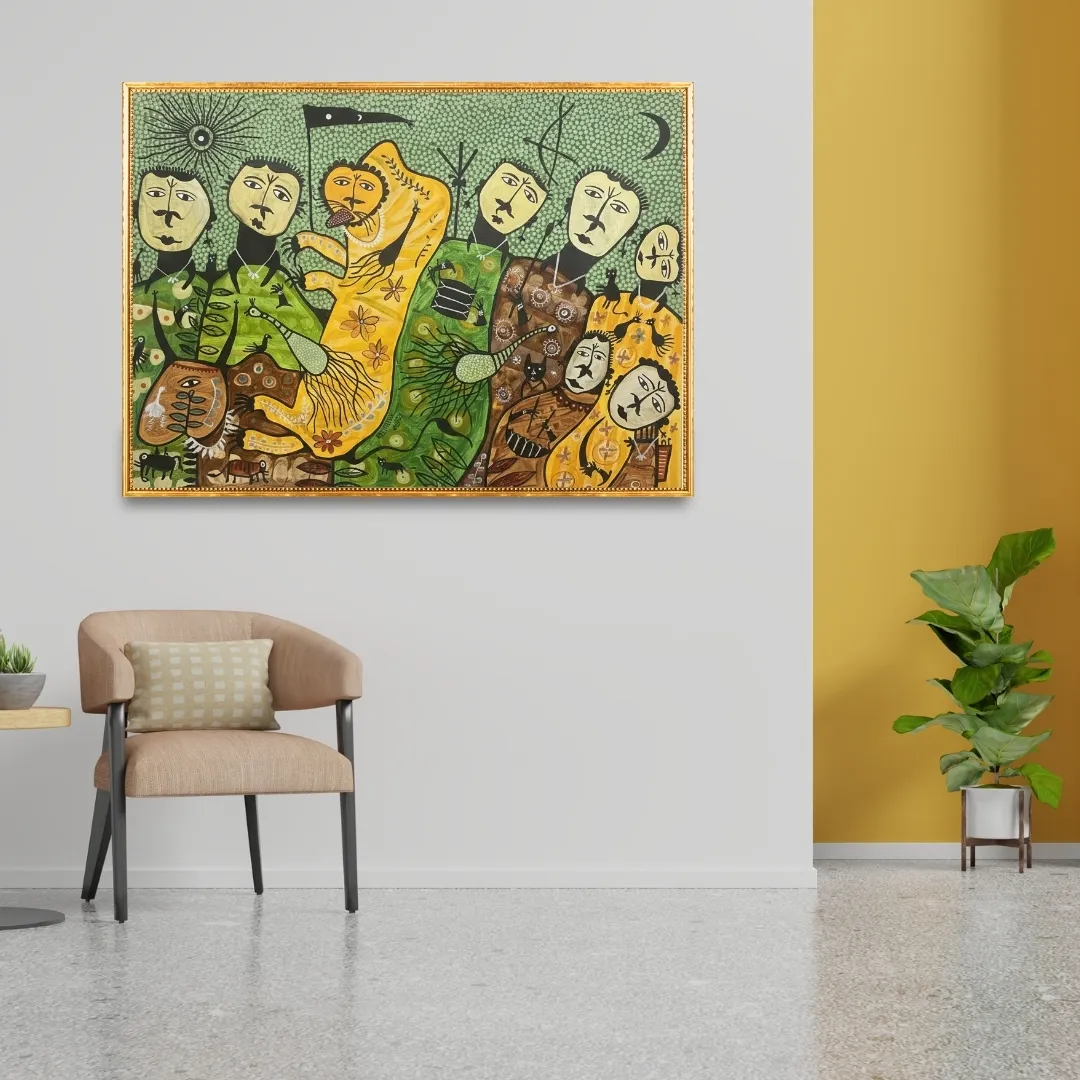
Forms unfold across the surface in a quiet, rhythmic arrangement, each element articulated through intricate patterning that gives the composition its internal pulse. Figures, animals or vegetal motifs—rendered in the distinctive Baranda vocabulary—interlock without crowding, held together by repetition and balanced spacing. Lines curve and repeat, filling bodies with dense ornament that reads not as embellishment but as structure, building each shape from within. Colour moves confidently across the plane, flat and luminous, allowing pattern to carry the primary visual weight. There is no fixed horizon, no illusionistic depth; instead, the composition exists as a continuous field where every figure participates equally in the overall harmony. Negative space is deliberate, giving the eye moments of rest between areas of concentrated detail. The surface feels animated yet controlled, its energy derived from careful accumulation rather than spectacle. Yashpal Baranda works within a living tribal tradition in which storytelling, environment and daily life merge seamlessly. In acrylic on canvas or paper, he translates inherited visual language into contemporary clarity, maintaining the integrity of pattern while refining composition and balance. Untitled XXIII stands as a testament to this continuity—an image built through repetition, colour and disciplined mark-making that transforms the everyday into something enduring and ceremonial.

$ 719
Gond Birds X
Certified

Tribal Art

Gond Birds X

Birds inhabit the surface with poised stillness, their bodies elongated and refined through disciplined bands of parallel hatching. Beaks extend in sharp profiles, tails taper into rhythmic points, and wings rest against compact torsos that feel structured from within rather than outlined from without. Each figure stands distinct yet connected, arranged in a composition that values balance over spectacle and rhythm over narrative. The monochrome palette intensifies the clarity of form. Directional shifts in the line articulate feather, chest and wing, creating subtle internal divisions that suggest light and density without departing from the flat authority of the picture plane. The surrounding ground remains open and deliberate, allowing the repeated patterning within each bird to generate its own atmosphere. Texture accumulates through patient repetition, transforming the surface into a field of quiet vibration. Working in acrylic on paper, Suresh Dhurve continues the Gond tradition of Madhya Pradesh, where repetition is both aesthetic principle and philosophical framework. In Gond Birds X, the artist constructs each bird mark by mark, allowing rhythm and density to shape presence. The result is a composition that feels meditative and grounded, translating avian form into a study of structure, coexistence and restrained elegance.

$ 379
Gond Animals XIV
Certified

Tribal Art

Gond Animals XIV

Animals stand poised across the surface, their bodies articulated through closely set, directional hatching that gives each figure both contour and internal resonance. Limbs are elongated with stylised restraint, torsos compact yet steady, and faces defined by sharp profiles and unwavering eyes. There is no overt drama in their stance; instead, the composition derives its strength from equilibrium, each creature occupying its place with measured certainty. The monochrome palette heightens the authority of the line. Subtle shifts in the direction of hatching distinguish flank from shoulder, neck from torso, creating a layered structure that feels almost carved from the page. The open ground surrounding the figures is intentional and unembellished, allowing the repetition of line within each body to become the central visual event. Texture accumulates gradually, building presence through patience rather than embellishment. Working in acrylic on paper, Suresh Dhurve continues the Gond tradition of Madhya Pradesh, where repetition is a method of invoking life rather than merely describing it. In Gond Animals XIV, the artist constructs each form from within, allowing rhythm and density to define character and coexistence. The result is a composition that feels both ancestral and contemporary, grounded in tradition yet unmistakably individual in its command of structure and balance.

$ 379
Gond Animals XIII
Certified

Tribal Art

Gond Animals XIII

Across an open field of paper, animals take form through a disciplined architecture of line. Each body is assembled from tightly controlled hatching, the strokes moving in measured directions that define torso, limb and flank with quiet precision. Heads tilt slightly, ears sharpen, tails extend in gentle arcs, creating a choreography that feels ordered rather than animated. The composition does not rely on narrative; instead, it draws its strength from balance, repetition and the steady accumulation of mark. The monochrome surface intensifies this structural clarity. Without the distraction of colour, the eye follows the shifts in density and direction, reading the animals as built forms rather than outlined shapes. Negative space remains deliberate and unbroken, giving the figures room to assert their presence while maintaining the overall compositional harmony. The repetition of line becomes both texture and pulse, suggesting life through rhythm rather than gesture. Working in acrylic on paper, Suresh Dhurve continues the Gond tradition of Madhya Pradesh, where pattern is inseparable from being. Each stroke participates in a visual grammar that understands living creatures as fields of energy shaped by repetition and flow. In Gond Animals XIII, the artist transforms familiar animal forms into a meditation on structure, coexistence and the quiet authority of shared space.

$ 379
Gond Animals VII
Certified

Tribal Art

Gond Animals VII

A constellation of animals unfolds across the surface, each figure composed through disciplined bands of parallel hatching that give the bodies both contour and internal gravity. Their forms are stylised yet assured: elongated limbs, poised torsos and carefully balanced heads that seem to listen as much as they look. There is no dramatic gesture, no theatrical movement. Instead, the composition rests in a state of contained energy, as though the animals share an unspoken rhythm that binds them together. The monochromatic palette heightens the authority of line. Directional shifts in the hatching articulate muscle and structure, creating subtle dimensionality without departing from the flatness of the picture plane. Negative space is left open and intentional, allowing each figure to breathe while still participating in the collective order of the whole. The repetition of mark becomes meditative, building density through patience rather than ornament. Suresh Dhurve works within the Gond tradition of Madhya Pradesh, where repetition is a method of understanding life as continuous and interconnected. In acrylic on paper, he constructs each animal from within, layering line upon line until presence accumulates. Gond Animals VII transforms familiar creatures into emblems of rhythm, balance and quiet strength, rendered through a visual language that is at once ancestral and distinctly contemporary.

$ 379
Gond Animals IV
Certified

Tribal Art

Gond Animals IV

Animals gather across the surface in measured stillness, each form defined by dense, directional hatching that gives the bodies a sculpted, almost architectural weight. Limbs extend in deliberate arcs, tails curl into rhythmic counterpoints, and steady, unblinking eyes anchor each figure within the field. The composition feels balanced rather than crowded, as though every creature occupies a space already prepared for it. There is no background in the conventional sense; instead, the animals exist within an open plane where line and density create their own atmosphere. Built entirely through monochrome mark-making, the figures carry their structure within them. Parallel strokes shift direction from torso to limb, creating subtle internal zones that suggest muscle, movement and breath without breaking the stylised clarity of the form. The repetition of line is patient and exacting, allowing the surface to accumulate visual depth through disciplined variation rather than colour. Suresh Dhurve works in the Gond tradition of Madhya Pradesh, where pattern is not embellishment but the primary language through which living forms are understood. In acrylic on paper, he constructs each animal mark by mark, allowing density, rhythm and controlled repetition to build presence from within. Gond Animals IV becomes less a depiction of wildlife and more a meditation on structure, balance and the quiet authority of shared existence.

$ 379
God I
Certified

Tribal Art

God I

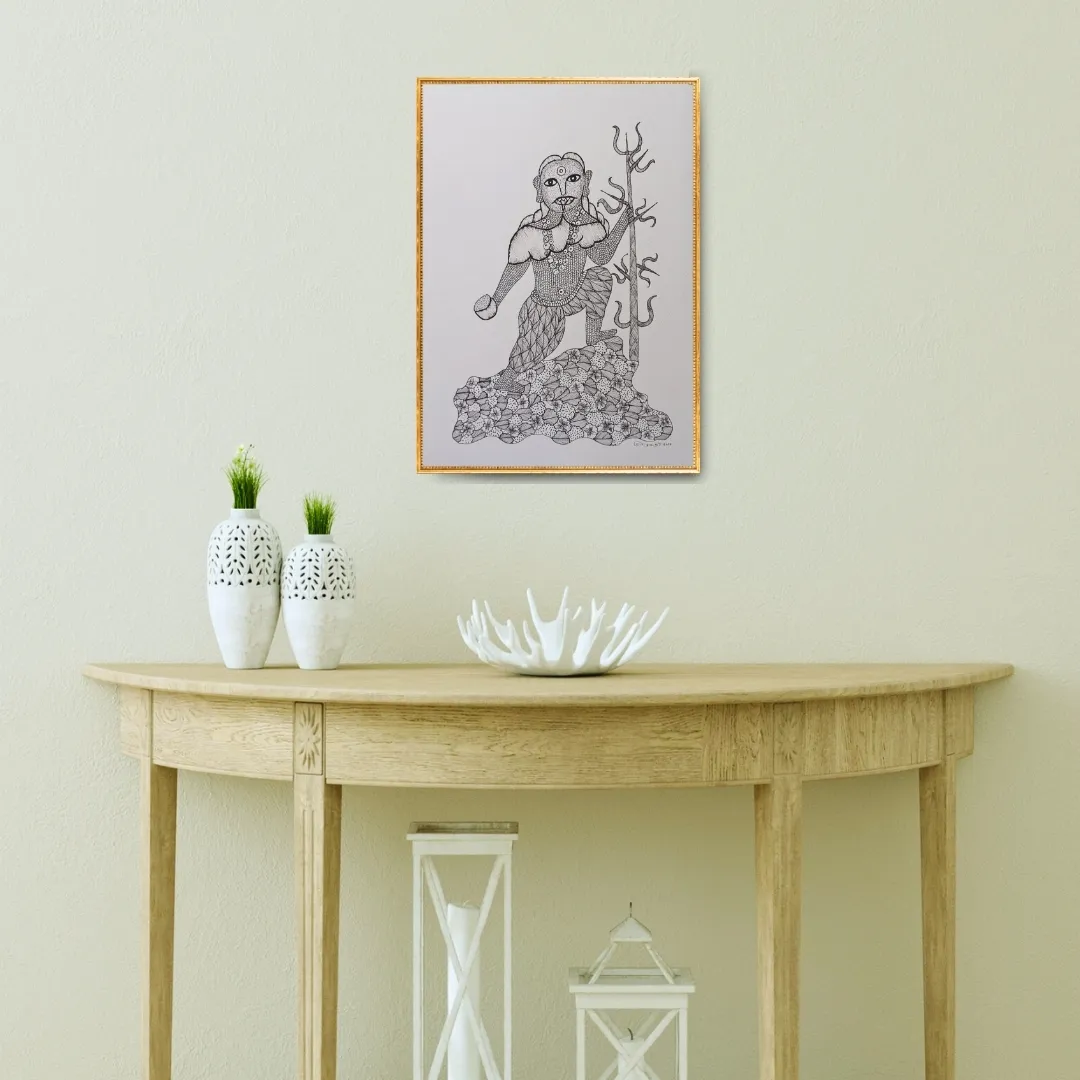
The figure strides forward with the measured confidence of someone who has always known where they are going. One knee is raised, one arm extended, and in the raised hand a trishul reaches upward toward the top edge of the composition, its three prongs curving slightly as though the implement itself is alive. Serpentine forms coil at the staff's midpoint and again near its base, their bodies rendered in loose, fluid line against the otherwise dense and constructed surface of the figure. A third eye marks the centre of the brow. The face is direct, mouth slightly open, bearing the expression of a presence that is neither threatening nor entirely benign but simply and completely itself. Every surface of the body is a different texture. The torso is built from close stippled dotwork, the garment from overlapping leaf and scale forms, the musculature of the shoulders from smooth rounded hatching that catches the light differently from every angle. A beaded necklace and belt of circular ornaments circle the body, each bead individually placed. Beneath the figure, the ground is not ground at all but an entire garden of flowers, each blossom rendered with its own petals and centre, the whole bed of them spreading across the lower portion of the composition like an offering laid out in advance of arrival. Suresh Dhurve works in the Gond tradition of Madhya Pradesh, where divine figures are not illustrations of mythology but encounters with it. The marks he uses, stipple, hatch, scale, petal, are not stylistic choices but a visual theology, a way of saying that the sacred is made of the same material as the world and is no less detailed, no less particular, no less alive. Painted in acrylic on paper, this work holds the full weight of that understanding. Why This Artwork Stands Out The trishul and third eye situate the figure within recognisable devotional iconography while the Gond visual language transforms familiar symbol into something entirely new. The floral base, rendered with individual attention to each bloom, elevates the ground itself into an act of reverence, making the earth beneath the figure as sacred as the figure above it. The range of textures across a single monochromatic palette, stipple, hatch, scale, petal, demonstrates a mastery of mark-making that rewards close and extended looking. Suresh Dhurve's ability to hold devotional intensity and intricate craft in the same image gives this work a rare quality of presence that is felt before it is understood.

$ 379
Jhaad Phoonk Bali
Certified

Tribal Art

Jhaad Phoonk Bali

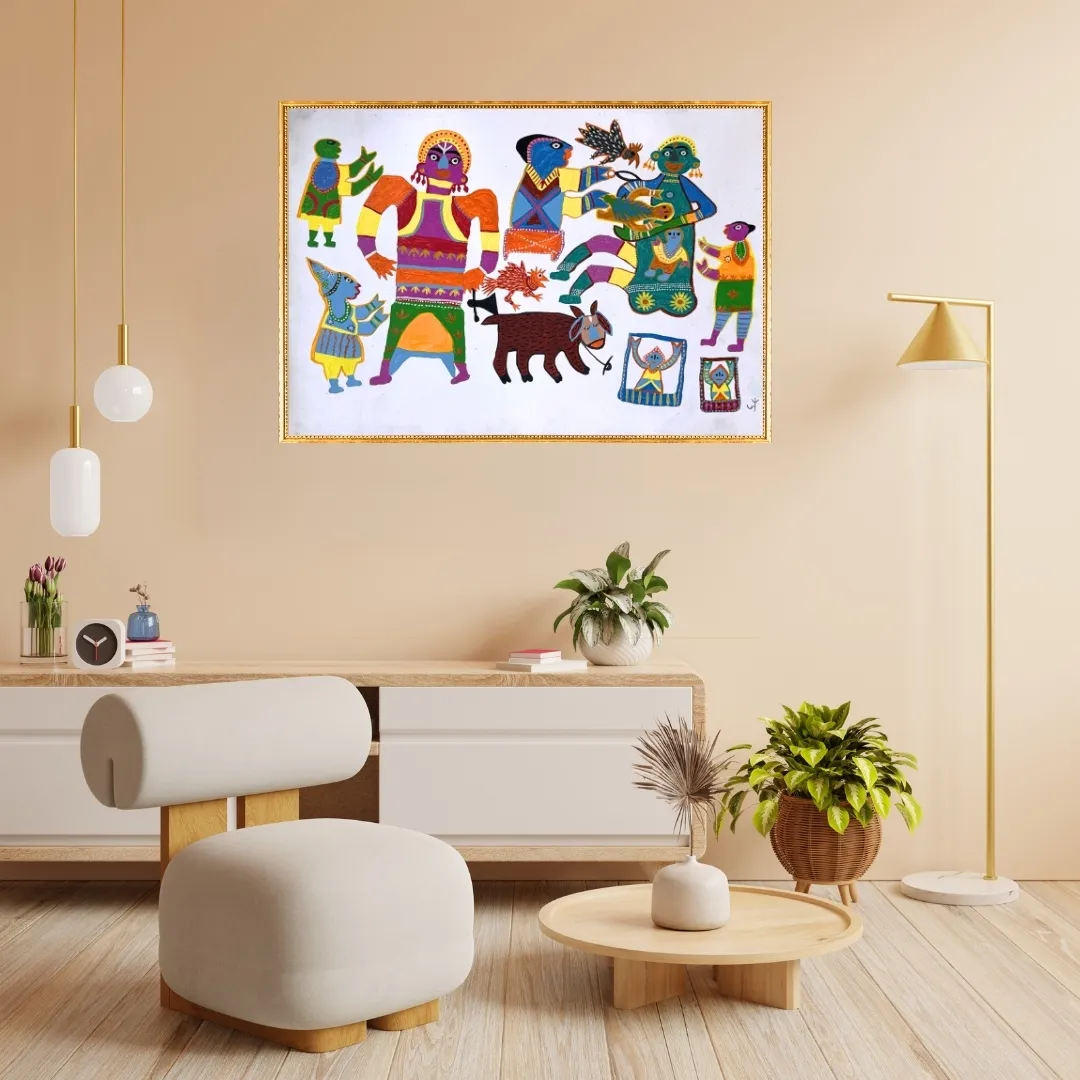
The scene is busy with life and purpose. Across an open white ground, a gathering of figures moves through the stages of a ritual that has been performed in Baiga communities for generations. At the centre, a tall, broad-shouldered woman dominates the composition in purple, orange and yellow, her stance wide and authoritative, a bag held at her side. Around her, the world is in motion: a man in blue reaches toward a bird mid-flight, another figure lifts and gestures, children stand at the edges watching, a brown dog moves through the lower middle of the scene with the easy confidence of an animal who belongs. A rooster struts near the ground. Two small framed figures appear at the lower right, contained within borders of their own, as though they exist in a different register of the same story, perhaps seen, perhaps dreamt, perhaps remembered. Jhaad phoonk bali refers to the ritual practices of healing, spirit appeasement and sacrifice that form a central part of Baiga spiritual life. Jodhaiya Bai paints this ceremony not as spectacle but as lived experience, the ordinary and the sacred folded into one another without hierarchy or explanation. Each figure is rendered in the bold, flat colour and confident outline that characterises her hand: green skin, blue skin, the wide eyes of people entirely absorbed in what they are doing. Painted in acrylic on canvas, the work carries the visual logic of a community whose relationship with the unseen world is practical, immediate and matter-of-fact. Jodhaiya Bai, a Padma Shri recipient and one of the foremost Baiga artists of her generation, documents this world from the inside, with the authority of someone for whom these ceremonies are not subject matter but lived memory. Why This Artwork Stands Out The composition's open, frieze-like arrangement across the white ground gives the ritual scene a timeless, almost mural-like quality, each figure and creature occupying its own clear space within the collective action. The inclusion of animals, birds and children alongside the central healing figure reflects the Baiga worldview in which ceremony is not separate from daily life but continuous with it. The two framed figures at the lower right introduce a second visual layer within the composition, suggesting the presence of vision, spirit or memory operating alongside the physical scene. Jodhaiya Bai's status as a Padma Shri laureate and keeper of Baiga visual tradition gives this painting the weight of cultural testimony as much as artistic achievement.

$ 11,309
Untitled I
Certified

Tribal Art

Untitled I

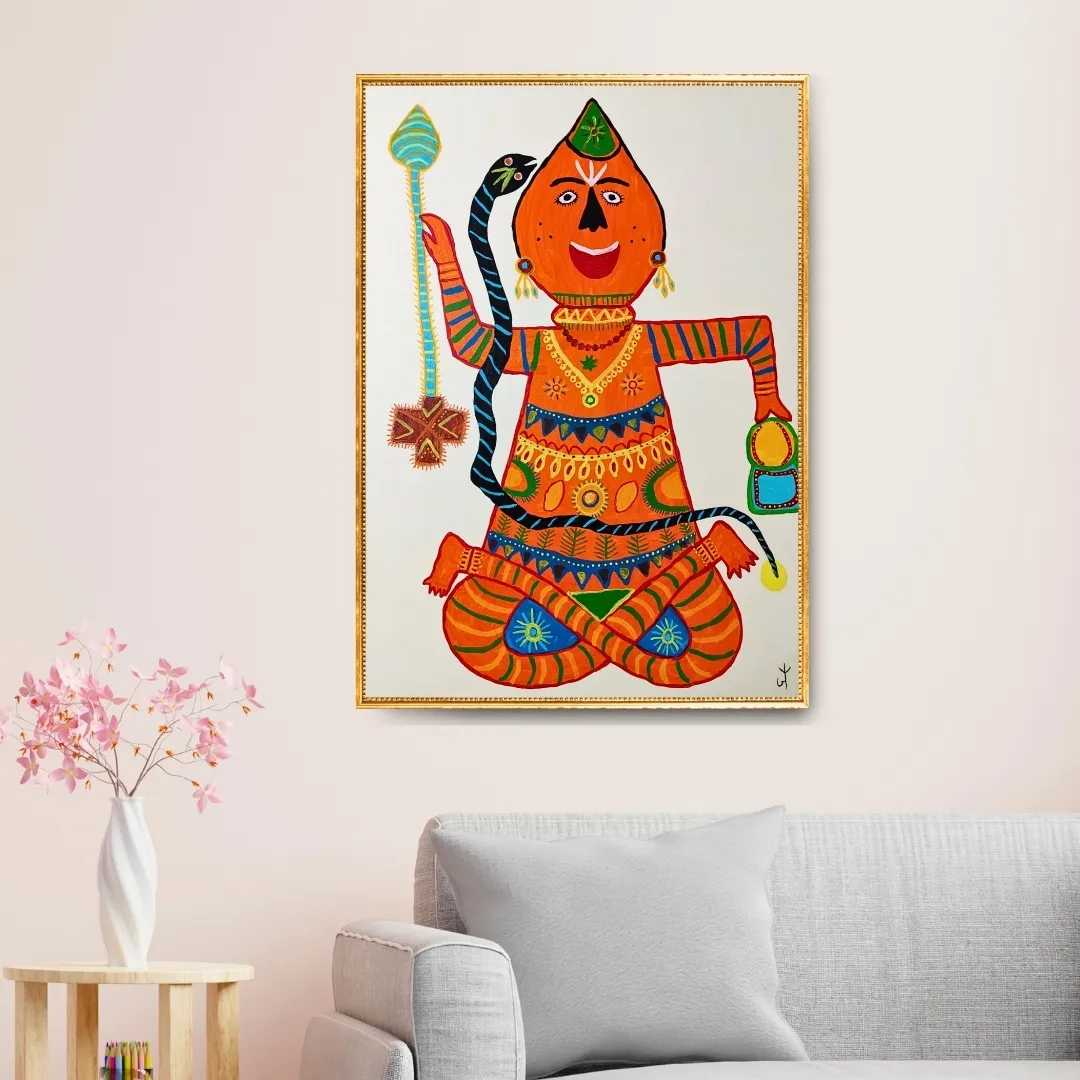
A deity sits at the centre of the world, cross-legged and entirely at ease. The figure is orange from head to foot, the colour of turmeric and marigold and the particular warmth of festival firelight, and every surface of the body is alive with pattern. Bands of green, blue, red and gold ring the arms and legs in stripes. The torso is a field of embroidered forms, flowers, stars, leaf shapes and geometric borders layered across one another with the generous hand of someone who understands that abundance is itself a form of devotion. Gold necklaces sit at the throat. Earrings fall in drops from each ear. A white tilak marks the brow beneath a pointed green crown. The face holds the widest smile in the room, open, joyful, entirely unguarded, the expression of a being who has nothing to withhold. In one raised hand the figure holds a staff wound with a black and blue serpent, its head alert at the top. In the other, a small green and yellow vessel, held lightly, like an offering or a secret. Jodhaiya Bai is one of the most celebrated Baiga artists working today, a Padma Shri recipient whose paintings carry the visual memory of a community whose relationship with the forest, the divine and the decorative is ancient and unbroken. Her figures are never portraits and never symbols alone; they are presences, full of personality and ceremonial weight in equal measure. Painted in acrylic on canvas, this work announces itself without apology, a vision of the sacred that is also, unmistakably, a vision of joy. Why This Artwork Stands Out The all-over patterning of the figure's clothing and body, rendered in Baiga visual vocabulary, transforms the human form into a living textile of cultural memory. The serpent staff and ritual vessel situate the figure within a specific devotional iconography while keeping the mood festive rather than solemn. The radiant orange ground of the body against the plain white canvas creates an intensity of presence that makes the figure feel genuinely monumental at any scale. Jodhaiya Bai's status as a Padma Shri laureate and living master of the Baiga tradition makes this work both a significant artwork and an important cultural document.

$ 18,099
Fishes III
Certified

Tribal Art

Fishes III

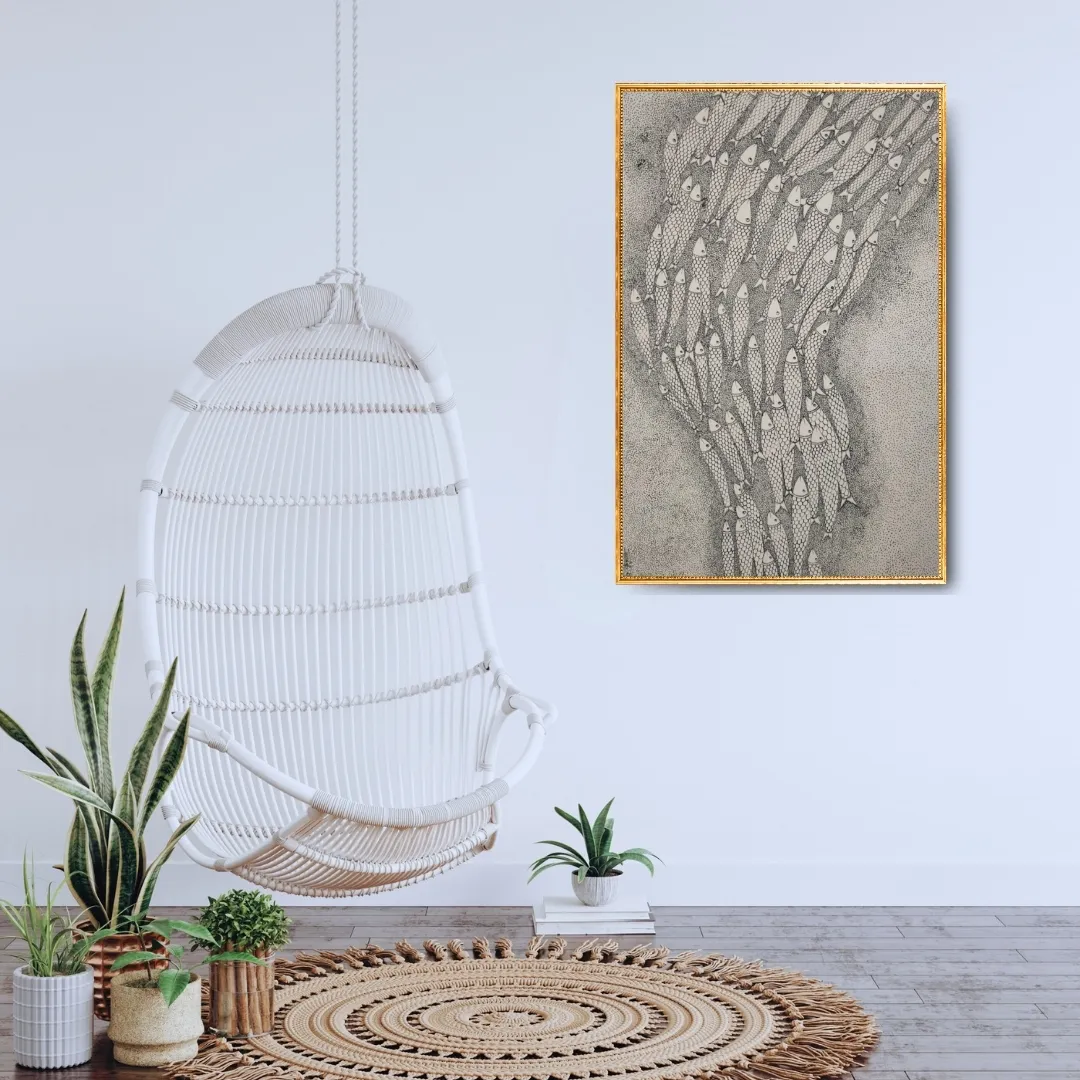
They move as one. Dozens of fish sweep across the composition in tight, overlapping streams, their bodies aligned with the kind of collective purpose that makes a school of fish look less like many creatures and more like a single living current finding its shape. Each fish is rendered with the same patient attention: scales built from small, interlocking circles pressed together in careful rows, a pointed head, a watchful eye, a tail that tapers into the next body behind it. No individual fish commands the composition. The power belongs entirely to the movement itself, to the great arcing flow that carries all of them in the same direction at the same unhurried velocity. The ground from which they emerge and into which they dissolve is a dense field of stippled dotwork, darker at the edges and softer at the centre, suggesting depth, water pressure and the particular quality of light that filters through deep water. There is no hard horizon, no fixed plane. The fish exist somewhere between surface and darkness, suspended in a space that feels genuinely aquatic. Sandeep Dhurve works in the Gond tradition of Madhya Pradesh, where repetition is never mere pattern but a way of understanding the world as continuous, interconnected and alive. Each scale on each fish is a mark made by hand, and the cumulative effect of hundreds of such marks held in formation is something closer to a natural phenomenon than a painting. Working in acrylic on paper, Dhurve transforms collective movement into a meditation on belonging, rhythm and the quiet intelligence of the natural world. Why This Artwork Stands Out The sweeping diagonal formation of the school creates a strong compositional current that carries the eye across the entire surface without rest, making the act of looking feel like participation in the movement itself. The repetition of individually scaled fish bodies, each rendered by hand, gives the collective mass an intimacy that purely abstract pattern-making cannot achieve. The stippled dotwork ground dissolves at its centre into open space, creating a sense of genuine depth and aquatic atmosphere within a monochromatic palette. Sandeep Dhurve's work demonstrates how the Gond tradition's visual grammar of pattern and repetition can describe the natural world with both precision and feeling.

$ 459
Fishes II
Certified

Tribal Art

Fishes II

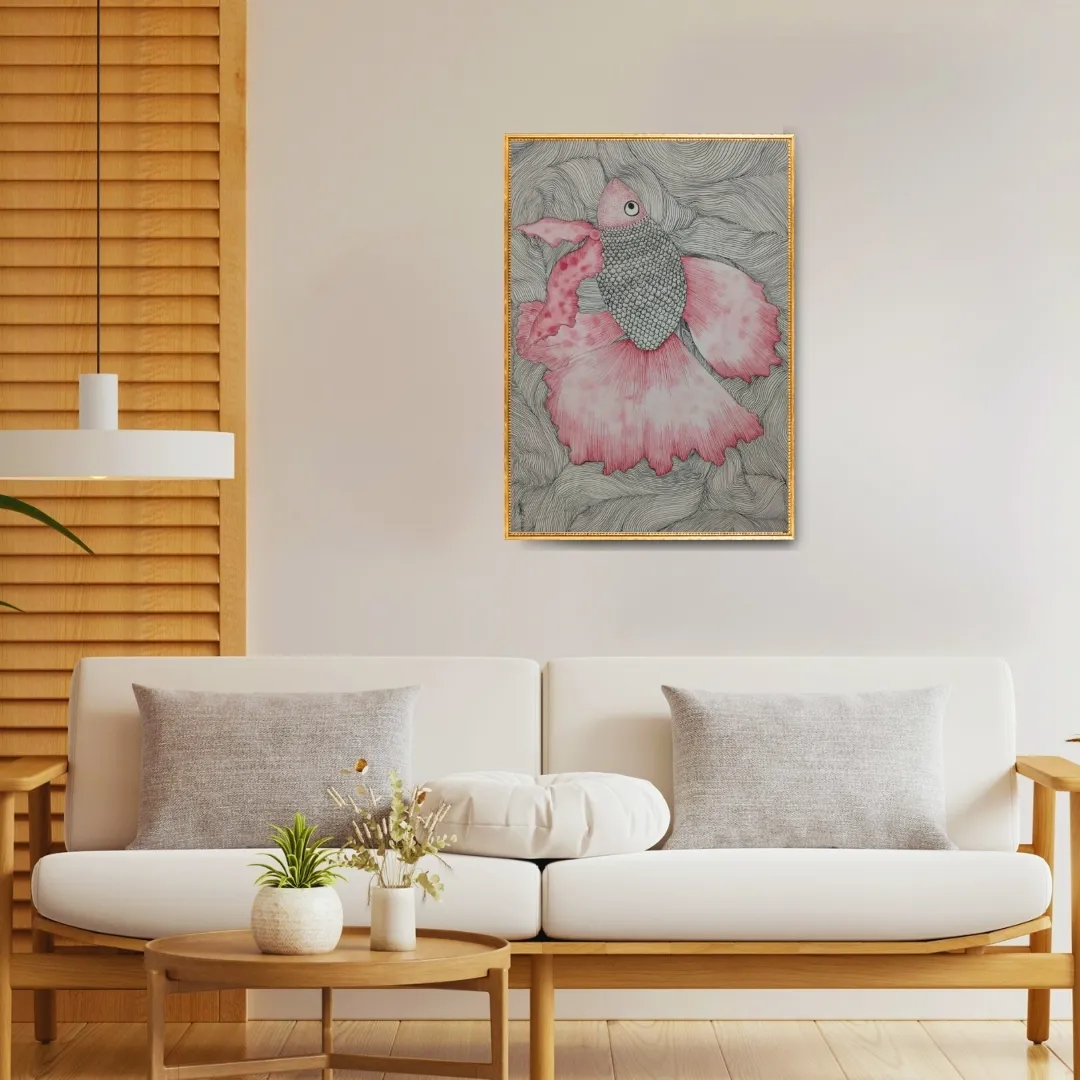
A single fish fills the frame with the quiet confidence of something that knows it belongs exactly where it is. Its body is rendered in dense, carefully built scale patterning, each small form pressing against the next with the patient accumulation of a craftsman who understands that structure is its own kind of beauty. From this grey, textured core, great fins billow outward in deep rose and blush, their edges ruffled and full, radiating fine parallel lines from the body's centre to the outermost tip like light spreading through water. The fins do not simply extend from the fish; they expand, filling the composition with a soft, ceremonial presence that is closer to a gown than a gesture. The ground against which all of this unfolds is a sea of flowing grey linework, wave upon wave of close parallel curves that move in unison without ever becoming monotonous. The fish sits within this field not as a subject against a backdrop but as one form of movement held briefly still within another. Sandeep Dhurve works in the Gond tradition of Madhya Pradesh, a visual language built on the understanding that every living creature carries its own inner world of pattern and energy. The contrast here between the cool monochrome of the undulating ground and the warm rose of the fins is not decorative but felt, a single creature luminous against the continuous flow of everything surrounding it. Working in acrylic on paper, Dhurve renders the natural world as a place where beauty and structure are always one and the same. Why This Artwork Stands Out The juxtaposition of densely scaled body and expansive flowing fins creates a visual tension between containment and release that gives the composition its emotional charge. The rose and blush palette of the fins against the monochromatic wave ground makes this one of Dhurve's most striking works in terms of colour contrast and spatial presence. The undulating linework of the background is itself a complete mark-making achievement, transforming negative space into active, living form. Sandeep Dhurve's command of scale, proportion and Gond visual grammar elevates a single subject into a meditation on grace, pattern and the natural world.

$ 459
Trees III
Certified

Tribal Art

Trees III

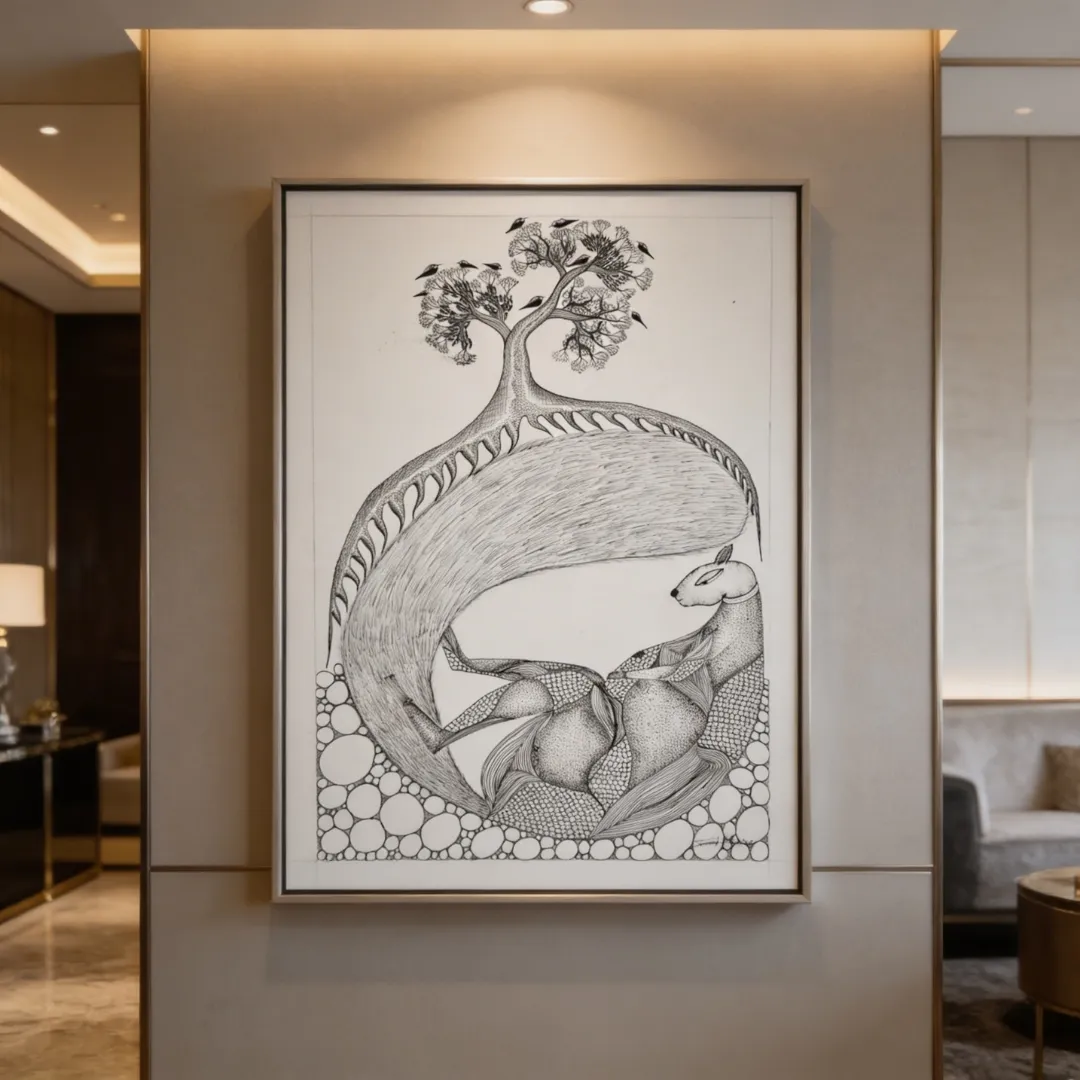
A tree rises from the upper half of the composition with the unhurried authority of something that has always been there. Its canopy spreads wide and full, birds perched quietly along its branches as though they have chosen this particular tree above all others. Below, the trunk does not simply descend into roots. It curves, sweeps and billows outward in a great arc, its body filling with dense parallel hatching that gives it the weight and warmth of living wood. The inner edge of this arc is lined with a row of pointed forms, like teeth or leaves or the repeated breath of something ancient, marking the boundary between the tree's interior world and the open space it holds within its curve. Sheltered inside that curve, a deer rests with its legs folded beneath it, its small alert face turned gently outward. The ground beneath is rendered in close circular patterning, stones or seeds or the simple fact of earth, while larger hollow circles border the lower edge of the painting like a quiet, rhythmic refrain. Sandeep Dhurve works in the Gond tradition of Madhya Pradesh, where the relationship between tree and creature, root and sky, is not metaphor but worldview. Every mark in this composition, the hatched trunk, the textured earth, the dotwork body of the deer, carries the visual logic of a tradition that understands all living things as continuous with one another. In acrylic on paper, Dhurve renders this understanding with a precision that feels both ancient and entirely his own. Why This Artwork Stands Out The sweeping arc of the tree trunk creates a natural shelter around the resting deer, making protection and interdependence the quiet subject of the entire composition. The variety of mark-making across a single monochromatic palette, hatching, dotwork, concentric circles, scale patterning, demonstrates the full range of the Gond visual vocabulary within one unified work. The birds in the canopy and the deer at the root establish a vertical axis of life, connecting sky, tree and earth in a single unbroken gesture. Sandeep Dhurve's command of line and texture gives the composition a density that rewards sustained attention, with new detail emerging the longer one looks.

$ 459
Fishes I
Certified

Tribal Art

Fishes I

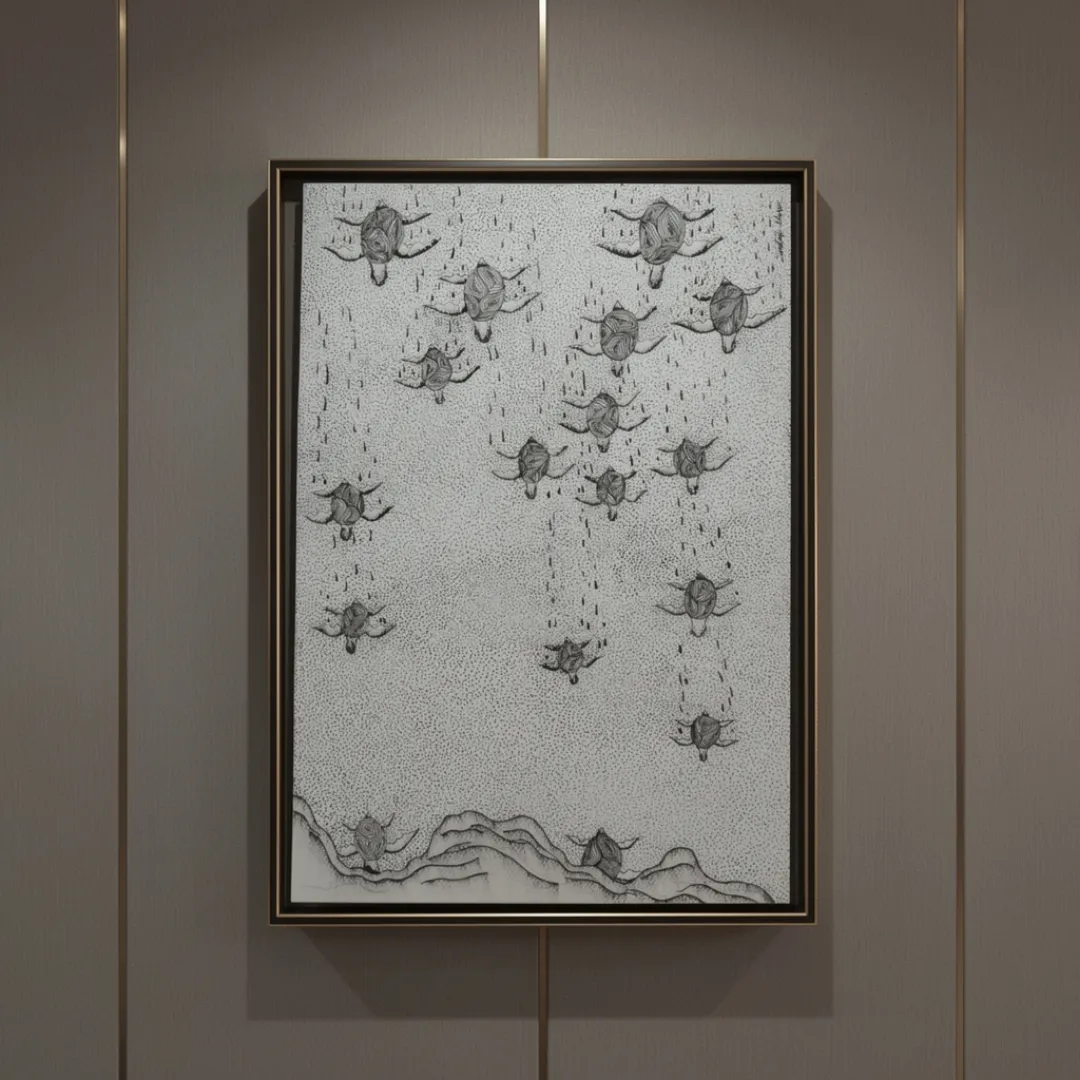
Across a pale, open field, fish fall like rain. Dozens of them descend through the composition, each body filled with the flowing concentric lines that are the signature language of Gond mark-making, spiralling inward as though the creature carries its own small cosmos within. Thin vertical strokes scatter between them, suggesting water, air or the simple passage of things through space. Nothing anchors the scene to a fixed horizon. The fish are neither rising nor falling with urgency; they move through the picture plane with the unhurried certainty of creatures that belong equally to depth and to sky. At the base of the painting, undulating wave forms settle into the lower edge, offering the gentlest suggestion of water waiting below. Sandeep Dhurve works in the Gond tradition of Madhya Pradesh, a visual language in which every living form is understood as a meeting point of pattern and spirit. The concentric fill that gives each fish its density is not simply ornament; it is the tradition's way of showing that life moves in continuous, interconnected currents. Working in acrylic on paper, Dhurve brings a graphic clarity to the composition, the white ground acting as both sky and sea, giving the repeated forms room to breathe without ever losing their collective rhythm. The dotwork atmosphere surrounding each fish charges the negative space, making the emptiness feel alive and inhabited. Why This Artwork Stands Out The all-over, gravity-free composition dissolves the boundary between water and air, creating a meditative visual field that invites extended looking. Each fish is individually rendered with Gond concentric patterning, giving the repeated motif an intimacy that resists mere decoration. The monochromatic palette of black on pale paper gives the work a quiet intensity, allowing form and mark to carry the full weight of the composition. Sandeep Dhurve's command of the Gond visual language transforms a single repeated subject into a sustained meditation on movement, pattern and natural abundance.

$ 459
Pithora Horses
Certified

Tribal Art

Pithora Horses

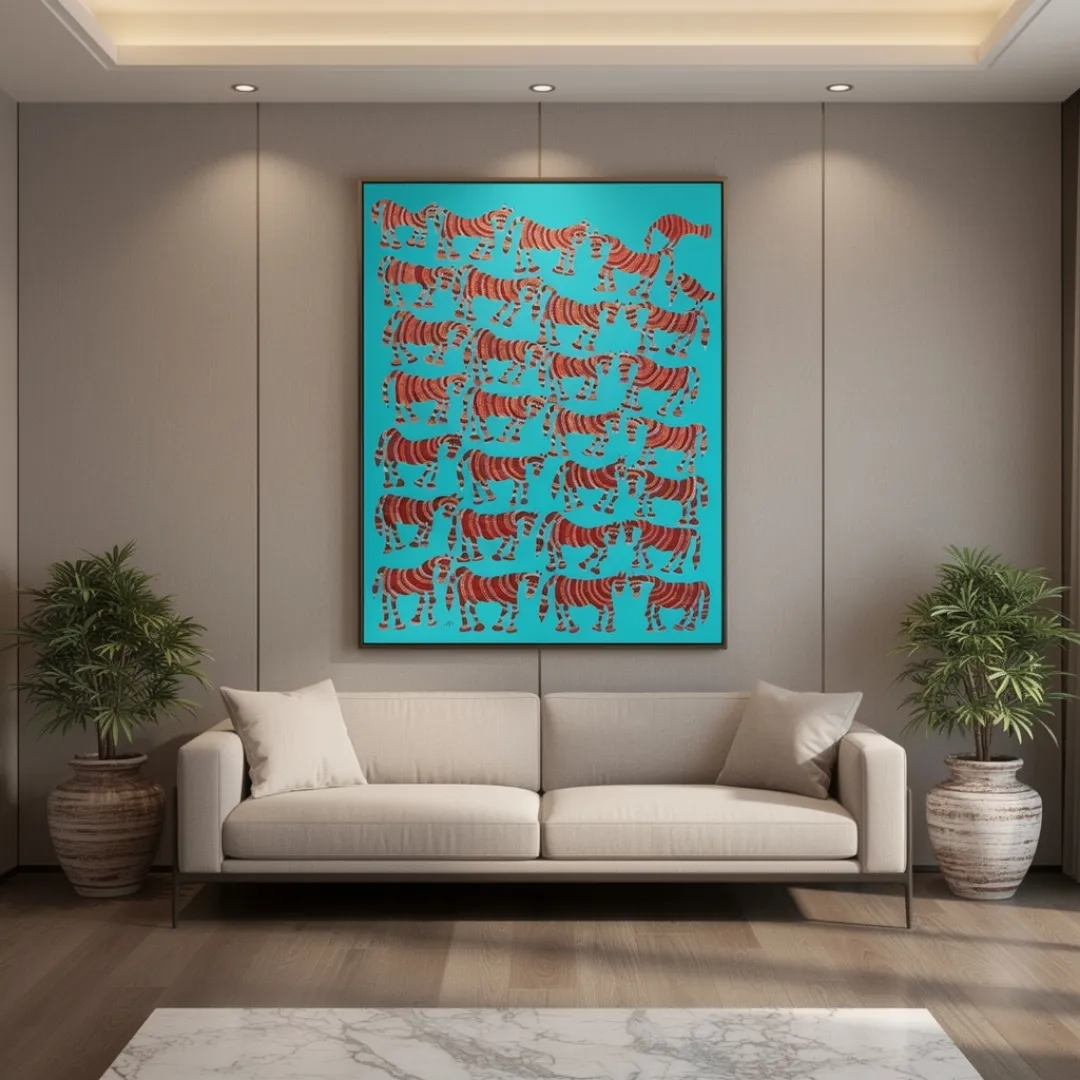
Across a field of electric turquoise, horses move in every direction at once — grazing, turning, nuzzling, standing still. There are dozens of them, filling the canvas from edge to edge without a single gap of empty ground, yet the composition never feels crowded. Each animal carries its own inner world of colour: bands of deep crimson, burnt orange, rose and gold ring the body in concentric stripes, as though the horses themselves are made of accumulated ritual energy. Their eyes are wide and watchful, their legs planted with a quiet, grounded confidence. This is Pithora, the ceremonial painting tradition of the Bhil and Rathwa communities of central India, in which horses are not merely depicted but invoked. Lado Bai works in acrylic on canvas, translating a practice rooted in sacred wall painting into a format that holds the same living charge. The repetitive dotwork and banded patterning that fill each form are not decorative choices — they are the visual grammar of the tradition itself, a language of marks that animates the creature from within. The turquoise ground, luminous and steady, gives the herd a stage that feels neither earth nor sky but somewhere between the two: a space where the sacred and the everyday meet without announcement. Why This Artwork Stands Out The all-over composition creates a sense of abundance and ceremonial abundance rooted in Bhil cosmology. Each horse is individually patterned, giving the collective energy of the herd an intimate, handcrafted character. The turquoise and crimson palette carries a visual intensity that feels both ancient and strikingly contemporary. Lado Bai's work belongs to a living oral-visual tradition, making this painting a cultural document as much as a work of art.

$ 2,569
Nature God
Certified

Tribal Art

Nature God

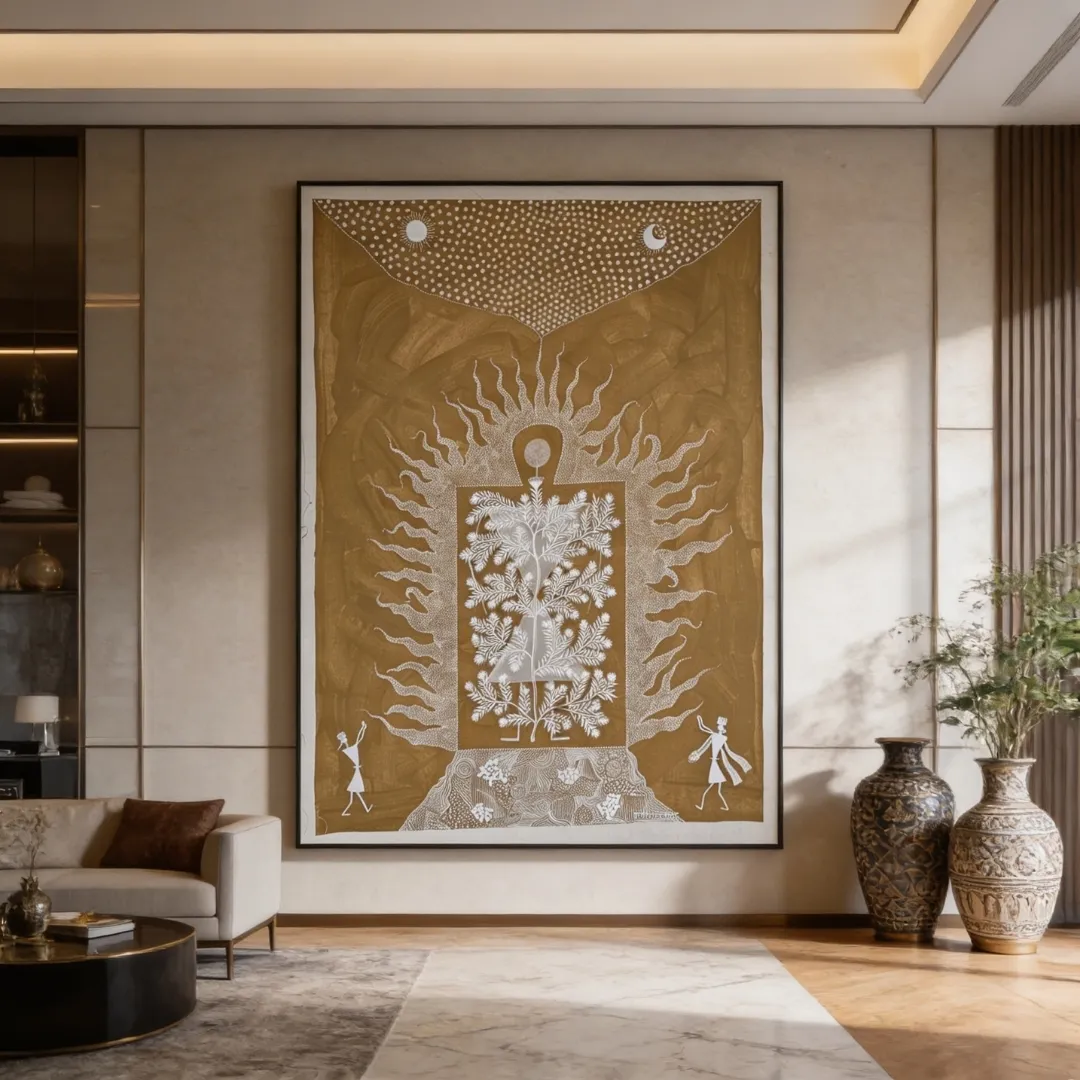
A sacred tree stands held inside a luminous frame, its branches spreading in all directions like breath released into open air. Around it, flames arc outward in long, rhythmic curves, filling the ochre field with a pulse of cosmic energy. Above, a starlit sky curves downward between the sun and the crescent moon, as though the heavens themselves have leaned in to witness what burns below. At the base, two Warli figures move lightly at the edges of the scene, small, unhurried, present, their quiet presence a reminder that this vision belongs to the living world as much as the divine. Anil Vangad works in the classical Warli tradition, using white pigment on cloth in a language of dots, lines and elemental form that has been passed down through generations of tribal painters from the Palghar district of Maharashtra. His hand is both precise and instinctive. The dotwork that traces the flames carries the meditative rhythm of ritual; each mark accumulates into something larger than its individual gesture. The earthy ochre ground glows beneath the white, suggesting firelight and soil in equal measure. This is not decoration. It is cosmology rendered in the most direct and human of marks. Why This Artwork Stands Out The framed sacred tree at the centre creates a visual altar, holding the entire composition in a state of quiet consecration. Radiating flame forms built entirely from dotwork give the painting a charged, ceremonial energy without losing intimacy of scale. The dual presence of sun and moon within the celestial arc speaks to the Warli worldview of nature as a unified, breathing whole. Anil Vangad's mastery of the tradition carries the authority of lived practice, making this a document as much as a painting.

$ 649
Living Roots
Certified

Tribal Art

Living Roots

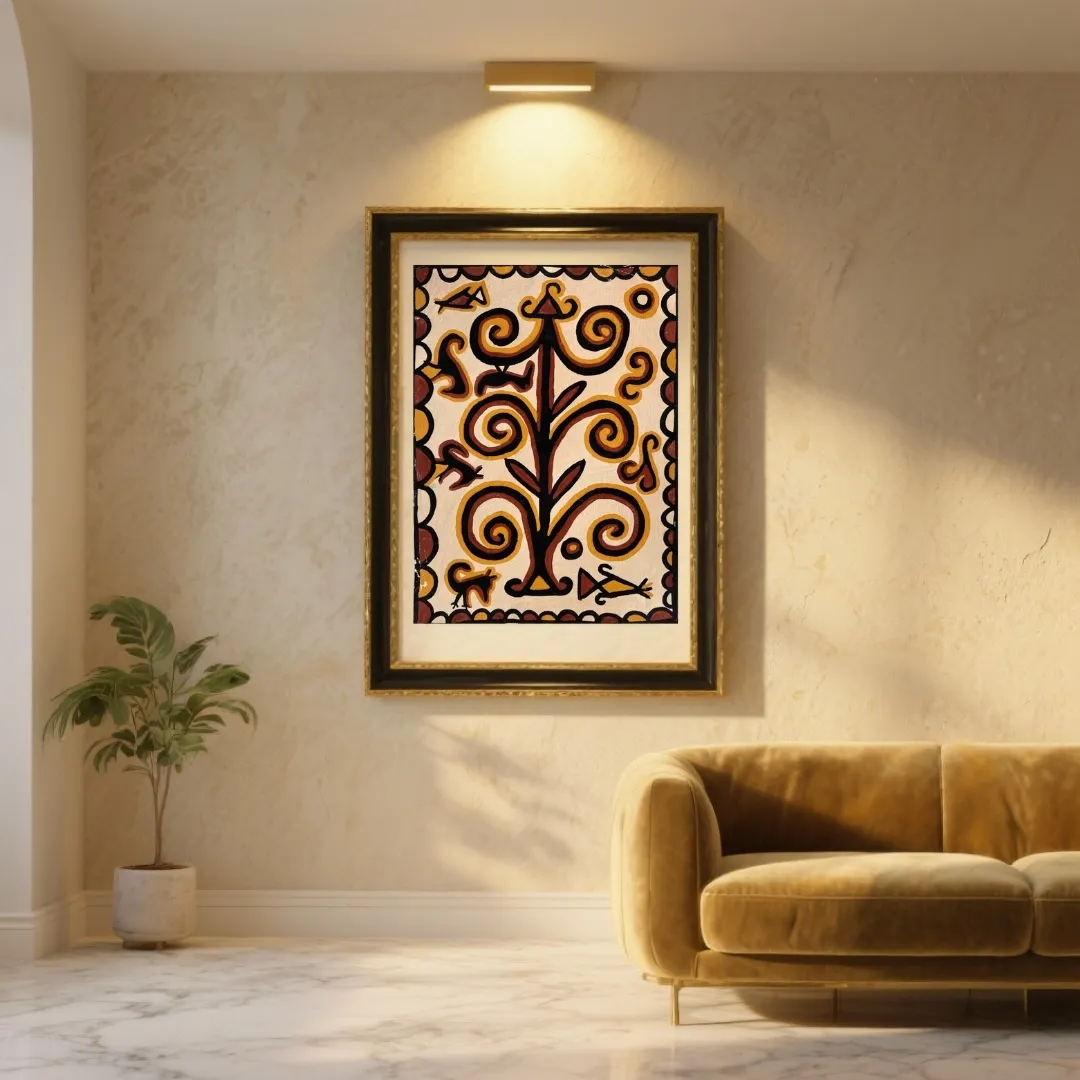
Living Roots' by Parwati Devi is a quiet celebration of growth, balance, and connection. The painting rises from the earth, each spiral branch unfurling with a sense of movement and renewal. Using simple, natural colours, Parwati Devi transforms clay pigments into symbols of life’s continuity, echoing the ancient belief that all beings are part of one living rhythm. Around the tree, animal and bird forms appear like guardians of nature, each line alive with warmth and instinct. ### Why This Artwork Stands Out: ### - The tree’s spiral branches capture the endless cycle of birth, decay, and rebirth. - Parwati Devi’s earthy palette grounds the work in the soil and traditions of Jharkhand. - The surrounding motifs of birds and animals express harmony between human and natural worlds. - The artist’s steady, freehand drawing carries the quiet authority of inherited tribal wisdom. This painting invites a moment of stillness, a reminder that the roots of life run deep beneath us all."

$ 829
Rooted in Bloom
Certified

Tribal Art

Rooted in Bloom

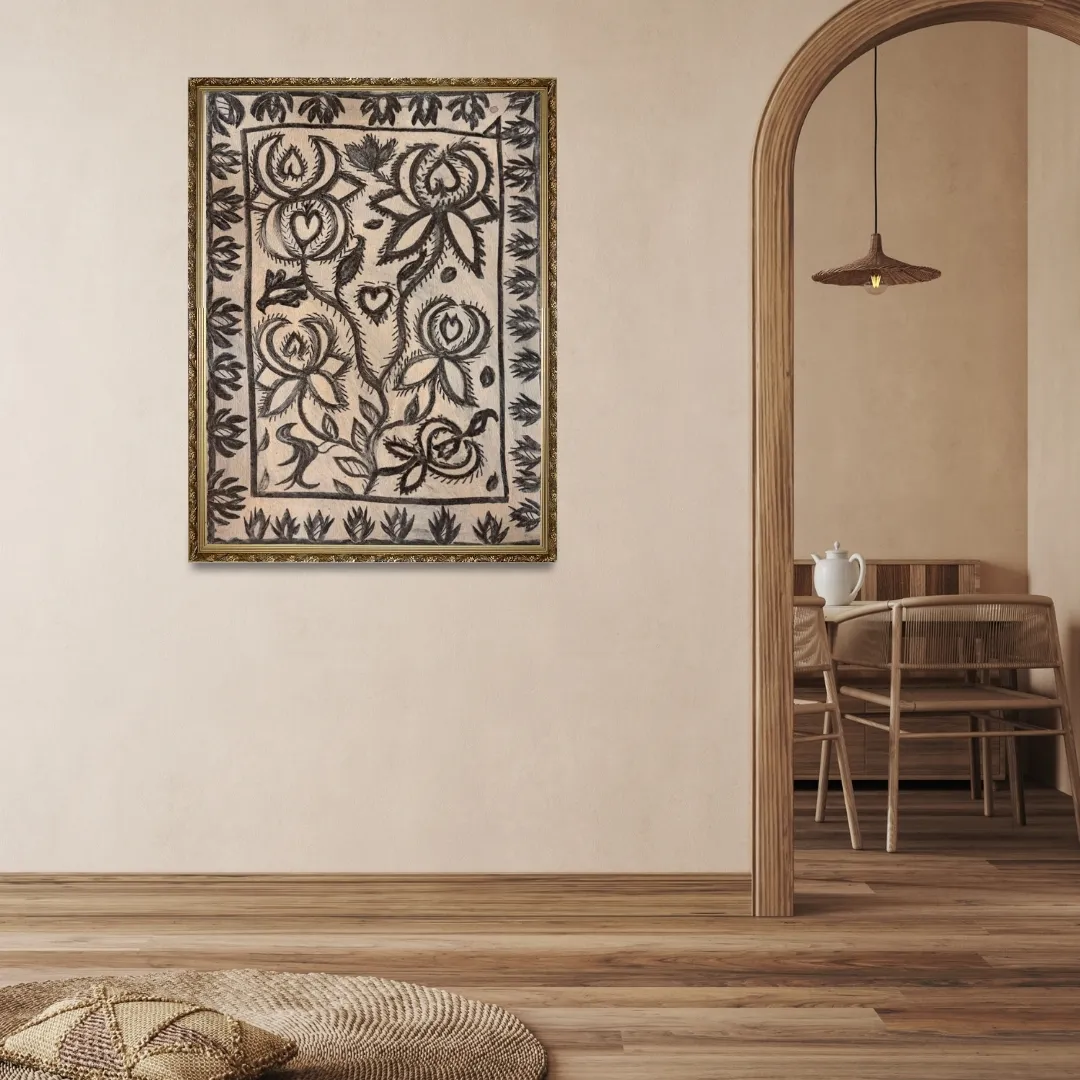
"Rooted in Bloom' by the late Yashodha Devi shows a graceful composition of flowering stems spreading across a pale, earthen background. Painted in deep black on a soft beige surface, the work is made using natural pigments that echo the look of traditional wall murals found in Jharkhand’s homes. The lotuses are drawn with broad, rhythmic strokes, each petal outlined with care and filled with fine hatching. Around the border, small leaf forms repeat in a steady pattern, framing the central vines that seem to rise gently towards the top of the paper. ### Why This Artwork Stands Out: ### - The use of natural black pigment creates a striking contrast against the raw paper surface. - Yashodha Devi’s brushwork is confident and fluid, revealing her control over organic line and balance. - The layered floral arrangement recalls the decorative tradition of Khovar walls, now preserved on paper. - The handmade irregularities add warmth, keeping the texture of rural artistry alive. - The painting feels like a quiet garden captured in earth and ash, holding the calm beauty of a ritual space."

$ 829
Papyrus Bloom in Still Water
Certified

Tribal Art

Papyrus Bloom in Still Water

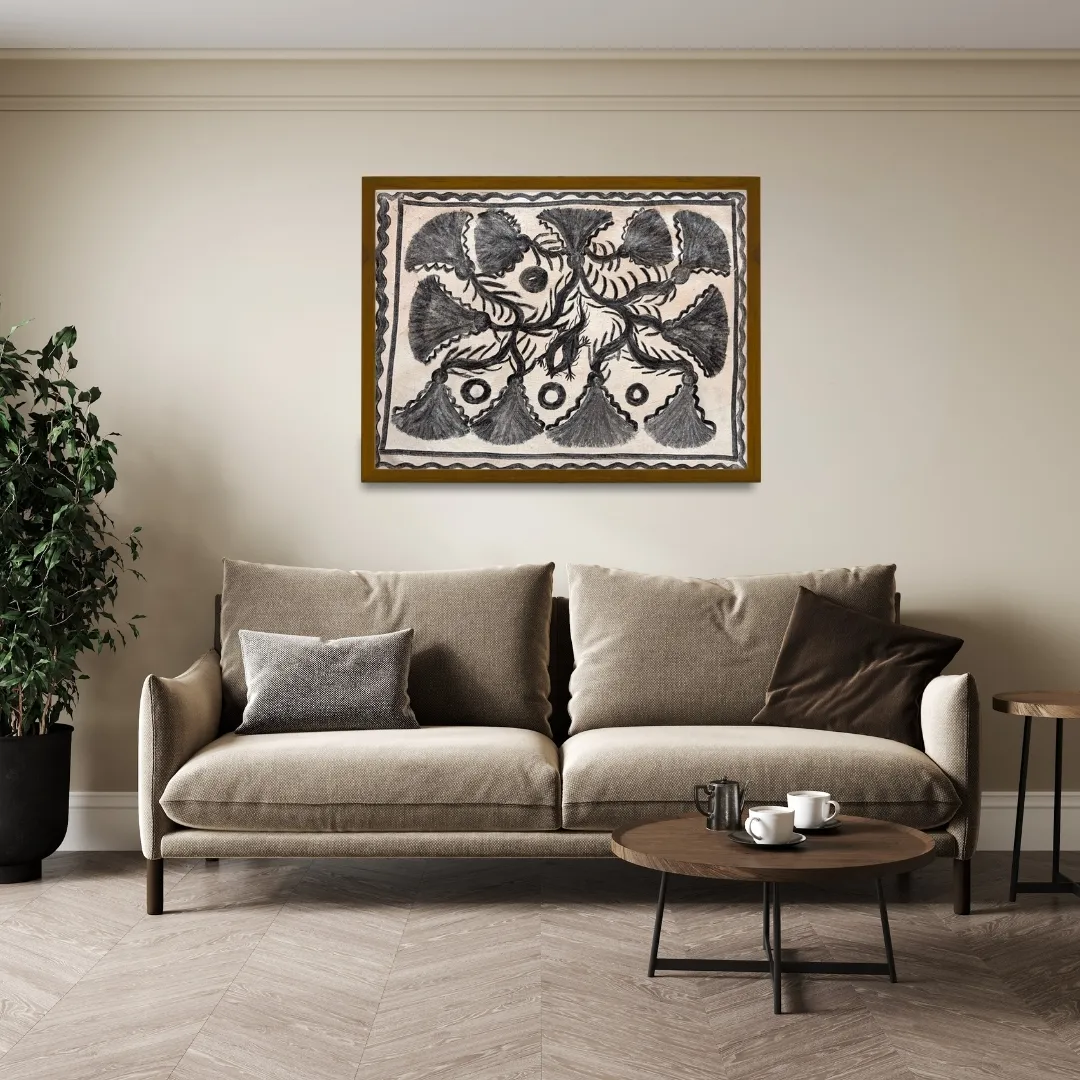
Papyrus Bloom in Still Water by Sugiya Devi is a 2009 Khovar painting that offers a rhythmic study of flora, where fan-like papyrus leaves circle a serene pond. Sugiya Devi’s monochromatic palette and precise strokes capture both motion and stillness—an ode to balance in nature. True to the Khovar style, the work reflects fertility and regeneration through its dense, repeating patterns. ### Why This Artwork Stands Out: ### - A masterful use of natural black pigment to create texture and rhythm. - Symbolizes abundance and cyclical renewal within the Khovar tradition. - Evokes quiet movement through a grounded visual harmony. - An excellent example of nature-inspired tribal abstraction. A fitting piece for those who value minimal, earth-toned tribal art with symbolic depth.

$ 829
Dance of Feathers and Fins by Anita Devi
Certified

Tribal Art

Dance of Feathers and Fins by Anita Devi

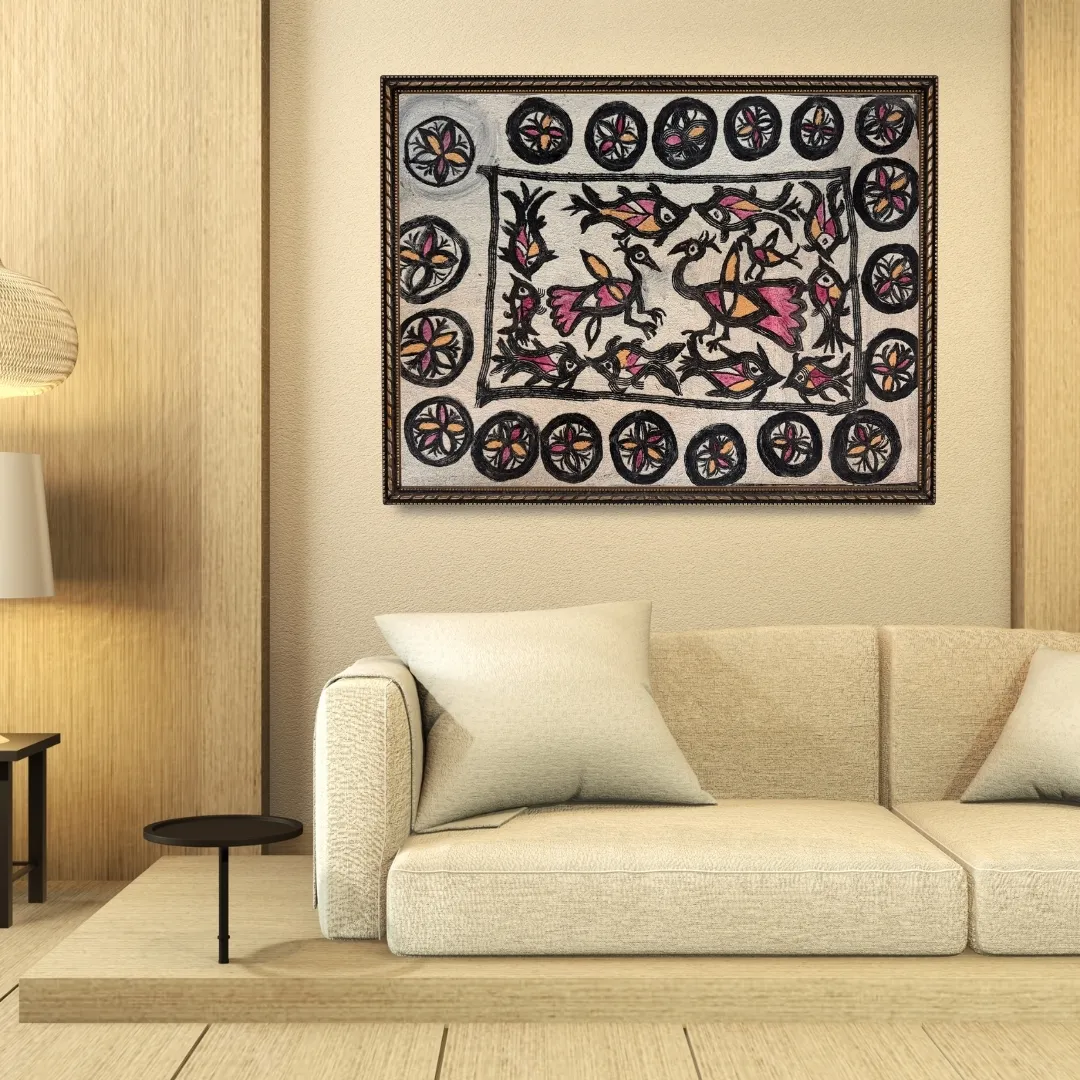
Dance of Feathers and Fins by Anita Devi is a 2014 Khovar painting, where Anita Devi composes a lyrical interplay of birds and fishes encircled by rhythmic wheel-flower motifs. The balanced geometry of the border frames the dynamic central scene, symbolizing coexistence and fertility, key elements in the Khovar tradition. The limited palette of black, pink, and ochre highlights the artist’s mastery of restraint while keeping the composition lively and full of movement.The scene is one of harmony, togetherness and community, that the Khovar tradition is all about. ### Why This Artwork Stands Out: ### - Beautifully merges avian and aquatic life in one flowing, circular rhythm. - The wheel-flower motif serves as both decoration and symbol of life’s cycles. - Evokes traditional marriage mural themes while maintaining contemporary minimalism. - Exemplifies the fine balance between discipline and spontaneity in tribal art. Collectors of folk symbolism, tribal geometry, and nature-inspired narratives will find this piece a captivating statement of cultural harmony.

$ 829
Shaadi Chowk I
Certified

Tribal Art

Shaadi Chowk I

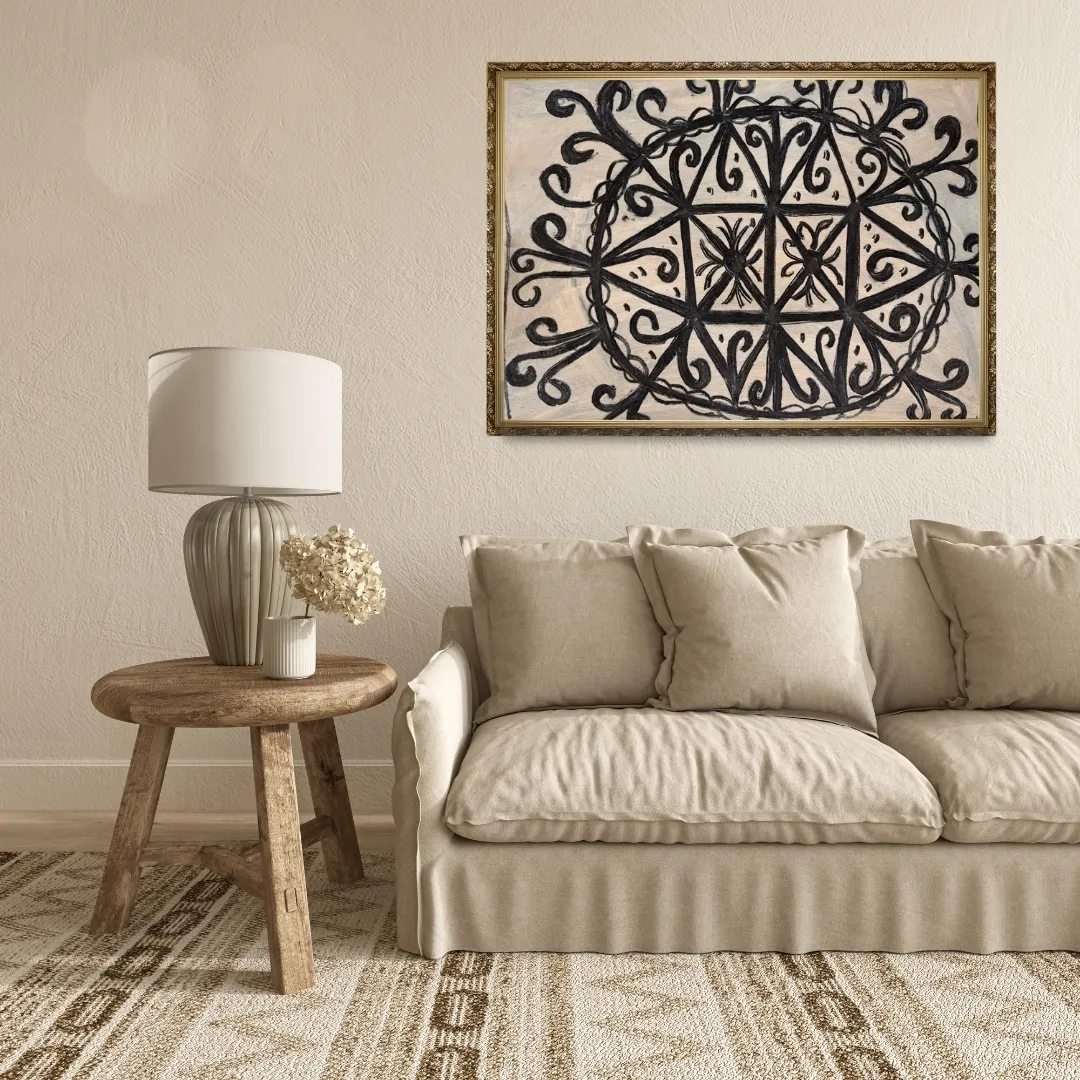
Shaadi Chowk I by Rudan Devi captures the sacred geometry and ritual symbolism central to Khovar art traditions. This work represents the ceremonial chowk, a sacred square or mandala-like design drawn during tribal weddings to bless the union of the couple. The painting’s concentric patterns, anchored by fluid floral and spiral motifs, symbolize fertility, protection, and the cyclical nature of life. Executed in deep black pigment on natural paper, the artwork radiates an aura of symmetry and devotion. The delicate balance of curves and intersecting lines reveals Rudan Devi’s intuitive understanding of spatial rhythm and cultural iconography. Each stroke embodies the spirit of ritual art, where every form carries meaning and purpose within the broader context of community life. ### Why This Artwork Stands Out: ### - A spiritual representation of the tribal marriage ritual space - Features symmetrical geometric and organic motifs rooted in Khovar symbolism - Crafted using natural pigments on handmade paper - A refined and meditative piece from the Justin Imam Collection

$ 829
The Circle of Life
Certified

Tribal Art

The Circle of Life

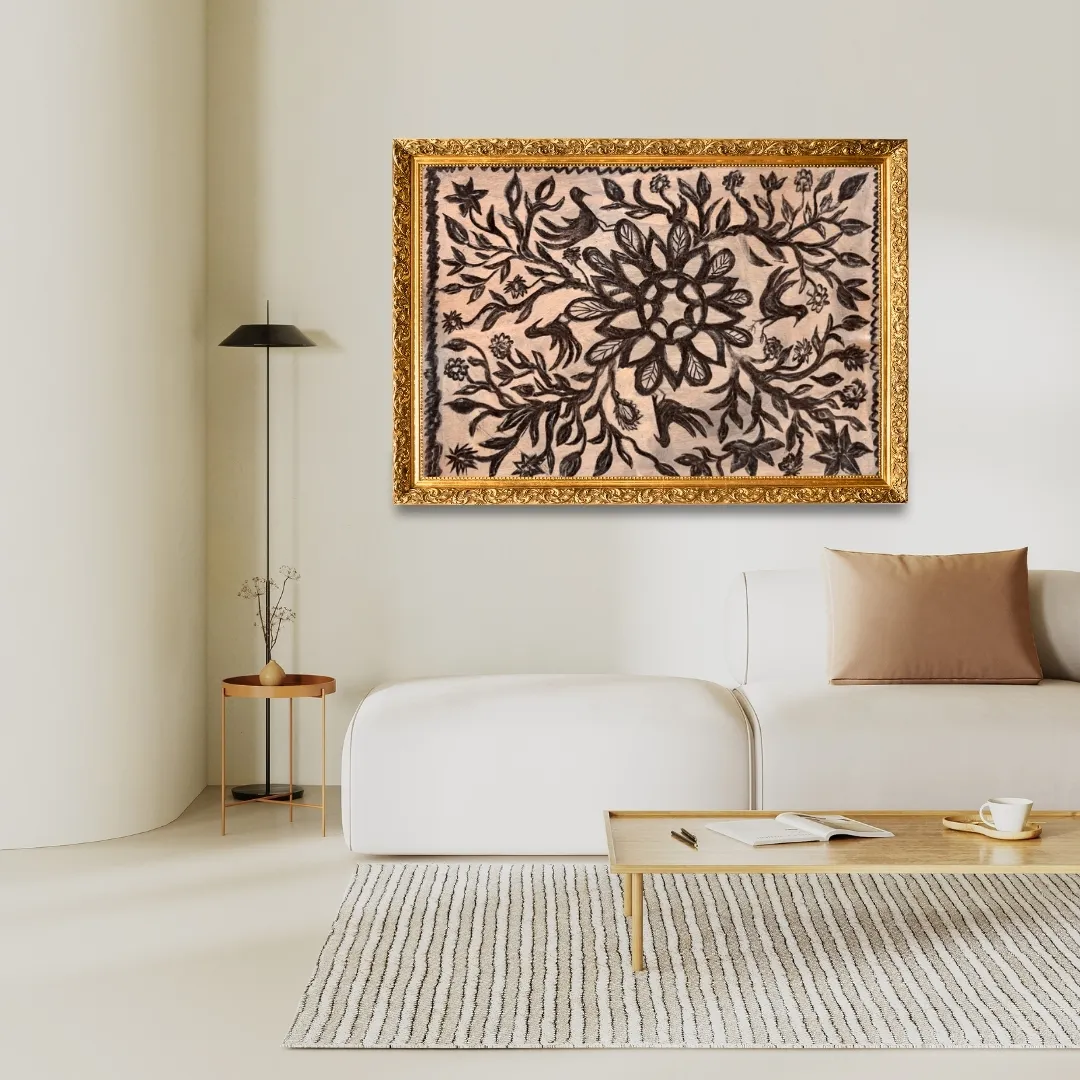
The Circle of Life by Yashoda Devi is a profound visual meditation on growth, harmony, and continuity. The artist reimagines the traditional Tree of Life motif into a circular floral composition, where every branch, bird, and leaf is part of an interconnected rhythm. The black monochrome palette, characteristic of Khovar murals, lends a timeless, sculptural quality to the design. The circular arrangement at the center represents the eternal cycle of existence, while the surrounding birds and plants symbolize vitality and regeneration. Through deliberate, flowing lines, Yashoda Devi brings together the natural and spiritual worlds in a seamless expression of balance. The artwork’s meditative composition invites quiet reflection on the beauty of life’s interconnected patterns. ### Why This Artwork Stands Out: ### - A refined interpretation of the Tree of Life motif in circular form - Created using natural earth pigments on handmade paper - Showcases Yashoda Devi’s rhythmic brushwork and symbolic depth - A contemplative and poetic piece from the Justin Imam Collection

$ 829
The Marriage Doli

Tribal Art

The Marriage Doli

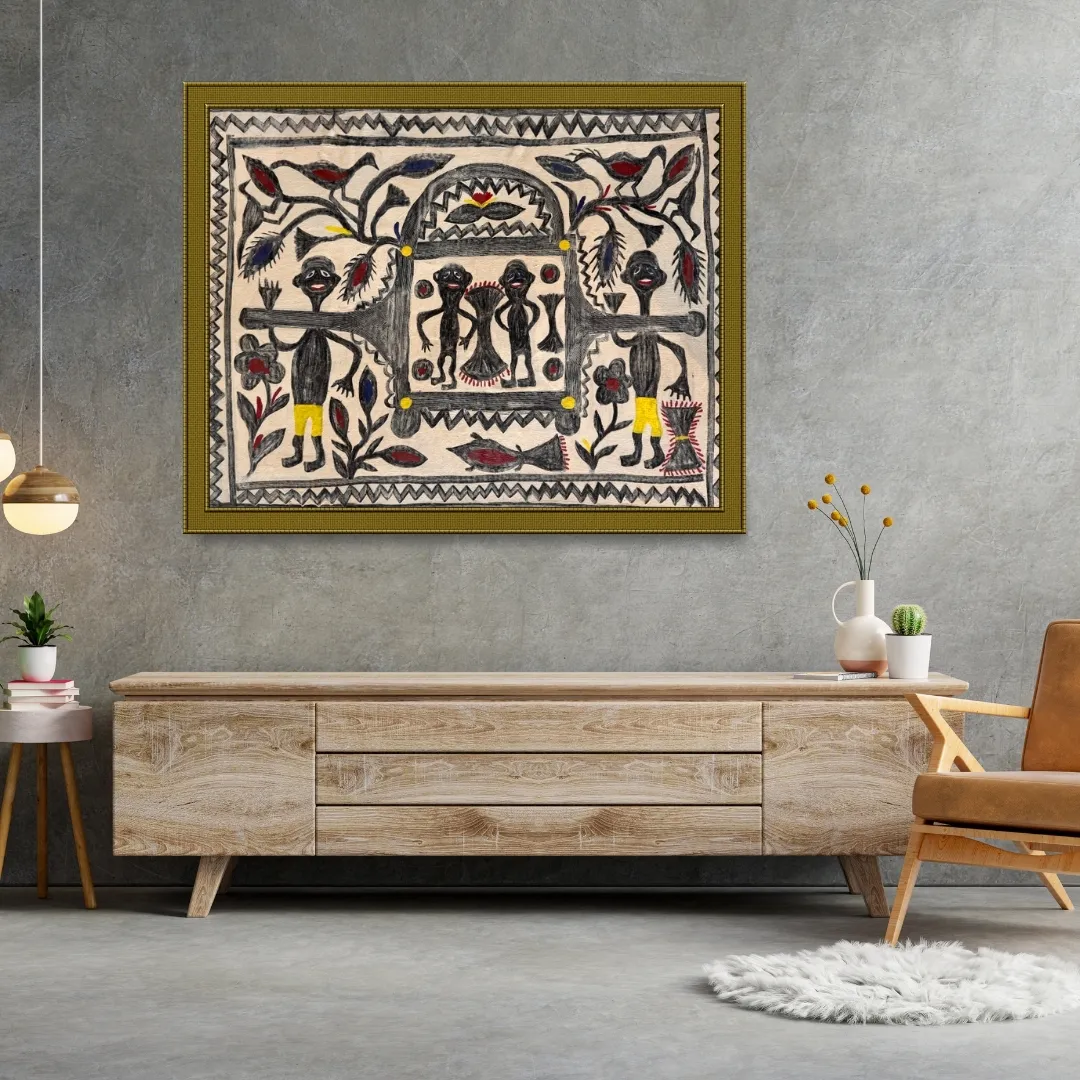
The Marriage Doli by Sugiya Devi captures the vibrant spirit of a traditional wedding procession through the distinctive vocabulary of Khovar art. The composition centers on a symbolic bridal doli (palanquin), surrounded by figures joyfully engaged in the celebration. Their animated gestures, framed by rhythmic floral and fish motifs, reflect the deep cultural connection between ritual, community, and nature. Rendered in earthy tones of black, red, and yellow, the painting exudes both movement and emotion. The artist’s linear precision and symbolic detailing bring to life the essence of festivity, fertility, and togetherness that define village celebrations. This piece stands as a lively visual record of indigenous marriage traditions, where art and ceremony are deeply intertwined. ### Why This Artwork Stands Out: - A vivid portrayal of traditional tribal marriage festivitie - Created using natural pigments on handmade paper - Reflects Sugiya Devi’s expressive storytelling through Khovar symbolism - A culturally rich piece from the Justin Imam Collection

$ 829