

The Keeper of the Scroll: Phad Artist Prakash Joshi Settles Everything the Internet Gets Wrong
Phad artist Prakash Joshi on the Joshi and Chhipa confusion, thanda karna, the first stroke, colour rules and whether Phad survives without the Bhopas.

Kartik Gaggar
Author
This piece is drawn from a long conversation Rooftop recorded with the National Award-winning Phad artist Prakash Joshi of Bhilwara, in Hindi. His answers have been translated and lightly edited for clarity. We went in with the contradictions the internet holds about Phad painting, on its age, its caste, its rituals, and asked him to settle them at length. He did.
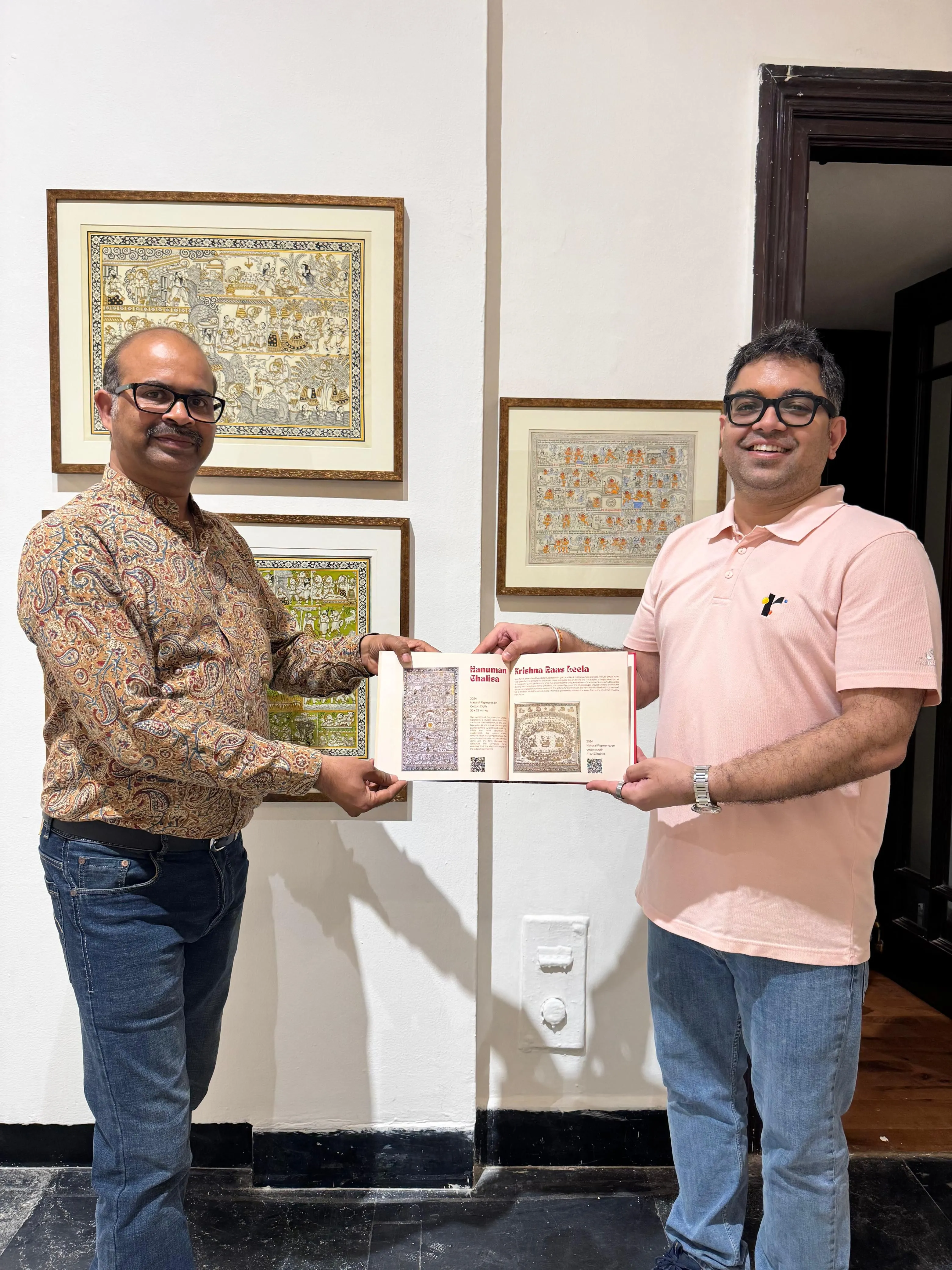
Rooftop's Founder Kartik Gaggar with Phad Artist Prakash Joshi ji
Read ten articles about Phad painting and you will come away with ten different facts. One says the painters are Chhipas, another says Joshis by divine grant. One says the art is seven hundred years old, another says a thousand, a third says the tenth century. The Bhopas who perform the scrolls are described as Rabari priest-singers in one place and as a Nayak community in another. Almost nothing online explains what happens after the sketch stage, and the rite of decommissioning a worn scroll barely exists on the record at all.
So we took the contradictions to the one kind of person who can actually resolve them, a hereditary keeper of the tradition. Prakash Joshi of Bhilwara began learning Phad at eleven from his father, the master Nand Kishor Joshi. He received the National Award in 2009, painted the first ever Phad of the modern folk deity Om Banna, and helped pioneer the miniature format that carried a thirty-foot mobile temple onto apartment walls. Over several hours he answered everything, patiently, precisely and at length, and what follows is the record.
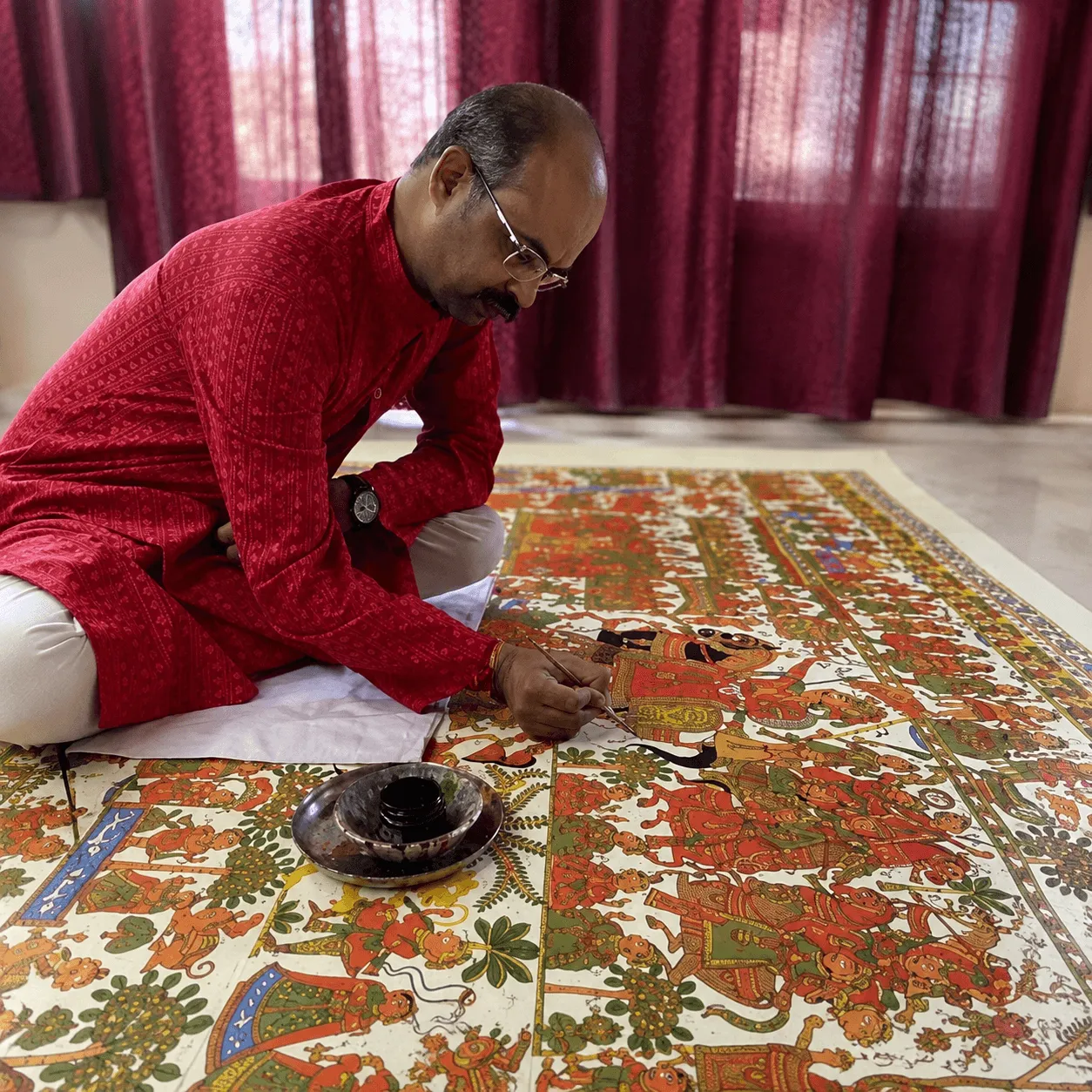
Prakash Joshi of Bhilwara, hereditary Phad painter and National Award winner, at work.
ROOFTOP: Sources contradict each other. Some say the Chhipa caste paints the phads, others say the Joshi community by divine grant. What is the actual relationship, and where does the confusion come from?
PRAKASH JOSHI: Chhipa is our jaati, our community, and Joshi is our surname within it. The two are not different things. The Chhipa are the samudaya who did block printing work, and within that community ours was a family that did the work of jyotish, of astrology, which is why we were called Joshi. Then Chochu Bhat, who was the bhat, the genealogist bard of Devnarayan, came to our family and asked us to make a phad of Devnarayan. Our family made it, and he was pleased, and he gave the blessing that from now on this Joshi family will do the work of the phad. So they are not two separate things. They are one. And we are called Chitere because we began to make chitras, to paint. The whole lineage is one community, one jaati. There is nothing separate in it.
There it is, the sentence that dissolves a decade of contradictory articles. The Chhipa are the community, the Joshis are a family line within it named for their old astrological work, and the phad commission came to that family through the blessing of Devnarayan's own bard. Every source that picked one word or the other was holding a piece of the same truth.
ROOFTOP: The age is stated everywhere as 700 years, 1,000 years, the 10th century, the 14th. What does your family's own history say?
PRAKASH JOSHI: The beginning of the phad is in the tenth century, at the time when Devnarayan Bhagwan was returning to his dham and taking samadhi. It is said that at the time of his going, the first phad was made, by the Joshi family, by the Chiteras. But in the tenth century only one or two phads were made. It was not an art in circulation. Then, as the believers grew and the Bhopas grew, each performing for their own livelihood, the vachan of the phad spread and it became popular. Those who say seven hundred years are counting from the time when books began to be written and the art was already in wide circulation. And there is a second reason. When the Mewar darbar asked for artists, some of our artists were sent to Shahpura, and Shahpura's history is counted from after Maharana Pratap, five or six hundred years. So each writer wrote according to the period he could see. Devnarayan's phad was the first. Pabuji's came later, and after that Ramdevji's, then Gogaji's, then Mataji's.
One origin, three honest dates
In the family's telling, the first Devnarayan phad was made in the tenth century at the deity's samadhi, the art entered wide circulation centuries later as the Bhopas multiplied, and the Shahpura workshop dates from the Mewar court's summons five to six hundred years ago. Every published age of Phad is a snapshot of one of these three moments.
His sequencing also quietly corrects the record on which epic came first, since most summaries lead with Pabuji. The broader documented history, from the Joshi migration to Shahpura and onward to Bhilwara, is traced in Rooftop's encyclopedia entry on Phad, and his account slots into it exactly, from the inside.
Who the Bhopas Actually Are
ROOFTOP: One source calls the Bhopas priest-singers of the Rabari tribe, another says they are a Nayak Scheduled Caste community, a third calls them a Bhopa tribe. Who actually commissions phads from your family?
PRAKASH JOSHI: First understand what a bhopa is. Bhopa means pujari, the one who performs the puja. In Rajasthan the pujari was called bhopa, the one in whom it is believed an ansh of the god arrives, a portion of the deity comes into him. That is why he is the bhopa of that sthan, that sacred place. There are bhopas of Pabuji, bhopas of Devnarayan, bhopas of Mataji. In Rajasthan the temple of a folk deity is called a devra, and its priest has his own names from place to place. Now, Rebari and Nayak, these are jan-jaatis, communities of the Jaisalmer and Barmer side, camel keepers and herders. They are among the followers. Pabuji's believers are the Rebari and Nayak people. Devnarayan's believers are the Gujjar community. So bhopa is the role, the priesthood, and Rebari, Nayak, Gujjar are the communities of the faithful. The confusion comes from mixing the role with the community.
It is the cleanest resolution imaginable. Bhopa is an office, not an ethnicity. Every source that assigned the Bhopas to a single community was describing one deity's following and mistaking it for the whole institution.
Giving the Painting Its Eyes
ROOFTOP: It is said that once the hero's eyes are painted, the phad stops being art and becomes a mobile temple. Describe painting the eyes. Is there a ritual? Do you feel it?
PRAKASH JOSHI: To paint the eye means to give life to the image. While we paint this great scroll, we sit on it, we work on top of it. Sometimes something falls on it, sometimes the hands are ashuddh, unclean from the body, and all of that touches it. The murtikar also sits on his murti while he carves it, his hammer and chisel strike it, and there is pain in that, but his bhav is that he is making a murti. It is the same for us. When the painting is complete, when the whole kalakriti is done, then one thing remains. We must give it life. So the very last thing we paint is the eye of Devnarayan or of Pabuji, the black pupil, the eyeball itself. And from that moment we do not sit on the chitra, we do not place it anywhere improper. For us it has become devtulya, godlike, a mandir. And it is called a walking, moving temple, a chalta firta mandir, because the story is inside it. The believers can see the whole life and leela of Devnarayan or Pabuji before them. That is why the whole thing is considered a temple.
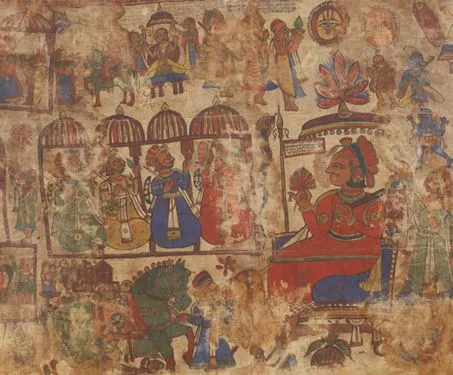
Devnarayan ki Phad
Thanda Karna: How a Temple Is Laid to Rest
ROOFTOP: Almost nothing exists online about thanda karna, the decommissioning of a worn phad. Have you done it? What are the exact steps, and what happens to the cloth?
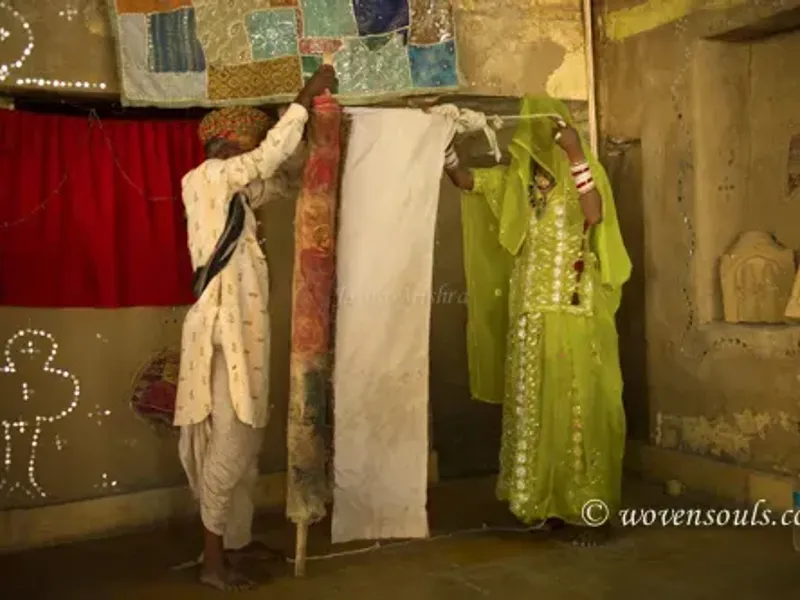
PRAKASH JOSHI: Thanda karna, to make it cool, means its visarjan, its immersion. Understand how a phad lives. It works like a backdrop, and in the old days there were no lights, so the bhopi, the bhopa's wife, carried a deepak, a lamp, to the very panel her husband was singing, to show the people, this is the picture. So many times the flame touches the cloth, or a gust of wind moves it, and it burns a little. The cloth is handwoven cotton, and over long years it fades, it tears, it rots. In our Sanatan culture, when any object of worship becomes khandit, damaged, we do not keep it fit for puja. We say it must be immersed, and immersed at a place of significance, flowing water, a river. In our Rajasthan the sarovar of Pushkar is held in that honour. So the bhopa himself takes the phad there, whether it is Pabuji's or Devnarayan's or Ramdevji's, and it is immersed. Many times a pandit is called for the mantra uchcharan. This rasm is observed for all the phads. And once it is made thandi, that cloth, that chitra, will never be worshipped again.
A complete liturgy, delivered in one breath. The lamp that consecrates the performance is the same lamp that slowly wounds the scroll, the wound eventually renders the temple khandit, and the temple then goes to Pushkar to be cooled, escorted by its own priest, sometimes with a pandit's mantras, and retired forever. The life cycle of a phad is not a metaphor. It is administered.
The First Stroke, and Who May Make It
ROOFTOP: One account says a virgin girl of the painter's family, or of a higher caste, paints the first stroke after offerings to Saraswati. Is that still practised? And do you agree with the higher caste framing?
PRAKASH JOSHI: Before beginning, the vandana of Ganesh ji and Saraswati is done, because Saraswati is the swaroop of vidya, of learning, and we ask that the painting be completed nirvighna, without obstruction. The first stroke is made by a kanya, a girl of tender age, under ten years, before her first period has come. She is considered devi-tulya, like the goddess, completely shuddh, the same way we do kanya bhoj in Navratri. We do her tilak, we feed her sweets, and if sweets are not available then gud, jaggery, and some dakshina is given to the child. She makes the first stroke in the kachcha colour, and the moment that stroke is made, the main artist or the senior begins the rekhankan, the drawing. Now, about higher caste. I have never heard that anywhere. There is no such requirement. We are Joshis, we come under OBC, and the kanyas were of our own house. It was from our own daughters that we had the first strokes made. Perhaps some writer added that from somewhere. We give importance to no caste and no sampradaya in this. We keep only this much, that she is a kanya, under ten years, and shuddh. That much we observe, and the parampara is kept.
Notice what he did there. He confirmed the ritual in loving detail, explained its logic through the Navratri parallel, and then flatly retired the higher caste claim as something a writer invented, using his own family's OBC status and its own daughters as the proof. This is exactly why primary sources matter. The ritual is real. The caste clause was never part of it.
Kachi Likhai and the Ladder of Colours
ROOFTOP: The sketch stage, kachi likhai, is named everywhere, but no source explains what follows it. Give us the full sequence, in your terms, start to finish.
PRAKASH JOSHI: Kachi likhai means exactly that it is not final. The kachcha colour is taken from the flowers of the palash tree, made thin like water, and drawn light, only so the artist knows which scene sits where. After that, the colours go light to dark. First orange, which goes into the body, the limbs of humans and of animals. Then yellow, for the borders and for the ornaments, the jewellery, because gold is yellowish and shining, and in the old phads no real gold or golden colour was used, so wherever the gota or the kinari or the earrings and bangles are, we show them in yellow. Then green, which shows prakriti, nature, the trees, and goes into clothing. Then the gerua, the brown, which shows the buildings, the architecture, and goes into horses and cows. Then red. Red is the royal colour, the colour of the highest seat, and it goes to the main kings, into the dress of Devnarayan and of Pabuji, and into borders, clothes and animals. Then the asmani, the blue, for water, for clouds, and for the rakshasas, the demons. And last of all comes black, for the eyeballs, for the black horses, and for the final outlining that completes the whole phad.
ROOFTOP: And the colour rules are fixed? You could not paint Pabuji's mare in brown?
PRAKASH JOSHI: The colours are fixed to their subjects, and if you use them elsewhere, the authentic part of that chitra is finished. Pabuji must be made in the deity's red, and his mare, the Kesar Kali, must be black. Devnarayan's dress must be red and his mare must be in her own colour, the Lilan. You cannot make her black or brown or orange. And nature guides the logic. Our skin is brownish, orangish, so the body is orange, light to dark. Gold is yellow, so ornaments are yellow. Trees are green. The buildings were of earth, so architecture takes the gerua. The sky and water are blue. The rules come from the world, and then they become the rules.
Minerals, Gum, and Who Grinds the Colours
ROOFTOP: Sources say the colours were always made by women while men prepped and painted. Is that still true in your household? And what were the original sources of the colours themselves?
PRAKASH JOSHI: In the early time, yes, the wife of the artist and the women of the household made the colours, because the colours were made from stones, and the grinding, the pounding, was work they took up in the spirit of sahyog, of cooperation, while the Joshi was doing the kachi likhai. But it was never fixed that only women will make colour and only men will paint. It is a bhavna of helping each other. Even today, if there is extra work, I sit with the women and help grind the colours. In this age men make colours and paint, and women paint and make colours, both together, to carry the parampara forward. As for the sources, as far back as I have seen and heard from my forefathers, vegetable colours were never used in Phad. Rajasthan is rich in minerals, and the colours of the mineral stones are what we use. The medium from the beginning has been the gum of trees, the kheriya gond, and other gums are also taken. And no synthetic colours were used in the old days at all.
Two myths tidied in one answer. The gendered division of labour was real but was courtesy, not law, and it is dissolving in both directions with his blessing. And the vegetable colour claim that decorates half the articles online is, in his family's memory, simply wrong. Phad is a mineral art, ground stone bound in tree gum, on cotton stiffened with starch and burnished with stone.
For anyone who wants the visual grammar of all this in their own hands, the shapes, the colour ladder, the border logic, Rooftop's Artventures of Phad Essentials book breaks the tradition into step-by-step practice drawn from master artists of the form.
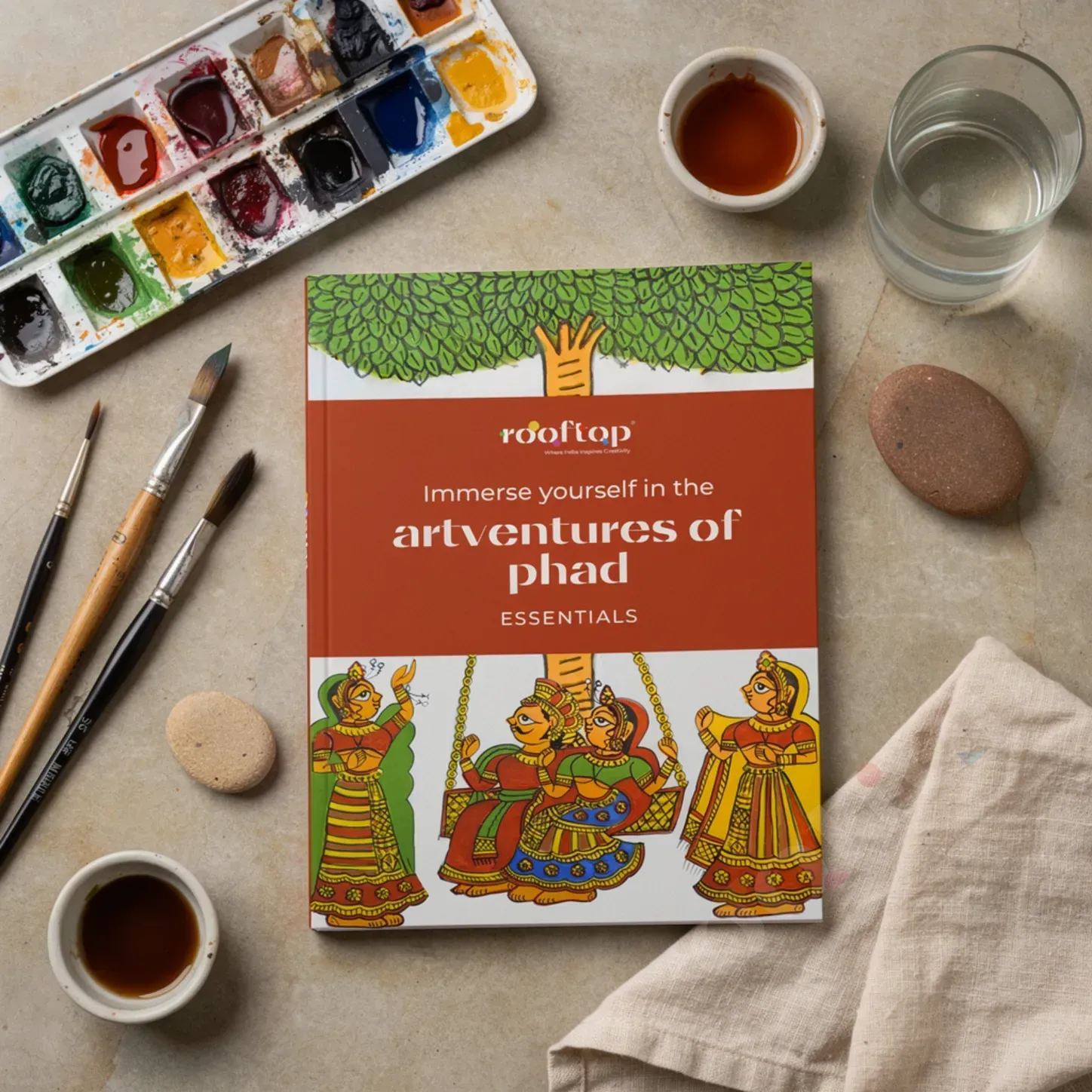
Artventures of Phad Essentials, a step-by-step learning book on the Phad style. View on Rooftop
Side Faces, the Epic Map, and the Moving Lamp
ROOFTOP: Why do phad figures face each other and never the viewer? And what decides which direction the bhopa moves across the scroll?
PRAKASH JOSHI: The phad is a story shown in pictures, like a moving picture, a chal chitra. The figures are not speaking to the one who watches. They are speaking to each other. If Kelam speaks to her companion, her face turns to her companion, and the companion's face turns to Kelam. In battle the armies face each other, so the faces are side faces. But it is not true that there is never a front face. The rakshasas, the demons, are always made front-faced, with both eyes showing. And in Devnarayan's phad there is the wife of Sawai Bhoj, who is told as the swaroop of Kali, who comes for the destruction, and when she shows her full form, seated, wearing the mala of the twenty-four brothers, she is shown front-faced. The terrible and the fully revealed face you. The story faces itself.
ROOFTOP: And the staff, the lamp, the movement?
PRAKASH JOSHI: The vachan begins with the stuti of Ganesh ji and Saraswati, and the bhopi shows that panel first. After that, understand the phad as a naksha, a map, where the different cities and villages that Pabuji or Devnarayan travelled to are depicted in their places. As the story moves, the bhopa and bhopi move with it, sometimes left to right, sometimes right to left, and sometimes back again, because Pabuji goes out to one side and returns. Nothing is fixed, not where the bhopa stands, not where the bhopi stands. They follow the story across the map, and the lamp shows the audience which picture is speaking now.
Temple or Decoration: What Makes a Phad Ritually Valid
ROOFTOP: You now sell phads as art. When is a phad a living temple, and when does it stay a painting?
PRAKASH JOSHI: The phad and the chitra are two different words. The traditional phad is made for the Bhopas, or for museums where our parampara is shown. When a bhopa comes, we make his phad at an absolutely nominal price, because he takes it for his livelihood and he comes from a very poor community. In our heart it is a form of charity. The chitra is what we make for the art collector, for the art lover who has less wall and less space, small compositions from the kathas of Pabuji and Devnarayan. And many times the buyers say, let there be no war scenes in our painting, no fighting, no rakshasa, no snake. So for them we compose only the happy moments, Pabuji's wedding, the scenes of Kelam swinging on the jhoola. And whether it is worshipped depends on the subject. We have made the Ramayana in phad, the Hanuman Chalisa, the Durga Saptashati, the Ganesh katha, and people install these in their mandir and do their puja, exactly as Pabuji and Devnarayan were worshipped. The size became small and the story changed, but the devotion of the one who keeps it is not different. And if the chitra shows only a procession or a wedding or a dance, then obviously it is not worshipped. Then it is a subject of shobha, of decoration for a wall.
Shrinking a Temple, Painting a Motorcycle God
ROOFTOP: You introduced the miniature form. What did shrinking a thirty-foot mobile temple do to its meaning?
PRAKASH JOSHI: A phad is five feet high and thirty or forty feet long, and it needs a space that only a museum, a hall, an auditorium or an airport can give. To save this art, to give it new life, it had to reach the people who love art, and when I took the big panels to the market they said, sir, we do not have the space. Now, phad means a picture founded on a story, and I was not willing to tamper with the story. So I kept the stories whole and made the figures small. The figures that were five inches, eight inches, I began to make in one inch, two inches, so the entire katha still reaches the person, and they can give the phad a place on the wall of their own home. The story lost nothing. Only the figures bowed their heads a little to fit through the door.
ROOFTOP: And Om Banna, a modern legend, a motorcycle shrine, in this sacred form. Did traditionalists object?
PRAKASH JOSHI: My new experiments and my paintings on modern stories are my padaav, my contribution, and for them I was given the National Award in 2009. With time you must also change. Not everyone everywhere knows Pabuji and Devnarayan. Our shaili, our style, the big round faces, the large eyes, the small noses, in that I changed nothing. Only the subjects are new, and even those are ones the people know and hold. Om Banna is of the Marwar side, a folk deity of the people there. His believers brought me his authentic story, and I put exactly that story into the chitra, without any tampering. And no one can interfere in this, nor should they, because this is the freedom of the artist, and it is also our oldest tradition. First Devnarayan's phad was made. Then the believers of Pabuji came, and Pabuji's was made. Then Gogaji's, then Ramdevji's. Whoever brings the story of their devta, we paint it. Om Banna simply stood in a very old queue.
Devnarayan and Pabuji: Two Gods, Two Grammars
ROOFTOP: Devnarayan's phad runs about thirty feet, Pabuji's about fifteen. Beyond size, what actually changes between the two?
PRAKASH JOSHI: They are both lok devtas, folk gods of Rajasthan, but their stories are different and their believers are different. Devnarayan's believers are the Gujjar community, Pabuji's are the Rebari and Nayak. The sizes are counted in haath, and one haath is a foot and a half. Pabuji's story is shorter, so his phad is ten or twelve haath, fifteen to eighteen feet. Devnarayan's is made at eighteen haath and even at twenty-four, because his katha must include the vritant of his ancestors, the twenty-four Bagdavats, and his father Sawai Bhoj. When the first phad was made, Chochu Bhat sang the entire vanshavali to our ancestors, and they depicted all of it. Later, people understood that not everything need be told every time, and the phads became shorter. For pehchan, for identification, each god has his own mount and his own sign. Devnarayan's mare is the Lilan, and before him is the serpent, black. Pabuji's mare is the Kesar Kali, black, and before him is the bhala, the spear. Four samants, four chiefs, sit in Pabuji's court and four in Devnarayan's. Change none of it, and anyone who knows can read at a glance whose temple has been unrolled.
The Secret That Ended, and the Dependence That Reversed
ROOFTOP: Your family opened the art to outsiders in 1960, breaking the rule that techniques stayed inside the community. Was that resented? And what happens to Phad if the Bhopas stop performing entirely?
PRAKASH JOSHI: Understand why the secrecy existed. In the old days the Bhopas were few and the vachan happened only when someone needed it, and one phad was enough for one bhopa for his whole lifetime. So the orders were few, and the fear was simple. If this art goes from our family to another family, our means of living goes with it. That is why it was not taught outside. But when the phad itself was changed, when the small pieces began to go to the market and the admirers of the art grew, that fear ended by itself. You were no longer dependent only on the Bhopas. New buyers came, new subjects came, a whole new platform opened. And now, if you ask what happens if the Bhopas stop, I will tell you plainly. If this had happened thirty years ago, it would certainly have fallen on the Joshi families. Today the parts have changed completely. The Bhopas depend on the chitrakars, because only if we make the chitra can they perform. But the Joshis, the Chiteras, no longer depend on them. Corporate gifting orders come to us. Wall painting work comes. The new designers put our shaili on the clothes people wear. I have painted a Switzerland and India collaboration. Our kshetra has grown so large that however much we work, it is less. So if the Bhopas stop, the effect will not fall on the painters. But if the painters stop making phads, the effect will certainly fall on the Bhopas.
ROOFTOP: Do working Bhopas still commission from you? When was the last?
PRAKASH JOSHI: You will not believe it, but even today, in our workshop, at least two traditional phads are made every single month, the big ones, the real ones, and it is continuous. The Bhopas get good performance programmes now. They go to their own communities, and our Indian government and the Rajasthan government promote them, send them abroad even. Yes, there are some who could not learn the tradition fully, who are incomplete, and for them the instrument remains and a couple of songs remain, and they sing for their living. But the phad itself is being made, month after month.
Two traditional phads a month, still
Against every obituary written for the tradition, Prakash Joshi's workshop continues to produce at least two full traditional phads every month for working Bhopas and museums, alongside the miniatures, corporate commissions and design collaborations that now sustain the painters independently.
Five Nights, and the Vow That Keeps It Alive
ROOFTOP: The full Pabuji epic takes five nights of dusk-till-dawn performance. Have you ever seen a complete reading of a phad you painted?
PRAKASH JOSHI: The vachan happens only at night, and how long it runs depends on the bhopa and on the host, on how many days their programme is. The believers are on the Jodhpur and Jaisalmer side, and staying there that long is difficult. When we arrange performances at the museums, the new audiences do not have five nights to give, and the organisers call the bhopa for a single day. So no, the chance has never come to me to see the full vachan across five nights, and honestly I do not think it will be possible now. And there is another distance. Their gayaki, their language, is the deep dehati boli of inner Rajasthan, which only their own communities truly follow. We are captivated by the singing, the dance, the playing of the instrument, and the lyrics run ahead of us. We understand what we can.
ROOFTOP: And are Bhopas still called during sickness and misfortune, as the tradition holds?
PRAKASH JOSHI: In our Bharat and our Rajasthan, the cultures and the beliefs can thin a little with time, but for them to end is not possible. Where there is vishvas, faith, and aastha standing on that faith, I do not believe it can be finished. Even today, if a bhopa is performing a vachan somewhere, the reason is this. A follower of Pabuji was in sorrow, and his sorrow did not rise above his faith. He prayed, if this trouble of mine passes, I will have your phad read. And when the trouble passes, the vachan is held. And they call the Bhopas in the sorrow itself too, so that the god may be praised and the trouble be prayed away. This is why the vachan continues, unbroken and as it was. The belief is not decreasing. If anything, the way the Bhopas keep coming to us for phads, it is growing.
The Record, Corrected
Count what this one conversation settled. The Joshi and Chhipa question, resolved as one community and one blessing. The age of Phad, resolved as three honest dates telescoped by careless retelling. The Bhopas, resolved as an office of priesthood rather than a single caste. The consecrating pupil, the cooling of a worn temple at Pushkar, the under-ten kanya whose first stroke opens every scroll, the full ladder of colours from palash wash to black outline, the mineral palette that was never vegetable, the front faces reserved for demons and the fully revealed goddess, and the quiet inversion by which the singers now depend on the painters. Almost none of it existed on the record before he said it.
This conversation is part of Rooftop's series of sittings with the hereditary masters of Indian folk art, keeping their knowledge on the record in their own words. If the tradition itself calls to you, the courses taught by master traditional artists on Rooftop are where these lineages now teach directly, which, as Prakash Joshi's family proved in 1960, is exactly how a closely guarded art outlives its own secrecy.