

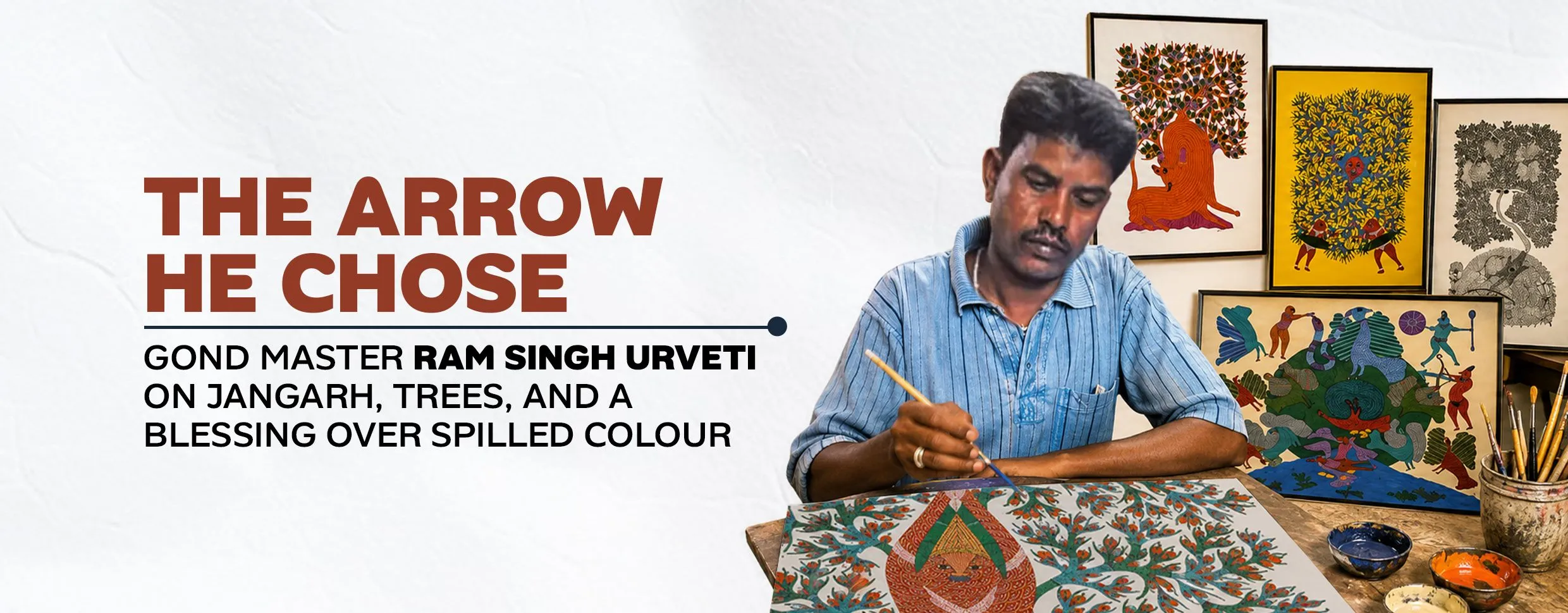
The Arrow He Chose: Gond Master Ram Singh Urveti on Jangarh, Trees, and a Blessing Over Spilled Colour
Gond master Ram Singh Urveti on his five years with Jangarh Singh Shyam, the blessing over spilled colour, why he chose the arrowhead, and the trees he refuses to leave out.

Kartik Gaggar
Author
This piece is drawn from a conversation Rooftop recorded with the Gond artist Ram Singh Urveti in Bhopal, in Hindi. His answers have been translated and lightly edited for clarity. He speaks here about the years he lived with Jangarh Singh Shyam, the moment his own signature was forced into being, and the songs he still hears while he paints.
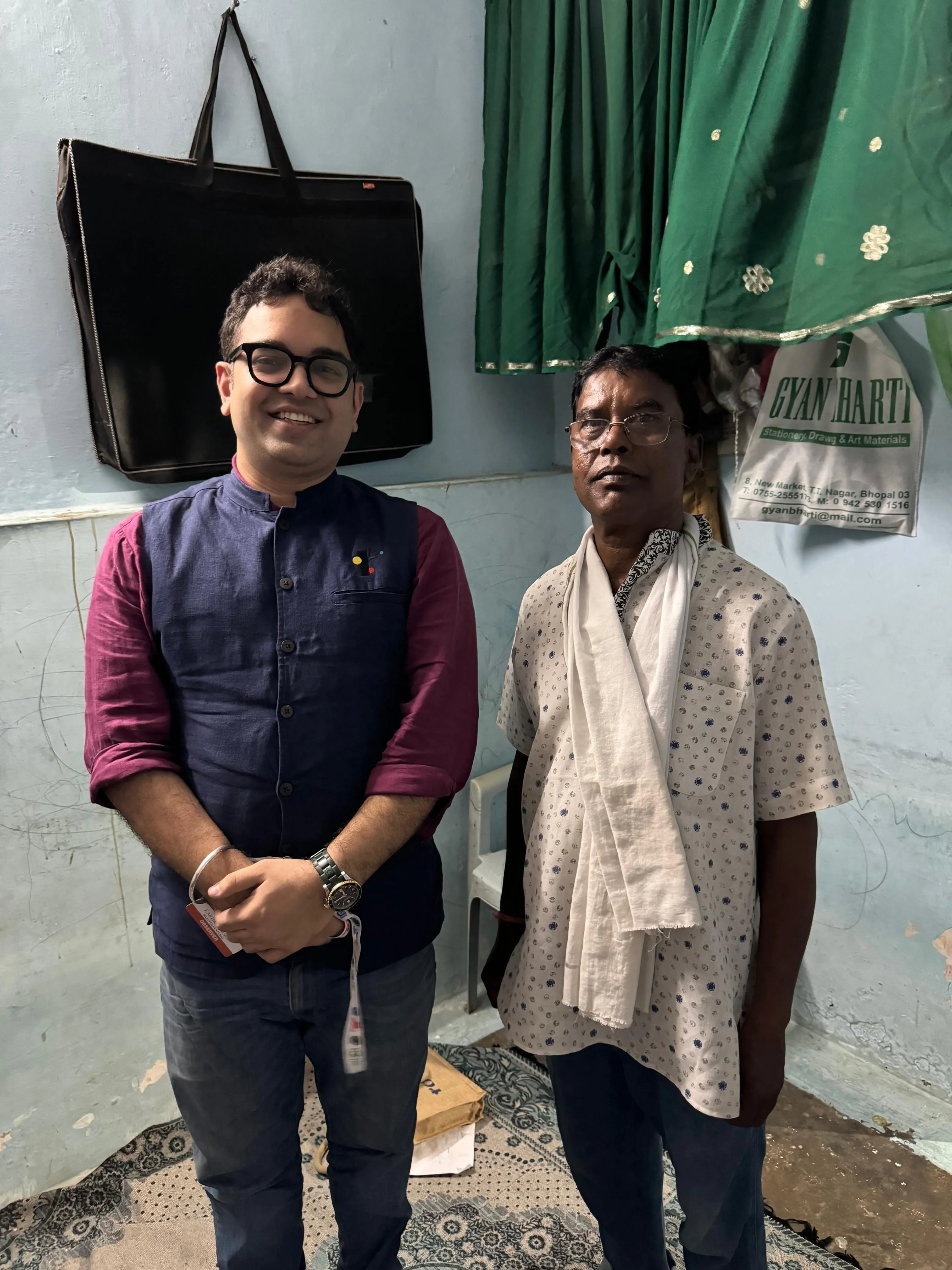
Rooftop's Founder Kartik Gaggar with Ram Singh Urveti ji
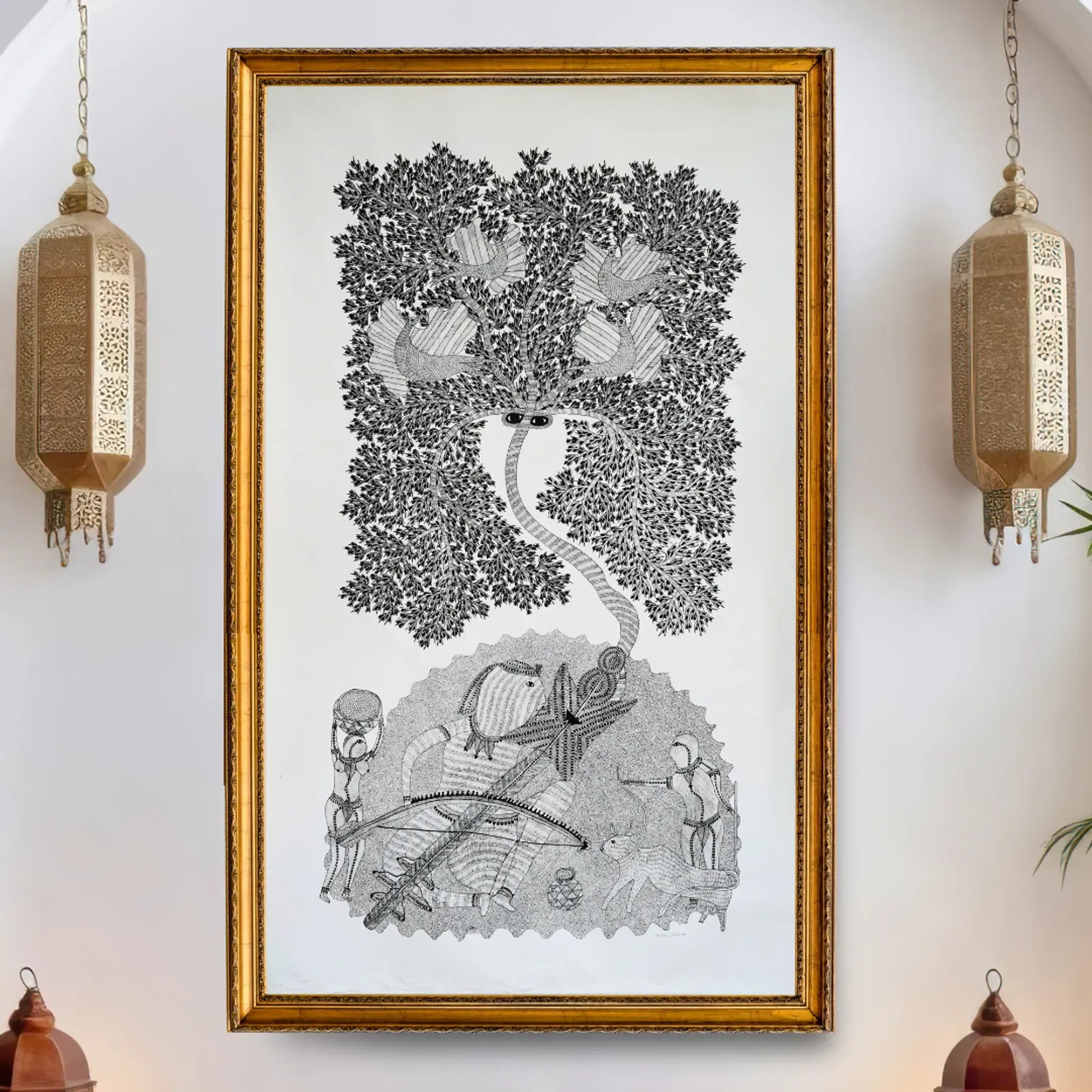
Look closely at a Ram Singh Urveti painting and you will find that the surfaces are not filled with dots. Where most Gond artists lay down bindis or rice-grain strokes to give a body its texture, his forms are packed with tiny arrowheads, thousands of them, marching across a buffalo's flank or the trunk of a tree. Museums describe it as his formal signature. Collectors recognise a canvas by it from across a room. Almost nobody knows that the arrow arrived because two other artists would not let him work.
Urveti is among the senior most painters of the Gond Pradhan community, born in Patangarh in Madhya Pradesh, with no formal training in art, whose works now sit in museum and private collections around the world. He co-authored The Night Life of Trees with Bhajju Shyam and Durga Bai, a book that won the Bologna Ragazzi award, and wrote I Saw a Peacock with a Fiery Tail. His murals are on the walls of the Indira Gandhi Rashtriya Manav Sangrahalaya in Bhopal, where he also worked for years. What follows is his own account of how all of it began, told in the order the years happened.
1992: Arriving in Bhopal
ROOFTOP: You and Satrupa ji came to Bhopal in 1992 and lived with Jangarh ji for close to five years. What do you remember of those first days?
RAM SINGH URVETI: The days before that passed in great difficulty. We did not get work every day. If you worked one day, you had to sit idle for two. That is how it went, continuously. Seeing this condition, my mama, the late Jangarh Singh Shyam, said that in Bhopal work would come without a break, and he brought me here. He put me to work in the forest department, planting saplings. I worked there from eight in the morning until six in the evening, and in the evening I would give a hand to mama ji in his work. That was my routine, day after day, and slowly, working alongside him like that, I stayed. I am still living in Bhopal, exactly as he told me to.
It is worth pausing on the shape of that day. Ten hours planting trees for the forest department, then a second shift at night as an assistant to the man who had just invented a school of Indian painting. He does not present this as a hardship story. He presents it as the arrangement that made everything else possible, and there is something quietly fitting about a painter now known for his trees having spent his first Bhopal years putting real ones into the ground.
Understand what household he had walked into. Jangarh Singh Shyam had been found in Patangarh a decade earlier by the painter and poet Jagdish Swaminathan, brought to Bhopal, and had gone on to paint the dome of Bharat Bhavan and the interiors of the Madhya Pradesh Vidhan Bhavan. By 1989 his work had travelled to Paris. He had taken a wall practice made with mud, cow dung and natural colour and moved it onto paper and canvas, creating what the art world now calls Jangarh Kalam, and in doing so he had opened a door that an entire generation of Patangarh painters would walk through. Ram Singh Urveti walked through it carrying a spade.
1993: A Blessing Over Spilled Colour
ROOFTOP: There is a story about the first time colour spread across your canvas, and what Jangarh ji's mother said to you. Can you tell it?
RAM SINGH URVETI: It is completely true. Jangarh ji gave me a canvas to do my own work. I began my first painting on it, and I was making a picture of Bada Dev. Just as I started to make the head, the colour began to run from my brush. Mata ji was sitting right there. She saw it, and she gave me a blessing. She said, the way the colour is spreading from your brush, in the same way your name will spread across this world.
ROOFTOP: Did that blessing come true?
RAM SINGH URVETI: Today it is proving true for me. A blessing from your elders is the biggest thing there is for us, and it is by their grace that this happened. When we first came to Bhopal we were new, and there was great hesitation in us. Now the work travels alone to every city in the country, and people abroad keep these works in their collections too. So it is a matter of great fortune for me that, exactly as mata ji said, my name still moves through the country and the world.
The detail that makes this story land is what he was painting when it happened. Bada Dev is the great deity of the Gond, and the young man ruining his first canvas was ruining an image of his own god. What could have been read as a bad omen was turned, by an older woman sitting in the same room, into a prophecy. The record shows how quickly it began to come true. Within a few years he received a mention at the Lalit Kala Akademi's 41st National Exhibition in 1998, the same year he was given the South Central Zone Cultural Centre Award for tribal art, and in 2001 the Kalidas Samman.
A ruined first canvas, then a national mention
Ram Singh Urveti had no formal training in art. His first canvas, a painting of Bada Dev, was spoiled by colour running from the brush. By 1998 his work carried a mention at the Lalit Kala Akademi's 41st National Exhibition and a South Central Zone Cultural Centre Award, and by 2001 the Kalidas Samman.
1996: Two Days He Was Not Allowed to Paint
The next answer is the one that changes how you look at his paintings forever, and he told it without any sense that he was handing over the origin of his own signature. To place it properly, Bharat Bhavan in Bhopal is among the most significant institutions of tribal and contemporary art in India, the place Swaminathan built around the conviction that Adivasi artists belonged in the same rooms as urban modernists. An invitation to work there was not a small commission. It was arrival.
ROOFTOP: Other artists fill their forms with dots or rice grains. You chose the arrowhead. How did that identity come about?
RAM SINGH URVETI: Every one of my fellow artists works by taking some symbol of their own community to build their identity with. Jangarh Singh Shyam worked with the bindi, the dot. In the same way, I work with the arrow of the Adivasis. There is a moment behind this. In 1996 there was a print exhibition at Bharat Bhavan, and it was the first time an institution invited me to make paintings. The late Jangarh Singh Shyam was there, and the late Durgabai was there. The three of us were from the same community. I started to work, and as I worked they kept stopping me. For two continuous days they did not let me work.
ROOFTOP: What did you understand from that?
RAM SINGH URVETI: I thought, they are saying this so that I make my own identity. So what should I make my identity from? Then it came into my mind that our community once lived in the forest and hunted with the bow and arrow to make a living. So why should I not use this in my painting? That is how the mark of the arrow came into my work, and it has been there ever since. Today it has become my identity in the country and in the world. People recognise it and say, the bow and arrow, that is Ram Singh Urveti's work.
Read that again, because it describes a kind of teaching that has almost no equivalent in a formal art education. Two senior artists blocked a younger one from working, for two days, at his first institutional commission. They did not explain themselves. They did not offer an alternative. They simply refused to let him proceed until he arrived, alone, at the thing that would separate his hand from theirs. He did not resent it then and he does not resent it now. He treats it as the moment he was given his own name.
There is also a deeper logic in what he reached for. He did not invent a decorative motif. He went back into the history of his own people, to the bow and arrow the Gond carried when they lived by hunting in the forest, and he brought that into the surface of the paint. His fill pattern is not a texture. It is a memory of how his community once ate.
Nowhere is that origin more literal than in In the midst of Hunting Birds, where the bow itself is drawn into the scene. Hunters stand at the edges with arrows raised while birds and animals climb a green rise above blue water, so the weapon that became his fill pattern appears in the painting as subject and as surface at once.
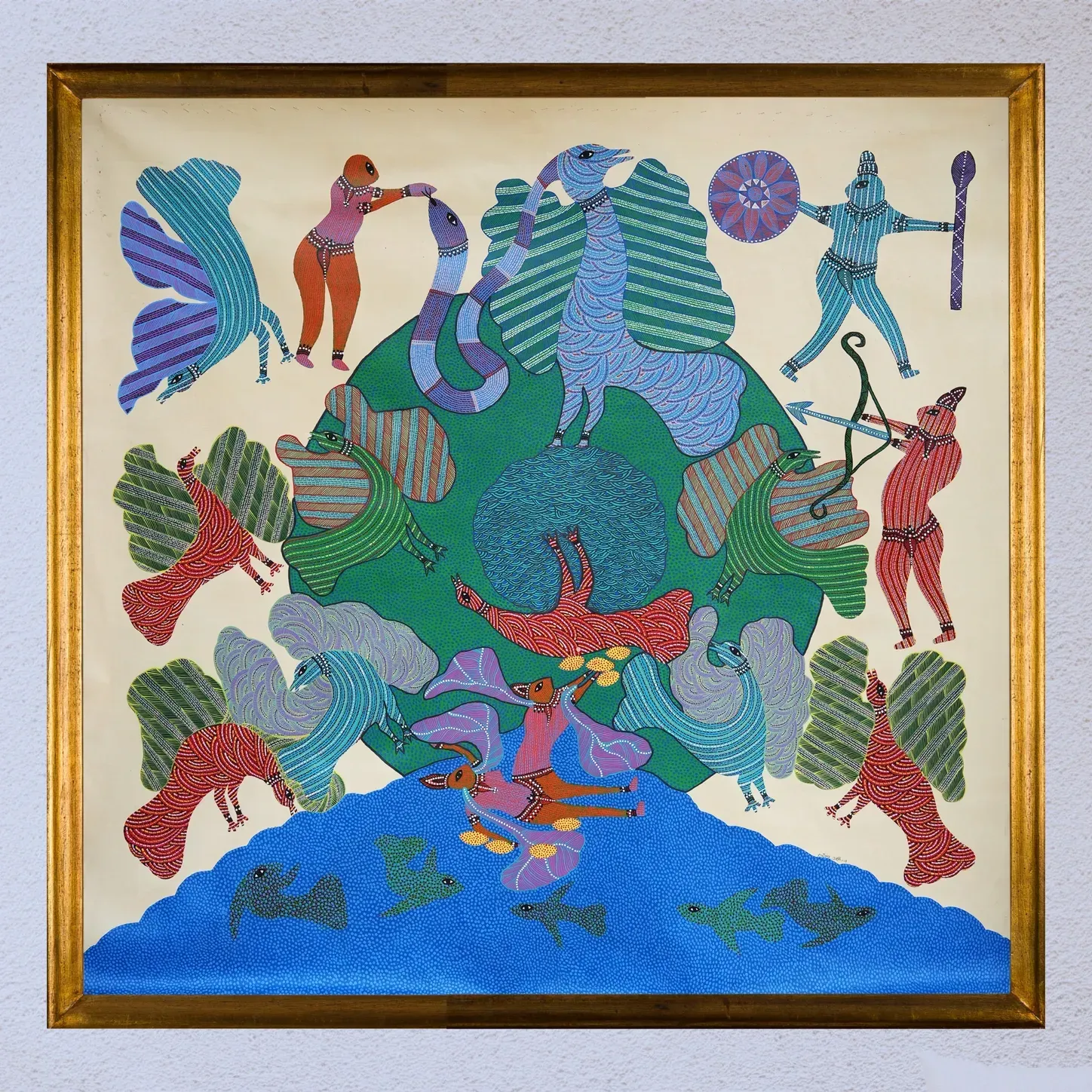
In the midst of Hunting Birds. Certified original, Rs 2,04,999, one piece remaining.
1998: The Argument About Trees
ROOFTOP: Trees appear again and again in your work. Did that come from your time with Jangarh ji, or was it always yours?
RAM SINGH URVETI: I make pictures on stories, so the use of trees becomes necessary. When I paint the Gond rajas and maharajas, those kings travel from one kingdom to another, and they cross forest, thicket, river and mountain to get from one to the next. That is why I consider it necessary to make the tree. And when I am painting, if I complete a picture without a tree in it, then that picture feels poor to me. It feels as though it has nobody in this world. So the possibility of making a picture without a tree does not even enter my mind.
ROOFTOP: Did Jangarh ji ever say anything about your trees?
RAM SINGH URVETI: Once he did compare his trees with mine, and said, do not make this kind of tree, this is the kind of tree I make. This was in 1998 at the Adi exhibition at the Lalit Kala Akademi. So there, in front of the director of the Akademi and the director of the IGNCA, I said to him, mama ji, we are people of one community, and we all make pictures from the same stories. Our minds and our thinking may be different, but the story and the culture are one. If I give this tree the form of something else, if I make a banana tree, then I will not be recognised by that banana tree. So I make the trees that are in our culture, around us, in our forest, the trees we actually use.
ROOFTOP: How did he take that?
RAM SINGH URVETI: Hearing this, mama ji became happy. He said, that is the right thing, we are people of one janjaati, and if we go and paint the pictures of some other community's world, then our own identity will not be built.
This is a remarkable scene to have on the record, and not only because it captures Jangarh Singh Shyam in the act of teaching. It captures a student answering back, in public, in front of two institutional directors, and winning the argument on the older man's own principle. The rule Jangarh had been enforcing, that an artist must have his own recognisable hand, was the same rule Urveti used to defend his trees. Both men were right. That is what makes it a good argument rather than a quarrel.
It also explains the deep consistency of his subject. His trees are not generic foliage. They are the specific species of a specific forest, the ones his community lives beside and uses, which is why a banana tree would have been a betrayal rather than a variation. The line about a picture without a tree feeling poor, as though it had nobody in the world, is the most revealing thing he said all conversation. In his compositions a tree is not scenery. It is company.
That conviction eventually produced the work he is best known for outside India. Together with Bhajju Shyam and Durga Bai, he made The Night Life of Trees with Tara Books, a handmade volume of Gond tree paintings silkscreened onto black paper, which won the Bologna Ragazzi award and put Gond trees into libraries and collections across the world. He later made I Saw a Peacock with a Fiery Tail. It is a neat piece of justice that the artist who could not imagine a picture without a tree ended up making the book that taught much of the world what a Gond tree looks like.
His trees also live on walls, at scale. He painted murals at the Indira Gandhi Rashtriya Manav Sangrahalaya in Bhopal, the national museum of humankind, where he was employed for many years, so the same forms that began on the mud walls of Patangarh houses now hold a public institution's surfaces. He had a solo exhibition at Bharat Bhavan in 2018, more than two decades after the show where he was not allowed to paint for two days, and one at Jahangir Art Gallery in Mumbai in 2001.
You can watch the whole argument resolve inside a single canvas in The Sun-Face Tree, where a tree of blue foliage opens across a yellow ground with a sun wearing a face at its crown and two figures standing among its roots. It is not a botanical study and it is not decoration. The tree holds the sun, the people and the composition together, which is precisely what he told Jangarh a tree is for.
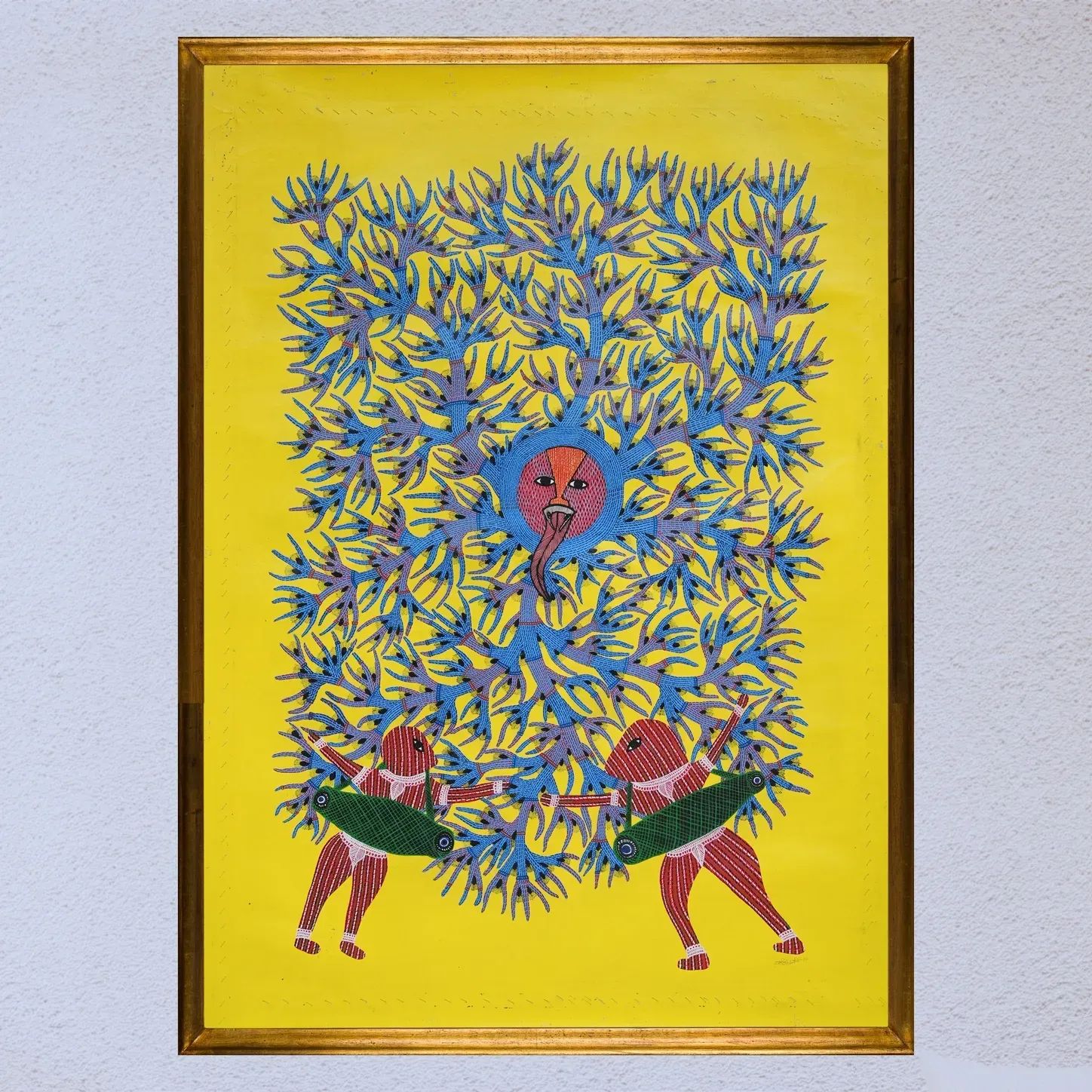
The Sun-Face Tree. Certified original, Rs 2,06,999, one piece remaining.
1990s: The Harmonium and the Tabla
The Gond Pradhan were traditionally the bards of the Gond, the community that carried the songs and the genealogies, and Jangarh came from that line. We asked whether he sang while he worked.
ROOFTOP: Did Jangarh ji sing or tell stories while painting? Is there a song you remember from that time?
RAM SINGH URVETI: Mama ji used words whose full meaning we could not always follow. But he was always cheerful, and he was always singing. He was always humming something to himself. While making a picture, while sitting, while walking on the road, something was always going on in his mind. As for stories, he did not tell them in the middle of everyone. Only sometimes, if the occasion came up, if talk turned to some subject, then he would certainly tell the story. But about songs, mama ji had a great fondness for singing and playing. When I came to Bhopal he found a friend from his childhood here, and after the day's work, at night, the singing and playing would go on.
ROOFTOP: Is there one night that stays with you?
RAM SINGH URVETI: I remember it. Swaminathan ji came to mama ji's house with a doctor I remember as B K Raiverman, and said that all the artists have a party at a hotel today, and you will have to sing there. Mama ji signalled to everyone, and there, for the first time, they gave me English liquor to drink. After that we picked up the tabla and the harmonium and reached the hotel. Mama ji began to play the harmonium and started his tune, and in my intoxication I began to play the tabla. I still remember the song he started. It said, you become the bird, my king, and I will become the hunter. When he sang it and I played, every artist sitting in that hotel got up and began to dance, and everyone was very happy. Afterwards Swaminathan ji asked mama ji where he had brought this man from, and mama ji said, he is my bhanja, he has just come from the village, he sings and plays well.
It is a wonderful scene, and it contains a small, sharp irony that he did not point out and probably never thought about. The song is about becoming the bird and becoming the hunter. The man singing it filled his paintings with dots. The man playing tabla beside him would, within a few years, fill his own paintings with the hunter's arrow.
The Pardhan Gond were the community's bards
Jangarh Singh Shyam came from the Pardhan Gond, the lineage that traditionally carried the songs, genealogies and oral narratives of the Gond people. The paintings that became known as Jangarh Kalam grew directly out of that inheritance of story and song.
He closed the conversation with the sentence that explains his working method better than any technical description could. All of these things, all these people, come back to him while he is painting, and it is from that remembering that he continues to make pictures. He is not illustrating myths he was taught. He is painting a room he once sat in, an argument he once won, a woman who once blessed him over a spoiled canvas, and a man playing a harmonium in a hotel at night.
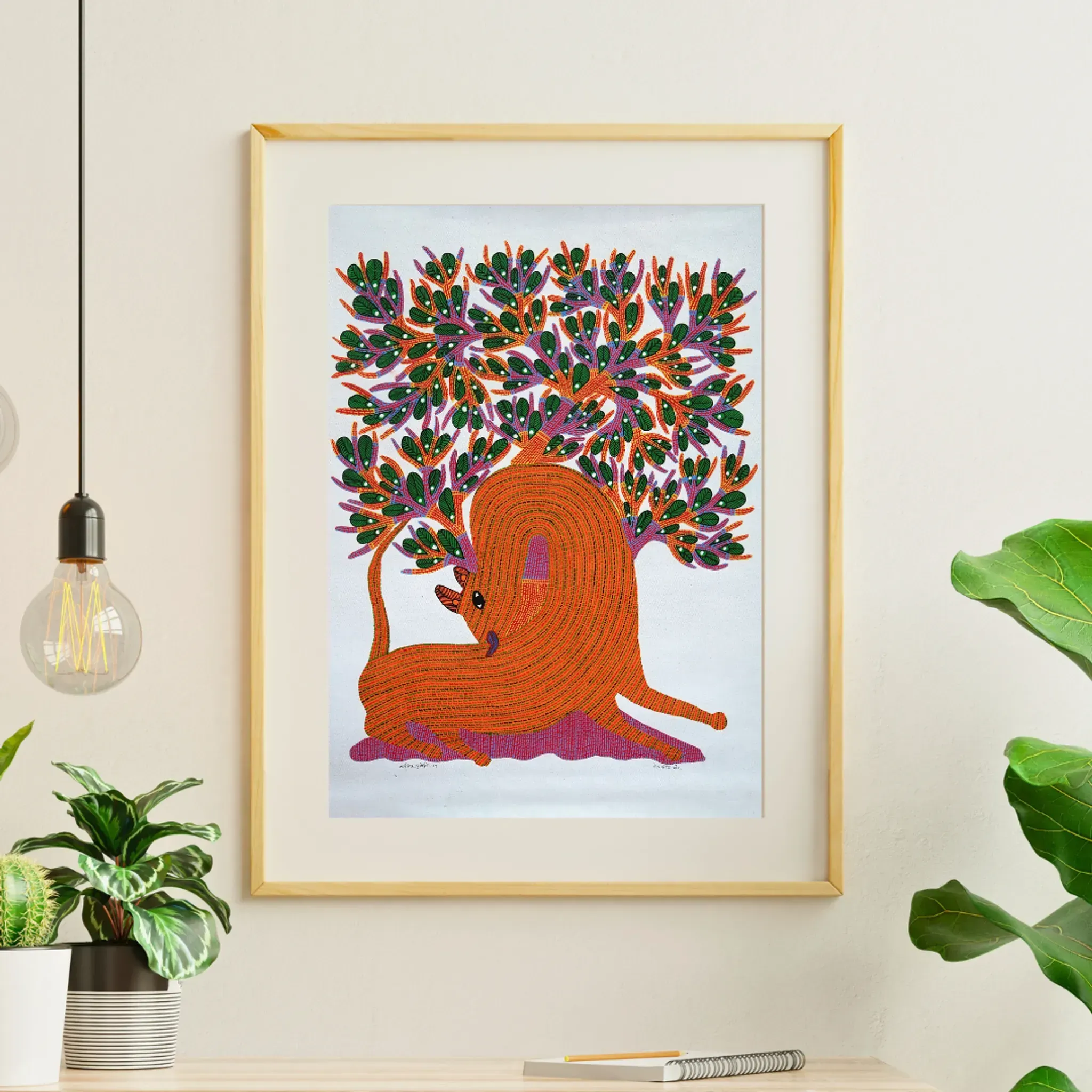
Tiger Under a Tree. The tree as company rather than scenery, the form he refuses to leave out of a composition.
What the Arrow Carries
Six interviews into this series, a pattern has become impossible to ignore. Every master we have sat with can name the exact moment their hand became their own, and in almost every case it was handed to them by an elder rather than found alone. A Padma Shri painter learned Madhubani while washing dishes in the house of the woman who taught her. A Phad chitera received his family's commission through the blessing of a bard. Ram Singh Urveti received his signature from two artists who refused to let him paint for two days, and his prophecy from an old woman who watched his brush fail.
What he did with it is his own. The arrow is not decoration and not branding. It is the weapon his community carried when it lived inside the forest, converted into the texture of everything he paints, so that a buffalo, a tree, a deity or a king is built out of thousands of small memories of how the Gond once survived. He was told to find an identity. He went looking for it in his people's hands rather than in his own imagination, which may be the most Gond answer possible to a question about originality.
There is one more thing worth drawing out of his account, because it runs against how these traditions are usually described. Nothing in his story was inherited automatically. He had no formal education in art and no training. He arrived because there was no work in the village, took a labouring job, and learned by sitting beside someone in the evenings after a ten hour shift. The transmission happened through proximity and stubbornness rather than through any system, which is exactly why it is so fragile, and exactly why the courses and books that now teach these forms openly matter more than they may appear to.
The tradition he works inside, and the artists carrying it now, are set out in Rooftop's encyclopedia entry on Gond art, from Jangarh Singh Shyam's transformation of a wall practice into a contemporary language through to the painters of Patangarh working today. Ram Singh Urveti is named there among them, which is its own quiet vindication of a blessing given over a ruined canvas.
For anyone who wants to put these patterns into their own hand rather than only look at them, Rooftop's Artventures of Gond sets out the community's origins, colour palette, eight signature patterns and iconic motifs as step by step practice, with room to work on every page.
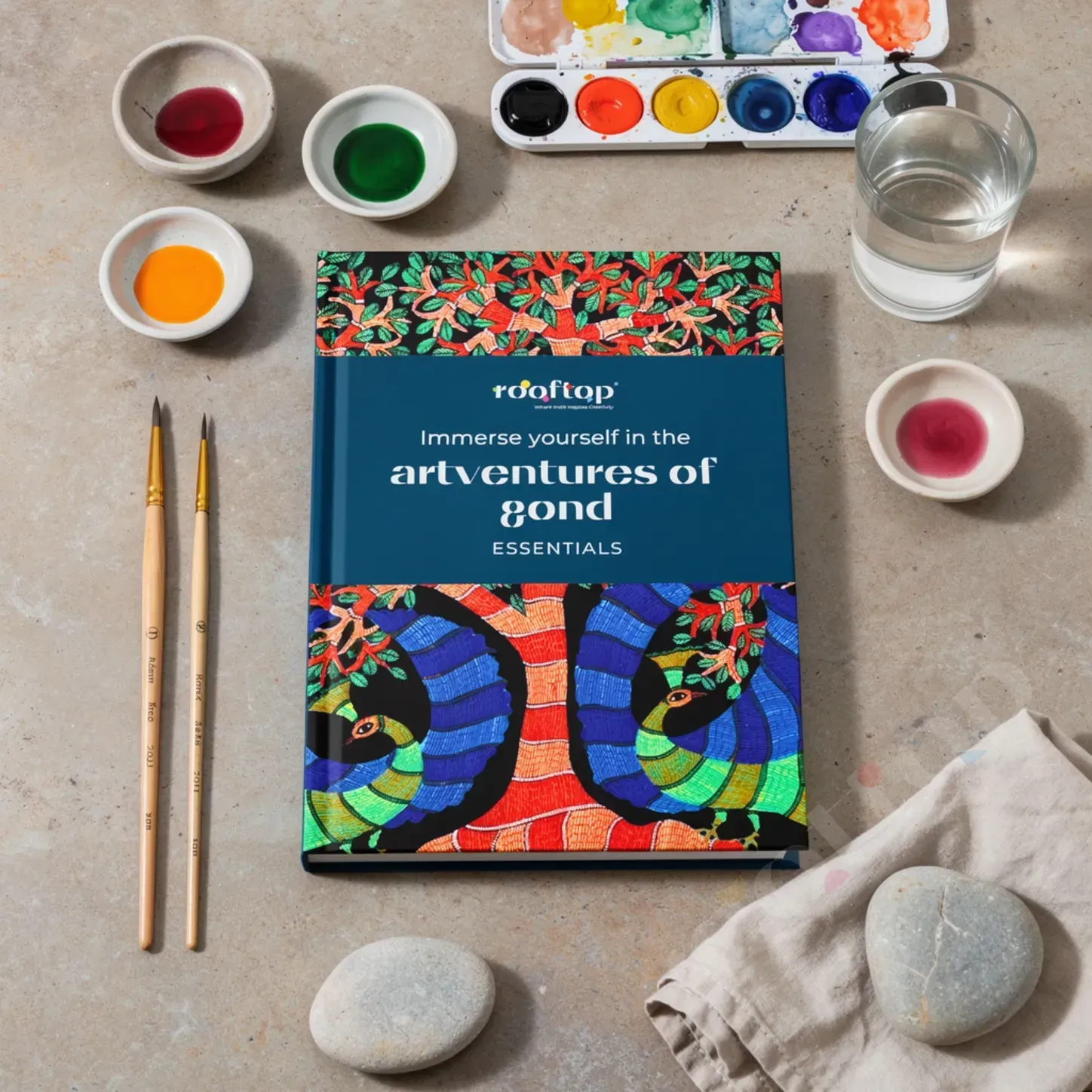
And if the form itself pulls at you, the way to meet it properly is from inside a practising artist's hand. Rooftop's Gond art course with Venkat Raman Singh Shyam, another painter of the same Patangarh lineage who trained with Jangarh, covers the history, the traditional brushes, the making of natural colours, and the dots, lines and patterns that give Gond painting its surface.

Gond Art Course, taught by a master of the same Patangarh lineage. Enroll on Rooftop
Somewhere in Bhopal this evening, a man who once planted saplings for the forest department from eight until six is filling another trunk with arrowheads, hearing a harmonium he last heard thirty years ago. The colour spread. The name spread. She was right.