

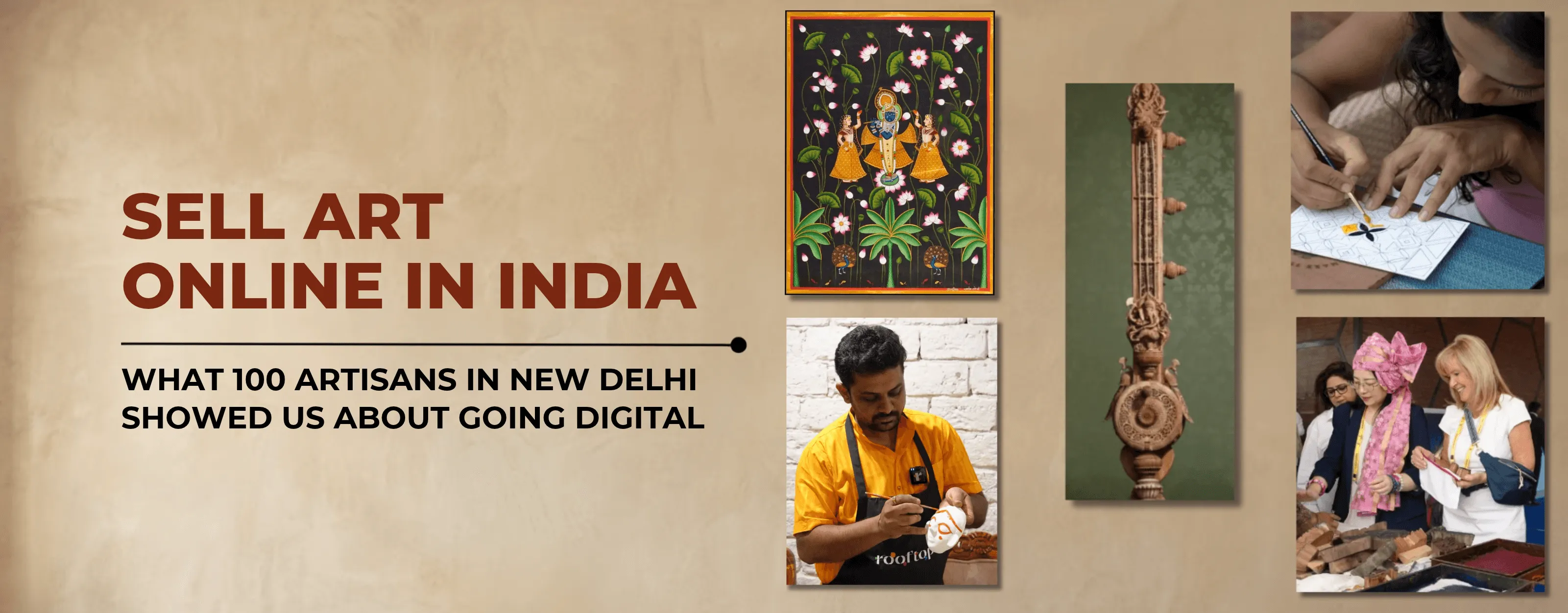

On 29 October 2026, Rooftop ran a live onboarding desk at Scope Complex on Lodhi Road in New Delhi. It was open for three hours, from 2:30 to 5:30 PM, and around 100 artisans came by. Most of them already knew how to make work that people want to buy. What they wanted to know was how to sell art online without a middleman taking the larger share, and without needing a GST number, a website or a courier contact to get started.
The checklist we printed asked for six things. One or two sample artworks or their photos, an expected selling price, address proof, a bank passbook, an Aadhaar and PAN card, and a working phone number and email ID. That list is short on purpose. It is everything an artisan needs to open a seller account on Rooftop.
This piece covers what the afternoon was for, what is happening in India's craft economy right now, and what any artist or craftsperson can do next, whether or not they were in Delhi that day.
Why a government complex in Delhi was the right place to start
The event carried the branding of the Ministry of Textiles and its Indian Handicrafts programme. That matters because of the network behind it. The office of the Development Commissioner (Handicrafts) is the Government of India's nodal agency for craft, and it reaches artisans through six regional offices in Mumbai, Kolkata, Lucknow, Chennai, Guwahati and New Delhi, along with 61 field units. Many of the artisans who came to the desk arrived through that system. Several had been registered with government schemes for years and had never sold a single piece online.
The money in Indian craft is real. The Export Promotion Council for Handicrafts put the sector's exports at ₹33,425.26 crore for 2025–26. This year is moving faster. Between April and August 2026, handicraft exports grew 21.07% in rupee terms to ₹16,910.90 crore, against ₹13,967.79 crore in the same months of the previous year. Last December, Union Textiles Minister Giriraj Singh said he expected handicraft exports to touch ₹1 lakh crore soon, and that the government had partnered with 100 artisans under its hub model to export craft products worldwide.
The ministry has also been working on the digital side. In December 2025 it rolled out its Chaupal programme nationwide, distributing kits to support district-level demonstrations, workshops and the digital onboarding of artisans. This month, artisans and weavers deputed by the Development Commissioner's office attended a seminar on crafts and commerce and then toured exporter stalls at the 62nd IHGF Delhi Fair. And on 28 October, the ministry approved two Guru Shishya training programmes in Kashmir, for carpet weaving and Sozni embroidery, with an allocation of ₹15.01 lakh.
All of this builds skill and visibility. None of it, by itself, puts an order on an artisan's phone. That last step is where a marketplace has to do its job.
The gap between making art and selling it online
Ask artisans why they have not started selling online and the answer is rarely about skill. It is usually about photographs, pricing, paperwork and shipping.
Technavio, a market research firm, estimates that around 40% of artisans in rural regions lack the technical literacy needed for global e-commerce. The government has seen the same problem. The Ministry of Textiles built the India Handmade portal to bring the work of more than 35 lakh handloom weavers and 27 lakh handicraft artisans directly to buyers, offering free handholding from registration to order fulfilment. That is a very large number of people who have the skill and still need a way in.
Generic marketplaces do not solve much here. A Pichwai painter listed next to printed posters has to explain on her own why her painting costs what it does. A mojari maker has to argue with a courier about how to pack a pair of hand-stitched shoes. A potter who never registered for GST finds that most seller forms stop him on the second page. A block printer in a small town may have customers in Bengaluru who would pay well for her work and have no idea she exists.
The Scope Complex desk was set up to answer exactly these questions, with a person sitting across the table instead of a help article.
What Rooftop is, for an artist reading this for the first time
Rooftop started in Jaipur in 2019. It grew from there to Mumbai, Delhi, Goa and other cities, and now has 470+ verified artists and a community of more than 42,800 members. The platform is built around Indian folk, tribal, classical and craft traditions, and around people who want to buy them, learn them and experience them in person.
That focus is why it works for artisans. Rooftop's provider page lists 1,600+ artworks and products on the platform, more than 50,000 buyers and learners, and average monthly earnings of ₹45,000 for providers. Padma Shri awardee Bhuri Bai has 17 original Bhil works listed, and Pichwai artist Rajaram Sharma of Udaipur, with 46 years of practice, teaches his tradition through a Rooftop course. They sit in the same shop as a first-time seller who signed up in Delhi this week.
The other reason is that one account covers everything. An artisan can sell, teach and host from a single dashboard. Most start with one and add the others later. You can read more about how the platform began on the About Rooftop page.
Three ways artists earn on Rooftop
The first is selling your work. That means original paintings in folk, tribal, miniature, devotional and contemporary styles, which sit in the Rooftop paintings shop, and handmade products such as decor, textiles, jewellery, wooden toys and heritage stationery. Rooftop checks every image, helps write the story behind each piece, and handles payment, pickup and delivery.
The second is hosting. In-person painting workshops, pottery, block printing, bamboo weaving and heritage walks are listed under Rooftop experiences. Corporate sessions for companies, colleges and international groups are often the highest-value bookings an artisan gets, and they come through the same account.
The third is teaching online. A self-paced video course in your tradition, listed with other Rooftop courses, keeps earning long after you record it.
The provider page publishes average monthly figures for active providers in 2025. Painting workshops average ₹62,000, artwork and product sales ₹58,000, online courses ₹55,000, heritage and cultural walks ₹48,000, craft and textile sessions ₹39,000, and wellness and yoga ₹34,000. These are averages. What any one artisan earns depends on pricing, how often they list or host, and where they are based.
Fees in plain numbers
Rooftop charges a 20% service fee on each confirmed order and booking, and the artisan keeps the remaining 80%. On a painting sold for ₹10,000, that means ₹8,000 reaches the artisan's bank account. The fee covers the Razorpay payment gateway, buyer support, seller tools and the marketing that puts listings in front of collectors. Terms and conditions apply.
There is no listing fee and no monthly subscription, so an artisan who sells nothing pays nothing. There is no minimum number of listings and no forced discount during sale seasons.
The rule that brought many people to the desk was about GST. Rooftop registers both GST and non-GST sellers. An artisan without a GST number can register with a personal PAN card and skip the heavy documentation. For a lot of first-time sellers, that single rule decides whether they go online this year or put it off again.
Earnings are transferred to the artisan's registered Indian bank account within 3 to 5 business days after an order is delivered or a session ends.
Pricing your work before you list it
Rooftop lets you set your own price, which means the decision sits with you. A simple method helps. Add up what the piece cost you in material. Add your hours at a rate you would accept from a local buyer. Then account for the 20% fee. If you want ₹8,000 in hand, list at ₹10,000.
Look at what similar work by artists with your experience sells for in the shop before you decide. And do not underprice to get the first sale. A buyer who sees a hand-painted Phad on cloth for ₹1,500 does not think it is a bargain. They wonder what is wrong with it.
Photographs matter almost as much as price. Shoot in daylight near a window, against a plain wall. Take one full photo, one close-up of the brushwork or stitching, and one with a hand or ruler in the frame for scale. The onboarding team helps improve your photos, but a clear original makes their work much easier.
Shipping, safety and the parts artisans should not have to handle
When a piece sells, Rooftop arranges doorstep pickup, gives packaging guidance for fragile work, books tracked delivery and keeps the buyer updated. The artisan never has to negotiate with a courier. Every order and booking is verified, and settlements go straight to the bank through Razorpay.
Each provider also gets a profile page with their bio, artisan lineage, awards and reviews. For a master craftsperson, that page does what a visiting card and a folder of newspaper cuttings used to do, and buyers can find it from anywhere through the Rooftop artists directory.
Artisans already selling art online through Rooftop
Mohan Lal Gujar makes leather mojaris in Jodhpur. According to his family's oral history, his ancestors made mojaris for the Jodhpur royal family for over 300 years. He received the Rajasthan State Award in 2008 and a National Merit Certificate in 2011, and his mother, Chanda Gujar, is a two-time National Award winner. For years his sales depended on local fairs. With Rooftop he reaches high-value buyers in Indian cities, takes online orders and supplies corporate gifting. The craft itself is documented in the Art Wiki entry on leather jutti and mojari making.
Javed Usta works in Bikaner's Usta tradition of gold embossing on camel hide. He is a hereditary master from a family that has practised and restored this gold work for generations, and he has given it more than thirty years. He is a state awardee, and through Rooftop he sells collector-grade pieces and teaches masterclasses to art historians in other countries. In his conversation with Rooftop about the Usta family record, he explained the manoti and siyahi formulas, how to tell real gold from fake, and why only about ten artisans still practise the craft.
The third example is about reach. Rooftop has taken traditional Indian artists to cultural forums in Japan and to international exhibitions, and has exhibited at Abu Dhabi Art and World Art Dubai and partnered with the Louvre Abu Dhabi. Those rooms are hard for a single artisan to enter alone. A platform with a track record can get them in.
How to register as an artist on Rooftop
Most accounts go live within 48–96 hours of the first conversation.
- Meet an onboarding specialist, who helps you fill in the registration form on the website.
- Complete the registration and verification form.
- Build your listing. You write the story behind your craft, the team helps improve your photos, and your verified listings go up.
- Start receiving orders, course enrolments and bank payouts.
Keep these ready before you apply: 1–2 sample artworks or clear photos of them, the price you expect, address proof, bank details or a passbook, Aadhaar and PAN, and an active phone number and email ID.
You can apply to become a Rooftop provider online, call or WhatsApp +91 96729 60980, or write to connect@rooftopapp.com or ops@rooftopapp.com.
The desk closed at 5:30. Onboarding did not.
Scope Complex was one afternoon. The work behind it happens every day. Rooftop's team onboards new artists and craftspeople daily. Some are master awardees with decades of practice. Some are selling their first piece. The 100 artisans who came by on 29 October joined a line that keeps moving.
If you make something by hand, paint in a tradition your family has kept, or know a craft well enough to teach it, you can sell art online with Rooftop starting this week. After you apply, a member of the onboarding team reviews your application personally and contacts you within 2 to 3 business days.
Frequently asked questions
Can I sell art online in India without a GST number?
Yes. Rooftop registers non-GST artisans using their personal PAN card, without a complex documentation process.
How much commission does Rooftop charge artists?
20% on each confirmed order or booking. You keep 80%, and there is no listing fee or monthly charge.
How long does it take to start selling paintings online?
Most accounts go live within 48–96 hours once your form and documents are complete.
I make handicrafts, not paintings. Can I still join?
Yes. Decor, textiles, jewellery, wooden toys, stationery, pottery and other handmade products are welcome, as are workshops and heritage walks. If your craft is not listed, tell the team when you apply.
When do I get paid?
Payouts reach your bank account within 3–5 business days after an order is delivered or a session is completed.