

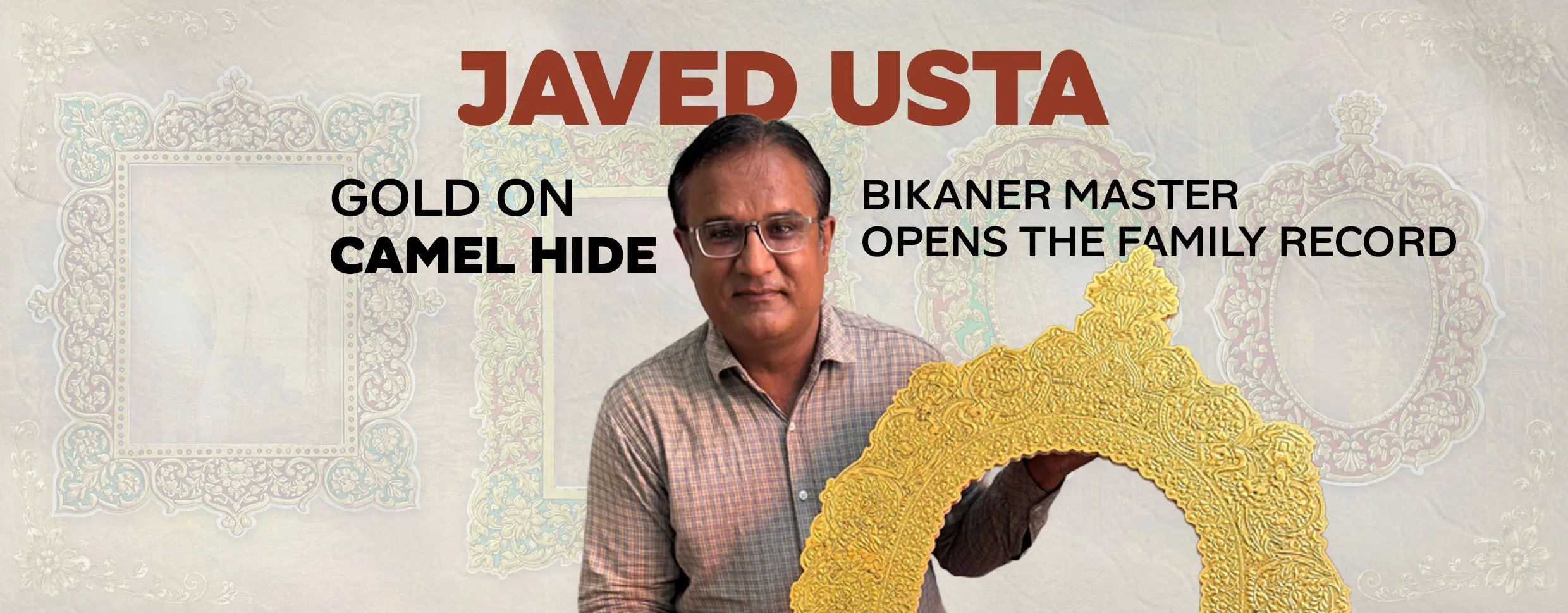
Gold on Camel Hide: Bikaner Master Javed Usta Opens the Family Record
Bikaner Usta master Javed Usta on the craft's Akbar-era origins, the manoti and siyahi formulas, real gold versus fake, and why only ten artisans remain.

Kartik Gaggar
Author
This piece is drawn from a conversation Rooftop recorded with Javed Usta, a hereditary master of Bikaner's Usta community whose family has practised and restored this gold work for generations. His answers, given in Hindi, have been translated and rendered here in reported speech, lightly edited for clarity. What he shared includes working formulas and lineage history that exist nowhere else on the public record.
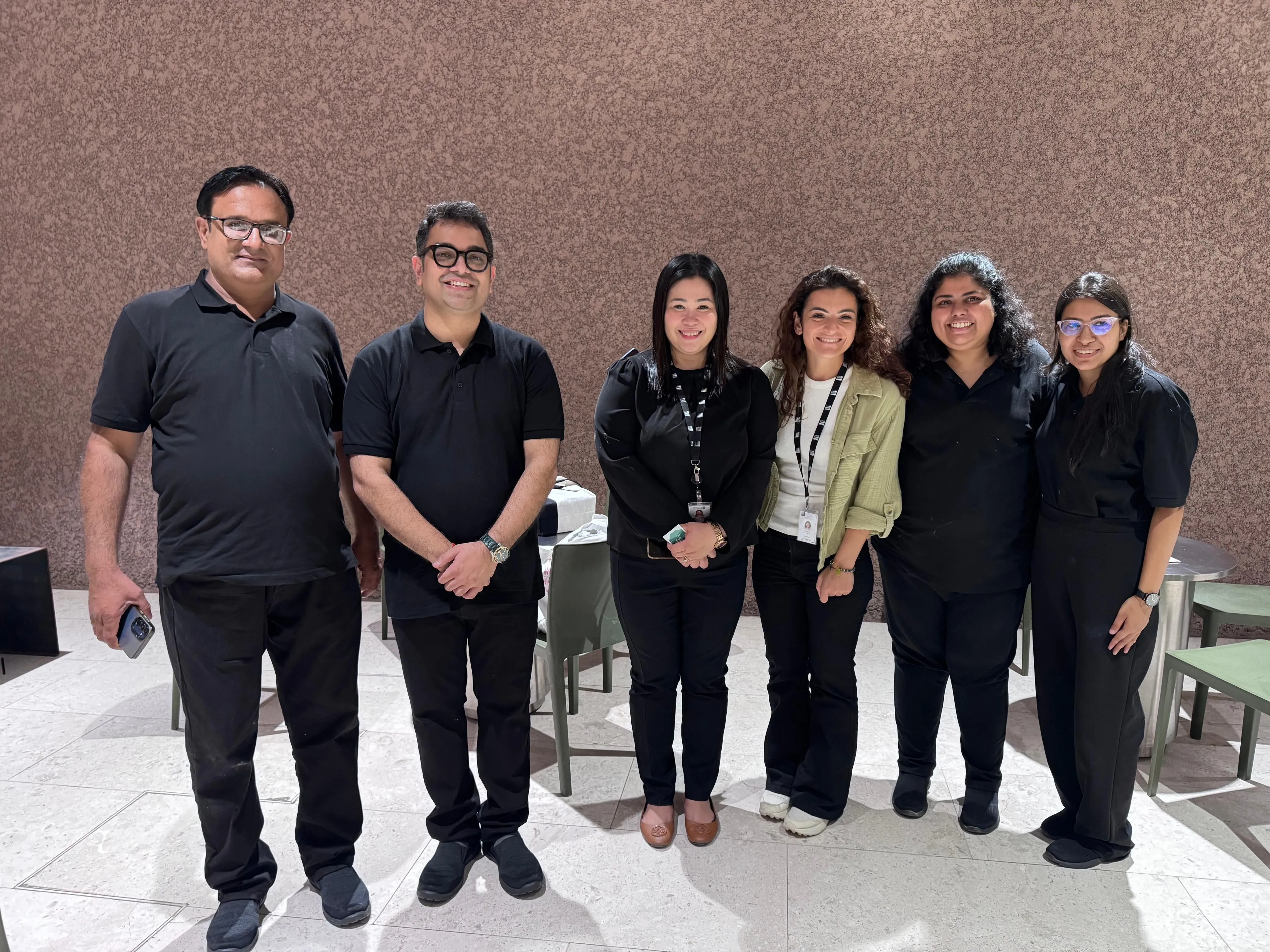
Master artist Javed Usta with Rooftop's founder Kartik Gaggar and team
He began the conversation with an apology. He was sorry for the delay in answering, he said, because he had been at the table too much these past days. The table, for Javed Usta, is where gold is coaxed onto camel hide in patterns fine enough to need a squirrel-hair brush, and a man who has given this work more than thirty years still describes himself, without irony, as someone who is learning it. That sentence, offered casually near the end of our exchange, is the whole tradition in miniature. Usta kala is the kind of craft where three decades earns you the right to call yourself a student.
What follows is Javed Usta's account of that craft, from its origins in the ateliers of Emperor Akbar to the formula for the black ink his family still cooks from lamp soot, to the blunt arithmetic of a tradition now carried by roughly ten men. We went in with questions that the published record answers vaguely or not at all. He answered them all, precisely, and occasionally with a correction that the record will now have to absorb.
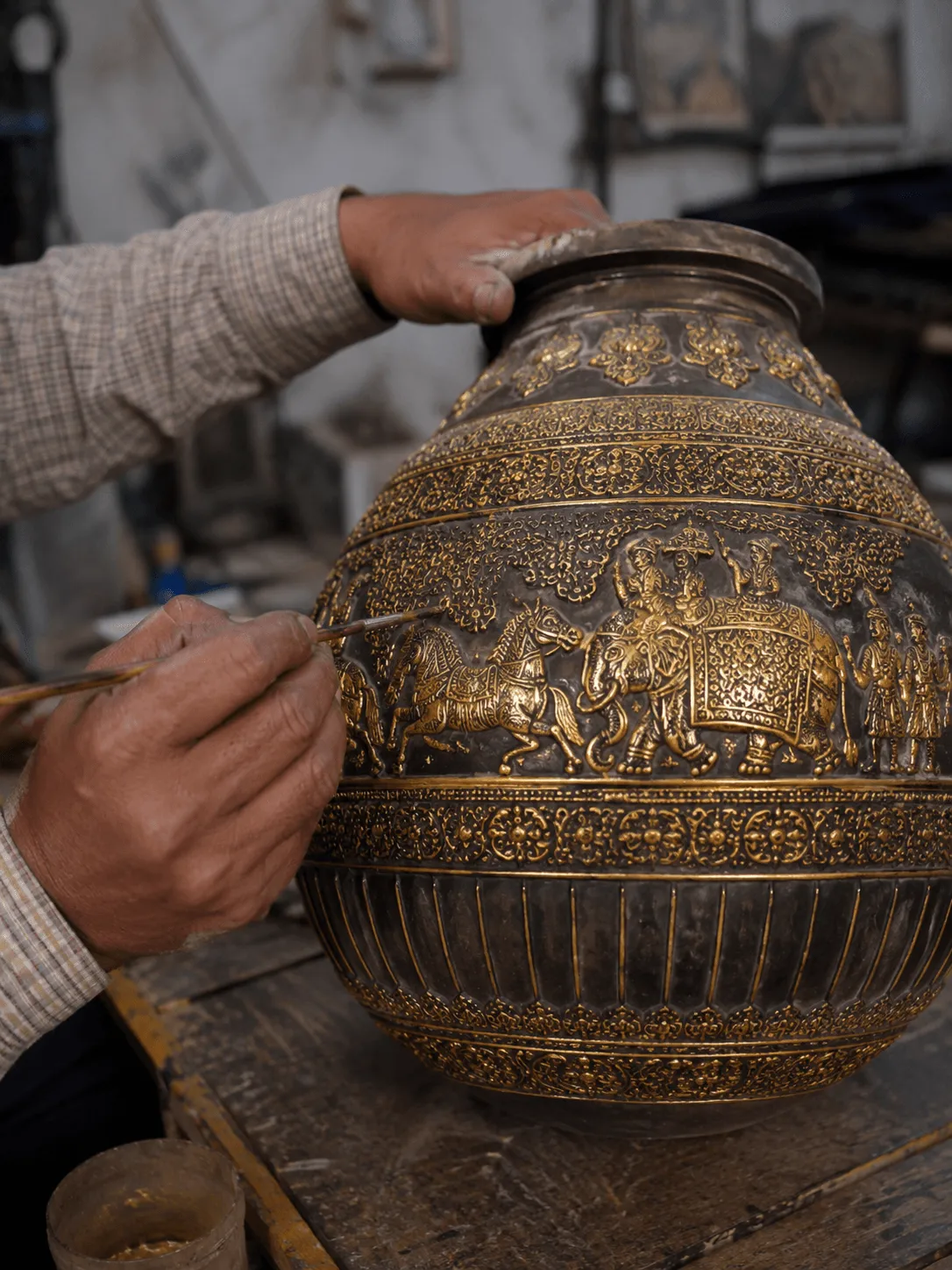
manoti is the raised relief. naqqashi is the fine carving that gives it form. the gold comes after... turning camel hide into a surface of embossed detail, delicate carving and real gold leaf. in usta kala, they are not two separate arts. they are two names for the same craft.
Out of Akbar's Atelier
Asked where the Usta community truly came from, whether Iran, Multan or local converts, since the published sources contradict one another, he went straight to the names his family's oral history preserves. The founding artists of this craft came from outside Bikaner, he said, and they were part of Emperor Akbar's imperial court. The two pioneers the ancestral record remembers are Ustad Ali Raza and Ustad Ruknuddin, the men who established the art in Bikaner. Both names, it is worth noting, survive independently in the documented history of the Bikaner school, where Ali Raza's hand is recorded on royal commissions and Ruknuddin stands among the great court painters. The family memory and the archive agree.
The bridge between Delhi and the desert, he explained, was Maharaja Rai Singh of Bikaner, a trusted commander of Akbar who served the empire as far afield as the Herat frontier and campaigned wherever the emperor sent him. When Rai Singh set out to build his state and raise Junagarh Fort, master artists were brought directly from Delhi to execute the work, and as construction progressed more artists followed, until the community settled in Bikaner for good. The fort they decorated still holds their proof. The Anup Mahal, Karan Mahal and Phool Mahal glow with the gold work of those first hands.
On the question of whether Usta is an earned title or a surname, his answer widened the craft's whole frame. Usta comes from ustad, a master, and the community were masters of many things at once, not gold embellishment alone. The finest architectural draftsmen were Ustas. So were wood carvers and the sculptors of red sandstone, and he pointed out that the village of Dulmera, source of Bikaner's famous red stone, was granted to his ancestors for their carving. They were miniature painters and portraitists too, and their pencil sketches, he added, are prized to this day by major collectors, naming the celebrated Bikaner collector Motichand Khajanchi. The gold on camel hide that the world now calls Usta art is one room in what was once a very large house.
That larger house has a name in art history, the Bikaner school, one of the most refined ateliers of Rajput painting, and it grew from these same families. The court workshops that Ruknuddin's generation anchored produced miniatures prized in museum collections worldwide, delicate, Mughal-inflected, unmistakably Bikaneri, and the Usta community supplied that tradition its hands for three centuries. When he says his ancestors were masters of many arts, he is not embellishing a family legend. He is summarising a school of Indian painting that scholars catalogue under the very names his household still uses at dinner.
One boundary, though, he drew firmly. The Dapgar community, who prepared raw camel hide for drums and vessels, are entirely distinct from the Ustas. In the traditional division of labour, the Usta artisans designed and sculpted the underlying forms and finished the clay base moulds, and the Dapgar craftsmen stretched and processed the raw hide over them. An Usta can do hide work, he said, but the processing of raw leather has always been the Dapgars' specialised domain. Two communities, one object, and a courtesy between crafts that outsiders routinely collapse into confusion.
One Process, Two Names
The record lists Manoti and Naqqashi as if they were two styles, and we asked him to separate them. He declined, politely, because the separation is the error. Manoti, or Manowat, is the traditional name of the craft process itself, he said, and Naqqashi is a Persian word for the fine carving, the relief work. They are not different arts. They are aspects of the same embossed, carved and gilded work, two words that travelled different distances from the same table. Scholars who catalogue them as separate categories are indexing vocabulary, not practice.
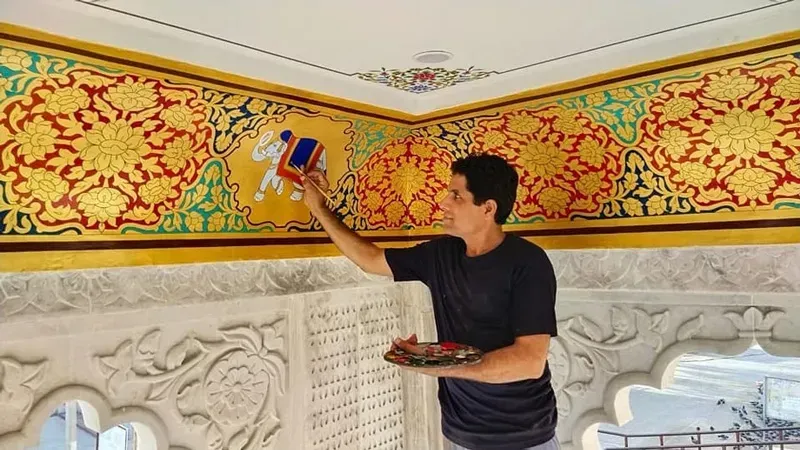
Usta started as miniature paintings when the artists created floral & geometric designs, and deities on walls of palaces and temples.
Pic: Ayub Ali Usta
Then he did something no article on Usta art has done. He gave us the formulas.
F R O M T H E F A M I L Y F O R M U L A B O O K
The embossing paste, as the family cooks it
✦ Clay ground from old earthen pitchers, the ghada, forms the body of the paste. ✦ Jaggery, natural gum and copper sulphate, the nila thotha, go in with it, the copper sulphate added as a natural insecticide so no pest ever eats the raised work. ✦ The mixture is cooked and worked until it reaches the thickness of honey. ✦ Applied to the surface, it hardens permanently only after curing in high heat, and the raised pattern it leaves is the manoti that the gold will later crown.
The gold itself, he was clear, is real or it is nothing. Traditional Usta work uses genuine gold foil, the vark, so delicate it can barely be handled, laid onto an adhesive paste at the precise moment the paste reaches roughly ninety percent dryness. Foil is the standard, though for special architectural commissions solid gold has been used, and he mentioned historical gilding inside the Ajmer Dargah as the example. Asked how a buyer can tell the real thing from brass paint, he gave the connoisseur's answer. Pure gold carries a soft, natural lustre that does not change for a lifetime. Imitation shines too loudly, and within two to four months it betrays itself, dulling, oxidising, breaking out in black spots. Gold does not age, he said. Everything pretending to be gold does.
The ninety percent figure deserves a pause, because it contains the entire difficulty of gilding. Lay the vark while the adhesive is too wet and the foil drowns and wrinkles. Wait until it is fully dry and nothing holds. The window in between, judged by eye and fingertip in Bikaner's shifting desert air, is where a decade of apprenticeship quietly lives. There is no gauge for it and no timer. There is only the trained hand hovering over the paste, deciding that now, and not thirty seconds from now, is the moment the gold goes down.
Real gold keeps its light for a lifetime. Fakes break out in spots within months
Genuine 24-carat Usta work holds an unchanged soft lustre indefinitely, while imitation foil and metallic paint dull visibly and develop black oxidation spots within two to four months. Time, in this craft, is the one authenticator that cannot be bribed.
Siyahi, the Line Almost No One Can Draw
If the gold is the glory of Usta work, the siyahi is its examination. Siyahi is the fine black line work executed immediately after the gold leaf is laid, the drawing that turns sheets of gold into pattern, and he described it as the most expertise-hungry stage of the entire craft. Everything in siyahi must arrive in perfect symmetry, he said, and that symmetry asks for years of practice with a brush made from squirrel hair. Then he offered the assessment that should trouble every casual buyer of Bikaner souvenirs. Of the work visible in the market today, he estimates that seventy percent gets it wrong. What is being sold as siyahi is often not siyahi at all, because the hands that can actually do it have become that rare.
Understand what symmetry means at this scale and the seventy percent figure stops being surprising. A siyahi pattern is built from repeating units, florals, creepers, borders, each one drawn freehand and each one required to match its neighbours so exactly that the eye reads machine regularity in handwork. There is no tracing and no correction, because a wrong line on gold cannot be erased, only lived with. The galleries of Junagarh were drawn this way, ceiling after ceiling, by men working from memory and muscle. When he says most of what the market sells today is not siyahi, he means the symmetry is not there, and once you know to look for it, you can never unsee its absence.
F R O M T H E F A M I L Y F O R M U L A B O O K
The siyahi ink, from lamp flame to line
✦ An oil lamp, a diya, is lit, and an inverted vessel is placed above the flame to catch the rising soot. ✦ That pure lampblack, the kalikh, is collected and ground rigorously until no grain survives. ✦ Natural gum binds it, a little copper sulphate protects it, and a measure of sugar completes it. ✦ Worked into a smooth paste, this is the ink that has drawn every true siyahi line in Bikaner for four centuries.
There is something almost defiant in a tradition that manufactures its own black from fire and its own relief from broken water pots, in a city famous for gold. The expensive material in Usta art was never the problem. The rare material is the hand.
A Green Dream in the Thar
We asked him whether the famous story is true, that Usta art's saturated colour was the desert's answer to its own emptiness, and he confirmed it as the teaching of his elders. There was no greenery in the sand, so the artists painted the garden the land refused to grow. The proof he offered is architectural and it is wonderful. Inside Junagarh Fort stands the Badal Mahal, the palace of clouds, built because it did not rain in the desert, its walls painted with cloud-blue motifs and flowering colour, fitted with water features, so that the kings who sat in it could feel a monsoon that never came. He called it, with a craftsman's grin, that era's air cooler. Sitting there, he said, you truly felt you were sitting in greenery, and that was precisely the effect the whole art form was engineered to produce. In the Thar, vibrance was not a style. It was a service.
When the Art Learned to Travel
For its first centuries, he reminded us, Usta kala existed only on architecture, on the walls, ceilings and great doors of palaces. The move onto objects, and onto camel hide in particular, was driven by admiration and luggage. When the British came, their officers loved the work and wanted pieces they could carry home. Wood was tried and found wanting, heavy to ship and prone to warping. And then the artisans noticed an object that already existed all around them, the seamless vessels of camel hide made for carrying oil, light, tough and effectively unbreakable. The gold went onto the kuppas, and a portable art form was born. The earliest museum examples of this hide work, he noted, are displayed to this day at the Albert Hall Museum in Jaipur and date to around 1873.
Then came the regret, delivered with a sigh you could hear in the transcript. Today, he said, the camel hide work has become very rare, and the craft has shifted onto wood, marble and glass instead. The reasons are structural. Almost no leather craftsmen remain to prepare the raw forms, and the dye and mould process for hide is enormously effort-intensive, a labour that today's buyers rarely pay for. The surface that made Usta art famous around the world is quietly leaving the tradition, not because the artisans forgot how, but because the economy beneath it dissolved.
From palace walls to a vessel of oil, around 1873
Usta art lived only on architecture until British-era demand for portable pieces moved the gold onto seamless camel hide oil vessels. The earliest museum examples sit in Jaipur's Albert Hall Museum, dated to around 1873, from where the hide tradition travelled the world it is now vanishing from.
Walls Versus Objects, and the Restorer's Ledger
Because his family works at both scales, we asked how architectural Usta work differs from the handicraft pieces, and his answer reversed the assumption hidden in the question. The small work is the comparatively easy work. The imarati kaam, the architectural commissions, are the mountain. On a wall, the base preparation alone is a discipline of its own, the colour must run across great surfaces without a single visible joint, and the whole performance happens overhead, at height, where nothing forgives. A handicraft object sits in your hand and waits. A ceiling does not.
His family's restoration ledger reads like a walking tour of old Bikaner. They have restored original Usta work two hundred and fifty to three hundred years old at the Panch Mandir, at the Dadabari Nal Jain temple, at the Prachina Museum and at the Ghodi Parshvanath temple, and he made the restorer's proudest boast, that a visitor today would swear the work was three centuries old and never touched. Restoration in this tradition is not repainting. It is the art of becoming your own ancestors for the length of a commission.
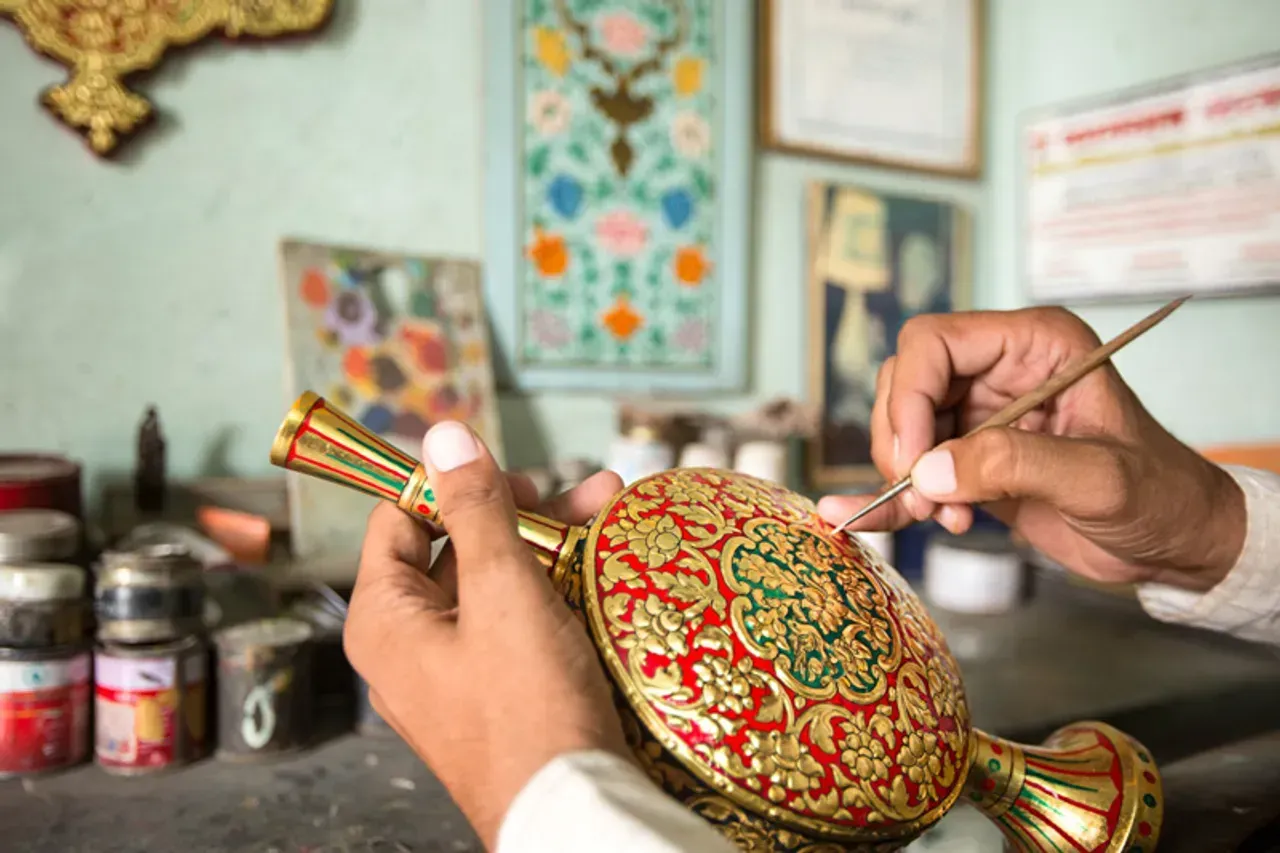
Image: an Usta artisan at work with fine brush and gold on a prepared surface
Ten Men and a Tag
Then the conversation arrived where every conversation about Usta art must eventually arrive, at the counting. Asked whether the community has really fallen from two hundred masters to around ten, he confirmed it without drama. Before Partition there were more than two hundred master craftsmen.
Partition took many across the border, and the decades after took most of the rest, as royal patronage ended, public awareness faded and families steered their sons toward professions that could feed them. Today, he said, if you look across the whole field you will find ten or fifteen men, no more, who can carry the entire process independently, from the hide to the manoti to the gold to the siyahi. And not every man holding a brush is an Usta, he added, in the single sharpest sentence of the interview. This work took him thirty years to learn, his father has given it forty to fifty, his uncles and his father's colleagues the same, and even now, he said, we say we are learning.
The next generation, he told us plainly, is not adopting the craft, and who could blame them when the dozen men still in it describe their situation as a matter of survival. Which brought us to the Geographical Indication tag, the intervention that was supposed to help, and his verdict was the bluntest thing he said all day. The GI tag has done the Usta community no good at all, and he suspects it never will.
Since the tag arrived, he said, people who merely know how to hold a brush, art college students with no traditional training whatsoever, have had themselves stamped with artisan identity cards declaring them Usta artisans, a development he called a disaster, because the title that took his family generations to earn can now be acquired without the decades. And the tag itself, he pointed out, is not even held by the community. The rights sit with an external institution that runs it as it sees fit, while the artisans have no NGO, no body of their own. He has sat in the GI council meetings himself. The paperwork of protection exists. The protection does not.
From 200 masters to 10, and a GI tag that changed nothing
More than two hundred Usta masters worked before Partition. Ten to fifteen remain who command the full process. The craft's GI tag, held by an external institution rather than the artisans, has meanwhile allowed untrained individuals to register as Usta artisans, diluting in paperwork the very mastery it was meant to protect.
What would actually save the art, in his accounting, is unglamorous and specific. Institutional support that reaches working artisans rather than institutions about artisans. Compensation honest enough that a young person can choose the craft without choosing poverty. And patience, on all sides, for the one thing no scheme can compress, the twenty or thirty years it takes to make a hand that can draw a siyahi line. Everything else, he suggested, is decoration on the problem.
Still Learning, After Thirty Years
It is worth sitting with the arithmetic Javed Usta carries lightly. A craft brought from Akbar's court by masters whose names his family still speaks, four centuries of walls, temples, palaces and camel hide, an entire visual identity of a famous city, all of it now resting on roughly ten pairs of trained hands, most of them past fifty, in an economy that stamps out counterfeit artisan cards faster than it produces apprentices. And at the centre of it, a man who apologises for answering late because he was at the table, and who, after thirty years at that table, calls himself a student. Traditions do not die announcing themselves. They die quietly, at tables like his, one unreplaced master at a time. This one is still alive, still gilding, still cooking its black from lamp flame. What it needs now is not admiration. It is the thing it has always run on, patronage, arriving before the counting reaches zero.
Patronage, in practical terms, is not a mystery. It is a hotel or a museum commissioning a restored ceiling instead of a printed imitation. It is a collector buying a signed hide vessel at a price that accounts for the weeks inside it. It is an institution funding two apprentices for a decade rather than a festival for a weekend. And it is buyers learning the two tests he handed us freely, the lifetime lustre of real gold and the machine-perfect symmetry of true siyahi, so that the market finally rewards the twelve men who can produce both. None of this is charity. It is simply paying the correct price for the correct thing, which is all this community has ever asked.
This conversation is part of Rooftop's series of sittings with the hereditary masters of Indian traditional art, alongside the Padma Shri painters of Mithila and the Phad chiteras of Bhilwara, keeping endangered knowledge on the record in the masters' own words. The documentation of these forms, their histories and their living practitioners continues across Rooftop's Art Wiki, because the first thing a ten-man tradition needs from the rest of us is to be accurately, permanently known.