

Phad Painting Symbols Decoded: Gods, Heroes and the Visual Language of Rajasthan
Phad paintings look chaotic until you learn how to read them. This guide decodes symbols, colours, gods, heroes and motifs, turning a dense Rajasthani scroll into a structured visual language you can finally understand.

Rooftop
Author
Have you ever chanced upon a Phad painting? Phad paintings are traditional scroll paintings of Rajasthan that have been in existence since the past 700 years. The term ‘Phad’ literally means ‘to fold’ deriving from the way it is kept folded and unfolded when in use. These are folk paintings that are intended for worship. They were traditionally made by the Joshi family belonging to the Chipa caste and settled in Shahpura in Bhilwara, Rajasthan.
When you first look at a Phad painting, what one first notices is that the colour palette is predominantly composed of red, yellow and orange interspersed with blues, greens and black. This colour scheme is reminscent of the desert landscape that it originates from. And also that the painting depicts various scenes that tell a story. But as well continue to look, we realise that it is not easy to know what the story being told here is. We wish to know what the scenes dictate. However, this is not an easy task as the Phad is often composed like a map and the scenes are not arranged chronologically but spatially. One needs to be familiar with the stories that the compositions are based on.
As such, the themes depicted in these paintings primarily revolve around local mythological stories of Devnarayan and Pabuji who are given the status of Hero-Deities. Another hero-deity of Ramdevji is worshipped by the Meghwal and Regar leather-working communities. Besides the popular themes of Devnarayanji and Pabuji, Phad paintings also depict stories of other Gods and Godesses namely Lord Krishna, Lord Rama, Lord Buddha, Lord Hanuman, Goddess Kali, Lord Shiva and Lord Ganesha. Few themes are also based on history and mythology and may also incorporate love stories, philosophy and erotica as also psychological, social and contemporary subjects.
Pabuji and Devnarayanji
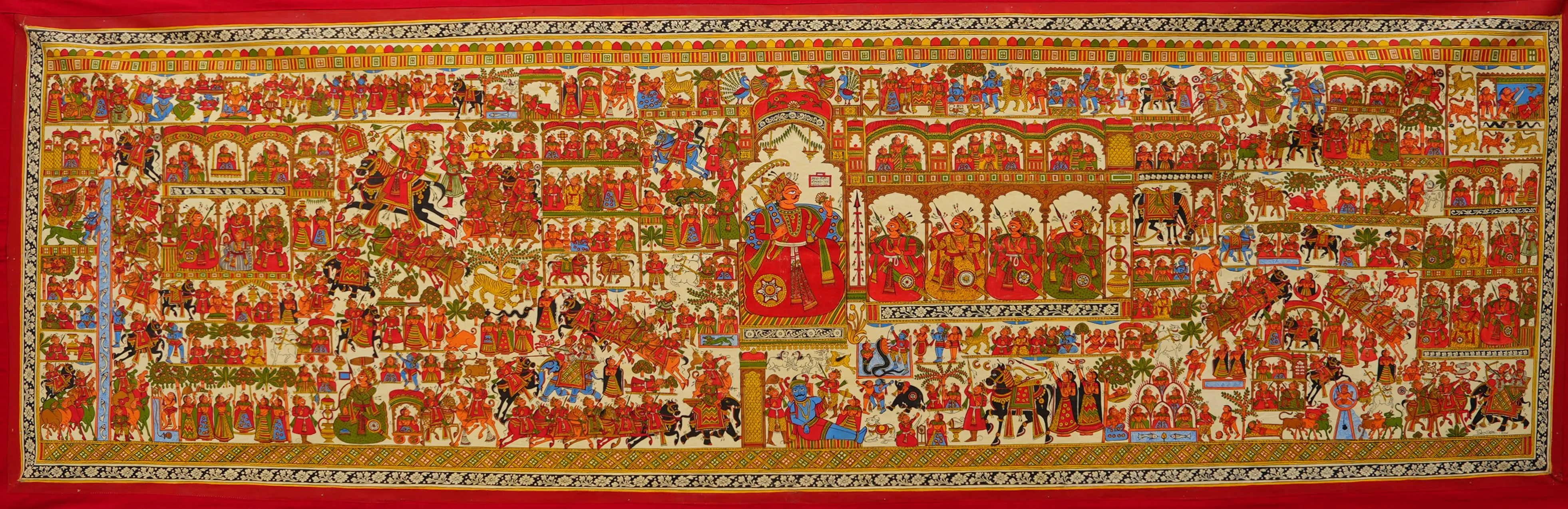
The epic of Pabuji retells the story of the life and adventure of Pabuji, a Rajput chieftain. The story itself is said to originate around the 14th century. Pabuji is considered as the reincarnation of Lord Lakshmana and as a symbol of ultimate protection and sacrifice. He is primarily worshipped by the Rabari community.
The story of Devnarayan is divided into two parts, the first that talks about 24 brothers belonging to the Bagrawat lineage of the Gurjar cattle herding caste. And the second which talks about Devnarayanji who is considered to be the avatar of Lord Vishnu. Devnarayanji is portrayed with sharp features and as wearing gold ornaments which indicate the aesthetic preference of his primary worshippers, the Gurjar community.
In every Devnarayanji and Pabuji Phad paintings, the hero-deity is depicted royally seated in a central frame around which the story unfolds. This central depiction is larger than the surrounding figures and plays a key role in establishing the visual ques through which each hero-deity can be recognised with ease. The facial attributes themelves play a role to identify a character such as the shape of the face, eyes and nose, style of facial hair, etc. The main figure may also be depicted as slightly larger in the rest of the painting to indicate their divine or royal status.
The key features through which one is able to recognise Pabuji is that in the central depiction of the figure, Pabuji is shown as seated without his legs being seen and a decorated heavy spear is shown right in front of him. Also, in the rest of the artwork, Pabuji can be recognised through his black mare named Kesar Kalmi. On the other hand, in the Devnarayanji Phad, in the central depiction, Devnarayanji is shown as seated on a python where his legs can be seen. And in the place of the spear, a black snake is depicted to indicate that it is him. He also rides a green mare through which he can be identified.
Divine Iconography
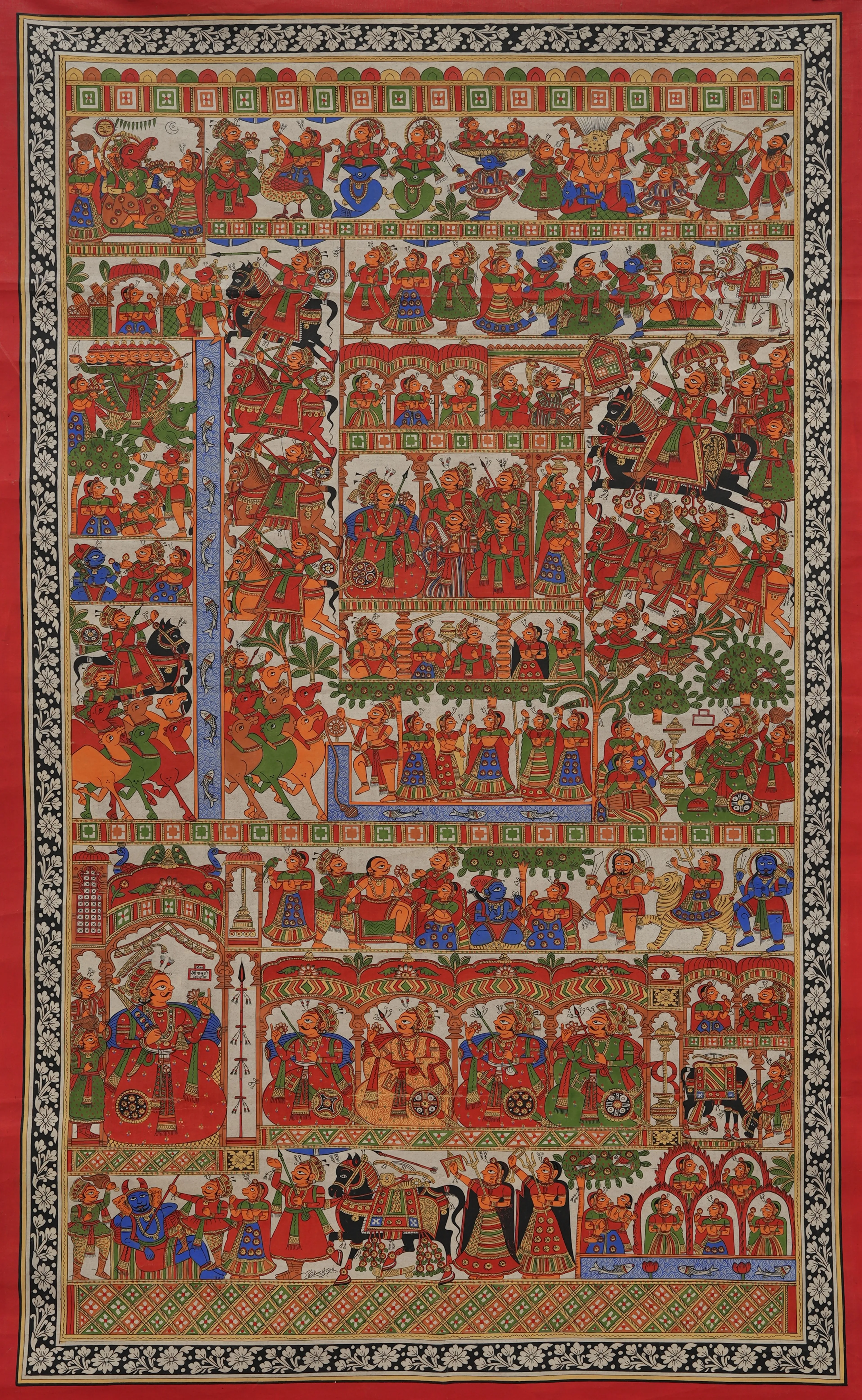
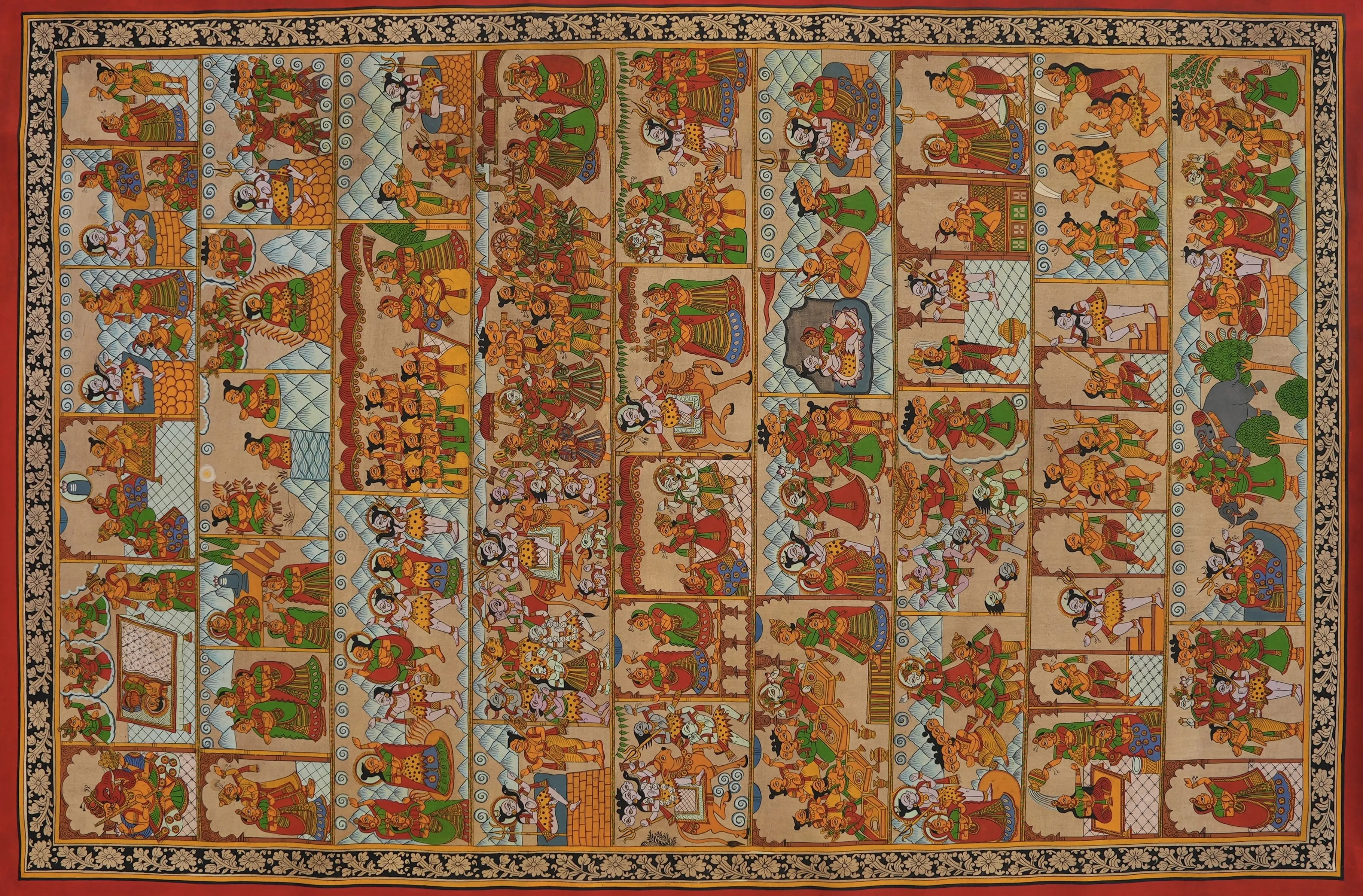
Divinity in Phad paintings may also be shown according to their attributes and figures. For example, Lord Krishna is portrayed in his characteristic blue skin tone and a crown with a peacock feather. Lord Shiva may be depicted with a slight, grey skintone to symbolise the smeared ash on his skin besides his trident, drum and the snake coiled around his neck. Divine and royal figures may also be depicted with a ‘Chhatri’ which is often considered as a symbol of royalty in Indian tradition.
Divinity may also be represented with the presence of a halo. Thus, the most commonly recognisable features for deities are derived from the broader Hindu iconographic tradition; even though the figures themselves might be characteristically depicted in the traditional Phad style of rounded faces and elongated eyes. A feature that stands apart in Phad paintings is that the only the elephant-headed Lord Ganesha’s head is depicted entirely in the colour red.
Animal Motifs in Phad Painting
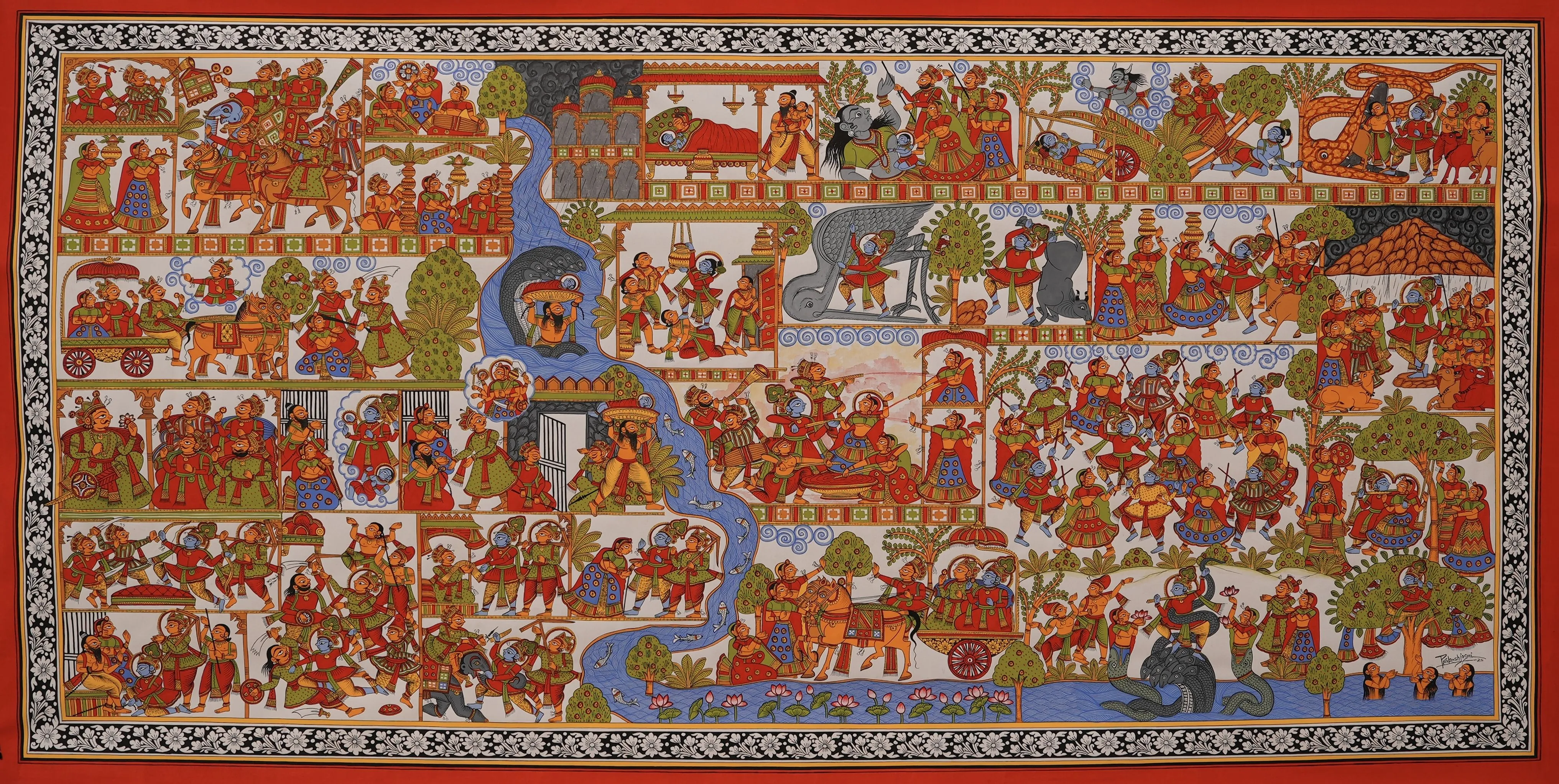
Animals are also a recurring motif in Phad paintings. They indicate the divine status of the protagonist or are an integral part of the plot. Up for example, is Kesar Kalmi, the black mare of Pabuji who is said to have magical powers and who was acquired by a cattle and horse breeder called Deval by Pabuji. Camels are native to the pastoral life of Rajasthan. Pabuji is also accorded the status of being the protector of cattles and camels. In the Devnarayan Phad, Devnarayanji is portrayed as sitting on a Basag Nag or the King of Serpents.
Elephants, camels and horses are often depicted in ceremonial and military processions and also to denote the status of the rider. Royal processions mostly portray elephants. These animals are highly decorated. Besides these, animals which are a part of mythological stories are also depicted either as benevolent or malevolent like in the case of Lord Krishna and his childhood ‘leelas’ where he annihilates Vatsasura, a calf demon and Bakasura, a crane demon and Kaliya Naag, a multi-headed serpent. In Phad depicting the Ramayana, the demon-in-disguise Maricha is depicted as a deer.
Cows are an important motif in Phad paintings and symbolise divine grace and prosperity and the pastoral life of Lord Krishna. Peacocks are another recurring motif that signify monsoon rains, prosperity and love.
Composition and Colours
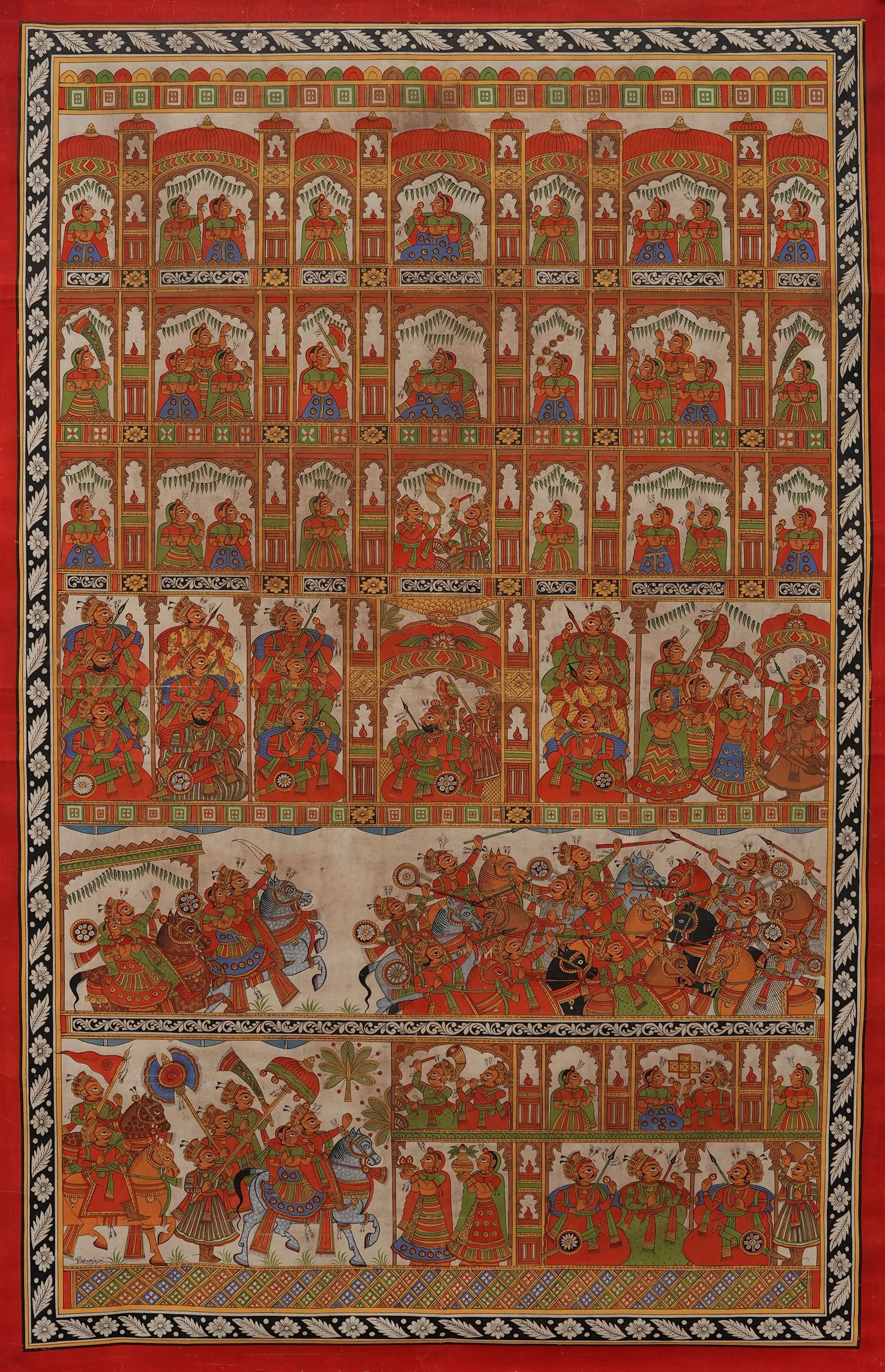
The composition is a dense amalgamation of various elements. A thick red floral border frames the composition. As mentioned earlier, a central panel depicts the main figure whom this narrative is about. Other compositional elements include human figures, animal figures, architectural elements and local flora. Architectural elements include stylised pillars, ‘jharokhas’ and ‘chhatris.’ Trees such as the Banyan tree, Kadamba tree, mango and neem also find representation in the composition. The Banyan tree is the symbol of divinity and stability and the Kadamba tree is associated with Lord Krishna.
Phad paintings amply depict scenes of battle that sugges the heroic valour of the central figures. Battle scenes are intense compositions with human figures as well as horses and elephants in the battle field. Phad paintings also may depict historic battles such as the Battle of Haldighati. Phad paintings also showcase royal processions and ceremonial occasions, local gatherings and musicians and dancers. Scenes of daily life are also found in abundance in the Phad that portray farmers, artisans, women carrying water and pastoral animals.
The dresses of the figures are mostly painted in red and decorated with yellow and green tones.
- Yellow is used to paint ornaments which indicates the status of the depicted figure.
- An orange tone is used as the skin tone for the figures.
- Foliage is depicted in green.
- Blue is used for water and is also used to signify divinity.
The elements are rendered in a flat two-dimensional style. Human figures always appear in profile facing eachother with rounded heads and elongated eyes. Yet owing to minor changes in the proportion of the features and expressions, each figure looks different. Posture and gesture also imparts emotional depth to the rendition. Scale is used to indicate power and status.
The colour palette consists of pigments that are mineral-based in origin and consists of red, orange, yellow, green, brown, blue, white and black. Red is termed as ‘hinglu’ which is artificial cinnabar or mercuric sulphide.
- Orange is ‘peori’ or ‘sindoor’, the former being magnesium and calcium salts of euxanthic acid while the later is made using slaked lime, turmeric and lime juice.
- Yellow is ‘hartal’ or yellow orpiment which is essentially arsenic sulphide.
- Green is derived from ‘jangal’ or verdigris which is primarily copper acetate.
- Brown is ‘hirmich’ or ‘geru’ which is hydrated iron oxide with silica-containing clay.
- Blue is termed as ‘angeera neel’ and is plant-based in origin. Black is ‘kajal’ which is lamp black.
- White is shell white or calcium carbonate.
The binder used is plant gum derived from the Keekar or the Gum Arabic tree. Each colour is applied in layers after the previous layer has dried.
In Conclusion
The Phad is ritually immersed in water after being employed in years of performance which is known as ‘thandi karni’ or ‘to cool down.’ In contemporary times, Phad paintings also incorporate social issues and text highlighting the same. It aligns with the original intended of the Phad as a means of transmission and awakening among the masses through a unique, sophisticated visual language of it’s own.
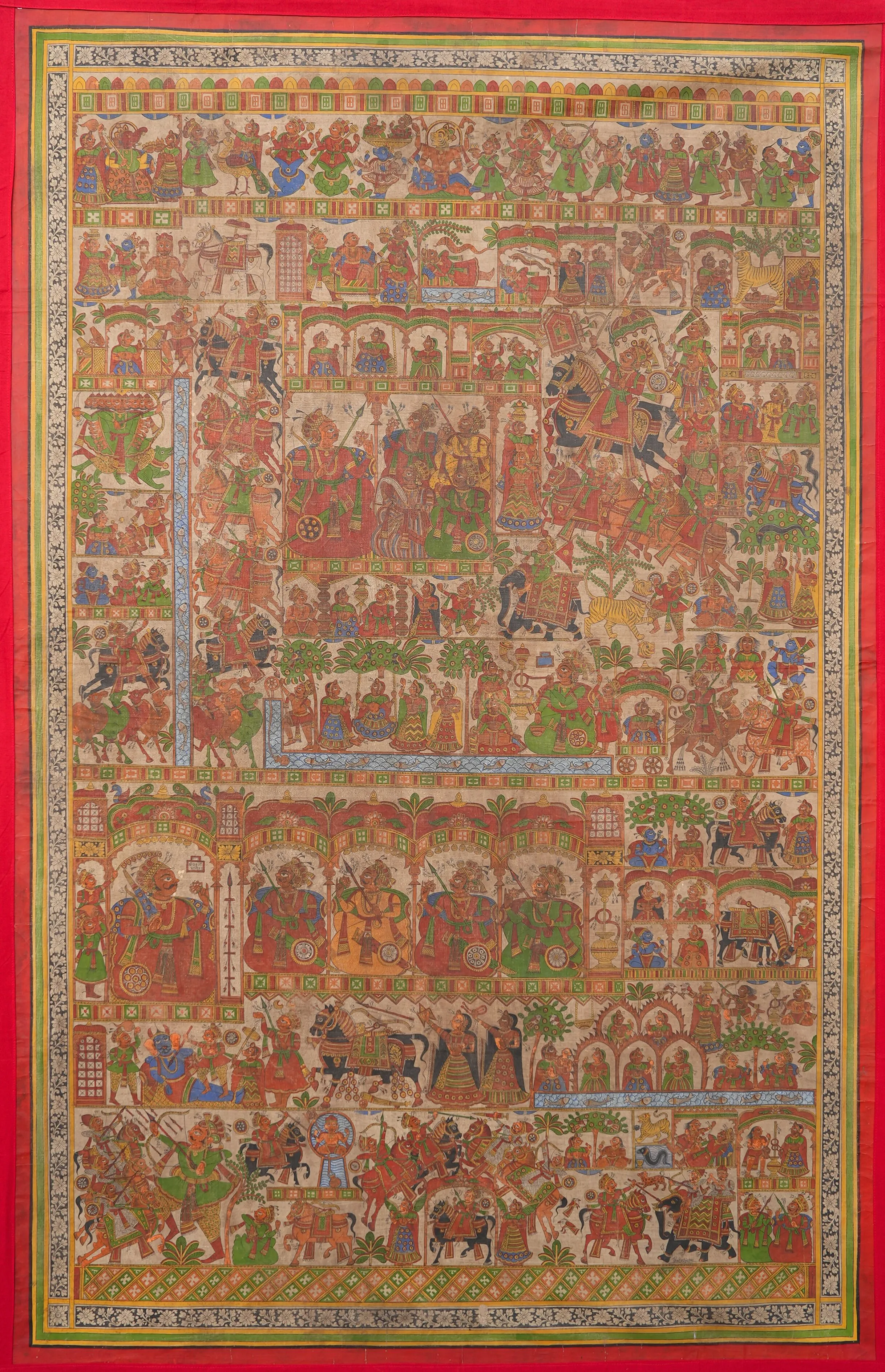
Phad paintings are an excellent repository of historical, philosophical and sociological information that along with the messages that they transmit, also bear communal memory and identity throughout the ages and continue to do so as a living tradition. You can explore a curated collection of exclusive Phad artworks on Rooftopp and bring home original pieces crafted by master artisans.