

Updated 14 November 2026
Lippan art is mud and mirror relief work from Kutch in Gujarat. The clay is shaped by hand into raised lines and set with small mirrors, so a plain wall catches every bit of light in the room. In Kutch it began on walls, not in frames. Families pressed it straight onto the walls of their round mud houses, and they renewed it the way you would repaint a home.
Today you see Lippan on MDF boards in Mumbai flats, on hotel walls in Ahmedabad and in weekend workshops across India. That popularity has blurred what the craft actually is. This guide covers where Lippan comes from, how the people of Kutch make it, what the motifs mean, how modern Lippan differs from the old wall work, and how to make an easy Lippan piece at home.
| Lippan art | |
|---|---|
| Also called | Lippan kaam, chhittar kaam, mud and mirror work |
| Home | Kutch district of Gujarat, especially the Banni grasslands near the Great Rann |
| Practised by | Rabari, Kumbhar, Mutwa, Marwada Harijan and Meghwal communities (CSJM University paper) |
| Traditional materials | Clay mixed with camel or wild ass dung, small mirrors called aabhla, a white clay finish |
| Modern materials | MDF or wooden board, air-dry clay or a glue-based dough, glass or acrylic mirrors, acrylic paint |
| Where to see it | Bhungas in Banni villages and around Dhordo, home of the Rann Utsav, held from 1 November 2026 to 7 March 2027 |
| GI status | An application, Kutch Lippan (Mud Mirror) Craft of Gujarat, is on the IP India GI registry, filed by the Kutch Art Trust, Samtra |
What is Lippan art?
Lippan comes from the Kutchi and Gujarati word for a mud plaster, often translated as mud washing, and kaam means work. So Lippan kaam is, quite literally, mud work. Older names for it include chhittar kaam. The craft is a bas-relief: the design stands up from the wall in raised lines of clay, and mirrors sit inside the shapes those lines make.
It belongs to the bhunga, the round, thatched mud house of Kutch. The Government of India's Incredible India guide to Kutch describes the bhungas along the highway to the Rann with elaborate mirror work on their walls. Inside, the relief work did two jobs at once. The thick mud kept the room cooler in summer and warmer in winter, and the mirrors bounced the light of a single lamp around a dark interior.
One point worth clearing up, because it confuses a lot of buyers: Lippan is a Kutch craft. You will find it sold in Rajasthan and painted in workshops all over the country, but the tradition grew in the villages of Kutch, among communities who settled there over centuries.
Who makes Lippan, and how the styles differ
Lippan is not one community's style. A paper published by CSJM University in Kanpur lists the Rabari, Kumbhar, Marwada Harijan, Mutwa and Meghwal among its makers, and notes that most practising artisans today come from the Kumbhar community.
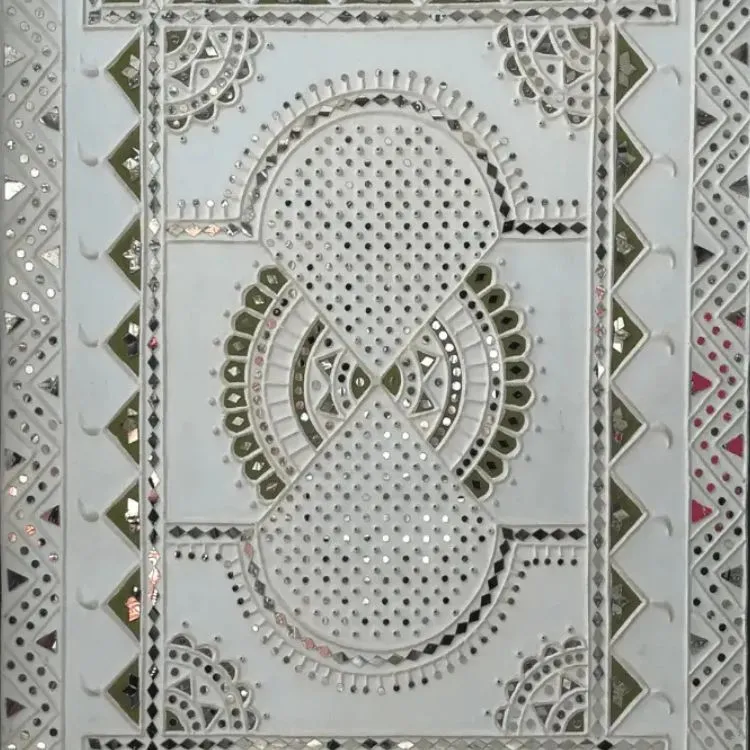
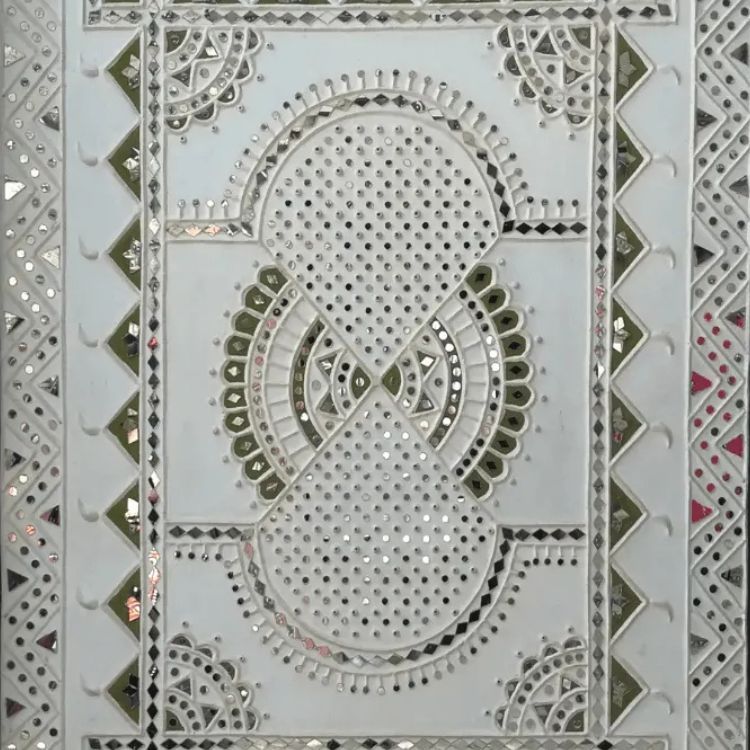
Traditional white Lippan with rows of mirror work · Image credits: BhaveshRRabari via Pixahive, from Rooftop
Each group brings its own habits to the wall.
- Rabari women traditionally did the work, and they often worked freehand, without a sketch, borrowing patterns from their own embroidery.
- In the Mutwa community it is the men who make the mud and mirror work. The Mutwa trace their arrival in Kutch from Sindh to roughly 400 years ago.
- Muslim artisans tend to keep to geometric patterns, leaving out human and animal figures.
- Hindu artisans mix geometry with figures from daily life and nature.
The Press Information Bureau has profiled one such artist, Majikhan Ilamkhan Mutva, who began with ₹1,500 worth of raw materials and in 2013 started teaching and selling the craft beyond his village, where he says only five people still knew it. The Rann Utsav organisers bought 12 of his pieces to decorate a hall.
How Lippan is made in Kutch
The traditional process is simple to list and slow to do well.
- The artisan mixes clay with dung into a stiff dough. Camel or wild ass dung was the usual binder, because its fibre holds the clay together.
- The wall is dampened so the fresh clay grips it.
- The dough is rolled between the palms into thin strips and pressed onto the wall to form the design, often with no drawing underneath.
- Mirrors are pressed into the wet clay inside the shapes. Before cut mirrors were easy to buy, people broke larger mirrors with stones and used the shards.
- The work dries, and is then coated with white clay or fine sand, which gives old Lippan its chalky white finish.
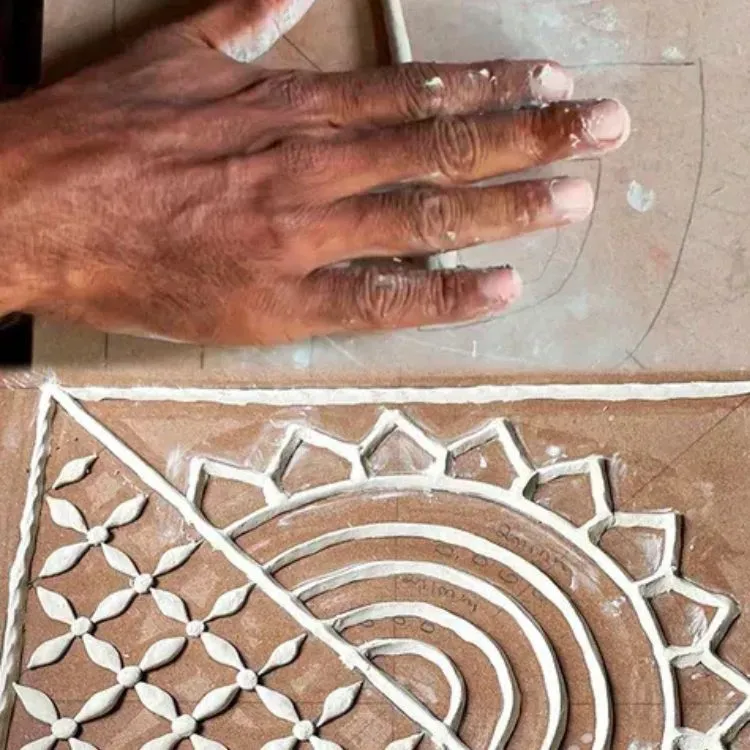
Clay rolled into strips and pressed into a Lippan design · Image source: Amounee
The All India Artisans and Craftworkers Welfare Association says a Lippan piece takes two to seven days and one or two artisans. Wall work in a bhunga needed touching up every year, because mud weathers. That is why the craft stayed alive inside families: it was maintenance as much as decoration.
The mirrors and the motifs
The small mirrors are called aabhla. They come cut as circles, triangles, diamonds and other small shapes, and they are what turns a mud relief into Lippan. In a room lit by one lamp, the aabhla throw tiny points of light onto every wall. Rabari families also use them to turn away the evil eye, as they do in their embroidery.
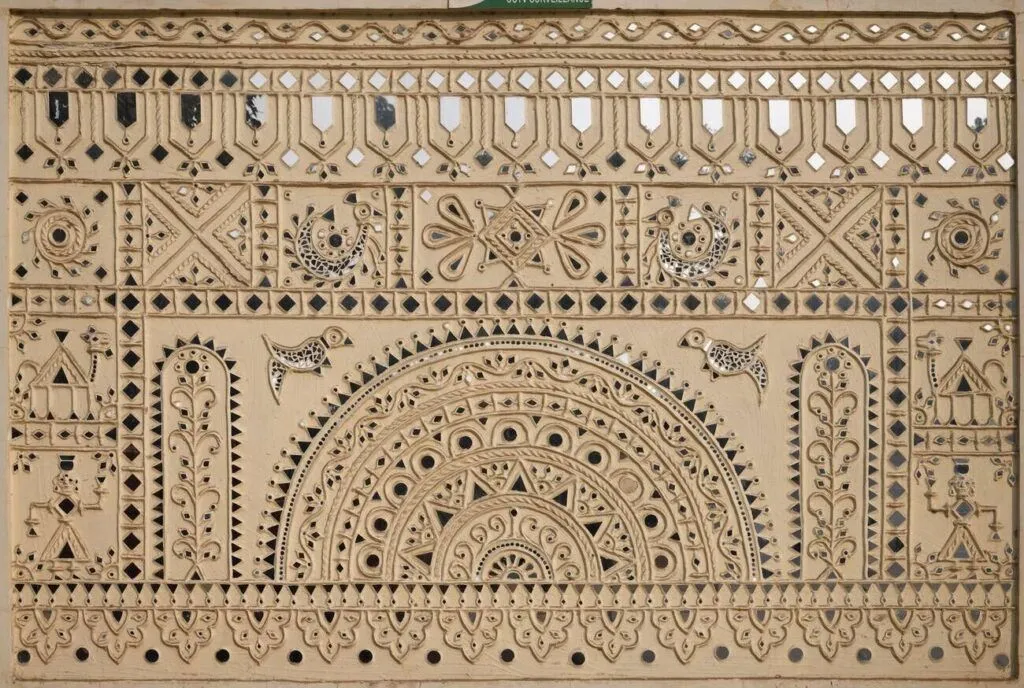
Mud relief and aabhla mirrors on a Lippan panel · Image source: AuthIndia
The clay lines around the mirrors follow a shared vocabulary. These are the motifs you will meet most often.
| Motif | What it shows | What people read into it |
|---|---|---|
| Mor | Peacock | Grace and beauty |
| Popat | Parrot | Joy and good news |
| Surya | Sun | Life and an ever-present god |
| Gaj | Elephant | Strength and prosperity |
| Panihari | Woman carrying water | The daily work that keeps a household alive |
| Camel | The animal of the Rann | The desert life of herding families |
| Geometry | Circles, diamonds, interlocking stars | Used by every community, and the only kind of motif in Muslim homes |
Women churning buttermilk, mango trees and small temples also appear, especially in Hindu households. Look closely at any good piece and you will see the clay lines doubled or tripled around each mirror, which is what makes the surface shimmer even before light hits the glass.
Traditional Lippan and modern Lippan art
Two things changed Lippan over the last 25 years. After the 2001 Gujarat earthquake, many bhungas came through standing, and the craft revival that followed brought buyers and designers to Kutch. Then the Rann Utsav began in 2005 and brought visitors in large numbers. Lippan moved off the walls and onto boards that could be sold and carried home.
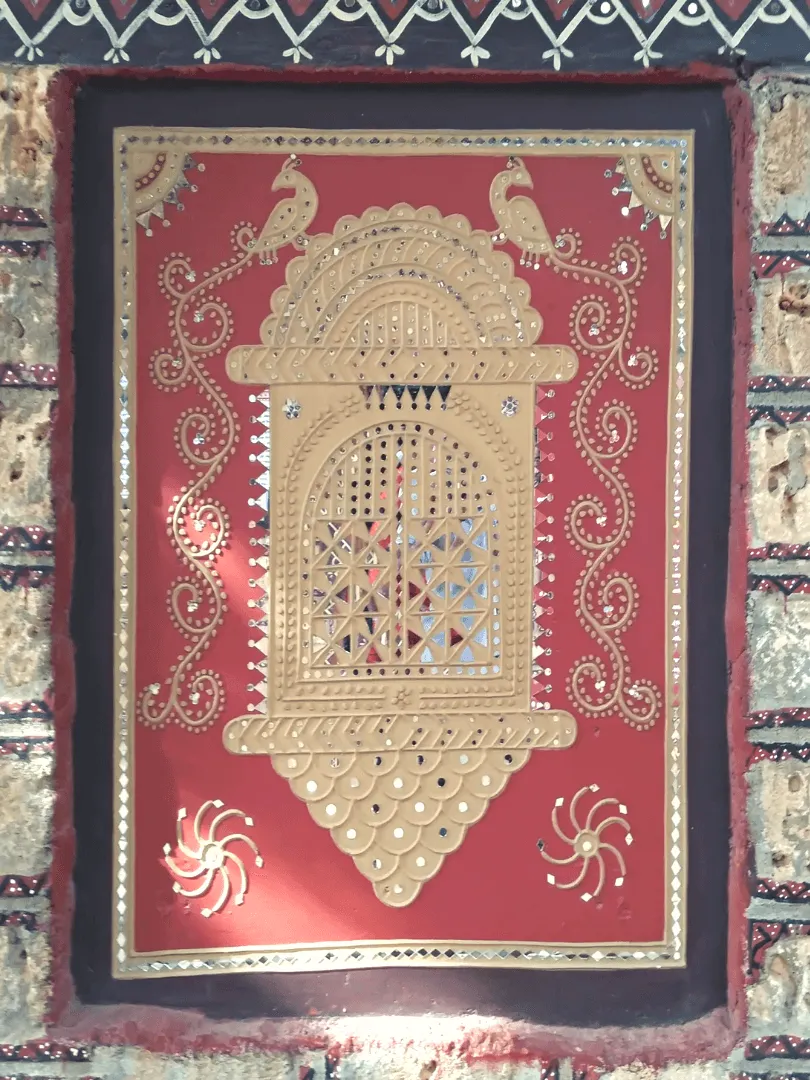
Lippan peacocks around a temple form on a red ground · Image credits: BhaveshRRabari via Pixahive, from Rooftop
The materials changed with it. Modern Lippan art usually swaps dung for chalk powder, sawdust and glue, or for ready-made air-dry clay. These are lighter, do not smell and do not need yearly repair. The base is MDF, plywood or canvas, and the finish is often painted.
| Traditional Lippan | Modern Lippan art | |
|---|---|---|
| Surface | Mud walls of the bhunga, granaries, doorways | MDF, plywood, canvas, wall panels |
| Dough | Clay and camel or wild ass dung | Air-dry clay, or chalk, sawdust and glue |
| Colour | White, ochre, earth brown | White plus bright turquoise, red, green, gold, black outlines |
| Mirrors | Hand-cut or broken shards of glass | Pre-cut glass or acrylic mirrors |
| Upkeep | Repaired every year | Dust it and keep it dry |
| Who buys | The family who lives there | Homes, offices, hotels, gift buyers |
Neither version is wrong. Many Kutch artisans make both, and some contemporary pieces are made by the same families who still plaster bhungas at home. What matters is knowing which one you are looking at.
How to tell handmade mud Lippan from a decor copy
The All India Artisans and Craftworkers Welfare Association gives three useful tests for mud-based work. Real Lippan has a grainy, earthy texture with small cracks and uneven clay lines. A mud panel is heavier than a resin or MDF replica of the same size. And because the mirrors are pressed into wet clay, they sit slightly below the surface, not glued on top of it.
Design gallery: Lippan in walls, panels and homes
Lippan works at almost any scale, from a 6 inch coaster to a whole room. These are the forms you will see most.
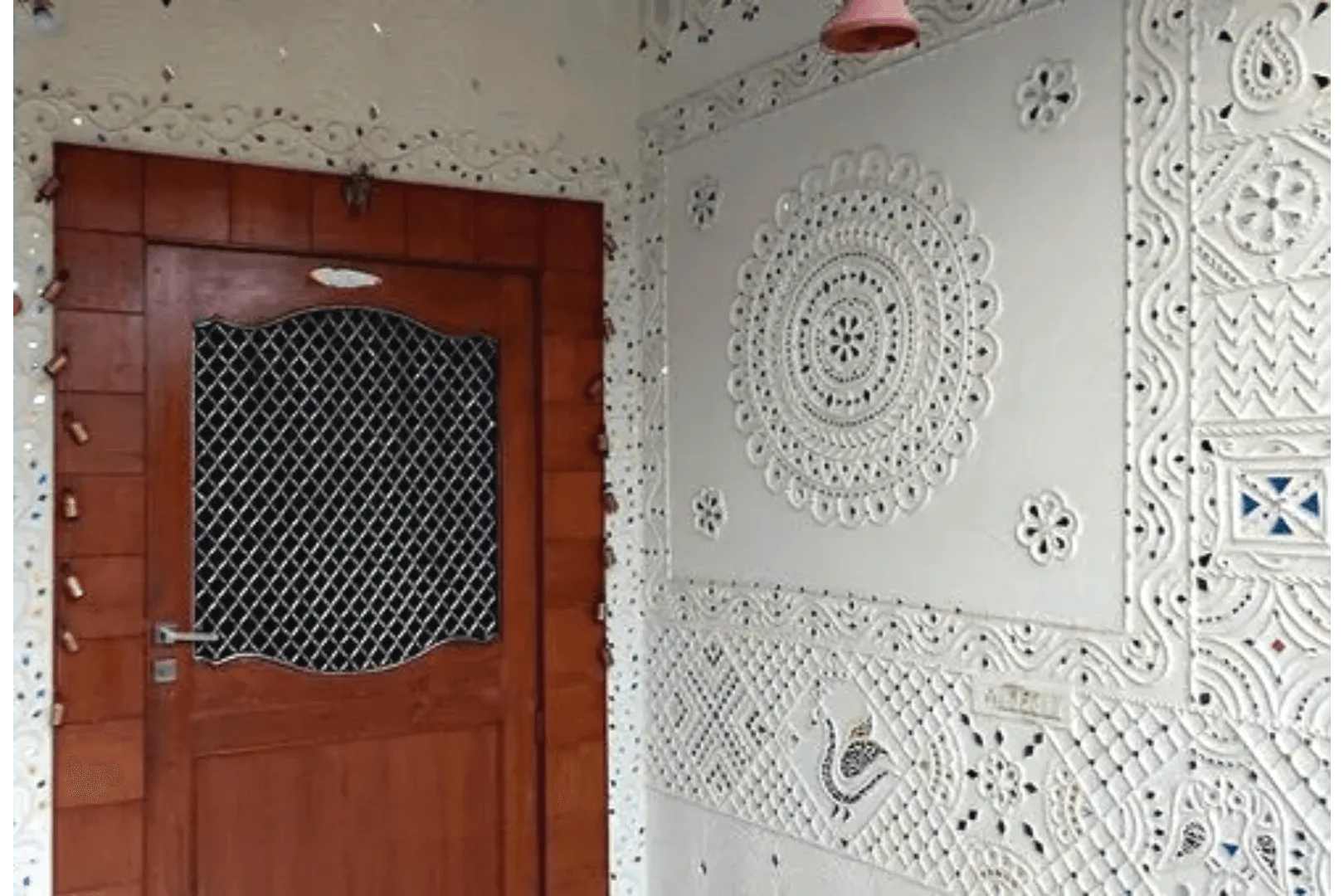
White Lippan relief framing a doorway · Image credits: IndiaMART
Wall installations wrap a doorway or a window in white relief, the way a bhunga's entrance would be framed. This is the most traditional way to use Lippan in a modern home, and it needs an artisan on site.
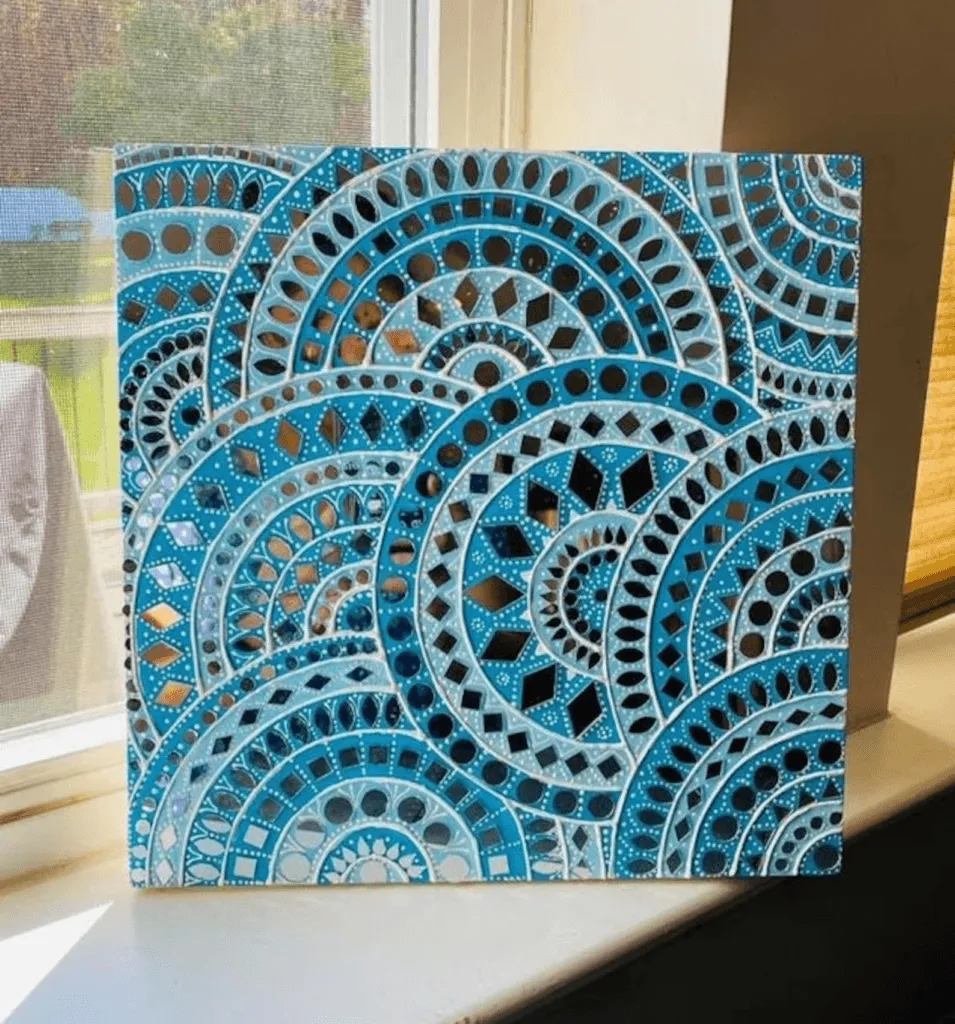
Modern Lippan art in blue and white on a panel · Image credits: Shastrends via Etsy
Panels on MDF are the most popular form of modern Lippan art. Rings and arcs of clay and mirrors repeat across the board, which suits the circle-based geometry of the craft. Blue, teal and white schemes are common in city homes.
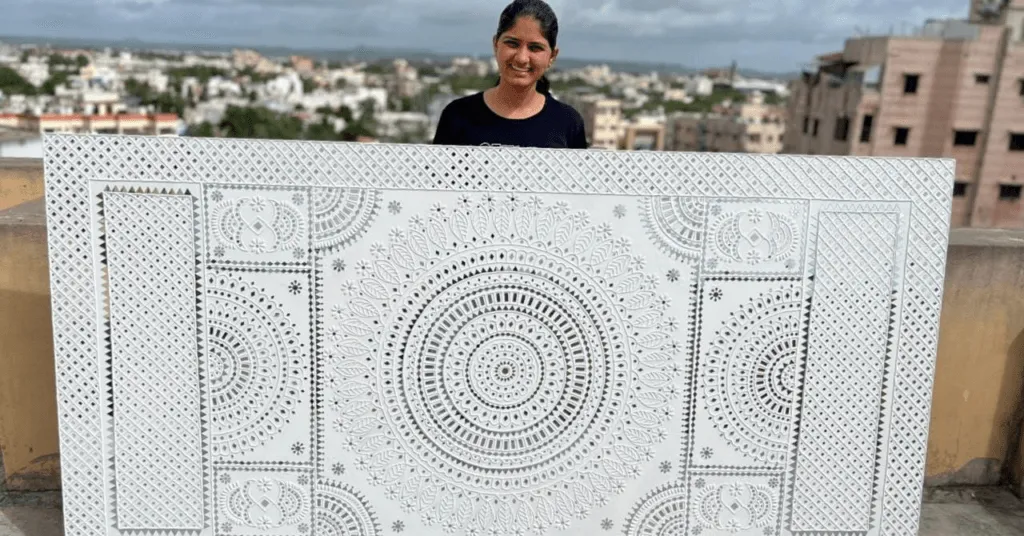
A large white Lippan panel with its maker · Image credits: Mital Shah Mud Work via Facebook
Large white panels like this one, made by a mud work studio, carry the old bhunga look into apartments, with dense mirror work and no colour at all.
Easy Lippan art at home: a step-by-step guide
You do not need dung or a mud wall to try Lippan. A round MDF board and a pack of air-dry clay will teach you how the craft feels in the hands. Our guide to choosing a Lippan art kit goes through what to buy. Here is the method.
What you need
- A round MDF board, 8 to 12 inches across
- Air-dry clay or moulding dough, white or terracotta
- Mirrors in two or three shapes, such as circles, triangles and diamonds
- Strong craft glue for the mirrors and white glue for the clay
- Acrylic paint for the base and the relief, plus a flat and a fine brush
- A pencil, a compass or round lids for circles, a ruler and a toothpick
- A small bowl of water and a damp cloth
Steps
- Paint the board. A dark base, such as brown, maroon or deep blue, makes white clay lines stand out. Let it dry fully.
- Draw the design. Start with three or four concentric circles from the centre, then divide them with straight lines like the spokes of a wheel. Lippan is built on repetition, so keep the design simple and symmetrical.
- Stick the mirrors first. Glue a large mirror at the centre and smaller ones at the points where your lines meet. Doing this before the clay keeps them flat and exactly where you want them.
- Roll the clay. Take a small ball and roll it on a smooth surface into a thin snake, about the thickness of a matchstick. Keep a damp cloth over the rest of the clay so it does not dry.
- Outline each mirror. Run a strip of clay around every mirror, pressing gently with a fingertip so it holds. A second, outer ring makes the shape richer.
- Follow the drawn lines. Lay strips along your circles and spokes. Where two strips meet, smooth the joint with a wet finger.
- Add dots and small shapes. Fill the gaps with tiny balls of clay, small arches and leaf shapes. This is where Lippan gets its density.
- Let it dry. Leave the board flat, away from direct sun, until the clay is hard all through. Check the pack, but most air-dry clay needs about a day.
- Paint the relief. Paint the clay white, or pick a colour and keep it consistent. A fine brush keeps paint off the mirrors.
- Clean the mirrors. Wipe each one with a damp cotton bud. Fix a hook to the back, and your piece is ready to hang.
Mistakes beginners make
- Rolling the clay too thick. Thick strips look heavy and crack as they dry.
- Pressing the clay too hard. It flattens into a smear instead of a raised line.
- Drying it in the sun. Fast drying causes cracks and lifts strips off the board.
- Using too many mirror shapes. Two or three shapes look more like Lippan than eight.
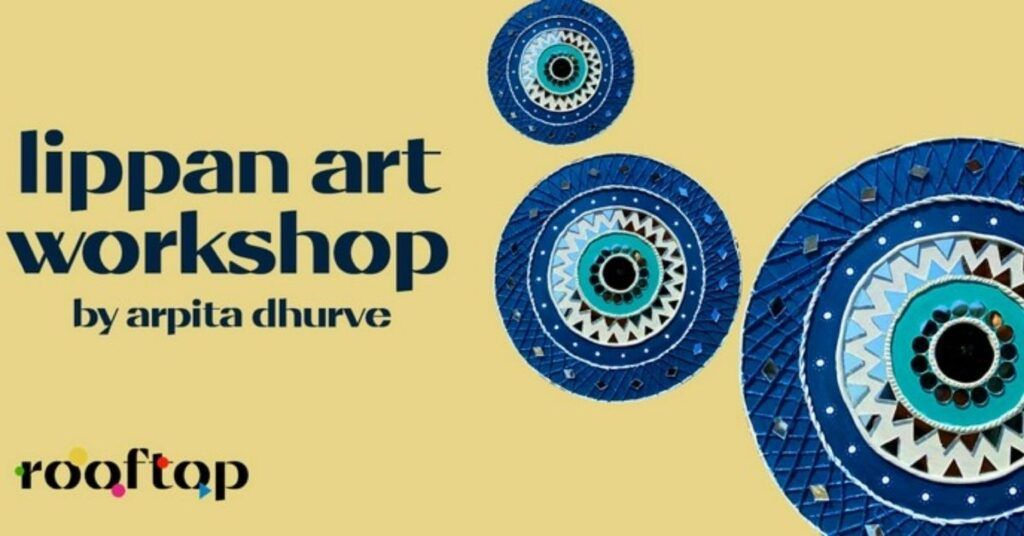
If you would rather learn with a teacher, Rooftop has hosted live Lippan sessions, including a Lippan art workshop with Arpita Dhurve, who built a circular piece from black clay, white paint and small mirrors in a single sitting.
Where to see real Lippan
The best place to see Lippan is still Kutch, in the villages of the Banni grasslands north of Bhuj. Dhordo, where the Rann Utsav tent city stands, is known for its traditional mud architecture, and Gujarat Tourism notes that the UN World Tourism Organization named it one of the 54 Best Tourism Villages of 2023. The 2026 to 2027 Rann Utsav runs from 1 November to 7 March, which makes this winter the right time to go.
When you visit, ask before photographing inside a home, and buy directly from the artisan if you can. A piece bought from the family who made it tells you more about Lippan than any workshop.
For the longer story of the craft, its communities and the bhunga, read Lippan kaam on Rooftop's Art Wiki, and for how it found its way into city homes, the contemporary demand for Lippan art.
Frequently asked questions
What is Lippan art?
Lippan art is a mud and mirror relief craft from Kutch in Gujarat. Raised lines of clay are pressed onto a wall or board and small mirrors called aabhla are set inside the shapes. It was traditionally made on the walls of bhungas, the round mud houses of Kutch.
Which state is Lippan art from?
Gujarat. It comes from the Kutch district, especially the Banni region near the Great Rann. It is often sold in Rajasthan and elsewhere, but the tradition belongs to Kutch.
What is Lippan art made of?
Traditionally, clay mixed with camel or wild ass dung, small mirrors and a white clay finish. Modern pieces use MDF boards, air-dry clay or a glue-based dough, pre-cut mirrors and acrylic paint.
Is Lippan art easy to make at home?
Yes. A simple round design on an 8 to 10 inch MDF board, with air-dry clay and a few mirrors, takes an afternoon to build and about a day to dry. Keep the clay lines thin and the design symmetrical.
Is Lippan art GI tagged?
Not yet. An application for Kutch Lippan (Mud Mirror) Craft of Gujarat, number 1768, filed by the Kutch Art Trust, is listed on IP India's GI registry as a new application.
What is the difference between Lippan kaam and modern Lippan art?
Lippan kaam is the traditional wall craft made with mud, dung and mirrors in Kutch homes. Modern Lippan art usually means panels made on MDF with air-dry clay, acrylic mirrors and paint, sold as wall decor.