

Updated 14 November 2026
A good Lippan art kit should tell you exactly what is in the box: the base board, the clay, the mirrors and the tools. Check each one before you buy. Most disappointing kits fail on one of these four, usually the clay or the mirrors, and you only find out halfway through your first piece.
Lippan art kits are everywhere in India now, from ₹299 boxes in stationery shops to larger sets with several boards. They make it easy to try the mud and mirror work of Kutch at home. This guide explains what each part of a kit does, compares the kits on sale, lists the Lippan art materials you need if you would rather buy them loose, and tells you what no kit can give you.
What a Lippan art kit should contain
Use this as a checklist when you read a listing. If a kit leaves something out, you will need to buy it separately.
- ☐ A base: an MDF board, a plywood board or a canvas board, with its size stated
- ☐ Clay or moulding dough: air-dry clay or a dough such as Mouldit, with the weight stated
- ☐ Mirrors: pre-cut pieces, with the shapes, sizes and whether they are glass or acrylic
- ☐ Adhesive: glue that will hold mirrors to the board
- ☐ Paint: acrylic colours for the base and the relief, usually white plus a few shades
- ☐ Brushes: at least one flat brush and one fine brush
- ☐ A design: pre-marked lines on the board, a printed template or a stencil
- ☐ Instructions: printed steps or a video, including how long the clay takes to dry
A kit that ticks all eight is ready to use the day it arrives. Six out of eight is fine if you already own brushes and glue.
What each item does, and what to look for
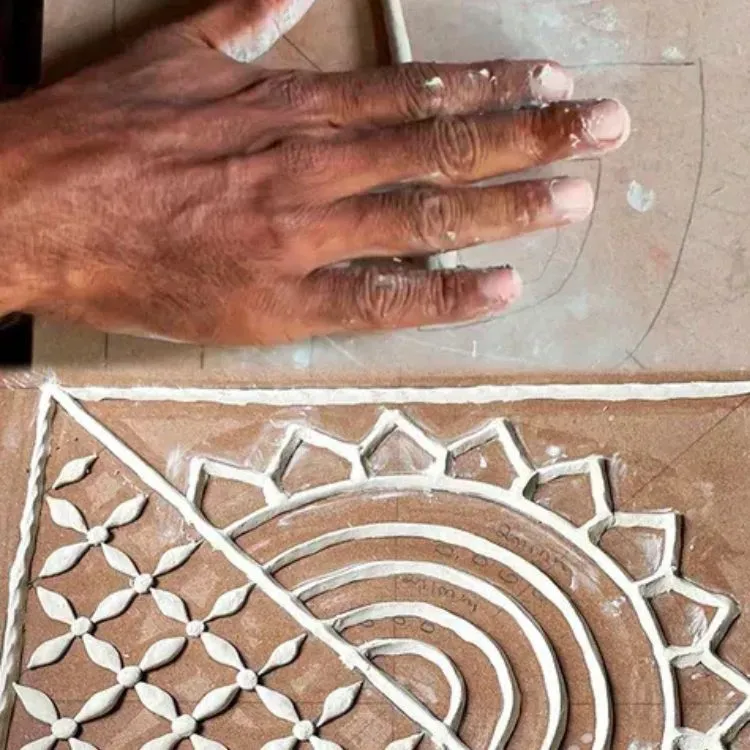
Rolling clay into thin strips, the first skill any Lippan kit teaches · Image source: Amounee
The base board
In Kutch, Lippan was pressed straight onto mud walls. At home, you need something flat and stiff. MDF is the usual choice because it does not warp easily and takes paint well. Look for a board at least 3 mm thick, since thin boards bend as the clay dries and pulls on them.
Size matters more than people expect. An 8 inch round board is a good first project. Below 6 inches, there is little room for mirrors. Above 12 inches, a beginner runs out of clay and patience.
Some kits give you a pre-marked board, with the design already printed on it. That is easier for a first try, but you are tracing someone else's pattern. A blank board with a printed template lets you change the design.
The clay
This is the part that makes or breaks a kit. Lippan lines need a clay that rolls into thin strips without cracking, sticks to the board and dries hard at room temperature. Good options are air-dry clay and moulding dough made for craft use.
Avoid two things. Oil-based modelling clay never dries, so the piece stays soft forever. Polymer clay has to be baked in an oven, which does not suit an MDF board. If the listing just says clay, check which kind it is.
Check the quantity too. A small pack can run out before you finish the outer rings. If the kit shows a dense finished piece in its photos but contains only a small pack of clay, expect to buy more.
The mirrors
Mirrors are what make Lippan shimmer. In Kutch they are called aabhla, and artisans use small glass pieces cut into circles, triangles and diamonds. Kits use either glass or acrylic.
| Glass mirrors | Acrylic mirrors | |
|---|---|---|
| Look | Bright, sharp reflection, like traditional Lippan | Softer reflection, can look slightly plastic |
| Safety | Edges can be sharp, so adults should handle them | Safer for children |
| Weight | Heavier | Very light |
| Best for | Adults making a piece to hang | Children and group workshops |
Count the mirrors in the sample photo of the finished piece, and make sure the kit has more than that. Mirror stickers, which are thin reflective foil with a sticky back, are not the same thing, and they peel off over time.
Glue, paint and tools
You need a strong glue for the mirrors and a white craft glue to help clay stick to a painted surface. Some kits include an instant adhesive. It works fast but bonds skin just as fast, so keep it away from younger children.
Acrylic paint is standard for both the base and the relief. A dark base, such as maroon, brown or navy, makes white clay lines stand out the way they do on a bhunga wall.
Lippan needs very few tools. A toothpick, a ruler, a pencil and something round to draw circles with are enough. You do not need carving tools.
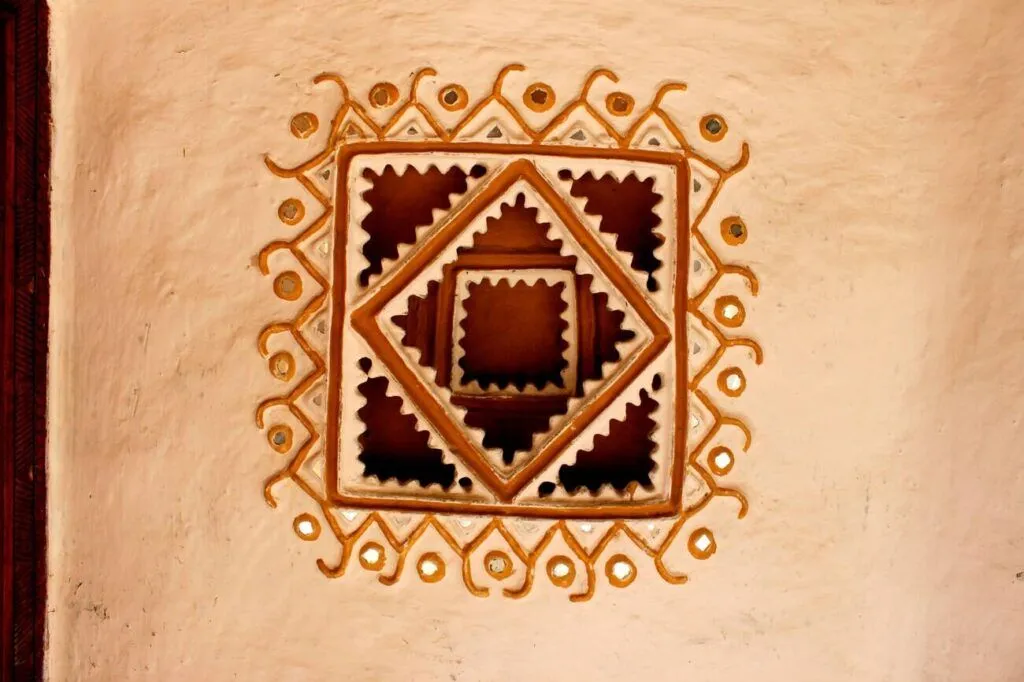
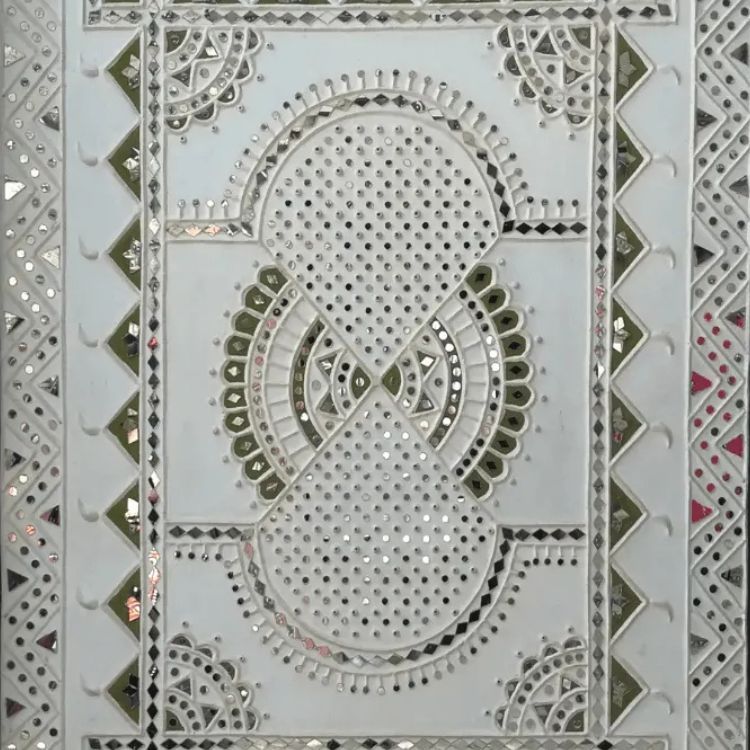
A single Lippan motif in clay and mirrors, about the scale of a first project · Image source: AuthIndia
Lippan art kits in India compared
These are listings we checked on 14 November 2026. Contents are as each seller describes them, and prices change often, so treat this as a guide to what each type of kit offers, not as a quote.
| Kit | What the listing says is inside | Listed price | Good for |
|---|---|---|---|
| Fevicryl Lippan Mini Art Kit | Canvas base, mirrors, Fevikwik craft adhesive, Fevicryl Mouldit, acrylic colours | ₹299 at Mango Stationery | A quick first try, or a return gift |
| Fevicryl Art of India Lippan Kit | The brand's own page lists a pre-printed canvas and a QR code to video tutorials. Retailers add Mouldit, mirrors, six acrylic shades and a round brush | MRP ₹699 on the Fevicreate shop, ₹549 on BigBasket | Beginners who want a guided design and video help |
| Hunar Setu Lippan Art Materials DIY Kit | Two round MDF boards, Lippan clay, mirrors, a brush and six acrylic colours | Check the listing for the current price | Two pieces, or a parent and child working together |
| Kits with three pre-marked MDF boards | Three 8 inch pre-marked MDF boards, acrylic paints, moulding clay and mirrors, from brands such as Craftinger | Varies by seller | Someone who wants to practise the same skills across a few pieces |
| Loose materials | You choose every item yourself | Depends on what you buy | Workshops, repeat makers, bigger pieces |
One detail in this table is worth noticing. Fevicryl's own page for its Art of India Lippan kit, which was designed by the artist Shreya Shah, lists only the canvas and the video tutorials, while the same kit on retail sites lists clay, mirrors and paint. That gap is exactly why you should read the contents, not the product name, before you pay.
Lippan art materials, if you buy them loose
Buying materials one by one costs more time but gives you better control. This is the full list.
| Material | What to buy | Why |
|---|---|---|
| Board | Round or square MDF, 3 mm or thicker, 8 to 12 inches | Stays flat as the clay dries |
| Clay | Air-dry clay or craft moulding dough | Rolls thin, dries hard, needs no oven |
| Mirrors | Pre-cut glass or acrylic in two or three shapes | Two or three shapes look closest to traditional Lippan |
| Mirror glue | Strong clear craft glue | Holds glass to a painted board |
| Clay glue | White craft glue | Helps strips grip the board |
| Paint | Acrylics: one dark base colour, white, plus one or two accents | Dark base makes the relief stand out |
| Brushes | One flat, one fine round | Base coat and detail work |
| Tools | Pencil, ruler, compass or round lids, toothpick, damp cloth | Drawing, shaping and keeping clay moist |
| Hanging | A sawtooth hook or a loop on the back | So the finished piece can go on a wall |
Our step-by-step guide to making Lippan art at home shows how to use all of this, from the first base coat to cleaning the mirrors.
How to choose the right kit
Start with who is going to make it.
- For a child aged around 8 to 12, pick a small canvas kit with acrylic mirrors, and have an adult handle any instant glue.
- For an adult trying Lippan for the first time, pick one 8 inch MDF board, real glass mirrors and enough clay for a dense design.
- For a gift, pick a boxed kit with printed or video instructions, so the person can start without looking anything up.
- For a group or classroom, buy loose boards, clay and mirrors in bulk. It is usually cheaper per person and lets everyone design their own piece.
- If you want to keep going after the first piece, buy loose materials, so you are not tied to one pre-printed pattern.
Red flags in a listing
- No list of contents, or only a product name and a photo
- Mirrors described as stickers or foil
- Clay with no weight given
- A finished sample photo that looks far denser than the kit could make
- No drying time or instructions
- The word Lippan with no mention of mirrors at all
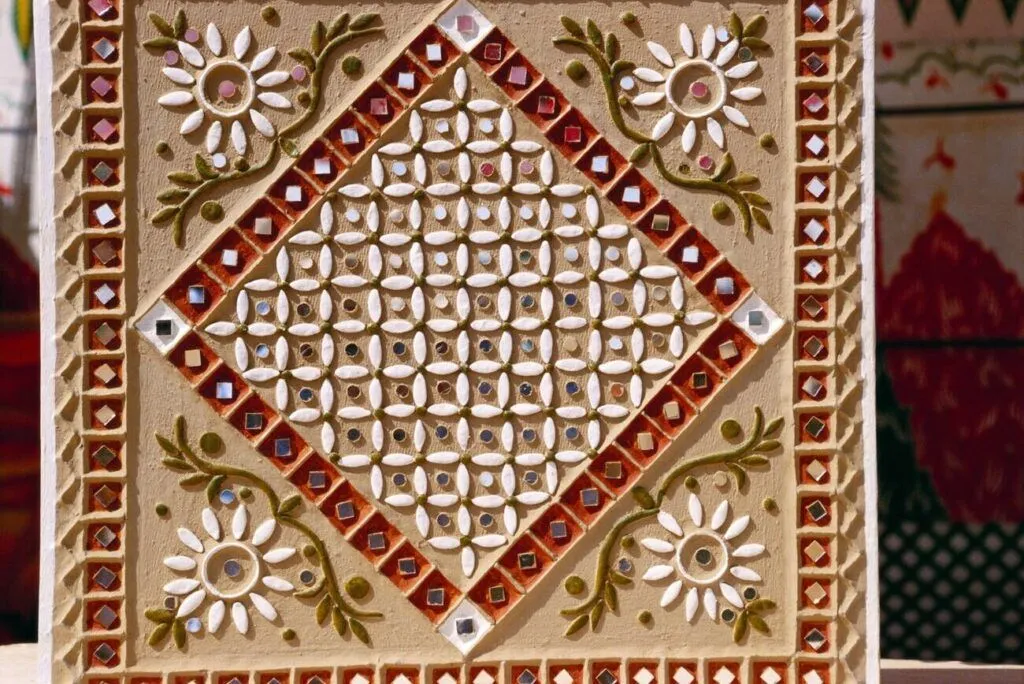
A coloured Lippan panel built on a diamond layout · Image source: IndiaMART
What a kit cannot give you
A kit teaches your hands the basic movement of Lippan: rolling thin clay, outlining a mirror, building a pattern out from the centre. It does not teach where those patterns come from.
Lippan grew on the walls of bhungas, the round mud houses of Kutch, made by Rabari, Kumbhar, Mutwa, Marwada Harijan and Meghwal families from clay mixed with camel or wild ass dung. Each community has its own habits. Rabari women often worked freehand, and Mutwa men carry the craft in their families. If you make your first piece and want to go further, read about Lippan kaam on Rooftop's Art Wiki, and look at real pieces before you design your second one.
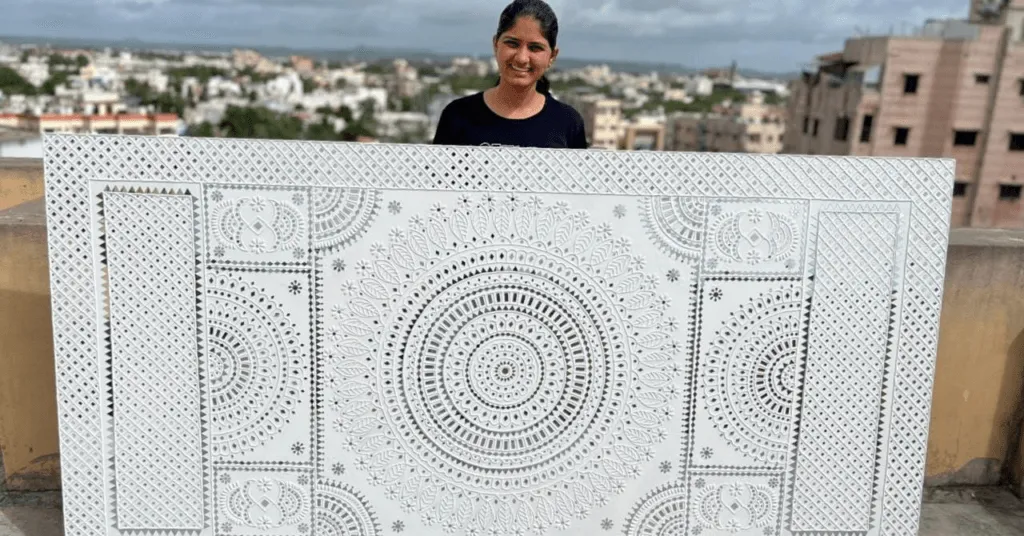
A large handmade Lippan panel with its maker · Image credits: Mital Shah Mud Work via Facebook
There is also a difference between a kit piece and a handmade piece from Kutch. A kit makes modern Lippan art on MDF. A piece from a Kutch artisan carries a hand trained over years, and often a family's own motifs. An application to register Kutch Lippan (Mud Mirror) Craft of Gujarat as a Geographical Indication has been filed on the IP India GI registry. If you travel to Kutch for the Rann Utsav, held at Dhordo from 1 November 2026 to 7 March 2027, you can buy directly from the people who make it. The Press Information Bureau's profile of Majikhan Ilamkhan Mutva, who built a mud work practice from ₹1,500 of raw materials, is a good picture of what that work looks like from the inside.
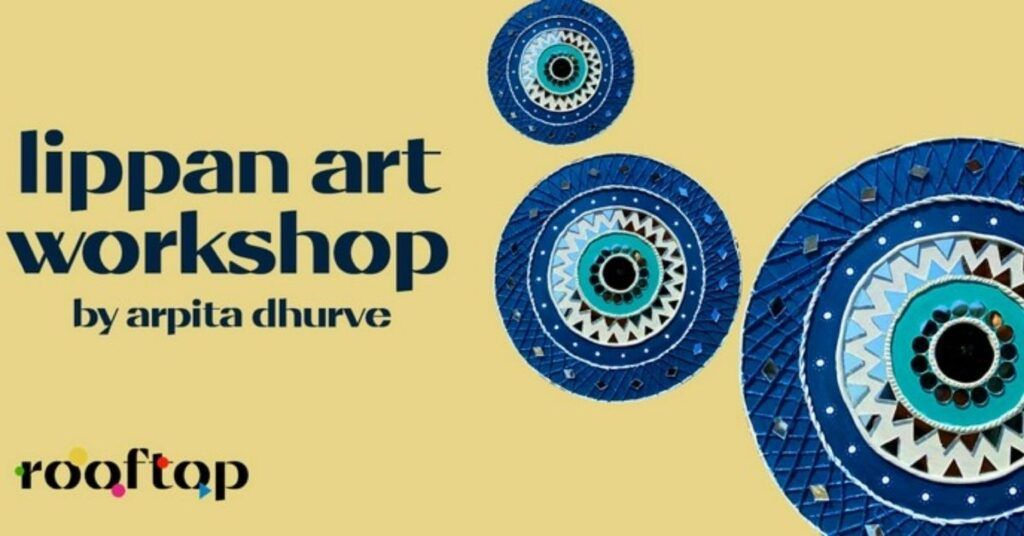
If you like learning through a kit, Rooftop's own kits do this for other art forms. The Warli art kit comes with a canvas sheet, bookmarks, postcards, stickers and an activity book on Warli's history and technique, and there are also kits for Phad, Pichwai and Madhubani. For a live session, Rooftop has run Lippan workshops such as the Lippan art workshop with Arpita Dhurve.
Caring for your finished piece
- Hang it away from steam and direct sun. Air-dry clay softens with moisture, and sun fades acrylic paint.
- Dust it with a soft, dry brush. Never wipe the clay with a wet cloth.
- Clean the mirrors with a slightly damp cotton bud, one at a time.
- If a mirror comes loose, fix it back with clear craft glue and press for a minute.
Frequently asked questions
What comes in a Lippan art kit?
A complete kit has a base board, clay or moulding dough, pre-cut mirrors, glue, acrylic paints, a brush or two, a design and instructions. Many cheaper kits leave out one or two of these, so read the contents list before buying.
What materials do I need for Lippan art?
An MDF or canvas board, air-dry clay or moulding dough, mirrors in two or three shapes, craft glue, acrylic paint, brushes, and basic tools such as a pencil, ruler, compass and toothpick.
Which clay is best for Lippan art?
Air-dry clay or a craft moulding dough that rolls thin and dries hard at room temperature. Avoid oil-based modelling clay, which never dries, and polymer clay, which needs an oven.
How much does a Lippan art kit cost in India?
When we checked in November 2026, small canvas kits were listed at ₹299, and a fuller Fevicryl kit at an MRP of ₹699. Kits with several MDF boards vary by seller.
Is a Lippan art kit suitable for children?
Yes, with adult help. Choose a kit with acrylic mirrors, and let an adult handle any instant glue and glass mirrors.
Can I buy a Lippan art kit online?
Yes. Lippan kits are sold on brand shops, grocery and stationery apps, and craft sites across India. Compare the contents list, not just the price.