

Koku Cards: How to Play India’s Fastest Symbol-Matching Card Game
How to play Koku Cards, the Indian symbol-matching card game with 57 folk motifs. Rules for all 3 modes, player count, age and Diwali game night tips.

Rooftop
Author
Somewhere in a Koku deck, a camel is sharing a card with a tarpa, a shankh and a supda. Pick up any two cards in the Koku card game and they will have exactly one picture in common. Your job is to find it before your cousin does, then shout its name loud enough to wake the dog.
That really is the whole game. It takes about thirty seconds to explain, and roughly one round before the youngest player at the table starts winning.
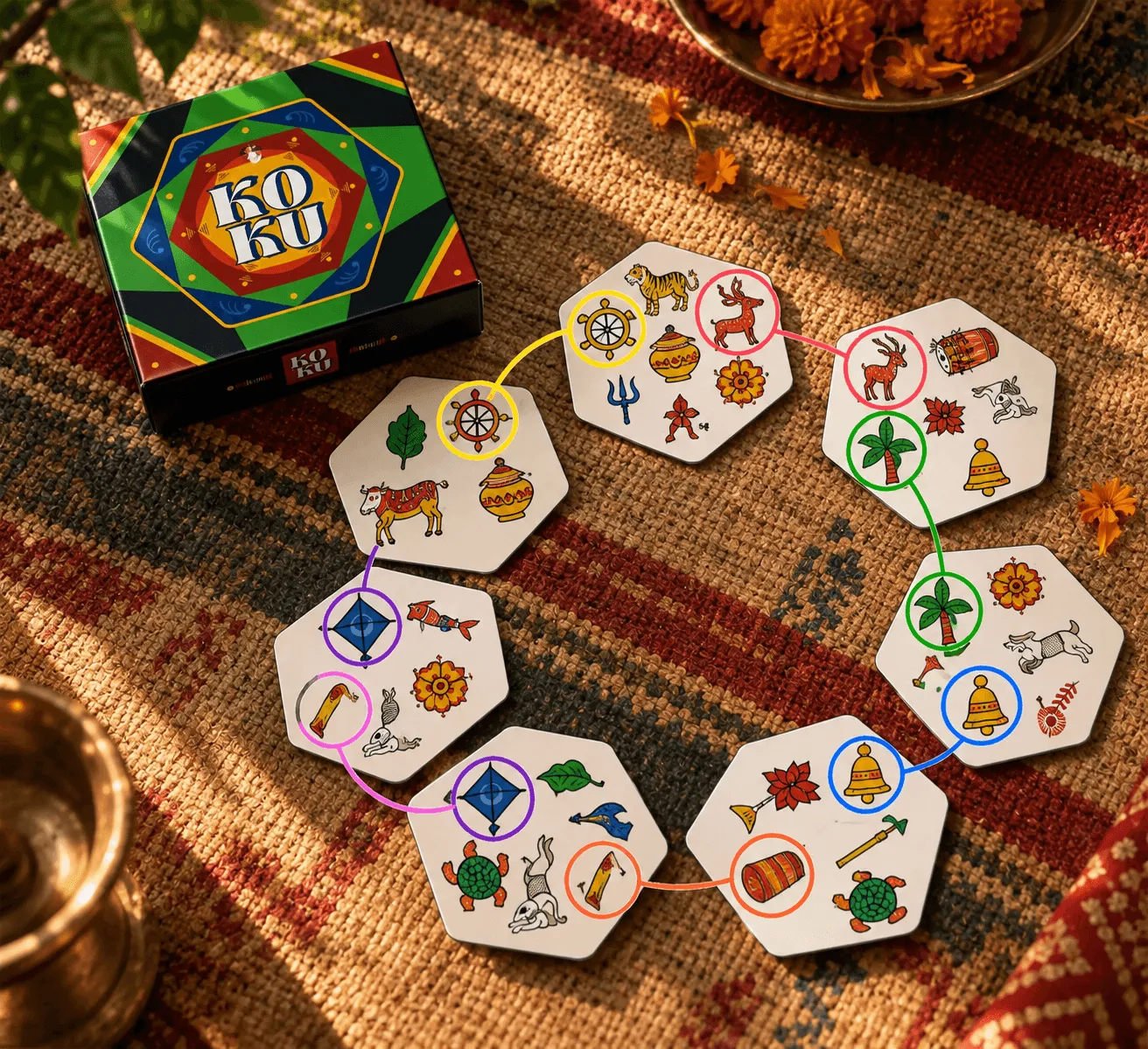
Koku cards are hexagons with eight symbols apiece. Any two cards in this photograph share exactly one picture.
What is Koku?
Koku Cards is a symbol-matching card game made by Rooftop. The deck draws on 57 symbols from Indian folk life and folk art, and each card carries 8 of them. The cards are hexagons, which feels cosmetic until you stack them into a tower for the third mode. Among Indian card games it sits closer to a party game than to rummy or teen patti, and nobody has to count points.
The deck is built on one rule. Any two cards share exactly one symbol. Never two, never zero. That means every call can be checked, and every argument can be settled by pointing at the table.
If that sounds suspiciously like maths, it is. Fifty-seven symbols at eight per card is the arrangement mathematicians call a finite projective plane of order 7. The French game Dobble runs on the same structure. Koku keeps the maths and swaps the insects for things you would find in an Indian home, at a village mela or on a Warli wall.
Know your symbols before the first round
Rooftop’s product page names eight of the 57 symbols. Eight happens to be exactly one card’s worth. Learn these and you already know roughly one symbol in every seven.
Warli bird. Drawn the Warli way, with a couple of triangles and a line. Warli painters in Maharashtra work in white on mud walls, and their birds are about as minimal as birds get.
Dholak. The two-headed hand drum that turns up at every sangeet, usually with a cousin who believes he can sing.
Camel. The Rajasthan one. Under pressure, at least one person at the table will call it a horse.
Supda. A flat winnowing basket, tossed to separate grain from husk. Anyone over fifty spots it instantly. Children tend to call it the dustpan.
Peacock feather. Krishna’s mor pankh. Easy to see, oddly hard to say at speed.
Tarpa. A Warli wind instrument made from a dried gourd, played at the centre of the circle dance. The symbol most likely to start a conversation mid-game.
Rangoli. The pattern drawn at the doorstep. On Diwali night you can check your answer on the way out.
Shankh. The conch blown at puja time, and by some distance the most satisfying word in the deck to shout.
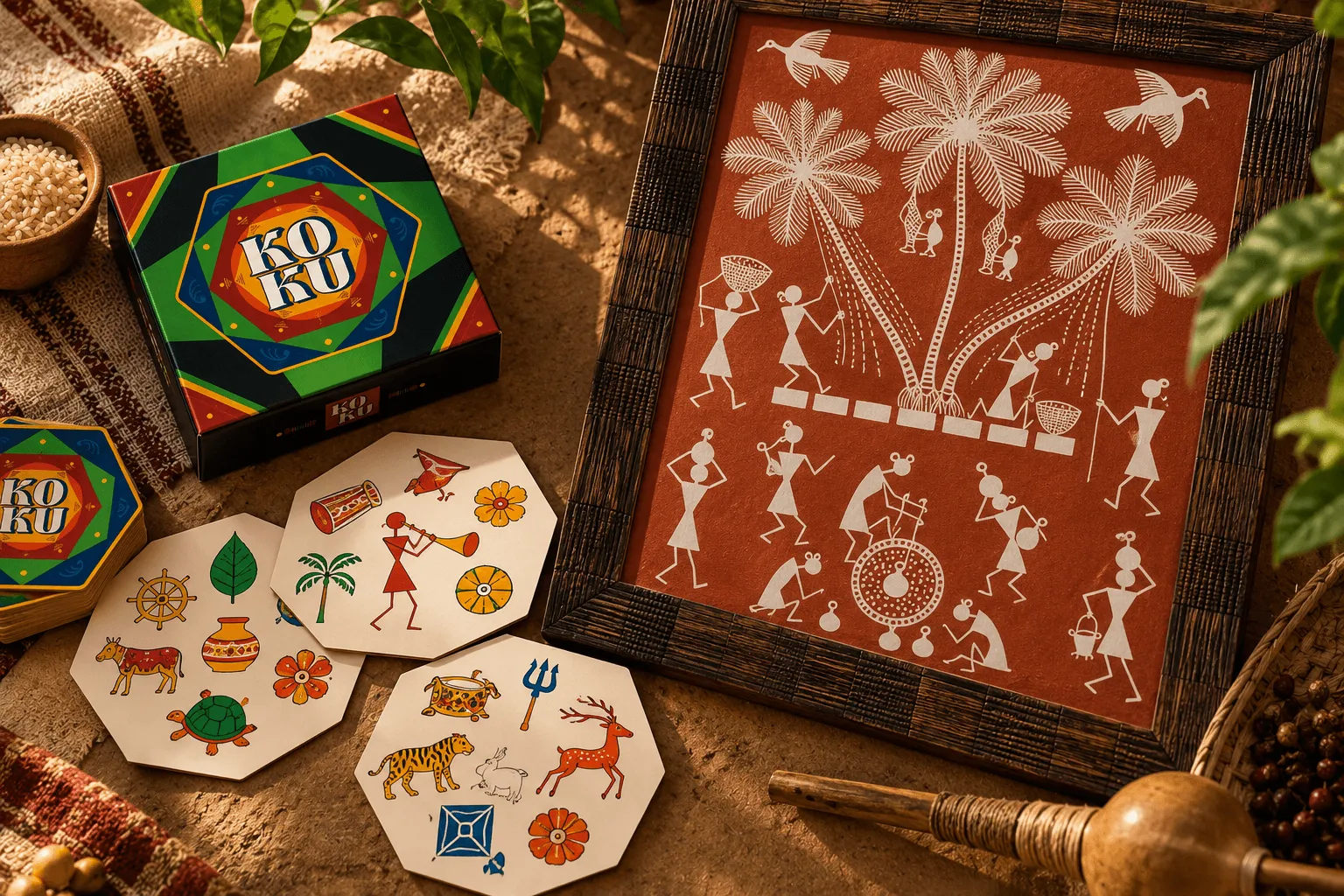
The Warli bird and the tarpa on Koku cards both come out of Warli painting, where the tarpa player often stands in the middle of the dancers’ circle.
If a child asks why a basket is in a card game, you have just been handed the best five minutes of the evening. The Warli entry on Rooftop’s Art Wiki is a good next stop.
How to play Koku: all three modes
Game 1: Koku, the classic race
Deal the cards out among the players and place one card face up in the centre. Everyone looks at the top card of their own pile.
Compare your top card with the centre card. The moment you spot the symbol they share, call it out and put your card on the centre. Your card is now the centre card, so everyone else’s target has just changed under their noses. The first player to empty their pile wins.
Teach this mode first. The only thing anyone has to track is eight small pictures.
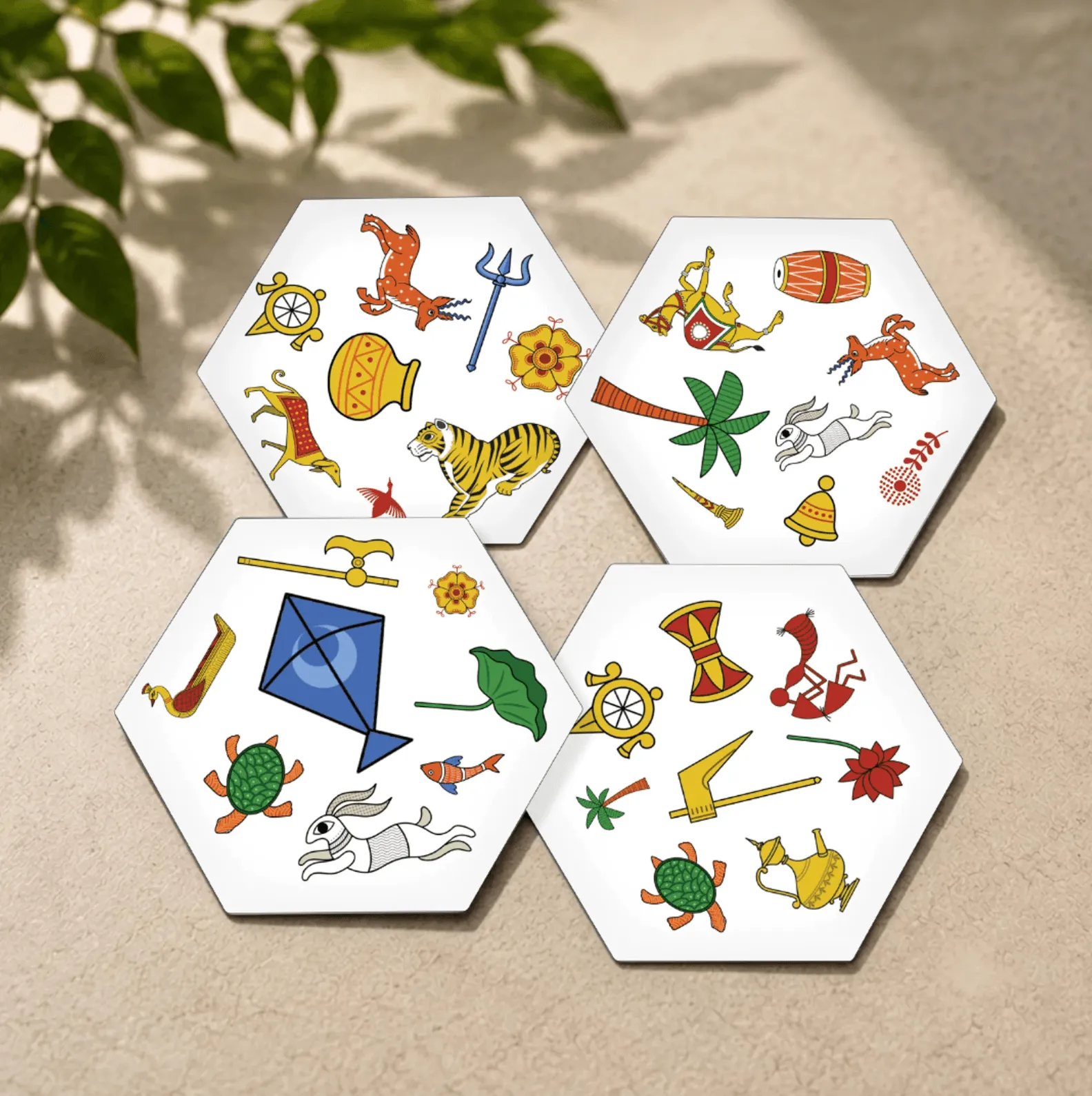
Two cards, sixteen symbols, one match. Scan the other card, not your own.
Game 2: Neighbours Envy, where winning is losing
Here the stakes flip. Match a symbol between your card and an opponent’s card, and you snatch their card. Finishing your cards first means you lose, so the table turns into a room full of hoarders.
Every Indian family keeps a long, unwritten record of who took whose last gulab jamun. This is the mode where that record gets settled.
Game 3: Reverse Koku, the tower
Stack the whole deck face up into a tower. Players draw one card at a time and race to find its match with the central card. Whatever you win, you keep. When the tower runs out, the player holding the most cards takes the game.
Reverse Koku suits big groups, because nobody needs their own pile and people can wander off to refill the chai mid-round.
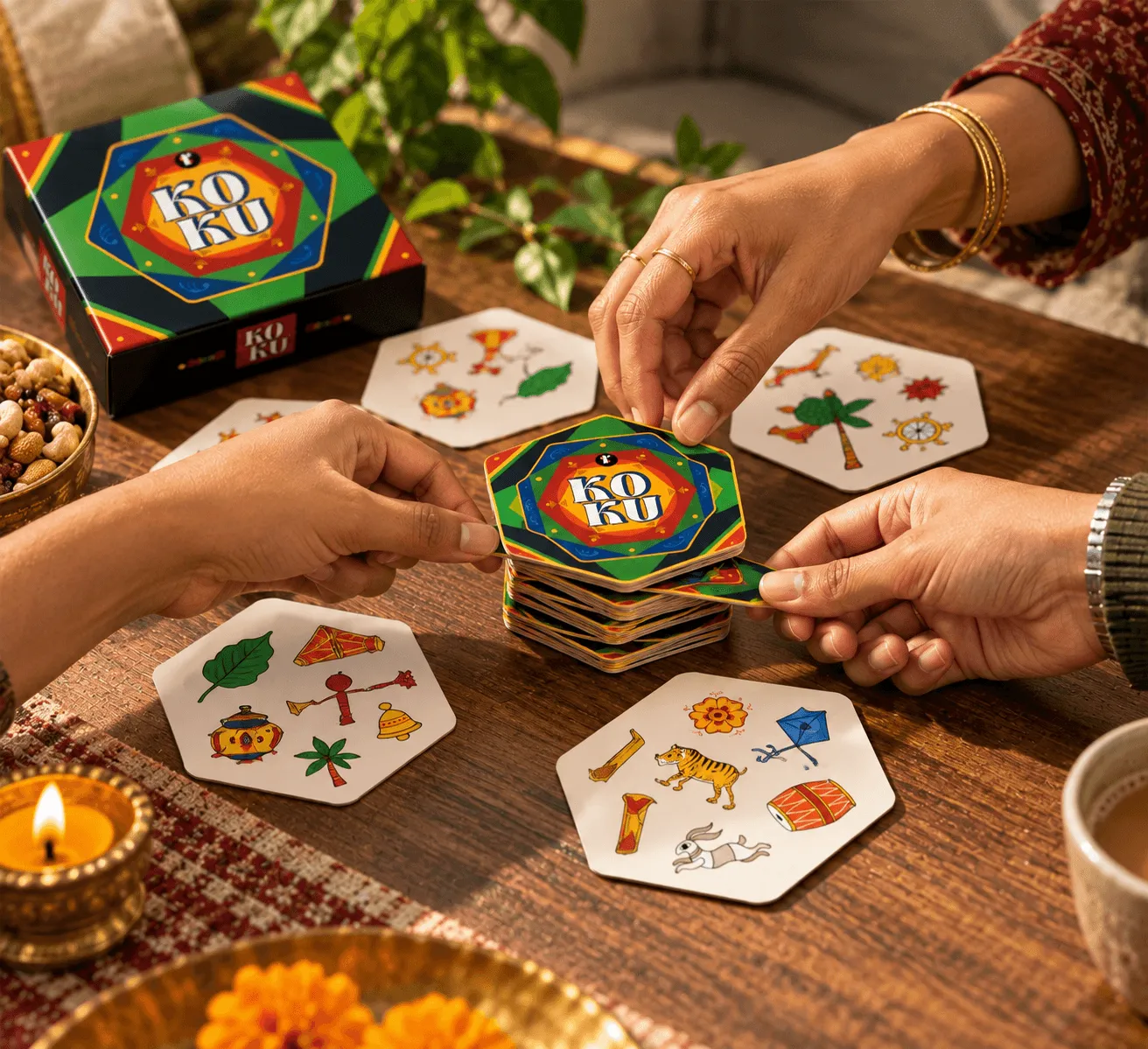
Reverse Koku turns the deck into a tower. It is the mode to pull out once the group passes eight people.
How many players, what age and how long a game takes
Koku works with two players and stays playable at twelve or more. Two players suit the classic race. Four to six is the sweet spot for Neighbours Envy, since there are enough opponents worth robbing. Past eight, build the tower.
The minimum age is six. A table with a seven-year-old, two parents and a grandparent is the fairest test there is. The grandparent will get the supda. The seven-year-old will get almost everything else.
Play time is the one number the box does not promise, and it would be fibbing if it did. A round ends when somebody’s pile is empty, so its length depends on how many cards you deal. Deal small piles for a quick round before dinner, or the whole deck for a long night.
Where to play Koku?
Anywhere with a flat surface and room for elbows: the floor after the puja, a dining table once the plates are gone, a berth on an overnight train. Loud rooms are fine. Koku was built for shouting.
Koku for Diwali, Navratri and office parties
Diwali falls on Sunday, 8 November 2026. By the time the puja is done, the house is full, the phones are out and somebody suggests teen patti. Koku is the version of that moment where an eight-year-old and an eighty-year-old can sit at the same table, and nobody has to explain what a pure sequence is.
It also earns its place at an office Diwali party, where twelve colleagues can share one deck. Neighbours Envy is a gentle, deniable way to let the intern take cards off the manager. Navratri runs from 11 to 19 October 2026, and the late nights after garba need something that starts in the time it takes to find a seat. For Bhai Dooj on 10 November, play the classic race sibling against sibling, and let the winner choose the gift.
Hunting for Diwali gifts for kids, or a return gift that will not end up in a drawer by January? Koku outlasts a box of mithai by several years. Rooftop’s round-up of Indian art gifts has more ideas, but for a family that plays together, this is the one to wrap.
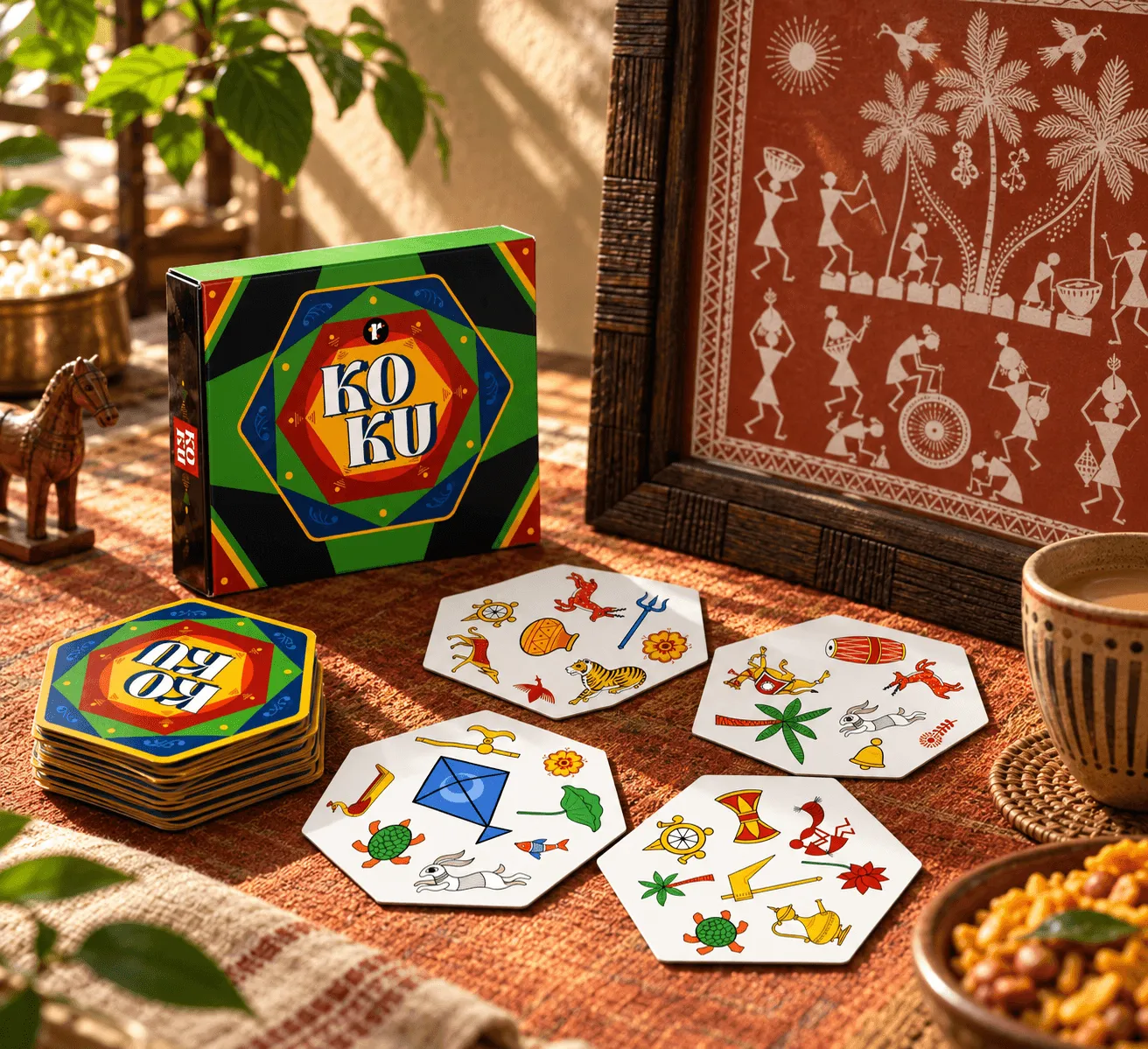
Symbol-matching card game, 57 Indian folk motifs, 3 game modes, 2 to 12 players, ages 6 and up
Four house tips worth adopting
- Say the symbol out loud. Pointing starts arguments, and naming ends them.
- Accept any language. Supda, soop and chhaj all count, and so does whatever your nani calls it.
- Play one open round first with every card face up, so younger players learn the symbols before the speed arrives.
- When two people call at the same instant, both put their card at the bottom of their pile and the game carries on. Nobody wins a tie.
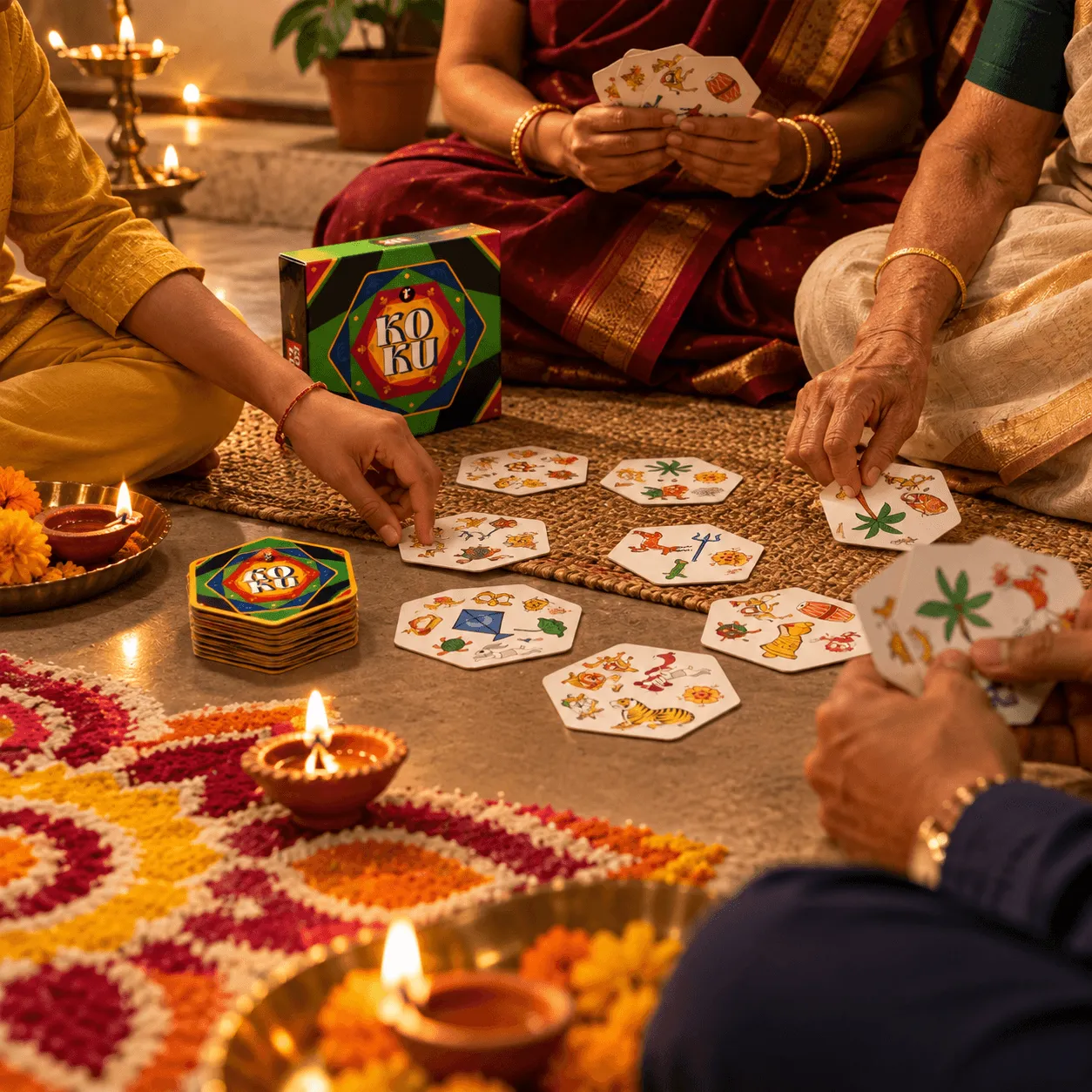
Diwali night, 8 November 2026. Koku lets three generations play the same game without anyone sitting out.
If the smallest player at your table is under six, Koku has a younger cousin. FATAC runs snap, memory and slap games on cards drawn in Bhil, Warli, Gond and three other art forms, and its product page starts the age at three.
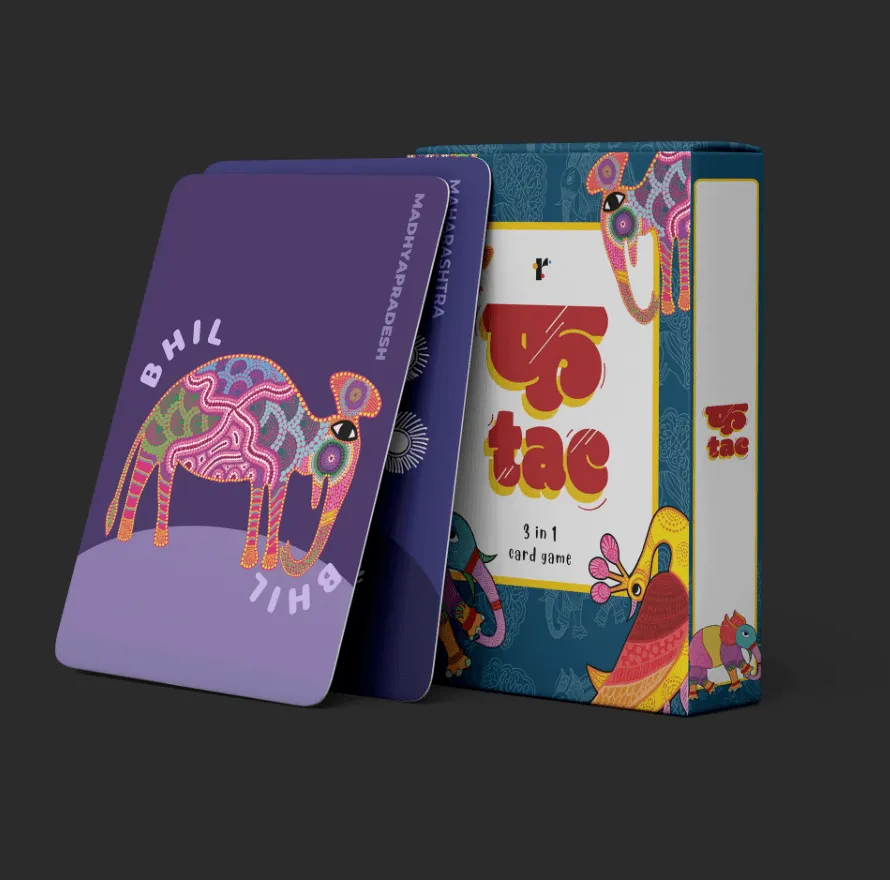
Three games in one deck: Snap, Memory and Slap Dash. Paper cards, 5 x 3.5 inches
The only rule that really matters
Somewhere in your first game, someone will call the supda a dustpan. Correct them gently, then take the card. That is most of the cultural education plan, and it works better than any lecture. The deck, all 57 symbols of it, is waiting on the Koku Cards page.