

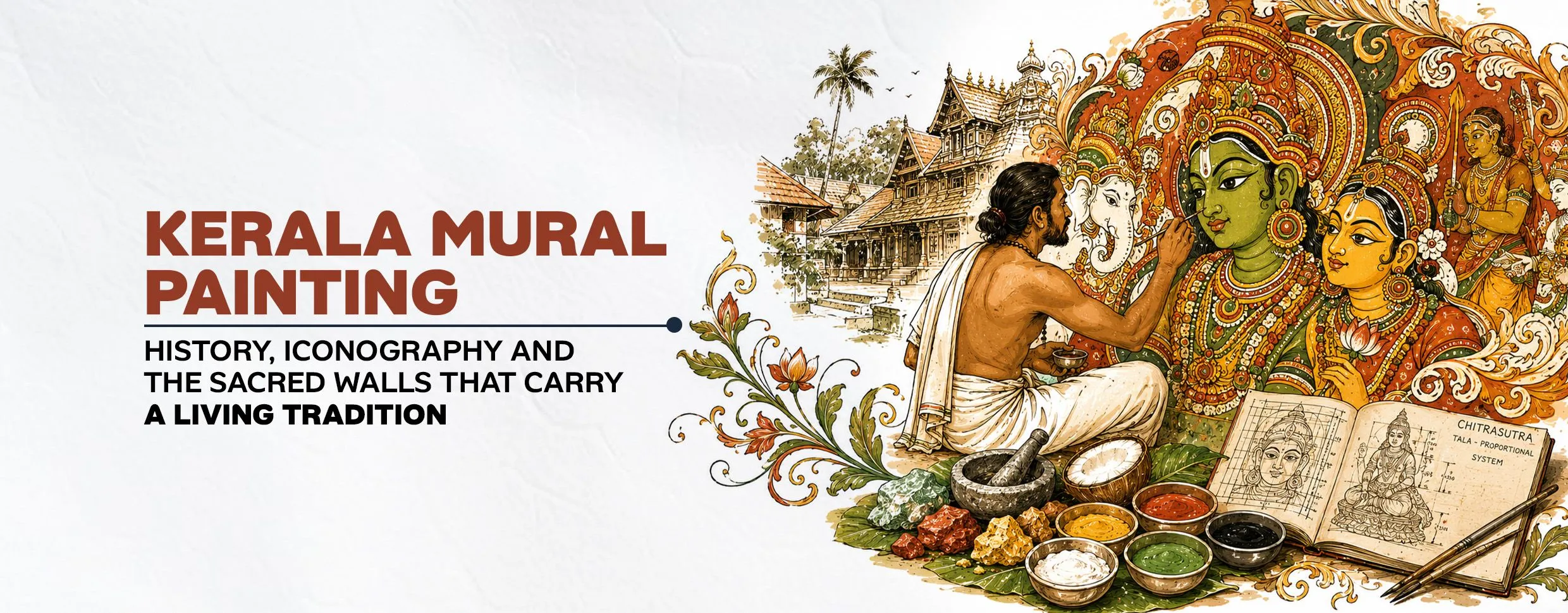
Kerala Mural Painting: History, Iconography and the Sacred Walls That Carry a Living Tradition
Kerala mural painting is one of the most technically demanding and theologically precise painting traditions in India. A deep guide to its history, iconography, the panchavarnam palette, and the artists who keep it alive on temple walls today.

Rooftop
Author
Step inside one of Kerala's older temples, or one of the few surviving princely palaces, and the walls take over the room. They are dense with painted figures, and the figures are unmistakable. Vishnu, in deep ochre and forest green, reclines on the cosmic serpent. Krishna lifts Mount Govardhan on a single finger. The Devi turns her head at the precise angle the ancient texts demand. There is no decorative impulse at work here. There is a sacred programme being executed by hands that have spent years learning the proportions of every limb, the colours that may and may not appear, and the order in which the figures must take their places.
This is Kerala mural painting, among the most technically demanding and theologically precise painting traditions in India. It has survived into the present not as a museum specimen but as a living practice. The murals on temple walls today are still being commissioned, still being painted, still being made by artists who have spent five years or more learning a single proportional system before they are allowed to draw a face that will hang inside a sanctum. What that survival depends on, and what makes the form what it is, is the subject of this essay.
The Origins and Historical Spread of Kerala Mural Painting
The earliest surviving Kerala murals are typically dated to around the eighth century, with the cave temple at Thirunandikkara, in what is now the Kanyakumari district of Tamil Nadu but was historically part of the Kerala cultural sphere, often cited as the oldest extant example. The form developed inside the temple architecture of the region and matured under the patronage of Kerala’s royal houses between roughly the ninth and eighteenth centuries, with its richest period running through the fifteenth and sixteenth.
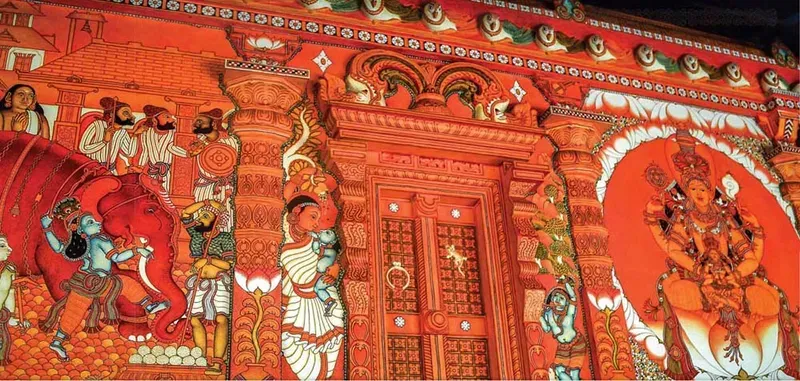
The major sites that survive give a sense of the form's range. Mattancherry Palace in Kochi holds some of the most celebrated late-medieval murals, including a famous Ramayana cycle. Padmanabhapuram Palace, the former seat of the Travancore kingdom, contains intricate murals across its prayer rooms and ceilings. The Vadakkumnathan temple in Thrissur, the Sree Padmanabhaswamy temple in Thiruvananthapuram, and the Ettumanoor Mahadeva temple all carry significant mural programmes. More than 150 temples across Kerala carry surviving wall paintings. Three things about Kerala specifically gave the form its character. First, the temple architecture, with its enclosed sanctums, mandapas, and ceiling spaces, provided the surfaces these paintings were designed for. Second, the strong Tantric strain in Kerala's religious practice, including the worship of fierce forms of the goddess and the use of yantric diagrams, brought a specific iconographic intensity into the visual language. Third, the parallel development of Kathakali dance-drama in the same cultural region, with its codified facial makeup, elongated eyes, and stylised hand gestures, fed directly into how the muralists conceived their figures.
The Chitrasutra and the Iconometric Foundation of Kerala Figures
Kerala mural painting does not begin with inspiration. It begins with proportion. The proportional system used to construct figures in this tradition descends from the Chitrasutra, the ancient Sanskrit treatise on painting that forms part of the Vishnudharmottara Purana and which has guided classical Indian image-making across centuries. The Chitrasutra specifies the tala system of measurement, in which the height of a divine figure is calculated in units of the face, with precise proportional relationships between every part of the body, from the length of the fingers to the height of the crown.
Within this broader iconometric framework, Kerala developed its own school, often called the sopanam style after the sopanam musical tradition of the temples. The figure conventions are immediately recognisable. The eyes are large and elongated, almond-shaped, often extending well beyond the face itself. The eyebrows arch with deliberate emphasis. The hands and fingers are stylised into the same precise gestures used in Kathakali, with each mudra readable to a knowledgeable viewer. Ornamentation is heavy and layered, with elaborate crowns, garlands, armbands, and patterned textiles giving every figure ceremonial weight.
A Kerala muralist does not invent a figure. The figure is constructed according to rules that have been written down for a thousand years.
This is why training matters. A student of Kerala mural painting spends the first long stretches of their apprenticeship copying proportional diagrams and learning the mudras of the figure conventions. There is no shortcut. An artist who has not internalised the iconometric system will produce work that, however technically polished on the surface, will read as wrong to anyone who knows the form. Mastery of the proportional grammar is the threshold the apprentice must cross before they are permitted to paint anything that will be seen.
The Panchavarnam: Kerala Mural's Five-Colour Palette and What It Means
One of the most striking features of Kerala mural painting is the strictness of its colour palette. The tradition is built around a five-colour system known as the panchavarnam, and every pigment is derived from natural mineral or plant sources. The five colours are not chosen for visual variety. They reflect the panchabhuta, the five elements of classical Indian cosmology, and they carry theological weight as much as aesthetic weight.
The pigments and their sources follow a long-codified list:
- Red from red oxide or red ochre, ground from naturally occurring iron-rich earths. Red dominates the palette and gives the form much of its visual heat.
- Yellow from orpiment, a mineral pigment with a long history of use across South Asian painting traditions.
- Green produced by mixing indigo with orpiment, since pure green pigments suitable for fresco work were not historically available.
- Black from lampblack, made by collecting soot from oil lamps over long periods.
- White from lime, often the same lime used in the wall plaster itself.
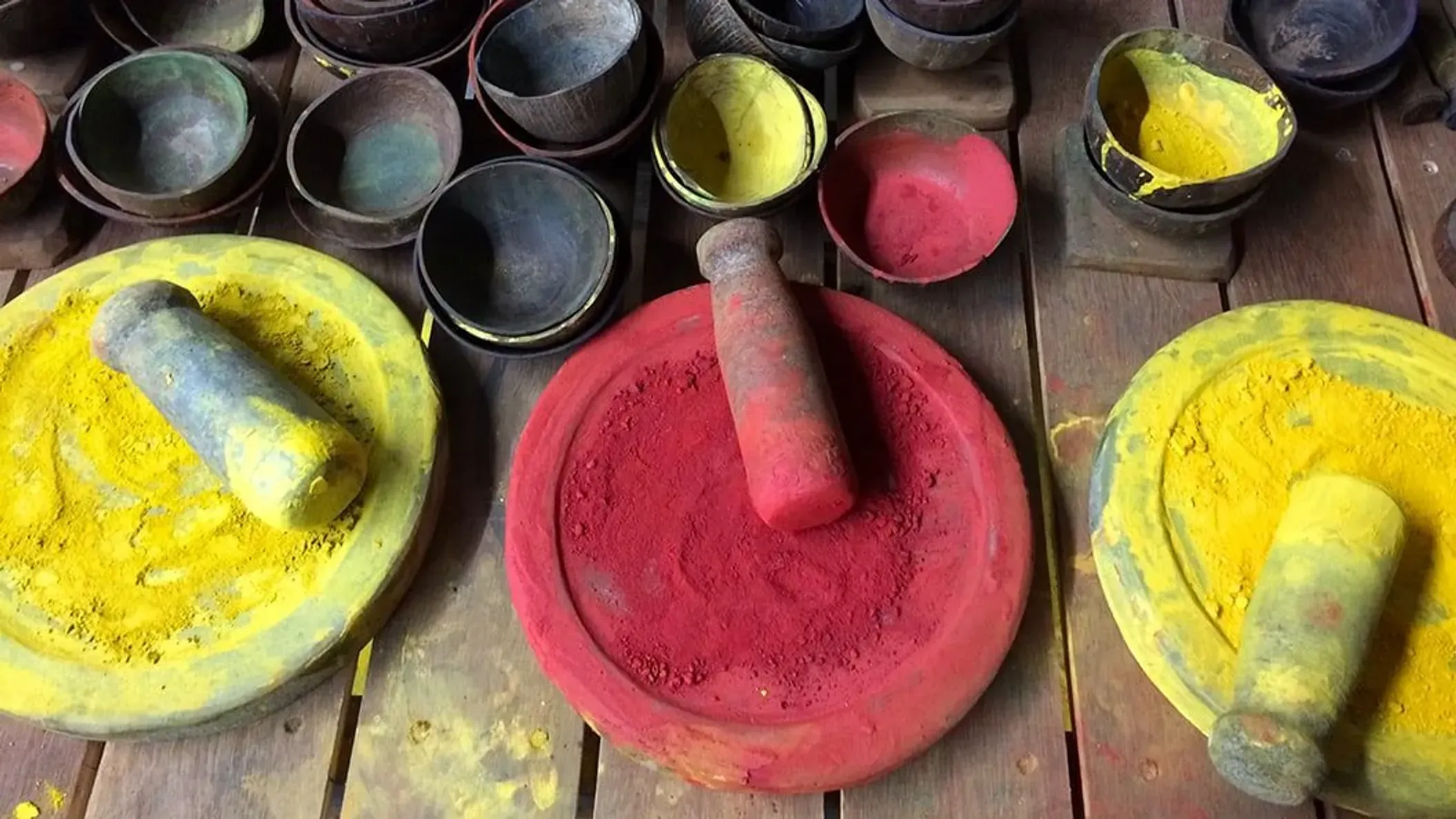
Image Source: Shutterstock
The discipline of the five-colour palette is what makes the visual range of Kerala mural painting all the more impressive. Within this limited set, artists achieve extraordinary tonal subtlety through layering, mixing, and the quality of the pigment preparation itself. A skilled muralist might apply six or seven thin layers of red oxide to build a single passage of skin tone, allowing each layer to settle and dry before the next is laid down. The same five pigments, in the hands of a master, produce a body of work that no industrial paint set can replicate.
Preparing the Wall and Applying the Plaster: The Surface as Sacred Ground
Before any pigment touches the wall, the wall itself must be made. Kerala mural painting is executed on a specially prepared plaster known as kattusarkara ojus, made from a mix of slaked lime, fine river sand, coconut shell ash, and plant fibre that may include the juice of certain herbs to give the surface its strength. The plaster is applied in several layers over the underlying brick or stone, each layer trowelled smooth and allowed to set before the next is laid on. The final coat is polished to a matte, slightly absorbent finish that can hold pigment without bleeding.
The painting must be applied to the plaster while it is still slightly wet, in a technique that resembles the buon fresco method used in Italian Renaissance wall painting. The pigments bind chemically with the lime as the plaster cures, producing a paint film that becomes part of the wall rather than sitting on top of it. This is what gives Kerala murals their longevity. The murals at Mattancherry, Padmanabhapuram, and Ettumanoor are still vivid and structurally sound four or five centuries after they were painted because the pigment is part of the wall.
The fresco technique also makes the painting urgent and unforgiving. The artist has only the working life of the plaster, often a single day or two, before that section of the wall is too dry to accept pigment. There is no room for hesitation, no opportunity for major revisions. The figure has to be drawn correctly the first time, in the correct proportions, with the correct colours, in the correct sequence. By the time a muralist is given a section of temple wall to paint, every move must already be in their hands.
The discipline of the preparation, the materials, and the proportional system are inseparable from the discipline of the painting itself. These layered processes are what make Kerala mural what it is, and why the artists who carry the tradition forward are trained in all of them together rather than in any single specialism.
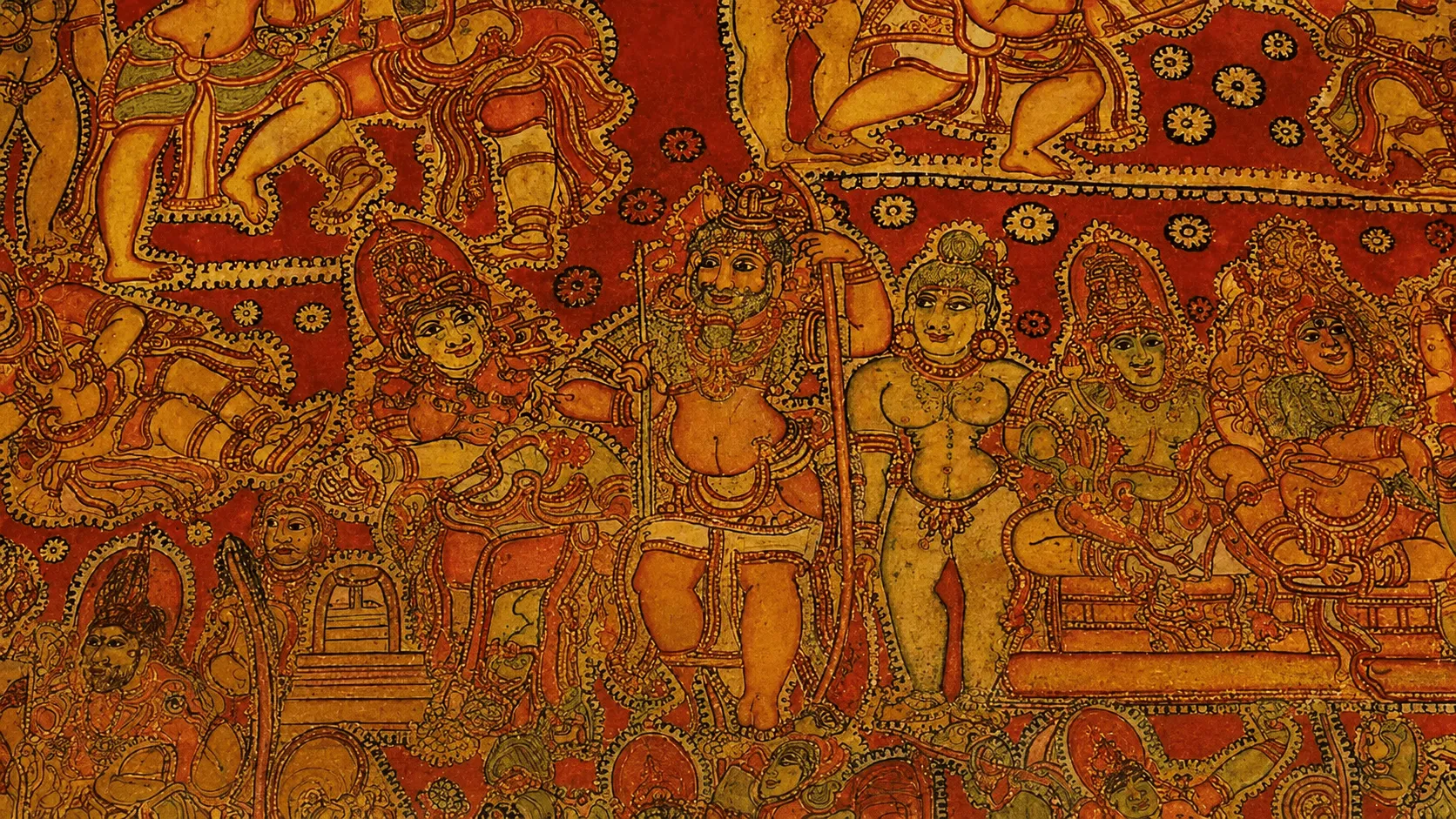
Image Source: Kerala State Archaeology Department
The Iconographic Programme: How a Temple Wall Is Planned and Read
A Kerala temple is not a neutral architectural container that happens to have paintings on its walls. The painted programme is the temple, in an important sense, organised according to the same ritual and architectural logic that governs the building. The selection and arrangement of subjects across the interior follows rules about which deities belong where, which scenes face which directions, and how the worshipper is meant to move through the painted space as part of the act of darshan.
The primary subjects are drawn from a deep and codified iconographic repertoire. The Bhagavata Purana provides many of the Krishna scenes that fill mural cycles, including the lifting of Govardhan, the Rasa Lila, and the various encounters of Krishna's childhood. The Ramayana provides the long narrative cycles that often appear in mandapa ceilings and outer walls. The Mahabharata appears in particular episodes, notably the Gita Upadesha and key scenes from the Kurukshetra war. The Tantric strain brings in fierce forms of the goddess, the Bhadrakali, and various protective and esoteric figures in specific architectural zones.
The viewer is meant to read the wall as a sequence, not a single image. A worshipper entering at the eastern entrance encounters the painted cycle in a specific order, and the order matters. The Ganesha at the threshold prepares the viewer for what follows. The deity in the sanctum is the culmination of the visual journey, not its start. This is why scattered photographs of Kerala murals, as beautiful as they are, never quite capture what the form does. The form was made to be walked through.
Kerala Mural Painting Today: Training, Revival, and the Artists Keeping It Alive
By the late nineteenth and early twentieth centuries, the tradition had entered a long decline. Royal patronage had collapsed under colonial reorganisation. Temple commissions had become rarer. The number of trained muralists working in the proper iconometric and material discipline had dropped to a handful of practitioners working in the older temple towns. The form was in real danger of becoming a museum specimen.
The revival is now well underway, through a combination of institutional and individual effort. The Institute of Mural Painting at Guruvayoor, established as a dedicated training centre under the gurukula system, has been one of the most important nodes of revival. Students complete intensive multi-year programmes covering iconometry, pigment preparation, plaster technique, and the iconographic vocabulary of the tradition. The Kerala Lalithakala Akademi has supported documentation, exhibitions, and apprenticeship programmes. Restoration projects at major temple sites have brought senior muralists back to the work of repairing the surviving cycles.
Among the artists leading this revival, P.K. Sadanandan stands out. Born in Kerala in 1965, trained at the Guruvayoor institute under the gurukula system, and holder of a Master of Fine Arts from Karnataka Open University, he led the mural renovation team at the Sree Padmanabhaswamy temple in Thiruvananthapuram, completing approximately 3,400 square feet of sanctum wall murals over four and a half years between 1993 and 1998. His online course on Kerala mural painting is one of the few structured introductions to the form taught by an artist of his stature, walking students through the philosophy, the proportional grammar, and the technical foundations of the tradition.

Younger Kerala muralists are also moving the work onto canvas and paper, opening the form to collectors who could never have commissioned a temple wall. The shift requires adaptation rather than compromise. The proportional system remains the same. The five-colour palette can be mixed and applied on paper using the same natural pigments. Kerala mural panels on paper and canvas by artists trained at Guruvayoor and within the traditional gurukula system bring the tradition into homes while preserving the iconometric and material discipline that defines what Kerala mural actually is.
What the Walls Carry
Every Kerala mural, whether it stretches across the sanctum of a temple in Thrissur or sits framed on a paper panel in a home in Bengaluru, carries the same accumulated knowledge inside it. The Chitrasutra is in every proportion. The panchavarnam is in every colour. Centuries of layered tradition sit inside each brushstroke, placed there by an artist who has spent years earning the right to make that mark.
The form has not survived because anyone tried to preserve it. It has survived because every generation has trained the next, and the trained next generation has kept painting. That is what the walls carry. Not nostalgia, not heritage frozen for visitors to admire, but a living transmission that runs from the eighth century through Thirunandikkara, Mattancherry, Padmanabhapuram, and Guruvayoor, and out into the studios and temples and homes where Kerala mural painting is still being made.