
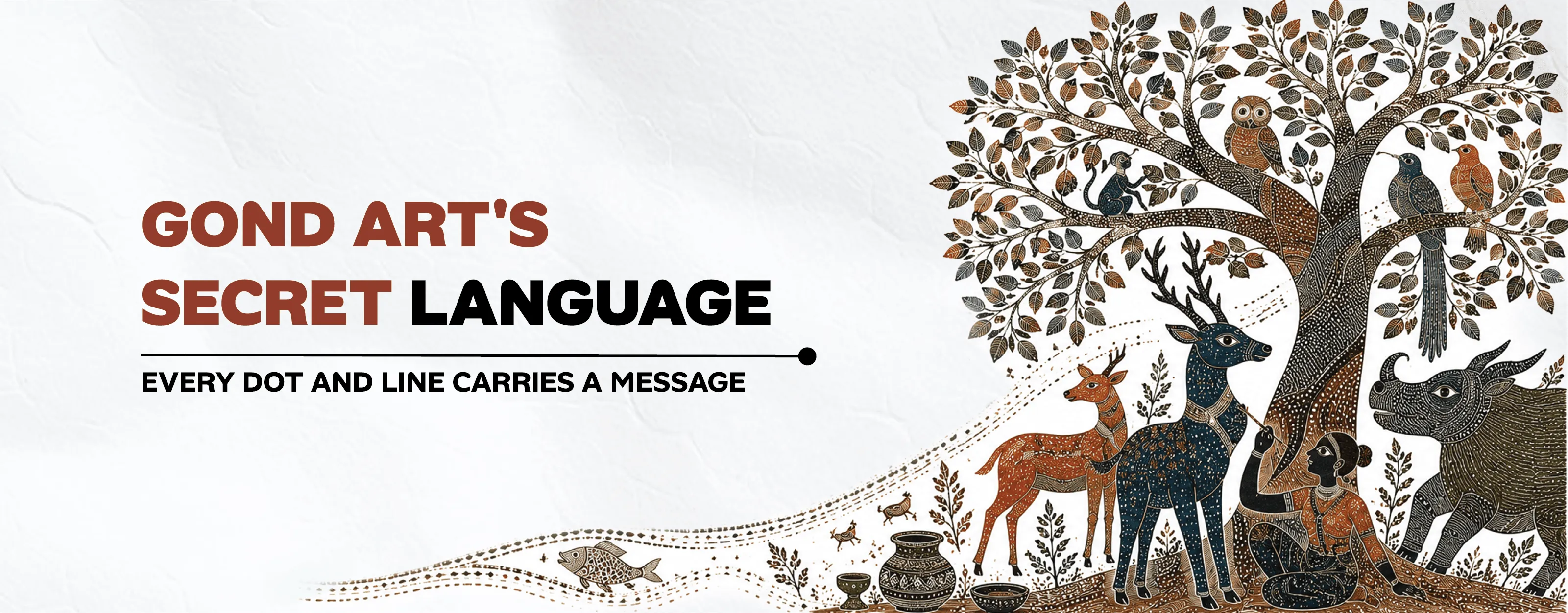
Gond Art's Secret Language
Gond Art's Secret Language: Every Dot and Line Carries a Message
Discover the hidden language of Gond art and learn how dots, lines, patterns, and motifs carry meaning, stories, and cultural significance.

Rooftop
Author
You must have heard of Gond Art before. Whenever Indian art is discussed, Gond is often one of the first traditions to come up. But there is a lot more to Gond art than its striking patterns and colours. It was never created simply for decoration purposes. Especially for the Gondi people of central India, these paintings became a way of recording and passing down their understanding of the world around them, from their cosmology and ancestry to their deep knowledge of nature. To look at Gond art, then, is to see a tradition that carries an entire way of life within it. Moving step-by-step, let’s try to understand: what is Gond Art?
What is Gond Art?
To understand Gond art, it helps to first look at the people and traditions it grew out of. The word “Gond” is believed to come from the Dravidian word Kond, meaning “green mountain.” The Gondi people historically lived in the dense forest regions of the Vindhyas, Satpura, and Mandla in Madhya Pradesh, where their lives and beliefs were closely connected to the natural world.
Meaning of Gond Art
The history of Gond painting is also closely tied to the Pardhan Gonds, who traditionally served as bards and keepers of their community’s heritage. They carried family genealogies, sacred myths, and legends from one generation to the next through oral histories and songs, often accompanied by the Bana, a traditional stringed instrument. Gond art emerged as a visual expression of this same tradition, giving shape to stories and beliefs that had previously been preserved through memory and song.
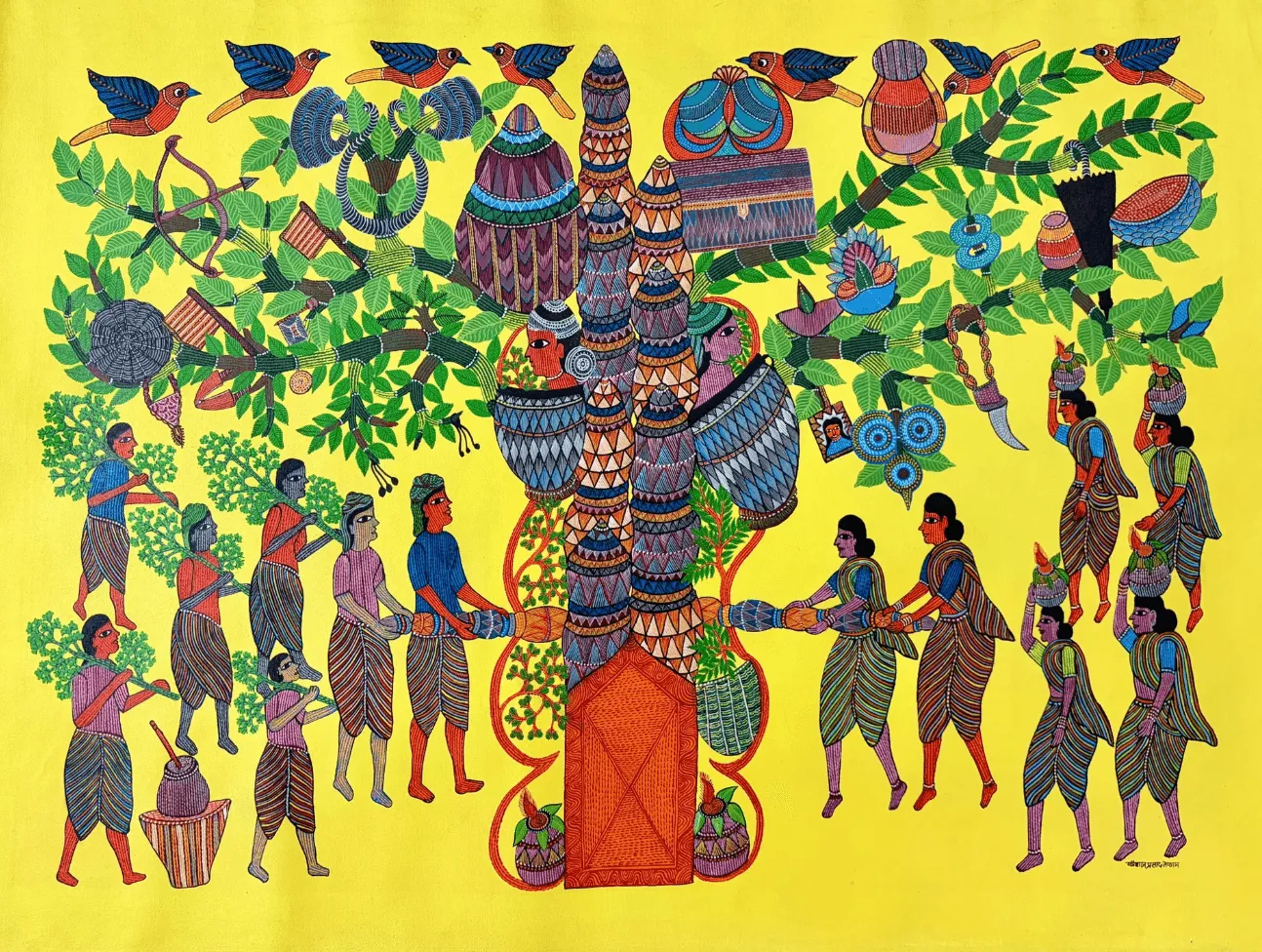
This is an important part of understanding the Gond painting meaning. For the Gondi people, painting was not simply an artistic activity or a way to decorate their homes. Auspicious images painted on walls and floors were believed to bring good fortune, prosperity, and well-being. Many Gond art symbols draw from animals, trees, plants, myths, and everyday life, reflecting the way the community understood its place in the world. In that sense, Gond paintings were part of everyday life, carrying stories and beliefs while also serving a purpose within the home.
Gond Art Was Never Just Art
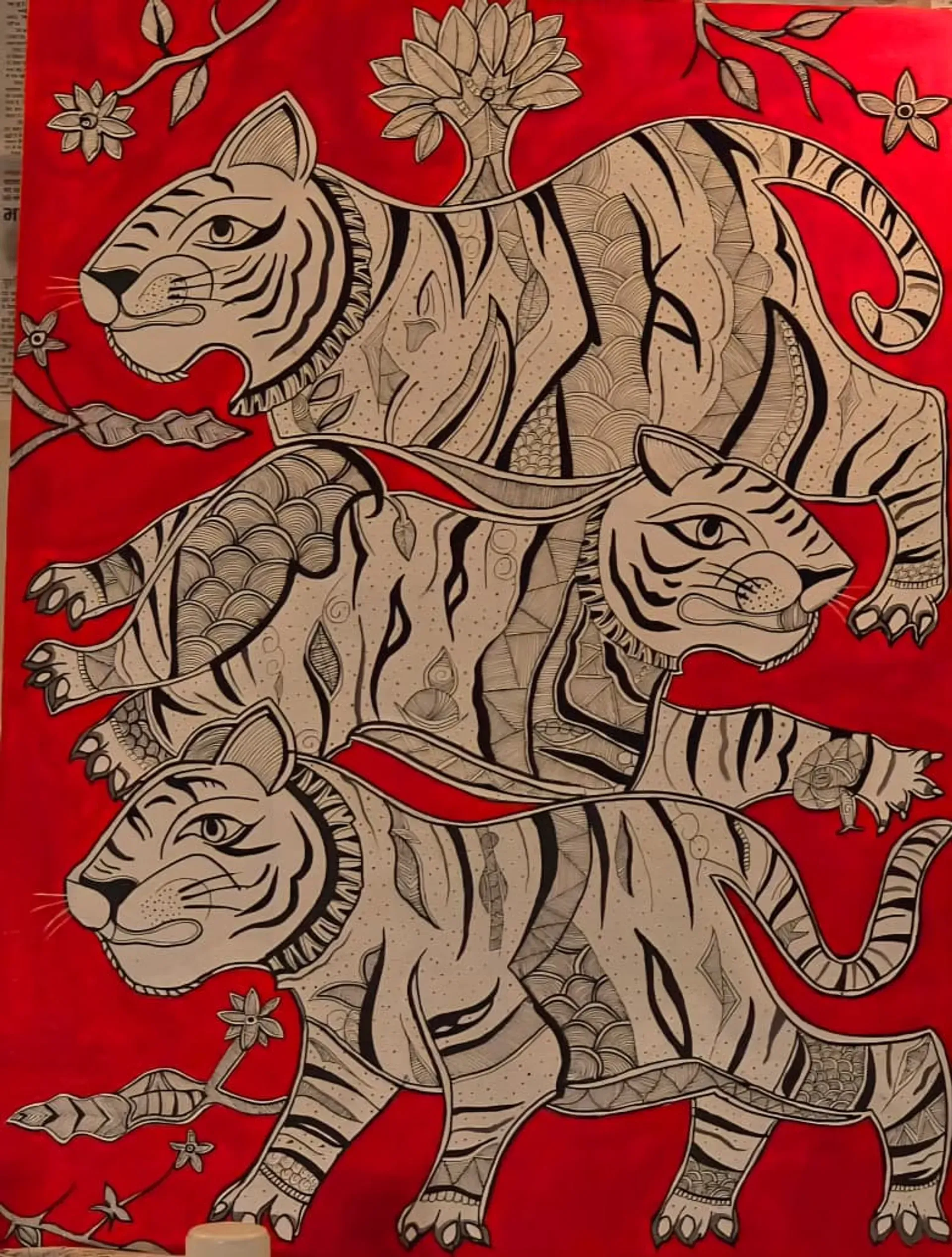
The artistic side of Gond Art is a complex subject in itself. Traditionally, Gond painting was not made for galleries or collectors. It began as a sacred domestic practice known as digna or bhittichitra, with women painting geometric and figurative designs directly onto the mud walls and floors of their homes. These paintings appeared during important occasions such as Diwali, Nag Panchami, weddings, births, and crop harvests, becoming part of the celebrations themselves.
History of Gond Art
The materials involving the Gond art history were just as rooted in everyday life. Artists worked with what was readily available, using mixtures of lime, chalk, mud, and cow dung to create their designs. These paintings were not simply there to be looked at. They were believed to invite protection, ward off evil spirits, and mark important moments in the life of a family and community. The act of painting was therefore part of the ritual.
This changed significantly in the 1980s, when Gond artists began moving their work from mud walls and floors onto paper and canvas. The new medium allowed the intricate lines, vibrant colours, and distinctive forms of Gond painting to travel beyond the homes and communities where they originated. But something else changed along with the medium. A painting that was once created for a particular festival, ceremony, or ritual could now exist independently as an artwork to be displayed and collected.
This shift gave Gond artists a wider audience and helped the tradition reach the contemporary art world. At the same time, it separated the paintings from much of the domestic and sacred context that had originally given them meaning. What was once part of a living ritual could now be encountered as a finished work on a gallery wall.
A Language Built from Nature
More than just an art form, Gond Art is a visual language rooted in nature. The forests, rivers, fields, and animals that surround Gond communities have long found their way into these paintings. Nature is not treated as a backdrop or something separate from human life.
It is a living presence, filled with its own spirit and meaning. This is why even the smallest line or pattern can carry an idea or tell part of a story. Some of the most recognisable Gond art symbols come directly from this relationship with the natural world.
The Fish-Scale Pattern
One of the defining patterns in Gond painting, the fish-scale motif is associated with water, prosperity, and abundance. Fish and trees are often placed together within the same composition, reflecting an interconnected ecosystem where water, forests, and living beings depend on one another.
The Spiral
The spiral speaks to the cyclical nature of life, particularly the movement between birth and death. It also appears in depictions such as spiral-shaped bird nests, where the form can suggest warmth, origin, and continuity. Rather than representing a single moment, the spiral captures the idea of life constantly moving and returning.
The Peacock (Mor)
A familiar sight across central India, the peacock is closely associated with the arrival of the monsoon. In Gond paintings, it can represent rain, fertility, prosperity, and hope. It also holds a spiritual significance, often understood as a messenger between the earthly and divine worlds, carrying the movement of the soul between human and spirit realms.
The Hidden Grid Beneath the Image
The image itself is only part of what makes Gond Art fascinating. Look more closely at a Gond painting and you will notice that the composition is rarely random or purely decorative. The placement of trees, animals, birds, and human figures reflects an understanding of the universe rooted in Gondi cosmology.
The Gondi worldview is traditionally understood through three interconnected realms: Paatal, the netherworld, Dharti, the earth, and Aakash, the sky. Rather than separating these realms through conventional perspective, Gond artists allow them to exist together on the same surface. There is no vanishing point, realistic shading, or fixed horizon in the Western sense. The painting instead unfolds across a flat plane, with every figure given its own presence.
This is also why the empty areas of a Gond painting do not feel quite empty. There is no emphasis on passive negative space. Trees, animals, birds, and patterns often overlap, nest within one another, and fill the composition. A bird might sit within a canopy of patterned leaves, while fish curve beneath the branches of the Tree of Life. Nothing exists in isolation.
The result is a world without a conventional horizon, where humans, animals, plants, and the spirit world occupy the same visual space. The way a Gond painting is composed therefore tells us as much about the Gondi understanding of life as the individual figures and symbols within it.
What the Dots Actually Mean
The patterns inside Gond paintings deserve as much attention as the figures themselves. Those rhythmic dots, dashes, waves, and crosshatching that fill the bodies of animals, birds, trees, and other forms are not simply there to add texture. They form a structured visual language, built from recurring modules and sequences that can express relationships within the natural world.
There is also a deeper spiritual idea behind these marks. Gond traditions are rooted in an animist understanding of nature, where the boundaries between humans, animals, and spirits are not always fixed. In some Gond beliefs, shamans in a trance state are said to experience the particles of their own bodies dispersing into space and merging with the spirit world. The tiny marks that animate Gond paintings can be understood within this larger idea of a world made up of interconnected forms of life and energy.
What makes these patterns even more fascinating is how personal they can be. Different Gond communities, families, and artists have developed their own recurring ways of filling forms. Some patterns resemble mustard seeds (sarson ke daane), while others draw from wheat spikes (gehu ke baal), waves, combs, crosshatching, or drops of water. Over time, these patterns become closely associated with particular artists or lineages.
For someone familiar with the tradition, these patterns can therefore reveal who made a painting even before its label is read. They are not just decorative details filling up the picture. They can act almost like a signature, carrying traces of the artist, their family, and the tradition they belong to.
From Forest Walls to the World
The evolution of Gond Art is a fascinating story because the tradition has changed dramatically without losing its roots. The turning point came in the early 1980s, when the seventeen-year-old Jangarh Singh Shyam (1962–2001) was discovered painting the mud walls of his home in Patangarh by painter and curator J. Swaminathan. Impressed by his work, Swaminathan invited Jangarh to Bhopal, where he was introduced to materials that were very different from the mud walls he had grown up painting on, including paper, canvas, acrylic paints, and brushes.
Jangarh quickly developed a distinctive style of his own, combining the visual language of his community with these new mediums. His work went on to inspire what became known as Jangarh Kalam, or the style of Jangarh. He eventually took Gond art far beyond its original setting, exhibiting at the Centre Pompidou in Paris in 1989 and gaining international recognition and commercial success.
But taking Gond art into the mainstream also brought a new set of problems. As the paintings became more popular, their designs began appearing outside their original cultural context, including as mass-produced and mechanically uniform “tribal-style” decor. A Geographical Indication (GI) tag was awarded to Gond paintings in 2023, helping protect the regional identity and authenticity of the art form, but attribution remains important for another reason. A Gond painting is connected not only to a visual style but also to the artist, their family, their community, and the stories and beliefs they inherit.
That is the tension facing Gond art today. Its movement from mud walls to galleries and international collections has created opportunities for artists that would once have been difficult to imagine. But as the tradition enters wider commercial spaces, the challenge is to make sure that its cultural and spiritual identity does not get separated from the paintings themselves. For contemporary Gond artists, keeping that lineage alive is as important as finding a place for their work in the modern art world.
Someone is Keeping the Art Alive
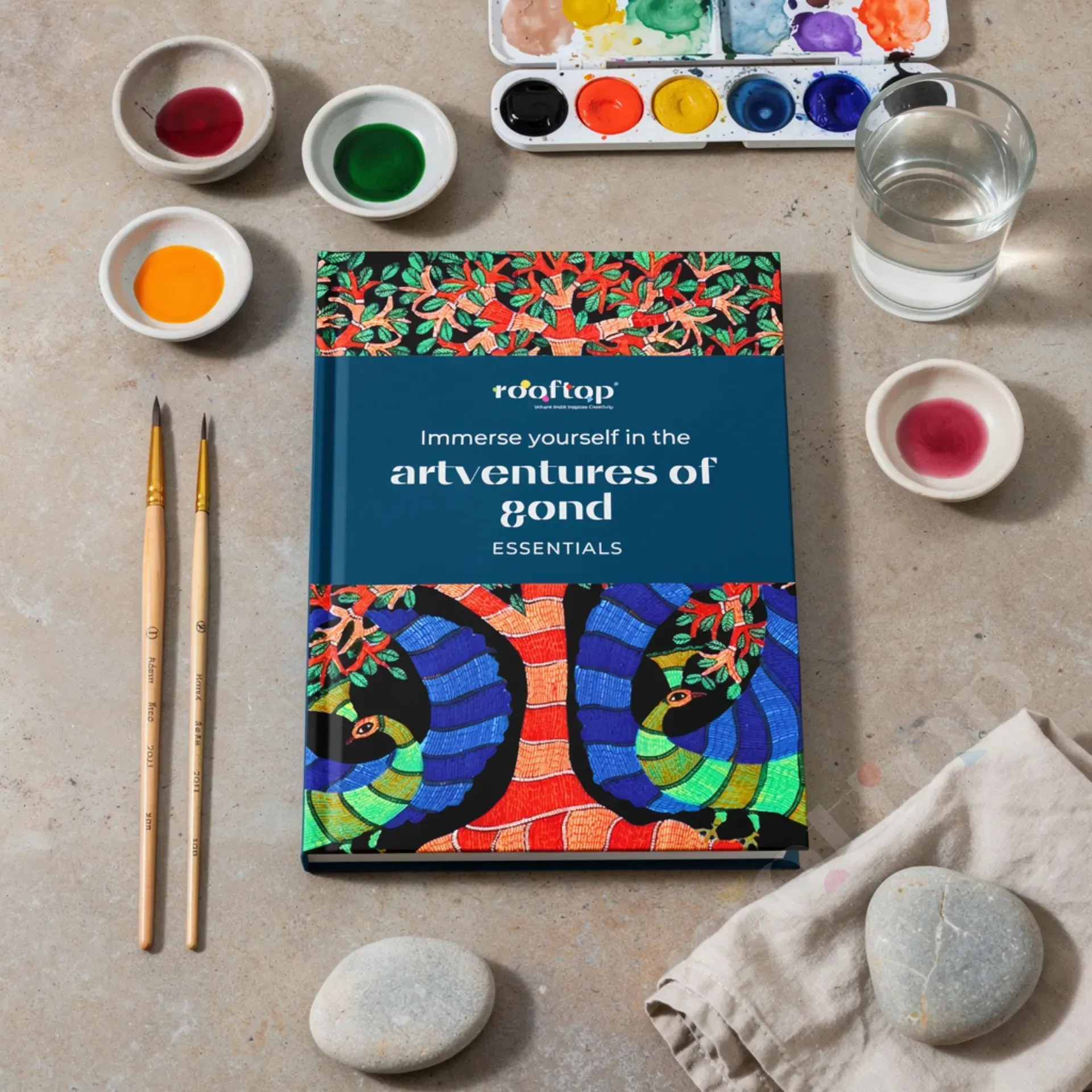
Artventures of Gond
Gond Art may not be as widely known as some other Indian art traditions, but it continues to find new audiences through platforms like Rooftop. Its curated collection of Gond paintings, books, and online courses makes it possible to explore the art beyond its decorative appearance and understand the stories, techniques, and traditions behind it.
One such resource is the Gond Art Course with Venkat Raman Singh Shyam, a master artist who has practised Gond art for over four decades. The six-hour course, divided into four chapters and 28 lessons, takes learners through the art form with step-by-step instruction while also offering insights drawn from the artist's experience and knowledge of the tradition. It is an opportunity to learn how Gond art is made while understanding the ideas and motifs that give the paintings their character.
For those who prefer to learn through books, Artventures of Gond – Essentials offers an introduction to the origins and evolution of Gond art, its connection to Gond traditions and storytelling, and its relationship with nature. The book covers eight distinctive patterns and includes guided exercises for drawing motifs inspired by aquatic animals, birds, and other forms of fauna. There are also Elementary and Expert editions for readers who want to explore the tradition at different levels.
Resources like these are valuable because learning Gond Art is not only about reproducing its recognisable dots, lines, and patterns. It is about understanding why those patterns exist, where the stories come from, and the cultural knowledge carried within them. When that context remains part of the learning process, Gond Art can continue to evolve without losing the traditions that shaped it.