

Cheriyal Scroll Painting: History, Iconography, Materials and the Artists Who Keep It Alive
Cheriyal is one of India's most complete surviving narrative art forms, kept alive by a handful of Nakashi families in Telangana. A deep look at its origins, iconography, materials, and the artists who continue to paint, narrate, and perform with it.

Rooftop
Author
Imagine a courtyard in a Telangana village somewhere between Warangal and Hyderabad in the seventeenth century. A small crowd is gathering as dusk falls. At the centre, a man begins to unroll a long painted scroll, panel by panel, while another stands beside him with a musical instrument, ready to sing the story the scroll is about to tell. The painting is forty feet long. It will take all evening to narrate.
This is what Cheriyal scroll painting was made for, and in important ways still is. It was never meant to hang on a wall. It was meant to move, to speak, to perform. Each scroll was a piece of cinema, painted by hand, designed to unfurl panel by panel as a Mandhet storyteller carried the audience through the Ramayana, the Mahabharata, or the local legends of regional deities and clan ancestors. The painted image and the spoken word were inseparable.
That this art form still exists today, more than four hundred years after it took shape in the village of Cheriyal in present-day Siddipet district of Telangana, depends not on museum preservation but on the living knowledge of a small number of artist families who have kept its iconography, materials, and storytelling function intact across centuries. What they carry forward is one of the most complete surviving narrative art traditions in India.
The Origins of Cheriyal Painting and Its Place in Telangana's Cultural Life
The town of Cheriyal sits roughly a hundred kilometres north of Hyderabad in the old Warangal district. The form takes its name from the village, but its origins reach back further into a tradition called Nakashi art, brought south by the Mughals in the sixteenth century, and possibly earlier through migrations of Rajasthani artisans who carried versions of Phad painting with them into the Deccan. The form is roughly four hundred years old, with the term naqash, meaning to draw or sketch, in active use during the Nizam period.
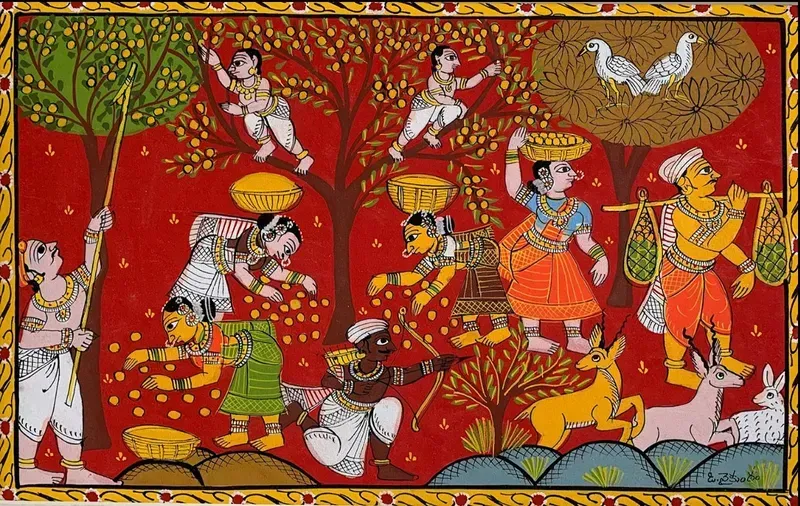
The artists who painted these scrolls belonged, and still belong, to a hereditary community known as the Nakashis. The storytellers who travelled with the finished scrolls were called Mandhets. A Nakashi would paint a long narrative scroll over weeks. A Mandhet would buy it from the painter, give a small ceremonial gift in payment, and then move with a group of bards and musicians from village to village, performing the story to communities who came to hear the specific telling, the specific cadence, and the painted figures the scroll would reveal.
A typical Cheriyal scroll might stretch thirty to forty-five feet in length and thirty to forty-five inches in breadth, divided into horizontal panels read top to bottom. Each panel held a single moment in the story, and the storyteller would pause at each one, sing its episode, and unroll the next. The performance might run for an entire night during a temple festival or a wedding.
The Cheriyal scroll was a piece of moving cinema painted by hand, four centuries before the first projector was ever set up in an Indian village.
The repertoire was deep. Stories from the Ramayana and the Mahabharata, episodes from the Bhagavata Purana, legends of caste-specific deities like Markandeya for the Padmasali weavers or Katamaraju for the Gollas, and tales of local saints and folk heroes. Each community had its own set of stories, and the Nakashis painted scrolls tailored to the audiences.
The Iconography of Cheriyal: Gods, Heroes, and the Stories They Tell
The visual conventions of a Cheriyal scroll are immediately recognisable once you know what to look for. Figures are arranged in long horizontal panels with a clear directional flow. Each panel functions as a single scene in the unfolding narrative, with the principal characters foregrounded against a flat colour ground and supporting figures arranged in fixed iconographic positions.
Characters are identified through visual codes the audience already knew how to read. Rama and Krishna appear with their conventional blue skin. Shiva carries his trident and crescent. Hanuman is rendered with a monkey's face and a warrior's body. Local heroes are marked by costume, weapon, posture, and the colours associated with their lineage or community. There is no need for written labels because the painted conventions do the work of identification.
Within the broad framework of Hindu epic and Puranic narrative, Cheriyal embraced regional and caste-specific stories that other classical traditions tended to leave out. The Goud community's brewing traditions appeared on Cheriyal scrolls. The Padmasali weavers had their own Markandeya Purana scrolls. The Mudiraj fishing communities had stories featuring fishing scenes, riverboats, and their own deities. The result was an iconography both pan-Indian and intensely local at the same time.
The Visual Style That Makes Cheriyal Instantly Recognisable
Even before you read a Cheriyal scroll for its narrative content, the visual style announces itself. The bold red background that unifies almost every traditional Cheriyal composition is the first thing you notice. This rich vermilion ground, described as the colour of life and ritual, sets the entire visual register and gives the figures their characteristic glow against it.
Against this red field, the figures are flat and stylised, rendered with bold black outlines and filled with strong, opaque colours that do not modulate or shade. Faces are drawn with distinct conventions that vary by character type. The almond-shaped eyes, the strong eyebrows, and the carefully ornamented hair and headdresses follow visual rules passed down across generations within Nakashi families.
The intricate borders that frame every Cheriyal scroll are themselves a defining feature. The floral patterns, animal forms, and geometric units in the borders draw on temple architecture across southern India, particularly the carved stone designs at sites in Warangal. The borders mark the spatial and ritual boundary of the painted narrative, separating the story inside from the everyday world outside the scroll.
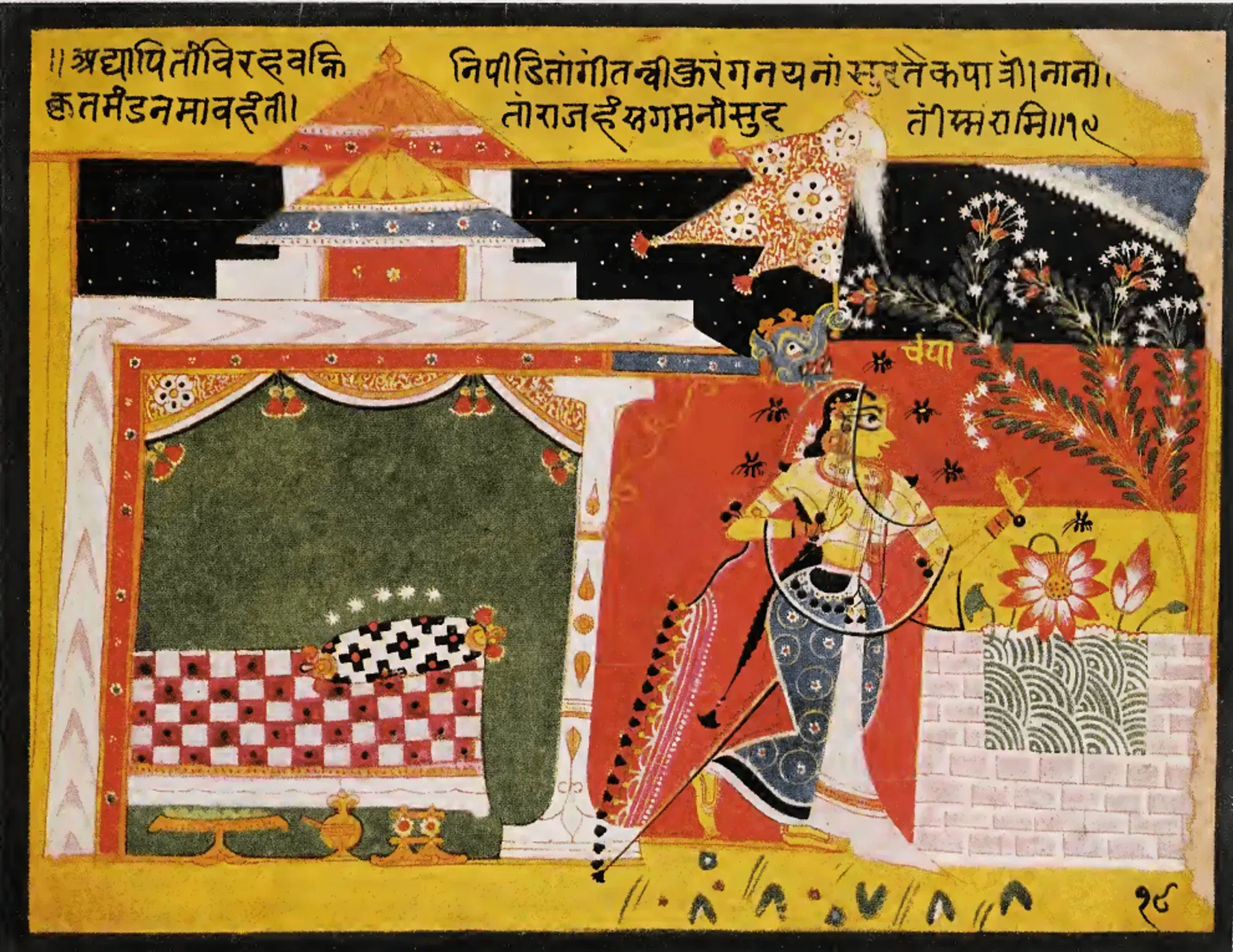
Cheriyal painting by D. Vaikuntam (image source: DirectCreate)
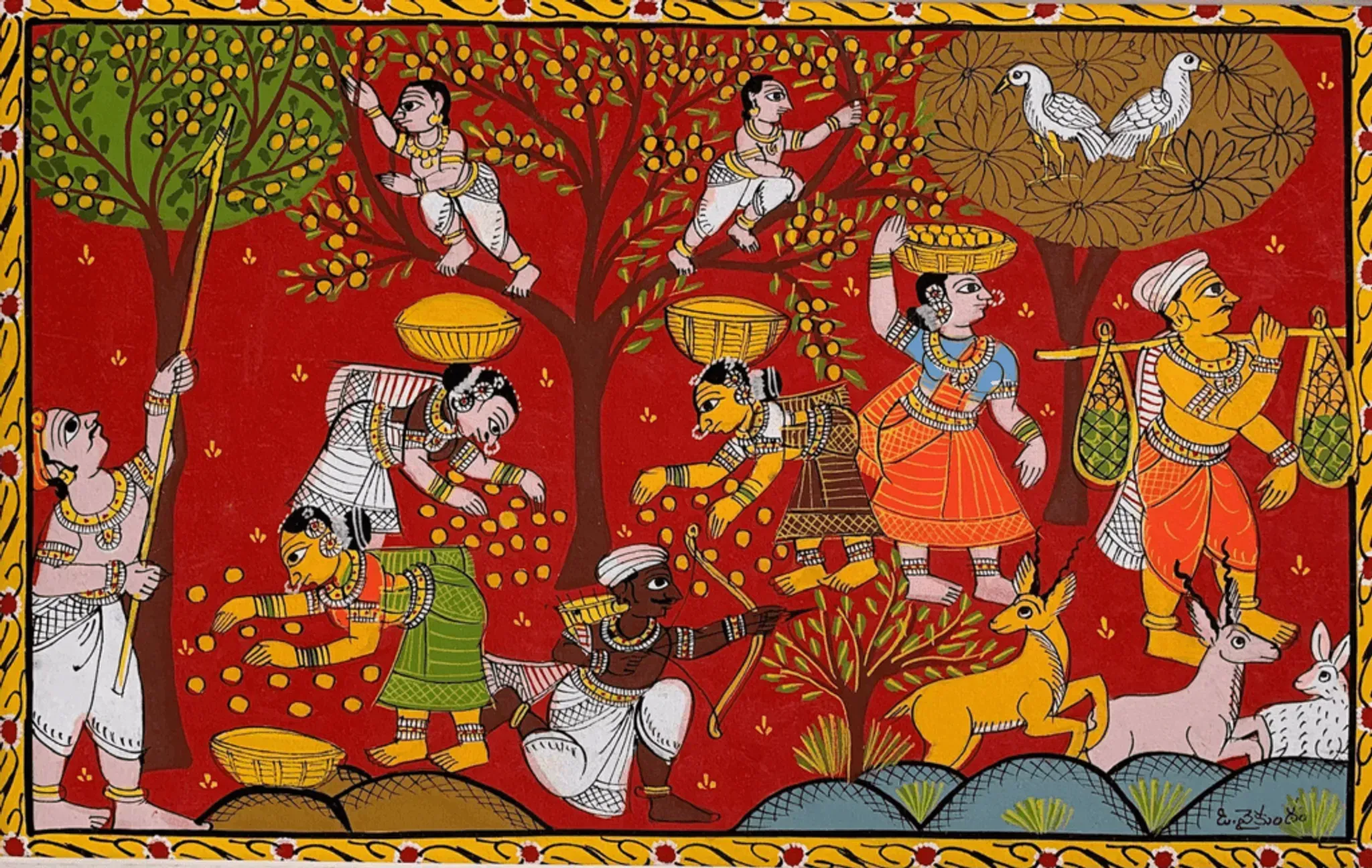
(image source: cultureandheritage.org)
The palette as a whole reads as high-contrast and ceremonial. Reds, yellows, blacks, whites, and accents of green, blue, and orange are used in clear, unmixed combinations. There is no atmospheric perspective. There is no realistic light. The visual language was built for narration at a distance, for an audience seated in a circle around a storyteller, with the scroll held up or hung where everyone could see.
Materials, Preparation, and the Making of a Cheriyal Scroll
The making of a Cheriyal scroll is a long, patient process that can take days or weeks for a single full-length work. The materials are largely natural and locally sourced, with traditional techniques that have changed only modestly even as some artists have shifted from full khadi cotton bases to milled cotton for practical reasons.
The base
The traditional surface is a length of kora cloth, an unbleached cotton, prepared with a paste of rice starch, tamarind seed paste, white mud or chalk known as pidatha, and a binding gum. The cloth is stretched and the paste applied in several thin coats, each drying before the next is laid on. The result is a smooth, slightly stiffened ground that holds pigment without bleeding and can be rolled and unrolled repeatedly without cracking. Preparing the cloth alone might take three or four days.
The pigments
The colour palette draws on minerals and plant materials sourced from the immediate landscape:
Red from vermilion, the foundation colour for most Cheriyal backgrounds. Yellow from peori or orpiment, a mineral pigment that gives the form its warm golds. Black from lampblack, made by collecting soot from oil lamps. White from seashell powder or chalk. Blues and greens traditionally from indigo and locally available plant sources.
The pigments are bound with a mixture of natural tree gum and a small amount of tamarind paste, which keeps the colour workable and prevents flaking. Artists often make their own brushes from squirrel or goat hair set into bamboo handles, with finer brushes reserved for facial features and ornamental detail.
###The sequence
The painting proceeds in a clear order. The base is laid down first, often with the entire surface coated in a uniform red. The compositional skeleton is drawn in faint outline. The principal figures are blocked in with their main colours. Costumes, ornaments, and patterning are added next. The fine black outlines that define faces, limbs, and ornamental detail are drawn last, with the smallest brushes and the most concentrated attention. Borders are completed around the perimeter as the final stage. A full narrative scroll might take a family of artists three to six weeks to complete.
The same materials and visual logic also produced the masks and dolls that traditionally accompanied Cheriyal performances. A paste of tamarind seed and sawdust served as the sculpting medium, with the resulting figures painted in the same palette as the scrolls. The Mandhets used these masks and dolls as part of the live performance, lifting them out at specific narrative moments to stand in for the painted figures on the scroll.
The Nakashi Artists of Today and the Challenges They Face
Only four to six families in and around Hyderabad still practise Cheriyal scroll painting in its full form. The Dhanalakota family is among the most significant. Their lineage stretches back across generations of Nakashi painters, and figures like Nageshwar Dhanalakota and his children continue to make full-length scrolls in the traditional manner. Pavan Nakash, who received the State Award in 2016, is another voice from the contemporary generation, working alongside other Cheriyal painters including Somya Nakash on collaborations such as the Indian Art, Architecture and Design Biennale.
The challenges facing these artists are real and economic in nature. A full thirty- or forty-foot narrative scroll takes weeks of work, and there is no traditional patron system left that pays for that kind of labour. The Mandhets are gone. The travelling village performance has been displaced by television, cinema, and the digital screen. To survive financially, many Cheriyal artists have shifted toward smaller decorative pieces: individual painted panels, framed single-character works, masks and dolls sold as collectibles, and short scrolls aimed at the home decor market.
The shift from forty-foot performance scroll to framed three-foot panel is not stylistic. It is an economic adaptation that risks hollowing out the narrative depth that made Cheriyal what it was.
The risk is straightforward. If the only market for a Cheriyal artist is decorative single panels, the iconographic knowledge that allows a painter to sequence an entire Ramayana into forty connected scenes begins to atrophy. The technique survives in the surface. The grammar of long-form narrative starts to fade. This is why the small number of families who still make full-length scrolls, and who teach their children the storytelling logic of the form, matter so much.
Cheriyal in Contemporary Collections and Cultural Memory
Cheriyal received its Geographical Indication tag in 2007, recognising the form's distinct cultural origin in the Cheriyal region of Telangana and offering theoretical protection against fraudulent reproduction. The GI tag has delivered visibility and a degree of legitimacy. What it has not delivered, on its own, is reliable income for practising artists or sustained institutional support for full-length scroll work.
Cheriyal scrolls now appear in significant museum and craft collections. The Crafts Museum in Delhi holds important examples. State craft emporiums across Telangana and Andhra Pradesh stock Cheriyal masks, dolls, and shorter panel paintings. Exhibitions at venues like Bikaner House in Delhi and the India Art Fair have helped place the form in front of urban audiences who would otherwise never encounter it.
Educational and publishing initiatives also play a role. Artventures of Cheriyal, a guided art book produced with the Dhanalakota family, walks readers through the origins, motifs, and themes of the form with space to attempt their own work. The same logic underpins the work of bringing original panels to buyers looking for authentic folk paintings of India, where each piece comes with the artist context that turns a purchase into a relationship with the family who made it.
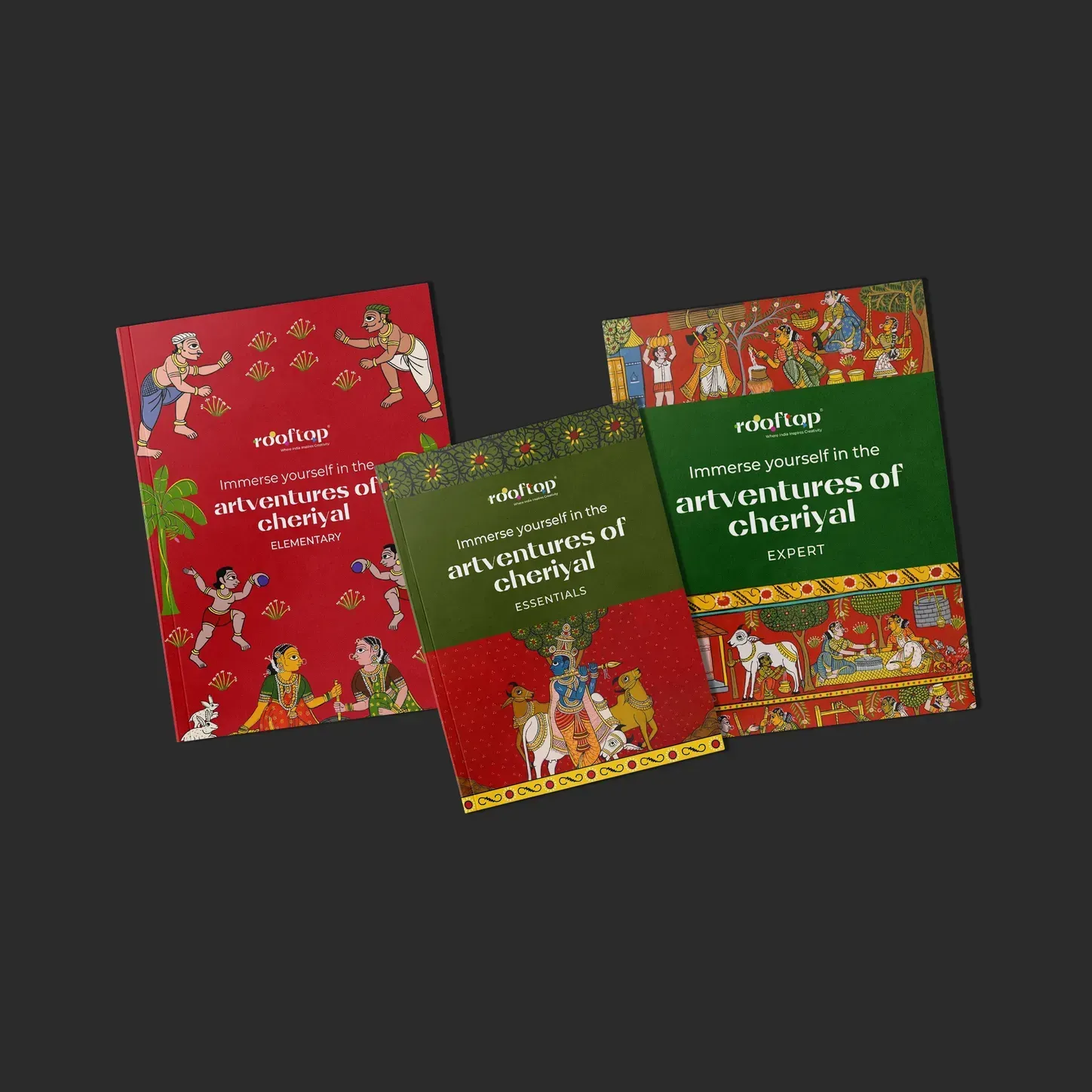
Artventures of Cheriyal: The Complete Scroll Art Journey (Set of 3)
Return to the Scroll
Imagine the courtyard again. The dusk has thickened. The Mandhet has unrolled the final panel, and the audience is quiet. The painted figures in the scroll, rendered in vermilion and orpiment by a Nakashi who may have spent six weeks of his life on this single work, have done what they were always meant to do. They have carried a story across the gap between the painter and the listener, and they have made that story present in the room.
This is what Cheriyal still does when the people who know how to use it are given the time, the patronage, and the audience the form deserves. The four hundred years of accumulated knowledge inside a single full-length scroll is not preserved by being framed and hung. It is preserved by being painted again, seen again, and narrated again, by the families who have carried it this far.