
Santhal Painting: Folk Art of India's Santhal Community
Let's learn about the art form of the Santhals!
Introduction and Origin
Santhal painting is one of India's most striking forms of tribal folk art, created by the Santhal community spread across West Bengal, Jharkhand, Odisha, Bihar, and Assam. Rooted in a deep connection with forests, nature, and the spiritual world, these paintings have been used for centuries to celebrate festivals, mourn the dead, and document everyday life. Today, Santhal painting is gaining new recognition as collectors, students, and art lovers rediscover its raw, expressive power and its role in India's living folk art tradition.
What Is Santhal Painting?
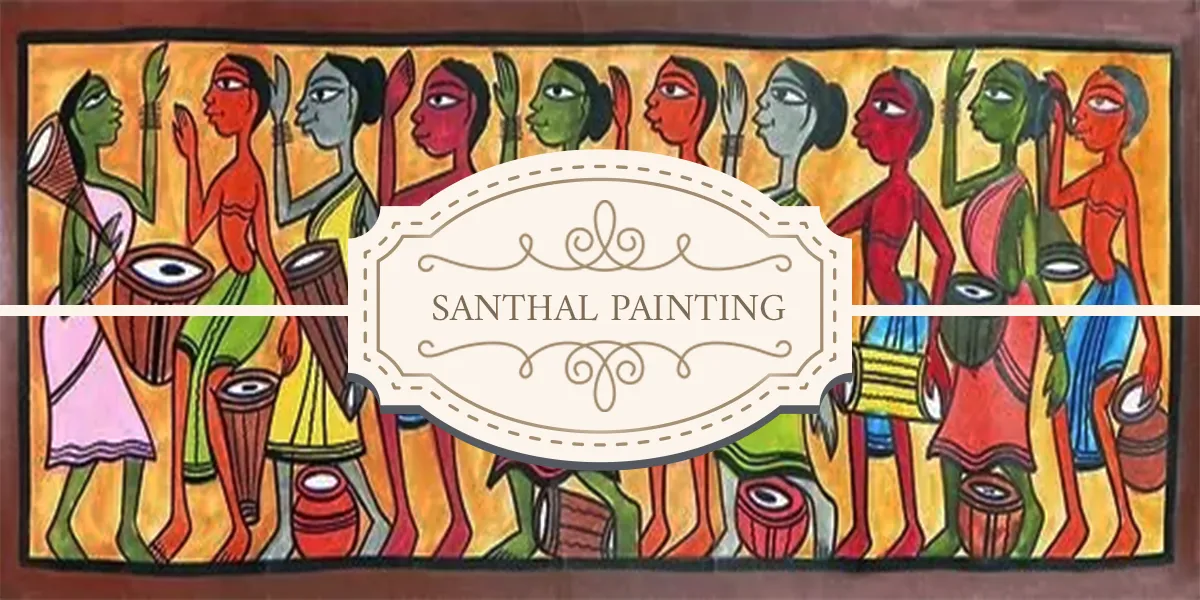
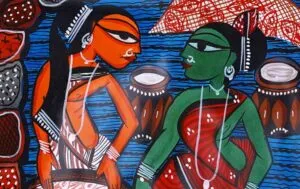
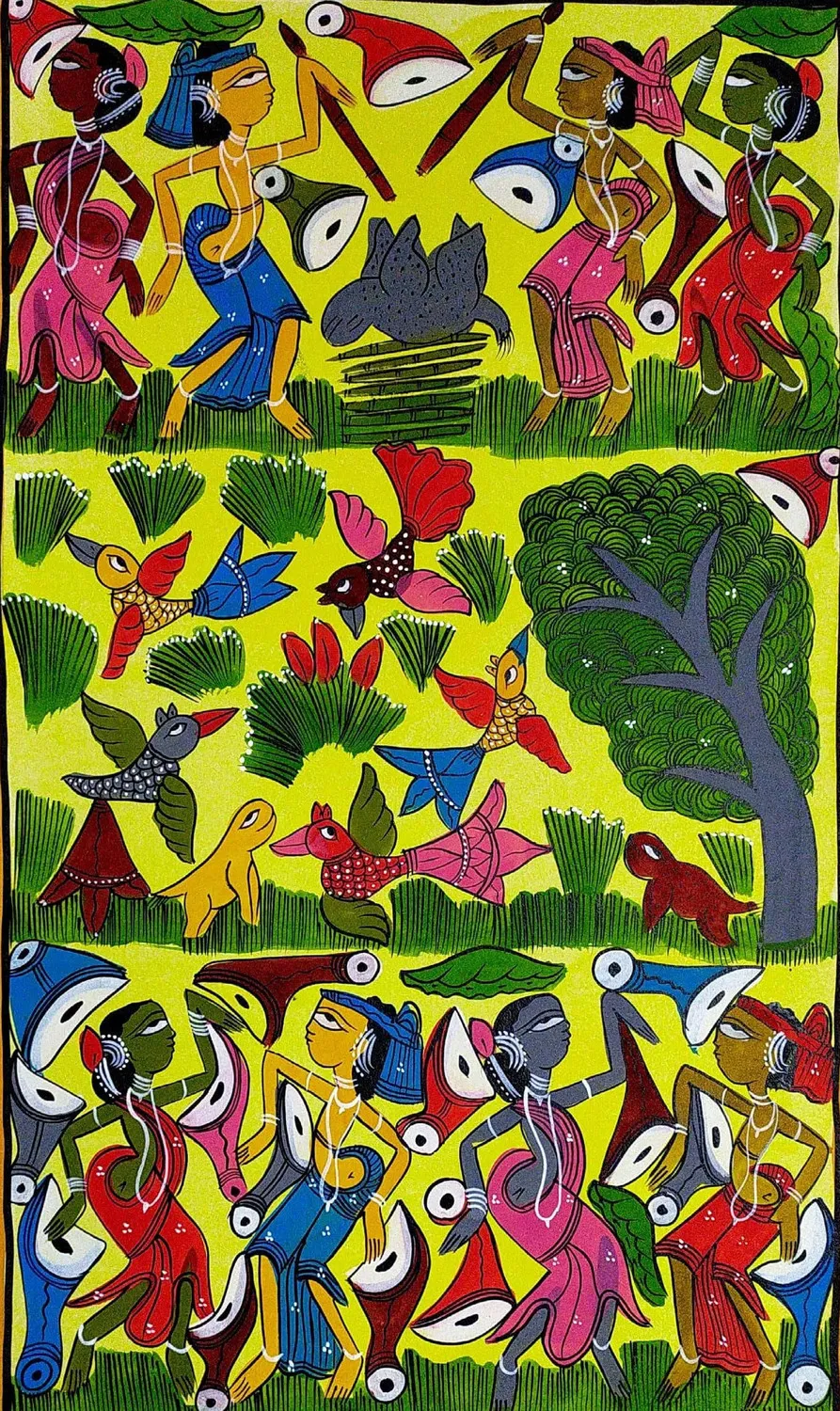
Santhal painting is a traditional form of Indian folk art practised by the Santhal tribal community, one of the largest tribal groups in India. The art appears in two main forms: wall paintings made directly on the mud walls of Santhal homes, and scroll paintings known as pata or patas, created on cloth or stitched paper. Visually, these works are immediately recognisable by their floral borders, flat figures of humans and animals drawn without anatomical precision, and a balanced background filled with leaves, insects, and flowers. The paintings use natural pigments prepared from forest materials including leaves, flowers, mud, and rocks, applied with sticks, twigs, and frayed brushes. Traditionally, Santhal paintings served as expressions of devotion to deities, records of daily life, and storytelling tools for important events like festivals, marriages, and death rituals. Browse the full Rooftop Art Wiki to explore related tribal and folk art traditions from across India.
History and Origin
The Santhal people are believed to have been painting their world long before written records captured the practice, with the tradition rooted in their animist beliefs and forest-dwelling way of life in eastern India. As a community that eventually settled across Bihar, Jharkhand, West Bengal, and Odisha, the Santhals carried their art with them, painting the walls of their huts to mark celebrations and connect with the divine. A distinct sub-tradition of scroll painting developed within the Santhal Paragana region of Bihar, practised by a sub-community called the Jadupatua or Jadua Patiya. These scroll painters would travel to bereaved households, paint the soul of the deceased, and narrate its journey to the afterlife through their scrolls. The word Jadupatua, when split, translates to 'magic painter' - jadu meaning magic and patua meaning painter. In the 20th century, Rabindranath Tagore brought wider attention to Santhal painting when he introduced it at Shantiniketan, where it was studied and taught as part of India's folk art heritage.
Key Features and Famous Artists
Key Features and Visual Style
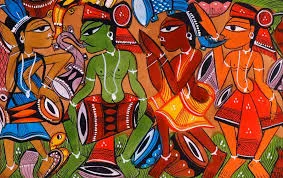
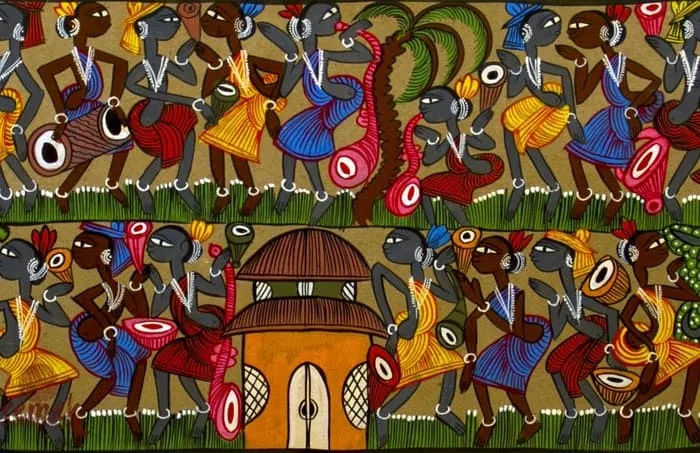
What makes Santhal tribal art visually distinct is its honest simplicity - figures are drawn with intention and feeling rather than anatomical accuracy, giving the work an expressive energy that feels both ancient and immediate. The paintings operate on a primary colour scheme and carry a strong narrative quality in every composition.
Colours are made from natural materials found in forests, including charcoal, leaves, mud, flowers, and rocks, and never synthetic dyes in the traditional form.
Central motifs include animals (especially birds and cattle), scenes of farming and fishing, dancing and singing figures, women working in fields, and the folklore surrounding death and the afterlife.
Compositions feature floral borders surrounding the main scene, with backgrounds densely filled with leaves, insects, and flowers to create a forest-like atmosphere.
The linework is first sketched in black or brown pigment made from burnt wood charcoal, and colours are filled in after the outline is complete.
Paintings are made on cloth, stitched paper, or directly on mud walls, with contemporary artists also working on canvas to reach wider audiences.
Famous Artists of Santhal Painting
Several artists have shaped the legacy and modern visibility of Santhal art painting, both by preserving traditional techniques and by carrying the form into contemporary spaces.
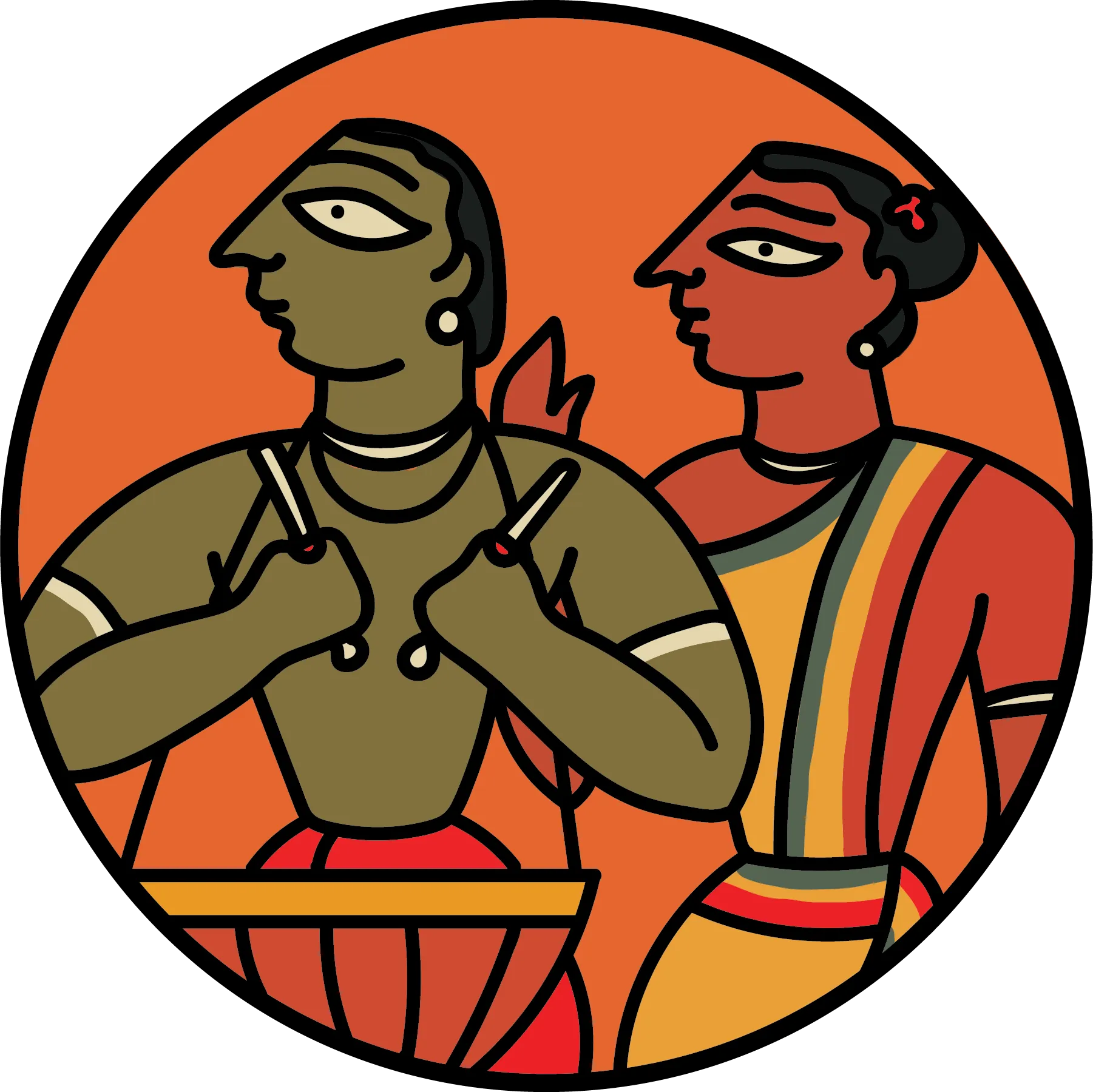
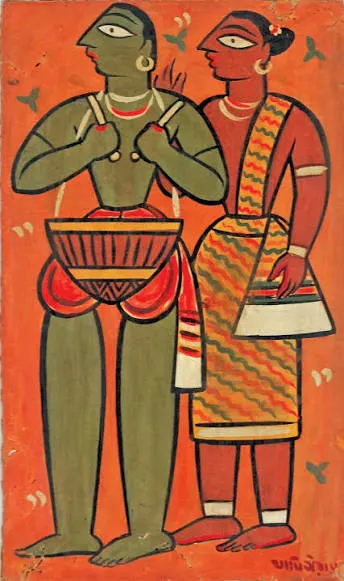
Jamini Roy (West Bengal) is among the most celebrated Indian artists of the 20th century, whose work drew directly from Santhal and Bengali folk painting traditions. Trained at Shantiniketan under Rabindranath Tagore's influence, Roy simplified his style to mirror tribal art, using flat figures, bold outlines, and earthy tones drawn from Santhal visual language. His work brought Indian folk painting to international galleries and helped legitimise Santhal aesthetic traditions within fine art. See the Kalighat painting course by Anwar Chitrakar on Rooftop for a closely related scroll-painting tradition from Bengal.
Dukhushyam Chitrakar (Birbhum district, West Bengal) is a Jadupatua scroll painter known for keeping the ritual scroll tradition alive, particularly the practice of painting soul scrolls for the bereaved. His work documents the Santhal belief system around death, the journey of the soul, and the role of the magic painter within the community.
Swarna Chitrakar (West Bengal) is a noted pata scroll artist who blends traditional Santhal storytelling themes with contemporary subjects, including social issues and current events, while retaining the visual grammar of traditional Santhal folk art.
How to Learn Santhal Painting
If you are wondering how to learn Santhal painting online in India, Rooftop offers courses taught by artists who carry this tradition first-hand. These are not generic art classes - they are structured learning experiences guided by practitioners from within the Santhal and related folk art communities. Whether you are a beginner curious about Indian tribal art or someone who wants to deepen their practice, Rooftop's folk art courses give you direct access to the techniques, motifs, and cultural context behind the art.
Where to See and Buy Santhal Paintings
Original Santhal paintings can be seen in person at the Shantiniketan campus in Birbhum, West Bengal, where Tagore's revival of folk art traditions is still evident in nearby collections and galleries. The Lalit Kala Akademi in New Delhi also holds works in this tradition, and folk art festivals across West Bengal and Jharkhand feature live demonstrations by Santhal and Jadupatua artists. For those looking to buy authentic traditional Indian art, Rooftop's shop carries verified original works by folk artists, including pieces in the Santhal tradition.
Learn Santhal
Frequently Asked Questions
What is Santhal painting and where does it come from?
Santhal painting is a traditional folk art form created by the Santhal tribal community, one of the largest tribal groups in India. It originates from the eastern Indian states of West Bengal, Jharkhand, Odisha, Bihar, and Assam. The art includes both wall paintings made on mud surfaces and pata scroll paintings on cloth or stitched paper, used for festivals, rituals, and storytelling.
Which state or community in India practises Santhal tribal art?
The Santhal community practises this art form and is spread across West Bengal, Jharkhand, Odisha, Bihar, and Assam, with Jharkhand having the highest concentration of Santhal population. A specific sub-community called the Jadupatua or Jadua Patiya, from the Santhal Paragana region of Bihar, specialises in scroll paintings associated with death rituals and soul narratives. The name Jadupatua translates literally to 'magic painter', reflecting the ritual function of these artists within their community.
Who are the most famous Santhal painting artists in India?
Jamini Roy of West Bengal is among the most internationally recognised artists who drew from Santhal folk visual traditions in his modernist work. Dukhushyam Chitrakar from Birbhum district is a noted Jadupatua scroll painter who maintains the traditional ritual form. Swarna Chitrakar is a contemporary pata scroll artist known for blending classical Santhal motifs with present-day themes.
What materials and colours are used in Santhal art painting?
Traditional Santhal painting uses natural pigments prepared from forest materials including leaves, flowers, mud, charcoal from burnt wood, and rocks. These are applied using sticks, twigs, and frayed brushes, with the outline first drawn in black or brown made from burnt charcoal and colours filled in afterwards. Contemporary artists increasingly use acrylic paints and canvas, though traditional practitioners continue with the older materials to preserve the visual character of the art form.
Can I learn Santhal painting online in India?
Yes, Rooftop's online courses cover Santhal painting and related Indian folk art traditions, taught by experienced artists who practise within these communities. The courses cover the visual style, motifs, techniques, and cultural context of the art form, making them suitable for complete beginners as well as those looking to develop an existing interest in tribal art.
Where can I buy authentic Santhal paintings in India?
Authentic Santhal paintings can be purchased from tribal art fairs in West Bengal and Jharkhand, from the Lalit Kala Akademi in New Delhi, and from curated platforms that work directly with folk artists. Rooftop's shop carries original works sourced from verified folk artists, making it possible to buy directly while supporting the artists and their communities. Santhal painting carries within it the full story of a community - its forests, its gods, its grief, and its celebration. Every scroll and wall painting is an act of remembering who the Santhals are and where they come from. If this art form has sparked something in you, explore folk art courses and original artworks on Rooftop and begin your own connection with one of India's most honest and expressive traditional art traditions.
Bibliography
Sources
Sengupta, A. Scroll Paintings of Bengal: Art in the Village. AuthorHouse, 2012.
Santhal Paintings. Lalit Kala Akademi, 2014.
Image Sources
"Santhal Painting: Revive of Classical Art for Modern People." Magic Decor, https://magicdecor.in/blog/santhal-painting-revive-of-classical-art-for-modern-people/. Accessed 14 July 2026.
"A Santhal Couple." Tallenge Store, https://www.tallengestore.com/products/a-santhal-couple-art-by-jamini-roy-canvas-prints. Accessed 14 July 2026.
"Festivities in Santhal Tribe Art." Fizdi, https://www.fizdi.com/festivities-in-santhal-tribe-art_7191_44252-handpainted-art-painting-14in-x-22in/. Accessed 14 July 2026.
"Santhal Painting: Revive of Classical Art for Modern People." Magic Decor, https://magicdecor.in/blog/santhal-painting-revive-of-classical-art-for-modern-people/. Accessed 14 July 2026.
"Santhal Painting: Revive of Classical Art for Modern People." Magic Decor, https://magicdecor.in/blog/santhal-painting-revive-of-classical-art-for-modern-people/. Accessed 14 July 2026.
"Santhal Folk Paintings of West Bengal." Culture and Heritage, Culture and Heritage, 25 June 2022, https://cultureandheritage.org/2022/06/santhal-folk-paintings-of-west-bengal.html. Accessed 14 July 2026.