

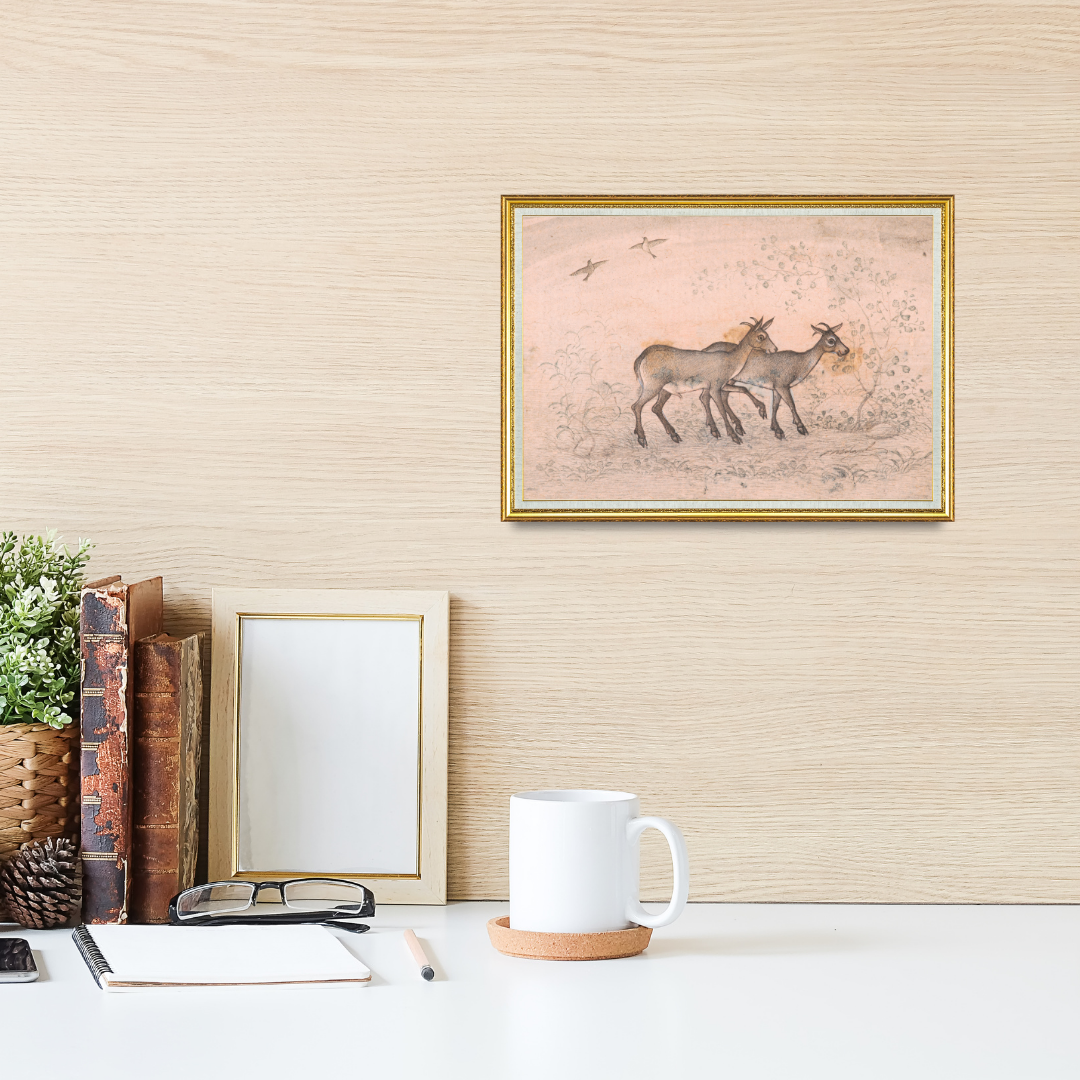
Step of the Twin Deer
Mahaveer Swami
Mahaveer Swami, born in Bikaner, Rajasthan, India, in 1959, is a highly accomplished artist. He began his artistic journey with home training before pursuing a Diploma in Painting & Sculpture at the Rajasthan School of Art in Jaipur. Mahaveer Swami's artistic themes frequently encompass asceticism, the everyday experiences of Indian women, and Hindu mythology, all influenced by Mughal and Rajasthani miniature traditions. With a strong interest in botany, he has produced remarkable miniature paintings with botanical themes. He has also collaborated with several prominent botanical societies, including the American, Korean, and Indian Botanical Societies. His art has gained international recognition through exhibitions at prestigious galleries in various Indian cities and abroad. He honed his skills in traditional painting under the tutelage of his mentor, the late Shri Vedpal Sharma "Bannu." Swami's work has been extensively exhibited, with over 60 galleries in India, including major cities like New Delhi, Mumbai and Kolkata, showcasing his art. Internationally, his reach extends to Paris, Brussels, Jerusalem, Washington DC, New York, Tokyo, Bangkok, Hong Kong, Shanghai, Singapore, Spain and Australia. Beyond exhibitions, Mahaveer Swami is dedicated to sharing his expertise. He has conducted workshops and training programs across India and globally, in locations such as Paris, Cairo, Jerusalem, Dubai, Bhutan, Algeria, Taiwan, Belgium, Shanghai, Hong Kong, Pittsburgh and Washington, DC. His artistic prowess has been recognized with numerous accolades, including the prestigious Master Craftsman Award (National Award). His art is held in the collections of over 17 museums and galleries worldwide, including institutions in Jerusalem, Berlin, Pittsburgh, New York, Paris, Belgium and Algeria. Mahaveer Swami's contributions to the art world are also documented in various books, magazines, and online blogs. His artwork is part of the permanent collections at esteemed institutions such as the Hunt Institute for Botanical Documentation at Carnegie Mellon University in Pittsburgh, the Museum Of Sacred Art in Durbuy, Belgium, the Cultural International Festival of Miniature & Illumination in Tlemcen, Algeria and the One Asia Project in Auroville, Pondicherry. His career exemplifies dedication and mastery, creating art that resonates across borders and cultures.
Description
Step of the Twin Deer captures a quiet moment where two deer move side by side with a calm, steady rhythm. Mahaveer Swami paints their bodies with soft shading that highlights the curves of their legs, necks and flanks. Their ears tilt forward and their narrow hooves lift lightly from the ground, giving the pair a sense of shared awareness. The slight overlap of their forms adds harmony to the composition, turning their movement into a graceful pattern.
The background is filled with delicate foliage and faint ground textures that create an airy sense of space. Two birds glide overhead, giving the scene a gentle upward flow. The natural black ink on old handmade paper gives the artwork a warm and timeless quality, allowing every line and shadow to stand out with clarity.
It is a miniature defined by simplicity, balance and quiet companionship.
Why This Artwork Stands Out:
- A serene portrayal of two deer moving in natural harmony
- Fine ink detailing creates soft depth and gentle realism
- Light foliage and birds add grace without overwhelming the subject
- A strong choice for collectors who appreciate subtle, nature-led miniature scene
What makes Step of the Twin Deer special?
How does Mahaveer Swami give the scene its gentle character?
Is this artwork suitable for modern interiors?
How should this artwork be displayed?

Mahaveer Swami
Bikaner Miniature Artist || Botanical Storyteller || Guardian of Sacred Themes
Unique Practice
He uses "pardaash" (black ink for 3D) and Sone ki syahi (golden effect), characteristic of Bikaner-style painting.