

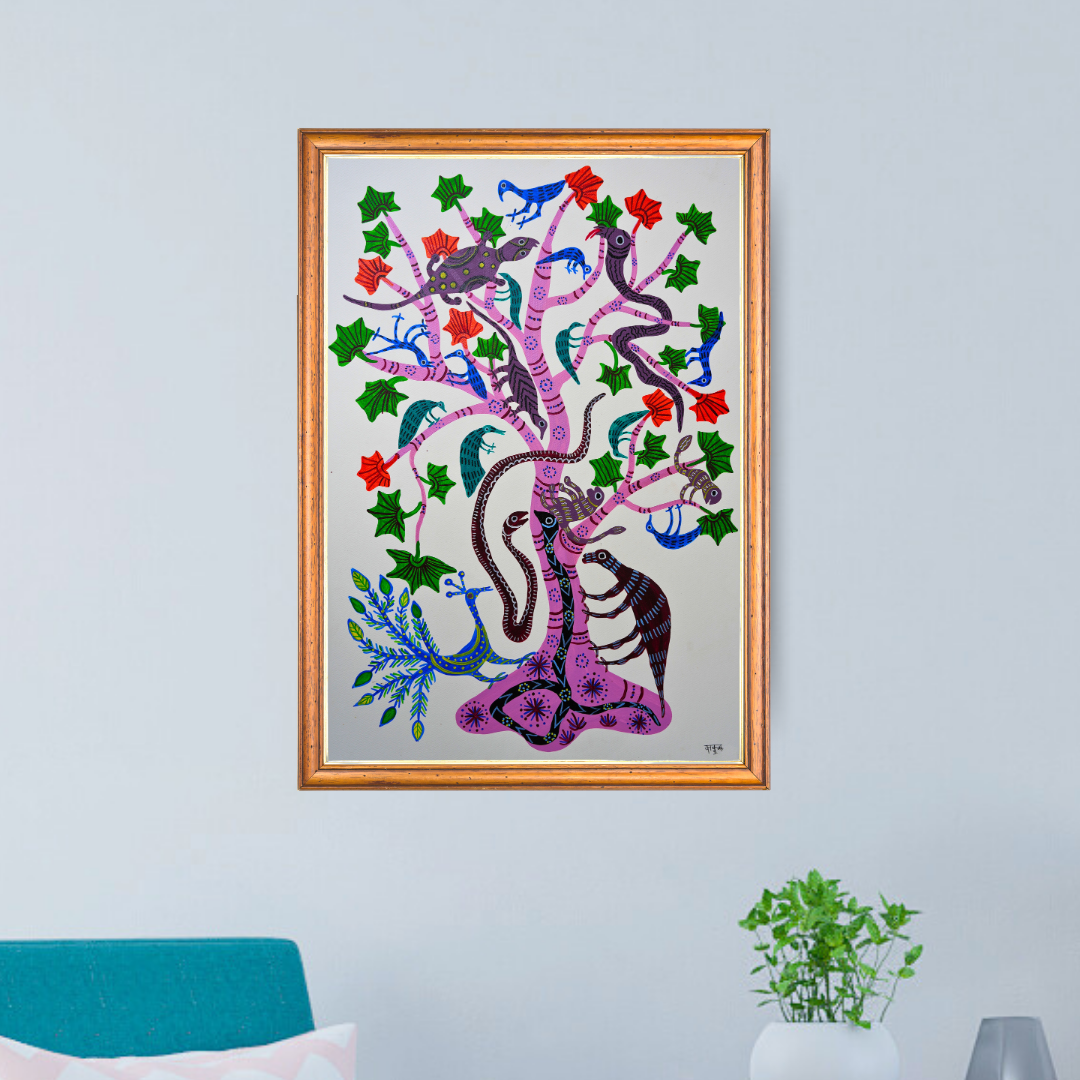
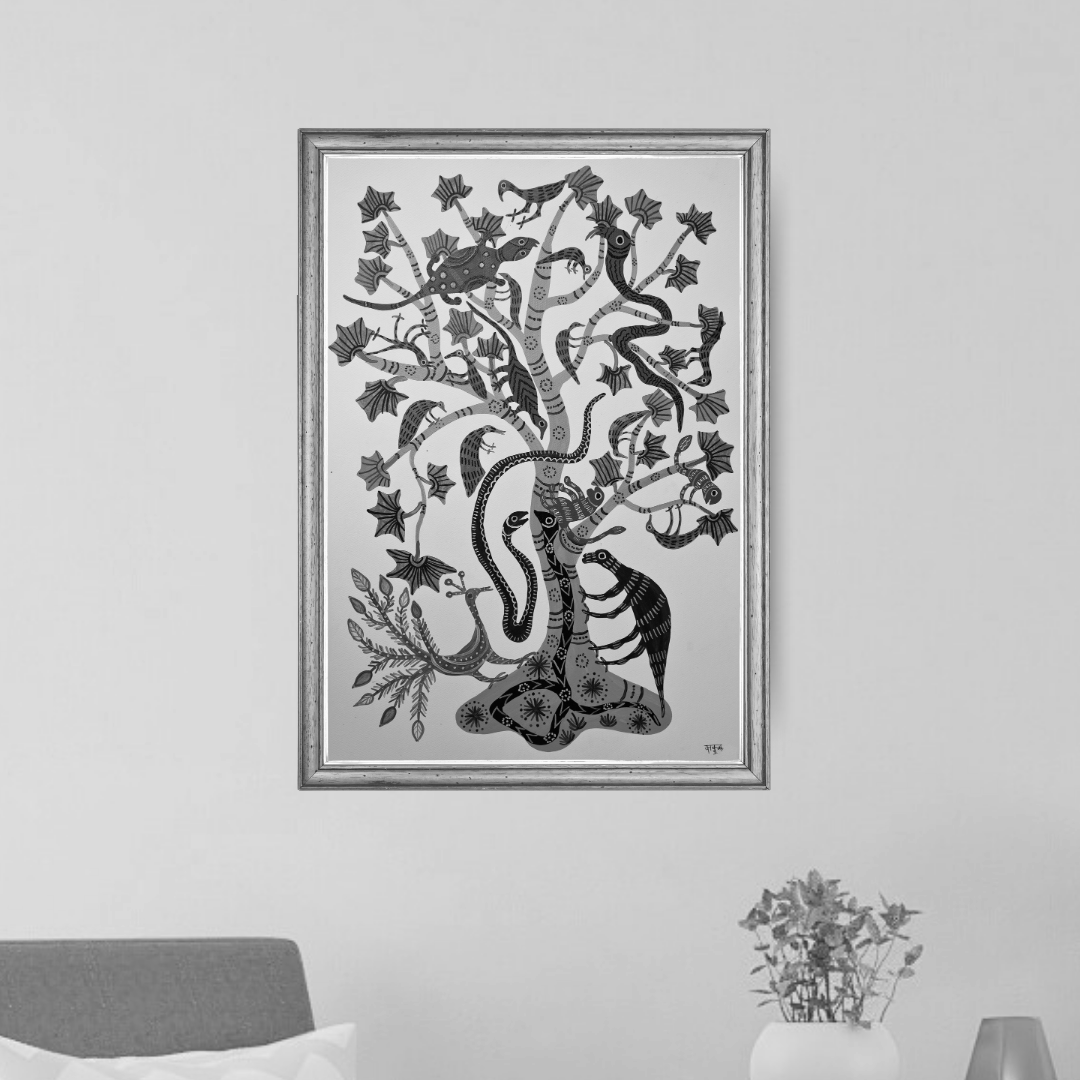
Kullu Tree surrounded by Baiga Creatures
Ramrati Bai
Ramrati Bai Baiga is a contemporary Baiga artist from Madhya Pradesh, whose work reflects the deep bond between her community, nature, and spirituality. She grew up surrounded by Baiga traditions, where everyday life was intertwined with rituals, folk stories, and reverence for the forests. Inspired by this heritage, Ramrati began painting as a way of narrating her community’s experiences and beliefs. Her creative journey took a new turn under the mentorship of artist Ashish Swami, who guided several Baiga women artists to bring their visual traditions onto paper and canvas. This transition helped Ramrati refine her style while still preserving the raw authenticity of Baiga art. Her paintings often depict animals, birds, trees, and sacred motifs, alongside scenes of village festivals, rituals, and moments of daily life. Through these subjects, she highlights the Baiga worldview where humans and nature coexist in a delicate balance. Working primarily in acrylics on paper and canvas, Ramrati’s art is vibrant, rhythmic, and full of symbolism. Each painting feels like a living document of Baiga heritage, while also standing as her personal interpretation of its spirit. Today, she is recognized as one of the significant voices of the new generation of Baiga artists, especially inspiring women from the community to carry forward tradition while opening it to new audiences.
Description
The Kullu tree holds immense cultural and spiritual significance in Baiga art and mythology. Deeply rooted in their worldview, the Kullu tree is often seen as a sacred symbol that connects the heavens, the earth, and the underworld. It highlights the interconnectedness of all living beings and the environment. In Baiga mythology, this tree is revered for its life-giving properties, serving as a sanctuary for all creatures and a representation of fertility, sustenance, and the cycle of life. Its depiction as the central element in the artwork emphasizes its importance as a life force and a guardian of balance in nature. The artist's choice to position the Kullu tree prominently might reflect an intention to celebrate its sacredness while visually narrating its mythological role within Baiga cosmology, where nature and spirituality are inseparable.
What is Baiga painting?
What materials are used in the creation of your Baiga paintings?
How should I care for my Baiga painting?
Are the paintings framed or unframed?
Can I commission a custom Baiga painting?

Ramrati Bai
Artist headline not available.
Unique Practice
Women-led perspective in Baiga art with powerful storytelling