

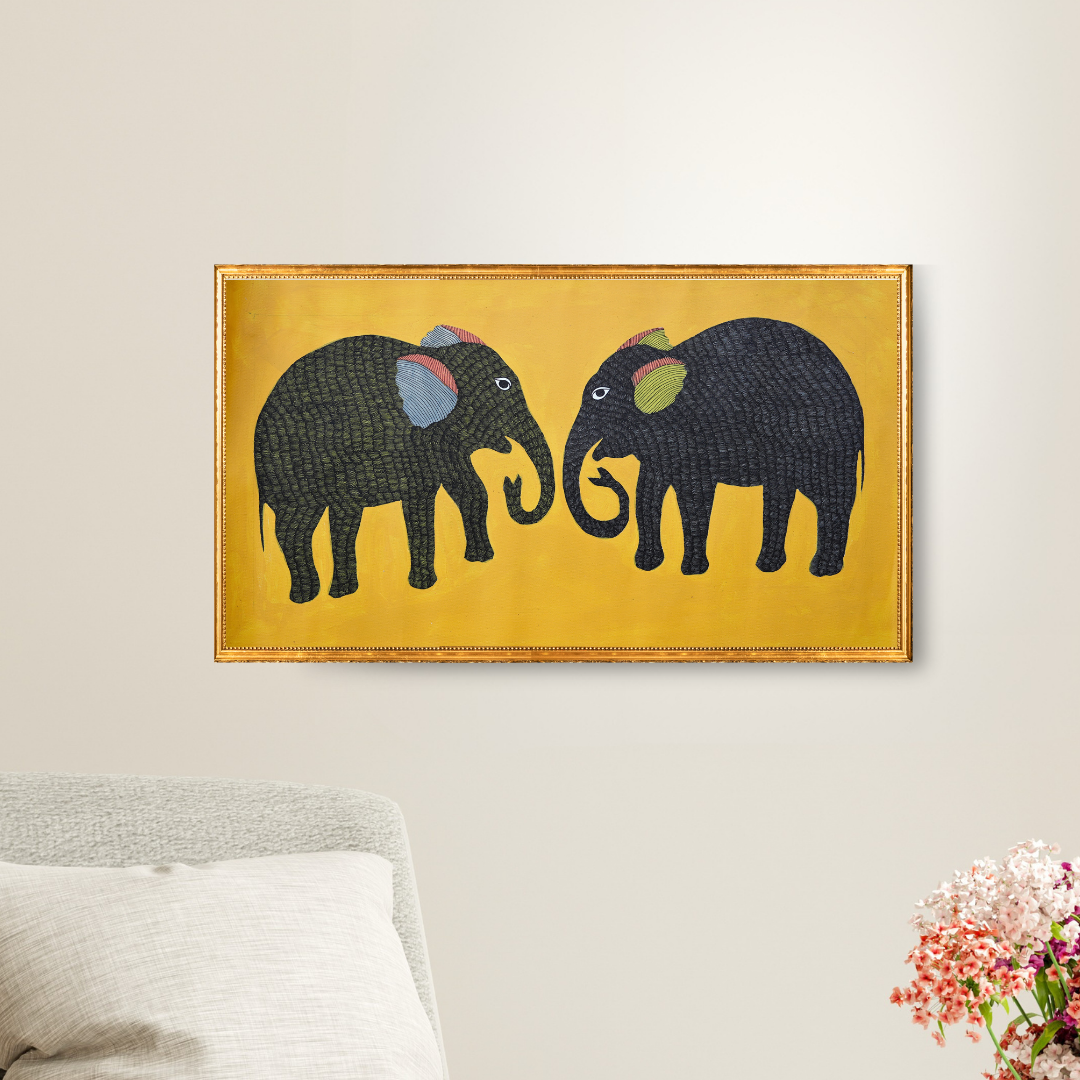
A couple of Black Elephants
Gariba Singh Tekam
Born into the legacy of Gond art, Gariba Singh Tekam has upheld and advanced this tradition for over 25 years. With each brush stroke, Gariba Singh Tekam reanimates the Gond mythology and highlights the prevalent practice of nature worship. Gariba Singh Tekam was born in 1976 into the Pradhan Gond community, the clan that has produced many talented Gond artists. Being the youngest brother of eminent artists Narmada Singh Tekam and Kala Bai, Gariba inherited the gift of artistry through the family. Moreover, he was fortunate to have received the mentorship of the acclaimed Gond artist Jangarh Singh Shyam, who was marvelled by his artistic excellence and inspired him to take painting as a profession. Glorifying colours and forms, Gariba Singh Tekam has a decorative and joyful style. A distinctive feature of Gariba’s paintings is the recurring three-line pattern, which he explains draws its inspiration from the trishul. Since childhood, Gariba has always been fascinated by the traditions and culture of the community. This is mainly why the artist’s artworks feature figures from the Gond pantheon. His vibrant paintings predominantly feature Baba Devi and Ghurri Dev, the principal deities of the Gond tribes, as well as the sacred Saja tree. Gariba Singh Tekam is committed to carrying forward the legacy of both his family and community, transforming his passion into a profession and ultimately into a mission. The artist carries this mission with the help of his wife, Prem Bai. Today, he teaches the next generation, ensuring the stories don’t fade. His artworks are widely recognised in the Indigenous Art and Living Traditions category, with one of his paintings fetching a record price of ₹3,30,108 at SaffronArt in 2020.
Description
Gareeba Singh Tekam's 'A Couple of Black Elephants’ is a radiant expression of Gond tribal art deeply rooted in ritual, symbolism, and reverence for nature. A traditional Gond artist celebrated for his intricate storytelling, Gareeba Singh brings to life this majestic scene of two black elephants standing face to face. Each elephant is adorned with rhythmic, hand-painted white dot patterns that lend a sense of movement and depth, while their ears bloom in vivid hues of blue, green, and pink, offering a vibrant contrast to the rich black bodies.
Set against a bold yellow background, the elephants command attention, creating a striking visual harmony. The use of saturated colour, combined with traditional Gond symbolism, reflects themes of unity, strength, and the sacred bond between living beings and the earth. Tekam’s meticulous craftsmanship, paired with cultural resonance, transforms this painting into more than just a visual delight; this Indian art painting becomes a bridge between tribal legacy and contemporary appreciation.
Whether as a collector’s piece or a striking decor element, A Couple of Black Elephants is a meaningful addition to any space that values tradition, nature, and artistic excellence.
Why this Gond Painting stands out:
Authentic Gond tribal art by Gareeba Singh Tekam- a tribal master artist known for his vibrant storytelling and deep reverence for nature.
A visual gateway to Gond heritage- It teaches the values of coexistence, nature reverence, and ancestral myths through intricate, symbolic forms.
A rich cultural piece perfect for collectors and art lovers- Perfect for gifting or as an addition to art lovers, wildlife lovers or tribal enthusiasts' collection.
Dimensions- Measuring 35x19 inches, this tribal piece of art is a perfect statement piece for drawing rooms, galleries, accent walls or creative studio spaces.
**From the heart of tribal India to your homes, this piece of Gond tribal art is a must add to your collection. **
What is Gond painting?
What materials are used in the creation of your Gond paintings?
How should I care for my Gond painting?
Are the paintings framed or unframed?
Can I commission a custom Gond painting?
Gariba Singh Tekam
Artist headline not available.
Unique Practice
A recurring three-line pattern signifying the trishul.