

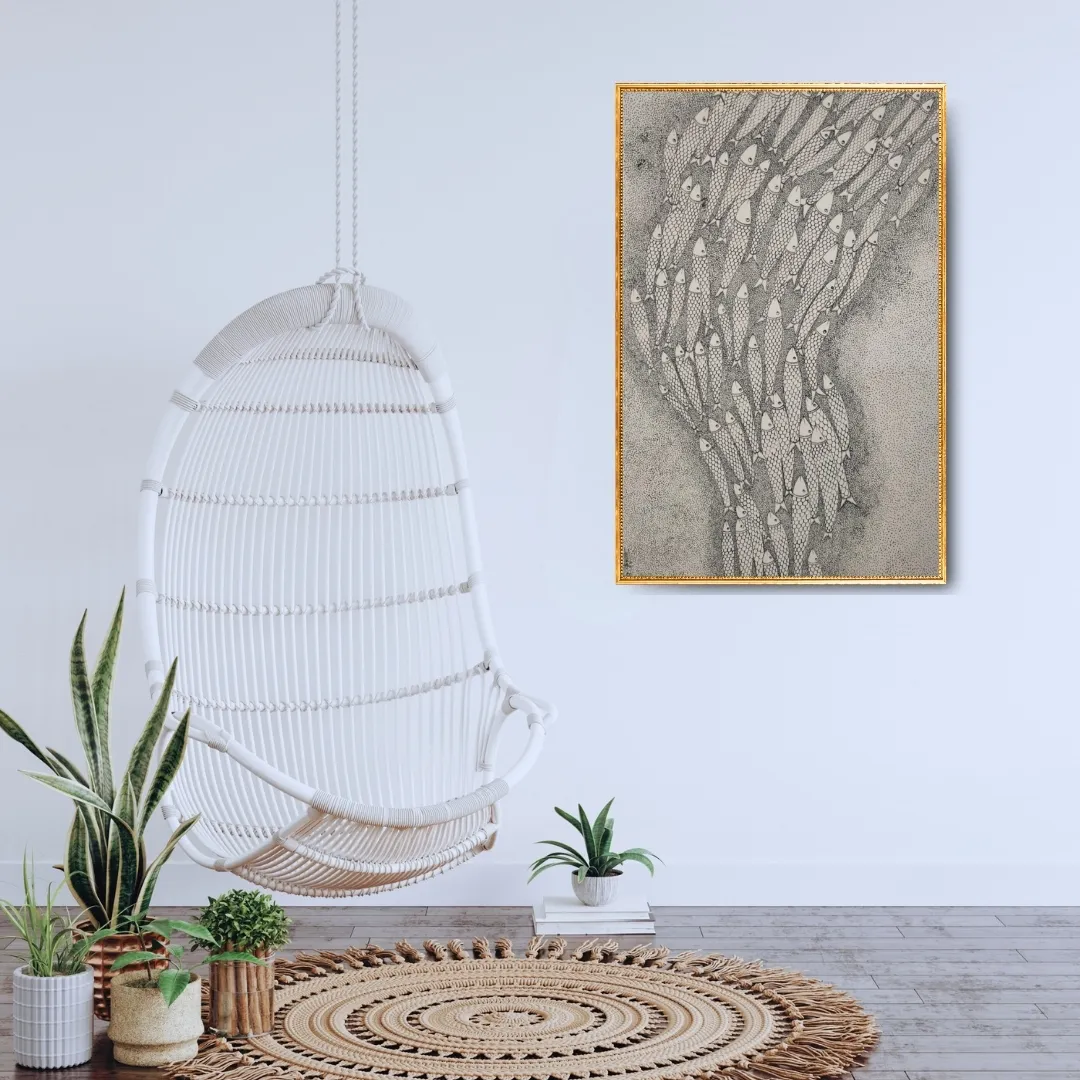
Fishes III
Description
They move as one. Dozens of fish sweep across the composition in tight, overlapping streams, their bodies aligned with the kind of collective purpose that makes a school of fish look less like many creatures and more like a single living current finding its shape. Each fish is rendered with the same patient attention: scales built from small, interlocking circles pressed together in careful rows, a pointed head, a watchful eye, a tail that tapers into the next body behind it. No individual fish commands the composition. The power belongs entirely to the movement itself, to the great arcing flow that carries all of them in the same direction at the same unhurried velocity.
The ground from which they emerge and into which they dissolve is a dense field of stippled dotwork, darker at the edges and softer at the centre, suggesting depth, water pressure and the particular quality of light that filters through deep water. There is no hard horizon, no fixed plane. The fish exist somewhere between surface and darkness, suspended in a space that feels genuinely aquatic. Sandeep Dhurve works in the Gond tradition of Madhya Pradesh, where repetition is never mere pattern but a way of understanding the world as continuous, interconnected and alive. Each scale on each fish is a mark made by hand, and the cumulative effect of hundreds of such marks held in formation is something closer to a natural phenomenon than a painting. Working in acrylic on paper, Dhurve transforms collective movement into a meditation on belonging, rhythm and the quiet intelligence of the natural world.
Why This Artwork Stands Out
The sweeping diagonal formation of the school creates a strong compositional current that carries the eye across the entire surface without rest, making the act of looking feel like participation in the movement itself. The repetition of individually scaled fish bodies, each rendered by hand, gives the collective mass an intimacy that purely abstract pattern-making cannot achieve. The stippled dotwork ground dissolves at its centre into open space, creating a sense of genuine depth and aquatic atmosphere within a monochromatic palette. Sandeep Dhurve's work demonstrates how the Gond tradition's visual grammar of pattern and repetition can describe the natural world with both precision and feeling.
Non-cancellable
This product cannot be cancelled once the order is placed. This item is non-returnable.
Is this painting handmade?
Does the painting come with a certificate of authenticity?
How will the painting be shipped?
Can I return or exchange the artwork?
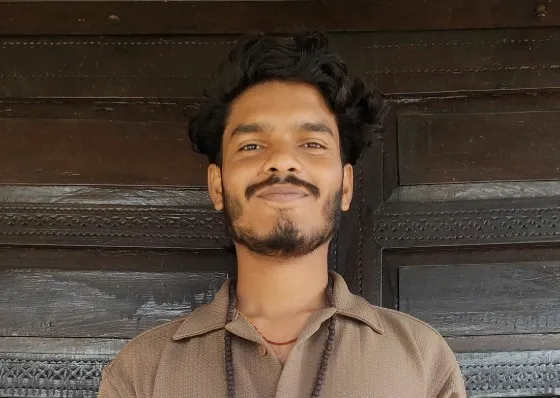
Sandip Dhurve
Unique Practice
Masterful focus on birds as symbols of memory and continuity