

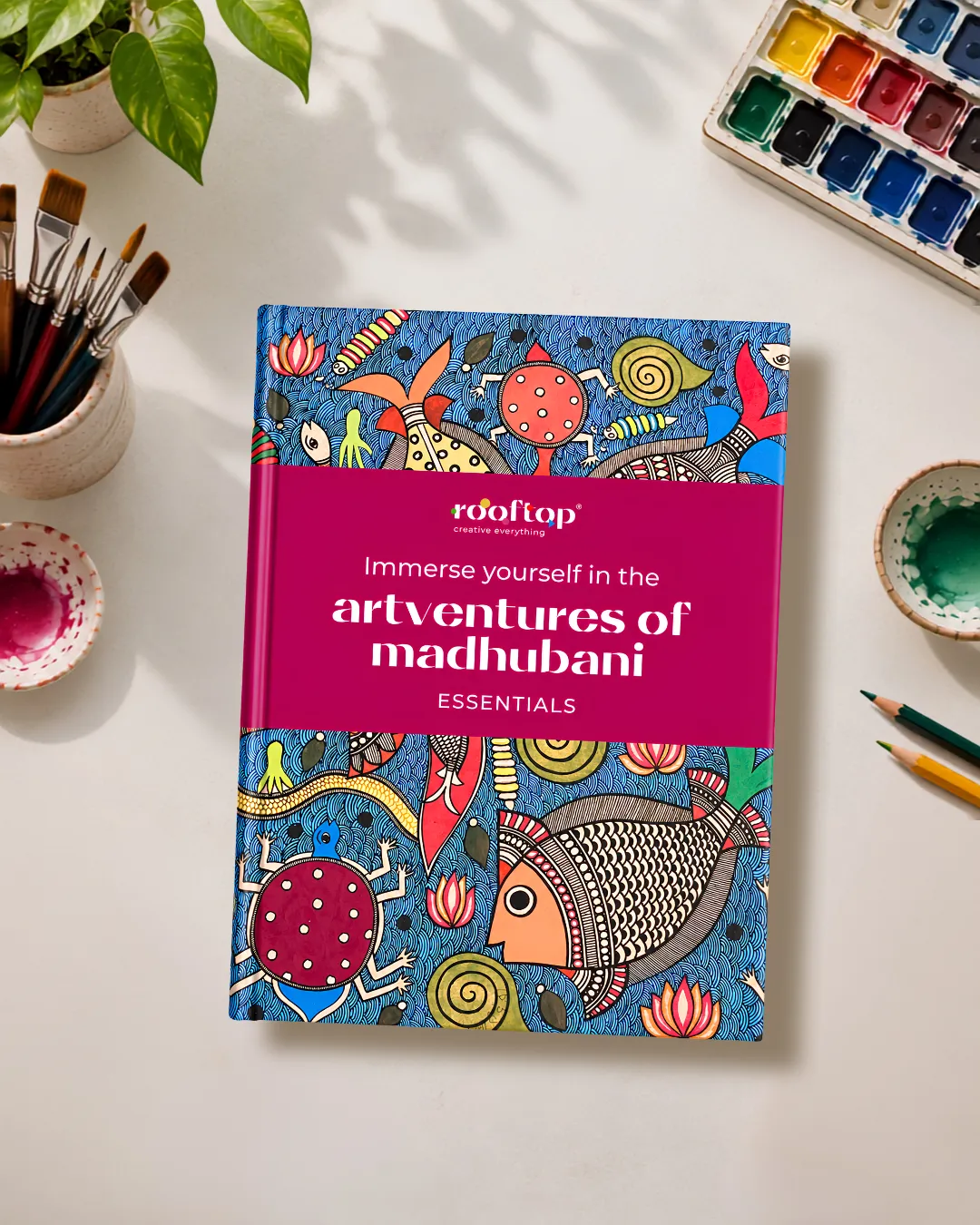
Artventures of Madhubani: Essentials
Description
Artventures of Madhubani: Essentials is the second level of the Madhubani series, written for people who want to understand the art form before drawing it. The opening section covers where Madhubani comes from and how it works. The word translates to forests of honey. The art belongs to the Mithila region of Bihar, with the main centres of practice in Madhubani, Darbhanga, Jitwarpur, Ranti and Purnea. It was made on walls for weddings and festivals, and stayed there until a 1934 earthquake exposed the painted interiors and the British official W. G. Archer documented what he found. The colour section is specific. Black comes from soot and cow dung, yellow from turmeric, blue from indigo, red from the Kusum flower or red sandalwood, green from apple tree leaves, white from rice powder and orange from Palash flowers. Gum Arabic and goat milk go in as binders. Bamboo twigs with a scrap of cotton tied to the tip serve as brushes. Two to five colours per painting, applied flat, with no shading anywhere. Style is treated as a question of community. Brahmin women painted Bharni, Kayastha women painted Kachni, and the Godana style belongs to the Dalit communities. The section on Dulari Devi that follows includes her own letter, which asks readers to understand the philosophy behind the art rather than only copying the patterns. Then the practice begins. Three border sections, four design sections and four pattern sections cover linear work, floral fills, dot and circle work, the fish motif and the patterns used to show water. Motif pages follow, each carrying a fact about Madhubani on the same page: sun motifs, two pages of parrots, fish, turtles and snakes, floral motifs, trees, and three pages of decorative fillers. The creative exploration section is the longest in the book. Complete a Chhath Puja composition. Fill in and background two facing fish. Finish a Lord Buddha composition. Join the dots and colour the result in Madhubani style. Complete a symmetrical sun. Pattern a peacock. Colour Devi Saraswati and finish her border. Complete a painting using only lines, dots and two colours, with no fills at all. Add elements around a swan. Finish a cow herder's village scene, help two fishermen fill a river, design a kurta neckline, and then make one composition entirely on your own.
Non-cancellable
This product cannot be cancelled once the order is placed. This item is non-returnable.