

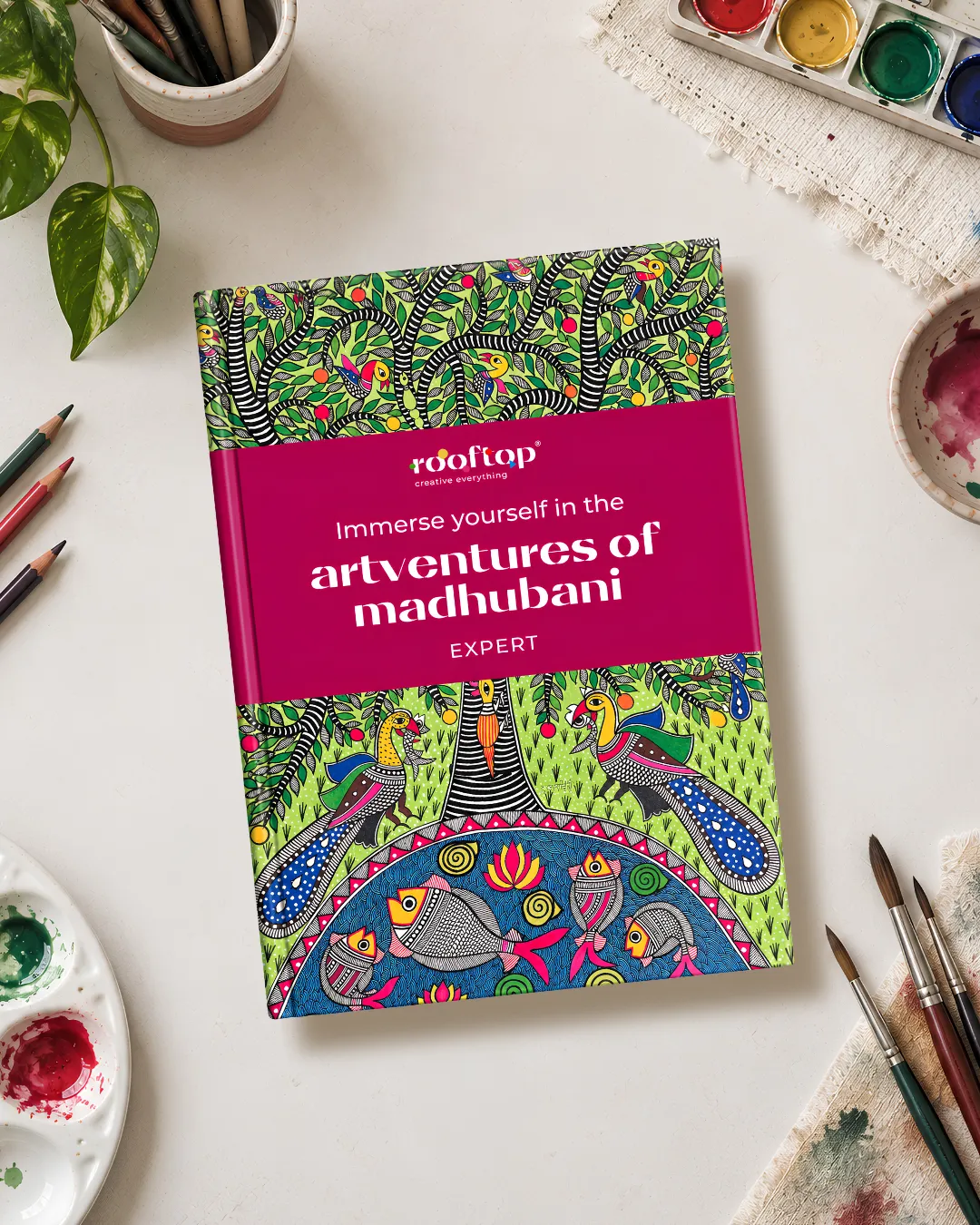
Artventures of Madhubani: Expert
Description
Artventures of Madhubani: Expert is the last book in the series and the only one with a dictionary in it. Six pages of catalogued forms: patterns, borders, and then motifs sorted into flora, animals and birds, gods, sacred motifs, human figures, jewellery and household objects. Flowers and two trees. Three birds, a parrot, two snakes, an elephant, a turtle, three fish, a cow. Lord Ganesha, Buddha and Goddess Saraswati. Two suns, a kalash, a lotus. A man, a woman and a child. Earrings and nose rings. Pots, a glass, a bucket, a tea cup, a water flask. Everything needed to build a composition without inventing shapes. The history section covers ground the other two books leave out. Mithila as a region takes in Madhubani, Jitwarpur, Ranti and Purnea, along with parts of Jharkhand and Nepal. The Kohbar paintings, made only for weddings, are said to have been painted for the first time when Raja Janaka commissioned artists for Ram and Sita's wedding. A full section covers Kohbar Kala: what the chamber is, who paints it, the four days the couple spend inside it, and which motifs go on the walls. Style is broken down by community. Bharni belongs to Brahmin women and carries bold colour with line work around solid forms. Kachni belongs to Kayastha women and works in one or two tones with the whole surface covered in line. Godana came out of the tattoo tradition and works in monochrome, often in circles. Tantric deals with ritual elements and is mostly painted by men. There is a long section on what each motif means. Fish for fertility, peacocks for romantic love, parrots as love birds, elephants for power and wealth, tigers for courage, turtles for the Kurma avatar, coiled snakes for eternity. Lotus for purity, bamboo for life, tulsi for protection, mango for abundance. Colour carries meaning too: red and yellow for energy, green for prosperity, black for protection against evil, white for purity. A contemporary outlook section takes on the harder question. Madhubani is now on sarees, trains, station walls and gallery walls, painted in acrylic, mixed media and digital tools. The book puts both readings on the page, that this is dilution and that this is what keeps the form alive, and does not pretend the argument is settled. The practice sections are the hardest in the series. Three advanced border sections and three cloth pattern sections. Four advanced motif pages covering flowers, birds, animals and human figures. Then compositions: master the patterns on a set of human figures, recreate Boat Chronicles from a Dulari Devi original, recreate her Goddess Durga, replicate a wedding scene, colour a line composition of Sita's birth story, complete a border and composition using every motif learnt, finish a bride being carried in a doli, complete a Kohbar painting before the groom arrives, and build a Madhubani comic storyboard from a first panel. Creative exploration goes fully open. Make a Tree of Life. Build an elaborate composition around a human figure of your choosing. Draw a scene from your daily life in Madhubani style. Arrange and paint a still life. The book closes with a trivia section: spot the difference, an eighteen-clue word search and a nineteen-clue crossword, both with answer keys.
Non-cancellable
This product cannot be cancelled once the order is placed. This item is non-returnable.