
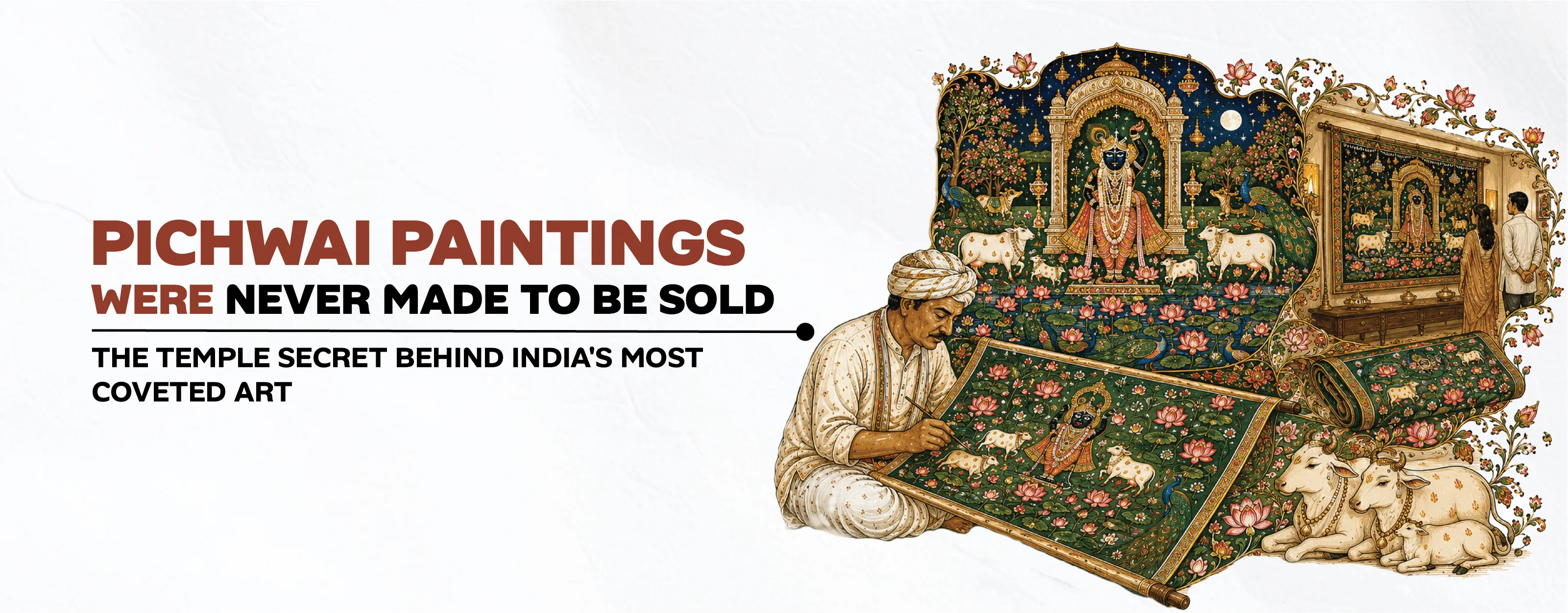

Pichwai paintings have travelled a long way from the temple town of Nathdwara in Rajasthan. Once created exclusively for the worship of Shrinathji, these elaborate cloth paintings are now found in galleries, private collections, and homes across the world. Their rich colours and intricate compositions have earned them recognition as some of India's most distinctive traditional art forms. But Pichwai was never meant to be a painting for someone to simply hang on a wall. Dating back nearly 400 years, the tradition developed around the worship of Shrinathji, a form of Lord Krishna depicted as a seven-year-old child.
The paintings adorned the inner sanctum of his temple, changing with religious occasions, seasons, and celebrations. For the hereditary artists who spent months preparing pigments, painting on starched cotton, and adding gold detailing, the work was an expression of Seva, or devotion. Their purpose was to serve the deity through their craft, rather than create something for commercial display. Knowing this changes how we approach Pichwai today. Beneath its elaborate floral patterns and striking imagery lies a tradition deeply connected to faith, temple rituals, and the artists who have preserved it across generations.
More Than a Painting Behind the Deity
More Than a Painting Behind the Deity
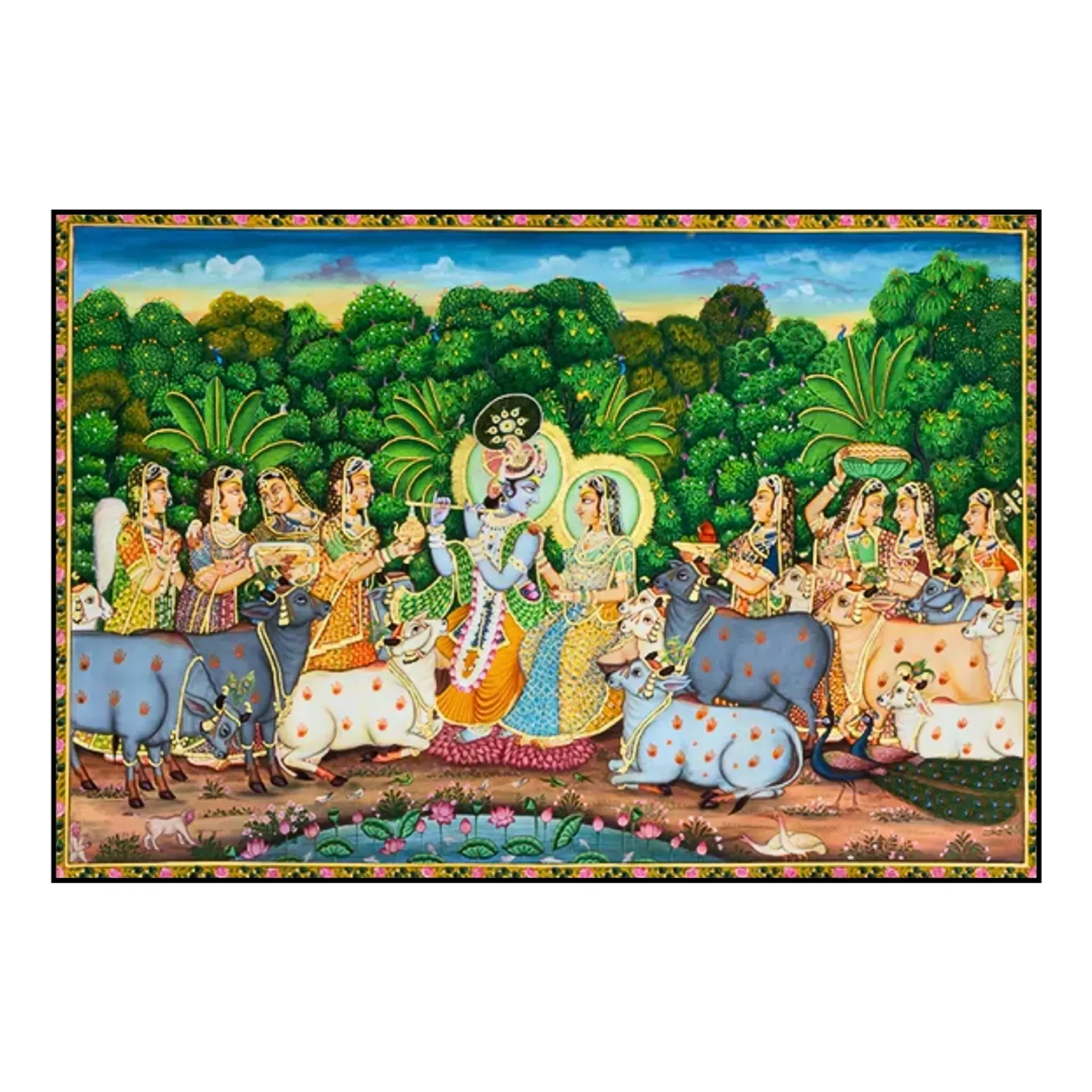
The name Pichwai tells us something about the purpose of this art form. It comes from two words: Pichh, meaning behind, and Wai, referring to a hanging or piece of cloth. Quite literally, a Pichwai is a painting that hangs behind the deity. But in Nathdwara, this cloth backdrop was never treated as an ordinary piece of temple decoration. It was an important part of how Shrinathji was worshipped.
To understand why, it helps to know a little about Pushtimarg, or the Path of Grace, a tradition founded by Shri Vallabhacharya in the 16th century. In this tradition, Shrinathji's temple is regarded as his Haveli, or home. The deity is cared for through eight daily darshans, with each appearance reflecting a different moment in his day. The surroundings, offerings, clothing, and decorations change with the seasons and religious calendar.
This is where Pichwai paintings become particularly meaningful. They help transform the temple space to reflect the world of Krishna's divine play (Lila).
- A Glimpse of Vrindavan: Paintings featuring lush groves, flowering trees, and the Yamuna bring to mind the landscapes associated with Krishna's childhood.
- The Presence of Govardhan: Some compositions depict Mount Govardhan, recalling the story of Krishna lifting the mountain to protect the people of Braj from torrential rain.
- A Changing Sacred Calendar: Different Pichwais are brought out for festivals, seasons, and special occasions. A painting of lotus ponds, for instance, carries a different seasonal mood from one depicting the monsoon or a winter celebration.
For the priests and devotees, these backdrops helped create the setting for Shrinathji's daily worship. The painting was part of the experience of darshan, giving the deity's surroundings a life and atmosphere of their own. What we admire today as a beautiful textile artwork once helped devotees feel closer to the world of Krishna.
A Painting for Every Season and Celebration
A Painting for Every Season and Celebration
One of the most fascinating things about traditional Pichwai paintings is that they were never meant to remain on display throughout the year. In Nathdwara, these cloth backdrops changed with the religious calendar of the Pushtimarg tradition. A particular painting would be brought out for a specific festival, season, or ritual, then replaced when the occasion passed. The colours, figures, and scenes depicted on the cloth were chosen to reflect what was being celebrated at the temple.
This meant that the temple needed an extensive collection of Pichwais, each made for a particular moment in the year. Some of the most significant compositions included:
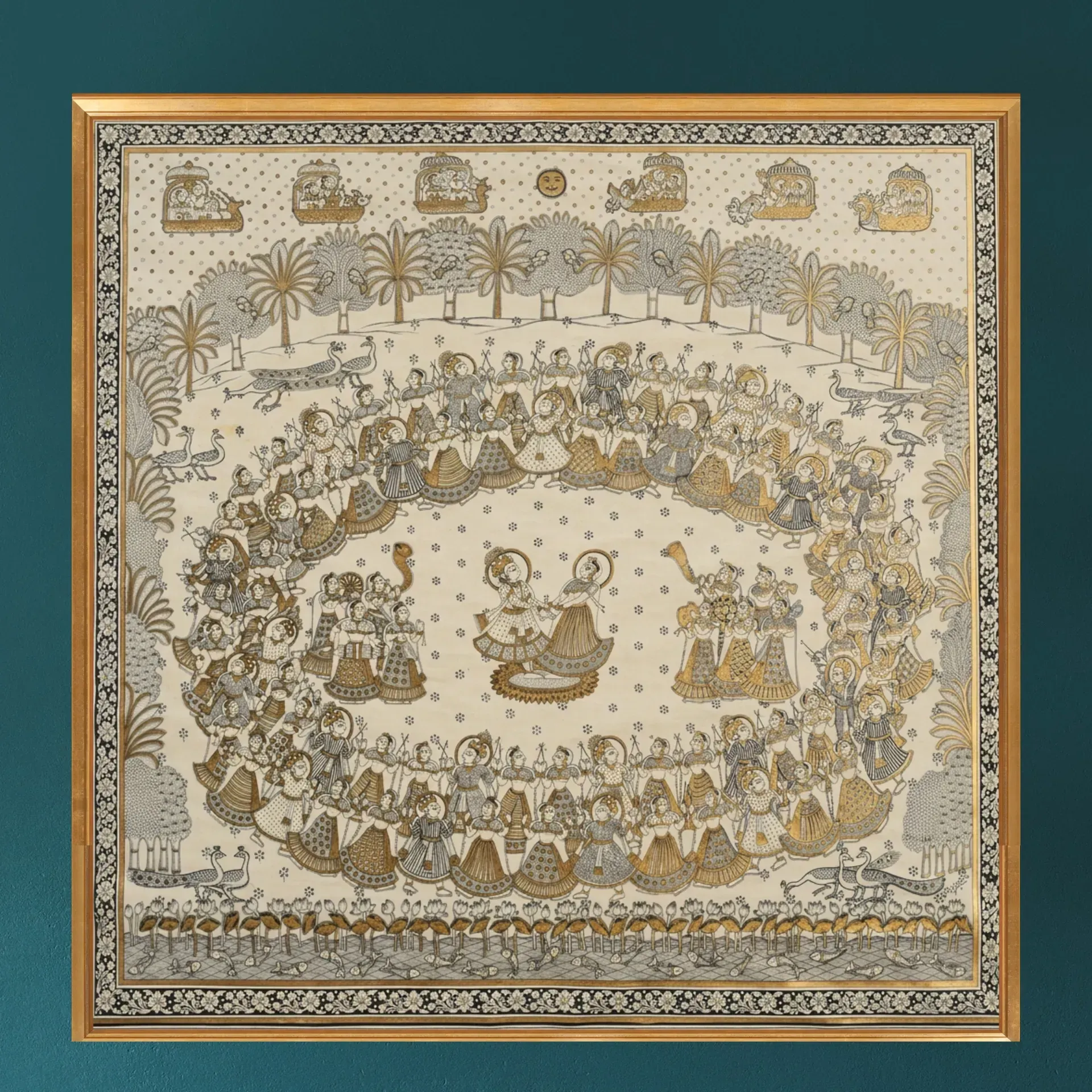
- Sharad Purnima: Created for the autumn full moon, this Pichwai depicts Shrinathji beneath a luminous night sky, surrounded by dancing Gopis and sacred white cows. The scene recalls the Maha Raas, Krishna's divine dance with the cowherd maidens, traditionally associated with the full moon night.
- Phool Bangla: During the hot months of late spring and early summer, the deity's surroundings were transformed into a garden of flowers. These Pichwais feature elaborate floral bowers and arches made up of blossoms such as marigolds, jasmine, and lotuses, bringing the freshness of a flower-filled retreat into the temple.
- Annakut: Celebrated after Diwali, Annakut commemorates Krishna lifting Mount Govardhan to protect the people of Braj from torrential rain. Pichwais made for the occasion depict Shrinathji holding the mountain aloft, often surrounded by elaborate offerings of rice, sweets, and other festive delicacies.
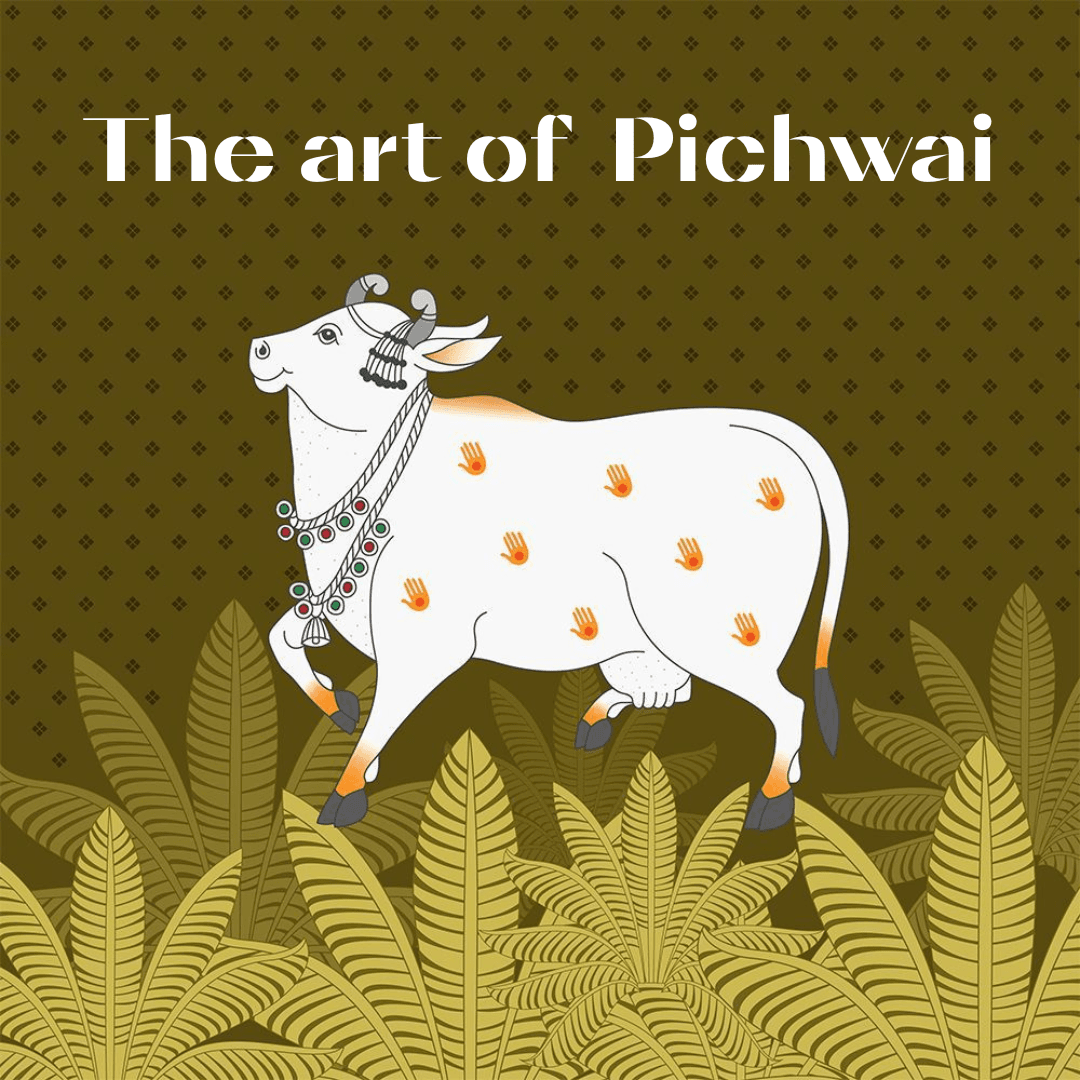
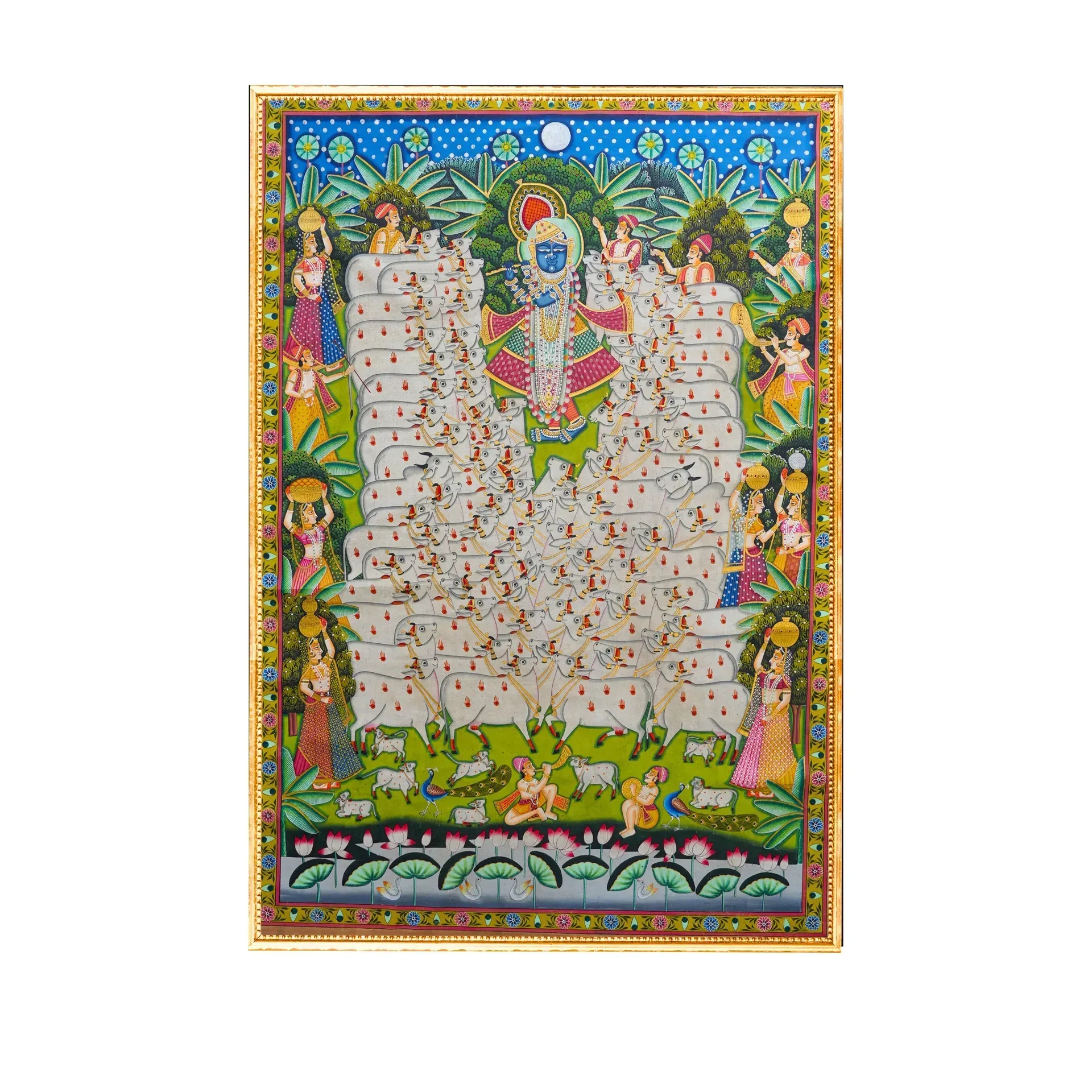
- Gopashtami: This festival marks Krishna's association with the care of cows. The corresponding Pichwais feature beautifully adorned cattle, decorated with peacock feathers, henna handprints known as thaapa, and brass bells.
- Varsha and Hindola: The monsoon season brings its own imagery to Pichwai. Dark rain clouds, flashes of lightning, dancing peacocks, and decorated swings known as hindolas capture the changing atmosphere of the season.
The timing mattered as much as the imagery. A Pichwai made for the monsoon would not be displayed during the summer, just as a Sharad Purnima composition belonged to its particular festival. These paintings followed the rhythm of temple life, giving the sanctum a changing appearance throughout the year. What might look like a collection of beautiful seasonal artworks today once served as a visual record of devotion, marking the passage of time through the worship of Shrinathji.
The Materials Behind Pichwai's Distinctive Glow
The Pichwai Glow
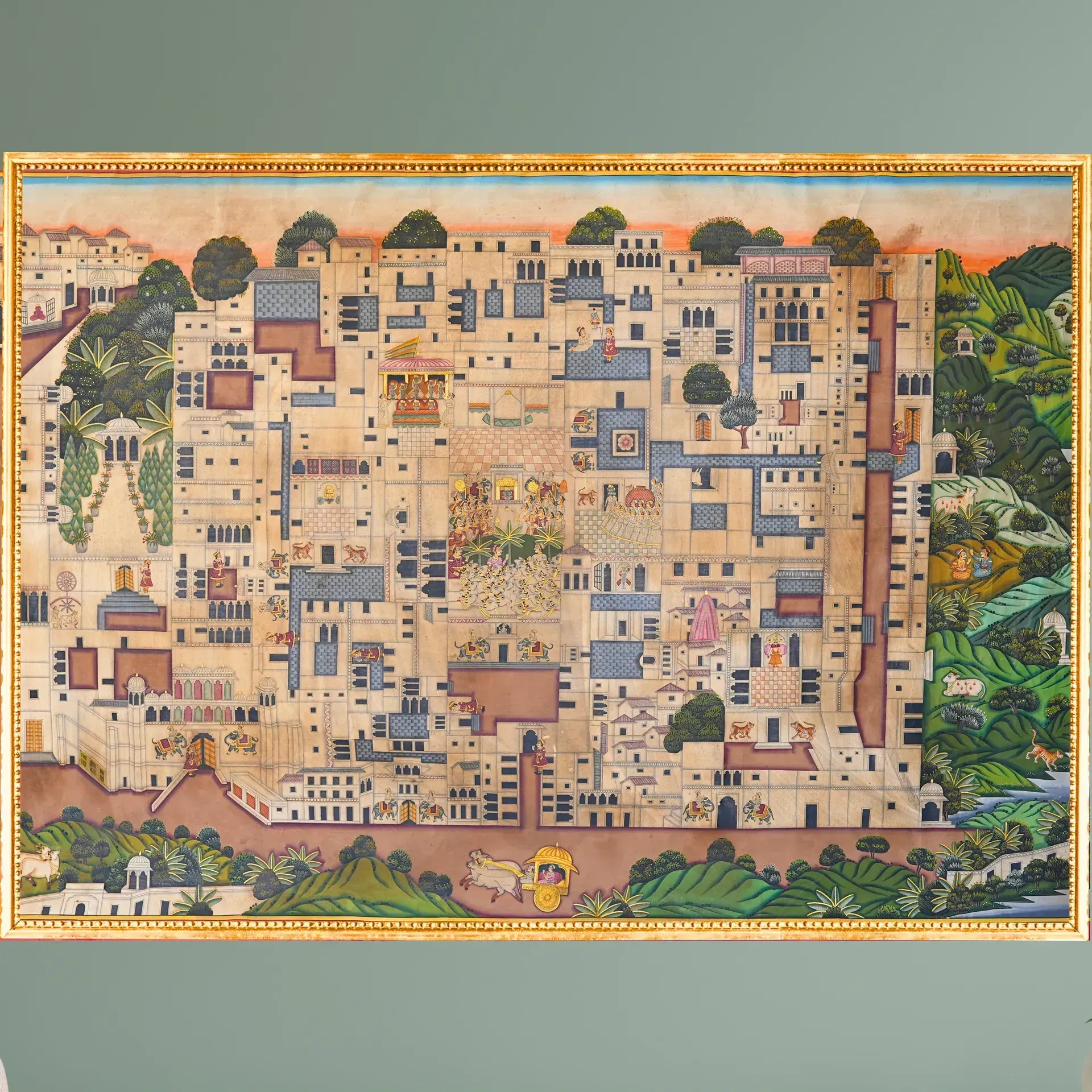
The rich appearance of a traditional Pichwai begins long before the artist paints the first figure. Preparing the cloth and colours was a careful process in itself, involving natural materials that had to be worked by hand. The result was a smooth, firm surface that could hold fine details and rich pigments, giving these paintings their characteristic depth and luminosity.
Preparing the Cloth
Traditional Pichwais were painted on heavy, handwoven cotton cloth, often khadi, or fine silk. The fabric was first treated with a starch solution called maand before being coated with a mixture of powdered white chalk stone (khaddi) and tree gum. Once the coating had dried, the cloth was burnished using a smooth agate stone known as Chikana Pathara.
This involved rubbing the surface repeatedly against a flat wooden block until it became firm and smooth. This preparation was important because it stopped the colours from seeping into the fabric fibres. It also gave artists a surface on which they could work with the fine lines, intricate patterns, and delicate details that Pichwai paintings are known for.
Colours Ground From Nature
Before synthetic paints became widely available, Pichwai artists prepared their pigments using minerals, stones, plants, and other natural materials. The process involved grinding these substances by hand to obtain colours with the desired texture and intensity.
Some of the traditional pigments included:
- Deep Indigo Blue: Obtained from fermented indigo leaves (Neel) or lapis lazuli stone.
- Fiery Red: Made using cinnabar (Hinglu) or natural red ochre (Dhau).
- Bright Yellow: Prepared from the mineral orpiment (Haritala).
- Pure White: Created by grinding crushed conch shells (Sankha).
- Earthy Greens: Derived from malachite (Subza) and copper verdigris.
Preparing these colours required time and patience. Artists had to grind the raw materials until they reached a consistency suitable for painting, with each pigment contributing to the distinctive palette of the artwork.
The Radiance of Gold
Gold was another important element in traditional Pichwai paintings. Known as Sone ka Vark, gold leaf was used to highlight details such as Shrinathji's crown, jewellery, and the decorative arches surrounding the deity. It added a richness to the composition that stood out against the deeper mineral colours. When illuminated by the oil lamps inside the temple, the gold detailing caught the light and gave the painting a warm, luminous quality. This interplay of natural pigments, carefully prepared cloth, and gold is a large part of what makes traditional Pichwais so striking to look at even today.
How Pichwai Found New Audiences
The History of Pichwai
For centuries, Pichwai paintings remained closely connected to the temple of Shrinathji in Nathdwara. They were created for specific rituals and festivals, and their use was rooted in a tradition preserved by generations of artists. It was only during the 20th century that these paintings began attracting attention beyond the temple town.
In the early 1900s, art historians such as Ananda Coomaraswamy and O.C. Gangoly began documenting the paintings of Nathdwara. Their writings brought attention to the scale, craftsmanship, and artistic sophistication of these textiles. Pichwai was gradually becoming part of a wider conversation about Indian art, reaching people who may never have encountered the tradition within a temple.
After Independence, museums and cultural institutions took a greater interest in preserving historical Pichwais. The Calico Museum of Textiles in Ahmedabad and the National Museum in New Delhi began collecting and exhibiting these works. Interest also grew beyond India, with institutions such as the Victoria and Albert Museum in London adding Pichwais to their collections. Scholars and cultural figures, including Pupul Jayakar and B.N. Goswamy, further explored the tradition's contribution to Indian art, textiles, and devotional history.
When the late 20th century arrived, historical Pichwais were also attracting private collectors. As older temple backdrops were retired or replaced, some began entering the secondary art market. Their age, craftsmanship, provenance, and connection to Nathdwara's temple traditions became important considerations for collectors. Auction houses such as Christie's, Sotheby's, Saffronart, and AstaGuru subsequently featured 18th- and 19th-century Pichwais in their sales, bringing them to an international audience.
Today, Pichwai paintings can be found in museums, private collections, and homes far beyond Nathdwara. Their presence in the art market has given them a new audience, but understanding their original purpose adds another dimension to appreciating them. Behind the elaborate compositions lies a history shaped by temple rituals, generations of artists, and a tradition that continues to hold its place in Indian art.
Pichwai's Story is Still Being Written
Pichwai has found admirers far beyond the temples of Nathdwara, but the future of this art form ultimately rests with the people who continue to practise it and those willing to learn about it. Its intricate compositions, traditional techniques, and stories of Shrinathji deserve to be carried forward, rather than remain confined to museum collections and old photographs.
This is where access to traditional art becomes important. At Rooftop, you can explore a curated collection of Pichwai paintings that brings the beauty of this art form into contemporary homes. For those who want to understand the process beyond simply admiring the finished work, Rooftop also offers Pichwai courses led by traditional artists. These lessons introduce learners to the techniques, motifs, and stories that have shaped the practice over generations.
Every new learner who picks up a brush and every art enthusiast who takes the time to understand a painting helps keep this tradition relevant. Pichwai has already travelled a long way from the temple walls of Nathdwara. With artists continuing their practice and more people finding ways to engage with it, there is every reason for its story to keep unfolding.