

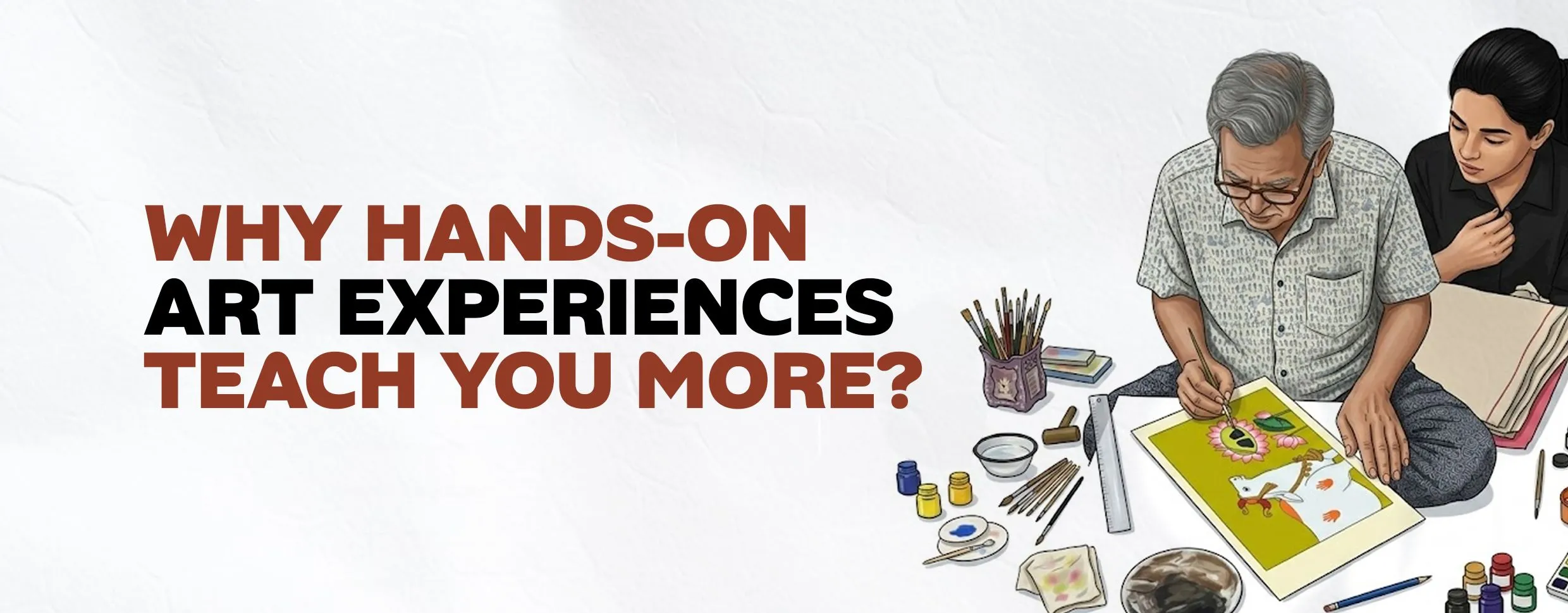
Why Hands-On Art Experiences Teach You More Than Any Tutorial: The Case for Learning Folk Art in Person
Art tourism in India is booming. Discover why learning folk art in person from master artisans teaches you more than any online tutorial, and where to book real painting workshops across India.

Rooftop
Author
You watched the tutorial. You paused at every step. You zoomed in when the brush moved too fast. The colours looked right on screen. But the painting in front of you still feels off. The lines are stiff. The rhythm is missing. The composition looks careful, but not alive.
This is the gap that tutorials cannot close.
Art tourism in India is growing for exactly this reason. People are realising that Indian folk art was never designed to be learned through a screen. It was passed down by sitting beside someone who had practised it for decades. Watching how they hold the brush. Hearing the scratch of bamboo on handmade paper. Feeling the resistance of clay between your fingers. These details rarely show up in a tutorial, but they are where real learning begins.
That is what makes a painting workshop India experience fundamentally different. It is not just about following steps. It is about understanding how the art moves, how it breathes, and how it lives in the hands of the person teaching it.
Why Tutorials Hit a Ceiling
Online tutorials are incredibly useful. They introduce you to art forms you might never have encountered otherwise. You learn what Indian folk art looks like. You see how Madhubani painting uses borders. You understand the structure of Warli art. You get familiar with Pichwai painting motifs.
This first layer matters.
But awareness is not the same as skill.
Folk traditions like Gond, Cheriyal, Paitkar, and Sohrai Khovar hold generations of knowledge in their brushwork and material preparation. A video shows the result. It cannot show the pressure applied at the tip of the brush. It cannot show the hesitation before a curve. It cannot show how pigment behaves differently on handmade paper.
Then there is the question of materials. Most online art courses India rely on acrylic paints and cartridge paper. They are accessible and easy to use. But traditional art forms often use very specific materials. Handmade wasli paper for miniature painting. Natural earth pigments for learn Pichwai painting sessions. Rice paste for learn Warli art workshops. Lamp soot mixed with natural binders for Paitkar painting.
These materials behave differently. They change the pace of your hand. They change the way lines form. And that experience is hard to replicate on a screen.
What a Painting Workshop Teaches You That a Screen Cannot
Something shifts when you sit across from a master artist.
You stop chasing the finished product and start observing the process. The way the artist holds the brush. The angle of their wrist. The speed of each stroke. The pause before starting the next section.
In a painting workshop India, correction happens instantly. The artist sees your hand stiffen and adjusts your grip. They notice too much water in your pigment and fix it. They suggest small changes before mistakes become permanent.
This is how art was traditionally taught in India. The guru-shishya model depended on proximity. You learned by watching, repeating, and being corrected in real time.
There is also context. When you attend a block printing workshop Jaipur, you stand in the same space where artisans have printed fabric for generations. The tools, dyes, and rhythms are part of the environment.
That context changes how learning feels. It becomes immersive instead of instructional.
The Range of Indian Folk Art You Can Learn in Person
The variety of art experiences India offers is wider than most people expect.
On Rooftop, there are over 30 in-person art experiences across India. You can learn Pichwai painting in Udaipur with Rajaram Sharma, practise Madhubani in Darbhanga with Smt. Asha Jha, try Sanganeri block printing in Jaipur with Raj Kumar Pandey, or work with Warli motifs in Dahanu with Pravin Mhase.
Each session is hosted by a practising artist. Not a content creator. Not a pre-recorded course. A working artisan.
The experiences go beyond painting. You can try terracotta craft in Bhubaneshwar. Kantha embroidery in Kolkata. Meenakari jewellery making in Jaipur. Palm leaf engraving in Odisha. Sanjhi paper cutting in Ajmer. Chitrakathi leather puppet making in Kudal.
Some sessions last two hours. Others run for a full day. Prices typically range from ₹1,500 to ₹15,000 depending on materials and duration.
What they share is the same core idea. Learning through doing.
Art Tourism in India: More Than a Trend
Art tourism in India is not just a passing idea. It reflects a real shift in travel behaviour.
Experiential travel in India grew by over 40% between 2022 and 2025. Travellers now plan trips around cultural experiences rather than just sightseeing.
Cities like Jaipur, Udaipur, and Varanasi already attract visitors. But art travel India takes you deeper. Into workshops, studios, and artisan homes.
When you learn folk art in Hazaribagh with Adam Christopher Imam, you engage with Sohrai Khovar painting, recognised by UNESCO. When you attend a Mata Ni Pachedi session with Kirit Chitara in Ahmedabad, you learn from a family that has practised this art for seven generations.
These experiences are not performances. They are living traditions.
When Online Learning Makes Sense
This does not mean online art courses India have no role.
Online learning works well for practice. After attending a workshop, you can continue refining your skills at home. Online courses also help learners who do not yet have access to in-person sessions.
Rooftop offers curated online courses taught by master artists, including Padmashree artists India, covering Gond, Warli, miniature painting, and more.
The best approach combines both.
Start with an in-person workshop. Practise using an online course. Return for another workshop when you want to improve further.
This cycle mirrors traditional learning methods.
If You Are an Artist: Share Your Craft and Earn from It
The demand for traditional art classes India is growing quickly.
Artists across India are earning by hosting workshops. Travellers, students, and enthusiasts are actively searching for folk art workshop experiences.
If you are a practising artist, you can list your sessions through Rooftop’s provider page. Onboarding usually takes two to three business days. There is no minimum number of sessions required.
You decide your format. Your pricing. Your schedule.
Whether you teach pottery in Rajasthan, fresco in Jaipur, or Cheriyal painting in Telangana, there is an audience waiting.
The Best Way to Learn Indian Folk Art Is to Be in the Room
Tutorials give you exposure. Workshops give you experience.
There is a difference between seeing a painting and understanding how it is made. There is a difference between watching pigment mix and feeling it under your brush.
Indian folk art is tactile. It is contextual. It is shaped by geography and community.
The best way to learn it is still the oldest way. Sit beside the artist. Work with real materials. Learn through your hands.
Explore art tourism in India through Rooftop’s in-person workshops. Over 30+ experiences across India & growing.
Every session led by a practising artisan. Every seat is a chance to learn something a tutorial cannot teach.