

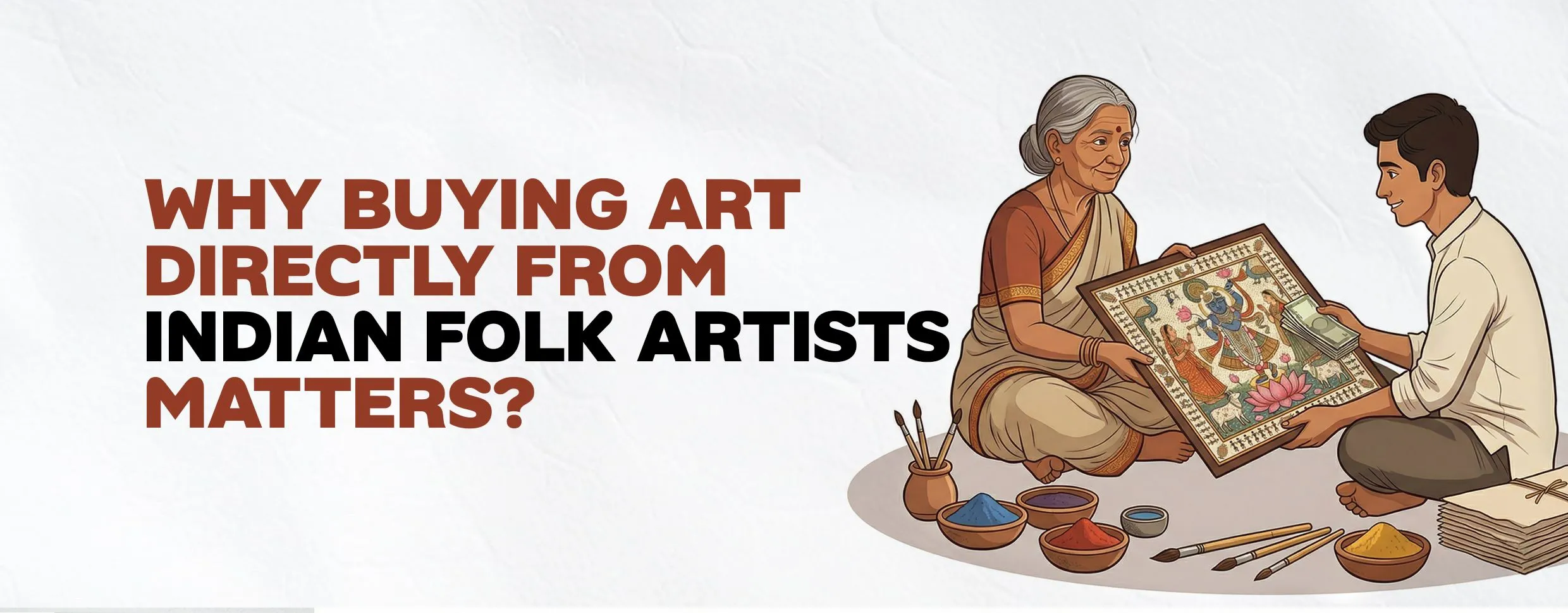
Why Buying Indian Folk Art Directly from Artists Matters: A Guide for Conscious Collectors
When you buy original Indian art direct from the artist, you get better provenance, fairer pricing, and a piece with real story. A practical guide for first-time and seasoned collectors.

Rooftop
Author
The market for Indian folk art has never been more visible. Madhubani paintings hang in offices in London. Gond works appear in design studios in Mumbai. Pichwai compositions sit in luxury hotels, collector homes, and glossy magazine spreads. There is real demand for original Indian art, and that growing interest should be good news for the artists who keep these traditions alive.
Yet there is a quieter reality behind the spotlight.
A buyer may pay ₹25,000 for a painting and assume the artist has done well. Sometimes the artist receives a small fraction of that amount after the work passes through dealers, wholesalers, retailers, or unverified online sellers. The people taking the largest share may never have touched a brush. That gap matters more than it seems. It affects whether artists can continue full-time practice, whether younger family members choose to learn the craft, and whether traditions remain living practices or become museum references.
This is why more collectors now prefer to buy Indian art online directly from artists or through platforms that work closely with them. It is partly an ethical decision. It is also a practical one. You often get better provenance, clearer authenticity, fairer pricing, and a far stronger relationship with what you own.
If you care about the object on your wall, it helps to care about how it reached you.
What Happens When You Do Not Buy Directly from the Artist?
The traditional supply chain for folk art can be long and opaque.
An artist in Mithila may complete a detailed Madhubani painting over several days or weeks. A local buyer purchases it quickly at a low rate because immediate cash is needed. That work may then move to a regional wholesaler, then to a city retailer, then to an online reseller, with markups at each stage.
By the time the piece reaches a collector in Delhi, Bengaluru, or abroad, the final price may be several times higher than what the artist received. This does two things at once.
First, it compresses artist income. The person doing the skilled labour earns the least secure portion of the transaction.
Second, it distorts buyer value. A collector may pay premium prices without receiving premium transparency.
There is also a growing issue with reproductions sold as originals. As demand rises, copies often follow. Lower-quality workshop versions, digitally transferred motifs, or works loosely imitating a known artist’s style may appear in marketplaces that provide little documentation.
A buyer thinks they purchased something rare. They may have purchased something generic.
Direct purchase shortens this chain dramatically. When you buy from an artist or a verified platform, the path becomes visible. That clarity protects both sides.
Why the Artist’s Income Decides Whether the Tradition Survives?
Craft traditions are often spoken about in cultural language. Heritage. Legacy. Preservation.
Those words matter, but economics usually decides the future.
A Gond artist needs enough income from painting to justify spending a week on a detailed composition. A Madhubani household needs art income to compete with other available work. A miniature painter training for years in fine brush control needs a market that respects the time required.
If the numbers fail, the tradition weakens.
This is not theoretical. Across many art forms, younger generations face a practical choice between uncertain craft income and steadier modern employment. When direct markets improve earnings, staying in the tradition becomes viable again. India has seen what happens when artists break through that ceiling.
Bhuri Bai helped bring Bhil painting into national recognition. Jangarh Singh Shyam reshaped how Gond art was seen globally. Dulari Devi became both practitioner and teacher for future generations.
On Rooftop, collectors can also discover artists like Jaggu Prasad, a master miniature painter from Jaipur whose works have entered international collections and been sold through Christie’s London. His journey from a modest household to global recognition is not just an inspiring biography. It is evidence that fair access to buyers can change an artist’s life.
When collectors buy directly, they are not donating. They are participating in a healthier market.
What You Gain as a Buyer
Buying direct is often framed as generosity toward artists. That misses half the story. Collectors benefit in meaningful ways.
Provenance That Holds Its Value
When you know who made a work, where it was created, when it was purchased, and what materials were used, you have provenance. That matters immediately for confidence. It matters later for insurance, gifting, resale, or inheritance.
An artwork with a clear story generally holds more value than one with vague origins.
Authenticity You Can Verify
If you buy paintings online India, authenticity becomes central. Direct channels reduce guesswork. You know whether the work came from the artist, their studio, or a platform that has verified them.
That is a very different experience from trusting an anonymous listing with three blurry photos.
The Story Behind the Piece
A Pichwai painting may depict a specific seasonal form of Krishna worship. A Madhubani border may reference marriage symbolism. A Cheriyal work may depict a folk episode from Telangana.
When you buy directly, these meanings can come with the artwork. That transforms the experience of ownership. You are no longer living with décor. You are living with narrative.
Better Work at Fairer Prices
This is the most underrated advantage.
A long chain adds cost without improving the object. Direct relationships often mean the artist earns more while the buyer pays a fairer price than heavily marked-up retail.
That is rare in most markets. In art, it matters.
How to Tell If You’re Buying Genuinely
Whether you plan to buy Indian folk art online or in person, a few practical checks help separate confidence from regret.
Questions Worth Asking
- Who is the artist and where do they practise?
- Is the work signed or otherwise attributable?
- What materials were used? Handmade paper, natural pigments, acrylic on canvas, cloth, board?
- Is there a certificate of authenticity?
- Can the seller share artist background and process details?
- Is the price consistent with the level of work and the artist’s reputation?
Documentation That Helps
- Certificate of authenticity
- Artist profile with biography
- Details of tradition and technique
- Purchase invoice with title and medium
- Images of the artist or studio where appropriate
Red Flags
- Multiple “originals” that look identical
- Sellers who cannot name the artist clearly
- Extremely low prices for labour-intensive work
- Generic phrases like “inspired by tribal style”
- No information about medium, size, or provenance
Collectors do not need to become suspicious experts. They simply need basic curiosity.
That curiosity usually protects them.
Platforms and Approaches That Work
Not every marketplace helps artists just because it says so. Some simply digitise the old middleman model. Better platforms share a few traits:
- Verified artist identities
- Transparent pricing structures
- Real artist biographies and location details
- Certificates for original works
- Quality control against copies
- Ongoing relationships rather than one-time sourcing
Rooftop is structured around this approach. Buyers can browse by tradition, artist, or budget band. Original works come with authenticity support, and artists receive the majority share of what buyers pay.
Collectors can explore the paintings collection to discover works across Madhubani, Pichwai, Gond, Warli, miniature, Cheriyal, Mata ni Pachedi, and more. This model benefits artists too. Instead of relying on sporadic offline buyers, they can reach a wider audience while focusing on the work itself.
Starting a Collection Intentionally
First-time collectors often assume they need expertise before they begin.
They do not.
They need interest, patience, and a willingness to choose slowly.
Start with One Tradition
Pick one form that genuinely draws you in.
If you enjoy dense storytelling and vibrant colour, explore Madhubani. If devotional iconography appeals to you, look at Pichwai. If nature forms and rhythmic patterns resonate, study Gond. If minimal line work attracts you, consider Warli.
Depth usually creates better collecting than random variety.
Choose One Meaningful Piece
Many new buyers try to fill a wall quickly.
A stronger approach is one good work in the right place. One original painting often changes a room more than several decorative prints because it carries presence and intention.
Match Size to Space
- Small works suit study corners, shelves, hallways, or gallery clusters.
- Mid-sized works anchor bedrooms, dining areas, or office walls.
- Larger works deserve breathing room and should be treated as focal points.
Set a Budget, Then Stay Thoughtful
Budgets help discipline. Taste helps allocate.
Sometimes stretching slightly for a stronger piece creates more long-term satisfaction than buying two weaker ones quickly.
Keep Your Records
Store certificates, invoices, artist notes, and correspondence. You are building not just a wall, but a collection history.
The Emotional Value of Buying Direct
There is another benefit collectors rarely mention.
When you know who made something, you look at it differently.
A painting stops being “that thing above the sofa.” It becomes the work of a specific person in Mithila, Jaipur, Bhopal, Ahmedabad, or Hyderabad who spent real time making it.
That connection changes ownership.
You become more attentive. More curious. Often more respectful of the craft itself.
Objects with known origins tend to stay meaningful longer.
Every Purchase Shapes the Future
Indian folk art survives because people continue making it. People continue making it when the economics are fair enough to justify the labour. Every rupee spent directly with artists or through verified fair platforms pushes that equation in the right direction.
It also gives collectors something better.
Better provenance. Better authenticity. Better stories. Better objects.
If you are starting now, begin simply.
Choose one painting you genuinely want to live with. Read about the artist. Place it well. Let your eye return to it over time.
Then continue from there.
Explore original Indian art from verified artists on Rooftop. If you are an artist yourself looking to sell directly, you can also register through Rooftop’s provider page and reach collectors without disappearing into the old chain.