

Warli Painting Workshop: What Really Happens When You Learn from a Palghar Artist
What really happens in a Warli painting workshop, minute by minute. The three shapes, the moment it clicks, and what you carry home beyond the paper.

Rooftop
Author
Nobody signs up for a Warli painting workshop because they need another hobby. The people who arrive, and most of them have never painted anything in their lives, come carrying a quieter suspicion. It is the suspicion that making something with your own hands, something that also happens to be several thousand years old, might change how the rest of the day feels. That the two hours spent drawing small white figures on a brown ground might follow you out of the room.
The suspicion turns out to be correct, and this piece is an attempt to explain why, by walking through what actually happens inside a Rooftop Warli session led by a practising artist from the Palghar tradition. Not the brochure version. The real sequence, minute by minute, including the strange and specific moment in the middle when the whole thing stops being a drawing class and becomes something else.
What Actually Happens in the First Twenty Minutes
The most surprising thing about the opening of a Warli session is what does not happen. No one touches a brush. A first-timer arrives braced for the humiliation of being asked to draw, and instead finds the artist talking, because in this tradition the grammar comes before the language.
0:00 The artist begins with where the art comes from, the villages of Palghar, the mud walls, the married women who painted for weddings and harvests, and the fact that for most of its existence this art was never sold to anyone.
0:07 Then the three shapes. A circle, which is the sun and the moon. A triangle, which is the mountain and the tree. A square, the one human invention, the sacred enclosure. The artist draws each one slowly and explains what it carries. You realise you are not being taught to draw. You are being taught to read.
0:14 The story of the Tarpa dance is told before anyone attempts it, the single musician at the centre, the chain of dancers spiralling around him, the meaning of a community that moves as one body. The image arrives in your head as a story first, which is exactly how it arrived in every Warli child's head for a thousand years.
0:20 Only now does the brush come out. Two triangles, point to point. Your first figure stands on the page, slightly crooked, entirely alive. The room goes quiet in a way that has nothing to do with concentration and everything to do with delight.
That sequencing is not a teaching gimmick. It is the tradition's own order of operations, and it changes what your hand does when it finally moves. A person who knows that the triangle is a mountain before it is a torso draws it differently, with a kind of respect that no amount of technical instruction produces.
The table itself tells you something before the session starts. Brown sheets or prepared kraft paper stand in for the mud wall, white poster colour stands in for rice paste, and the brushes are fine-tipped and few. Online, the same kit arrives at your door or gets assembled from a short list, and the artist teaches to a camera angled over their own page, so you watch the stroke being born rather than a slide about it. Either way, the materials are deliberately humble, because the tradition's whole point is that everything needed already sits within reach of an ordinary household.
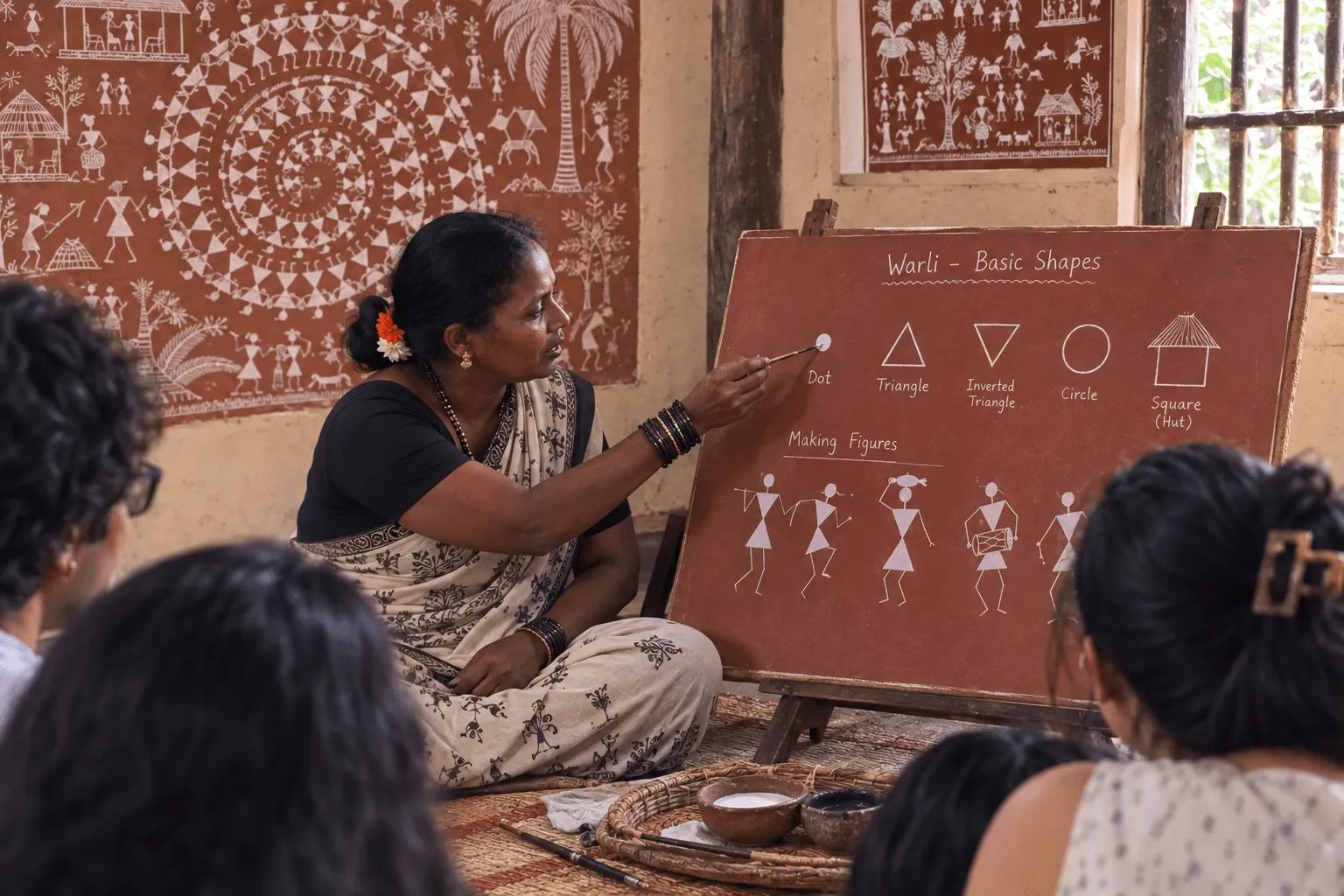
The grammar before the language. The shapes are explained, and what they mean, before any brush moves.
The Moment It Clicks
Somewhere past the halfway mark, in almost every session, the same shift happens, and it is the thing participants struggle to describe afterwards. For the first stretch, everyone is copying. Eyes flick from the artist's demonstration to their own page and back, checking, correcting, worrying. The figures come out stiff because they are being reproduced rather than made.
0:45 The artist sets a scene rather than a figure. Paint your village, or paint a harvest, or paint the dance. No reference to copy. Just the shapes you now own and a story you have to tell with them.
0:55 And here it happens. Hands stop hesitating. The figures start arriving in rows and clusters, each one slightly different from the last, and the page begins to fill with rhythm rather than drawings. People stop looking up. They are no longer copying. They are composing.
1:10 By now the geometry that looked so limited an hour ago has quietly revealed its secret, which is that three shapes with rules make infinite sentences. Two people at the same table, given the same prompt, produce completely different worlds, and both are unmistakably Warli.
Musicians know this shift as the moment a scale becomes a song. The constraint is not the ceiling. The constraint is the instrument. Warli hands you the smallest instrument in Indian art and then shows you, in real time, in your own hands, that it can play anything. Watching a room full of self-declared non-artists discover this about themselves is, frankly, the best part of the job for the artists who teach it.
Watch the artist during this stretch and you see what teaching from inside a tradition actually looks like. The corrections are tiny and strange and exactly right. Loosen your grip. Let the line tremble, the tremble is the art. Make the figures smaller, always smaller than you think. Lean the dancers into the curve so the circle moves. None of it is about accuracy, because accuracy was never the point of Warli. All of it is about rhythm, which is the actual skill being transmitted, hand to hand, the way it always has been.
Three shapes, ninety minutes, infinite sentences
A Warli session teaches a complete visual grammar in a single sitting, which almost no other art form can honestly claim. Participants arrive unable to draw and leave composing original scenes, because the system was designed by its community to be learnable by everyone, including children.
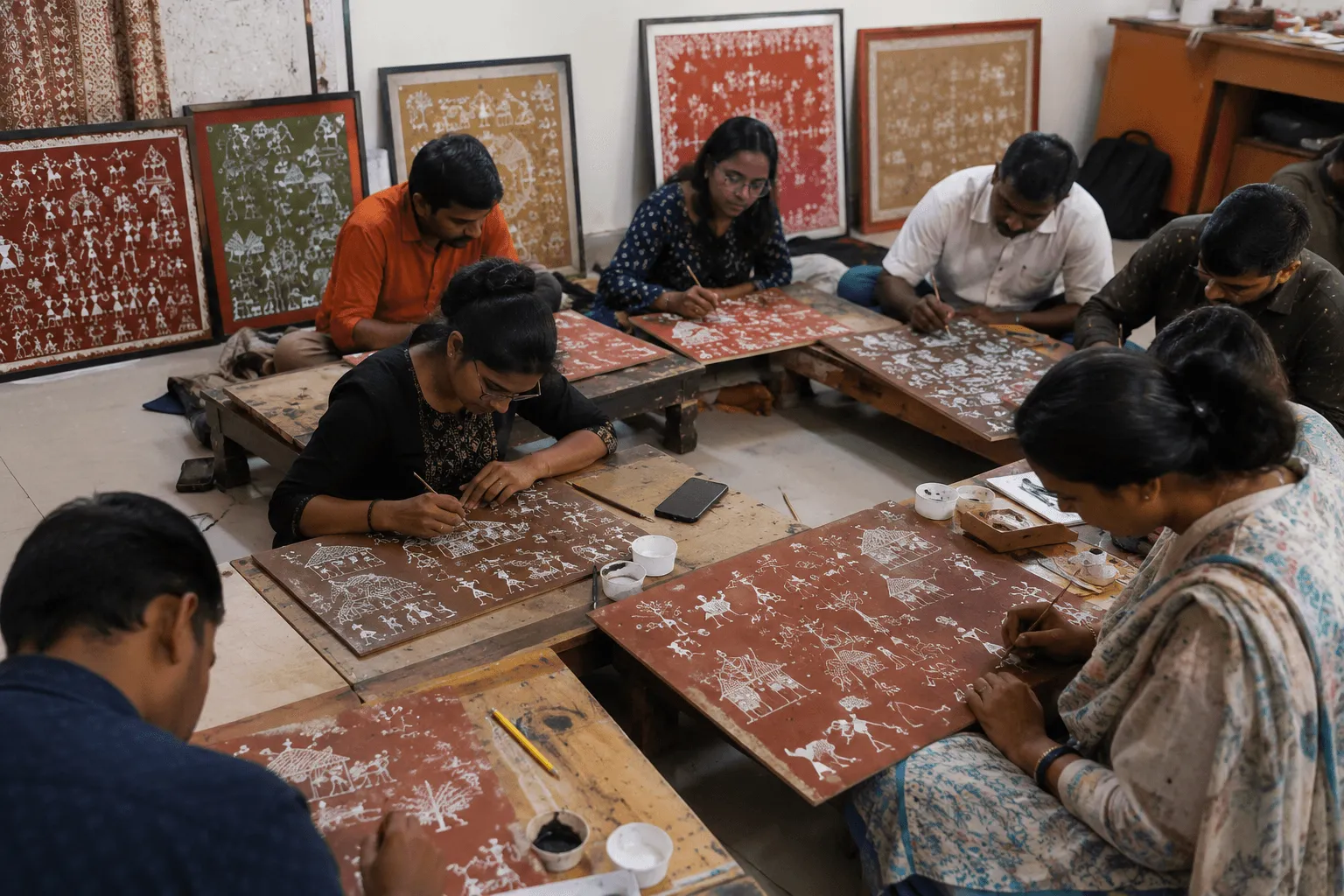
The mid-session shift. Copying becomes composing, and every page turns into a different world.
What You Come Away With Beyond the Paper
The bookmark or the small painting you carry home is the least of it. Ask people a week later what stayed, and three answers come back again and again, consistent enough that they are clearly properties of the experience rather than accidents of mood.
The first is a changed relationship with slowness. Warli is built from repetition, figure after figure after figure, and repetition done by hand for an hour does something that scrolling never will. Participants describe the session the way people describe long walks, as time that felt slower and larger from the inside. The tradition was always a meditation dressed as decoration, and two hours inside it is enough to feel that in the body.
The second is a permanent change in what you see. Once you have painted the tarpa spiral yourself, you can never again look at a Warli painting, on a wall, on a saree border, anywhere, without reading it. The dancers stop being a pattern and become a sentence you know how to parse. A visual language studied from the outside stays exotic. A visual language you have written, even badly, even once, becomes partly yours to understand for the rest of your life.
1:30 The session closes with the artist walking the table, or the screen, naming something specific and true about every single page. Not politeness. Reading. Because every page, however wobbly, now says something, and the artist shows you what yours said.
People also mention, almost sheepishly, how quiet their heads went. Two hours of repetitive handwork in company, phones face down, attention narrowed to a line, is a state most adults have not visited in years, and the body remembers it afterwards the way it remembers a swim. Nobody at Rooftop pitches the sessions as therapy, and this piece will not either. But it is no accident that the artists who built this tradition painted through the hardest seasons of village life, and that the calm inside the practice survives the journey to a city table completely intact.
And the third thing is harder to name but people keep reaching for the same words. The sense of having been admitted, briefly and genuinely, into something very old. The shapes you spent the evening making are the same shapes a grandmother in Ganjad made for a wedding wall, taught to you by someone who learned them inside that living line. That is not a craft class. That is a door held open.
For the people who want to keep walking after the door opens, the Warli Art Activity Book is the natural next step, a practice companion built by Rooftop that carries you from the workshop's three shapes into complex compositions and full themes at your own pace.
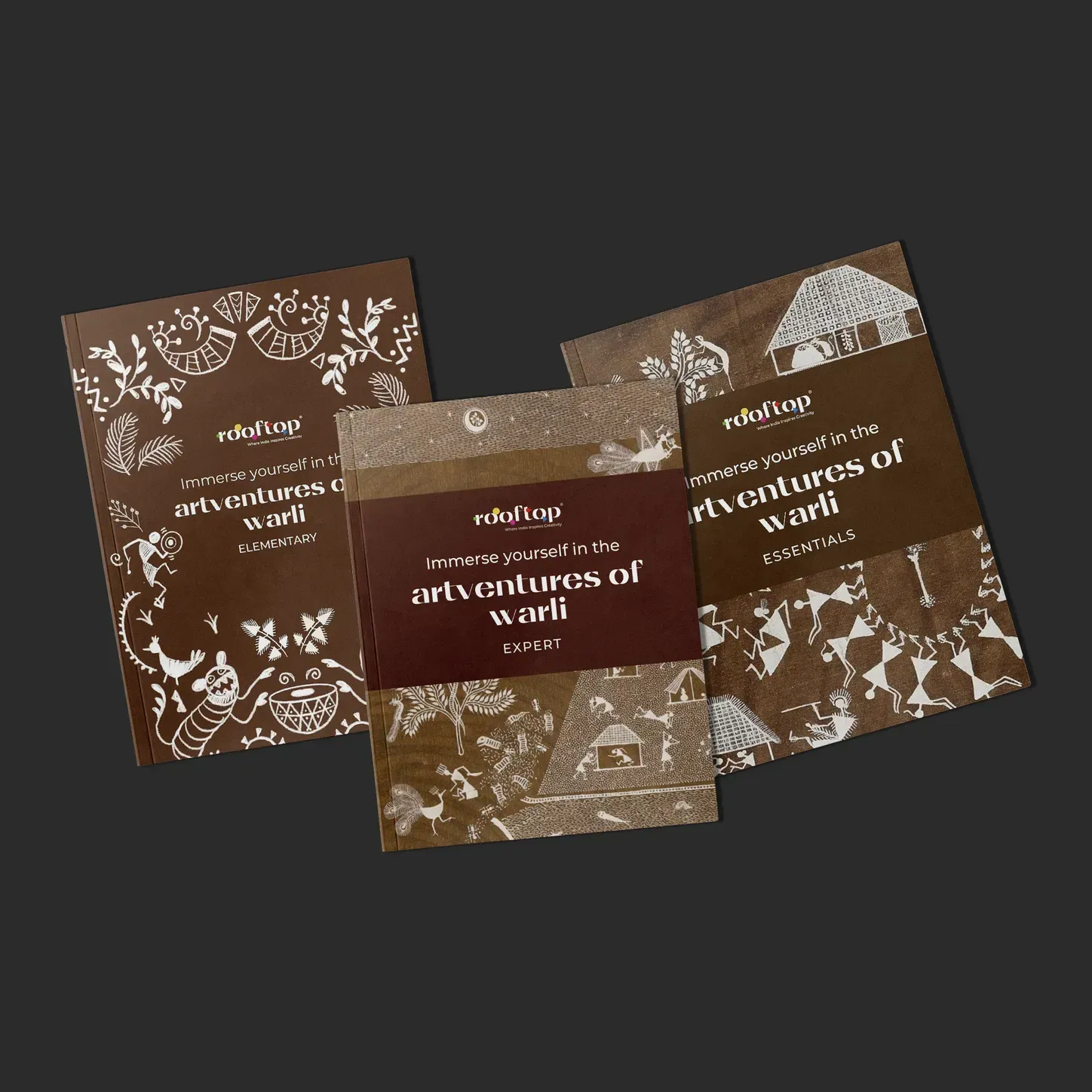
Artventures of Warli : A Creative Journey Through Tribal India
Who This Session Is For
The honest answer is a wider circle than any other art workshop we know, precisely because the form removes every prerequisite. But four kinds of people get something particular out of it.
- Complete beginners. If you have not held a brush since school, this is the art form that was structurally designed for you. There is no perspective to fail at and no likeness to miss. The session is engineered so that your first figure works, and everything after that is momentum.
- Design professionals. Illustrators, brand designers and architects come for a working masterclass in systematic reduction, a grammar that says the maximum with the minimum, and leave with a reference point no design school module provides.
- Parents with children. Warli is one of the very few activities where a seven-year-old and a grandparent work at the same table as genuine equals, and the stories inside the shapes give a family something to talk about that outlasts the evening.
- Anyone tired of passive experiences. This is the structural opposite of watching something. Two hours in, you have made an object, learned a language and heard a tradition speak in the first person. Very little else on a weekend calendar can say that.
The format stretches to fit all of them. Rooftop has run these sessions for schools, families and first-timers, and for corporate teams at organisations including FICCI and Google, where a Warli session painted onto kulhads turned an engagement activity into something people kept on their desks, a story told in Rooftop's account of its corporate art experiences. The grammar is the same at every scale. Only the table gets longer.
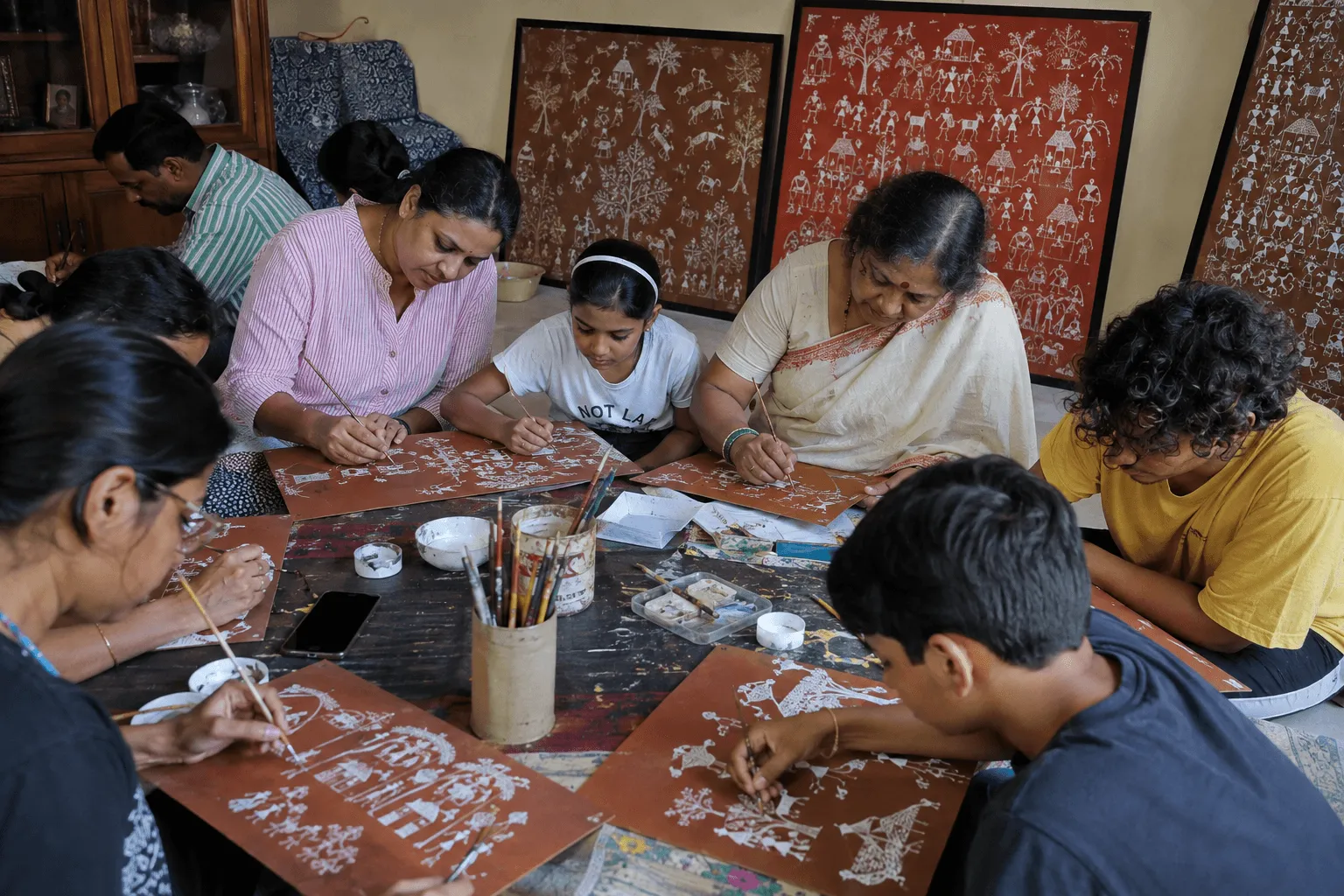
One table, all ages. Warli is among the few art forms where beginners and children work as equals.
Book the Two Hours
A practical note on formats, since Rooftop runs this experience in three depths. The live workshop is the two-hour arc this piece has described, scheduled in multiple slots so you paint in real time with the artist and a table of strangers who stop being strangers by the tarpa scene. The recorded course goes deeper and slower, letting you sit with each lesson for as long as your hand needs. And the activity book keeps the practice alive between the two. First-timers do best starting live, because the room, physical or virtual, is half the experience.
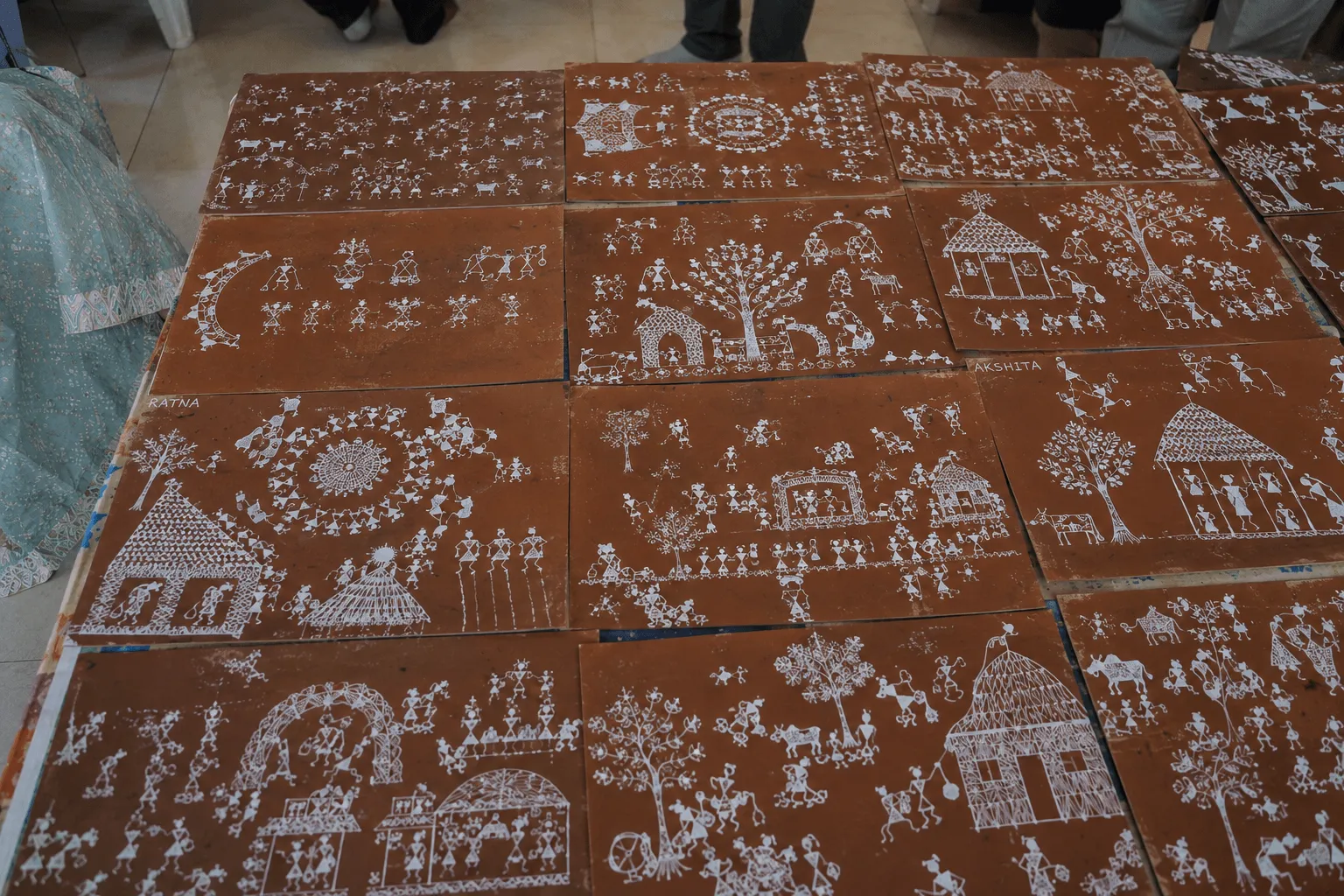
What the table looks like at the end. Every page different, every page unmistakably Warli. Source: Millennium Post
The suspicion that brings people here really is correct. Two hours with a brush and three ancient shapes does follow you out of the room, into how you look at walls, at patterns, at slowness itself. The sessions run online in live scheduled slots and in person in select cities, always led by practising artists carrying the Palghar tradition, and the flagship remains the Warli course taught by the Mhase family, the lineage of Jivya Soma Mashe, where the people who carried this art to the world teach you to write its first sentences yourself. Bring nothing. The suspicion is enough.