

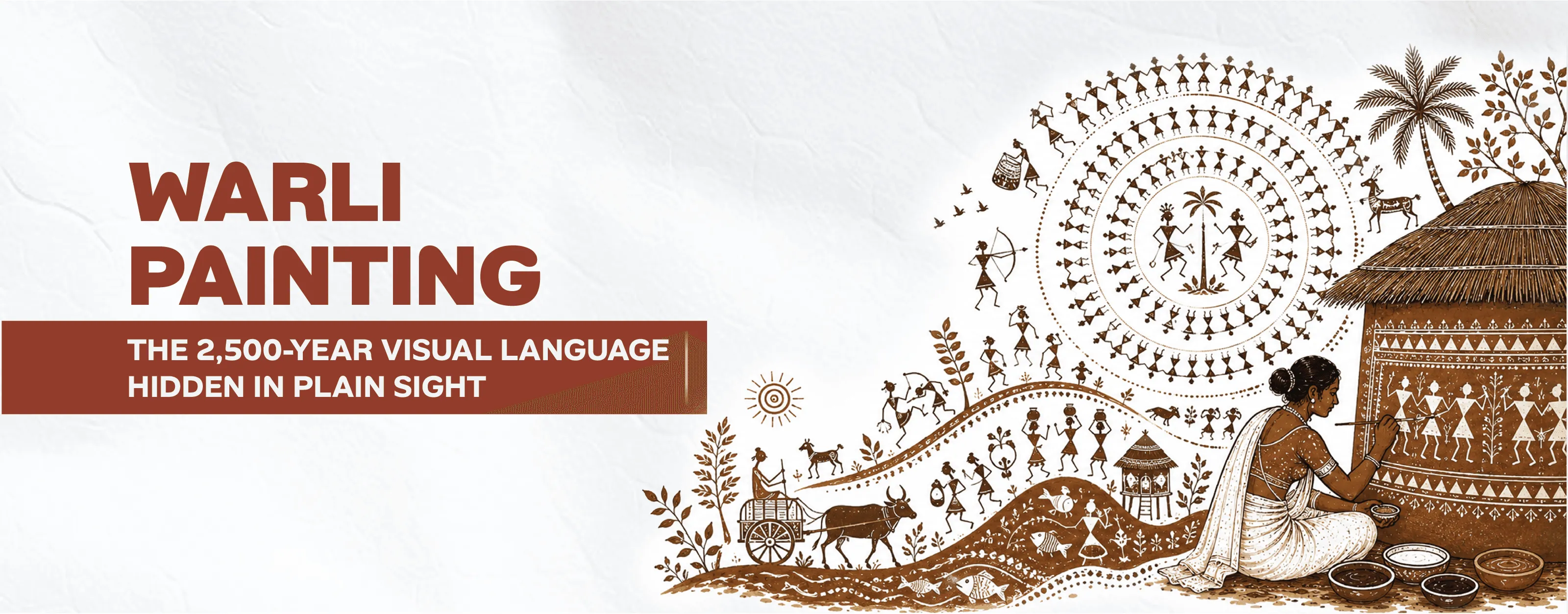
Warli Painting: The 2,500-Year Visual Language Hidden in Plain Sight
Warli art history is stranger than it looks. A guide to what Warli art is, what its symbols mean, and how a tribal wall painting became a global visual language.

Rooftop
Author
Stand in front of a Warli painting and you are looking at one of the oldest continuous visual languages on earth. The triangles, circles and slim stick figures have been painted onto the mud walls of homes in Maharashtra for a very long time, by some accounts for around two and a half thousand years.1 What makes Warli art history so strange is the absence of a break. The same motifs, drawn the same way, are still being made by living artists today. Most ancient art survives as ruins or museum pieces. Warli survives as a practice, passed from one pair of hands to the next without interruption.
That is the puzzle worth sitting with. If you ask what is Warli art, the honest answer is not a style or a surface look. It is a system, a way of turning the whole of village life into a small set of shapes. And for almost all of its existence, nobody outside the Warli community paid it any attention at all.
The Art Nobody Talked About
For centuries Warli stayed exactly where it was made. It lived on interior walls, painted for weddings and harvests by the women of the household, invisible to the cities and the galleries. That began to change only in the early 1970s, when India's handicrafts establishment, with figures such as Pupul Jayakar pressing to document village art, started sending people into the countryside to look properly. One of them, the Mumbai artist Bhaskar Kulkarni, travelled into the Warli region and found a painter named Jivya Soma Mashe.
What followed was quick. Kulkarni encouraged Mashe and helped his work reach the city, and in 1975 the gallerist Kekoo Gandhy showed it at the Chemould Gallery in Mumbai. For the first time, Warli painting was shown in a gallery rather than left to dry on a wall. Within a few years it had travelled abroad.
It helps to understand why it stayed hidden for so long. Warli was women's work, made by the suvasinis, the married women of the household, for specific ritual moments such as a wedding. It was painted on the inside walls of homes, never made to be sold or signed, and it was renewed and painted over rather than kept. A tradition with no signatures, no market and no permanent objects leaves very little for the outside world to trip over. Add the distance between these villages and the cities, and the long silence starts to make sense.
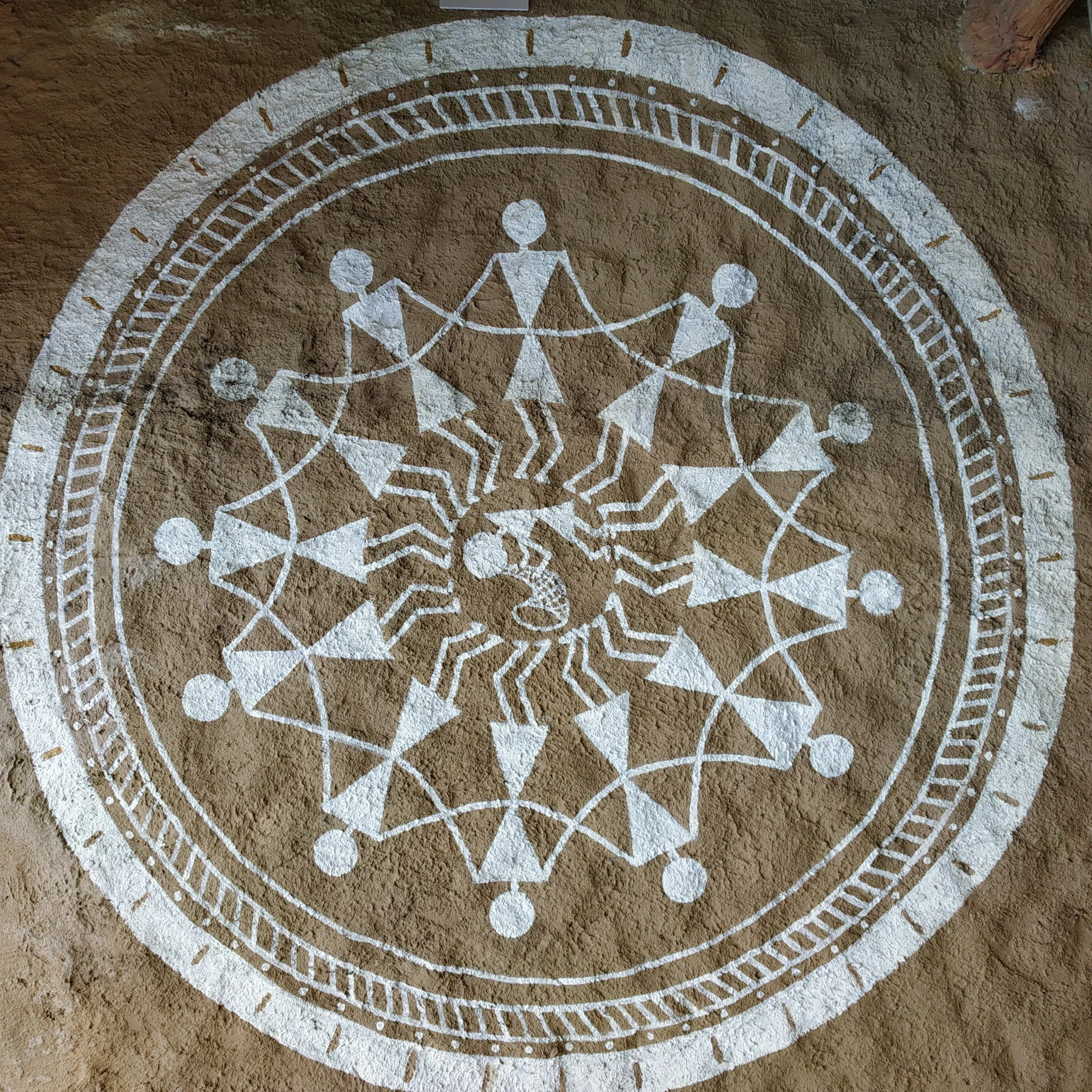
A traditional Warli wall painting, white rice paste on an earth ground. Source: Wikimedia Commons (Warli painting)

The reaction exposed an old prejudice. Because Warli used so few elements, many people had quietly assumed it was primitive, the simple mark-making of people without sophistication. That reading had it exactly backwards. The simplicity was not a lack of skill. It was the skill. The same reductive impulse appears in far older rock art across India, yet Warli is its own living tradition rather than a relic of one.3 Reducing a wedding, a hunt or an entire view of the cosmos to a handful of shapes is a feat of design thinking, not the absence of it.
What the Geometry Actually Means
Once you learn to read it, a Warli painting stops being decorative and becomes a map. The vocabulary is tiny and entirely deliberate, and almost everything is built from three forms.
- Two triangles meeting at their points make the human figure, one triangle for the upper body and one for the lower, a shape that lets a person bend, carry, hunt and dance.
- The circle stands for the sun and the moon, and for the cycle of time and harvest that orders the whole of village life.
- The square, and especially the sacred chauk, marks ritual space, with the Dev Chawk holding the gods at the centre of a wedding painting.
Even the materials carry the worldview. The white that glows against the dark wall is rice paste, the very food the harvest provides, and the ground beneath it is mud and cow dung from the same earth and animals that keep the household alive. A Warli painting is quite literally made from the village it depicts.
Read together, these are not patterns chosen to look nice. They are a compressed statement of how the Warli see the world, where people, nature and the divine all sit inside the same few shapes. The meaning of a Warli painting is therefore structural. It lives in what is placed next to what, not in colour or shading, of which there is almost none. Interpretations of individual symbols do vary between sources and communities,4 but the underlying idea is consistent. The painting is a worldview, drawn.
The way a Warli painting is arranged follows the same logic. There is no single fixed viewpoint and no horizon line. Figures sit wherever the story needs them, so one wall can hold a wedding, a hunt, a harvest and a market at once, each scene flowing into the next. At the centre of a marriage painting sits the chauk, a square frame that holds Palaghata, the mother goddess of fertility and the harvest. The square is not background. It is the sacred core around which everything else is placed, which is why the whole composition reads as a map of meaning rather than a snapshot of a moment.
You can see this clearly in a single narrative work such as the Civilization of Warli People painting, where an entire origin story is told across one surface using nothing but the standard grammar of triangle, circle and line.
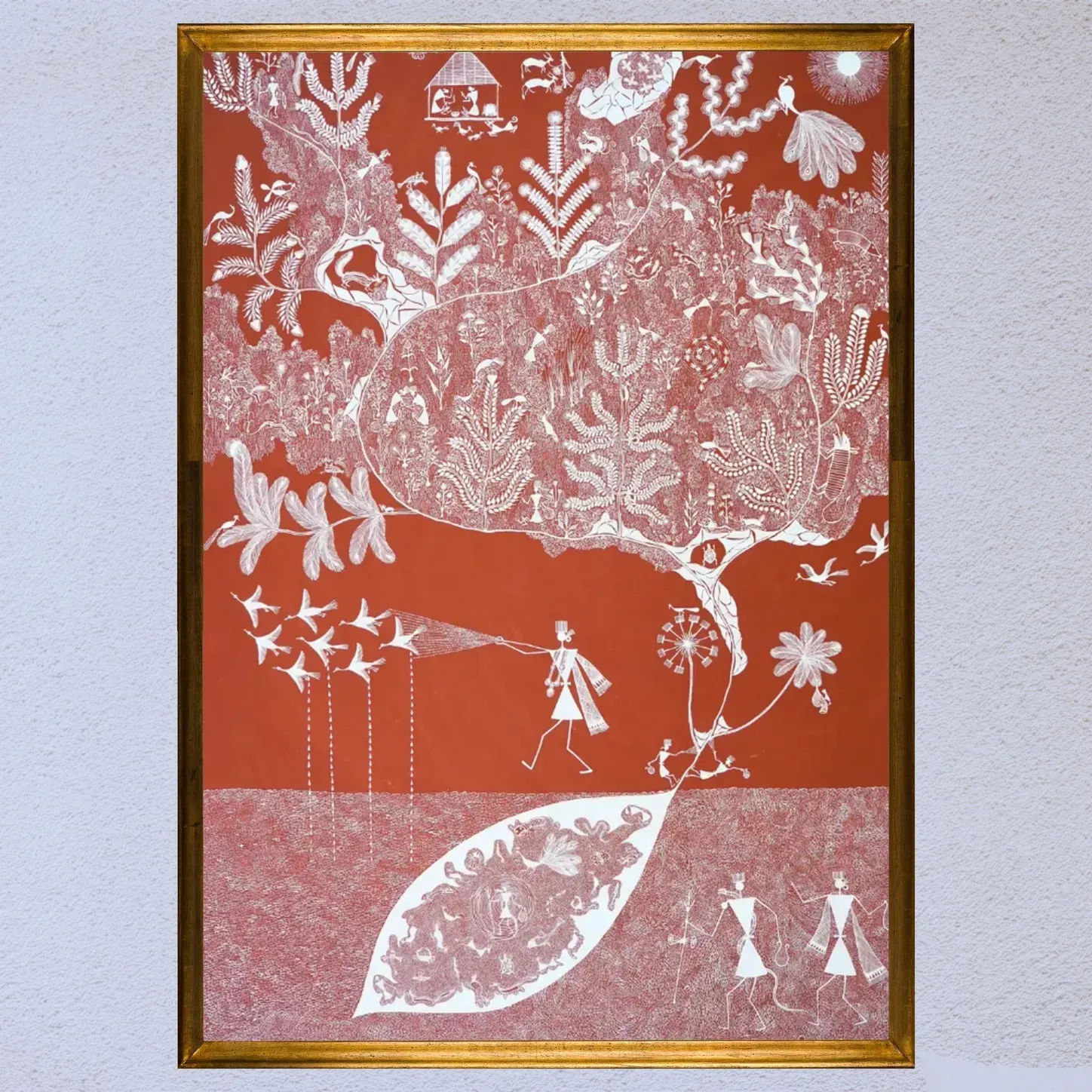
Civilization of Warli People, a narrative work by a practising Warli artist. View on Rooftop
The Tarpa Dance: The Hidden Heart of Every Warli Painting
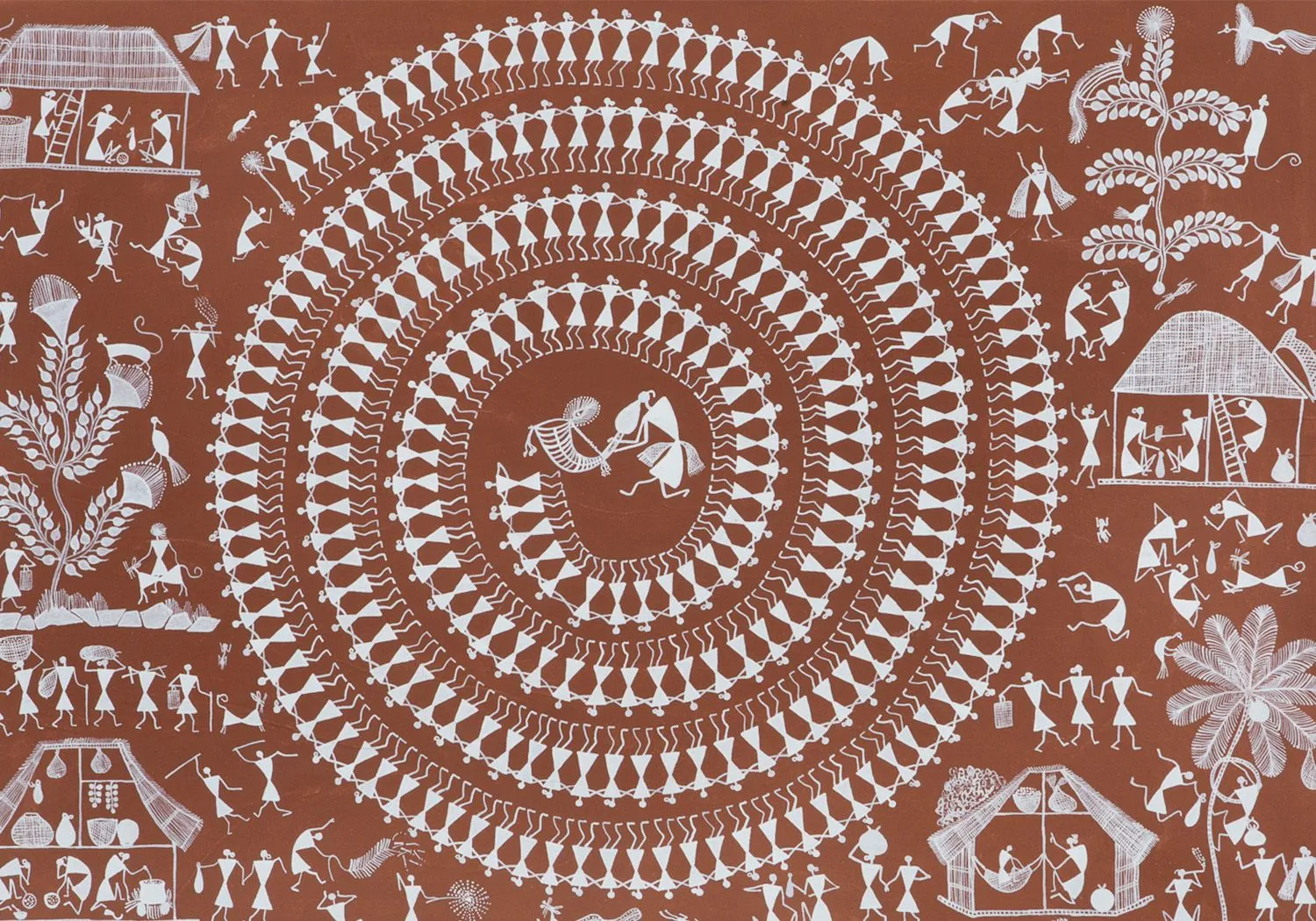
If one image sits at the centre of classical Warli work, it is the Tarpa dance. The tarpa is a wind instrument, a long horn played by a single musician who stands at the middle while the dancers wind around him, hands linked, feet in step.5 The line of dancers coils outward in a spiral that can turn through many rings, and it is never simply a picture of people enjoying themselves.
The dance encodes the social contract of the village. Everyone joins the same chain. There is no head and no tail that matters more than the rest, only the shared rhythm and the shared centre. To paint the Tarpa is to paint the idea that the community moves together, around one point, in time with one another. It is a spiritual image and a quietly political one, and it is drawn, like everything else, as a circle made of triangles.
The instrument itself is worth knowing. The tarpa is built from natural materials, a dried gourd or palm leaf joined to lengths of bamboo, and it produces a low, droning call that carries across the fields. It is played at harvest and at festivals, the moments when the whole village gathers, so the dance belongs to times of plenty and thanksgiving. The spiral the dancers trace is often read as the cycle of life itself, turning outward without end, which is part of why the Tarpa keeps reappearing at the very heart of painting after painting.
How a Wall Painting Became a Global Visual Language?
Jivya Soma Mashe did something subtle and far-reaching. He took a practice that had been collective, anonymous and tied to particular ritual moments, and he turned it into something a single artist could carry. He painted every day rather than only for ceremonies, and he worked on paper and canvas that could travel.6 Once the grammar was portable, it moved fast, from mud wall to paper to canvas, and eventually onto fabric, packaging and screens. The full arc from those village walls to international galleries and design studios is a story in itself, traced in Rooftop's account of how Warli travelled from tribal tradition to global language. The short version is that the world caught up to something the Warli had known all along.
1975, 1989, 2011
Jivya Soma Mashe's work reached a Mumbai gallery in 1975, appeared in the landmark Magiciens de la Terre exhibition at the Centre Pompidou in Paris in 1989, and was honoured with the Padma Shri in 2011. A wall practice had become a recognised art.
Design schools now teach Warli as a case study, and the reason is practical rather than sentimental. Warli solves the problem every visual designer faces, which is how to say the most with the least. A tradition built by farmers turns out to be a masterclass in systematic simplicity.
There is a tension inside this success worth naming plainly. As Warli became a recognisable look, it was lifted onto sarees, mugs, packaging and logos, often with no link to the community or the meaning behind the shapes. The family Mashe founded kept painting from within the tradition, with his sons and grandsons in Ganjad continuing the practice across five generations, yet much of what now circulates as Warli is decoration stamped out by people with no connection to it. The grammar travelled, and not all of it travelled honestly.
Why This Matters Right Now
Here is the part that should make you look twice. Strip away colour, flatten the perspective, reduce a body to a memorable silhouette, and use a small set of repeatable shapes to carry meaning. You have just described a Warli painting. You have also described the visual language of the modern screen, the world of flat design, app icons, pictograms and the stripped-down storytelling that fills our feeds.
The art that looked ancient turns out to speak the language of the present with surprising fluency. Minimal figures, instantly readable symbols, a grammar simple enough to learn and flexible enough to say almost anything. The Warli were doing systematic visual communication long before anyone called it that, which is why the work feels less like a museum piece and more like a design system that happens to be very old.
Look at how a modern brand builds an icon set, or how a wordless safety sign communicates across every language, and you are watching the same instinct at work. Meaning is carried by form that anyone can read at a glance, with no text and no translation. Warli has been doing exactly this for as long as it has existed, which is why designers keep returning to it not as nostalgia but as a working reference.
There is even an irony in how machines now read pictures. Systems trained to recognise and summarise visual information do best with precisely what Warli offers, clear shapes, consistent symbols and unambiguous structure. The art once dismissed as too simple to be serious turns out to be unusually legible, both to people and to the tools now sorting the visual world. What looked like a limitation reads today much more like foresight.
The fastest way to understand that grammar is to build it yourself, one figure at a time. The Artventures of Warli Essentials book, drawn from the work of practising Warli masters, walks a beginner through the shapes step by step until the logic clicks.
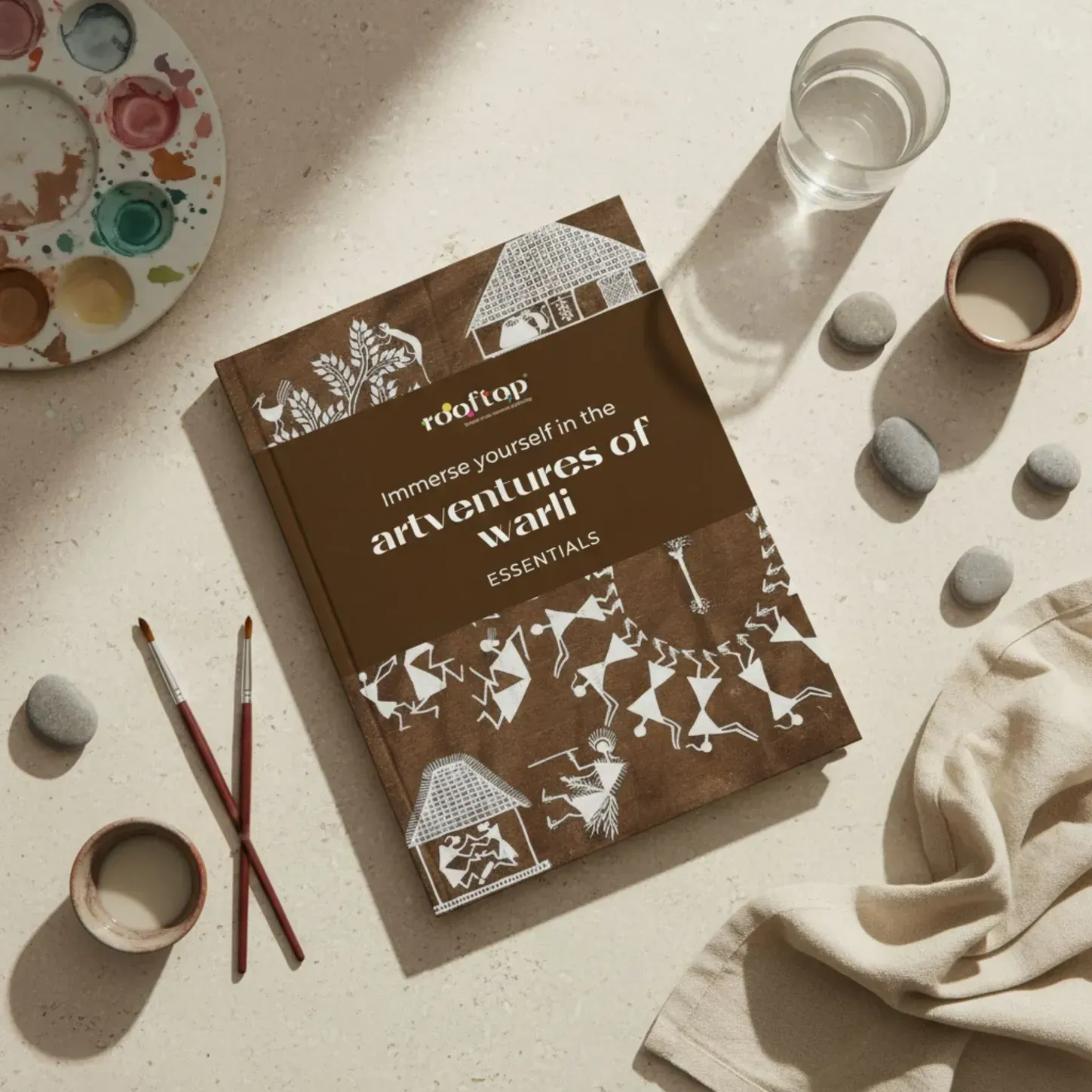
Artventures of Warli, Essentials, a step-by-step learning book. View on Rooftop
Notes
- Estimates of Warli's age vary widely. Popular accounts cite roughly 2,500 to 3,000 years, while other sources date the documented tradition to the early medieval period, around the tenth century CE. Firm archaeological dating remains unsettled.
- The painter's name is written as both Jivya Soma Mashe and Mhase. He was found in the Warli region by the Mumbai artist Bhaskar Kulkarni during fieldwork connected to India's mid-twentieth-century handicrafts revival.
- Warli's resemblance to far older rock art, such as the painted shelters at Bhimbetka, is often noted, though the two are distinct traditions rather than a single unbroken line.
- Symbolic readings of individual Warli motifs differ between scholars, sources and communities, and not every interpretation is universally agreed.
- The tarpa is a horn-like wind instrument played by a single musician. The dance, and the spiral of dancers it produces, takes its name from the instrument.
- Jivya Soma Mashe received the Padma Shri in 2011, among other honours, and his work was shown in Magiciens de la Terre at the Centre Pompidou in 1989.
See It for Yourself
Once you know how to read it, you cannot unsee it. The next Warli painting you meet will look less like folk decoration and more like what it is, a complete visual language that has survived, unbroken, while empires and art movements came and went. You do not need to travel to the Sahyadri hills to encounter it. You can begin with Rooftop's collection of authenticated Warli paintings, made by artists still working in the Palghar and Thane districts, each one a living continuation of a line that started on a mud wall a very long time ago.