

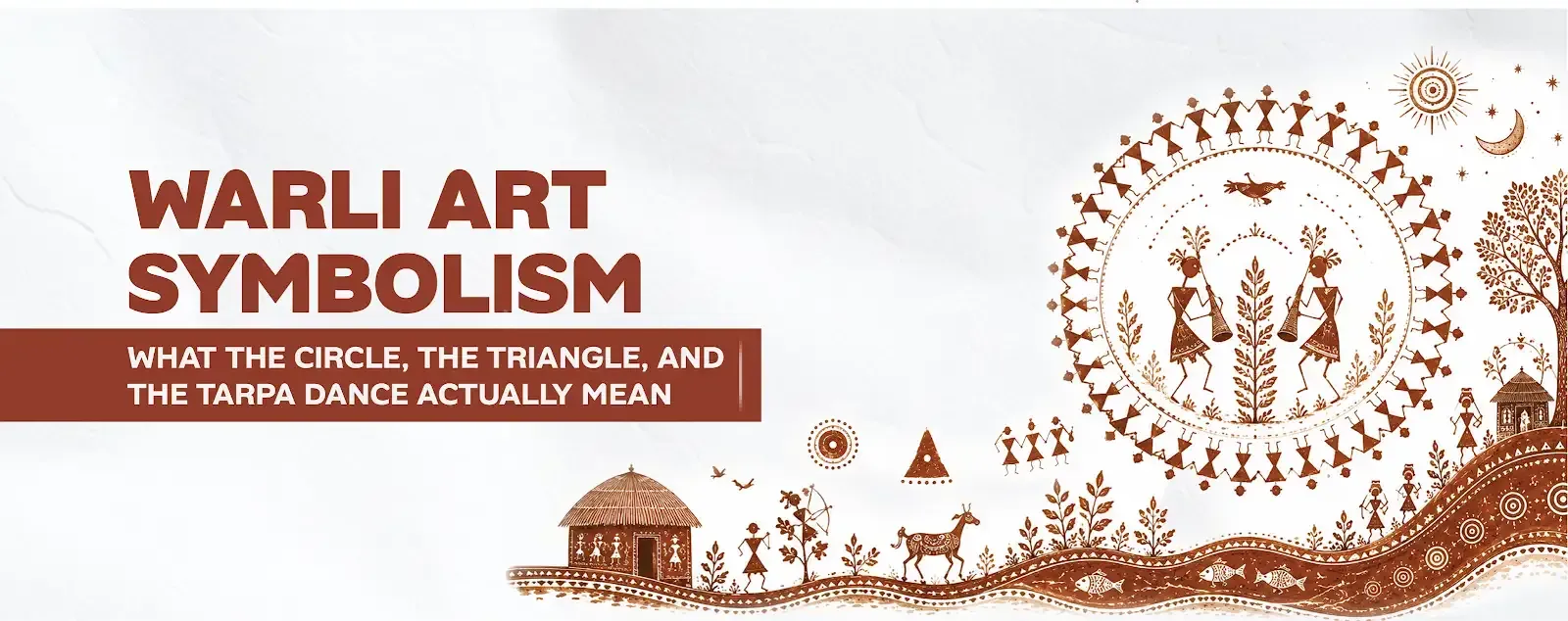
Warli Art Symbolism - What the Circle, the Triangle and the Tarpa Dance Actually Mean
Discover the various elements while creating the Warli Art and the Symbolism behind the Tribal Warli Paintings

Rooftop
Author
Warli Art Symbolism - What the Circle, the Triangle and the Tarpa Dance Actually Mean
The Warlis are known to be an aboriginal tribe living in the north-eastern part of the Thana district. It also includes the Jawhar state, the Portuguese territory of Daman, Dharampur and the Bansda States in the Surat Agency and in the western part of the Nashik district. They are reported from Khandesh living near the Satpuras, but are culturally cut off from Warlis in the Thana district and Surat Agency. They seem to have been assimilated with the Bhils of Khandesh. Known for their culture and traditional art, the roots of the tribe can be dated back to between 2500 BC to 10th century CE.
"There are human beings, birds, animals, insects, and so on. Everything moves, day and night. Life is movement". ~ Jivya Soma Mashe
Origin and History
Tracing their origin and history, the local or early element in the Thana population is unusually strong as the early tribes of it were almost considered as the only people in the Konkan in the wild North-East; they were in majority elsewhere (excepting some of the richer coast tracks). However, it is not known if it is the entire truth but Varal (Warli), according to Dr. Wilson, as mentioned by K.J. Save in his book “The Warlis”, meant a tilled patch of land, so the people who cultivated these patches are therefore Varalis or Varlis (Warli). On the other hand, Mr. Rajwade (the famous Maratha historian and also a research scholar of repute) thinks that the Warlis are mentioned as a non-Aryan tribe by the Katyayan in his Vartikas under the name Varud, along with Vyas and Nishad. Rajwade derives the word Warli from the word Varud, as mentioned in the Katyayan’s Vartikas and thus, Varud - Varudaki - Varulai and then Varuli; though the derivation seems to be far fetched and fantastic at the same time, it is known that the tribe is non-Aryan and resided in the country near the Vindhyas and Satpuras, and from which it came southwards. Their language, which is known to be influenced by the Gujrati language, also goes to prove that they moved south from the north.
Learn about Warli Paintings on the Rooftop App directly from master artists
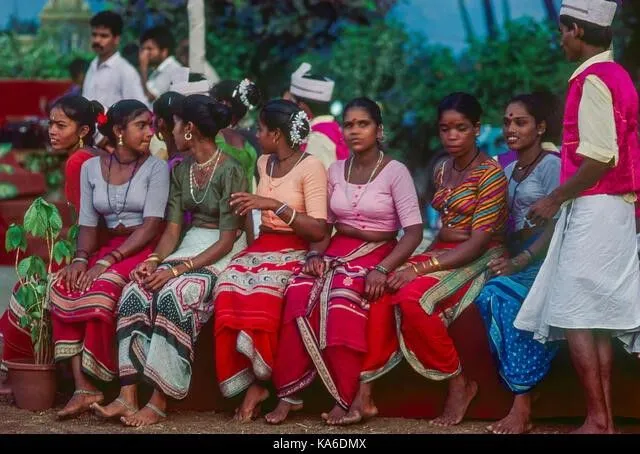
Warli Tribe - Source.
Habitation of the Warli Tribe
So far their habitation, Warlis are known to lead a quiet agricultural life, as the tribe as a whole is a settled one and the wandering habits are almost seen to be extinct. They are also known to love and also live a forest life. Their population had always been known to be distributed in small hamlets of about a dozen huts that are cut off from each other by miles often.
As they were agriculturists, their food and diet consisted of what they produced and cultivated on their own, so, rice of a coarser category was their chief food, which was turned into flour or bread or boiled with water and eaten with salt as a daily dish. During monsoon, particularly fresh fish and dry fish on occasions with other green vegetables were consumed to add flavor. They believed in offering the god at the time of threshing new corn before consumption.
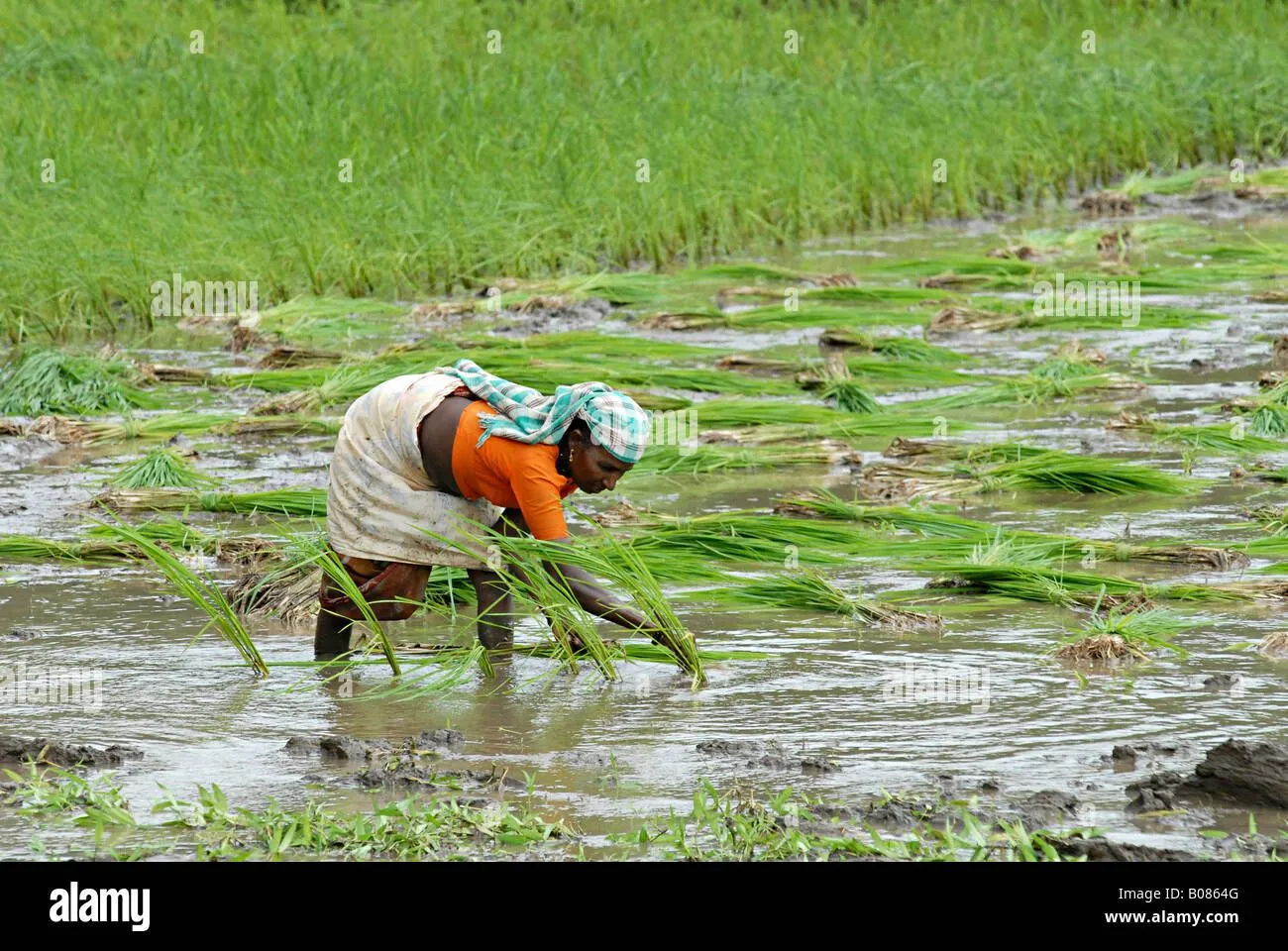
Warli tribal woman harvesting rice stock - Source
Social Organization and Families
The Warli tribe was traditionally divided into several social groups, mainly Murdes, Davars, Nihirs, and the "pure" Warlis. These groups were known to have different customs, dialects, habits and regional identities. Although they considered themselves separate and often avoided marriage with certain groups, these divisions were mostly based on geography and social status rather than strict tribal differences, and over the time, the interaction between the groups increased, and the boundaries became less rigid comparatively.
Within the Warli community, marriage follows the rule of exogamy, meaning a person must marry outside their own clan (known as a kuli or varg). The tribe has nearly 200 clans and each clan was identified by a surname. People from the same clan are not allowed to marry each other. These clan names were considered as more important than personal names in identifying social relationships.
A typical Warli family used to comprise a man and his wife together with their children, and sometimes the man’s brothers and sisters were necessarily included (if minors). The family life under the Warli community usually began with marriage where the man would acquire and maintain the status of a family man only if he has a wife. The sons on their part would not show any marked attachment for their old parents when there’d be a question of supporting them in their old age. The father in a Warli family would be the ‘pater familias’ (the male head of the household) of the family, with children or minors getting no rights to speak in the matter of family affairs, though children being an important part of a family. Far from being a burden, children were considered as the “wealth” and were seen as an additional source of income. Warli families are patronymic, where the wife and all the children would take up the husband’s/father’s name respectively, as the father/husband was considered as the ruler of the family in any case and matters.
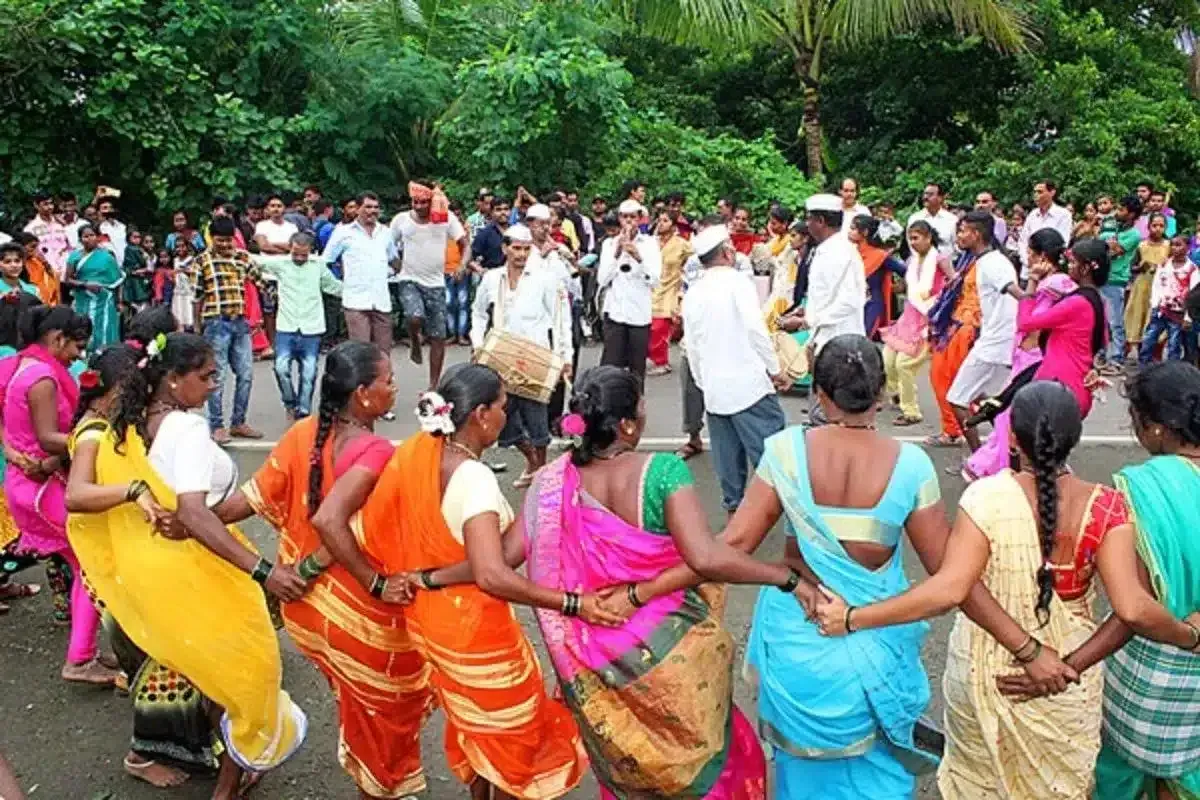
Warli as a social group - Source
Religion of the Warli Tribe
There is a vague consciousness in the Warlis that they belong to the Hindus though known to enjoy an inferior status and they do not follow orthodox Hinduism. They generally believe in Hindu Gods and deities, particularly Ram, Laxman, Hanuman and Shiva. But they are animalists in nature, in a sense that they worship some of the deities and spirits which are particularly tribal. Considering this, there is a very significant and remarkable trait in the character of these people as they have a very deep and almost universal reverence paid to their spirits and deities in the form of worship. They often regard these fierce spirits as evil and unfriendly and make them offerings only and only with a view to turn away the possible ill will, as the Warli gods are particularly regarded as to be harsh and are known to harm them if not properly appeased. The Warlis hence often attribute the sickness or other calamities to their gods, thinking that gods have not been worshipped properly. Belief in ghosts is also a noticeable feature of the Warli’s religious understanding.
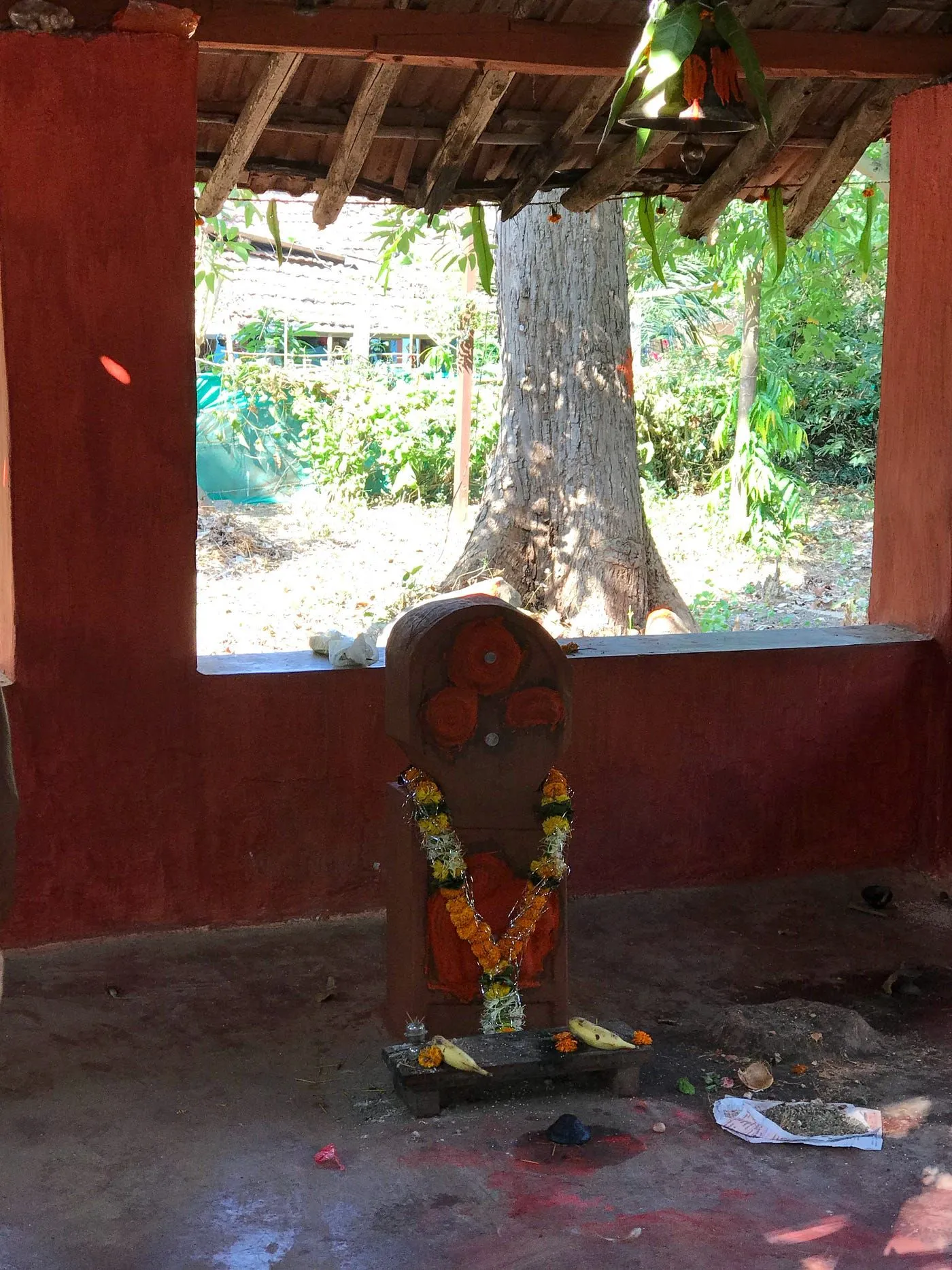
Warli Tribe Worship - Source
Warli Worship and Deities
Amongst the principal tribal deities, Naran Dev is the most common who is considered not so harmful as the other gods like Hirva or Waghya. There are other minor gods but Naran Dev is considered to be the god of the whole tribe, as every clan has an image of the Naran Dev where he is ordinally worshipped during every religious ceremony, though a special ceremony held in the month of Magh (February) to worship him. The ceremony is when young men and women spend the night singing and dancing as a part of worship and celebration, usually because the Warlis believe that Naran Dev is seen at night in the form of a human on a white bullock. To the Warlis, Naran Dev is also a great god who gives them rain. Another tribal god, Hirva, is the family deity of the Warlis who is regarded as the god of wealth. And as the Hirva god is associated with wealth, his image is made of silver, highlighting a symbol of wealth to the Warli. The tribe is also known to worship Himay or Hemay, a female deity and is supposed to be the object of worship for the women with no ritual or formula prescribed, and the women too do not exclusively worship her. Only during the Naran Dev ceremony, example during the marriage days, the image of Himay is placed along other deities, and during which the head of the family with his wife observe a fast and so the fast observed by the woman is supposedly to be in the honour of the Himay goddess. The goddess is regarded as Hirva’s sister by a few, while others do consider her as an individual deity.
Considering nature worship. The Sun and the Moon are regarded as the 2 eyes of the God under the Warli tribe, where the Sun is regarded as the only god who ‘reveals himself’ and that ‘there is no day if he does not arise’. Rain, as a part of nature worship, is also considered as the god of ‘pavasha dev’ because he helps in agriculture, and it is because of the contribution of the rain to human life that the Warlis hold rain to be Parameshvar (supreme god). Apart from these, clouds, wind, lightning, sea, storm etc. are also considered as divine, and the earth, cow, corn and women are all goddesses in the same context. All rituals during the worship involve the use of rice, and every particle of food is considered as wealth. To the Warli tribe, food is life.
Worship of the Tiger-god (Waghoba) is also known, and because there is a standing stone image of a tiger-god in every village. The Warlis are known to kill a tiger if an opportunity is received, what they worship is a tiger-god, as it is the lord of tigers and chiefly the god of cowherds, believing to protect the cattle grazing in the forest from wild beasts.
Worship of sacred trees like Bel and Pipal, though not regularly worshipped, is also included in the practising of Warli tribe, as Bel is known to be associated with Shiva and Pipal is seen to be a holy tree in Hinduism. Tulas or Tulsi is also a holy plant to the tribe but unlike Hindus, the tulsi leaves are offered to none of their gods, and more like it is only a holy plant to them.
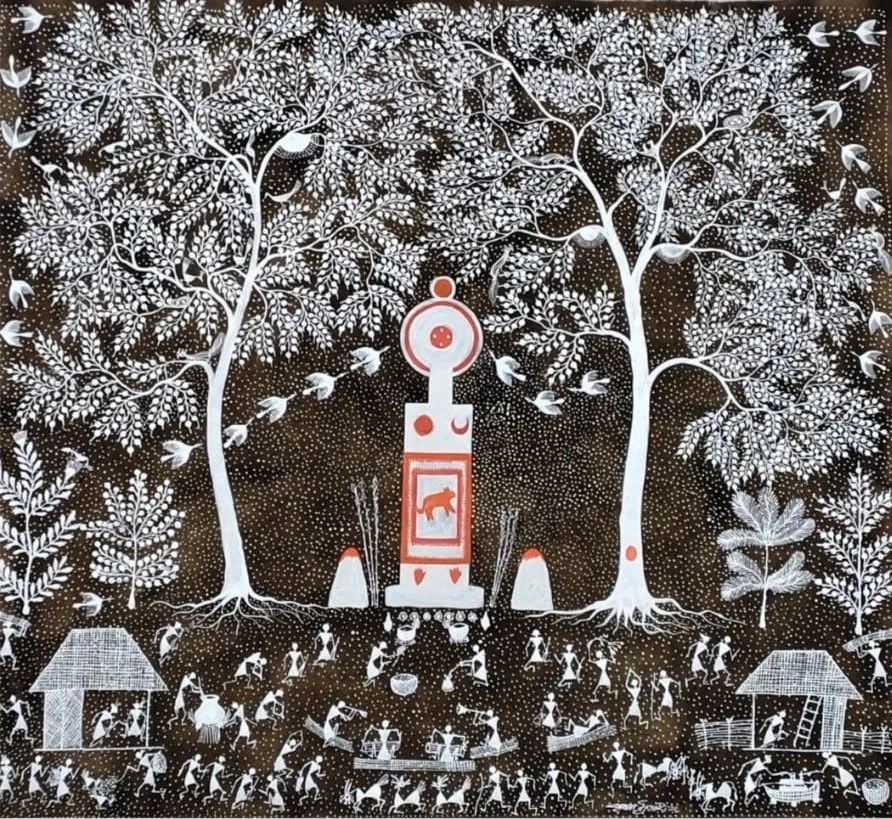
Warli God - Vaghya - Source
Marriages in the Warli Tribe
Children under the tribe’s understanding can be married off at any age, however typically, a girl is to be married usually at the age of 7 or 8 years old and the boy is nearly expected to be at least 12, though the age limit of the boy is considerable extended at times till he reaches the stage of becoming a good support to himself and the family and the girl to be sufficiently old enough to help her husband in the work. Marriage ceremonies are considered very auspicious and significant for the tribe, under which, the occasion of great social interest lasts for 4 or 5 days. According to Warlis, marriage within the clan is prohibited, as every clan is a group of some families and a boy or a girl must carry themselves outside his/her clan. Under this, cross cousin and parallel cousin marriages are also prohibited, though cross cousin marriage restriction is often not observed by the Southern Warlis (allowing a boy to marry his mother’s brother’s daughter and a girl can marry her father’s sister’s son) which is due to the Maratha and Kunbi influence.
Also, polygyny is allowed and also practised by the tribe to a certain extent, and though it is allowed, there are very few cases of them as the Warli could not afford to marry many times due to monetary difficulties, and marriage without money is hence not feasible. The idea of marrying a second or third wife is to extract work from them rather than just the satisfaction of desires, making the wives an economic asset and more of a helping hand to the husband. Another consideration for a second marriage is the absence of children if the first wife is barren, as it is socially degrading for an individual from the view point of the tribe if he doesn’t have any children.
Widow marriage is often common in the case of a younger brother remarrying the widow of his elder brother (if he dies), for which the consent of the woman, who is the widow, is necessary. She can also choose to marry one of the brothers if there are two or more brothers of the same family as that of her dead husband, and at the same time, opportunities are given to her to live a normal life. Though, if she wills, she may also choose to remain in the same family even without marrying the husband’s brother.
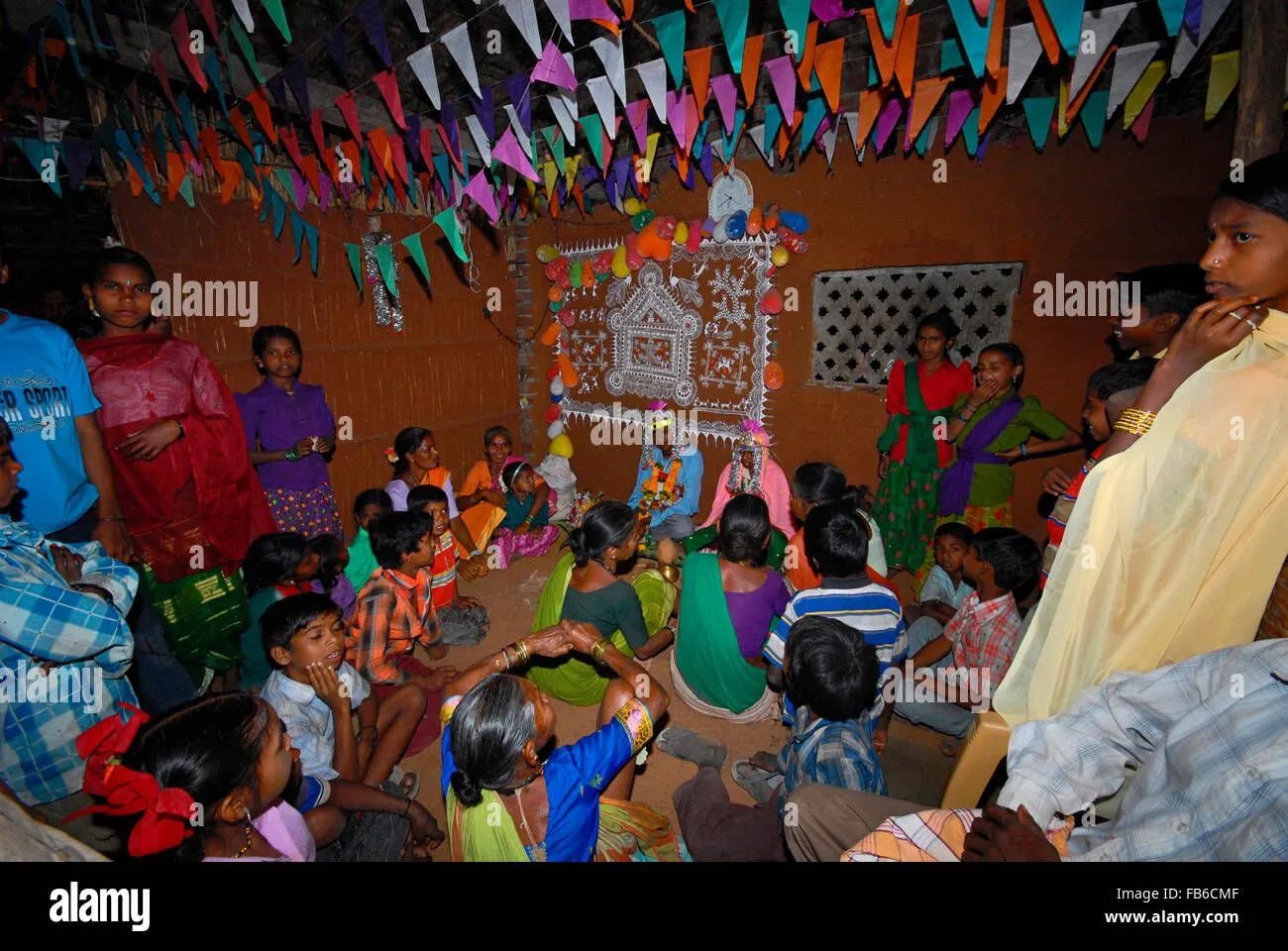
Warli Wedding Ceremony - Source
Warli Songs and the Tarpa Dance
Ritual songs connected with particular ceremonies and occasions are the soul of them, providing them meaning and depth, often involving mythological stories that are related to the particular occasion in a direct or indirect way. With a rich culture of specialised songs, they are often sung during marriages, pregnancy, delivery, performance of the Naran Dev ceremony, funerals, or songs that talk about birth and death, death and inevitability etc.
The Tarpa is a traditional musical instrument that serves as a profound symbol of the tribe’s identity and continuity of life, is used in the Tarpa Dance performed by the villagers through the night in an open courtyard by forming an open-ended human chain circling the Tarpa player and changing their movements whenever the melody changes, all performed during celebrations like Diwali, honouring the fertility of nature.
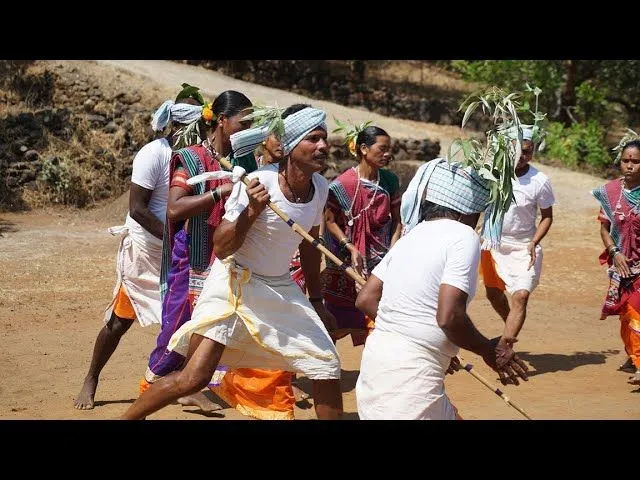
Warli Tarpa Dance - Source
Warli Paintings
Mother nature is a major idea found in many Warli paintings and the tribe uses natural objects to create a focus point in their art forms. Though, the Warli paintings are often categorised into sections such as paintings based on the ancient stories of the people of the tribe, under which the tribesman illustrates and demonstrates the view through the Warli art. Warli paintings with people in it show positive and negative deeds committed by them. Warli paintings also depict the many creatures (animals) present in their environment. And of all the genres present and known, paintings based on rituals and rights are renowned, showcasing images of joy, happiness, everyday life and activities of the tribal community.
Initially, only 2 colors were known to use to create the art forms, that is, earth brown and white by rice paste; later, the colors like and of henna, indigo, ochre, black, earthy mud and brick red started to appear and become a part in the background of the paintings.
At the start, only women called the Savasini (married women from the community whose husbands are alive) were known to be the artists of the paintings, though with time it was then shifted to male members of the tribal community.
You can find authentic tribal Warli Paintings at the Rooftop App
Concept of the Warli Paintings
The art form is found to be 2 dimensional, considered to be one with no proportion or perspective, with linear and simple structure. Often drawing inspiration from every life of the tribal community as themes, it never depicts any characters from mythology but pure social life with a maximum use of triangles as an expression. The art communicates with the help of basic geometric shapes, such as circles that represent the sun and the moon, triangles often symbolising mountain ranges and pointed trees, diagonal lines, polygons, and squares. Through the shapes, artists draw humans and animals by connecting the tips of 2 triangles - the upper resembling the torso and the lower resembling the pelvis.
Elements in the Warli Painting - the Marriage Goddess
The goddess Palaghata remains very significant during marriages. The word palaghata could be taken to come or mean from the word pal (plants) and ghata (pot), possibly translating as the goddess of fertility. A strangely disembodied figure without any head or physical features is considered very central, as without her the marriage cannot take place. The goddess’s head being absent indicates that she is not an individual woman, rather a representative of the universal creative power or the Mother earth herself.
In her book “The Painted World of the Warlis”, author Yashodhara Dalmia discussed 2 meanings of the word “Palaghata”, i.e. a pot overflowing with plants, symbolising abundance, fertility, prosperity, life and growth, all essential and related to women getting married and beginning a new phase in life, and the second meaning derived from the understanding and discussion with the Warli community, she mentioned sitting in a cross-legged position, especially during marriage rituals; the author suggested that both the meanings are connected. Though the cross-legged posture here in the context could symbolize sexual union, fertility, self control, meditation and spiritual power, meaning that the Warlis do not see these as any opposites and believe that the creative energy can be physical and spiritual at the same time.
The goddess Palaghata’s comparison with Mother Earth leads to the idea of stating about the multiple ancient Mother Goddess sculptures that are found across the country. Hence, seen as the source of plants, crops, animals and human life itself, making Palaghata a Warli symbol of the universal life-giving force that brings representation of the essential components that are a part of the tribal community.
You can now buy Warli Nature God Painting at the Rooftop App
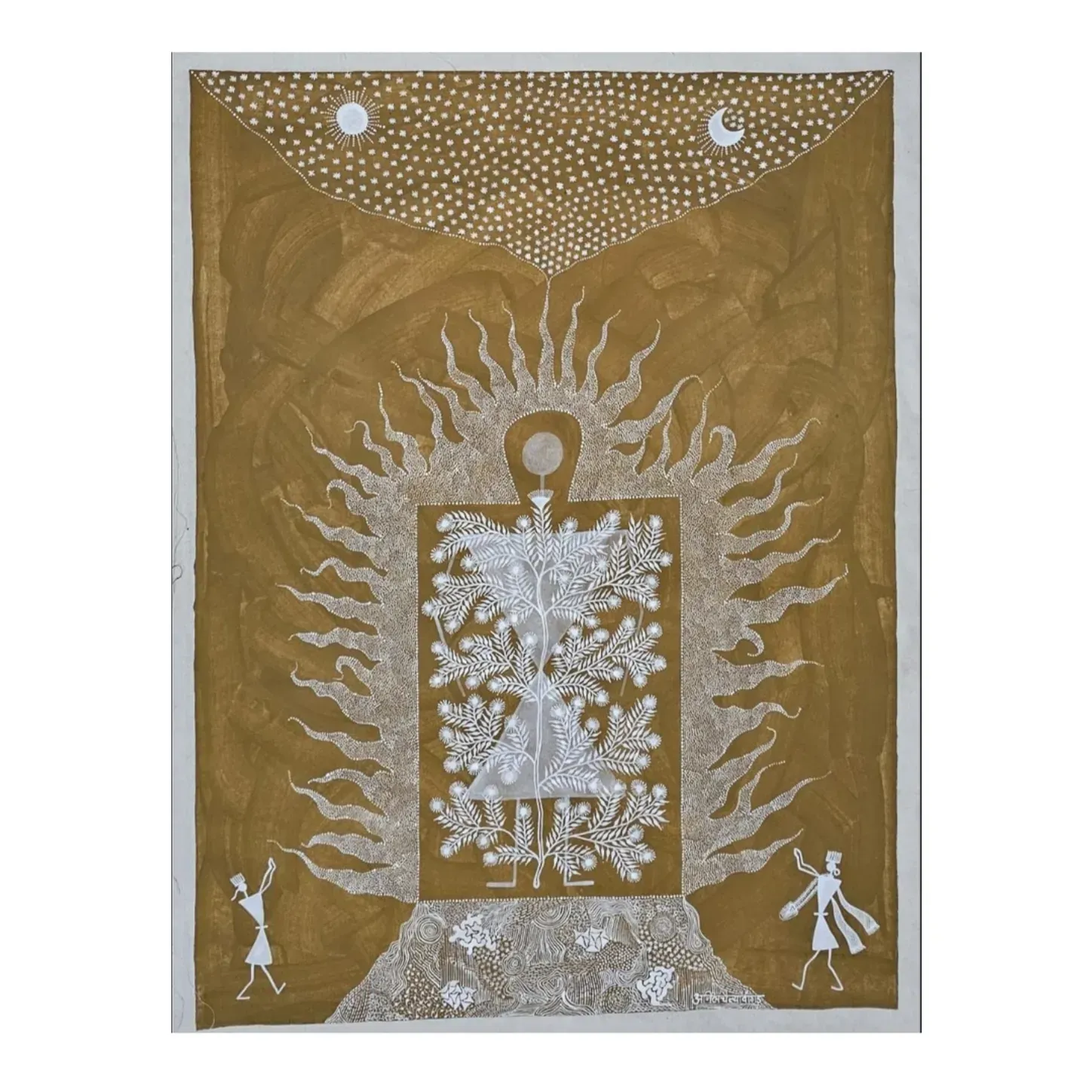
Warli Nature God - Source
Elements of the Warli Painting - The Caukat
All the patterns inside the cauk or in Warli art forms together express nature, fertility, marriage, prosperity, protection and the very harmony of the universe, as every symbol and line is made with some purpose to reflect the tribe’s identity. During marriage ceremonies, the bride and groom of the Warli community are expected to worship the Caukat, as all the rituals are performed around it to bless and protect the couple.
The Caukat that comprises of a dazzling square as a basic structure, in which there are circles, triangles, diagonals, polygons and other geometrical shapes is one of the most strong impression of paintings and art in the Warli Community, where the importance of this cauk is understood by the point where the entire painting is named after it, and indeed seems to be of utmost importance. In the Warli area, the cauks are drawn in vertical form on the wall with a white rice paste on the occasion of marriage, where the square in the paintings is seen to be an ornamentation and in co-relation to the deity inside as well as the surrounding landscape.
The very foundational cauk is a frame of parallel lines that are drawn to enclose a square space, only the square edges to be looped together in 3 or 4 loops to make the joints secure and firm. It can also be noticed that the lines might possibly represent the 4 household gods - Naran Dev, Hirva, Himai and Jhotinga. The smaller drawn cauk near the main cauk represents the cosmos, the hut and itself, i.e. a square of concentrated energy. The house of the male god Pancasiriya is called as the main Deva Cauk and is without any decorative patterns, instead, there are hands or harrows that are displayed from all the sides, making it an omnipotent power place.
The cauk consists of circle patterns inside the cauk (pophala), wherein the circle symbolizes the mother goddess, birth, life, death, and as circles have no beginning or end, it makes them an endless cycle of nature. The diagonal lines drawn are called sakhali, added later after the circles, where they resemble chains or jewellery, making them a symbol of connection and union, especially the union of male and female during marriage. The triangles inside the figure represent fertility, the yoni (female creative principle), creation, life energy, so when 2 triangles are combined to form something, they signify a couple, or a sexual union between them, leading to the beginning of a new life.
The patterns inside Warli paintings developed gradually with time, starting from square patterns to circles, then diagonal lines, leading to triangles and other decorative patterns, as artists became more skilled, making the designs richer and more comprehensive.
All the patterns inside the cauk or in Warli art forms together express nature, fertility, marriage, prosperity, protection and the very harmony of the universe, as every symbol and line is made with some purpose to reflect the tribe’s identity.
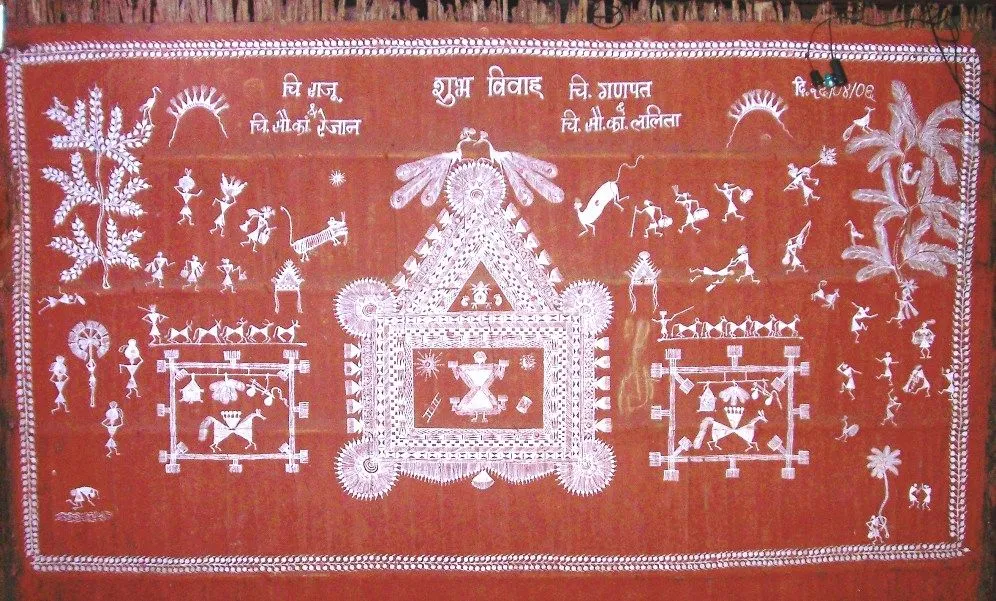
Warli Caukat drawn during marriage ceremony - Source - Wikimedia

Elements of the Warli Painting - Trees
In Warli paintings, the apparent reason of painting trees is to provide shelter and shade for the the Palaghata, but many paintings, apart from the elementary idea, watching a woman paint them, it forms a standard dohada pattern (the dohada picture in the context of Indian sculptures is known to show a beautiful woman satisfying the pregnancy longing by touching the tree with her foot) one gets the visual that their presence is also related to fertility.
The monkey tree is the most fertile and unusual tress of all in the context of Warli artworks, and no Warli painting is completed without it, with its size and shape varying. A monkey jumping from one branch to another as a good propagator, breaking fruits, eating them half and throwing the other half on the ground or carrying it to a long distance makes them important fertility charms. Monkeys are often replaced by squirrels or birds in the paintings, though trees are not just fertility charms according to the tribe’s understanding.
As trees are important elements found in the Warli Art, the Warli Tree of Life holds a special mention.
You can now buy The Warli Tree of Life at the Rooftop App
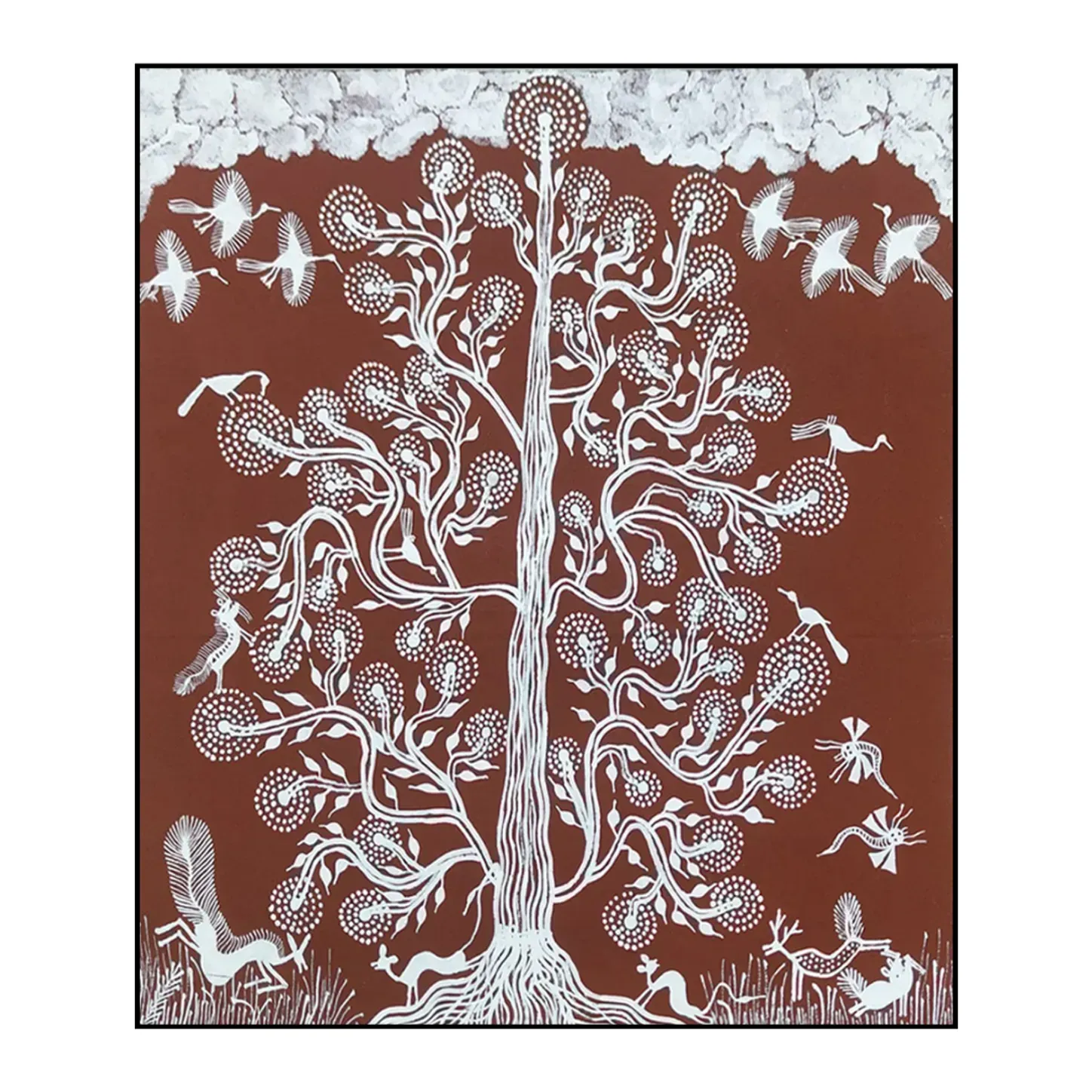
Warli Tree of Life - Source
Elements of the Warli Tribe - The Vertical Man
The Warli tribe is known to have a vertical man, which is known to be a wooden or stone statue that stands upright representing ancestors, village guardian spirits, even the Tiger-God and also the continuity of life after death, where them being upright symbolizes life, strength, continuity and energy growing upwards from the earth. Under this, the concept of Viras are also a part of the community, where Vira is known to represent the spirits of dead ancestors. According to the ritual specialist (Bhagats) of the Warli tribe, when a family faces repeated illness or misfortune, a wooden post is carved and placed near the house or the field, as the ancestor’s spirit is looking for a home, and after finding one, the ancestor is known to protect the family, and if placed in the fields, it is known to protect the livestock and crops.
Cheda, the guardian spirit of the whole village, who is considered stronger than individual ancestors whose statue often shows large eyes, a horse rider carved on the body, standing at the village boundaries, whose role is primarily to protect the entire community.
Most of the statues are not realistic, often intentionally made simple, flat, geometric, with very few facial features to present more spiritual power and less of physical appearance. Being the guardian, the statues with large eyes often are expected to represent awareness and constant watchfulness, to protect the community. Similarly, the tiger is made like an unrealistic sacred symbol to make it easier to worship and suitable for their rituals. The entire idea used by the community while showcasing their art is to focus more on representation rather than the accuracy of how it visually looks.
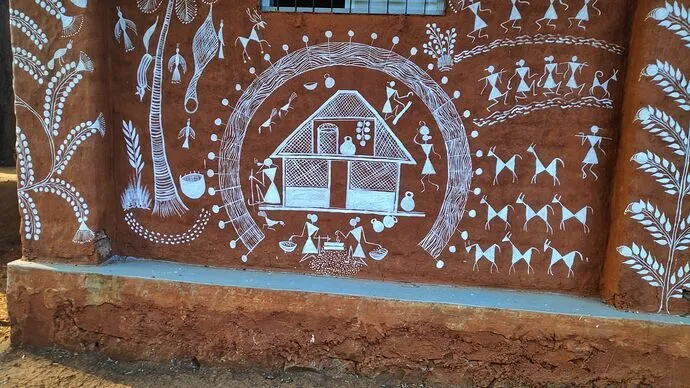
Warli Home - Source
Empty Space in the Warli Paintings
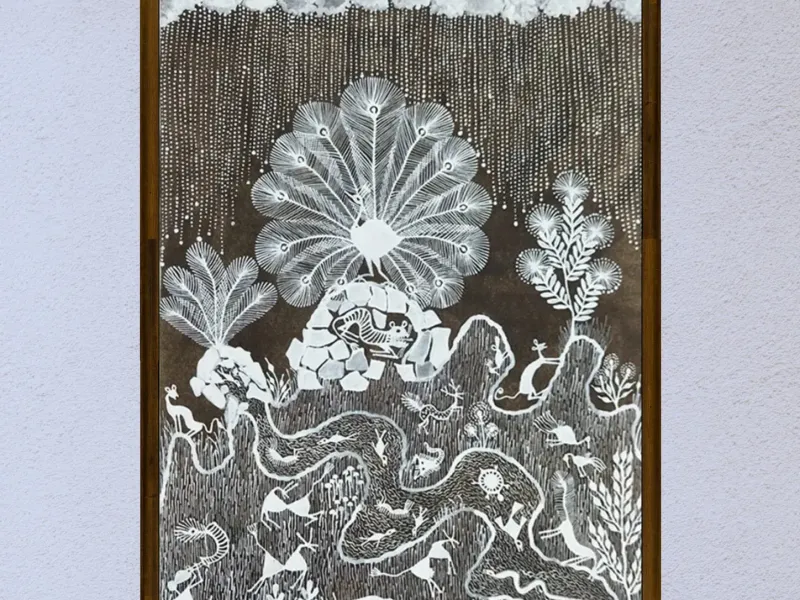
Yashodhara Dalmia, in her book, “The Painted World of the Warlis”, connects the idea of empty space to the Indian idea of śūnya (zero or emptiness), and here, the empty space in the art is nothing and rather full of possibility and where life can emerge as a whole, making the blank areas meaningful to some extent. Space in Warli paintings are never left empty, unlike Western paintings, as the community believes in showing importance of every part possible. One such example is seen in the painting The Delicate Web of Life Painting at the Rooftop App
Warli artists are often seen filling the surface with people, animals, trees, rituals, showing many events together by sharing the same space. As the Warli paintings are not seen from one fixed angle, hence, some concepts or entities are shown from above and others from the side to disclose many stories in one picture. The concept behind not having a perspective is that the intention is to show relationships, movements (dancing, farming. hunting, walking, animals, moving around), rituals, events and their importance rather than focusing on making the painting look realistic.
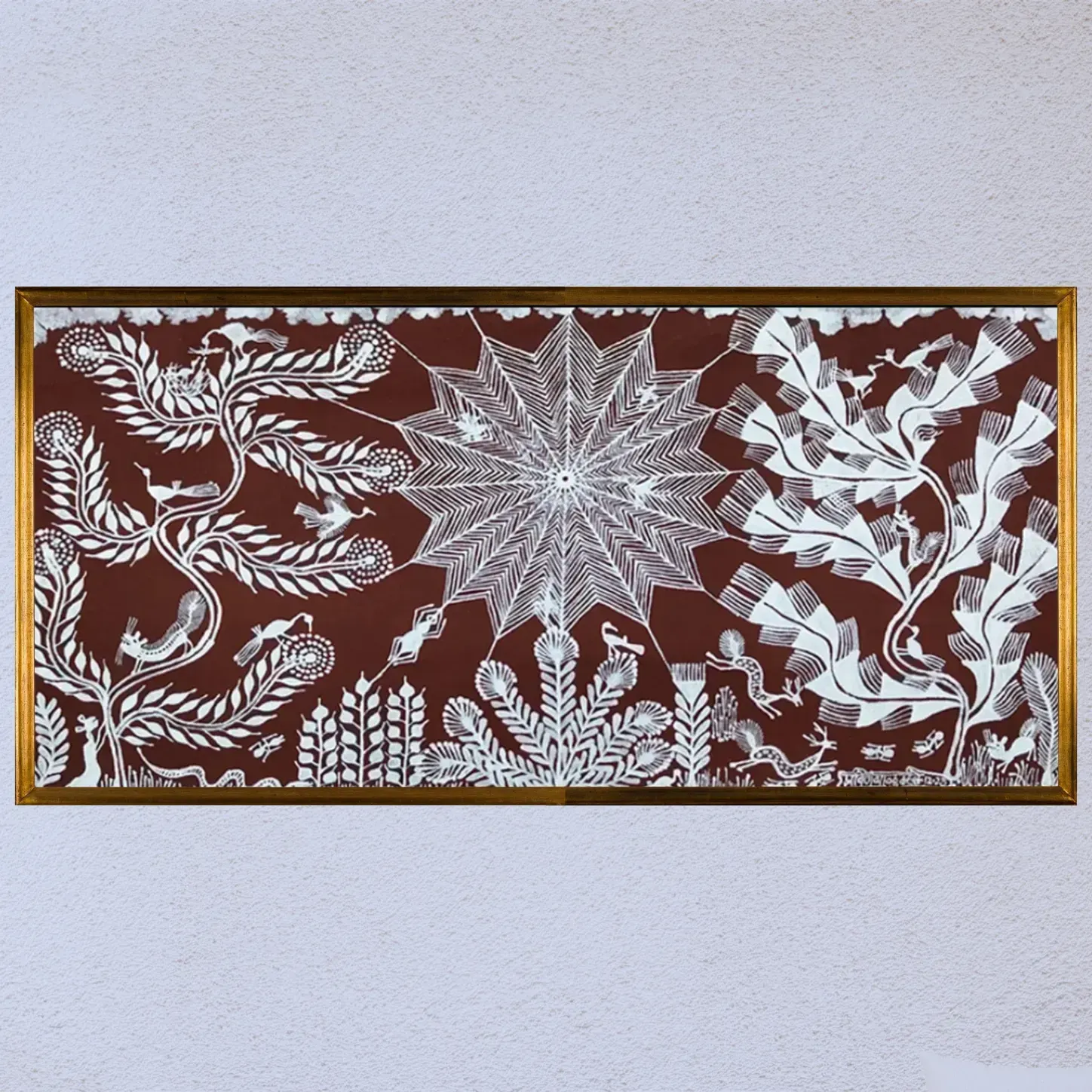
The Delicate Web of Life Painting - Source
Conclusion
Not being merely a decorative art, Warli paintings have established their own visual language and living script that speaks about the identity of the Warli community, portraying the significance of agriculture and other natural objects in their life, often also housing the balance of cosmos. What started as something historically confined to the walls of Warli houses has become an internationally celebrated art form, bridging the past and present, by inculcating urban reality, and while also preserving the tribe’s cultural symbols.
Bibliography
- The Painted World of the Warlis , authored by Yashodhara Dalmia
- The Warlis , authored by K.J. Save
- Indian Traditional Paintings A Journey through time , by Dr. S. Jayapriya, C. Anisha, J. Jaisri
- Warli Painting | Warli Art