

Warli Art Symbolism: What the Circle, the Triangle, and the Tarpa Dance Actually Mean
Warli art symbolism is a whole worldview in three shapes. The real meaning of Warli paintings, the Tarpa dance, and the Adivasi philosophy of community and nature.

Rooftop
Author
Warli art looks like the simplest visual language imaginable. A circle, a triangle, a line, and a crowd of little stick figures going about their day. You could be forgiven for filing it under charming folk decoration and moving on. That would be a mistake, because behind that plainness sits one of the most coherent worldviews in Indian art. Every Warli composition is a precise model of a social and cosmological order, a way of saying how the world is arranged and who belongs where in it, that has guided Warli Adivasi life for centuries.
This is the real subject of Warli art symbolism, and it is far more interesting than a key that translates shape into object. The circle is the sun, yes, and the triangle is a tree, but the deeper meaning of Warli paintings lies in how those elements are arranged in relation to one another. The arrangement is the argument. Read it closely and you find a philosophy that runs against almost everything a modern city dweller takes for granted. It helps to know that the Warli themselves treat their painting almost as a script. Scholars and artists alike describe it as a kind of lipi, a written language used to record and hand down knowledge across generations who kept very little in writing. If it is a language, then the question is not only what each shape means but what the whole sentence is saying, and the sentence turns out to be a description of how to live.
Why the Warli World Has No Centre
Look at a traditional Warli painting and notice what is missing. There is no hero in the foreground, no king drawn larger than his subjects, no human figure raised higher to signal importance. People, animals, birds, trees and rivers all appear at roughly the same scale, woven into the same busy surface. The eye is not led to a single focal point, because there is no single most important thing to look at.
It is tempting to read this as a technical limitation, the flatness of an art form that never learned perspective. That reading misses the point entirely. As Rooftop notes in its survey of symbolism in Indian art, these motifs are carriers of meaning rather than decoration. The same scale is a statement, not a shortcoming. The Warli are an egalitarian, animistic people who do not place humanity at the top of a ladder of beings. In their world a person is one participant among many, no more central than the tree that feeds them or the river they treat as a living god.
The contrast with most of the world's art is stark. Court and temple painting almost everywhere makes importance visible through size and position, the god or the king largest and highest, everyone else arranged below in descending rank. Warli does the opposite on purpose. Its flatness is a moral choice as much as a visual one. The same instinct shows in Warli life, which is famously egalitarian and collective, and in the belief that the rivers they depend on, the Vaitarna among them, are living gods to be respected rather than owned. The painting is not pretending the world is equal. It is insisting that it should be seen that way.
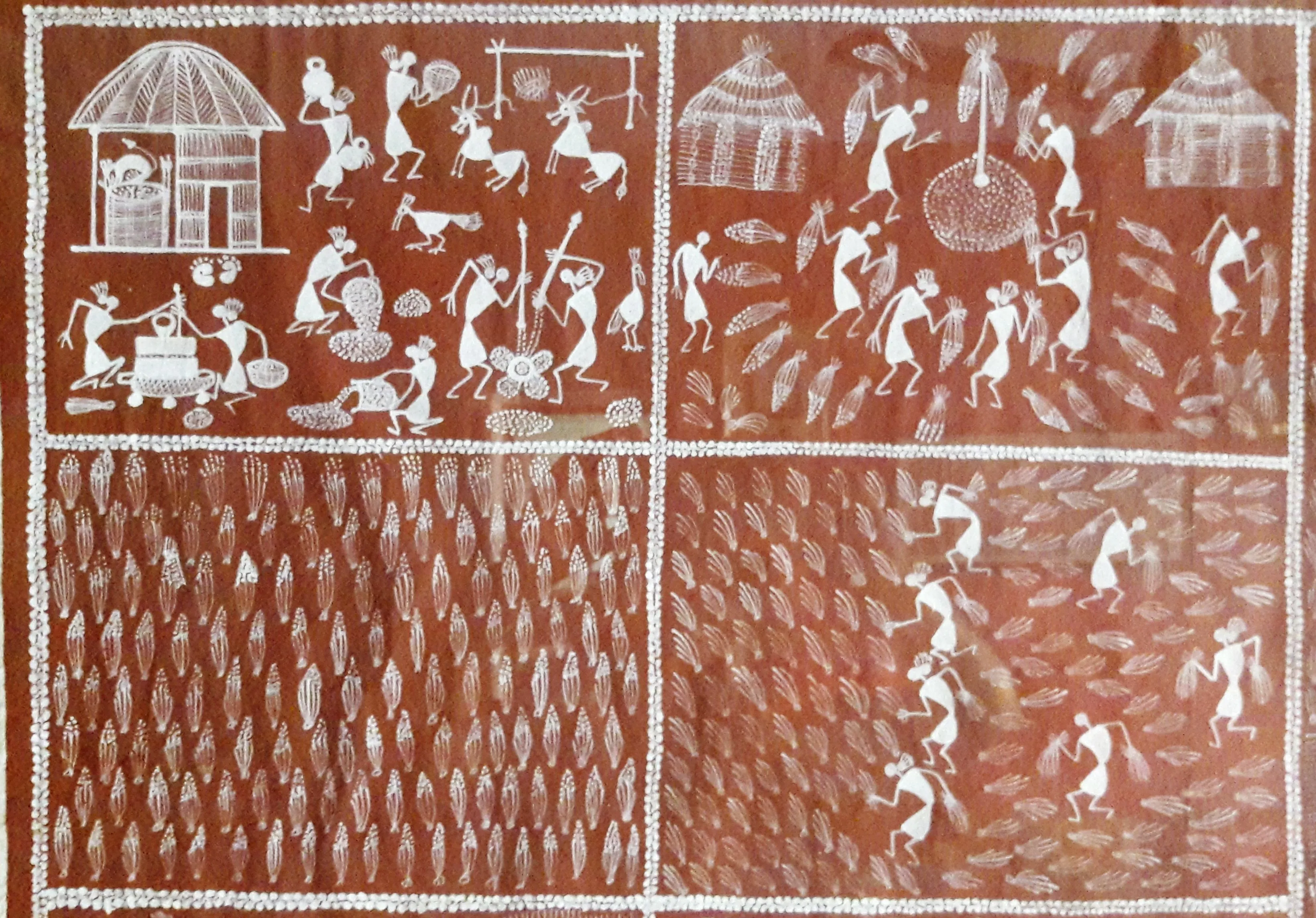
In Warli composition, humans, animals and nature share the same scale and the same plane. Source: Wikimedia Commons (Warli painting)
In the Warli world, nothing is at the centre, because everything belongs to the same circle.
Nature is not the backdrop. Nature is the deity.
Warli belief gives spirits to rivers, trees, mountains and animals. The grain goddess Kansari, the fertility goddess Palaghata and the tiger spirit Waghoba are nature itself, not rulers set above it. The art encodes a world where the divine and the natural are the same thing.
You can see this conviction rendered directly in a work like Nature God, where a sacred tree is held at the heart of the composition, not as a backdrop to human activity but as the living centre of the world the figures move through.
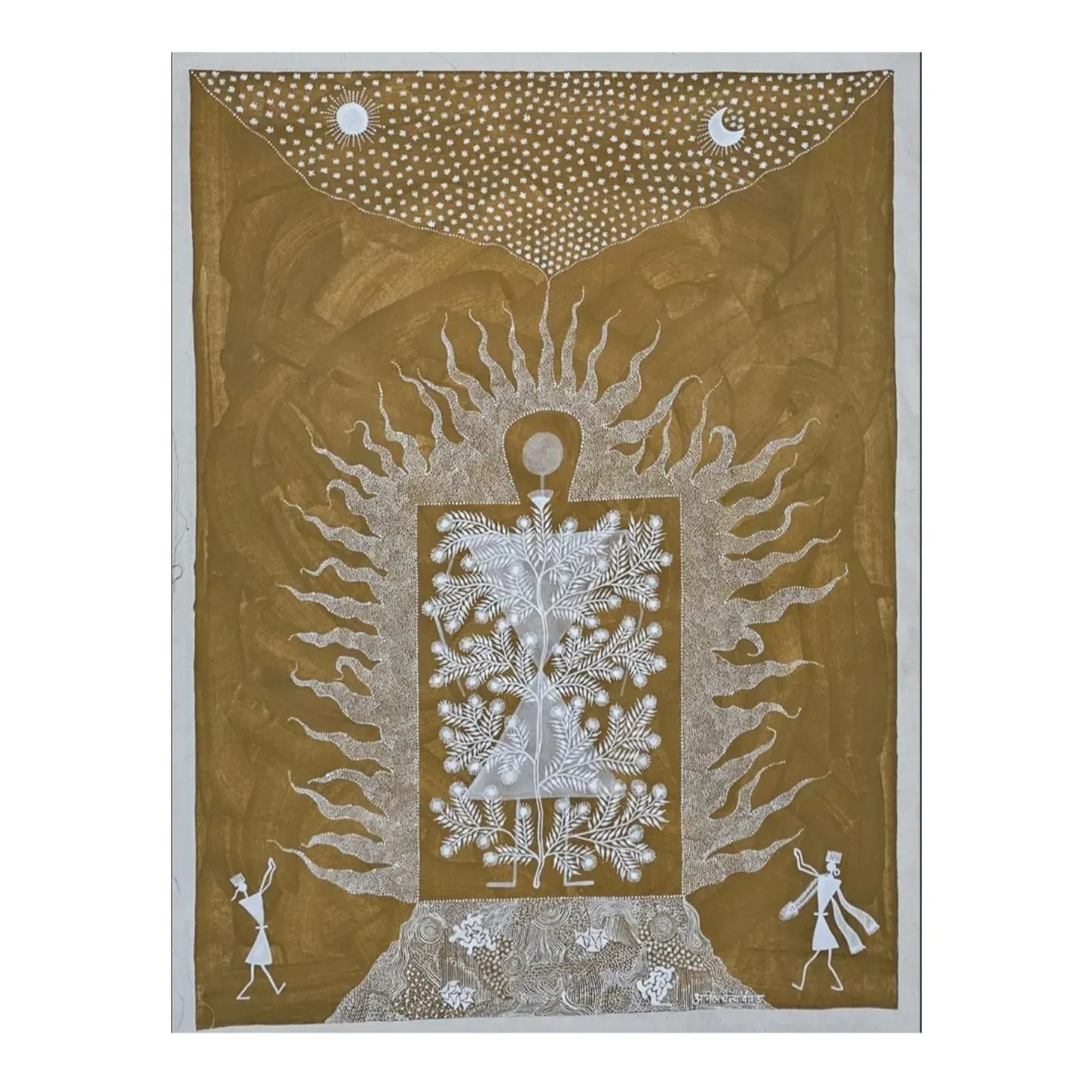
Nature God, a Warli work in which nature itself is the deity. View on Rooftop
None of this is sentimental nature worship either. The respect is practical. A community that lives directly off a river and a forest cannot afford the fiction that it sits above them, and the art keeps that truth in front of everyone's eyes, generation after generation, by simply refusing to draw a human being as the most important thing on the wall.
The Tarpa as the Philosophy Made Sound
If the painting states the philosophy, the Tarpa dance performs it. The tarpa is a wind instrument made from gourd and bamboo, played by a single musician who stands at the centre while the rest of the village winds around him in a long chain, hands linked, moving in step. The dancers never turn their backs to the player. The line coils outward in a spiral that, in the Warli understanding, has no beginning and no end.
It is easy to see a ruler in that central figure, but the Warli reading is closer to the opposite. The tarpa player is not a king the others orbit. He is the keeper of the rhythm everyone shares, and the role passes from man to man through the night rather than belonging to one. The dancers do not move because he commands them. They move because the music does, and he is simply its servant for a while. The dance encodes a belief that community is held together by movement and participation, not by the action of any single important person.
The spiral itself carries the rest of the meaning. A circle with no beginning and no end is the Warli image of time, which does not march forward toward some destination but turns, season into season, birth into death into birth. To join the dance is to step into that turning and accept your place in it. And because each dancer holds the hands of the two beside them, the whole figure depends on no one letting go. It is a small, danced lesson in mutual dependence, performed by the same people who painted it on their walls.
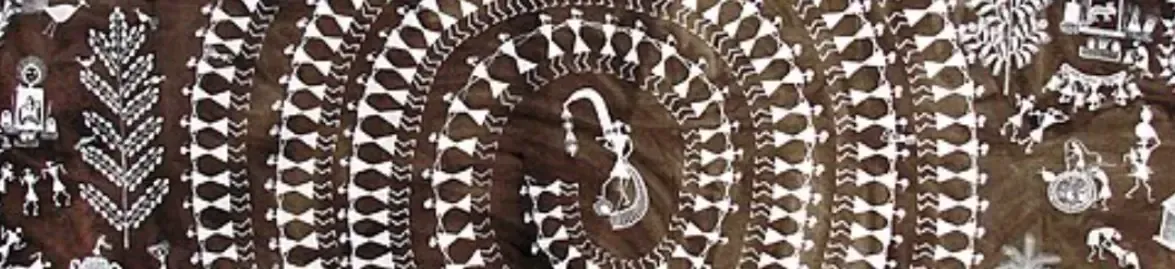
The Tarpa dance: a spiral with no beginning and no end, turning around a shared centre.
The circle does not turn because someone rules its centre. It turns because everyone keeps moving.
What the Harvest Paintings Actually Map
The Warli paint at the turning points of the agricultural year, and the harvest paintings are among the most loaded with meaning. On the surface they show what you would expect, people sowing, transplanting rice, cutting and drying the crop, fishing in the waterlogged fields. Underneath, they map a relationship, a three-way bargain between human labour, the generosity of the forest and field, and the divine reciprocity the Warli believe binds the two together.
This is where the grain goddess Kansari matters. In Warli belief she is the one who sows the seeds that populate the earth with plants, animals and people, which makes a harvest not simply a yield but a gift that has to be acknowledged. The painting is part of that acknowledgement. It is not decoration hung up to celebrate a good year. It is closer to an obligation, a record of the bargain, a way of holding up the community's side of an agreement with the land that fed it. To paint the harvest is to give something back for having received.
There is a detail here that deepens the point. The painting was traditionally made by the suvasinis, the married women of the household, and the materials themselves came from the land it honoured, white from rice paste, the ground from cow dung and earth. So the act of giving thanks was made out of the very things being given thanks for. The wedding chauk works the same way, framing the fertility goddess Palaghata at its centre, because marriage, like harvest, is another moment when the community asks the land and its gods for continuity and quietly promises something back.
The same ecological vision runs through the famous fishnet works of the master Jivya Soma Mashe, and through pieces like Double Fish Net, where the net and the fish of the rice fields become a meditation on the harmony between farming and water, between taking from nature and living inside it.
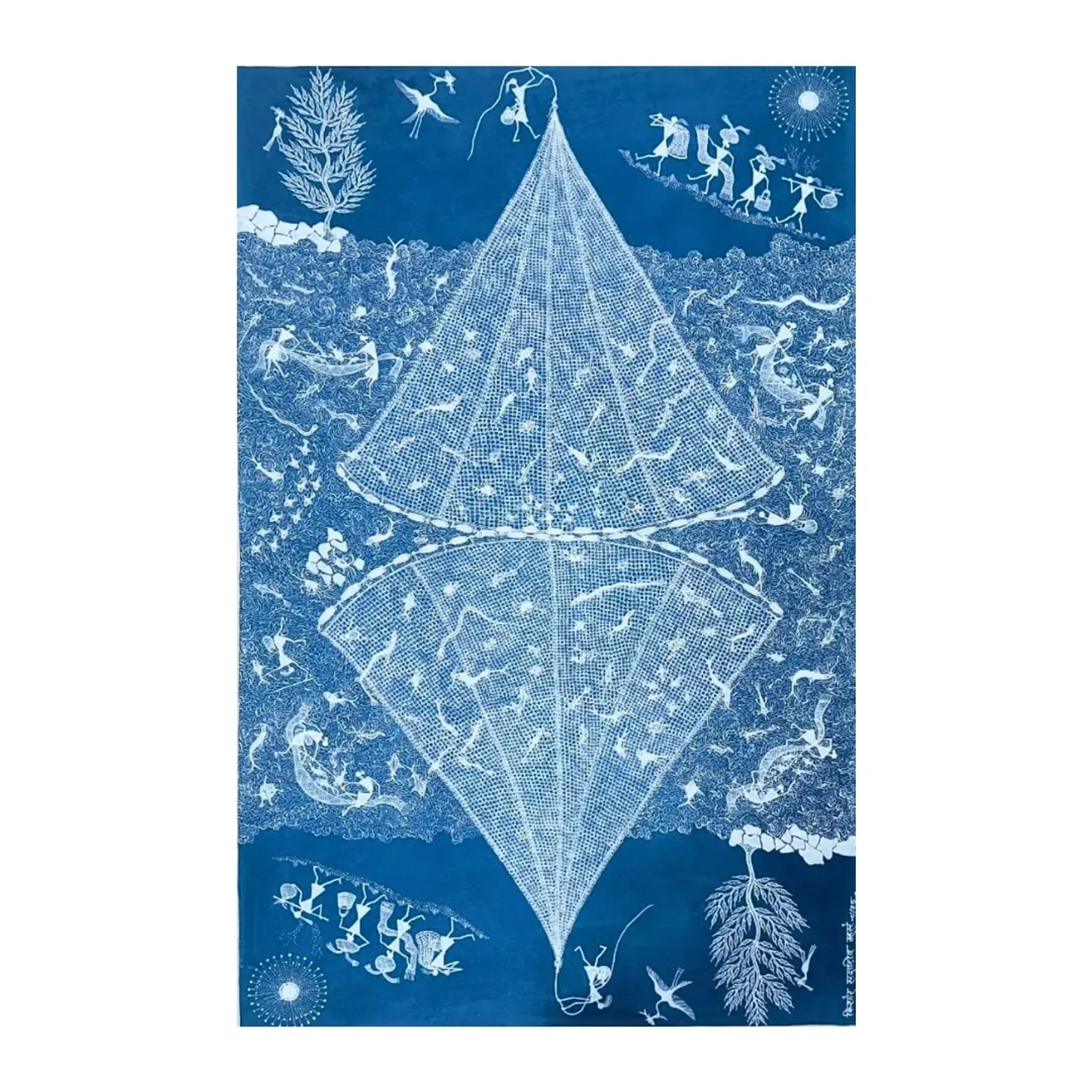
Double Fish Net, drawing on the fishnet motif Mashe made globally famous. View on Rooftop
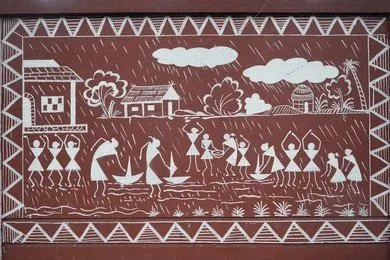
The paintings use basic geometric shapes, such as circles, triangles, and squares, to depict scenes from daily life, including farming, celebrations, and rituals. Traditional Warli painting.
A Warli painting is not a picture of the harvest. It is the community keeping its promise to the land.
What This Philosophy Offers a Contemporary Reader
It would be easy to admire all this from a safe distance, as a charming belief system belonging to other people in another time. That distance is worth closing, because the Warli worldview speaks with unusual directness to the things a city dweller in the present is quietly anxious about.
Consider what it actually proposes. A refusal of hierarchy, in which no being is worth more than another and importance is not the organising principle of the world. An ecological reciprocity, in which nature is not a resource to be drawn down but a partner owed something in return. And an insistence on community over the individual, in which meaning comes from the chain of linked hands rather than from any one person stepping out of it to be seen. Read from a city in the present, where so much pulls the other way, toward hierarchy, extraction and the lonely project of the self, this is not a quaint folk belief. It reads almost like a correction.
You do not have to strain to hear how current that sounds. An age worried about a heating planet is being told, in the plainest possible terms, that nature is a partner owed reciprocity rather than a stockpile to be spent. An age of loneliness and burnout is being shown a model of meaning that lives in the linked circle rather than the solitary climb. The Warli were not answering our questions, of course. They were answering their own. It is just that the answers happen to rhyme.
None of this requires romanticising the Warli or pretending their life has been easy, because it has not. It simply means taking their art seriously as thought rather than ornament. The shapes are kept simple so that the idea can be clear. Once you see the idea, the simplicity stops looking like a lack of sophistication and starts looking like a kind of distilled wisdom, the residue of a very long conversation between a people and the place that sustained them. It is the kind of knowing that cannot be argued into existence, only lived into shape over a very long time.
A world with no centre, in balance with the land, held together by everyone at once. The Warli have been drawing it for centuries.
The next time you meet a Warli painting, resist the urge to call it cute. Sit with it instead and read the arrangement. The same scale, the linked circle, the harvest given back. Each one is a sentence in a philosophy that has outlasted empires by being painted, again and again, onto the walls of ordinary homes.
That is the quiet power of this art. It does not argue or instruct. It simply shows a world arranged the way the Warli believe a world should be, and trusts you to notice the distance between that and your own.
If you want to encounter Warli as living philosophy rather than as a motif, the best place to start is with the work of practising artists, where the meaning travels with the painting. Rooftop's collection of Warli paintings presents each work alongside its artist and its cultural context, so the circle, the triangle and the Tarpa arrive with the worldview that gave them their meaning still attached.