

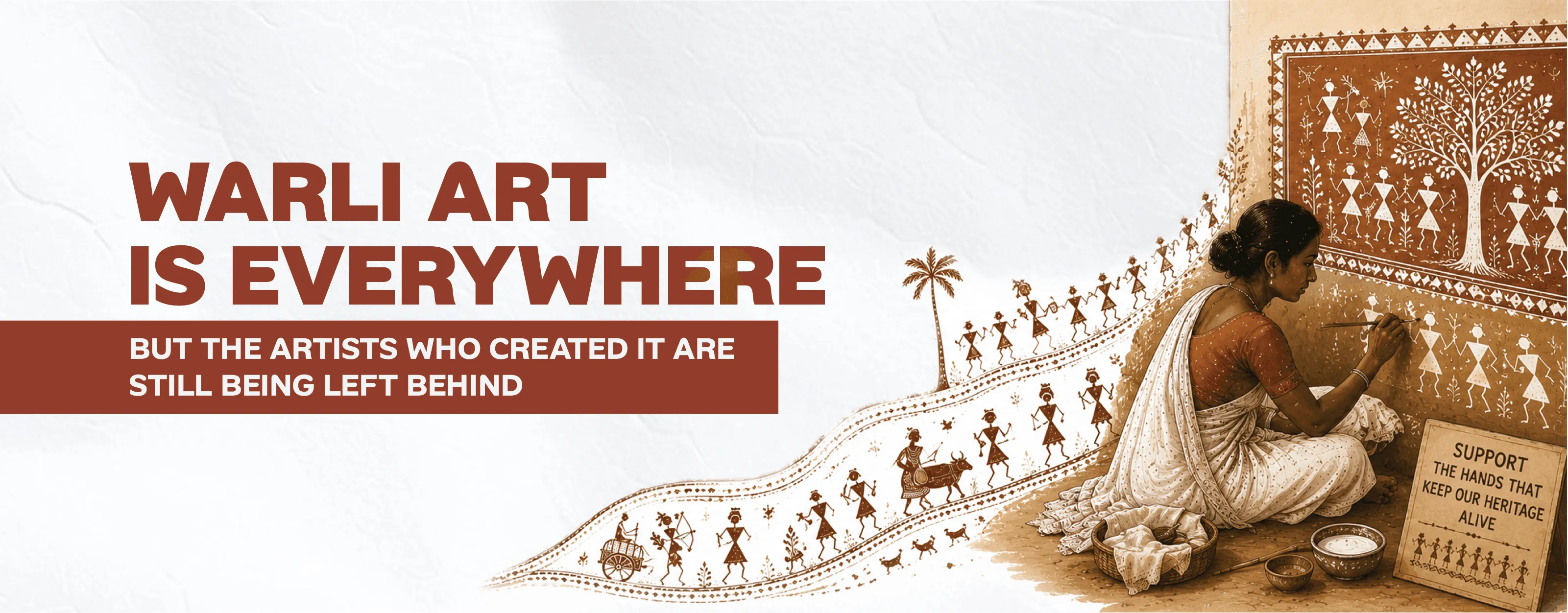
Warli Art Is Everywhere, But the Artists Who Created It Are Still Being Left Behind
Warli motifs sell on totes, cushions and campaigns while the Adivasi artists earn almost nothing. What folk art appropriation looks like, and what real support means.

Rooftop
Author
The triangles are on tote bags, cushion covers and corporate sustainability decks. The community that wrote this visual language on its walls for a thousand years is watching the money flow everywhere except home. This is an argument about where it should go instead.
Walk through any lifestyle store, scroll any home decor feed, flip through any brand campaign that wants to signal Indian-ness, and you will find them. The little white triangle people, dancing in spirals, carrying pots, ploughing fields. Warli has become the default visual shorthand for ethnic, earthy and authentically Indian, printed onto mugs, kurtas, wedding invites, chai packaging and the annual reports of companies that have never heard of Palghar.
The aesthetic is everywhere. The Adivasi artists whose grandmothers created it are, for the most part, not seeing a rupee of any of it.
That is not a rhetorical flourish. It is the documented economics of one of India's most visible art forms, and it deserves to be said without hedging. The market did not discover Warli and lift its makers. The market discovered Warli and left its makers behind, and the machinery of how that happened is worth understanding, because it is the same machinery that hollows out folk art everywhere.
How a Sacred Visual System Became a Pattern Library
Begin with what Warli actually is, because the appropriation only makes sense against it. Warli was never decoration. It was writing. The community itself insists on the verb. A chauk, the sacred wedding square, is written, not drawn, by married women called savasinis to the singing of dhavaleris, and it is worshipped, because every element of it carries a message. An art form that is also a script, a liturgy and a record of a people's relationship with land, painted in rice paste on mud walls for a thousand years without a single commercial transaction.
The route out of the village was genuinely well-intentioned. In the early 1970s, India's handicrafts establishment supplied Warli painters with brown paper and white paint so that a wall art could earn, and the rise of Jivya Soma Mashe carried the form to galleries in Mumbai and then the world. Nobody involved in that campaign was trying to strip the art of its meaning. But visibility has a second act that no one in the 1970s planned for. Once the geometry was out in the world, the design industry adopted the shapes and quietly discarded everything else, the ritual, the authorship, the community, the meaning. Somewhere in the 2000s, Warli stopped being a noun that referred to a people and became an adjective that meant ethnic, geometric, vaguely Indian. That is the precise moment a sacred visual system finished its conversion into a royalty-free pattern library.
It is worth being precise about the mechanics, because inspiration and extraction are not the same thing. An artist who studies Warli, credits it and builds on it in dialogue with the community is participating in culture. A production pipeline that treats the geometry as free clip art, reproducible by any illustrator with a reference image, is doing something else entirely. The digital age turbocharged the second path. Once a motif can be traced in minutes and printed in lakhs, the thousand years of meaning behind it becomes, commercially speaking, an inconvenience to be dropped.
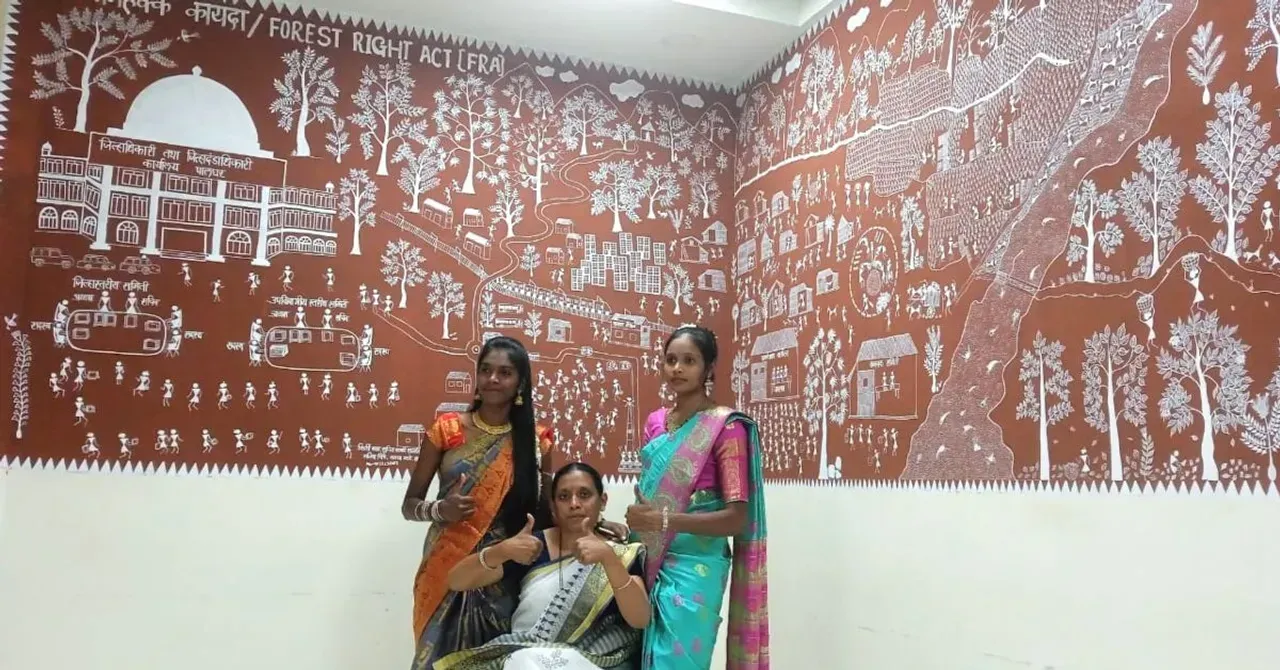
The Dhavaleri group with their wall mural at the Collector's office in Palghar.
T H E U N C O M F O R T A B L E Q U E S T I O N
If a design is sacred enough to be worshipped in Palghar, what exactly makes it free to print in a factory that has never heard the songs it was written to?
Who Benefits From the Current System
Name the beneficiaries plainly, because vagueness protects them. First, the urban manufacturers who lift the aesthetic wholesale, printing Warli-style motifs onto textiles, ceramics and stationery with no attribution and no connection to the community, at volumes no village workshop could ever see. Second, the platforms and sellers who market machine-printed copies with the words handmade and folk art attached, capturing the price premium that authenticity commands while supplying none of it. Third, the brands that deploy Warli as cultural signalling, borrowing a tribal community's visual identity to decorate campaigns and reports while sourcing nothing from the people it belongs to.
None of this is hypothetical. Coca-Cola built a Deepawali campaign around Warli imagery in 2010. In 2018, Adivasi organisations served a legal notice on Bata for putting Warli painting on footwear, an act the community described as demeaning to an art bound up with worship. And the most telling incident of all came in 2007, when the young Warli collective AYUSH posted a neighbour's painting online, with credit, and promptly received legal threats from French and German galleries claiming rights over the imagery. Read that again. Members of the community that created Warli were threatened with legal action for sharing Warli, by institutions an ocean away. It is hard to imagine a cleaner picture of who the current system serves.
The buyer, to be fair, is rarely the villain. Most people who bring home a Warli-print cushion genuinely like the art and assume, reasonably, that somewhere down the chain an artist benefits. The system is engineered so that this assumption is almost always wrong. Anonymity is the laundering mechanism. Strip the name, strip the village, strip the story, and a sacred script becomes an untraceable surface pattern whose profits can flow anywhere without a single visible injustice. The buyer sees a lovely object. The extraction happens entirely off-screen.
Bought at Rs 500, sold at Rs 5,000 to 10,000
Community members in Palghar have documented middlemen buying paintings from Warli artists for a few hundred rupees and reselling them for ten to twenty times as much, while Warli-style work by non-Adivasis sells in airports for Rs 10,000 and above. The value exists. It simply never reaches the source.
T H E U N C O M F O R T A B L E Q U E S T I O N
When a printed copy sells as folk art, the buyer pays for authenticity and the artist pays for the buyer's discount. Who exactly agreed to that trade?
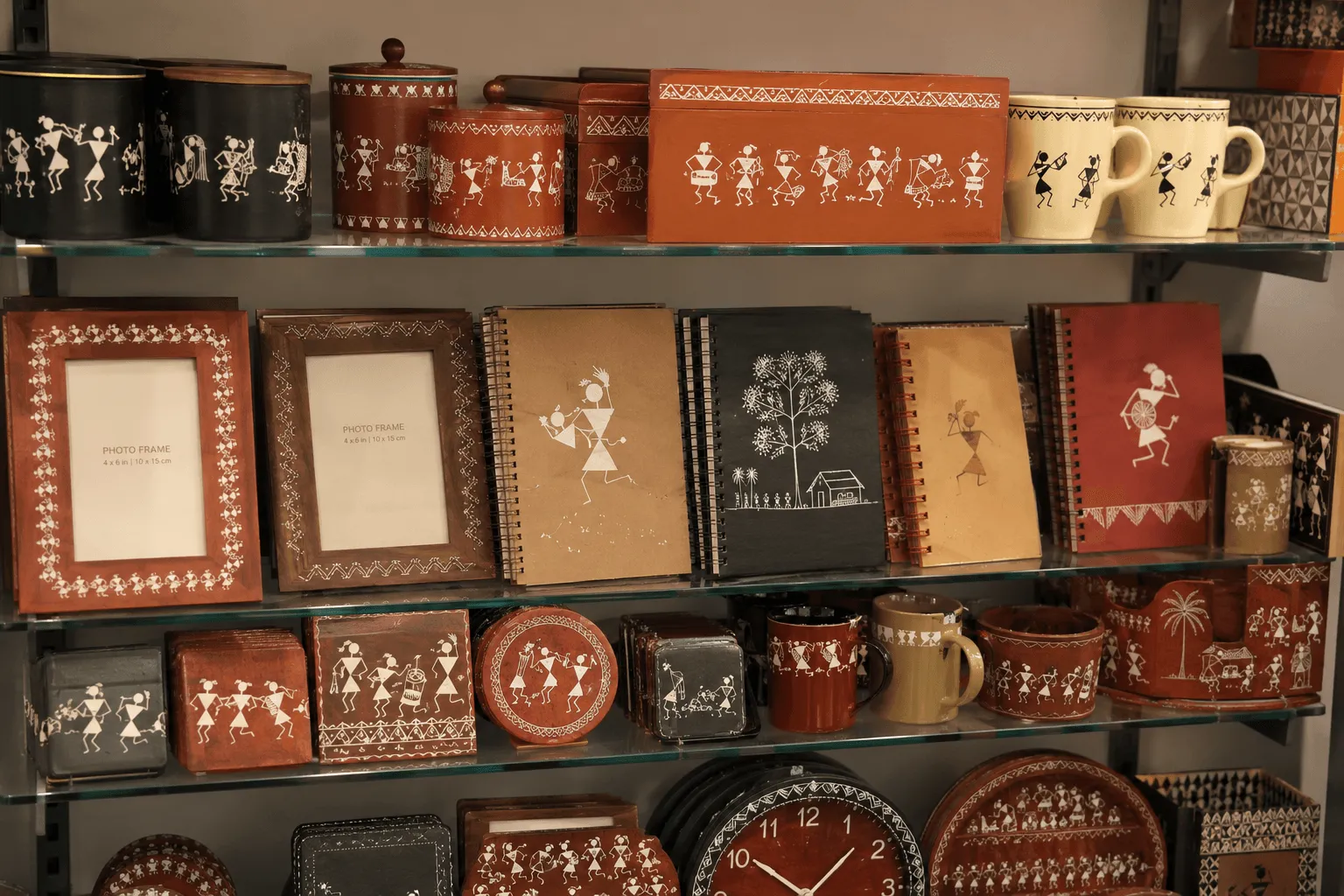
The aesthetic travels on mugs, footwear and fabric. The attribution and the money rarely travel with it.
What the Community Has Done, and Where the Law Runs Out
The community has not been passive. AYUSH and the Adivasi Yuva Seva Sangh filed for a Geographical Indication on Warli painting in June 2011 and won it in March 2014, covering not just paintings but stationery, decor and textiles. It was a landmark, and it matters. But a GI protects goods produced by a region's registered makers. It does not stop a studio in another city from producing Warli-style graphics, which is why the copying continues legally at industrial scale, a gap Rooftop has examined in its explainer on what GI tags and intellectual property can and cannot protect. The law, as it stands, guards the word Warli far better than it guards the Warli.
GI filed 7 June 2011, certified 31 March 2014
The Adivasi Yuva Seva Sangh secured the Geographical Indication for Warli painting across product classes covering stationery, wooden decor and textiles. A community of hereditary artists had to form an NGO and fight a three-year legal process to be recognised as the proprietors of their own thousand-year-old script.
What Genuine Support Actually Looks Like
The word support gets used loosely around folk art, so let it be defined with precision. Support is not buying a Warli-print cushion, however lovely, because none of that money touches Palghar. Support is a short list of specific behaviours, and everything outside the list is aesthetic extraction wearing a kind face.
- Buy original work from named artists at fair prices. A signed, certified painting by a known hand, at a price that respects the labour, moves real money to a real person and builds their name, which is the asset middlemen have always stripped away.
- Pay for teaching led by community practitioners. A workshop or course taught by a Warli artist converts cultural knowledge into income on the community's own terms, with the meaning attached, not amputated.
- Choose platforms that trace the money to the source. If a seller cannot tell you who painted a piece, where they live and what they were paid, the answer is already in the silence.
And since fair price does the heavy lifting in that first behaviour, define it too. Fair is not the lowest number a poor artist can be pushed to accept. On certified platforms, genuine Warli originals run from around eight thousand rupees for an entry work to a lakh and beyond for major signature paintings, signed, documented, and with a royalty flowing to the artist on the sale. That ladder is not expensive. It is what the work has always been worth, finally visible on a price tag instead of vanishing into a reseller's margin.
This is also the place to say what Rooftop itself is doing beyond the marketplace, because the argument would be hollow otherwise. The Rooftop Art Foundation works on documentation, artist spotlights and welfare for the traditional artists behind these forms, the slow unglamorous work of making sure the people are recorded alongside the patterns.
The teaching principle is not abstract either. The Warli course taught by the Mhase family, the lineage of Jivya Soma Mashe himself, is precisely what paying community practitioners looks like in practice, the tradition taught by the family that carried it to the world, with the fee going to them.
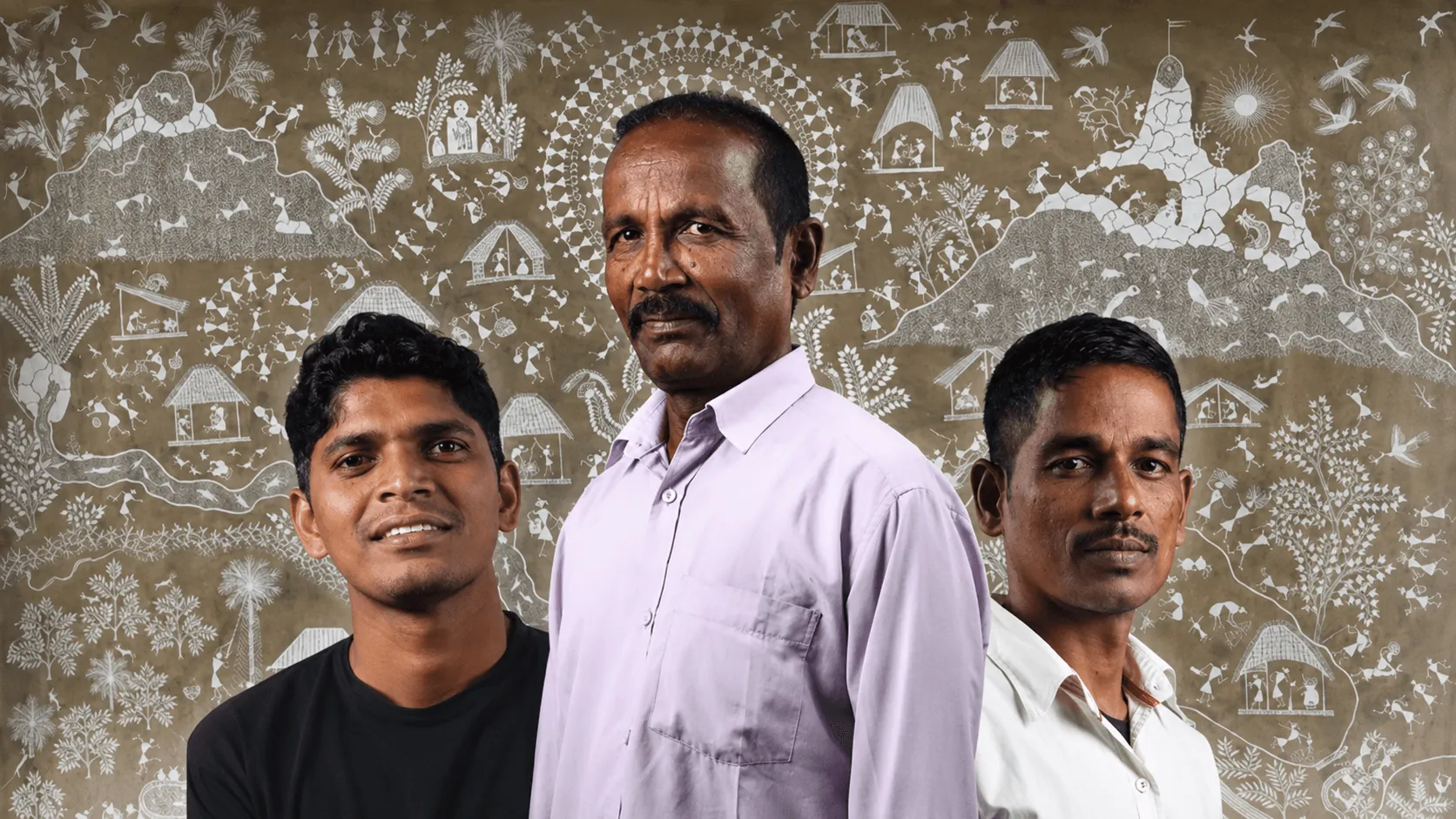
The Mhase family's Warli course, tradition taught by its hereditary carriers. View on Rooftop
The Artists Who Are Still Here
It is easy for a debate like this to float off into abstraction, so come back to the ground. In the padas of Ganjad, Dahanu and the villages of Palghar district, working Warli artists live inside a bitter arithmetic. Their visual language generates crores in commercial value every year across products they will never see, while the painters themselves navigate thin incomes, patchy infrastructure and a market that pays a middleman more for carrying a painting than it pays the artist for making it. The commercial visibility their art has produced comes with a complete absence of credit. The triangles are famous. The names are not.
There is a second injustice folded inside the first, and honesty requires naming it. As Warli became saleable, men, including non-Adivasi men, moved into a form that women had carried for centuries, and in parts of Palghar the savasinis have been displaced even from the ritual wedding paintings that were theirs alone. The dhavaleri women's groups now painting public murals and teaching the young are not just preserving an art. They are reclaiming it twice over, from the market and from within.
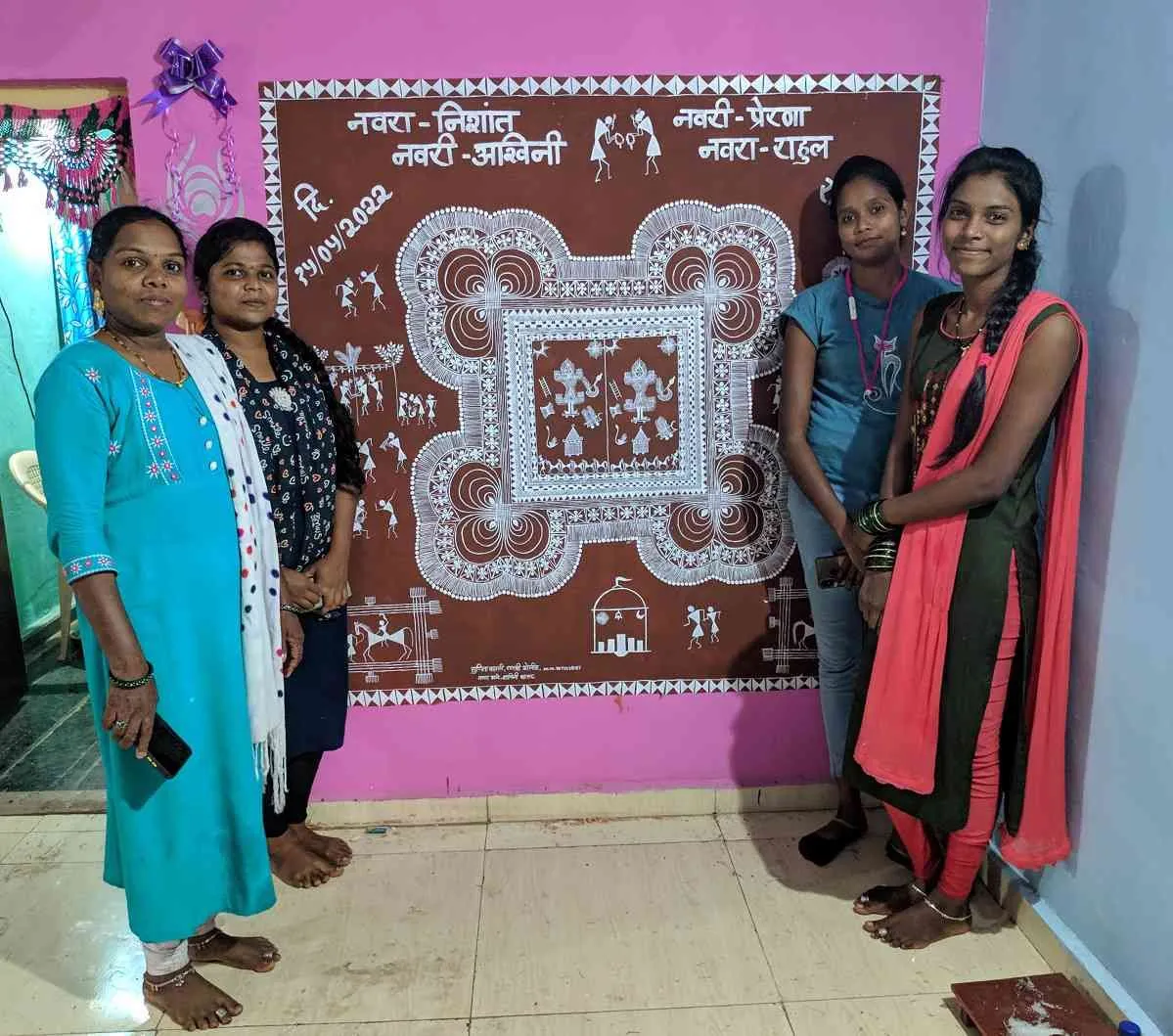
Shalini Kasat, Tanya Urade, Suchita Kamadi and Rajshri Bhoir, members of the Dhavleri group, with a chauk painting at Wada taluka, Palghar. The group is seeking to counter the erasure of women from the art form. Photos: Nolina Minj
And beneath the economics sits the deepest layer of all, the land itself. Community leaders in Palghar frame their fight in three words, jal, jangal, jameen, water, forest, land, because Warli painting is a portrait of a specific landscape drawn by the people who live inside it. As that landscape is dammed, diverted and built over, the art loses the very world it depicts. A community displaced from its hills cannot keep writing the hills. The threat to Warli art and the threat to Warli land are, in the community's own analysis, the same threat wearing two faces.
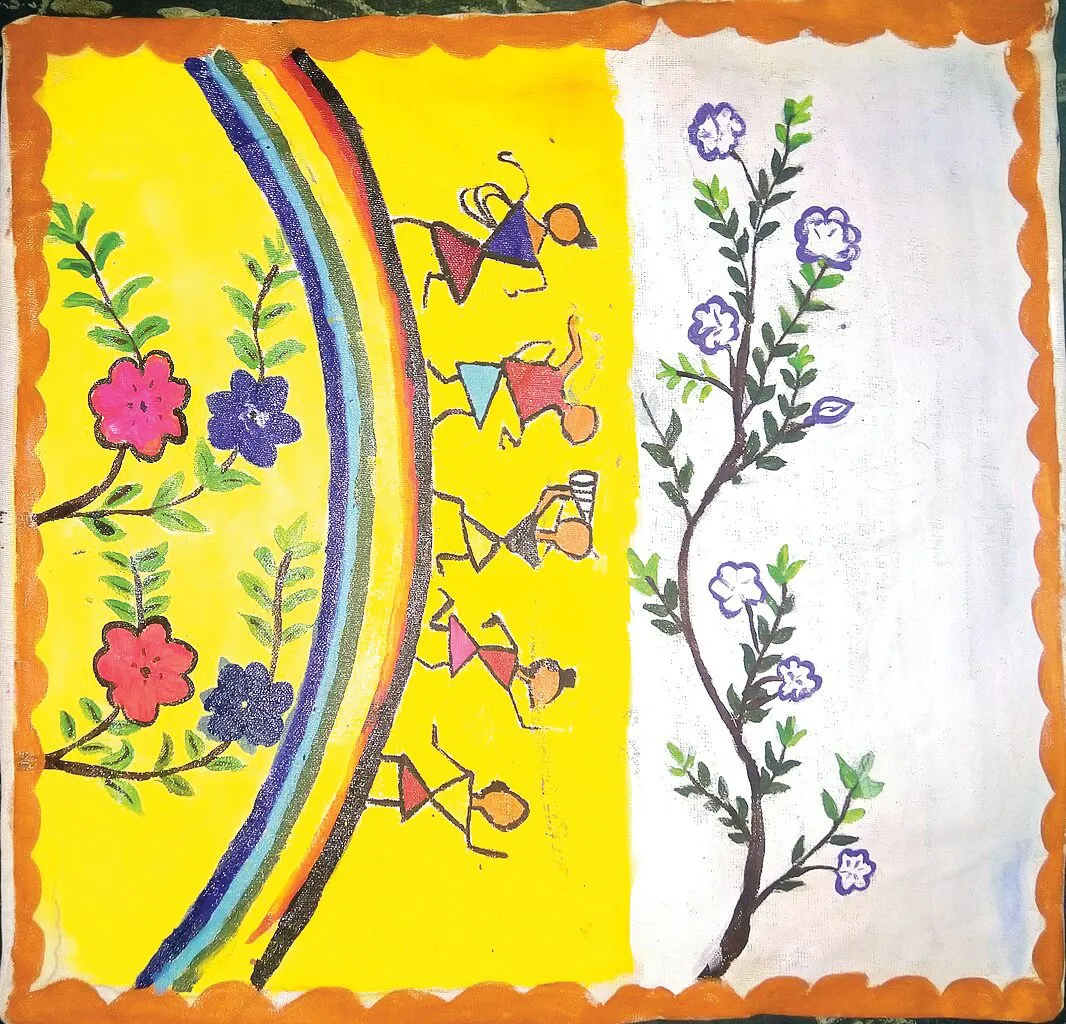
Warli painting is a portrait of a living landscape. Displace the people from the land, and the script loses its subject. Source: Millennium Post
T H E U N C O M F O R T A B L E Q U E S T I O N
The world can name the style in one word. Can it name even one living artist from Ganjad or Dahanu? If not, what exactly has all this visibility been for? Restoring the names is the whole point of buying originals. A work like The Legacy of a Surname, a certified narrative painting that tells the story of how the Warli received their very name, is the exact opposite of an anonymous print. The artist is named, the community is credited, and the price honours the hand.
Restoring the names is the whole point of buying originals. A work like The Legacy of a Surname, a certified narrative painting that tells the story of how the Warli received their very name, is the exact opposite of an anonymous print. The artist is named, the community is credited, and the price honours the hand.
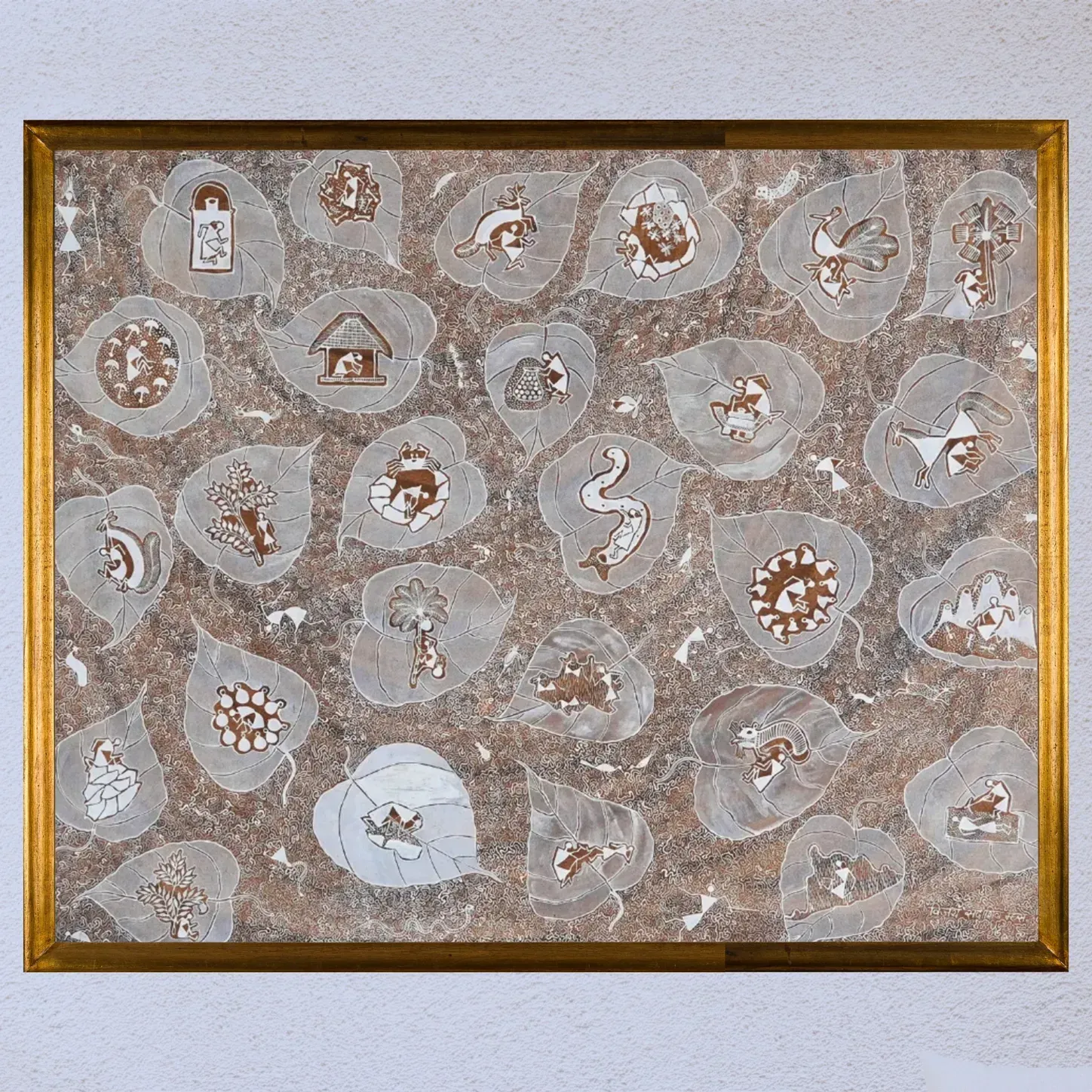
The Legacy of a Surname, a certified original with named-artist provenance. View on Rooftop
The Opposite Model
None of this argues that Warli should retreat behind a wall. The community itself wants the art to travel. What it argues is that the terms of travel have been written by everyone except the people who own the language, and that buyers, not brands, are the ones who can rewrite them, one traceable purchase at a time. Every rupee that reaches a named artist in Palghar is a small correction of a fifty-year imbalance. Every anonymous print purchased as folk art extends it.
Rooftop was built on the opposite model to the one this piece describes, original works sourced from the artists, sold with their names, their community and their certification attached, with the money traceable back to the hands that made them. If Warli is going to be everywhere, let it at least be everywhere on those terms. The collection of original Warli paintings is where that version of everywhere begins, one named artist at a time.