

Warli Art for Home Decor: Why Design-Savvy Buyers Are Choosing It Over Everything Else
Warli art for home decor signals a real eye for design. How Warli painting works in modern interiors, the rooms it suits, and why collectors buy originals not prints.

Rooftop
Author
Walk through enough well-designed homes and you start to notice the same kind of painting turning up in very particular places. It is on the wall of an architect who trained in Japanese minimalism. It is the first real artwork an NRI couple buys for the flat they are setting up abroad. It is what a Delhi collector reaches for after deciding they are finished with mass-produced prints and want originals only. The painting is Warli, and the people choosing it are rarely choosing it by accident.
Warli art for home decor has quietly become the marker of a certain kind of taste. Not the loud, look-at-me kind, but the quieter signal of someone who understands structure and restraint, and who knows the difference between decorating a room and curating one. This piece is about why design-literate buyers keep landing on Warli, where it works best, and how to choose a piece worth living with. The short answer is that Warli does more with less than almost anything else you can hang, and it manages it without ever raising its voice.
What Warli Signals About Your Eye
Most ethnic decor is bought for atmosphere. It tells a visitor that the owner likes the idea of craft, which is a perfectly good reason to buy something. Warli says something more precise. Because the form is so reduced and so structural, choosing it well signals that you can actually read a composition, that you prefer discipline to clutter, and that you understand the difference between cultural tourism and cultural knowledge.
A generic printed motif announces a mood. A signed Warli original, made by a named artist working in a living tradition, announces an eye. That distinction is subtle, and exactly the kind of thing design-literate people notice in each other's homes. It is also why Warli rarely reads as merely decorative once you know what you are looking at. The shapes are spare on purpose, and the restraint is the statement.
There is a quiet confidence in the choice as well. Warli does not lean on colour, gilding or obvious ornament to impress. It asks the room to slow down and read it, which only works if the person who hung it trusts their own eye. That is the real signal. Not wealth, and not a stamp in a passport, but the judgement to pick one disciplined piece and let it breathe.
It also ages differently from trend-driven decor. Fast interior fashions, the macrame hanging, the neon quote, the printed mandala, date quickly because they were never structural to begin with. Warli does not date, because it was never a trend in the first place. It is a system that predates every design movement it now sits beside, which is a strange and very useful kind of timelessness to put on a wall.
_01.jpg)
Why It Works in Modern Spaces
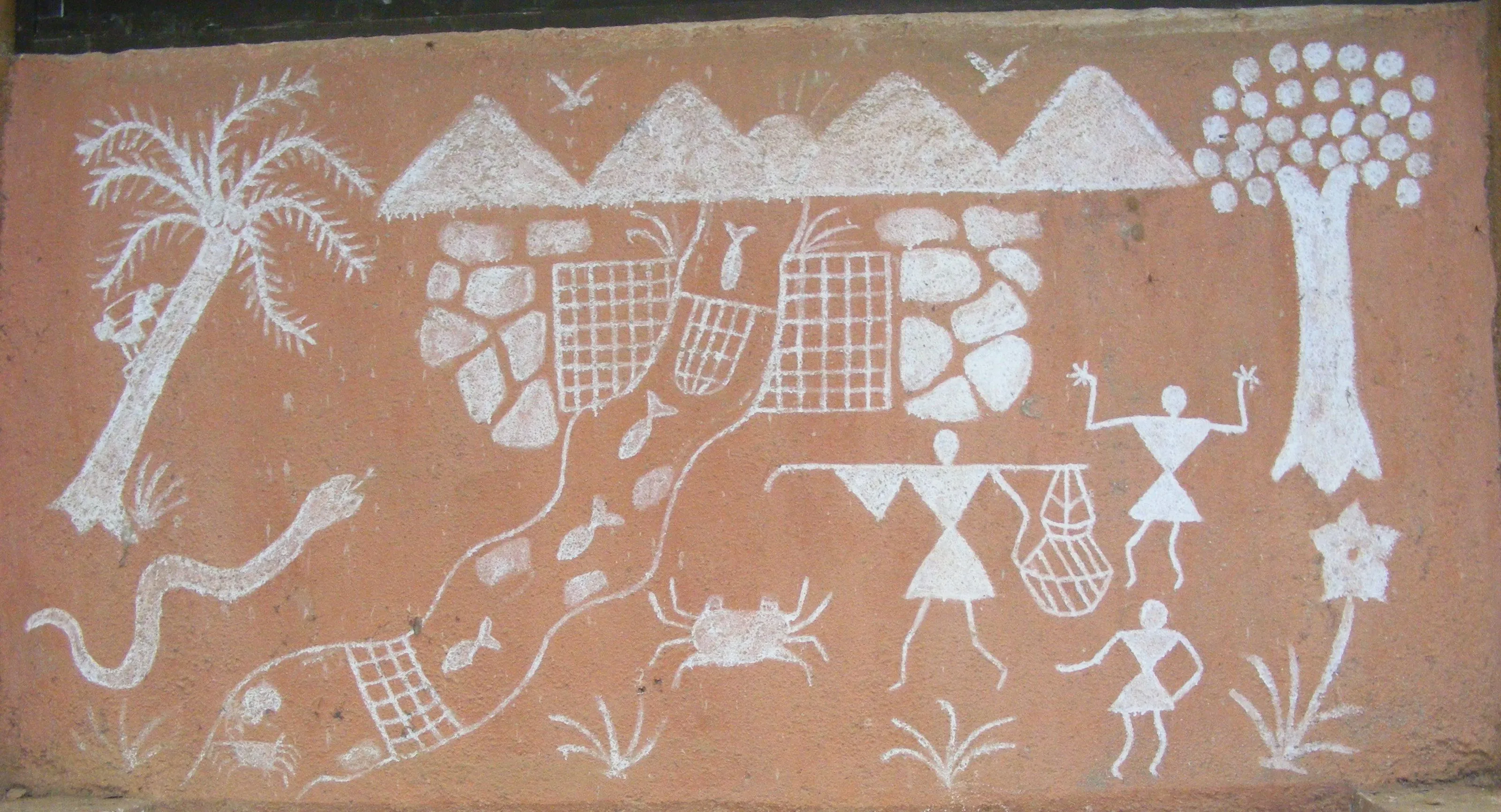
The reason Warli sits so easily in contemporary interiors is not luck. It comes down to a visual logic that happens to align with the principles most modern design already follows.
- The palette is monochrome. White figures on an earth-toned ground sit comfortably beside almost any colour story, from concrete grey to deep forest green, without ever competing with it.
- The geometry is universal. Warli's reduction of the body to triangles and circles rhymes with the same instincts that drove Bauhaus and Scandinavian design, which is why it never reads as out of place in a clean, modern room.
- The scale is elastic. The same composition holds its integrity at A4 on a shelf or blown up to a full wall mural, because the grammar does not depend on size to work. What surprises first-time buyers is how well Warli plays with materials, not just colours. The earthy ground loves the company of natural textures, raw wood, linen, jute, unfinished concrete and warm metals such as brass and aged copper. Against a cool, hard surface it adds warmth, and against a busy, textured one it adds calm. Lighting matters just as much. A warm, low light brings out the depth of the cow dung or mud ground, while flat overhead light tends to wash it out, so the work rewards a wall with a lamp nearby rather than a spot under a bare tube light.
This is why you find Warli across interior styles that otherwise share very little. It suits the warm minimalism of a Japandi home, the pared-back palette of a Scandinavian flat, the texture-rich layering of a boho space, and the clean lines of a modern Indian apartment that wants one rooted, handmade thing among the engineered furniture. Few art forms travel this freely across aesthetics without losing themselves along the way.
That flexibility is what makes Warli painting interior design so forgiving in practice. If you want concrete starting points for placement, Rooftop's guide to five ways to style Warli at home runs through framed pieces, furniture and wall treatments without turning the whole house into a theme.
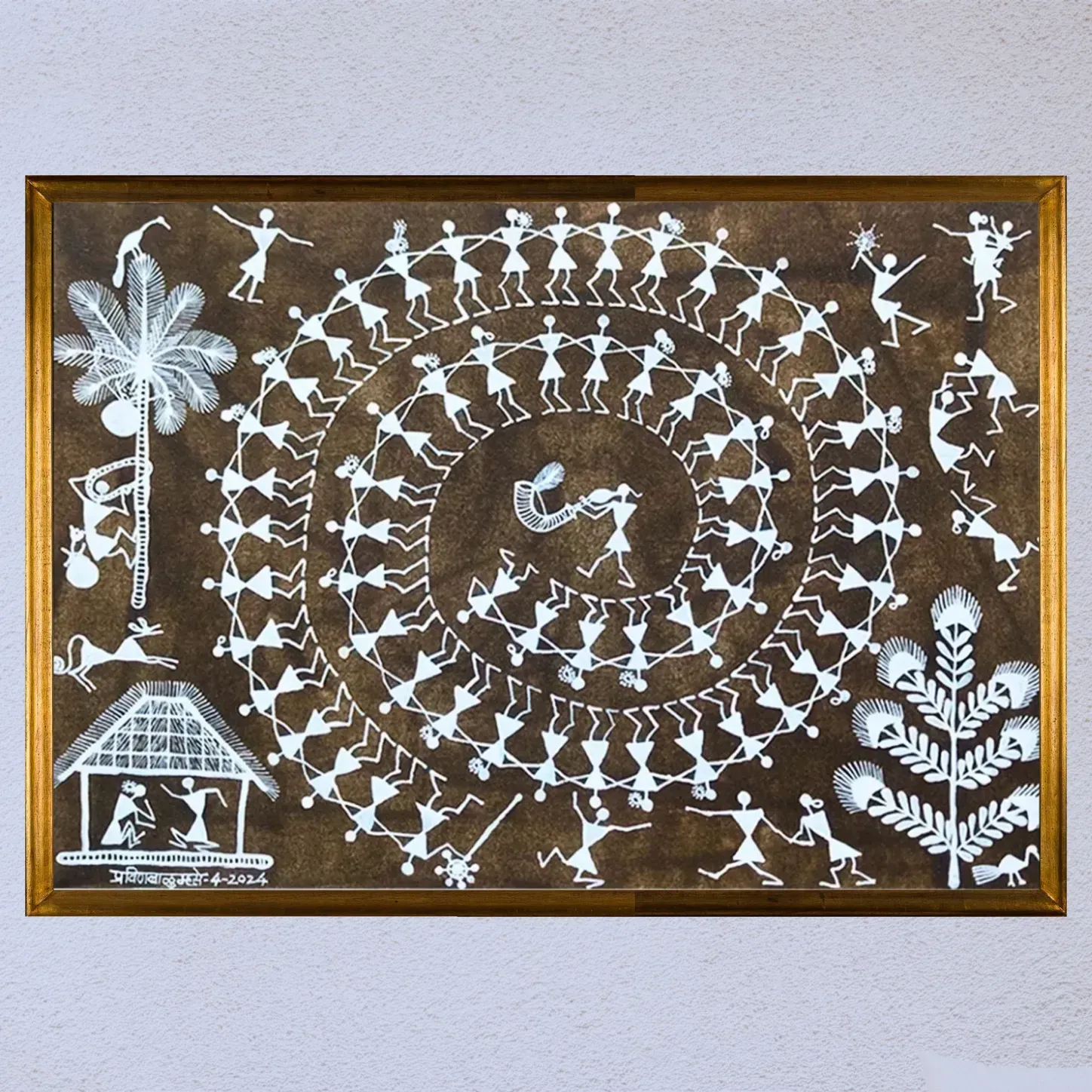
Product image: Rhythm of Tradition, Tarpa Dance, certified Warli original
The spiralling Tarpa dance is the most recognisable image in classical Warli, and at this scale it works as a single quiet focal point above a console or a bed, where the rhythm of the figures does all the talking.
The Rooms Where Warli Lands Best
Warli is not a fill-every-wall kind of art. It rewards a little space around it, and it tends to land hardest in three sorts of rooms.
In a white-walled study or reading corner, a single large Warli can be the only ornament in the room and still feel complete. The eye has nothing to fight with, so it settles into the composition and reads it slowly, which is exactly what this art was built for. Restraint plus one strong piece beats a gallery wall of small prints almost every time.
How you frame it changes everything. A wide off-white mount and a slim natural-wood or matte-black frame let the composition sit like a specimen, formal and deliberate, while an ornate gilded frame fights the whole spirit of the work. Hang it a touch lower than instinct suggests, close to seated eye level when it goes over a desk or a sofa, so the figures meet you rather than float somewhere above your head.
In an open-plan living area, a framed original works as an anchor for an otherwise neutral palette. Something like The Warli Tree of Life, with its central tree branching into birds and figures, gives a sofa wall a centre of gravity without adding visual noise.
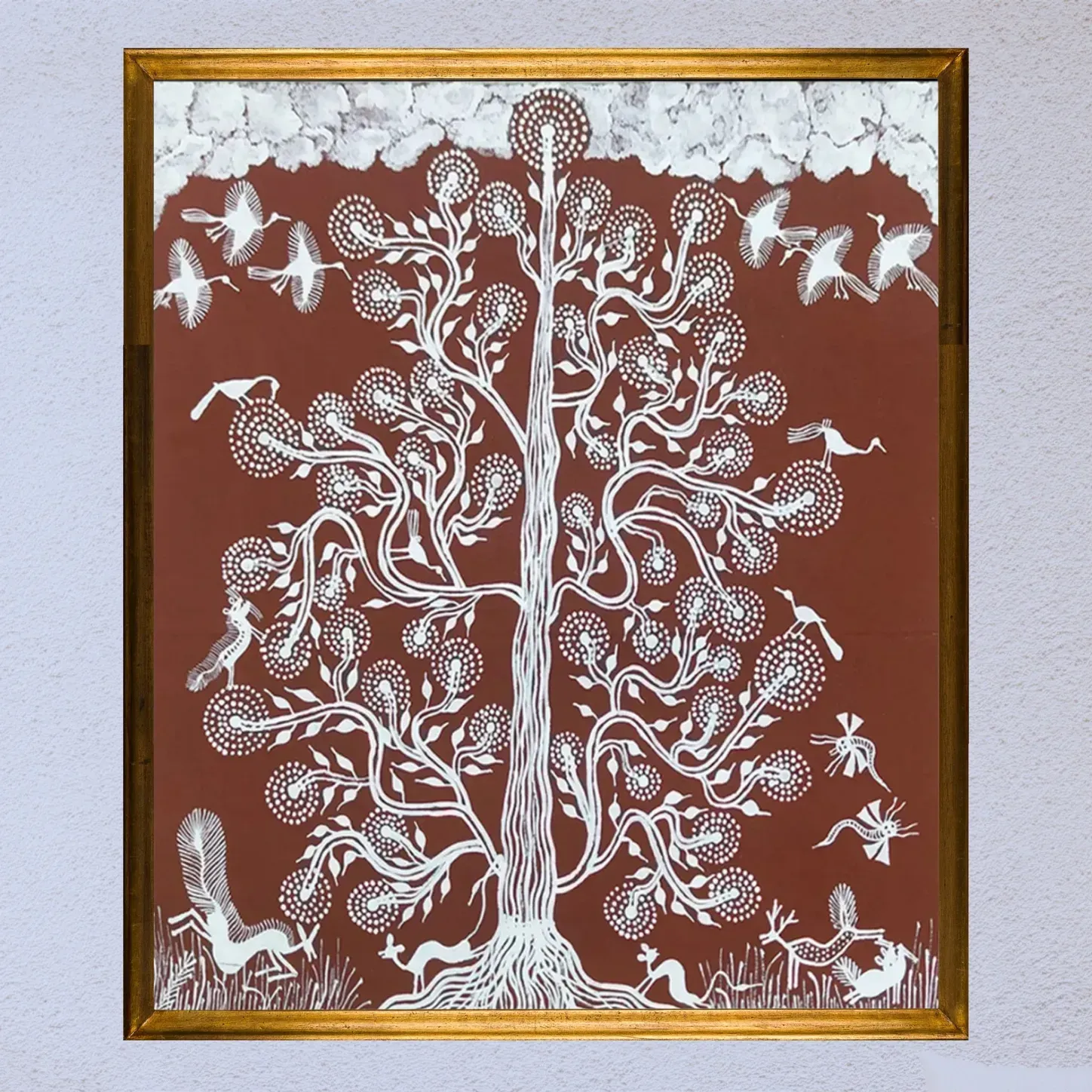
[ Product image: The Warli Tree of Life, certified original on Majarpat ] The Warli Tree of Life. Certified original, Rs 7,999, acrylic and poster colour on a cow dung ground. View on Rooftop
A child's room is the sleeper hit. The little figures, animals and dancers invite questions and storytelling, and a piece like The Enchanting Peacock Dance turns a wall into something a child actually looks at and asks about, rather than tuning out.
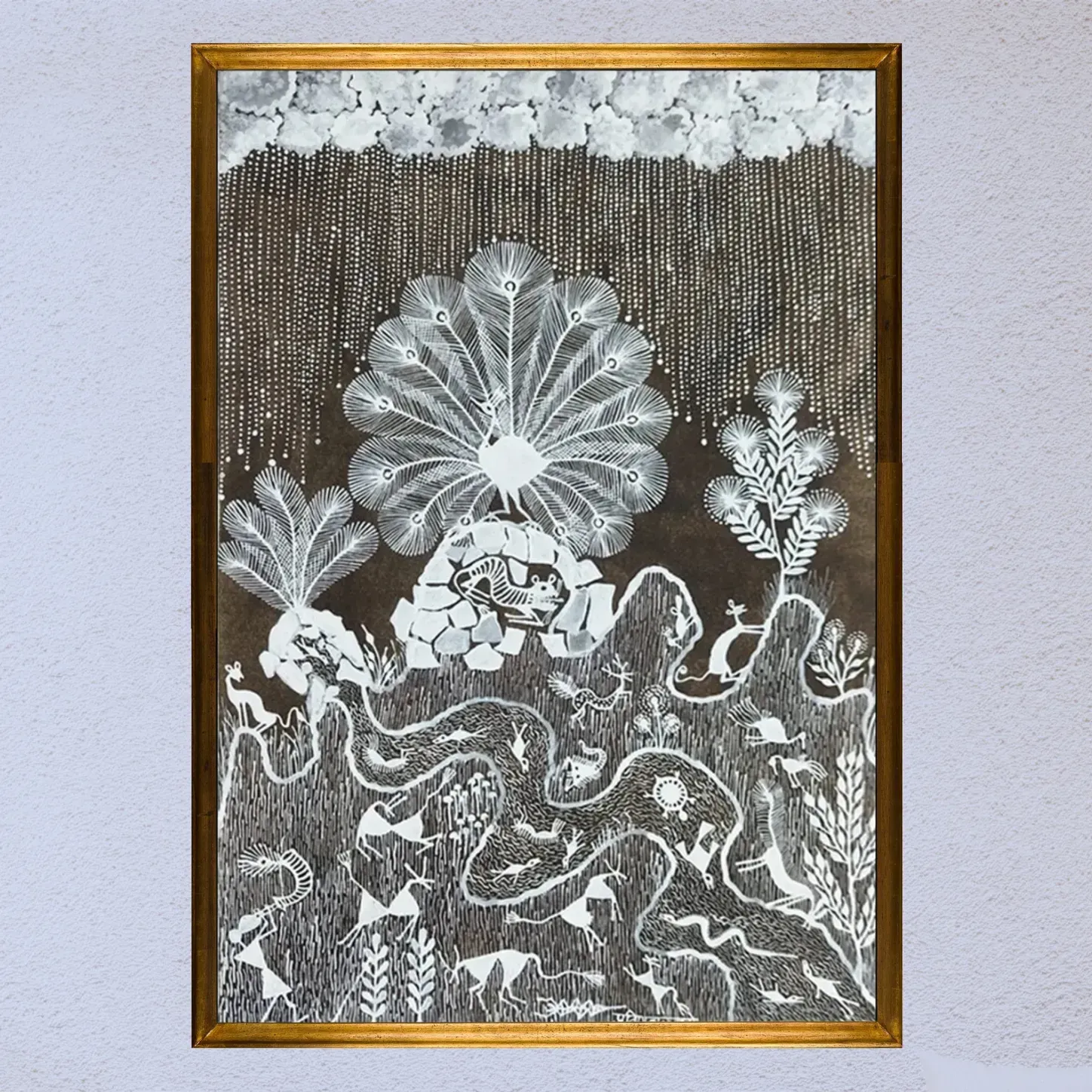
[ Product image: The Enchanting Peacock Dance, certified Warli original ] The Enchanting Peacock Dance. Certified original, Rs 7,999. View on Rooftop
One placement rule holds across all three rooms. Give a Warli room to breathe. A single confident piece on an otherwise bare wall almost always beats a cluster, because the painting is already a complete scene in itself and does not need neighbours to feel finished.
Original vs Print: What Collectors Actually Buy
Here is where the design-literate buyer and the casual shopper part ways. A printed Warli motif on a mass-produced canvas is a graphic. It has no maker, no provenance and no future beyond looking fine for a while. An original is a different object entirely. It is painted by hand by a named artist from the Palghar region, on a traditional ground of cow dung and Majarpat cloth or on handmade paper, and it carries the small irregularities that only a human hand leaves.
The gap shows the moment someone who knows art walks into the room. A reproduction reads as a furnishing, pleasant and forgettable. An original reads as a decision. People who care about design can tell the two apart at a glance, the same way they can tell a real marble counter from a printed laminate, and that recognition is part of what the buyer is quietly paying for.
Provenance is the whole point. When you buy an original, you are buying a specific artist's hand and lineage, which is why it is worth knowing who painted it. The Mhase family of Palghar, for instance, carries the Warli tradition across several generations from the line of the late Padma Shri artist Jivya Soma Mashe, and a work from a documented hand like that is both a cultural object and an asset that holds meaning over time.
From Rs 7,999 to over Rs 1,00,000 Certified original Warli works on Rooftop start around Rs 8,000 for a framed piece and rise past a lakh for major signature compositions. Each is signed, comes with certification, and pays the artist a royalty, which a printed reproduction never does.
That price range matters for how you think about the purchase. An entry-level original costs about what people happily spend on a mid-range printed canvas from a furniture chain, except this one appreciates in meaning, supports a living artist, and can never be exactly reproduced. At the top end sit the serious collector pieces, the kind built around a single ambitious narrative.
If you are buying your first original, a few checks separate the real thing from a dressed-up reproduction. Look for the artist's name and not just the art form, because provenance lives in the person. Ask about the medium and the ground, since a genuine Warli is painted, not printed, on cloth or handmade paper. And look for certification and a signature, the markers that the piece is one of one rather than one of thousands. On Rooftop every painting carries that paper trail, which is the line between owning a decoration and owning an artwork.
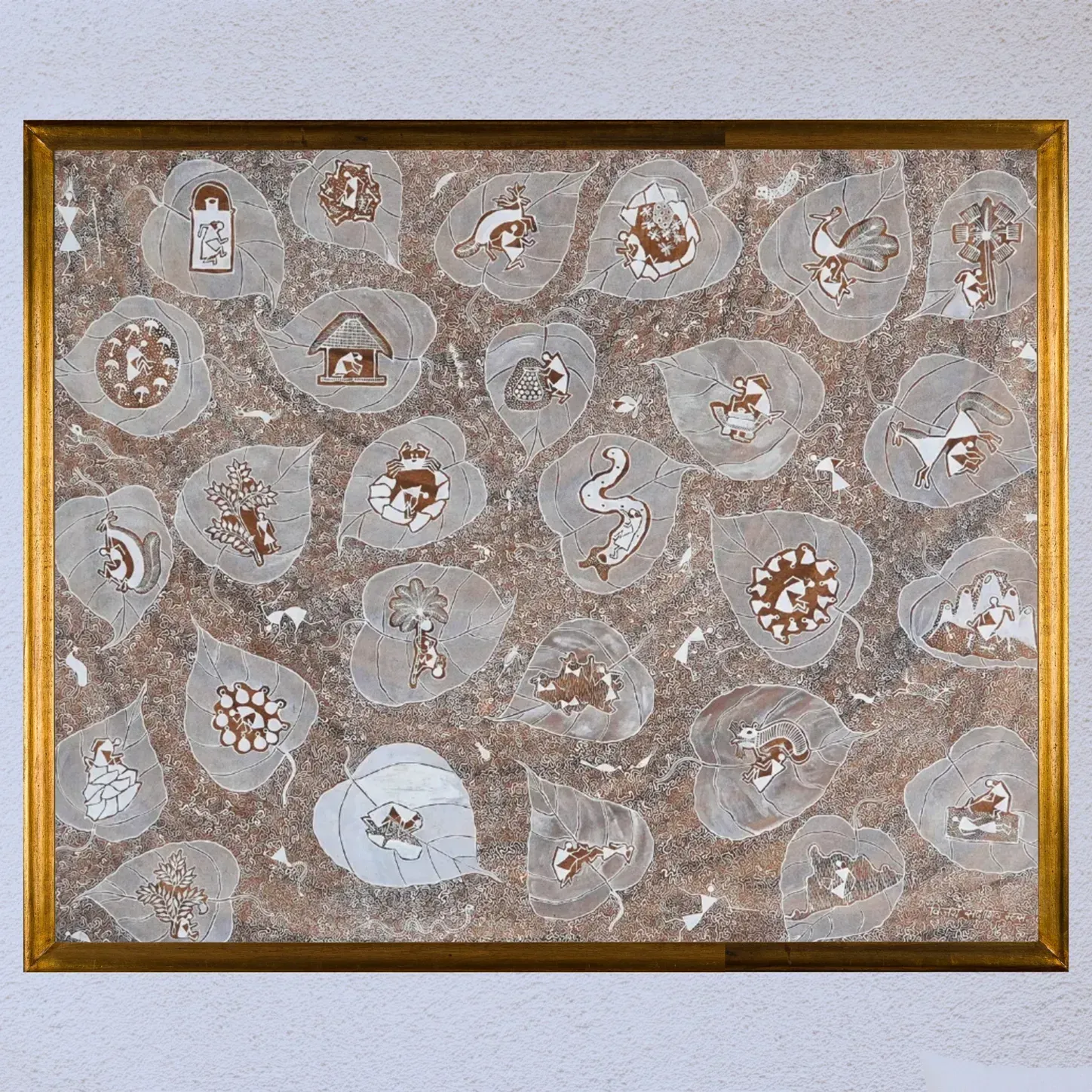
Product image: The Legacy of a Surname, large narrative Warli original. View on Rooftop Certified original narrative work telling the story of how the Warli received their name.
This is the piece for the buyer who has moved past decoration and into collecting. It carries a complete story across one surface, the sort of work that anchors a room and starts a conversation, and the kind of original that tends to look smarter with every passing year.
It is worth saying that these artists are not anonymous folk hands. Anil Vangad, who paints in the same tradition, holds the World Craft Council Award of Excellence recognised by UNESCO, and Warli work by these Palghar artists was shown at India's Republic Day Parade in 2022. Buying an original is buying into that level of recognition, not a souvenir version of it.
There is a practical side that collectors weigh and decorators often forget. An original on a traditional ground, framed and glazed properly and kept out of harsh direct sun, will comfortably outlast every printed canvas you could buy beside it, and it carries its story intact to whoever inherits it. A print fades and eventually goes to landfill. An original becomes an heirloom.
There is a social dimension too, which the aspirational buyer understands by instinct. An original Warli is a confident gift and a confident housewarming statement, the thing that signals you put thought rather than money into a space. It travels well across cultures, which is part of why it has become a favourite of Indians abroad who want one piece that says where they are from without having to explain itself. It belongs in the room the way good design always does, quietly and completely.
The Design-Literate Choice
Choosing Warli is rarely about wanting something ethnic on the wall. It is about wanting something structurally intelligent, quietly confident and genuinely rooted, which is why it keeps ending up in the homes of people who think hard about how their spaces look. If that sounds like the kind of piece you have been circling, Rooftop's collection of original Warli paintings comes with named-artist provenance, certification, framing guidance and delivery to any city, so the piece arrives ready to live with rather than ready to worry about.